COMMITTEE REPORT - BYLAW No. 950 - SIGN BYLAW INTRODUCTION OF DRAFT BYLAW (December 2017)
Original report from December 2017 introducing the concepts and motivation behind drafting the new stand-alone sign bylaw.
TOWN OF VIEW ROYAL COMMITTEE REPORT
TO: Committee of the Whole FROM: J. Davison, MCIP RPP, Planner DATE: December 4, 2017 MEETING DATE: December 12, 2017
BYLAW No. 950 - SIGN BYLAW INTRODUCTION OF DRAFT BYLAW
RECOMMENDATION
THAT Committee receive the report titled “Bylaw No. 950 – Sign Bylaw Introduction of a Draft Bylaw” for information.
CHIEF ADMINISTRATIVE OFFICER’S COMMENTS
I concur with the recommendation.
DIRECTOR OF PROTECTIVE SERVICES’ COMMENTS
I concur with the recommendation.
DIRECTOR OF DEVELOPMENT SERVICES’ COMMENTS
I concur with the recommendation.
PURPOSE OF REPORT
The purpose of this report is to introduce Draft Sign Bylaw No. 950 for initial Council consideration and comment. This report highlights the contents of the new draft bylaw based on Council and industry input this far, and presents the significant proposed changes to the existing Town regulations.
The bylaw is in substantially complete form, but will still require changes based on Committee input, pending legal review, and Staff changes to ensure consistency and proper functionality.
ISSUES AND ANALYSIS
Bylaw No. 950 will replace the sign regulations existing in Land Use Bylaw No. 35, 1990. The motivation to draft a new stand-alone bylaw stems from two broad desires:
- Make the bylaw easier to understand, and easier to navigate.
- More closely align the regulations with the requirements of both industry and of the community.
In addressing these two points, staff is mostly concerned with addressing the structure of the bylaw, and focusing on addressing regulations which have emerged as overly complex, problematic, or insufficiently considered. The draft bylaw relies on both staff experience in development planning, and through sample bylaws and research in contemporary best-practice sign regulations from materials made available by the International Sign Association, United States Sign Council, and the Sign Association of Canada.
As part of the consideration and eventual adoption of a new Sign Bylaw, staff will recommend that following adoption of the new Bylaw, that the Form and Character Development Permit Guidelines within the Official Community Plan be amended in 2018 to address sign issues which are inextricably linked with the form and character of a development. Most buildings or properties requiring signs will be within a Form and Character Development Permit Area, and staff will be recommending that more attention be paid to identifying the form and character of signs to be placed on the property at the time of Development Permit.
Additionally, staff recognizes the importance of subjective, complaints-based enforcement for many signs within the Town of View Royal. Staff will be bringing forward a well-articulated enforcement policy in the new year to better inform the public, business owners, staff and Council on those policies to ensure consistency and establish reasonable expectations.
Bylaw Structure
The draft bylaw is designed to flow to assist the reader in easily determining relevant sign regulations.
The draft bylaw contains these sections:
- Title and Scope of Sign Bylaw
- Definitions
- Sign Districts
- Prohibited Signs
- Signs Not Requiring Permits
- Signs Requiring Permits
- Regulations for All Signs
- Requirements for Sign Permits
- Administration
The bylaw contains many illustrations to supplement the bylaw text, to assist in understanding often complex regulation.
Bylaw Regulation
Major pertinent regulations changed, more clearly addressed or simplified are presented for Council feedback, and are as follows:
1. Units
All units of measurement are in metric units, and are rounded figures rather than lengths and area converted from imperial measurements.
2. Sign Districts
To simplify the bylaw, sign zones are established on the basis of use categories. This means that the sign bylaw will no longer require a concurrent amendment with a rezoning application.
- Rural Sign District: Covers any land under an ‘A‘ zone (Zoning Bylaw).
- Detached Residential Sign District: Any zone permitting residential uses in a detached or duplex form only, except those in the Rural Sign District.
- Attached Residential Sign District: Any zone permitting residential uses in a townhouse, rowhouse or apartment residential form but not permitting commercial (mixed) uses.
- Local Commercial Sign District: Any zone permitting commercial uses and a maximum base density of 0.6 FSR or less, but does not include automobile repair, servicing, sales of parts, service station, car wash or any other automobile-related uses.
- Service Commercial and Industrial Sign District: Any zone with cold storage plant, warehousing, garden centre, storage yard, wholesale, lumber and building supply yard, automobile repair, servicing, sales of parts, service station, medical marihuana production facility or car wash uses.
- Regional Commercial Sign District: Any zone permitting commercial uses with a base density of 0.8 FSR or more and a lot size of at least 4000m²
- Local Institutional Sign District: Any land under a ‘P‘ zone other than the Regional Institutional Sign District properties.
- Regional Institutional Sign District: The properties containing the View Royal Public Safety Building and the Victoria General Hospital.
3. Prohibited Signs
Remaining in the prohibited signs list are signs which are either not wanted in the Town or deserve Council consideration on a case-by-case basis through variances, including:
- Abandoned signs
- Balcony signs and signs mounted or supported on a balcony
- Balloon Signs
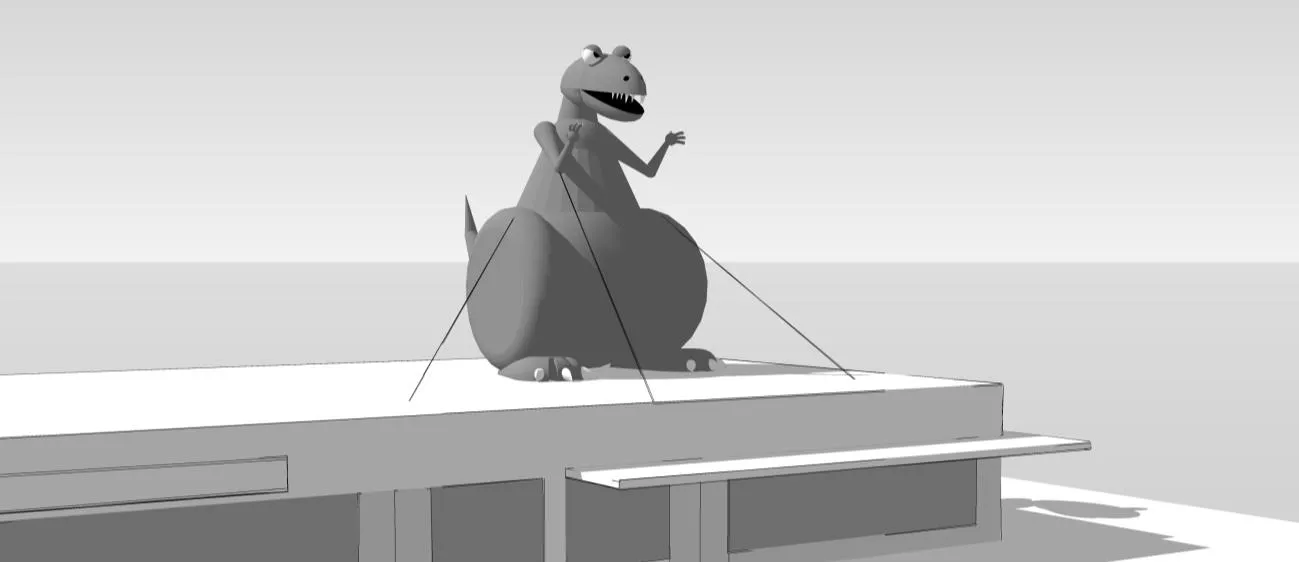
Rendering of an inflatable dinosaur balloon sign on a rooftop - Billboard signs
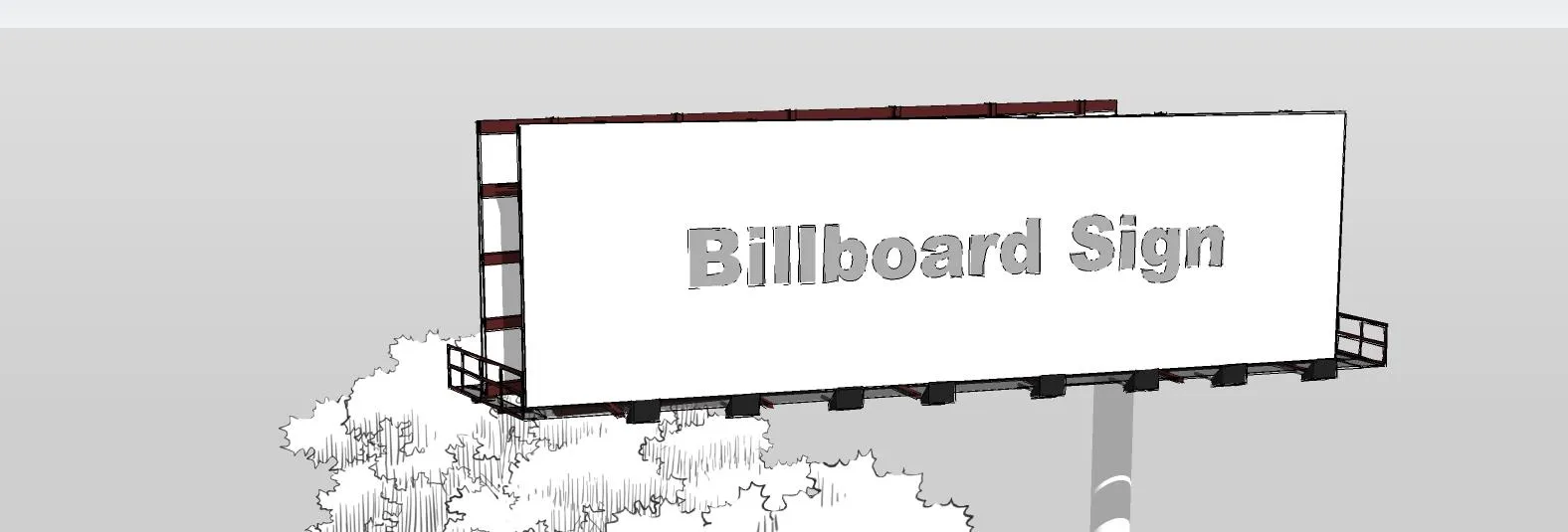
Rendering of a billboard sign - Changeable copy signs, including electronic message board signs
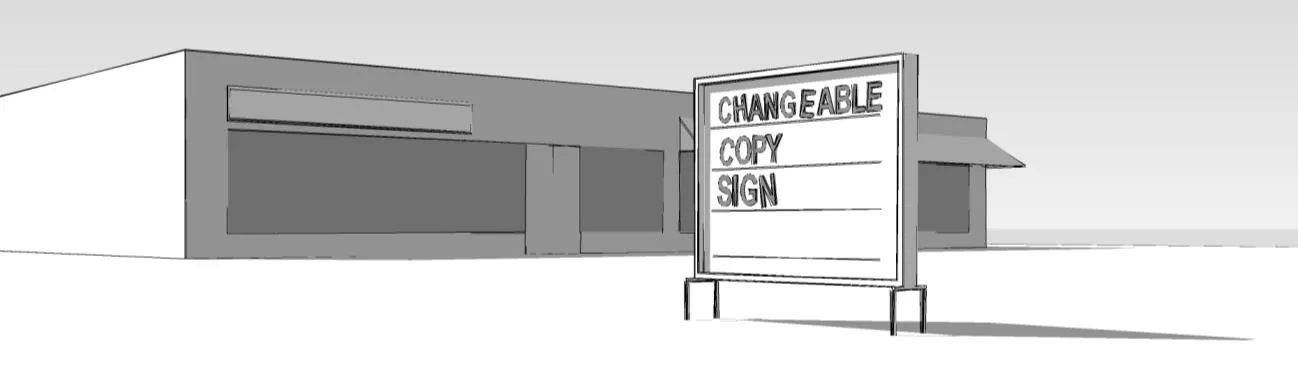
Rendering of a changeable copy sign on a stand in front of a building - Fence signs containing words of advertisement or any any other direct or indirect promotional message or content
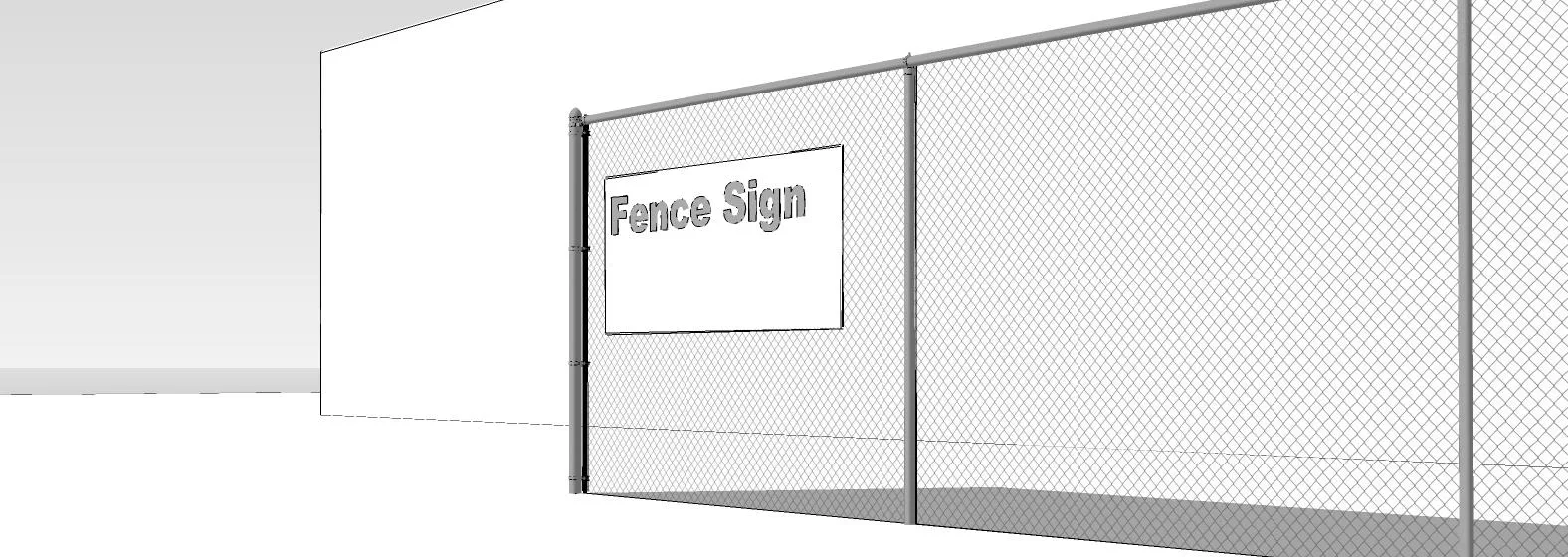
Rendering of a sign attached to a chain-link fence - Flashing signs
- Inflatable Signs
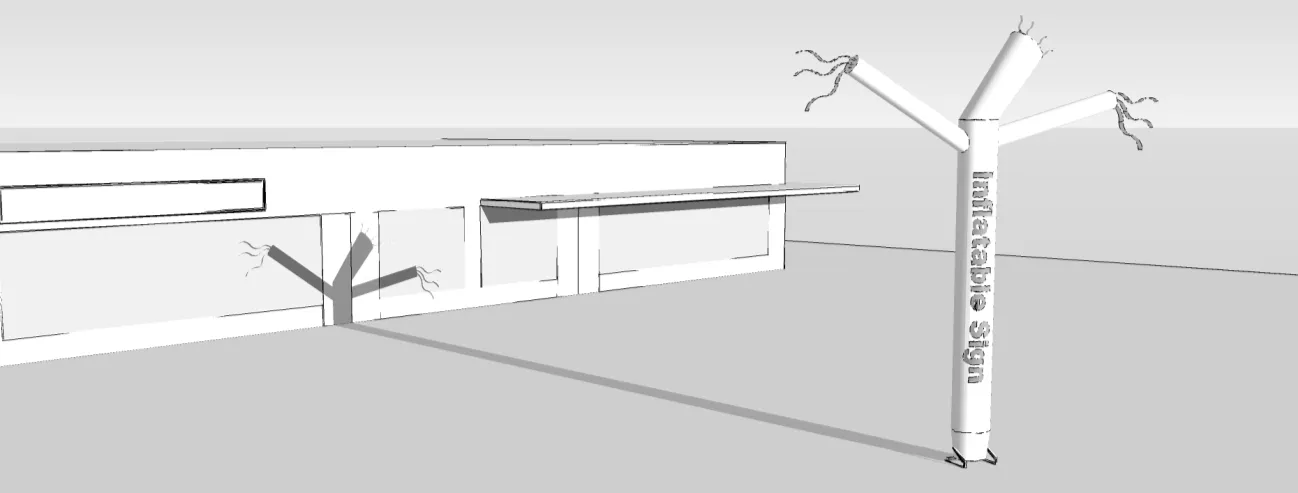
Rendering of an air-powered inflatable tube sign - Moving signs
- Portable signs
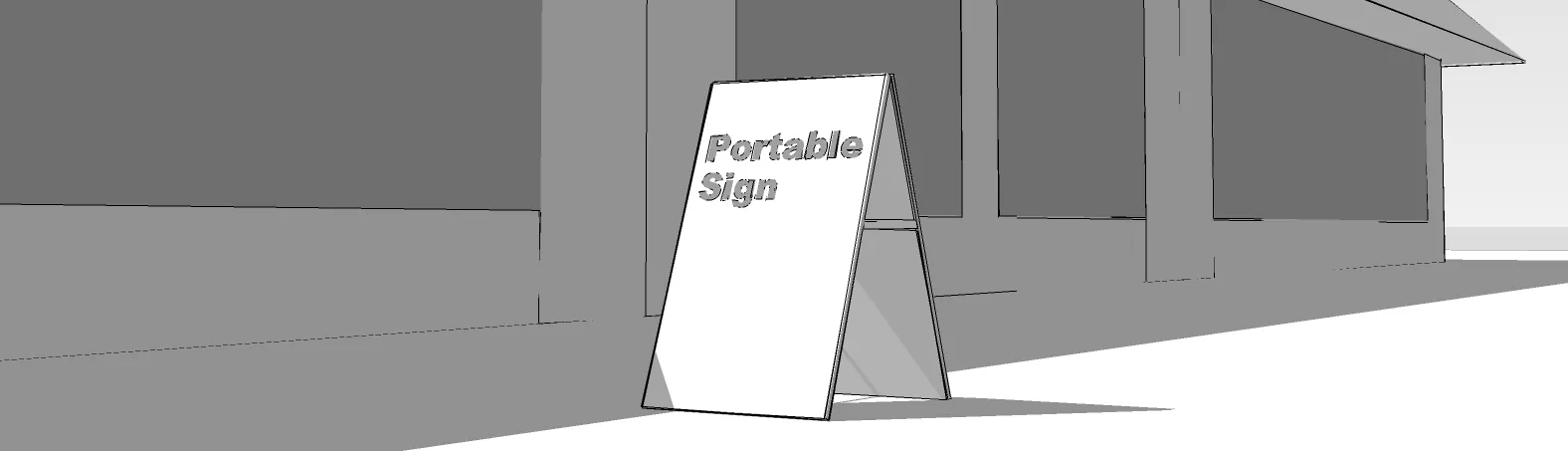
Rendering of a portable sandwich board sign - Roof signs
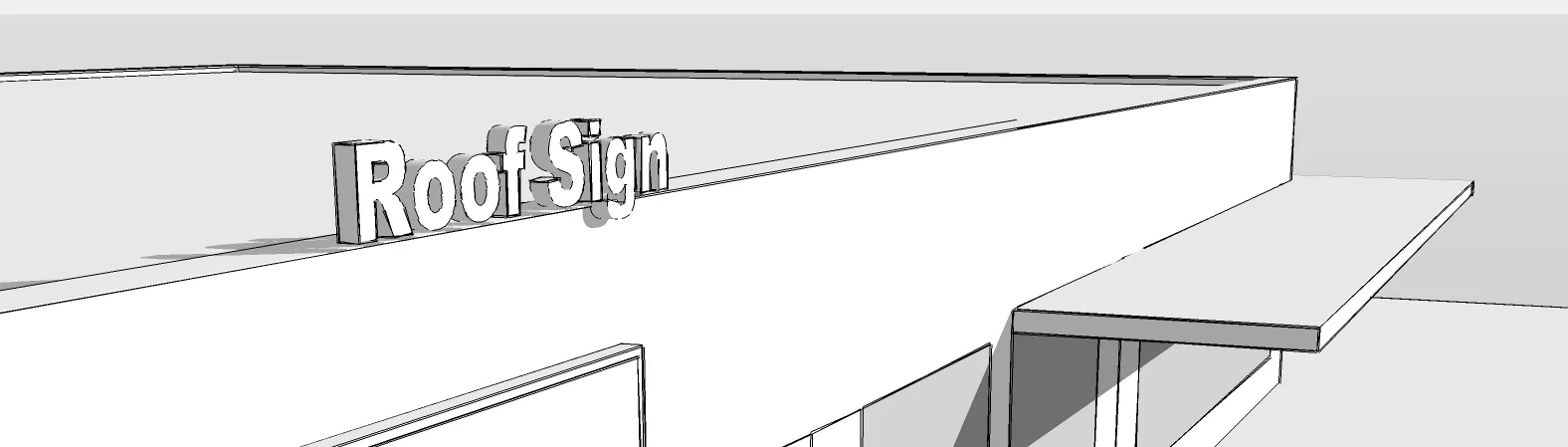
Rendering of a sign mounted on a building roof - Signs attached to trees, telephone poles, public benches, streetlights, bridges, pedestrian overpasses, or placed on or projecting into any public property or public right-of-way
- Signs placed on vehicles or trailers which are parked or located for the primary purpose of displaying that sign
- Signs that obstruct any part of a doorway or fire escape, or otherwise impede, obstruct or impair the free and uninterrupted use and enjoyment of any fire escape, fire exit window, or fire exit door.
- Signs within a Sight Line Triangle (6m from intersection of property line on a corner lot)
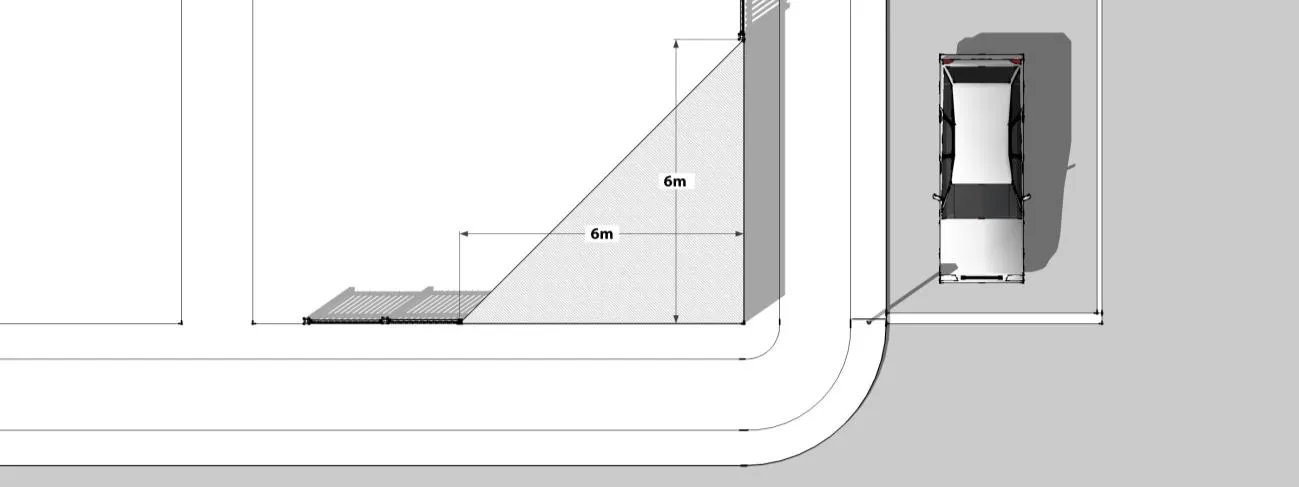
Top-down diagram of a street corner showing a 6m by 6m sight line triangle - Third party advertising signs (signs advertising goods or services available on another parcel of land)
4. Signs Requiring Permits
The section relating to signs permitted by the bylaw is re-organized from the previous bylaw. Rather than containing one single table for all the permitted sign types, each permitted sign type has its own heading and table. These include:
- Freestanding Signs
- Wall Signs (mansard roof signs, light box signs, window signs, channel lettering signs)
- Logo Signs
- Overhanging Signs (awning signs, canopy signs)
- Projecting Signs
- Commercial Real Estate Signs
- Temporary Signs
5. Sign Area Calculation
The calculation of what constitutes sign area is clarified, including recognizing that channel lettering without a backing is less visually intrusive than lightbox signs:
“Sign Area” means the total area within the outer edge of the frame or border of a sign. Where a sign has no frame, border or background the area of the sign shall be the area contained within the shortest line surrounding the whole group of letters, figures or symbols of such sign. In the case of a multi-faced sign, each sign face is considered separately.
As a subset of that, Message Area is also calculated and identified:
“Message Area” means the area of characters or logos forming all or part of the sign area, but does not include the non-message portion of a sign area.
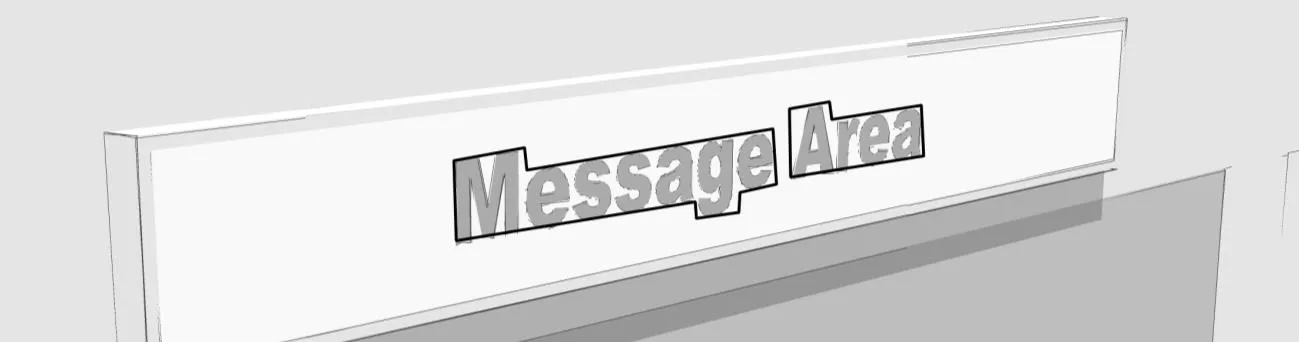
Message area is used to limit the area of message on signs for aesthetic purposes and visual balance in various signs, including light box signs (above), and awning signs.
6. Wall Signs (Formerly/Also ‘Fascia Signs’)
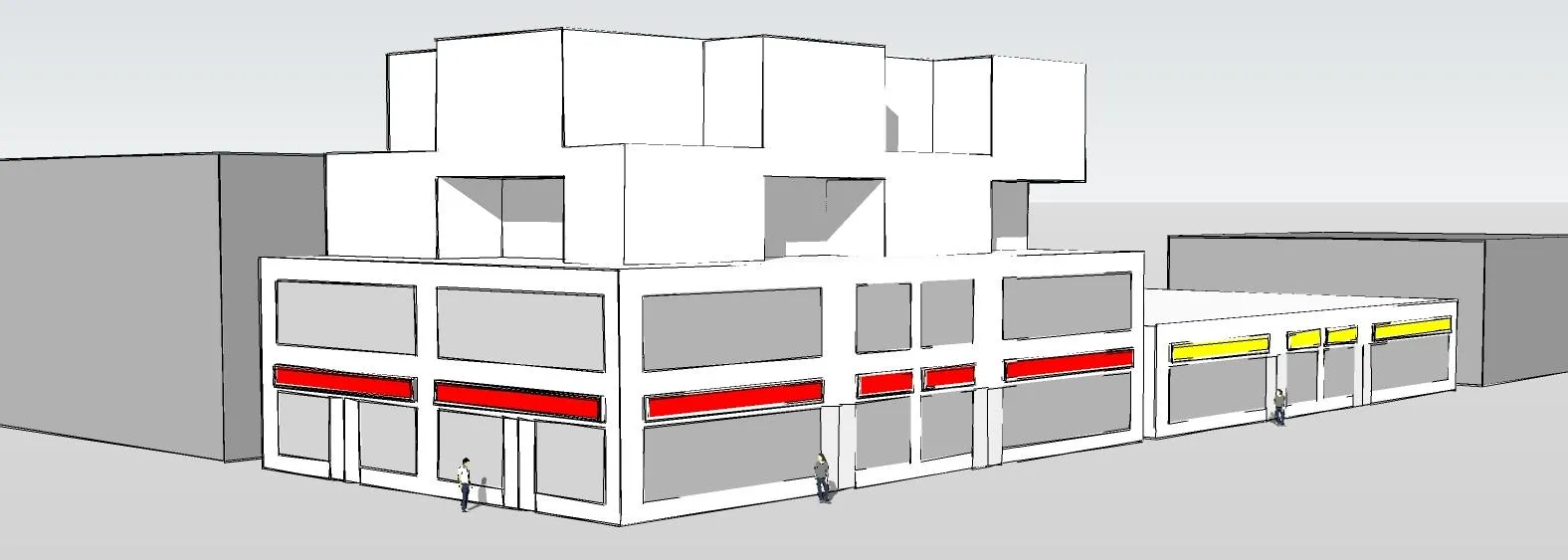
Wall signs are being significantly overhauled in the proposed regulation – it is a frequent variance and the current regulation doesn’t suit contemporary needs. From the illustration below, both red and yellow sign areas are reasonable and expected in a commercial or mixed-use context. The yellow sign area is 10% of the building face. The red signs on the same frontage (but a different building) are 3% of the building face. It doesn’t make sense to regulate on building face percentage alone; instead, regulation is proposed to be based on the typical and expected location for signs on a building.
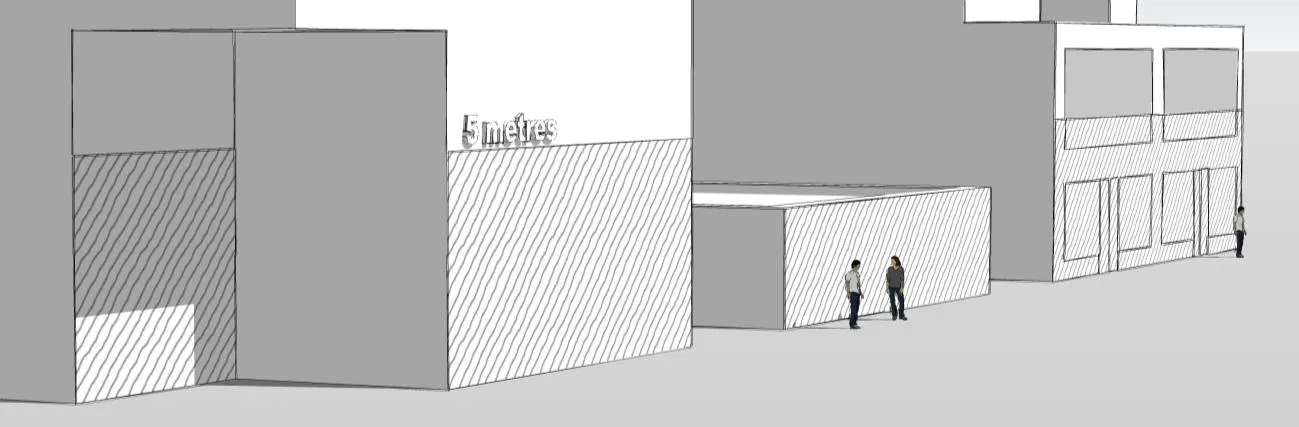
The proposed regulation will measure the area of building faces to a maximum of 5m high (as in the illustration at below). Permitted wall sign area is proposed to be 12% of that area.
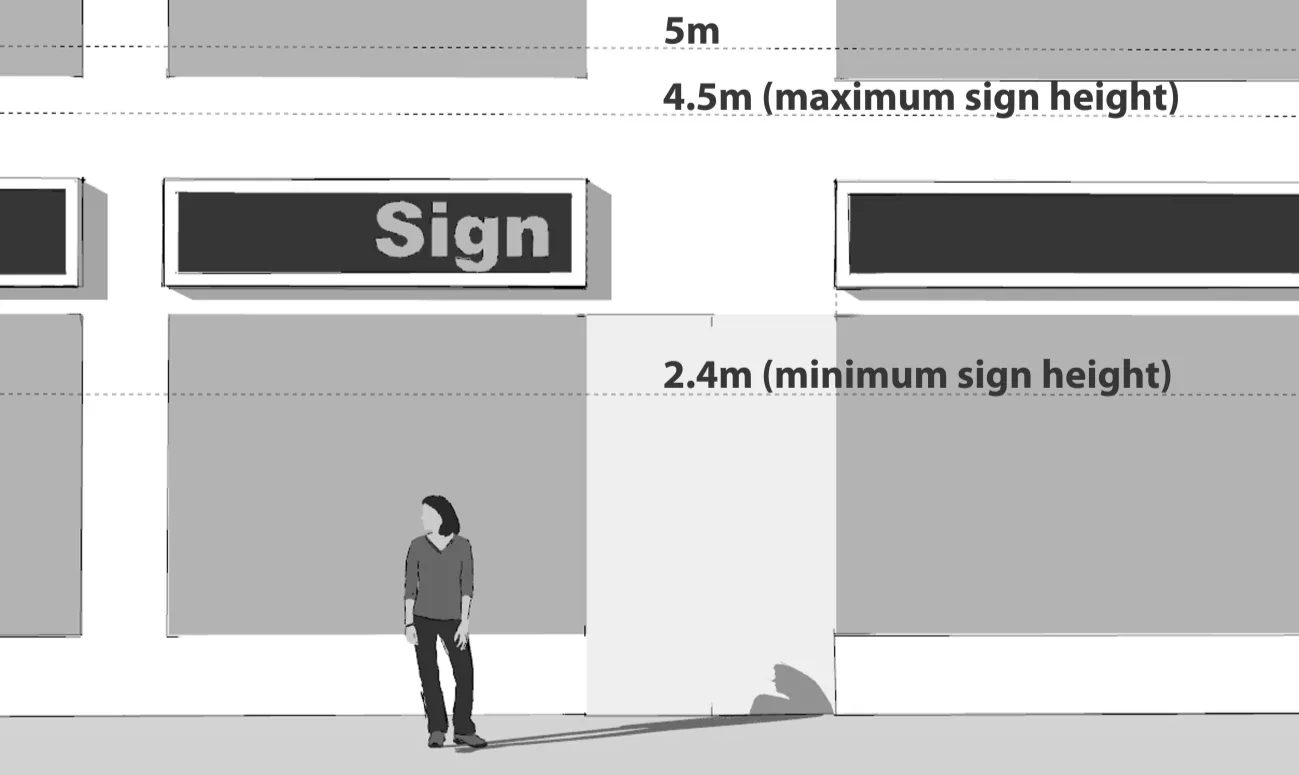
Signs are proposed to be permitted between 2.4m and 4.5m from grade on any given building face, as illustrated below. Variances will be required for second-storey signs (or higher), as they are now.
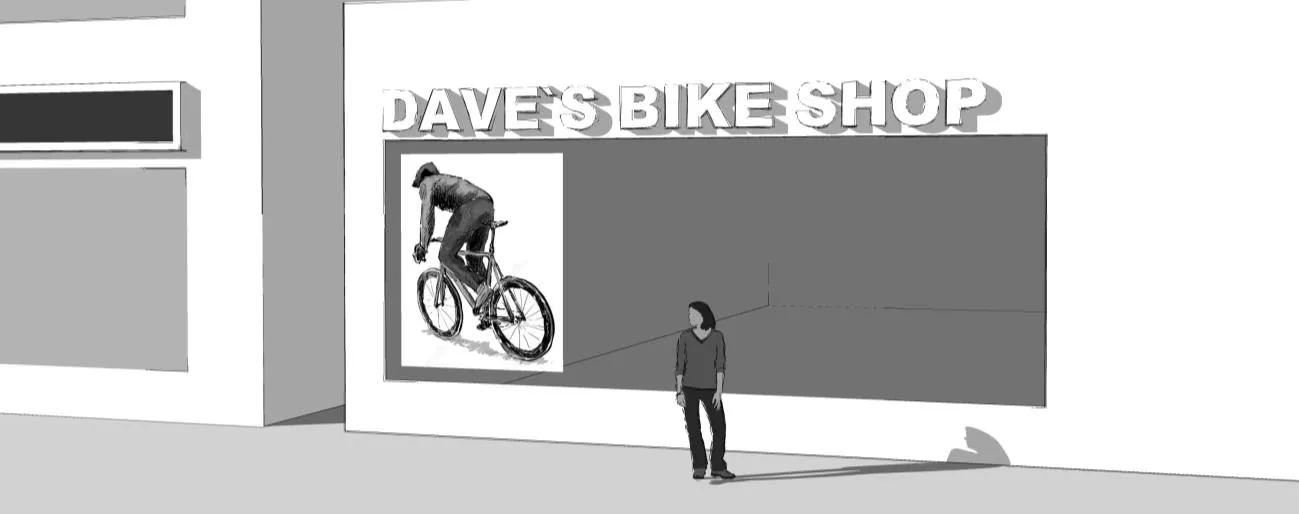
Window signs and promotional graphics, it should be noted, are also considered wall signs. Window graphics below the 2.4m height would require variances, and should also be considered Form and Character Development Permit issues. An example of a window sign that would require a variance, in that the graphic is promotional and relating to the business, and is below the 2.4m minimum sign height:
The maximum area of a sign on a building (currently 11m²) is proposed to be removed in favour of the simplified and more relevant building face controls.
7. Character Height
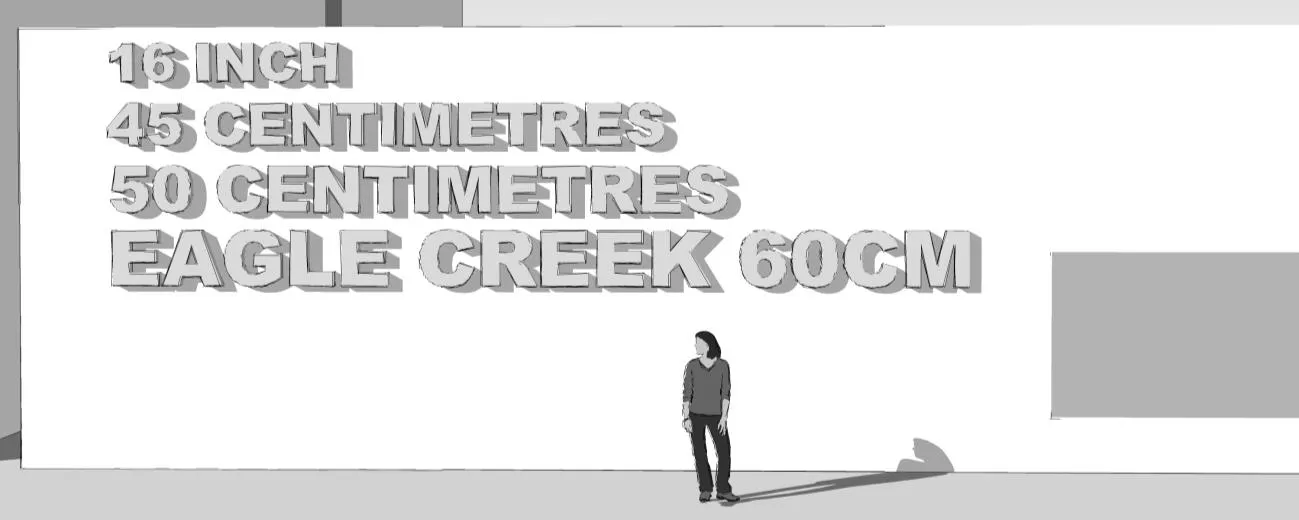
Character height is the most frequent subject of sign variances. Currently the regulation is for all characters and symbols to be no more than 16 inches. Proposed changes are as such:
- Increase the maximum base character height to 45cm tall from the existing 40.64cm (16 inches) for the sake of metric measurements.
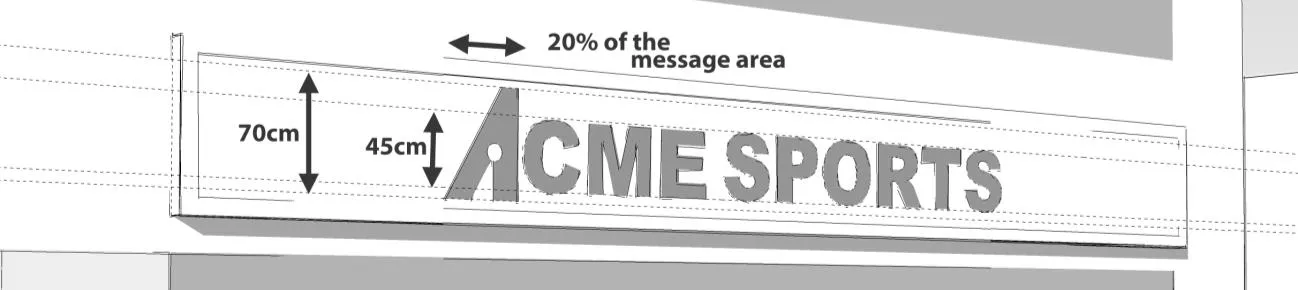
- Permit up to 20% of sign copy (characters) to extend to 70cm to increase flexibility in sign design.
- Consider permitting up to 50cm character height in Regional Commercial settings, with a similar 20% copy extension to 1m tall. Consider that the character height variance at Eagle Creek was to 24 inches (60cm).
- Remove the character height limitation in logo signs.
Below is a comparative character height illustration:
Below is an illustration where the ‘A’ in the ‘proposed’ sign is 70cm and the rest of the sign is 45cm in height. It permits creativity within a sign without overly affecting the total visual impact. Staff estimates that more than 50% of character height variances could be prevented with such a regulation.
8. Illumination
The regulation takes the recommendation from ‘Measuring Sign Brightness’ by Gregory Young (attached) which recommends adopting research based on the Illuminating Engineering Society of North America (attached to this report) of no more than 125 nits at night (sunset to sunrise) and 250 nits during the day (sunrise to sunset).
‘Nits’ are a measure of the International System of Units’ candela brightness per square meter, and is the international standard for measuring light intensity.
The following regulations are proposed for illuminating signs:
- Signs must not emit or be lit by light that is brighter than 125 nits between the time of sunset and sunrise (nighttime) and 250 nits between sunrise and sunset (daytime).
- Light intensity and timing of illumination must be adjustable on all new signs, sufficient to meet the regulations within 7.3.a. [note: 7.3.a is the regulation above]
- Illuminated signs must not be mounted at an upwards angle (more than 90 degrees from horizontal).
- External illumination for signs must light at a downwards angle (more than 45 degrees downwards from horizontal).
The regulations for angle of signs and lights are consistent with Dark Skies friendly policies.
ENFORCEMENT
Enforcement of bylaws is a significant component of any functioning sign regulation system in a municipality.
Signage, perhaps more than any other aspect of municipal regulation, concerns itself with subjective and aesthetic considerations which are often difficult to capture in regulation. While the Town’s Form and Character Development Permit process is the Town’s primary regulatory tool to ensure a high quality of built environment exists in View Royal, it is not practical to have Council or staff concern itself with every last sign not permitted by the bylaw. Equally, it is not business-friendly to be excessively rigid with enforcement practices. If the sign in question is not of significant concern to the public, or indeed is welcome and generally expected in its context, it can remain without broad concern.
Complaints-based Enforcement
The complaints-only enforcement policy the Town uses is a very powerful, flexible and efficient tool for the Town to be reasonable and practical in regulating signs. There are many signs which the Town does not permit due to aesthetic and functional consideration, including:
- Portable (sandwich board) signs
- Flexible banner signs
- Many forms of window signs
The reasoning behind being fairly restrictive in the sign bylaw is to reserve the option to enforce on a particularly egregious sign which has received complaints. On the other hand, if a sign is not permitted by the bylaw but otherwise reasonable and which does not receive complaint, then it can continue to exist.
A good example of the practical application of the complaints-only enforcement policy is relating to new businesses. Quite often, a new business will put up temporary banners, tents, window signs and other such signs to advertise their presence. While technically not permitted, these signs are often considered to be acceptable for a limited period of time. It makes sense to have an accepted policy around these practices.
Staff expects to bring forward a more robust and articulated policy in 2018 with regard to enforcement policies for signs, such that consistency can be achieved and that enforcement actions can be readily articulated to Council, business owners and to the public.
CONCLUSION
The bylaw is in a (mostly) finished form, but still requires some additional input:
- Possible changes as a result of Committee of the Whole feedback
- Changes due to a pending legal review of the bylaw (standard practice for bylaw review at the Town)
- Final staff review for functionality and consistency.
At the time of first and second reading, staff will articulate in more detail the changes made to the bylaw and compare existing and proposed regulation clearly in table form such that Council has a clear idea of all the changes before bylaw readings.
NEXT STEPS
Once the bylaw is reviewed, it is expected that the bylaw come forward for first and second reading in January or February 2018. Concurrently, staff will bring to Committee of the Whole some potential amendments to the Form and Character Guidelines within the Official Community Plan, and will also recommend enforcement policies for signs.
RECOMMENDATION
THAT Committee receive the report titled “Bylaw No. 950 – Sign Bylaw Introduction of a Draft Bylaw” for information.
SUBMITTED BY: J. Davison MCIP RPP, Planner REVIEWED BY: L. Chase MCIP RPP, Director of Development Services
ATTACHMENTS:
- Sign Brightness – Measuring Sign Brightness - Gregory Young
- DRAFT Sign Bylaw No. 950
Document Images
(4)