Letter from Avis Rasmussen regarding BC Transit Application 2018-02
A handwritten letter and supporting newspaper clippings opposing the rezoning of E&N Railway land for a BC Transit maintenance and operation facility.
2576 Estevan Ave. Victoria, B.C. V8R 2S9 May 1st, 2018
Dear Mayor David Screech, & View Royal Councillors,
Please do not accept B.C. Transit's application # 2018-02 proposal to rezone E&N Railway land for BC Transit's handyDART maintenance and operation facility.
As a public transportation passenger for 30 years bus transportation locally is good - But the E&N once modernized like trains I travel in Europe, UK - USA, Rail transportation (and Eastern Canada)
on Vancouver Island with E&N stations in the centre of every town except Victoria will be better environmentally and more efficient for commuters, retirees and those with wheelchairs, trolleys, bicycles and tourists.
Sincerely,
Avis Rasmussen Painter & Print Maker Victoria, B.C. eclecticgallery@shaw.ca
2 letters encl.
Letters Supporting Rail on V.I. — T/Colonist
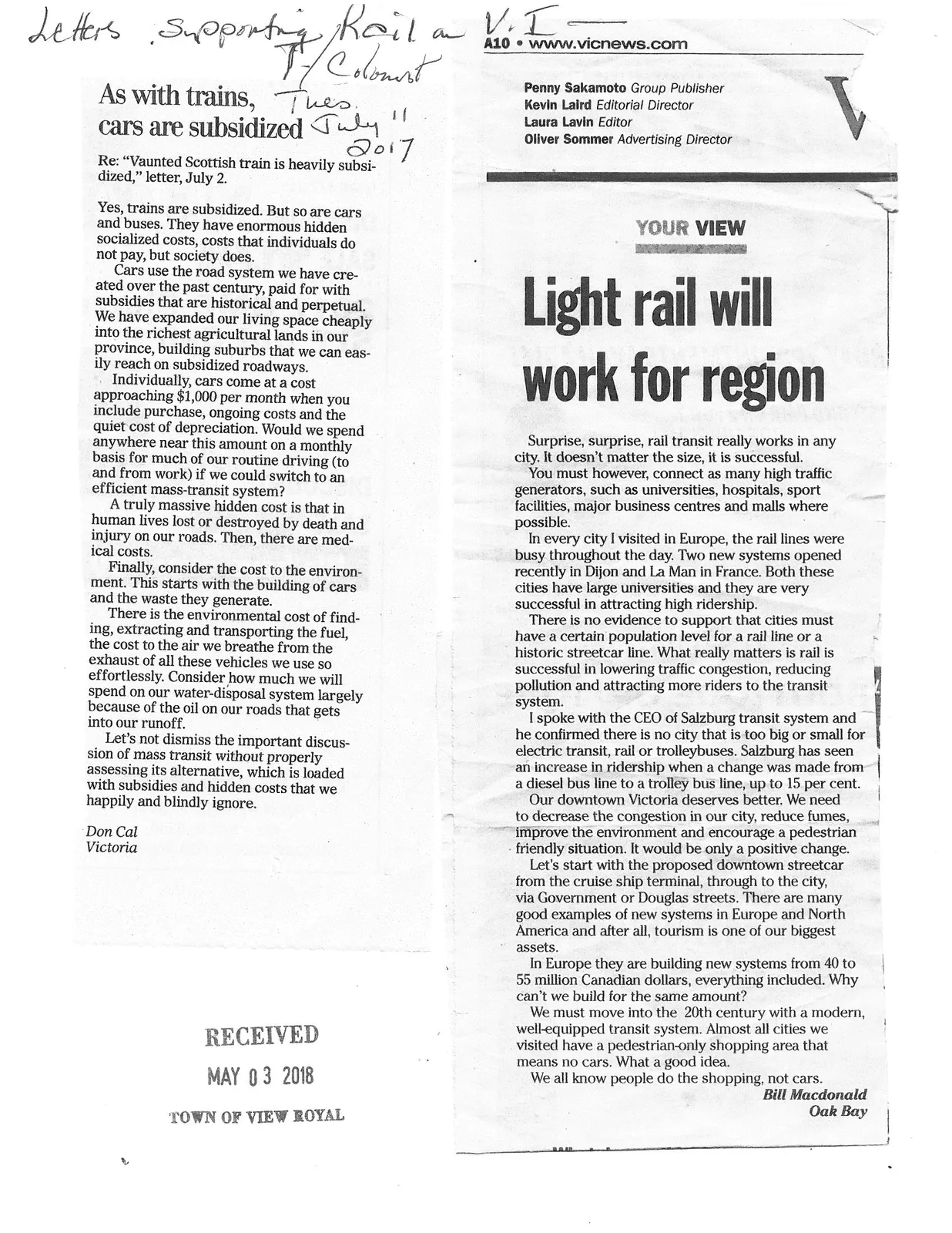
As with trains, cars are subsidized
July 11 2017
Re: "Vaunted Scottish train is heavily subsidized," letter, July 2.
Yes, trains are subsidized. But so are cars and buses. They have enormous hidden socialized costs, costs that individuals do not pay, but society does.
Cars use the road system we have created over the past century, paid for with subsidies that are historical and perpetual. We have expanded our living space cheaply into the richest agricultural lands in our province, building suburbs that we can easily reach on subsidized roadways.
Individually, cars come at a cost approaching $1,000 per month when you include purchase, ongoing costs and the quiet cost of depreciation. Would we spend anywhere near this amount on a monthly basis for much of our routine driving (to and from work) if we could switch to an efficient mass-transit system?
A truly massive hidden cost is that in human lives lost or destroyed by death and injury on our roads. Then, there are medical costs.
Finally, consider the cost to the environment. This starts with the building of cars and the waste they generate.
There is the environmental cost of finding, extracting and transporting the fuel, the cost to the air we breathe from the exhaust of all these vehicles we use so effortlessly. Consider how much we will spend on our water-disposal system largely because of the oil on our roads that gets into our runoff.
Let's not dismiss the important discussion of mass transit without properly assessing its alternative, which is loaded with subsidies and hidden costs that we happily and blindly ignore.
Don Cal Victoria
Light rail will work for region
YOUR VIEW
Surprise, surprise, rail transit really works in any city. It doesn't matter the size, it is successful.
You must however, connect as many high traffic generators, such as universities, hospitals, sport facilities, major business centres and malls where possible.
In every city I visited in Europe, the rail lines were busy throughout the day. Two new systems opened recently in Dijon and La Man in France. Both these cities have large universities and they are very successful in attracting high ridership.
There is no evidence to support that cities must have a certain population level for a rail line or a historic streetcar line. What really matters is rail is successful in lowering traffic congestion, reducing pollution and attracting more riders to the transit system.
I spoke with the CEO of Salzburg transit system and he confirmed there is no city that is too big or small for electric transit, rail or trolleybuses. Salzburg has seen an increase in ridership when a change was made from a diesel bus line to a trolley bus line, up to 15 per cent.
Our downtown Victoria deserves better. We need to decrease the congestion in our city, reduce fumes, improve the environment and encourage a pedestrian friendly situation. It would be only a positive change.
Let's start with the proposed downtown streetcar from the cruise ship terminal, through to the city, via Government or Douglas streets. There are many good examples of new systems in Europe and North America and after all, tourism is one of our biggest assets.
In Europe they are building new systems from 40 to 55 million Canadian dollars, everything included. Why can't we build for the same amount?
We must move into the 20th century with a modern, well-equipped transit system. Almost all cities we visited have a pedestrian-only shopping area that means no cars. What a good idea.
We all know people do the shopping, not cars.
Bill Macdonald Oak Bay