An annual comprehensive report from the RCMP detailing crime statistics, traffic safety, and strategic policing priorities for the West Shore region.
18,250 Calls for Service (CFS) in 2017Average of 50 calls per day71 sworn officers5% overall increase in CFS compared to 2016534 Crimes Against Persons (9% increase)
West Shore RCMP 2017 Annual Year End Report
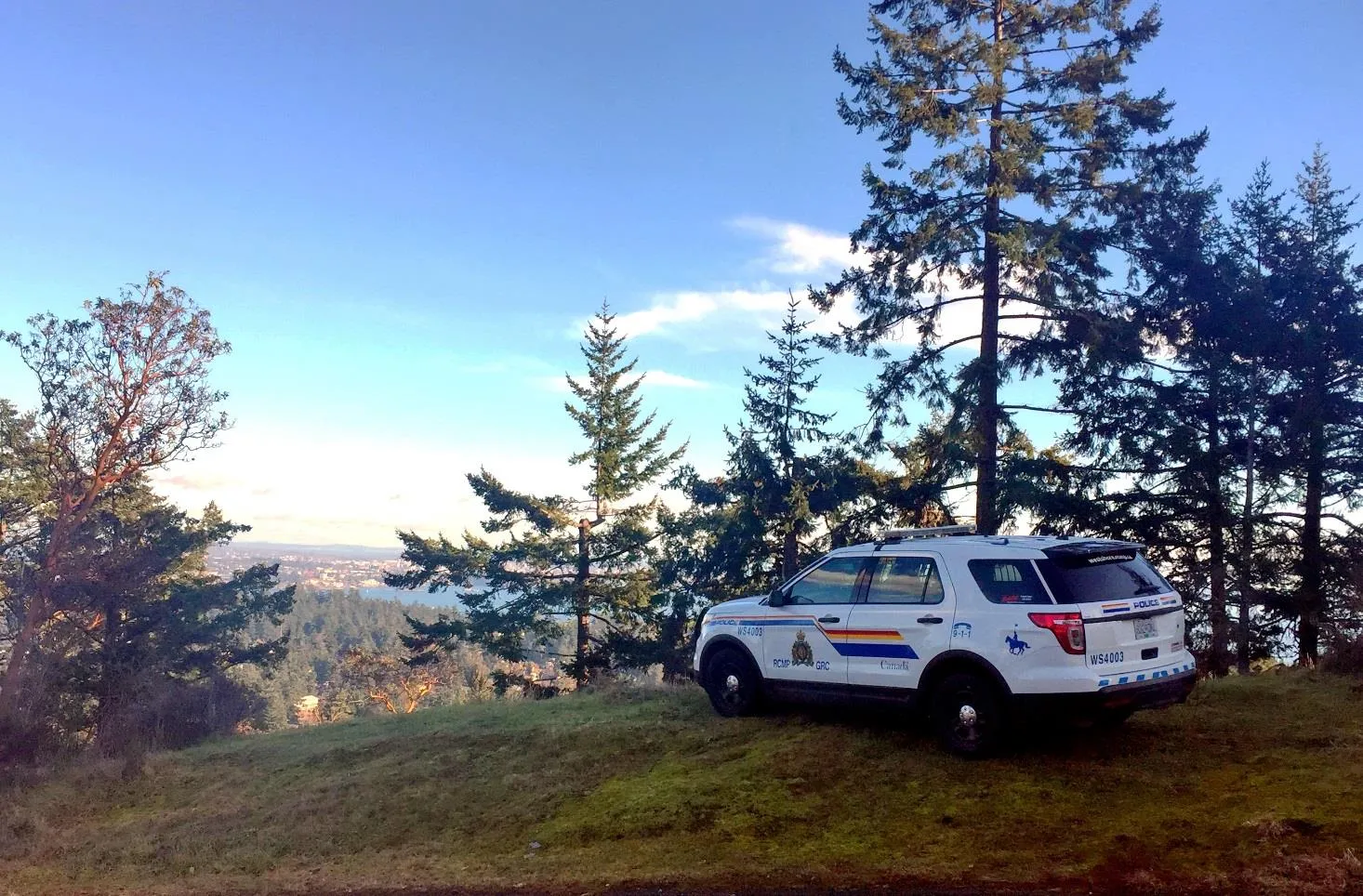
RCMP SUV parked on a grassy hill overlooking a valley
Page 18–43
MESSAGE FROM THE OFFICER IN CHARGE
During the past year, the West Shore Detachment has continued to be very busy and fully engaged with the community. The Detachment continues to grow and is a desirable posting amongst RCMP members, utilizing this reputation to attract highly skilled and motivated members to the Detachment. Community support for the Detachment, Members, and staff remains high. During the past year new members have arrived, the Detachment has fielded a complete municipal traffic unit, and will have a full time bike patrol unit on patrol by the summer of 2018. The bike unit will be instrumental in conducting patrols in high visibility areas, local parks, community events, the Galloping Goose Trail and will assist in targeting specific crime spikes and chronic offenders in the West Shore area.
The Municipal Traffic Unit has been active within the West Shore Community and worked with the General Duty Patrol Officers as well as our partner agencies. They have focused on our traffic priorities, as well as addressed issues with Commercial Vehicle compliance. As a result, compliance by commercial vehicle travelling the West Shore roadways has improved, which increase public safety on the roads. The Traffic Unit, along with the General Duty Patrol and Plain Clothes Unit, have also been engaged with organized crime activity and information gathering.
As in previous years, the Detachment is expected to continue its growth, allowing it to maintain pace with the increase in population in the West Shore and the heavy demands around investigative techniques and reporting through the justice system. The Detachment is continuing with the General Duty Staffing Analysis process, with a committee of local members and supervisors reviewing all aspects of the Detachment and workload issues. Through the diligence collection of statistics and data, and working closely with experts from E Division Headquarters, a complete picture of workload for the front line Members is being developed. This will result in recommendations for appropriate staffing levels and the potential for creating efficiencies within the existing work environment.
The West Shore Detachment remains fully engaged in the South Island policing environment and participate in numerous integrated agencies and units, attend a variety of intelligence sharing meetings and work closely with the other Municipal and RCMP policing agencies.
The West Shore Detachment continues to have a strong volunteer component with many active volunteers doing important work for the Detachment and within the West Shore Community.
The West Shore Detachment members, staff, and volunteers pride themselves on their community service and the high quality investigations and professional service they provide. All staff and volunteers are proud to represent the Detachment and Community throughout the region. As the Officer in Charge of the West Shore Detachment, it is my pleasure to provide this report as a snap shot of the work and achievements taking place at the Detachment through the dedicated and hard work of all staff and volunteers.
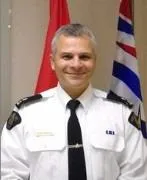
Portrait of Inspector Larry Chomyn, West Shore RCMP Detachment
Insp. Larry Chomyn
Officer in Charge
West Shore RCMP
Page 18–43
TABLE OF CONTENTS
Section
Page
MESSAGE FROM THE OFFICER IN CHARGE
1
TABLE OF CONTENTS
3
WEST SHORE RCMP
4
STATISTICS
5
STRATEGIC POLICING PRIORITIES – ANNUAL PERFORMANCE PLAN
14
GREATER VICTORIA POLICE VICTIM SERVICES (GVPVS) – WWW.GVPVS.ORG
21
PROLIFIC OFFENDER MANAGEMENT PROGRAM (POM)
22
SOCIAL MEDIA
23
STATS & FACTS
25
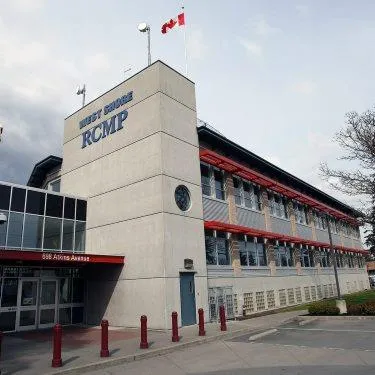
Exterior view of West Shore RCMP building at 698 Atkins Avenue
Page 18–43
WEST SHORE RCMP
RCMP & WEST SHORE COMMUNITIES
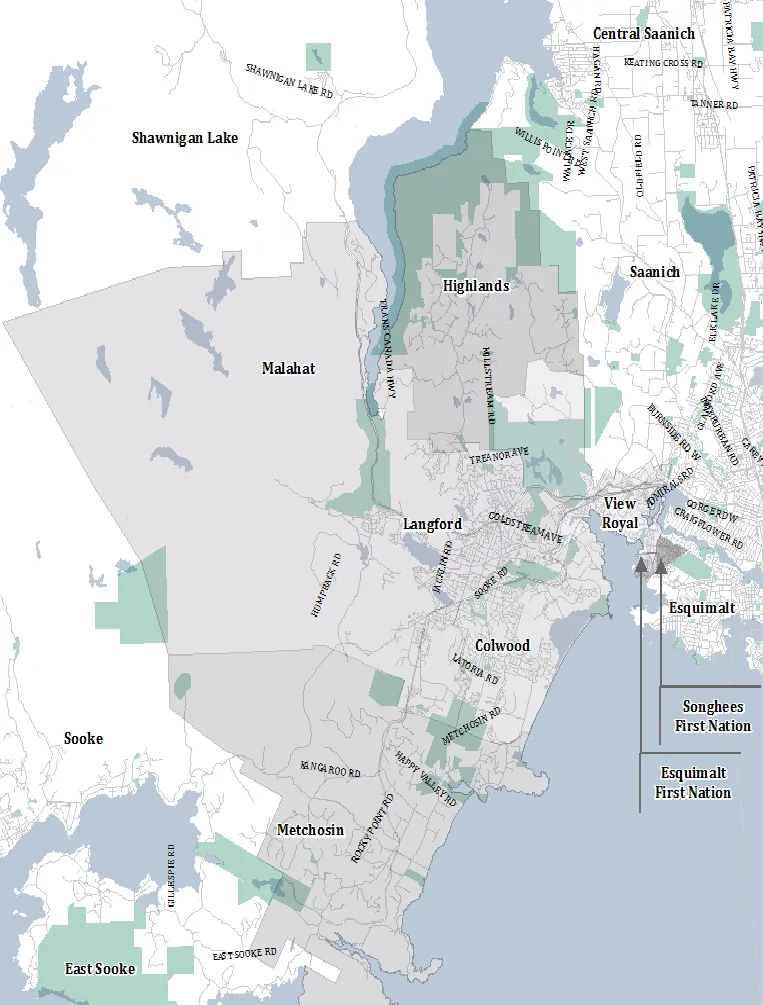
West Shore RCMP proudly serves approximately 78,000¹ citizens and is the fastest growing region on the South Island. West Shore RCMP report to five municipalities including the Cities of Langford and Colwood, the Town of View Royal and the Districts of Metchosin and Highlands. West Shore RCMP also serves the Songhees and Esquimalt First Nations. West Shore RCMP police rural and suburban residential neighborhoods, commercial & industrial zones, recreational waterfront areas, provincial parks and the Trans-Canada Highway.
Map of West Shore communities including Langford, Colwood, View Royal, Metchosin, Highlands, Malahat, and First Nations territories
West Shore is situated in a beautiful location between the Malahat and the Cities of Victoria and Saanich. West Shore has one of the fastest rising populations in the area thanks to lower housing costs and increasing amenities.
¹ Police Services Division provides population data. 2016 & 2017 population figures are projections. Population figures utilize Census data; however, to align the data with policing boundaries as opposed to Census boundaries, an algorithm is applied.
Seventy-one sworn officers, one civilian member, and twenty-six civilian personnel staffed West Shore RCMP in 2017. Together they handled 18,250 Calls for Service (CFS), an average of 50 calls per day.
West Shore RCMP also supports and works in conjunction with the Vancouver Island Integrated Major Crime Unit (VIIMCU), Forensic Identification Services (FIS), the Regional Domestic Violence Unit (RDVU), the Integrated Mobile Crisis Response Team (IMCRT) and the Mobile Youth Services Team (MYST). West Shore Detachment supports the aforementioned integrated units through secondment of Detachment personnel on a full time or rotational basis and through financial contributions towards their budgets. Presently, West Shore Detachment provides 2 officers to VIIMCU, 1 officer to RDVU, 1 officer to FIS (Table 1). In addition, West Shore Detachment provides 5 officers to the Vancouver Island RCMP Tactical Team (VITT), 1 officer as a Crisis Negotiator, and 1 member to the Vancouver Island RCMP Emergency Response Team (ERT).
Table 1 - Secondments
# MEMBERS
UNIT
2
VIIMCU
1
RDVU
1
FIS
West Shore RCMP works with & receives support from other Provincial Units and RCMP sections including the Integrated Road Safety Unit (IRSU), RCMP Air Services, RCMP Explosive Disposal Unit (EDU), Combined Forces Special Enforcement Unit (CFSEU), RCMP Emergency Response Team (ERT), Vancouver Island Underwater Recovery Team (URT), RCMP Special I and Federal Serious and Organized Crime (FSOC) teams.
Page 18–43
STATISTICS
TOTAL CALLS FOR SERVICE (CFS)
Table 2 depicts the total CFS for West Shore and each municipality, district & First Nations Reserve (FNR) for 2016 & 2017, along with a file count & percent change.
West Shore’s 2017 CFS increased by 5% in comparison to 2016. Colwood, Highlands, Langford, Malahat area², Metchosin & View Royal saw increases in the number of CFS. Esquimalt & Songhees FNR’s saw decreases in the number of CFS.
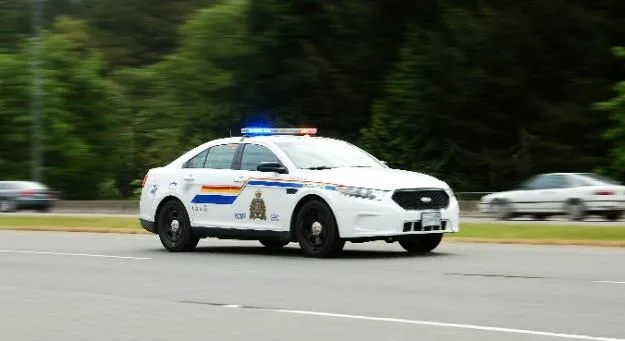
RCMP patrol car driving on a road
Table 2 - 2016/2017 Calls For Service Comparative Figures
Jurisdiction
2016
2017
FILE COUNT (+/-)
% CHANGE
Colwood
3439
3495
56
2%
Esquimalt First Nation
97
91
-6
-6%
Highlands
322
346
24
7%
Langford
10182
10752
570
6%
Malahat
180
184
4
2%
Metchosin
948
956
8
1%
Songhees First Nation
529
516
-13
-2%
View Royal
3036
3232
196
6%
West Shore Total
18875
19754
879
5%
² Provincial & part of Langford jurisdiction
CALLS FOR SERVICE & POPULATION
Table 3 depicts CFS per 1000 persons and the percentage of CFS per population³ for the municipalities, provincial areas⁴ & all West Shore.
View Royal had the highest number of calls per 1000 persons & as a percentage of the population followed by Langford, West Shore Provincial and Colwood.
Table 3 - CFS Per 1000 Population & Percentage of Population
Jurisdiction
2017 CFS
2017 POPULATION
2017 CFS / 1000 POP
% CFS / POP
Colwood
3495
17,049
205
20%
Langford
10752
40,220
267
27%
View Royal
3232
11,648
277
28%
West Shore Provincial
2093
9,301
225
23%
All West Shore Jurisdiction
19754
78,218
253
25%
CALLS FOR SERVICE – TOP 5
Some CFS are more prevalent than other types and some CFS tend to require more time & resources from initial response to conclusion.
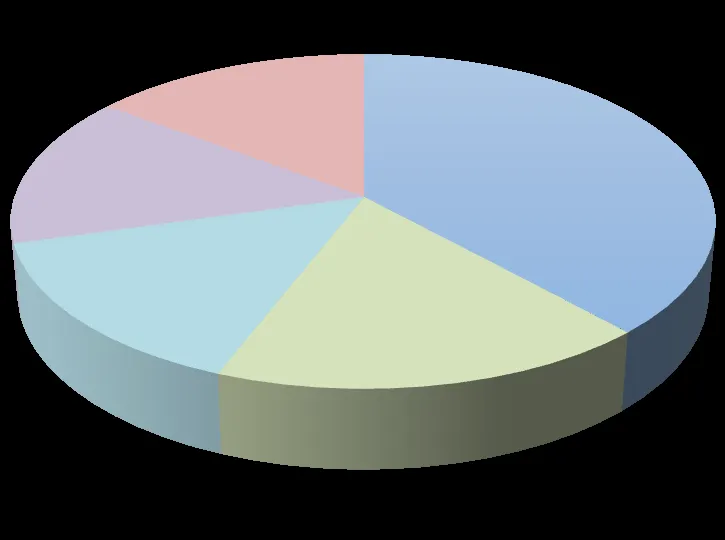
3D Pie chart showing Top 5 Calls for Service: Alarms, Thefts, Property Related, Assist Police/Fire/Ambulance, and Traffic Incidents
Table 4 - Top 5 Calls for Service
Table 4 illustrates the Top 5 CFS in 2017. Traffic incidents were the most prevalent CFS followed by Assist Police/Fire/Ambulance calls, Thefts, Alarms & Property Related offences. Traffic incidents include, but are not limited to, driving complaints insurance violations, seatbelts and speeding, erratic/dangerous driving, road rage reports.
³ Police Services Division provides population data. 2016 & 2017 population figures are projections. Population figures utilize Census data; however, to align the data with policing boundaries as opposed to Census boundaries, an algorithm is applied.
⁴ West Shore Provincial includes highway areas, Highlands & Metchosin Districts & First Nations Reserves.
In 2017, information indicates no change in the top 5 most time consuming CFS from 2016. The most time consuming CFS were Assist Police/Fire/Ambulance, Motor Vehicle Incidents, Disturbances, Domestic in Progress, and Traffic Incidents. (Each averaging 590 hours of labour annually)
During 2017, West Shore RCMP received 940 alarms requiring members to attend a location to investigate the status of the alarm. Investigators determined 706 where found to be “False Alarms” and 207 CFS were “Cancelled Alarms”. 27 alarms were results of criminal acts. Members spent, on average, 30 minutes per investigation into each “False Alarm” resulting over 353 hours of labor used to investigate and clear false alarms. The Detachment is currently developing strategies and policies regarding alarms, which will be presented and discussed with the communities in the future.
All times for CFS are captured using statistics gathered from “GDSA” and The Police Services Division. Information collected via West Shore RCMP members use of the Mobile Dispatch Terminal (MDT) in each Police car when responding to CFS. The Detachment is currently engaged in a policing study “General Duty Staffing Analysis” (GDSA). The General Duty Staffing Analysis (GDSA) document represents the analysis of General Duty constable workload using operational data and a computer model. Under normal circumstances, the GDSA document is created by the senior business intelligence analyst delegated to conduct the analysis in consultation with the General Duty Staffing Committee (GDSAC) at the detachment. The goal of the assessment is to provide analysis of General Duty resourcing in West Shore. The results can be used to efficiently deploy the General Duty constables and determine staffing levels based on time spent on calls for service and response time to dispatched calls. The primary measure of General Duty workload is time constables spend in response to calls for service from the public. The General Duty Staffing Assessment seeks to align the number of General Duty constables available with the number (and type) of calls for service from the public, operational objectives, service delivery performance targets, and public and police safety (e.g. the number of free General Duty constables available to respond in an Emergency). The methodology is supported by the RCMP’s Business Intelligence Call for Service dashboard and the Managing Patrol Performance (MPP) software. The assessment provides information for detachments and RCMP executives, as well as municipal and provincial governments.
CRIMINAL CODE OFFENCES – UCR CATEGORIES
West Shore RCMP respond to a vast array of CFS, including Criminal Code & non-Criminal Code incidents. In order to categorize the CFS, the Uniform Crime Reporting Survey (UCRS)⁵ serves as a guide. Each UCR category includes specific codes based on the offence or violation type. CFS are coded (scored) based on the type of call and subsequent investigation. There are eight UCR categories: Crimes Against Persons, Offences Against Property, Other Criminal Code (Other CC) Violations, Controlled Drugs & Substances Act (CDSA) Violations, Other Federal Statute Violations, Provincial Statistics Codes, RCMP Statistics Codes and Traffic Violations.
Table 5 shows the breakdown of actual⁶ files by UCR category for 2017. Increases include Crimes Against Persons, CDSA Violations & RCMP Statistics Codes. Decreases are observed for Offences Against Property, Other CC Violations, Other Federal Statute Violations, Provincial Statistics Codes & Traffic Violations.
TOP 5 CRIMINAL CODE OFFENCES – CRIMES AGAINST PERSONS
There were 534 Crimes Against Persons in 2017 compared to 492 offences in 2016, representing a 9% increase (or +42 files). Of the 534 offences, Assaults accounted for the highest incidence of offences followed by Uttering Threats, Harassing Communications, Sexual Assault and Assault with Weapon (Table 6).
Bar chart showing Top 5 Crimes Against Persons: Assault (43%), Uttering Threats (18%), Harassing Communications (10%), Sexual Assault (7%), and Assault w/Weapon (6%)
Table 6 - Top 5 Crimes Against Persons
TOP 5 CRIMINAL CODE OFFENCES – OFFENCES AGAINST PROPERTY
Page 18–43
Offences Against Property comprise the highest incidence of Criminal Code Offences. Property related offences decreased in 2017 compared to 2016, down by 7% (or -145 files). Of the 1,982 incidents in 2017, Theft From Vehicle accounted for the highest portion of offences, followed by Mischief, Theft – Other, Shoplifting and Bike Theft. (Table 7)
Bar chart showing Top 5 Offences Against Property: Theft From Vehicle (23%), Mischief (18%), Theft - Other (11%), Shoplifting (11%), and Bike Theft (5%)
Table 7 - Top 5 Offences Against Property
TOP 5 CRIMINAL CODE OFFENCES – OTHER CRIMINAL CODE VIOLATIONS
Other Criminal Code Violations (Other CC) consists of a variety of violations that do not fall under Crimes Against Persons or Offences Against Property. Other CC Violations include, but are not limited to, Cause Disturbance, Breach of Probation, Fail to Appear and Obstruction. (Table 8)
Bar chart showing Top 5 Other Criminal Code Violations: Cause Disturbance (38%), Breach/Bail Violation (21%), Breach Probation (7%), Weapons Possession (5%), and Counterfeiting Currency (4%)
Table 8 - Top 5 Other Criminal Code Violations
In 2017, Cause Disturbance was the most prevalent Other CC Violation, representing 38% (or 242) of actual CFS. Breach/Bail Violations was the second highest Other CC Violation followed by Breach Probation, Weapons Possession and Counterfeiting Currency.
TOP 5 – CONTROLLED DRUGS & SUBSTANCES ACT VIOLATIONS
There were 218 CDSA Violations in 2017 compared to 216 violations in 2016, representing a 1% increase. Table 9 depicts the Top 5 CDSA Violations. Possession violations constituted the highest incidence of CDSA violations with Cannabis possession representing 43% of files, followed by Possession of Methamphetamine, Possession of Other Scheduled I Drugs/Substances & Possession of Cocaine. Cocaine Trafficking represented 4% of the CDSA Violations. It is important to note that drug possession violations typically occur in conjunction with other offences (e.g. property crimes). (Table 9)
Bar chart showing Top 5 Controlled Drugs & Substances Act Violations: Possession Cannabis 30G/< (43%), Possession of Methamphetamine (10%), Possession Other Sch I (9%), Possession Cocaine (6%), and Trafficking Cocaine (4%)
⁶ “Actual” figures may be less than the total CFS as “actual” figures do not include information, prevention, assistance, unfounded or unsubstantiated CFS whereas “total” figures include all types.
TRAFFIC STATISTICS
Traffic related CFS represent the highest incidence of all CFS in West Shore jurisdiction & and are the fifth most time-consuming call type. Traffic incidents accounted for 13% of all CFS in 2017.
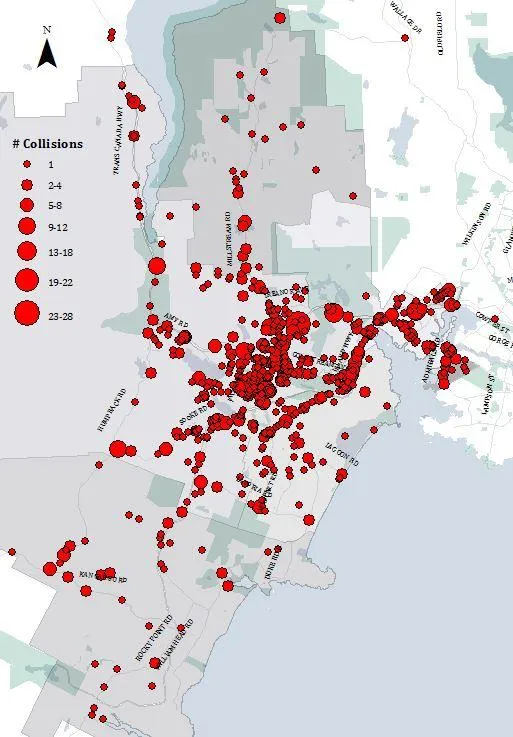
Figure 1 depicts the motor vehicle collision locations in 2017. Graduated symbols highlight the locations where multiple crashes occurred. Being knowledgeable about the high crash locations assists West Shore RCMP to engage in proactive enforcement activities at those locations.
Map of West Shore showing 2017 Motor Vehicle Collision locations with density clusters
Figure 1 – 2017 Motor Vehicle Collisions
Table 10 - Collisions Comparative Figures
MOTOR VEHICLE COLLISIONS
2016
2017
% CHANGE
FATAL
3
1
-67%
INJURY
187
180
-4%
NON-INJURY
892
926
4%
TOTAL
1082
1107
2%
Table 10 shows a comparison of the types of motor vehicle collisions in 2016 and 2017. Fatal and injury collisions decreased in 2017, down 67% and 4% respectively. Non-injury collisions increased by 4% in 2017. Overall, there was a 2% increase in motor vehicle collisions in 2017.
TOP 5 TRAFFIC VIOLATIONS
Table 11 highlights the top 5 Traffic Violations⁷ in West Shore in 2017. Fail to Stop/Remain ranked highest at 46%, followed by Impaired Operations of a Motor Vehicle (25%), Drive Without Care/Consideration (9%), Drive While Disqualified/Suspended (6%) & Fail to Provide/Refuse ASD (2%).
Bar chart showing Top 5 Traffic Violations: Fail Stop/Remain (46%), Impaired OP Motor Vehicle (25%), Drive Without Care/Consideration (9%), Drive While Disqualified/Suspended (6%), and Fail to Provide/Refuse ASD (2%)
Table 11 - Top 5 Traffic Violations
In 2017, West Shore RCMP issued 2060 Violation Tickets (VT). VT are offences committed under BC’s Motor Vehicle Act and Motor Vehicle Regulations. Highest number of VT issued were for speeding with 567 VT issued. Speeding offences can include but not limited to, “Speed inside municipality”, “Speed in School Zone”, and “Speed over 40kph”.
Our traffic initiative in 2017 was to focus on Distracted Driving. West Shore RCMP members issued 142 VT’s, an increase of 21% over 2016 where 114 VT were issued.
OTHER STATISTICS
LICENSED PREMISES - CHECKS
The majority of bars and nightclubs are in downtown Victoria, however; West Shore does have a few establishments that are open late and are popular drinking locations. West Shore RCMP conducted 53 bar walks in 2017. The Country Rose Pub has changed management and updated its business model to attract new clientele.
Bar chart comparing 2016 and 2017 Calls for Service at various West Shore licensed establishments
Table 12- Licensed Premise Calls For Service
Licensed drinking establishments sometimes generate activity requiring a police response. Table 12 illustrates the CFS at licensed premises in West Shore in 2016 & 2017. The number of CFS at locations differ by establishment, with some establishments having more calls than other establishments. A comparison of 2016 to 2017 CFS shows decreases in 2016 at some places & increases at other locations. Overall, there was a 41% increase in CFS in 2017 compared to 2016. With population growth & the opening of new liquor establishments, we may see increased CFS at these places.
MENTAL HEALTH ACT
West Shore RCMP often respond to calls where there is a mental health component. Under the Mental Health Act (MHA), police may apprehend individuals for their protection and for public safety. Individuals apprehended under the MHA are taken to Royal Jubilee Hospital in Victoria (adults only) or to the Victoria General Hospital (VGH) (youth only) for medical assistance. MHA apprehensions are time consuming, as police officers are required to take individuals to a physician for examination.
An upward trend continues of CFS with a mental health component (Table 13). In 2017, there were 809 calls, representing a 23% increase over the 657 calls in 2016. These included suicidal persons and Mental Health Act apprehensions. In 2017, West Shore RCMP responded to 298 calls for service related to suicidal persons and officers spent 469 hours attending to these types of calls.
Bar chart showing CFS with Mental Health Act Component from 2013 (488) to 2017 (809)
Table 13 – CFS with Mental Health Act Component
⁷ Not all traffic violations generate a police file (e.g. speeding, seatbelts, etc.) & these figures are not comprehensive.
When an apprehension is made under the Mental Health Act, the law requires a police officer to bring the person to a designated medical facility immediately for assessment by a medical doctor. Recently, West Shore RCMP in collaboration with Vancouver Island Health Authority (VIHA), captured data relating to “wait times” for medical staff to assess the patient at either Royal Jubilee Hospital or Victoria General Hospital.
AVERAGE WAIT TIMES FOR 2017/2018:
August – 1.5 hours
September – 2 hours
October – 1.6 hours
November – 1.1 hours
December – 1.2 hours
January – 1.2 hours
The average time per call indicates West Shore RCMP members spend close to 1.5 hours per apprehension. Times do not factor in investigation time or transit time.
CHOICES TRANSITIONAL HOUSING FACILITY
Page 18–43
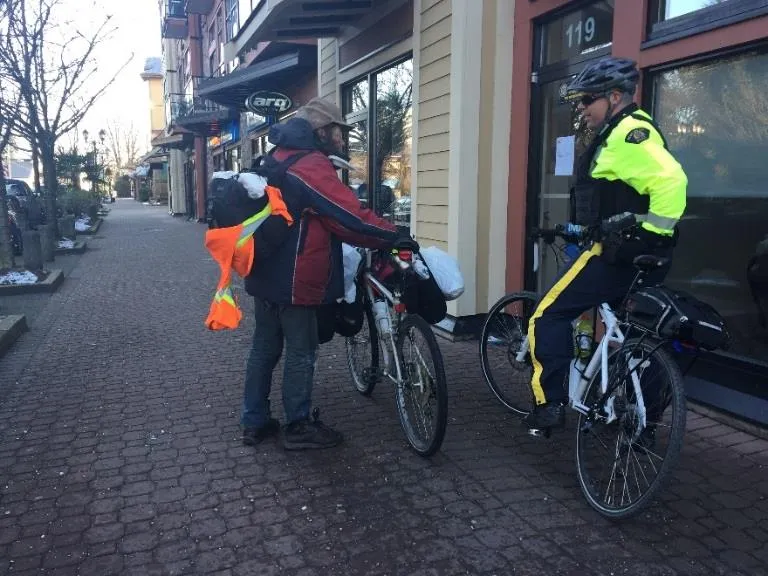
Choices Transitional Housing Facility, a facility providing shelter and support for homeless individuals, opened on February 23, 2016. Since the shelter opened in late February 2016, there was an increase in CFS from 65 CFS in 2016 to 73 CFS in 2017. Choices Transitional Housing Facility is in its own transition to an addiction recovery site. It’s doors were closed in the beginning of 2018. All homeless individuals are using downtown Victoria services and shelters.
RCMP bike patrol officer interacting with a person on the sidewalk near the Choices facility
Page 18–43
STRATEGIC POLICING PRIORITIES – ANNUAL PERFORMANCE PLAN
ANNUAL PERFORMANCE PLAN (APP) 2017-2018
West Shore RCMP’s management team works closely with our five distinct detachment communities and First Nations Reserves to identify local policing priorities. Each RCMP Detachment in British Columbia is mandated to prepare an Annual Performance Plan⁸ that addresses local policing priorities. Through consultation with elected officials and senior staff, the West Shore RCMP APP focuses on the issues identified throughout the region. The APP is designed to be flexible to the changing needs of the communities and the priorities are continually revisited and adjusted accordingly.
The five key priorities identified for 2017-2018 fiscal year were Organized Crime and Drug Trafficking, Traffic Safety, Aboriginal Policing and Relationships, Reduction of Property Crime, and Police/Community Relations.
ORGANIZED CRIME & DRUG TRAFFICKING: REDUCING THE THREAT & IMPACT OF SERIOUS & ORGANIZED CRIME
HIGHLIGHTS
Continuous intelligence sharing with partner agencies
Monitoring of local organized crime groups
Conducting proactive educational and awareness of organized crime groups to detachment members
12 educational sessions held for Members and partner agencies in 2017
Identifying & arresting drug traffickers
17 drug trafficking charges laid in 2017
Marijuana is the most prevalent drug seized, followed by methamphetamine & other drugs/substances
Specialized units proactively target prolific offenders
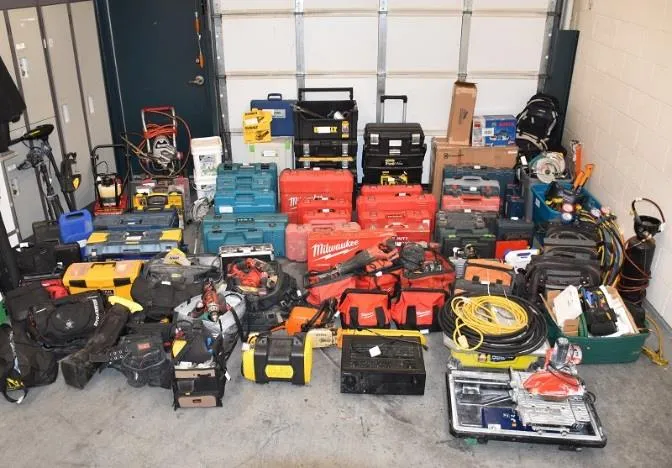
Large assortment of tools and construction equipment seized by police
Police seized estimated over $15,000 dollars in stolen tools and drugs after responding to a report of vehicle with inactive license plates.
⁸ The APP follows the RCMP fiscal year, April 1st to March 31st
2017 saw a 7% reduction in injury collisions compared to 2016
As of 2017, the Traffic Unit is fully resourced
A number of initiatives & enforcement strategies were implemented & are ongoing:
Working with partners including Commercial Vehicle Safety Enforcement (CVSE), the Integrated Road Safety Unit (IRSU) & the community
Increased enforcement in school zones
A number of road checks with CVSE
Total number of distracted driving tickets written for the fiscal year: 142
Total number of drug and alcohol impaired drivers prohibited: 217
RCMP patrol sedan driving on the highwayThree students holding school zone safety posters in front of Hans Helgesen Elementary School
Think of Me campaign at Hans Helgesen Elementary School and Ruth King Elementary School to promote school zone awareness. West Shore RCMP Traffic Services and ICBC team up to give over 200 hand drawn cards to motorists.
The West Shore Detachment commitment to establishing a traffic unit has shown a 453% increase in Violation Tickets issued.
West Shore Traffic Services are engaged with detachment members by holding educational sessions focusing on training and proper application of the law and provincial statues. Members of the detachment are using those skills resulting in decreases in motor vehicle injuries and fatal collisions.
Commercial Vehicle Safety Enforcement officers have noted, the presence of the municipal traffic unit has resulted in a noticeable increase in commercial trucks complying with safety regulations.
ABORIGINAL POLICING – RELATIONSHIPS: ENHANCE THE SAFETY AND HEALTH OF ABORIGINAL / INDIGENOUS COMMUNITIES
HIGHLIGHTS
West Shore RCMP’s First Nations Policing (FNP) officer aims to promote & participate in programs & initiatives focused on community youth
Our FNP officer meets with Chiefs & representatives from the Songhees & Esquimalt First Nations to discuss & implement crime prevention programs & identify community priorities
Our FNP officer was very engaged with Shoreline Middle School & Craigflower Elementary school as a school liaison officer
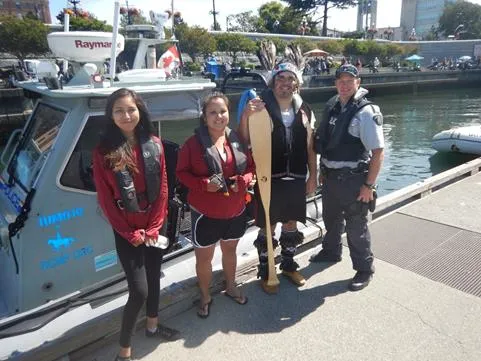
RCMP officer and three youth in a boat participating in a marine safety program
FNP Member Cst. Brewer with youth from Esquimalt First Nations summer programs. FNP Member conducted a Cold Water and Marine Safety Presentation with Community Youth.
RCMP officer and a student at a school event
Tour De Rock stops at Craigflower Elementary- FNP Member Cst. Brewer with a student who donated her hair to cancer patients.
PROPERTY – THEFT: REDUCE PROPERTY CRIMES
HIGHLIGHTS
The Detachment Street Crime Unit (SCU) & Crime Reduction Unit (CRU) combined resources to form one unit to tackle property crime & other offences
West Shore RCMP actively monitor individuals placed on court ordered curfew or house arrest
807 curfew checks conducted resulting in 11 breach charges
Continued targeted enforcement on prolific property offenders involved in residential & business break ins
5% decrease in Thefts From Motor Vehicles
132% increase in Theft of Motor Vehicles
24% decrease in Business Break Ins
12% decrease in Residential Break Ins
15% increase in Other Break Ins
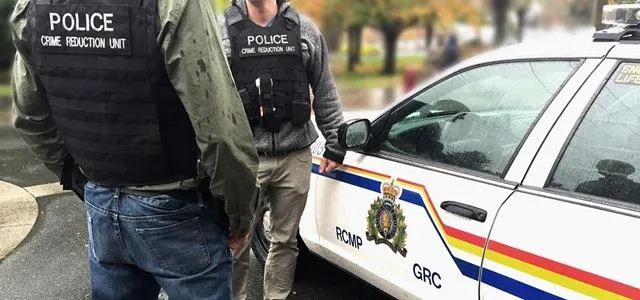
Two plainclothes officers in tactical vests from the Crime Reduction Unit by a patrol car
The Crime Reduction Unit proactively targets property crime offenders, prolific offenders and conducts warrant apprehensions on people with outstanding arrest warrants. Investigators liaise with outside agencies including Saanich and Victoria Police, the Prolific Offender Management Team, and assist General Duty members with investigations related to property crime, frauds, or where prolific or repeat offenders are involved. The Crime Reduction Unit also assists agencies and police departments from other jurisdictions where investigation is required in the West Shore area.
POLICE / COMMUNITY RELATIONS: VISIBILITY OF POLICE & COMMUNITY ENGAGEMENT
HIGHLIGHTS
Community Policing (CPVS) focused on visibility with programs of education and prevention throughout the year
CPVS trained 4 members on the RCMP Mountain Bike Course with in-house resources
In the summer CPVS implemented foot patrols in high visibility areas
Held a Lock or Lose it campaign
Eliminated a hangout area used by high risk youth
Foot/Bike patrols on Galloping Goose Trail
CPVS and FNP Members graduated over 7 DARE classes.
Officer and students wearing fake moustaches for Movember
Cst. Baker with students from Ruth King Elementary for a Movember Fund Raising event
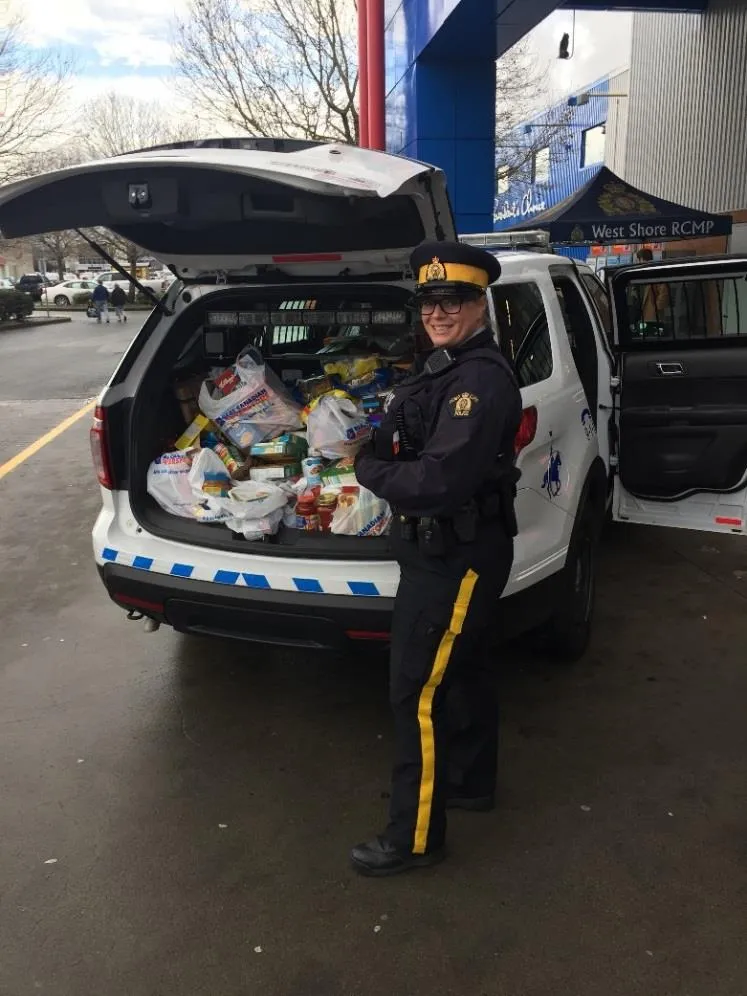
RCMP officer with a vehicle trunk full of donated food
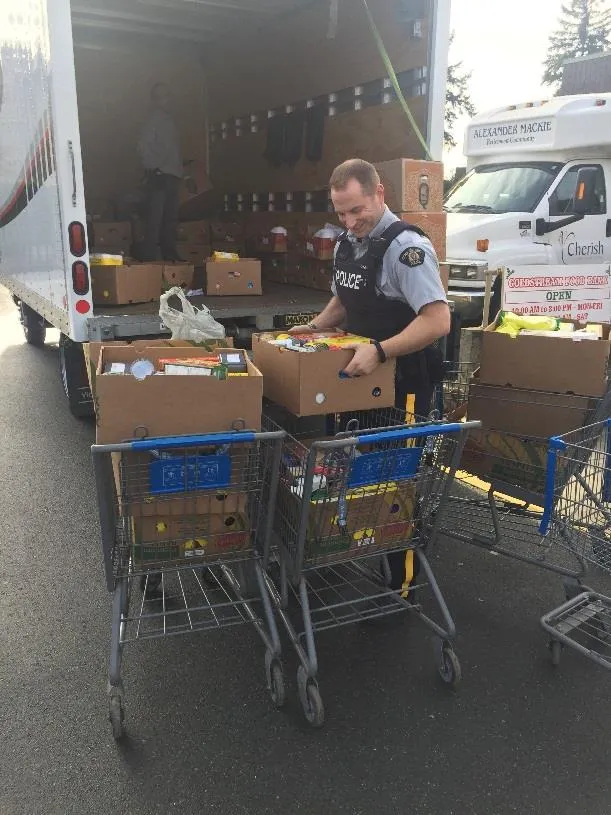
Cst. Scheidl at the Cram the Cruise food drive over 3000lbs of food and $2500 donated to Goldstream Food Banks
ANNUAL PERFORMANCE PLAN (APP) 2018-2019
In consultation with our distinct communities and First Nations partners, West Shore RCMP’s management has identified local priorities for 2018-2019 fiscal year. To address local policing issues the 6 key priorities are Organized Crime, Traffic Safety, Police/Community Relations Visibility and Preventative Measures, Property Crimes, and Domestic Violence.
Organized Crime – Drug Trafficking
Objective: Prevent and Reduce the threat and impact of serious and Organized Crime
Detachment Members to:
Gather intelligence of OMG members in our community
Complete enforcement through anti-drug trafficking projects
Goals to increase OMG intelligence and develop human sources
Conduct prolific offender management to identify and target prolific offenders and share intelligence
Perform regular curfew checks on criminals with an outstanding court ordered conditions living in West Shore area
Goals to reduce break and enters to business by 10% and theft of motor vehicles by 10%
Domestic Violence
Objective: Reduce crimes against persons
Detachment Members to:
Continue to focus on domestic violence investigations as a priority high risk area.
Work in partnership with RDVU, Victim Services and social service agencies.
Media Relations Officer to engage in educational and awareness campaigns to educate the public on domestic violence.
Goals to increase public awareness of domestic violence.
Page 18–43
GREATER VICTORIA POLICE VICTIM SERVICES (GVPVS) – WWW.GVPVS.ORG
Victim Services is a volunteer based program that works with police to help people impacted by crime and trauma. Their vision is to help victims achieve a state of well-being and assist in their recovery. They provide services to victims of crime or trauma who may or may not have reported the crime to police or be involved with the criminal justice system.
Victim services:
Provide emotional and practical support
Make referrals to services
Make safety plans
Assist with Crime Victim Assistance applications
Assist with Victim Impact Statements
Provide information about the court and criminal justice systems
Accompany victims to court
Provide education on victim rights and services
Recent Highlights from the GVPVS Program Director’s Report for December 2017/January 2018
Case referrals by Police Department reflect a pattern of West Shore RCMP maintaining the highest number of referred cases. Domestic Assault/Abuse remain the highest percentage of referrals made to GVPVS
CASES REFERRED BY POLICE DEPARTMENT FOR FISCAL YEAR 2017/2018
Cases Referred by Police Department
Number
Saanich
136
Sidney/North Saanich
51
Victoria
152
West Shore
322
Oak Bay
23
Central Saanich
12
CFB Esquimalt
9
Other
14
Totals
719
DID YOU KNOWIn 2017, West Shore RCMP received 551 False Abandoned 911 calls & 913 False Alarm calls. Each call required follow up and in many case, a police visit.
Page 18–43
PROLIFIC OFFENDER MANAGEMENT PROGRAM (POM)
West Shore RCMP participates in the Prolific Offender Management Program in conjunction with Municipal Police Agencies, Corrections, Probation, Crown and various Social Agencies throughout the Southern Island Region. The POM program was created due to the emerging consensus that a small proportion of offenders commits a disproportionate percentage of crime, particularly property crime. POM emphasizes inter-agency collaboration as a means to effectively target these individuals, reduce recidivism and increase community safety.
POM candidates are selected based on several factors, including the number of police contacts, and are then supported by an integrated team of service providers. Individuals selected to participate in the POM program receive individually tailored support including employment referrals, housing and income assistance and assistance with access to mental health and substance abuse treatment. Immediate response to reoffending or breaching conditions is the second component to the strategy with prompt apprehension and conviction with the assistance of Crown Counsel who manages files based on custom prepared POM templates from Police.
Of the fourteen Prolific Offenders in the Greater Victoria Region, West Shore managed 6 offenders in 2017. During 2017, 5 of 6 offenders were in custody; 3 offenders were incarcerated for more than six months of the year, 2 were in and out of custody throughout the year and one offender ceased offending. Presently, West Shore monitors 6 offenders; 4 are in custody and 2 are in the community. It is notable that when these offenders are incarcerated, property crimes such as break & enters, auto thefts and thefts from motor vehicles decrease dramatically.
Close-up of a person's hands secured behind their back with handcuffs
Although 5 of our 6 prolific offenders were in custody throughout 2017, together they had 188 police contacts during the year. Five of the six also suffer from drug &/or alcohol addictions, which factors significantly in their criminal offending.
Page 18–43
SOCIAL MEDIA
WEBSITE
West Shore RCMP updated their website to reflect the Government of Canada’s website. The transition was smooth and did not compromise content. The URL remains the same and the site is monitored and daily. The website contains information pertaining to some of the most commonly asked questions, including criminal record checks, contact information, volunteer programs and others programs, and the various services West Shore RCMP Detachment offers. The public is able to view emerging West Shore RCMP news releases and there is a direct link to Crime Stoppers.
TWITTER
Since February 2015, West Shore RCMP has been actively engaging the communities on social media via Twitter (@WestshoreRCMP). The West Shore RCMP’s Twitter account has the “blue verified badge”, meaning that Twitter reviewed the account and verified that it is an authentic account of public interest. The world is always evolving and the public’s method of accessing and obtaining information is evolving as well; many people want information directly from the source, rather than from mainstream media. We endeavor to provide information in a way that makes it the most accessible to our communities and social media plays a big role in providing that information to the public.
Some examples of West Shore RCMP’s Twitter activity show we consistently reach over 2500 profile and have over 50,000 tweet impressions every month. We are reaching more and more members of the Victoria community to share matters of public safety and public interest.
Twitter callout: **DID YOU KNOW? West Shore RCMP’s Twitter followers are @ 5600 & continue to grow daily!**
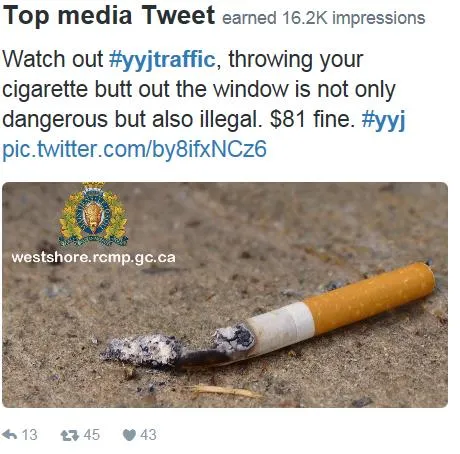
West Shore RCMP’s top tweet of the year, received over 16,000 individual views was:
Screenshot of a tweet about illegal littering of cigarette butts, showing a used butt on asphalt and a warning about an $81 fine
West Shore RCMP will continue to provide accurate and timely information to highlight matters of public safety and public interest, as well as building trust and confidence of the West Shore Communities.
COFFEE WITH A COP
“Coffee with a Cop” brings police officers and the community members they serve together, “over a coffee”, to discuss issues and learn about each other. West Shore is rather unique in the RCMP police world with 7 distinct communities, each with varied interests and concerns. In an effort to reach the communities, we will be holding bi-monthly informal “get together’s” in locally and privately owned coffee shops in each of our communities.
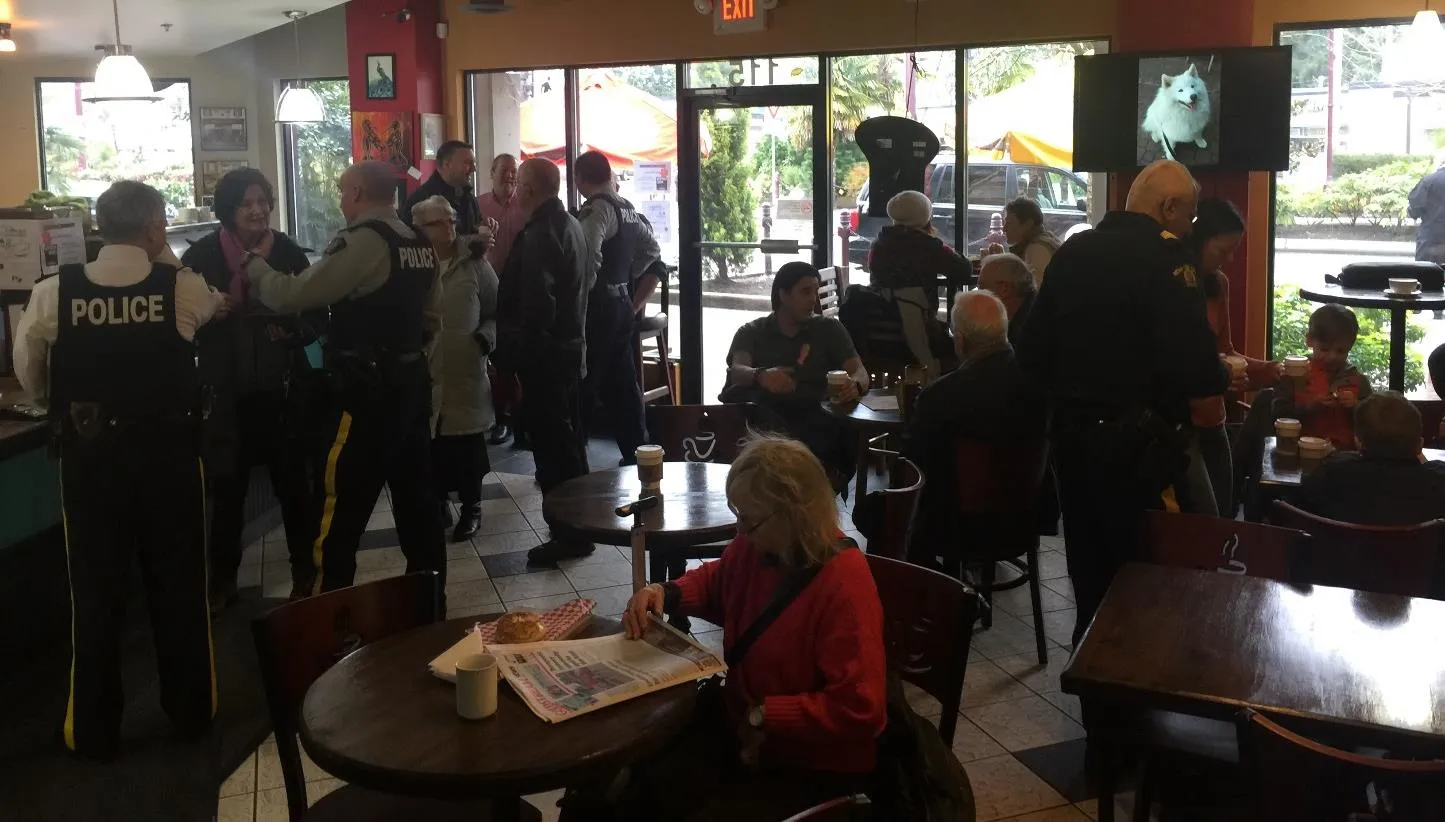
The first ever West Shore RCMP “Coffee with a Cop” was at Poncho’s Coffee House in Langford. West Shore RCMP senior management along with several General Duty members spoke with over 30 different members of the community. The topics discussed varied in range from uniform changes, to observed police action, to which police car they prefer.
Over the coming months West Shore RCMP will continue with the “Coffee with a Cop” initiative, and host an gathering in each of the West Shore communities providing the community members an opportunity to engage with the local Detachment members.
A group of RCMP officers and community members gathered inside a coffee house
West Shore RCMP Senior Management at Coffee with a Cop held at Poncho’s Coffee House on February 28th.
Page 18–43
STATS & FACTS
The West Shore RCMP Annual Report provides an overview of various statistics & policing in West Shore & is not comprehensive. The statistics presented in this report were retrieved from RCMP E Division Business Intelligence and the British Columbia Police Records Information Environment (PRIME) & are accurate on the retrieval date. All data is preliminary and is subject to change based on investigational factors and data quality processes. In cases of discrepancy with previous/subsequent data, the most current data will take precedence. Data collection utilized “most serious offence” scoring consistent with Statistics Canada and the British Columbia Ministry of Justice (Police Services Division (PSD)) data collection practices. PSD provides population data. Collision data is not complete as it only includes files where police attended and not all collisions reported to the Insurance Corporation of British Columbia (ICBC). Impaired Operation denotes impaired by alcohol &/or drugs.
RCMP officer unloading multiple shopping carts full of food donations into a delivery truck
Cst. BAKER unloading food from Cram the Cruiser 2017.
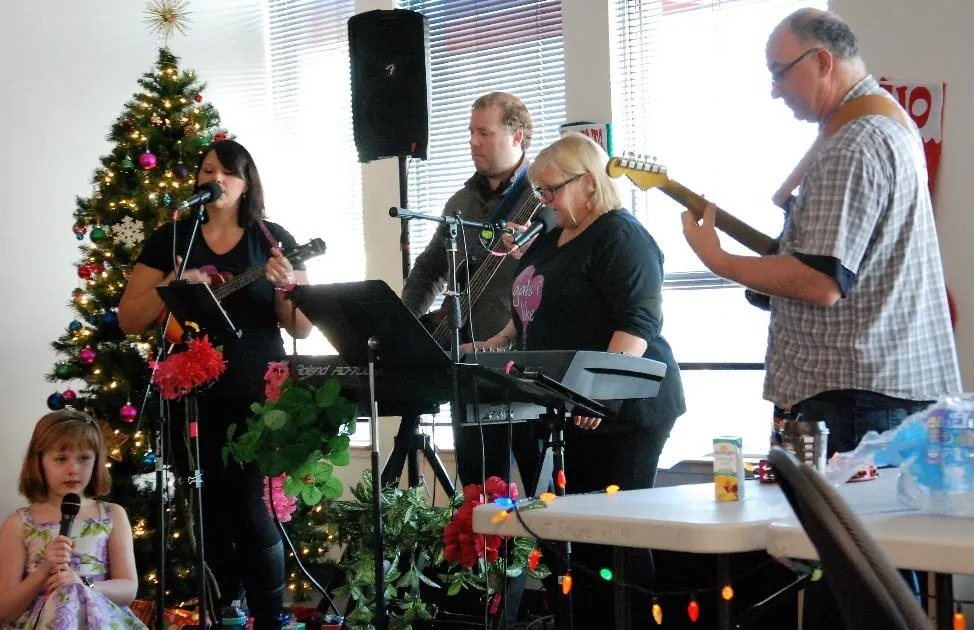
A local band performing with guitars and vocals at an indoor community event
Cpl. Sean French with his band at the West Shore RCMP Santa’s Breakfast
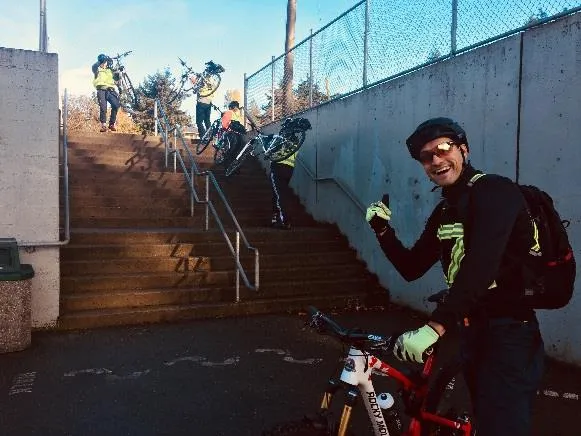
RCMP bike patrol officers practicing maneuvers on a set of outdoor concrete stairs
Cpl. Dave Vunic instructing West Shore Members on Mountain Bike Course.