Capital Regional District Regional Growth Strategy - DRAFT (v.1.43) Track Changes Version
A detailed version of the draft RGS document showing all deletions and additions made during the review process.
Regional Growth Strategy
Capital Regional District
DRAFT (v.1.43) January February 2016
The Regional Growth Strategy for the Capital Regional District
The Regional Growth Strategy was adopted by the Board of the Capital Regional District on August 13, 2003.
The Regional Growth Strategy is an agreement, developed and approved by the Capital Regional District and its member municipalities, in accordance with the Provincial legislation contained under Part 25 of the Local Government Act. The participating municipalities and electoral areas include the:
- District of Central Saanich
- City of Colwood
- Township of Esquimalt
- District of Highlands
- Juan de Fuca E.A.
- District of Langford
- District of Metchosin
- District of North Saanich
- District of Oak Bay
- District of Saanich
- Town of Sidney
- District of Sooke
- City of Victoria
- Town of View Royal
CAPITAL REGIONAL DISTRICT BYLAW NO. 2952
A BYLAW TO ADOPT A REGIONAL GROWTH STRATEGY FOR THE CAPITAL REGIONAL DISTRICT
WHEREAS Part 25 of the Local Government Act provides for a regional district to undertake the development, adoption, implementation, monitoring and review of a regional growth strategy;
AND WHEREAS the Regional Board of the Capital Regional District is desirous of developing and adopting a regional growth strategy;
AND WHEREAS the Regional Board of the Capital Regional District on February 28, 1996 initiated by resolution, pursuant to part 25, Section 854 of the Local Government Act, a Regional Growth Strategy;
NOW THEREFORE the Regional Board of the Capital Regional District, in open meeting enacts as follows:
- Schedule "A" attached to and forming part of this Bylaw is hereby designated as the "Regional Growth Strategy for the Capital Regional District."
- This Bylaw may be cited as the "Capital Regional District Regional Growth Strategy Bylaw No. 1, 2002."
READ THE FIRST TIME this 27th day of February, 2002 READ THE SECOND TIME this 27th day of February, 2002 APPLICATION SUBJECTED TO PUBLIC HEARING PURSUANT TO PART 25, SECTION 855 (4) of the LOCAL GOVERNMENT ACT this 3rd day of April, 2002 READ THE THIRD TIME this 13th day of August, 2003 ADOPTED this 13th day of August, 2003
CAPITAL REGIONAL DISTRICT BYLAW NO. 3443
A BYLAW TO AMEND THE REGIONAL GROWTH STRATEGY FOR THE CAPITAL REGIONAL DISTRICT
WHEREAS Part 25 of the Local Government Act provides for a regional district to undertake the development, adoption, implementation, monitoring and review of a regional growth strategy;
AND WHEREAS the Regional Board of the Capital Regional District seeks to amend its regional growth strategy to include the expansion of the Regional Urban Containment and Servicing Policy Area (RUCSPA) within the District of Highlands;
AND WHEREAS the Regional Board of the Capital Regional District on December 6, 2006 initiated by resolution, pursuant to Part 25, Section 854 of the Local Government Act, the process to amend the Regional Growth Strategy;
NOW THEREFORE the Regional Board of the Capital Regional District, in open meeting enacts as follows:
- Bylaw No. 2952, Capital Regional District Regional Growth Strategy Bylaw No. 1, 2002 is amended as follows: a) Map 3 in Schedule “A” attached to and forming part of Bylaw 2952, is deleted in its entirety and replaced with the attached Map 3 forming part of Bylaw 3443.
- This Bylaw may be cited as the "Capital Regional District Regional Growth Strategy Bylaw No. 1, 2002, Amendment Bylaw No. 1, 2007."
READ THE FIRST TIME this 11th day of July, 2007 READ THE SECOND TIME this 11th day of July, 2007 PUBLIC HEARING HELD, PURSUANT TO PART 25, SECTION 855 (4) of the LOCAL GOVERNMENT ACT this 3rd day of September, 2007 READ THE THIRD TIME this 11th day of July, 2009 ADOPTED this 11th day of July, 2009
The Capital Regional District Regional Growth Strategy
(Schedule “A” to Bylaw No. 2952)
AUGUST 2003 Prepared by Regional Planning Services Capital Regional District
Vision
In 2038, Capital Regional District residents enjoy a healthy and rewarding quality of life within a region that is economically vital, where communities are livable and where the environment and natural resources are stewarded with care.
Fundamental to this vision is a commitment to work toward regional sustainability. Simply defined, sustainability means that actions taken to meet needs today do not compromise the ability of future generations to meet their needs, ensure the ongoing health of the natural processes that sustain life, and support the social and economic arrangements that create prosperity and well-being.
The purpose of the Regional Growth Strategy is to help realize this vision, through the commitment of the Capital Regional District, the Juan de Fuca Electoral Area and its member municipalities to a twenty-five year plan of action, to guide regional growth and change toward common goals.
Goals:
- The majority of future population is housed in existing urban areas;
- Rural areas experience limited population increases and maintain a strong agricultural and resource base;
- A belt of protected green space runs sea to sea from Saanich Inlet south to Juan de Fuca Strait, defining the western edge of Metropolitan Victoria;
- An integrated parks, green space, greenways and trail system protects important natural areas and links town to country;
- Downtown Victoria remains the primary regional employment, business and cultural centre and is complemented by major employment and population centres in Langford, Colwood, Saanich and Sidney;
- The proportion of trips taken in single occupant automobiles is reduced, trips by public transit are increased, and there is a region-wide foot path and cycle network;
- Established employment centres are enhanced;
- A wide range of housing types and tenures meet the needs of regional residents; and,
- Communities are socially and physically complete with new development that enhances the identity and walkable human scale of neighbourhoods.
Context
A regional growth strategy is an agreement, developed and approved by the municipalities and the regional district in partnership, for identifying social, economic and environmental objectives and priority actions. Its purpose, under Part 13 of the Local Government Act, is to “… promote human settlement that is socially, economically, and environmentally healthy and that makes efficient use of public facilities and services, land and other resources.” A regional growth strategy expresses how communities will work together to enhance regional quality of life and social well-being. As of 2008, regional growth strategies must also include policies, actions and targets for the reduction of greenhouse gas emissions.
The Capital Regional District adopted a Regional Growth Strategy bylaw in 2003. In 2008, the Capital Regional District Board in partnership with local municipalities initiated the required five year review of the Regional Growth Strategy (2003). The 2016 update to the Regional Growth Strategy follows considerable public and intergovernmental discussion and consultation. At the present time, the Capital Region’s ten First Nations are not partners in the regional growth strategy, nor does it apply to the Salt Spring Island and the Southern Gulf Islands Electoral Areas, which fall under the planning jurisdiction of the Islands Trust (see Map 1).
Citizens, local governments, First Nations, school district boards, stakeholders, and provincial and federal agencies have been involved in the Strategy’s update through a regional sustainability planning process. This process determined that many of the policies of the Regional Growth Strategy (2003) are achieving desired objectives, notably, increasing compact and complete communities, acquiring green space, and substantially completing the regional trail network. Further, key complementary planning documents identified as actions to implement the Regional Growth Strategy (2003) are complete, including:
- 2007 Regional Housing Affordability Strategy; and
- Regional Transportation Strategy (completed as the 2014 Regional Transportation Plan and the 2011 Pedestrian and Cycling Master Plan).
Input and feedback have affirmed the desire for a strong growth management framework rooted in the Regional Growth Strategy (2003) objectives. Updates integrate recommendations from completed planning documents and address the requirements for policies, actions and targets for greenhouse gas reductions.
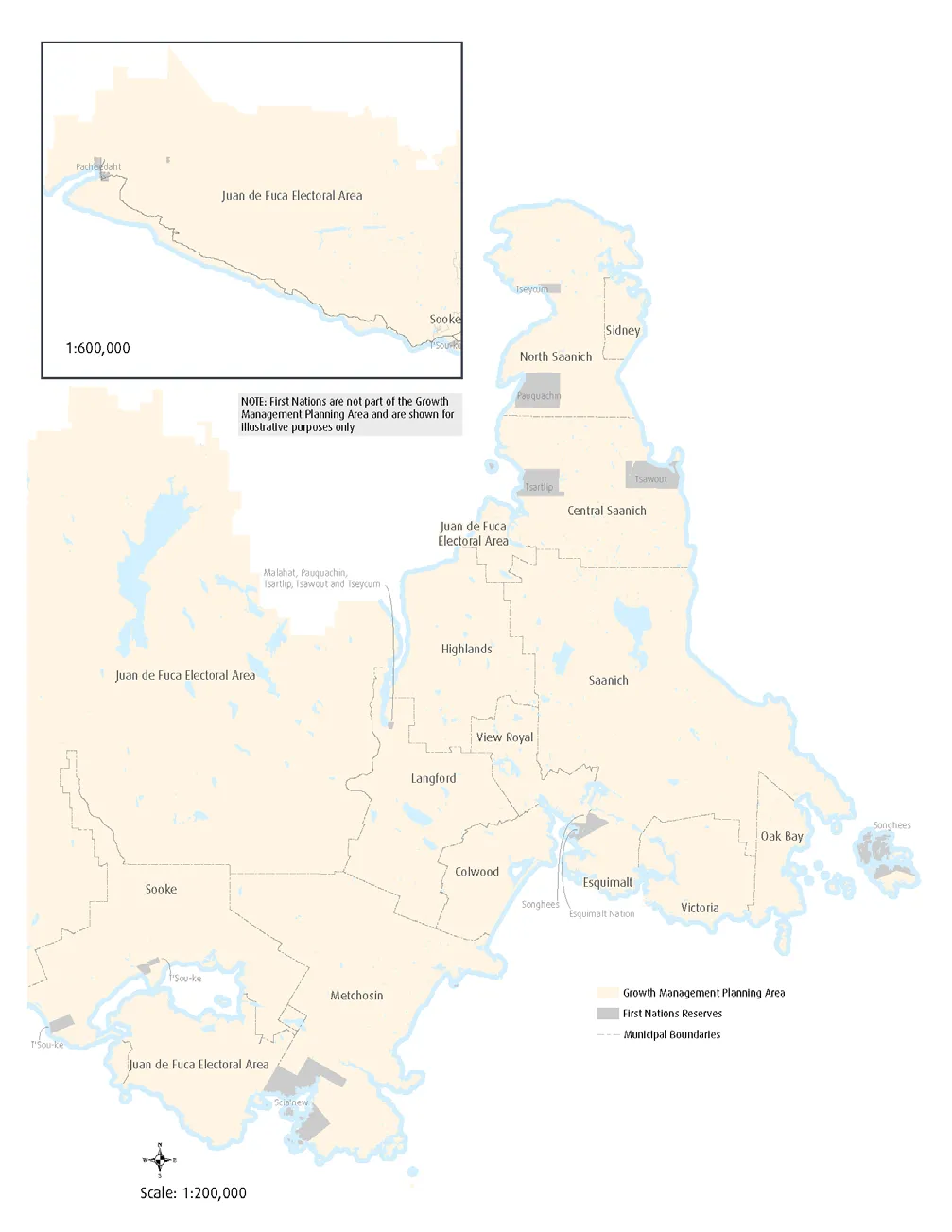
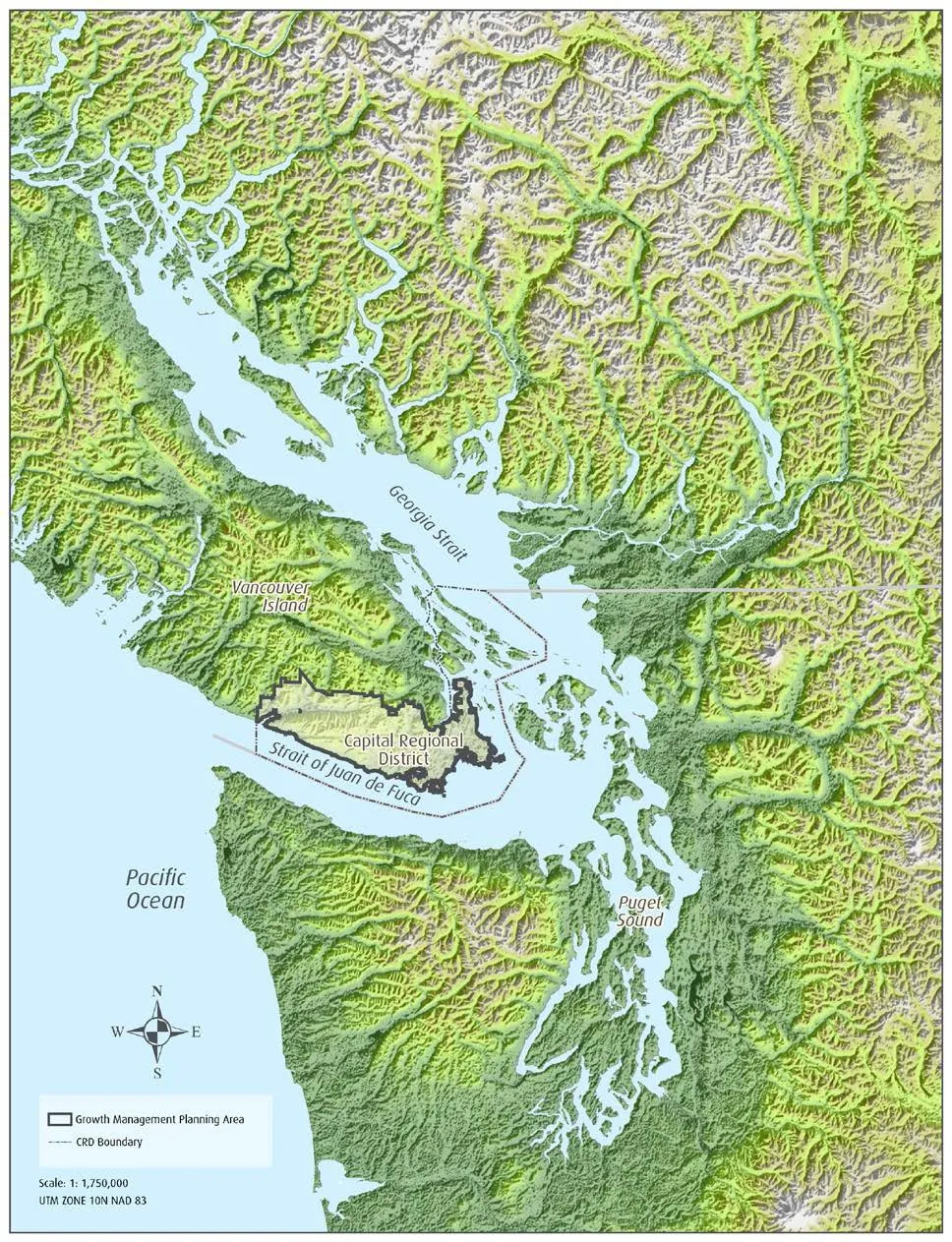
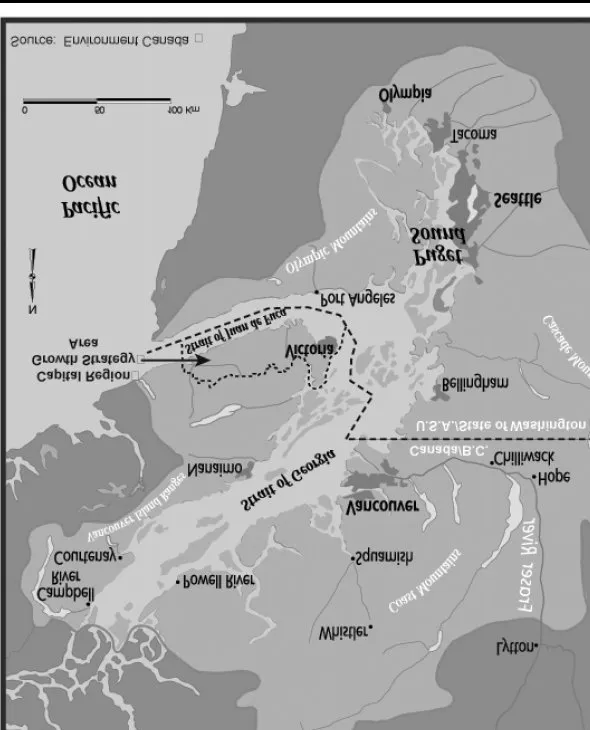
The Capital Region is located at the southern-most end of Vancouver Island, in the Cascadia/Salish Sea bio-region (see Map 2). The bio-region runs north-south along a coastal corridor stretching from Campbell River south to Olympia, Washington and east to Hope. The Capital Region’s present settlement pattern is characterized by a diverse mix of urban and rural communities, with a concentration of population in the Core Area located along key transportation corridors. The West Shore and Saanich Peninsula feature smaller urban centres, with forestry lands to the west throughout the Juan de Fuca electoral area. Agricultural lands are concentrated on the Saanich Peninsula, with some slightly more dispersed lands on the West Shore.
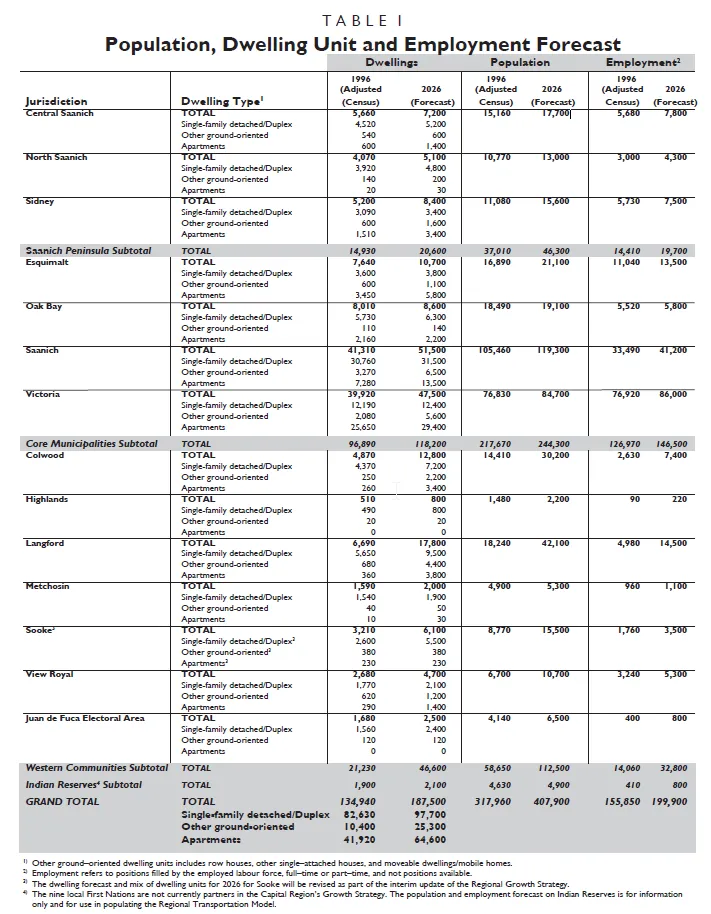
In this context, modest population growth is forecast for the Capital Region. Table 1 highlights existing and forecasted population, dwelling units and employment.
Table 1. Population, Dwelling and Employment Unit Forecast
| Jurisdiction | Population 2011 | Dwellings 2011 | Employment 2011 | Population 2038 | Dwellings 2038 | Employment 2038 | Population Share 2011 | Population Share 2038 |
|---|---|---|---|---|---|---|---|---|
| Core (Esquimalt, Oak Bay, Saanich, Victoria, View Royal) | 238,900 | 111,400 | 141,900 | 276,700 | 137,400 | 164,900 | 68.9% | 62.6% |
| Saanich Peninsula (Central Saanich, North Saanich, Sidney) | 38,400 | 16,100 | 20,300 | 47,300 | 20,900 | 24,900 | 11.1% | 10.7% |
| West Shore (Colwood, Highlands, Juan de Fuca E.A., Langford, Metchosin, Sooke) | 69,600 | 26,700 | 21,500 | 117,800 | 46,600 | 42,700 | 20.0% | 26.7% |
| Total | 346,900 | 154,200 | 183,700 | 441,800 | 204,900 | 232,500 | 100% | 100% |
Source: Urban Futures, 2014
From a 2011 base of approximately 346,900, the region’s population is forecast to increase by approximately 95,000 people to 441,800 in 2038, an approximate 1% average annual rate of population increase. The slow aging of the region’s population continues as a significant trend, with the proportion of residents 65 years and older expected to rise from 18% in 2011 to 26% by 2038. Further, although the workforce (ages 15 to 64) is projected to grow by 31,900, the proportion of workforce to total population is projected to decline from 69% to 61% by 2038. Serving the needs of an aging population in the context of a proportionally smaller workforce will affect all aspects of the region’s social, economic and physical development over the next quarter century.
It continues to be clear, however, that even modest population growth would undermine the regional vision if it were accommodated as it has been since the 1950s, through further urban expansion into farms, forests and countryside. Achieving the regional vision requires a concerted effort to largely shift to policies that encourage investment and development in designated urban centres.
The Regional Growth Strategy supports the regional vision by making this policy shift, through strategies that aim to: keep urban settlement compact; protect the integrity of rural communities; protect regional green/blue spaces; manage natural resources and the environment sustainably; build more complete communities; improve housing affordability; increase transportation choice; strengthen the regional economy; and, reduce greenhouse gas emissions.
Objectives
The Regional Growth Strategy includes eight integrated strategic objectives, incorporating policies, maps, targets and actions that together express a 25-year program of joint action by the Capital Regional District and local municipalities to achieve the regional vision.
- Policies are provided under the “policy” heading for each objective. The Capital Regional District will implement policies and undertake actions for regionally-delivered services and programs. Local municipalities will identify how their Official Community Plan aligns to each policy in a Regional Context Statement.
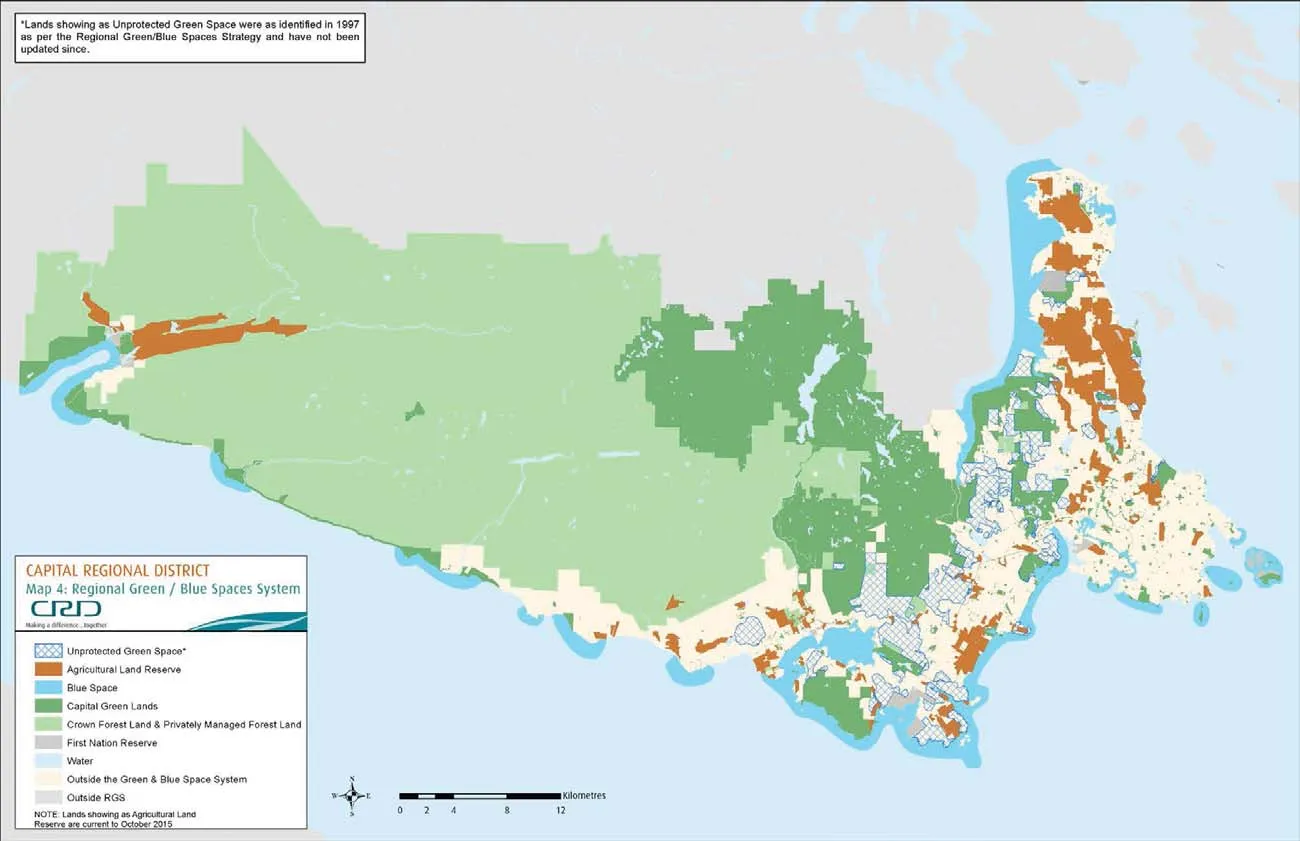
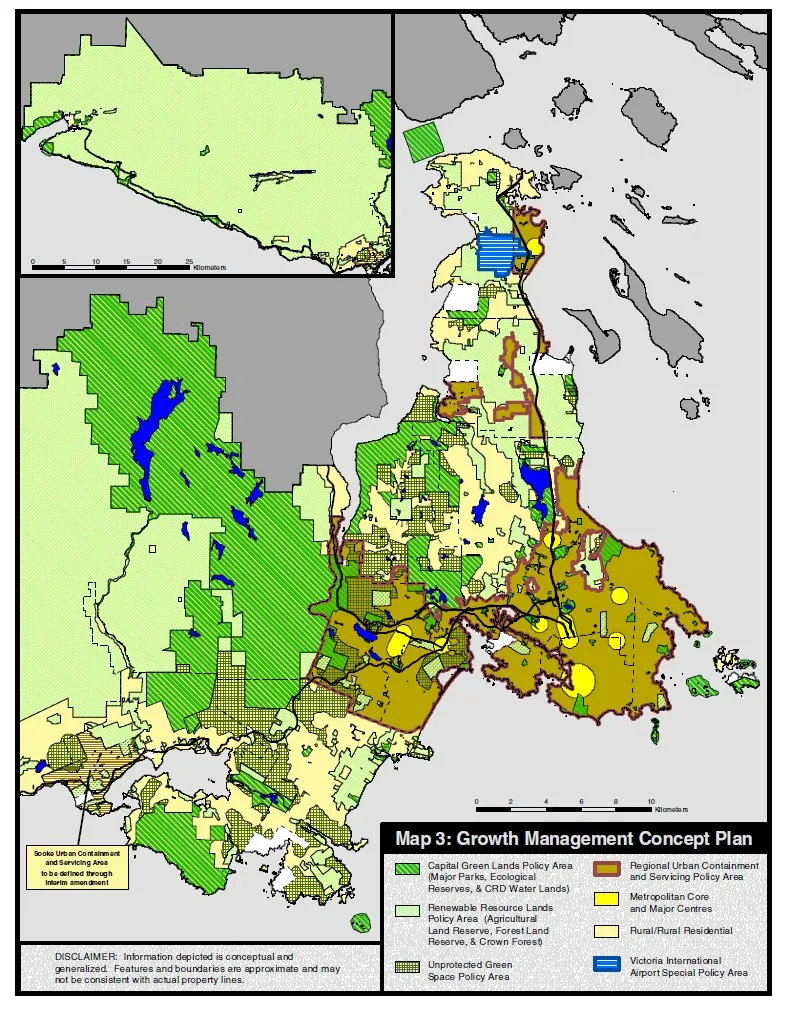
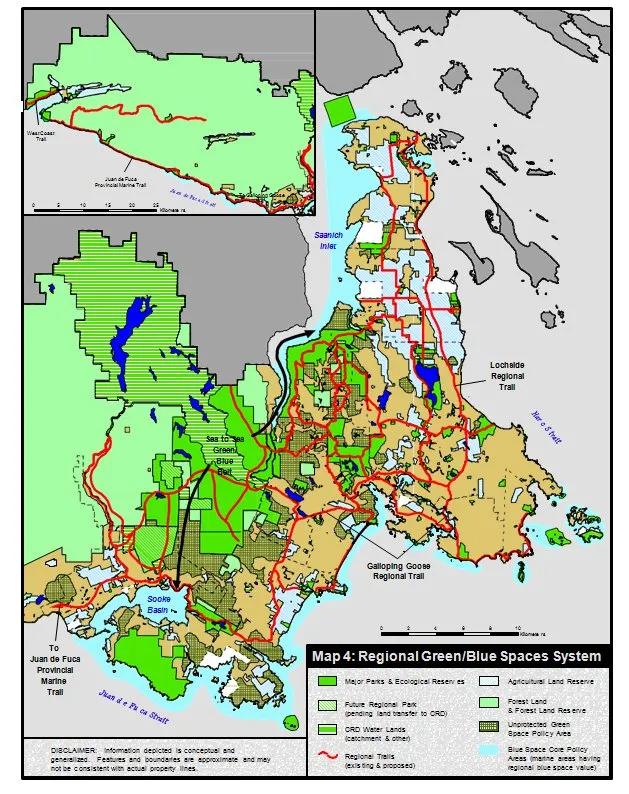
- Maps showing the growth management concept plan (Map 3) and the regional green/blue space system (Map 4) provide spatial definition for policy.
- Targets for each objective are provided in Table 2 at the end of the document.
- Actions for the Capital Regional District to implement the Regional Growth Strategy are provided in the Implementation Measures section.
1. Managing and Balancing Growth
1.1 Keep Urban Settlement Compact
The Regional Growth Strategy aims to keeping urban areas compact and largely contained within a Regional Urban Containment and Servicing Policy Area. Fundamental to urban containment, are four related principles that aim to increase the capacity of urban areas, particularly in the Core Municipalities and the urban West Shore, to accommodate new growth.
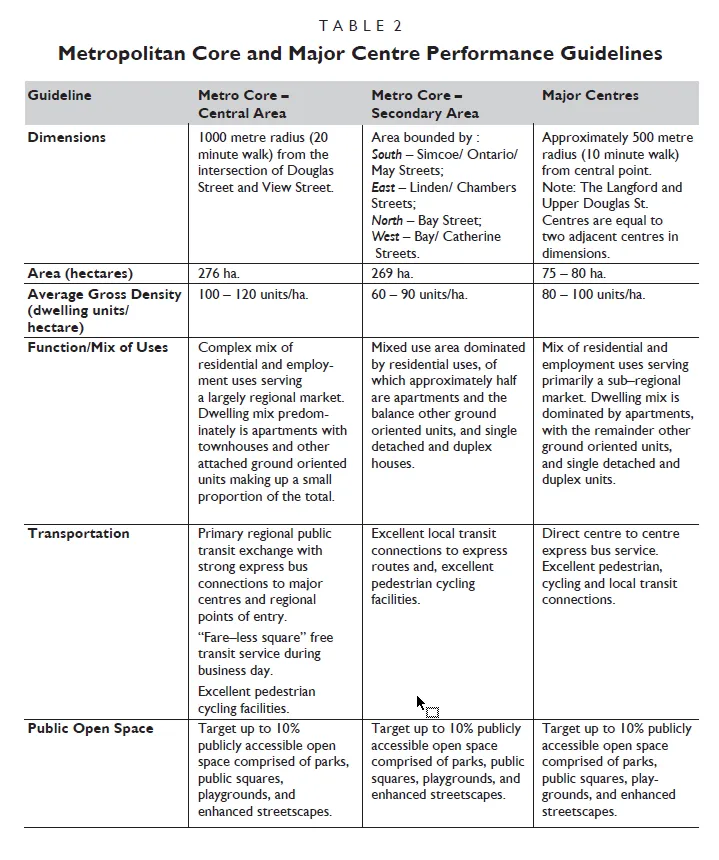
Principles: I. Establish a strong mixed–use Metropolitan Core focused around Victoria’s downtown core area; II. Focus new growth primarily in eight Major Centres, shown on Map 3, revitalized as walkable, transit–focused complete communities with a dense mix of businesses, housing, services and public open space; III. Increase the proportion of apartments, row houses and other attached housing types within the Regional Urban Containment and Servicing Policy Area, especially within Major Centres; and, IV. Locate a minimum of 95% of the region’s cumulative new dwelling units within the Regional Urban Containment and Servicing Policy Area.
The aim of the objective is to create a pattern of major centres within a firm urban containment boundary that will over time result in the concentration of most new growth in the centres and connecting corridors that can be effectively served by express-bus transit. This lays the foundation to achieve a longer term objective of connecting the downtown Victoria–Douglas Street–Uptown corridor with the Colwood and Langford Major Centres, by high–capacity public transit running in a dedicated right–of–way.
To support quality of life and community character in rural areas, the Regional Growth Strategy establishes policies to reduce development pressures that rural communities (and contained urban areas) in the Saanich Peninsula, West Shore, Sooke and the Juan de Fuca Electoral Area and to keep growth consistent with existing official community plans.
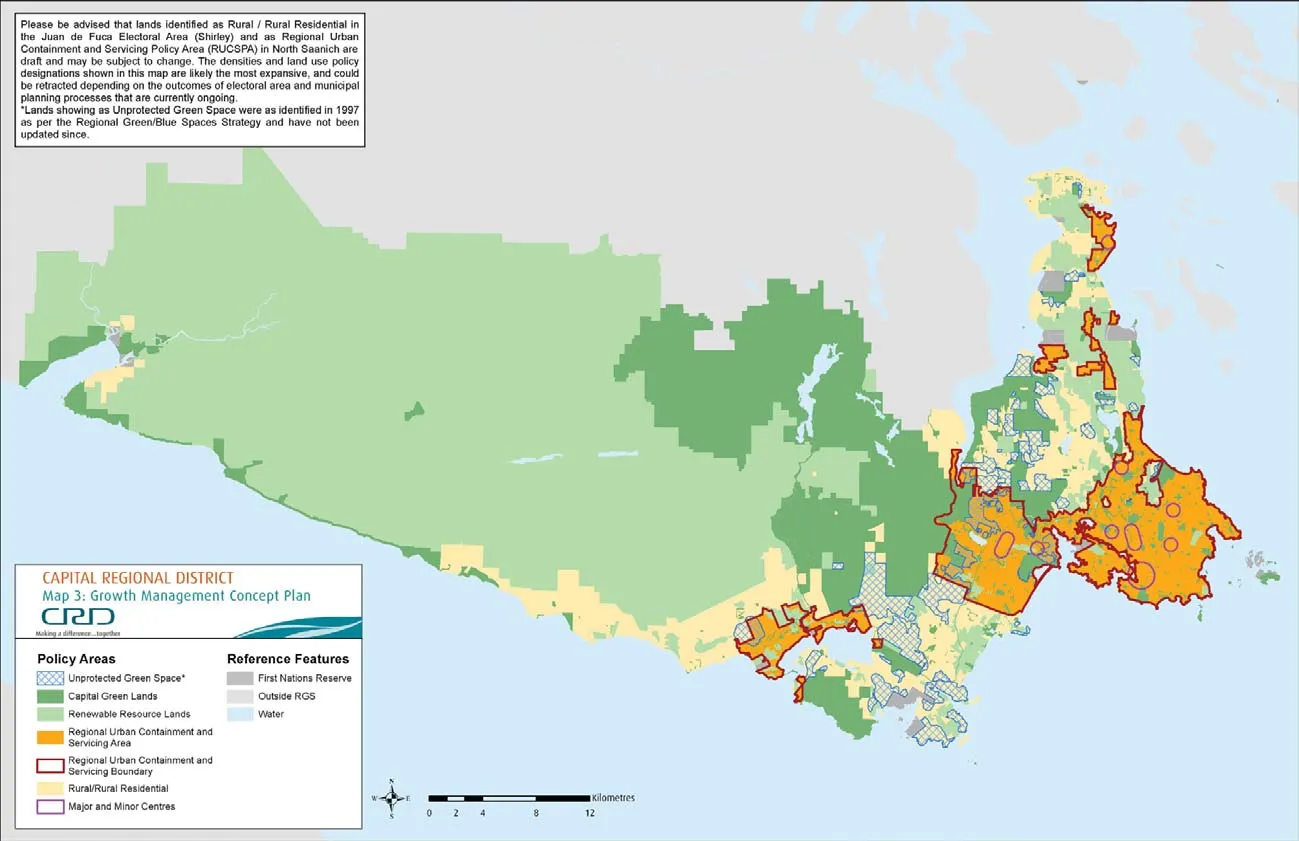
Map 3 illustrates this growth management concept with five land use policy designations and the general identification of locations for a Metropolitan Core and eight Major Centres.
The five land use policy designations on Maps 3 and 4 are:
Capital Green Lands Policy Area: Includes Ecological Reserves, Capital Regional District Water lands, and Major Parks identified in the Regional Green/Blue Spaces Strategy. The Regional Growth Strategy sets out in policy 2.1 the continued long–term use of these lands for these purposes.
Renewable Resource Lands Policy Area: Includes lands within the Agricultural Land Reserve (ALR), Privately Managed Forest Land and Crown Forest Lands identified in the Regional Green/Blue Spaces Strategy. The Regional Growth Strategy sets out in policy 2.1 the continued long–term use of these lands as renewable resource working landscapes.
Regional Urban Containment and Servicing Policy Area: Includes lands, at the date of the adoption of the Regional Growth Strategy bylaw, designated in official community plans primarily for urban development. The Regional Growth Strategy restricts extension of urban–standard sanitary sewerage and water services beyond the boundary of this policy area except as set out under policy 1.1(5). A complementary policy (policy 1.2[3]) restricts development potential for Capital Green Lands, Renewable Resource Lands and Rural/Rural Residential to subdivision and density limits identified in the applicable Official Community Plan at the date of adoption of the Regional Growth Strategy bylaw.
The policy area also includes the general locations for a Metropolitan Core and eight Major Centres. Boundaries for these centres are shown generally on the growth management concept map and may be defined more specifically by municipalities in municipal plans (e.g., Official Community Plans) and may be shown in Regional Context Statements.
Where Capital Green Lands and Renewable Resource Lands Policy Areas overlap with the Regional Urban Containment and Servicing Policy Area, the land use policy for the Capital Green Lands and Renewable Resource Lands Policy Areas shall take precedence. Liquid waste service may be provided to such lands within the Regional Urban Containment and Servicing Policy Area provided it is for a purpose consistent with the purpose and intent of the Capital Green Lands and Renewable Resource Lands Policy Areas.
Unprotected Green Space Policy Area: Includes lands, shown on Maps 3 and 4, identified in the Regional Green/Blue Spaces Strategy as unprotected core green space (i.e., areas with green space value which are not in existing parks or protected areas). The Regional Growth Strategy sets out in policy 2.1 the protection of that ecological value through a variety of means.
Rural/Rural Residential Policy Area: Includes lands at the date of adoption of the Regional Growth Strategy bylaw, designated in official community plans for rural and rural residential purposes and, for the Victoria International Airport, with development potential as established through approved Memorandum of Understanding. The Regional Growth Strategy sets out in policy 1.2(3) that these areas remain rural in character with development potential restricted to density and subdivision limits remaining within designated capacities in official community plans, as determined at the date of the adoption of the Regional Growth Strategy bylaw.
Policies:
- Provide for urban containment and servicing areas consistent with the Regional Urban Containment and Servicing Policy Area depicted on Map 3, and adopt associated policies regarding the protection, buffering and long term maintenance of its boundary.
- Permit amendment to the Regional Urban Containment and Servicing Policy Area designation generally, only as an outcome of a comprehensive 5–year review of the Regional Growth Strategy, recognizing that municipal councils and the Capital Regional District Board are free to initiate at any time amendments to official community plans and the regional growth strategy they deem necessary, through statutory processes established in the Local Government Act.
- Provide for Major Centres shown on Map 3, consistent with the guidelines set out in Table 2, recognizing that Major Center boundaries and performance guidelines are conceptual, and that municipalities will undertake detailed centre planning through their official community plan and zoning processes. Review, modify and implement policies to best facilitate growth and investment in Major Centres in partnership with the Capital Regional District, and permit the designation and development of additional Major Centres only as an outcome of a comprehensive 5–year review of the Regional Growth Strategy.
- Do not further extend urban sewer services, or increase sewer servicing capacity to encourage growth beyond subdivision and density limits designated in the official community plan at the date of the adoption of the Regional Growth Strategy bylaw, outside the Regional Urban Containment and Servicing Policy Area generally described on Map 3, except to address pressing public health and environmental issues, to provide fire suppression or to service agriculture. Where expansion or increased capacity of existing sewer services is proposed beyond the Regional Urban Containment and Servicing Policy Area boundary, the Regional Context Statement will provide specific guidelines to govern such service expansion and extension.
1.2 Protect the Integrity of Rural Communities
The Regional Growth Strategy seeks to protect the character and quality of rural communities, to ensure that they remain strongly rooted in the agricultural and resource land base, and that the rural countryside and natural landscape remain a durable fact of life in the Capital Region. It does this by designating for long term protection as Capital Green Lands and Renewable Resource Lands, those natural assets including major parks, ecological reserves, forests, farmland and watersheds identified in the Regional Green/Blue Spaces Strategy as the region’s green infrastructure.
Subdivision and development proposed for rural and rural–residential communities that are not defined as Capital Green Lands or Renewable Resource Lands, must be undertaken in a way that enhances rural character and quality of life.
Policies:
- Ensure the long–term protection of Capital Green Lands depicted on Maps 3 and 4. This would include policies aimed at buffering Capital Green Lands from activities in adjacent urban areas.
- Ensure the long–term protection of Renewable Resource Lands depicted on Maps 3 and 4. This would include policies aimed at buffering Renewable Resource Lands from activities in adjacent urban areas, and policies that support farming within the Agricultural Land Reserve, and forestry and silviculture within the Privately Managed Forest Land.
- Restrict development potential on lands identified as Capital Green Lands, Renewable Resource Lands, and Rural/Rural Residential on Map 3 to subdivision and density limits in the designated official community plan capacity levels as determined at the date of the adoption of the Regional Growth Strategy bylaw. Context Statements would reference specific mechanisms (for example, density bonusing provisions) that could be used to achieve this overall goal.
- Identify, where appropriate, policy guidelines for buffering and land use transition between urban areas and Capital Green Lands and Renewable Resource Lands, and how the guidelines would be applied through regulation.
2. Environment and Resources
2.1 Protect Regional Green and Blue Space
The Regional Growth Strategy aims to protect the landscape character, ecological heritage and biodiversity of the Capital Region. It does this by supporting the collaborative implementation of the Regional Green/Blue Spaces Strategy. Key elements include the protection of a sea to sea green/blue belt running from Saanich Inlet south to Juan de Fuca Strait, and the development of an integrated system of parks and trails linking urban areas to rural green space areas. Map 4 identifies the regional green/blue space system that the Regional Growth Strategy intends to achieve.
The Regional Growth Strategy sets a target to acquire a minimum of 100% of the sea to sea green/blue belt by 2011, and complete 100% of the Regional Trail network by 2016.
The objective is for the Capital Regional District and local municipalities to work together to protect from development, as much as possible, the lands identified as Unprotected Green Space Policy Area on Maps 3 and 4.
The Capital Region’s rich marine water and foreshore environments are an equally important part of the green/blue space system. The Regional Growth Strategy proposes that the CRD, member municipalities, and the Provincial and Federal governments work together to protect the ecological integrity of the marine areas.
Policies:
- Establish the regional green/blue space system identified on Map 4. Prioritize community and regional park land acquisition, public and private land stewardship programs and regional trail network construction that contributes to completion of the sea to sea green/blue belt.
- Protect lands within the area identified as Unprotected Green Space Policy Area on Map 4 using tools that may consist of policies, regulations, development permit area guidelines, incentives and initiatives delivered at the local level.
- Protect the ecological integrity of the marine areas identified as Blue Space Core Policy Area on Map 4 through collaborative initiatives (e.g., the preparation of a coastal zone management plan).
- Review and update in concert with the 5–year review cycle of the Regional Growth Strategy, the Regional Green/Blue Spaces Strategy and the Regional Parks Master Plan.
2.2 Manage Natural Resources and the Environment Sustainably
The Regional Growth Strategy intends that residents of the Capital Region enjoy a healthy environment where environmental quality is improved and the inheritance of renewable and non-renewable natural resources is carefully stewarded. Managing natural resources and the environment sustainably means following four general principles.
Principles: I. Waste discharges of all types should not exceed the assimilative capacity of the natural environment (including land, air and water); II. Depletion rates for natural resources should not exceed the regenerative capacity of the ecosystems that produce them; III. Consumption of scarce renewable and non–renewable resources should be minimized through conservation, efficiency and application of reduce, reuse and recycle practices; and, IV. Decision–making should give first priority to options that maintain ecosystem health and support the ongoing ability of natural systems to sustain life.
Managing regional district and municipal physical services consistent with these principles is a means of improving human health and environmental quality. By applying these principles, it will be possible to accommodate the anticipated population increase without significant changes to regional water, sewer and solid waste management services.
Policies:
- Manage, delivery, and extension of physical and environmental services, consistent with the principles of sustainability and overall intent of the Regional Growth Strategy.
- Manage surface water, drainage and groundwater in non–catchment watersheds throughout the region, using an integrated watershed planning approach consistent with the principles of sustainability included in the Regional Growth Strategy.
- Plan for the long term strategic resource needs in the Capital Region – including food (paying specific attention to local food production), energy, water, and aggregate materials. Plans will consider long term demand, security of supply, potential impacts of factors such as long term climate change, fossil fuel depletion and water reclamation where feasible, and make policy and program recommendations to ensure that future needs are successfully anticipated and met.
- The CRD agrees to review and update the Strategic Plan for Water Management, the Solid Waste Management Plan, and the Core and Peninsula Liquid Waste Management Plans in concert with the 5–year review cycle of the Regional Growth Strategy.
3. Housing and Community
3.1 Build Complete Communities
The Regional Growth Strategy supports the development of communities within the Regional Urban Containment and Servicing Policy Area that enable residents to undertake a wider range of daily activities closer to home. Complete communities are safe, socially diverse, openly accessible, and livable, thereby enhancing social sustainability and community health and well being.
Urban development projects contribute to community completeness when, to the greatest extent possible, all or some of the criteria listed below are satisfied:
Urban Development Criteria I. Projects are located within the Metropolitan Core or a Major Centre; II. Projects are located within a ten-minute walk (500 metres) of the Metropolitan Core or a Major Centre; III. Projects co-locate a mix of housing, employment, services, and recreation; IV. Housing is located within a ten minute walk of an existing commercial/employment centre, neighbourhood store, recreation facility, school, park, or community allotment garden; V. Projects either avoid locations with high seismic hazard – associated with ground-motion amplification, liquification, slope instability or are prone to flooding – or incorporate appropriate engineering and planning measures to mitigate risk; and, VI. Businesses, services, and housing is located within a seven minute walk (400 metres) of a public transit route.
Policies:
- Create complete communities that support the wellbeing of residents, using urban development criteria outlined in Objective 3.1 as a guide.
3.2 Improve Housing Affordability
Maintaining a broad range of housing types and forms that are affordable is necessary for individual quality of life, community health, and economic competitiveness. Urban containment and the establishment of a Metropolitan Core and Major Centres may have mixed results for housing affordability. Increased residential densities and an expanded stock of attached housing may enhance general affordability, while urban containment measures also have the effect of limiting the supply of new lands. The provision of affordable housing to accommodate the anticipated population increase is the responsibility of many stakeholders including the Capital Regional District, local and senior levels of government, industry and the not-for-profit sector.
The Capital Region Housing Corporation will continue to provide affordable housing to meet the needs associated with anticipated population growth. In addition to the provision of affordable housing, the Capital Regional District Regional Housing Affordability Strategy has been developed to support that all residents of the Capital Region – especially low and moderate-income households, the elderly, youth, those with special health and other needs, and the homeless – to have reasonable choice of housing by type, tenure, price and location.
Principles: I. Work across the housing spectrum when identifying the current and anticipated future issues concerning market and non- market housing affordability; II. Analyze the extent of present issues and forecast future problems; III. Focus on developing practical policies, and gaining commitments to action to address these needs and problems in the short, medium and long term across the Capital Region; IV. Involve the broader community in the development of the strategy and its recommended solutions; and, V. Act as a catalyst for activities to improve housing affordability in the Capital Region.
Policies:
- The CRD agrees to become a partner with a broad cross–section of business and community interests, member municipalities, the Province, and the Federal Government to establish, through a written agreement, a housing affordability partnership. The partnership would oversee the maintenance and updating of a Regional Housing Affordability Strategy and coordinate actions, programs, investments and initiatives in its implementation.
4. Transportation
4.1 Increase Transportation Choice
The Regional Growth Strategy supports the development of a balanced and sustainable transportation system providing residents with reasonable and affordable transportation choices that enhance overall regional quality of life.
To achieve this objective, the Regional Growth Strategy relies on two related initiatives. First, the coordination of land use and transportation so that the majority of regional residents do not have to rely solely on travel by automobile to meet their daily needs. Objectives 1.1 and 3.1 will tend to increase average urban densities and put people and their activities closer together.
Second, the Regional Transportation Plan and the Pedestrian and Cycling Master Plan guides the planning, development and implementation of a Regional Multi-Modal Network that provides travel choices and supports smart growth and livable, complete communities. Seven principles guide the Regional Transportation Plan.
Principles: I. Take a coordinated and engaged approach to planning; II. Prioritize strategic investments that serve regional mobility needs; III. Reduce greenhouse gas emissions and prepare for changes; IV. Integrate transportation and land use planning; V. Capitalize on the potential for alternatives to driving alone; VI. Enhance the role for public transit; and VII. Maximize efficiency of existing transportation corridors for multiple modes.
General performance targets include:
- By 2026, achieve a minimum PM peak period mode share by non–auto modes of 40% for trips to, from and within the Metropolitan Core;
- By 2026, achieve a minimum region–wide transit mode share of 15% for journey–to–work trips;
- By 2026, achieve a minimum cycling mode–share of 10% within the Victoria Census Metropolitan Area for journey–to–work trips, and 15% for journey–to–work trips for residents of the combined areas of Victoria, Oak Bay, Esquimalt and urban Saanich.
Policies:
- Implement the Regional Multi-Modal Network in accordance with the principles outlined in Objective 4.1.
- Locate growth and major trip-generating uses where it can be efficiently serviced by transit and active transportation.
- Prioritize transit and active modes in community planning and in the design and implementation of infrastructure, facilities and programs.
5. Economic Development
5.1 Strengthen the Regional Economy
The Regional Growth Strategy intends that residents of the Capital Region enjoy economic prosperity as a foundation of high regional quality of life. Economic sustainability means the production and distribution of wealth to meet the needs of present and future generations for goods and services in ways that ensure the long–term promotion of a satisfying and high quality of life for all residents.
The Capital Region already has a highly diversified economy. Current strengths include the internationally significant tourism industry, agri-tourism, colleges and universities, provincial capital services, major national defense headquarters, high technology, health services, small business, environmental consulting, retirement services, and the film industry. Issues that need to be addressed include:
- Finding ways to enhance job creation in the urban West Shore to achieve a minimum jobs/population ratio of: i. 0.60 in the Core Area ii. 0.53 in the Saanich Peninsula iii. 0.36 in the West Shore by 2026;
- Finding ways to expand and diversify the economy of formerly resource–dependent communities in Sooke and the Juan de Fuca Electoral Area;
- Finding ways to ensure the long term, affordable supply of strategic economic resources such as water, aggregate and energy;
- Finding ways to increase economic activity in forestry and agriculture;
- Finding ways to address the shortage of designated space–extensive industrial/business land;
- Finding ways to include high–value, clean industry and business in the Metropolitan Core and Major Centres;
- Finding ways to attract, develop and maintain a highly skilled workforce; and,
- Finding ways to reduce poverty in the Capital Region.
Policies:
- Build on the region’s economic, environmental and quality of life advantages to position the region as a highly desirable location for investing in existing and new businesses.
- Provide for land development patterns that maintain an adequate supply of employment land, transportation infrastructure and services to support a diverse regional economy.
6. Reduce Greenhouse Gas Emissions
6.1 Significantly Reduce Community-Based Greenhouse Gas Emissions
The Regional Growth Strategy supports the reduction of community-based greenhouse gas emissions to address the effects of a changing climate. In the Capital Region, greenhouse gas emissions come from the transportation system, the heating, cooling and energizing of buildings, waste, energy production, the production of goods and agriculture. Achieving the community greenhouse gas reduction targets means following four related principles.
Principles: I. Create a low-carbon built form to reduce energy demand; II. Increase energy efficiency and recovery from retrofits and new development; III. Promote energy efficiency and the use of renewable, clean energy to reduce reliance on fossil fuels; and IV. Protect the carbon sequestration value of natural systems, including forested lands and wetlands.
Policies:
- Prioritize investment in compact, complete communities to provide for a low-carbon built form that supports efficient energy use, the provision of clean and renewable district energy, active transportation modes, transit service, and low/zero emissions vehicles.
- Design, manage, fund and operate programs, services and infrastructure to reduce greenhouse gas emissions in keeping with the principles outlined in Objective 6.1.
- Strategically acquire protected areas that contribute to climate change mitigation.
Implementation Measures
To implement the Regional Growth Strategy, the Capital Regional District Board, working in partnership with local municipalities, the Province, the Federal Government and others, will undertake the following implementation measures:
I-1a. Maintain a collaborative, agreement-seeking regional strategic planning program directed to work towards achievement of the long term objectives of the Regional Growth Strategy. I-1b. At least once every five years, consider whether the Regional Growth Strategy should be reviewed for possible revision and amendment. I-2. Establish, within one year of the adoption of the Regional Growth Strategy, a process and program to monitor, evaluate and annually report on regional economic, population, social and environmental trends and progress towards achievement of Regional Growth Strategy vision and objectives. I-3(a) Prepare a Climate Action Strategy to support the implementation of community-based greenhouse gas reduction initiatives. I-3(b) Support local governments and electoral areas through regional capacity building, education and projects that reduce greenhouse gas emissions. I-4. Work to reach agreement with local municipalities on Regional Context Statements, within two years of the adoption of the Regional Growth Strategy, adopted within the applicable Official Community Plan, that set out how each municipality will address Regional Growth Strategy policies. I-5. Establish a mechanism to ensure that the vision, goals and objectives of the Regional Growth Strategy permit the Capital Regional District to demonstrate that all its plans, bylaws, services, and spending are consistent with the adopted Regional Growth Strategy as required by legislation. I-6. Coordinate the review and update of regional planning documents to inform future updates to the Regional Growth Strategy. I-7. Implement the Regional Growth Strategy without prejudice to any aboriginal rights or title that may currently exist, or be defined further through treaty or other processes. Work to develop partnerships with the ten First Nations Councils in the Capital Region. The Board recognizes that First Nations Councils are neighbouring governments in the Capital Region, with a shared interest in managing long term development to enhance regional quality of life. I-8. Coordinate with the Cowichan Valley Regional District and the Islands Trust to ensure that long term planning and development policies and initiatives in those jurisdictions are compatible with the vision and objectives of the Capital Region’s Regional Growth Strategy. I-9. The Capital Regional District will work with the Province, agencies such as the Vancouver Island Health Authority and BC Transit, and the federal government to coordinate implementation of the Regional Growth Strategy while respecting the authority of each jurisdiction.
Targets
| Priority Area | Objective | Targets |
|---|---|---|
| 1) Managing and Balancing Growth | 1.1 Keep Urban Settlement Compact | • Locate 30% of new growth (dwelling units) in walkable, bikeable, transit serviced communities that provide a variety of housing types and tenures close to places of work, shopping, learning, recreation, parks and green space. • Accommodate a minimum of 95% of the region’s cumulative new dwelling units within the Regional Urban Containment and Servicing Policy Area. |
| 1.2 Protect the Integrity of Rural Communities | • By 2038, do not exceed the subdivision and density limits in designated Official Community Plans in rural and rural residential areas. | |
| 2) Environment and Resources | 2.1 Protect Regional Green and Blue Space | • Acquire 100% of the sea-to-sea green/blue belt. • Complete a minimum of 100% of the Regional Trail Network. |
| 2.2 Manage Natural Resources and the Environment Sustainably | • Identify long-term capital plans for Capital Regional District utilities and major infrastructure improvements necessary to address the impacts of climate change and natural hazards. | |
| 3) Housing and Community | 3.1 Build Complete Communities | • Municipal targets to be established through desired development guidelines for individual Official Community Plans through Regional Context Statements, within two years of the adoption of the RGS. |
| 3.2 Improve Housing Affordability | • Increase the supply of more affordable housing. • Reduce the number of people in core housing need. • Reduce the number of people who are homeless. |
|
| 4) Transportation | 4.1 Increase Transportation Choice | • Achieve a transportation system that sees 42% of all trips made by walking, cycling, transit. |
| 5) Economic Development | 5.1 Strengthen the Regional Economy | • Achieve a jobs/population ratio of: - 0.60 in Core Area - 0.53 in Saanich Peninsula - 0.36 in West Shore |
| 6) Reduce Greenhouse Gas Emissions | 6.1 Significantly reduce community-based greenhouse gas emissions | • Reduce community greenhouse gas emissions by 33% (from 2007 levels) by 2020, and by 61% by 2038. |
APPENDIX A - The Framework for Our Future Regional Vision
On July 15, 1998 the CRD Board resolved to adopt the Framework For Our Future Agreement to guide the development of a regional growth strategy for the Capital Region. It describes a region:
Where modest growth and economic diversification occur while we continue to maintain and enhance our natural environment, our agricultural landscapes, our arts and culture and our established neighbourhoods and communities.
The core municipalities experience infill and modest population increases, with the bulk of new residential growth occurring in the Western Community municipalities of Colwood and Langford. The Saanich Peninsula retains its rural and small town character as do Sooke, Metchosin and the Highlands.
While the Metropolitan Core remains the dominant cultural and business hub of the region, economic expansion occurs in employment centres in Colwood and Langford. Transit, commuter cycling, and walking are common alternatives to travel by private automobile.
A regional green/blue spaces system protects and maintains the full range and diversity of the natural environment. Stable and durable physical limits contain ongoing change to urban communities and rural settlements.
More specifically, for The Western Communities:
- Colwood will become a more urban community while retaining its exceptional heritage resources and natural areas.
- The District of Langford has a cohesive town centre with pedestrian areas, commercial districts, and convenient vehicle access.
- View Royal will have a series of economic centres providing expanded retail, professional financial and convenience services.
- The Highlands will continue to preserve large areas of natural green space.
- Metchosin is a community of rural character with a choice of rural lifestyle options.
- Sooke will encourage more population and commercial development within its Urban Containment Boundary.
The Core:
- Esquimalt exhibits a more sustainable model of urban development where the quality of the natural and built environment is healthier than at present.
- Saanich remains a series of community focused neighbourhoods, within an urban containment boundary.
- Victoria, compact communities, with a diverse mix of population and housing, exist within walking distance of facilities and services. Downtown Victoria is the cultural and commercial heart of the region.
- Oak Bay continues to be a green, landscaped, quiet residential community.
The Peninsula:
- The District of North Saanich is a collection of coastal focused neighbourhoods which surround agricultural lands.
- Sidney remains the commercial centre for the north Peninsula.
- Central Saanich provides agricultural land, light industrial land, and residential areas with rural and suburban character.
APPENDIX B - The Framework For Our Future Guiding Principles
- The Capital Region’s Growth Management Strategy is based on the following four fundamental principles:
- Sustainability: actions to meet our needs today do not compromise the ability of future generations to meet their needs.
- Appropriateness: actions are appropriate to the aspirations and local conditions of the Capital Region.
- Continuity: the strategy will build on work that has already been undertaken.
- Cooperation, Collaboration and Coordination: the Capital Regional District, local municipalities, provincial ministries and agencies, and regional residents will work together.
APPENDIX C - The Regional Green/Blue Spaces Vision
The Green/Blue Spaces Strategy sets out a comprehensive, long–term strategy for maintaining, conserving, rehabilitating and restoring green/blue spaces on public and private lands in the region.
The objectives of the Regional Green/Blue Spaces Strategy are to:
- Conserve rare, threatened or endangered ecosystems and species;
- Maintain biological diversity by protecting and enhancing a variety of habitats;
- Conserve ecologically valuable areas in large, diverse, contiguous units and connect them with greenways;
- Maintain the character and diversity of green/blue spaces;
- Enhance and restore areas that could have green/blue space values;
- Develop a comprehensive set of priorities for the conservation of green/blue spaces;
- Educate people about the value of protecting green/blue spaces; and,
- Foster partnerships for the conservation and stewardship of green/blue spaces.
APPENDIX D - Glossary
Attached housing Any form of housing where more than two individual dwellings are structurally attached including townhouses, apartments regardless of tenure, stacked townhouses and the like.
Benchmark A statement or value of a level of performance widely considered to be acceptable or ‘best in class’, used for comparison purposes with actual performance results.
Climate Change A change of climate which is attributed directly or indirectly to human activity.
Complete Community Multiple–use urban community that contains within its boundaries the full range of facilities and activities necessary to meet typical household needs for employment, shopping, personal services, recreation, housing, education and other goods and services.
Core Municipalities The Capital Region sub–region that includes the municipalities of Victoria, Esquimalt, Oak Bay, Saanich and View Royal.
Core green/blue space Core green space areas contain the major examples of the Capital Region’s historic land–based ecosystems. Core blue space areas are marine environments with high ecological, recreational, and/or scenic value.
Density A measure of the intensity of occupancy and use of the land, generally described in terms of persons per hectare, or dwelling units per hectare.
Greenhouse Gas (GHG) Gases in the earth’s atmosphere that absorb and re-emit infrared radiation. GHG emitted through human activities include carbon dioxide (CO2), nitrous oxide (N2O), methane (CH4), hydrofluorocarbons (HFCs), perfluorocarbons (PFCs), and sulphur hexafluoride (SF6).
Greenways Corridors that link areas of greenspace to provide wildlife habitat and recreational opportunities.
Ground oriented housing Includes all dwelling units that have individual and direct access to the ground. Includes single–family (detached) dwellings, semi–detached (duplex) dwellings, and other ground–oriented housing town-houses, linked dwellings, and the like.
Growth management Implementation of government regulations that control the type, location, quality, scale, rate, sequence or timing of development.
High capacity transit A transit service operating in an exclusive corridor carrying from 15,000 to 20,000 riders per hour in the peak hour, peak direction.
Housing affordability Generally describes a condition in which housing costs consume no more than 30% of gross household income (unless by choice).
Infrastructure The physical capital and associated services considered basic and necessary to the functioning of an urban area.
Metropolitan Victoria That portion of the Capital Region from, Otter Point in the west to Swartz Bay in the north, defined by Statistics Canada as the Victoria Census Metropolitan Area.
Mixed–use Land use regulations that permit a variety of different uses and activities either on one legal parcel or within one defined land use zone.
Non–Ground Oriented Housing Dwellings that access the ground via shared corridors (typically apartments regardless of tenure) and not through individual direct access to the ground.
Official Community Plan (OCP) Under Section 471 of the Local Government Act, a general statement of the broad objectives and policies of the local government respecting the form and character of existing and proposed land use.
Peninsula The sub–region of the Capital Regional District including the municipalities of Central Saanich, Sidney, and North Saanich.
Regional Context Statement Under Section 446 of the Local Government Act, a statement, accepted by the regional district board, included in a municipal official community plan, that explains the relationship between the official community plan and the Regional Growth Strategy.
Regional Growth Strategy (RGS) Under Part 13 of the Local Government Act, a regional agreement (including a vision, goals, policies and actions) that commits affected municipalities and regional districts to a course of action.
Regional Multi-Modal Network The interconnected transportation corridors defined in the Regional Transportation Plan.
Sea to Sea Green/Blue Belt A band of watersheds running between Saanich Inlet and Sooke Basin that is currently or proposed for protection by the Regional Green/Blue Spaces Strategy.
Walkable In urban design, a community is walkable when it is scaled, dimensioned and provided with facilities and a mix of uses and activities that make walking an easy, convenient way to get around.
West Shore The sub–region of the Capital Regional District that includes the municipalities of View Royal, Colwood, Langford, Metchosin, Highlands, Sooke, and the Juan de Fuca Electoral Area.