PROJECT MEMORANDUM – Review of Reserve Funds and Surplus
Detailed consultant's project memorandum analyzing existing reserves and providing 5-year financial plan transfers and expenditures.
PROJECT MEMORANDUM
To: Michael Dillabaugh, Director of Finance From: Brenda Warner, Principle Brenda Warner & Associates Date: April 27, 2016 Re: Review of Reserve Funds and Surplus
Introduction
The Town of View Royal contracted with Brenda Warner & Associates to conduct a review of the Town's Reserves and Surplus, develop a Surplus and Reserve Fund Policy and recommended minimum and optimal balances. Development Cost Charges (DCCs) were excluded from the review.
As part of this project we reviewed the following (not exclusive):
Town Policies and Strategic Priorities related to Capital Funding and Reserves
2015 Revenue Policy Disclosure:
Objectives:
Policies
- In 2010, the Town of View Royal started to transition the funding of membership in the Greater Victoria Public Library (GVPL) from the Casino Grant to Property Value Taxes with the goal of a yearly transition equal to 1.5% increase in the Property Value Tax each year until Property Value Tax funds 100% of the GVPL.
- The Town of View Royal will examine municipal services to determine the suitability of user fees as the primary source of funding. Property Value Taxes will pay for the cost of annual operations that would be difficult or undesirable to fund on a user-pay basis.
- The Town of View Royal will examine the life cycle costs of all new infrastructure and new services before initiating. Operating, maintenance, and replacement costs for all existing infrastructure will be included in its Five Year Financial Plan
Strategic Priorities 2015-2018
Financial Sustainability and service Excellence
Actions/Behaviors:
Specific Projects/Initiatives:
- Compete a comprehensive asset plan through three linked steps:
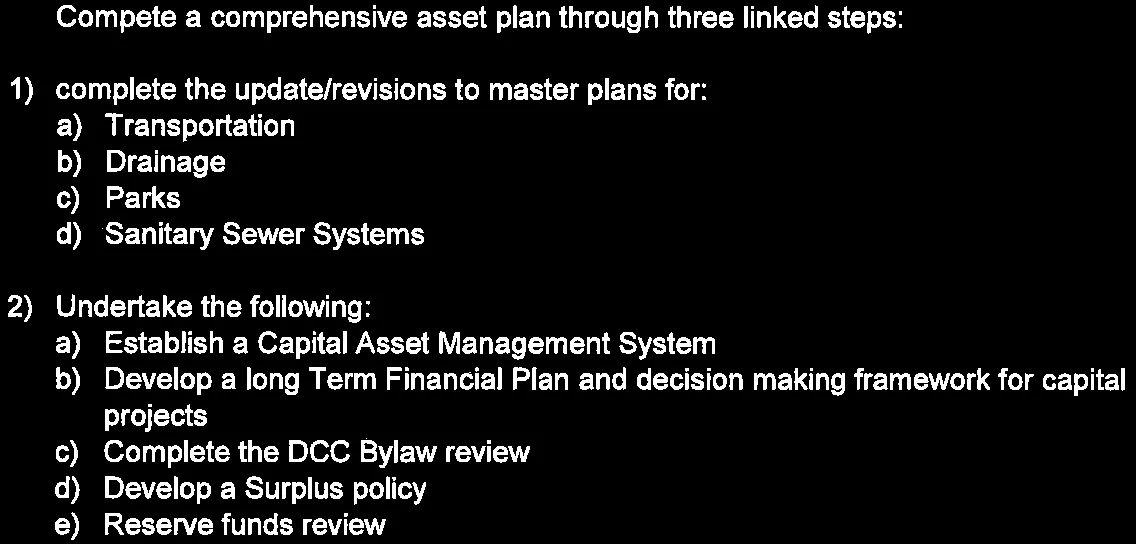
Undertake the following: a) Establish a Capital Asset Management System b) Develop a long Term Financial Plan and decision making framework for capital projects c) Complete the DCC Bylaw review d) Develop a Surplus policy e) Reserve funds review
Financial Sustainability Review to project future finance requirements and determine optimum reserve levels and annual contributions.
Overview
The Town has been setting aside money in Reserves since incorporation. The strategic focus on development of a comprehensive asset plan will provide the Town with the information to more accurately understand the true costs of providing services by ensuring that the full costs to adequately maintain, periodically upgrade and eventually replace existing assets is included in the Town’s annual budget, and funded appropriately.
What is a Reserve Fund?
A reserve fund is intended primarily to hold money for a planned or potential future expenditure.
The two primary purposes of reserves are to serve as a capital funding mechanism and to mitigate risk.
Pursuant to subsection 188 (1) of the Community Charter, Council MAY, by bylaw, establish a reserve fund for a specified purpose and direct that money be placed to the credit of the reserve fund.
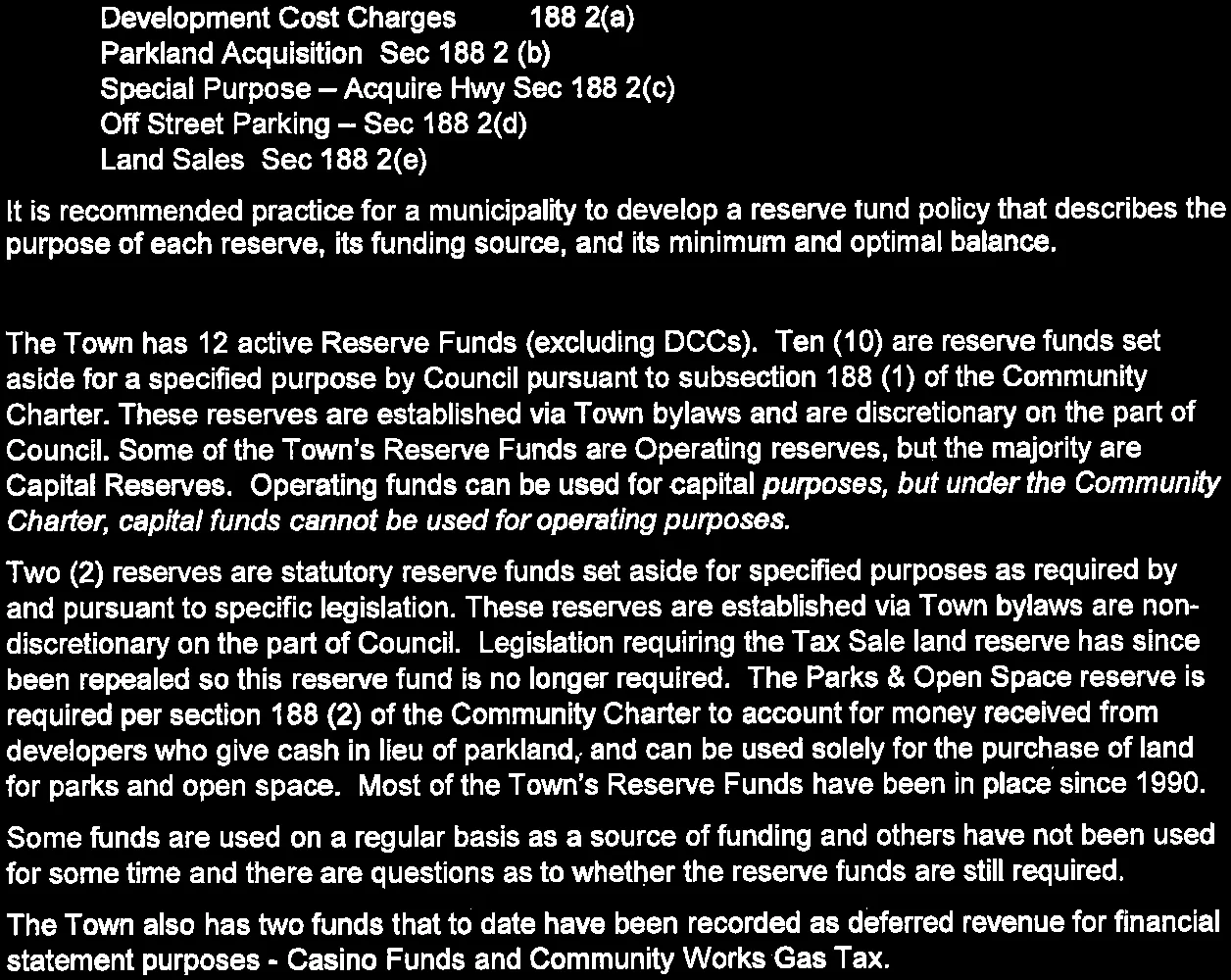
Per section 188 (2) of the Community Charter if a municipality receives monies from certain sources it MUST establish a reserve fund for example:
It is recommended practice for a municipality to develop a reserve fund policy that describes the purpose of each reserve, its funding source, and its minimum and optimal balance.
What Reserve Funds Does the Town Have?
The Town has 12 active Reserve Funds (excluding DCCs). Ten (10) are reserve funds set aside for a specified purpose by Council pursuant to subsection 188 (1) of the Community Charter. These reserves are established via Town bylaws and are discretionary on the part of Council. Some of the Town’s Reserve Funds are Operating reserves, but the majority are Capital Reserves. Operating funds can be used for capital purposes, but under the Community Charter, capital funds cannot be used for operating purposes.
Two (2) reserves are statutory reserve funds set aside for specified purposes as required by and pursuant to specific legislation. These reserves are established via Town bylaws are non-discretionary on the part of Council. Legislation requiring the Tax Sale land reserve has since been repealed so this reserve fund is no longer required. The Parks & Open Space reserve is required per section 188 (2) of the Community Charter to account for money received from developers who give cash in lieu of parkland, and can be used solely for the purchase of land for parks and open space. Most of the Town’s Reserve Funds have been in place since 1990.
Some funds are used on a regular basis as a source of funding and others have not been used for some time and there are questions as to whether the reserve funds are still required.
The Town also has two funds that to date have been recorded as deferred revenue for financial statement purposes - Casino Funds and Community Works Gas Tax.
EVALUATION OF EXISTING RESERVES
Cost of Maintaining Separate Reserves
Can Any Existing Funds Be Eliminated?
For optional Reserves, in order to reduce complexity and administrative burden, and to improve clarity, it is recommended that funds with similar purposes be combined, and those with redundant or outdated purposes be eliminated.
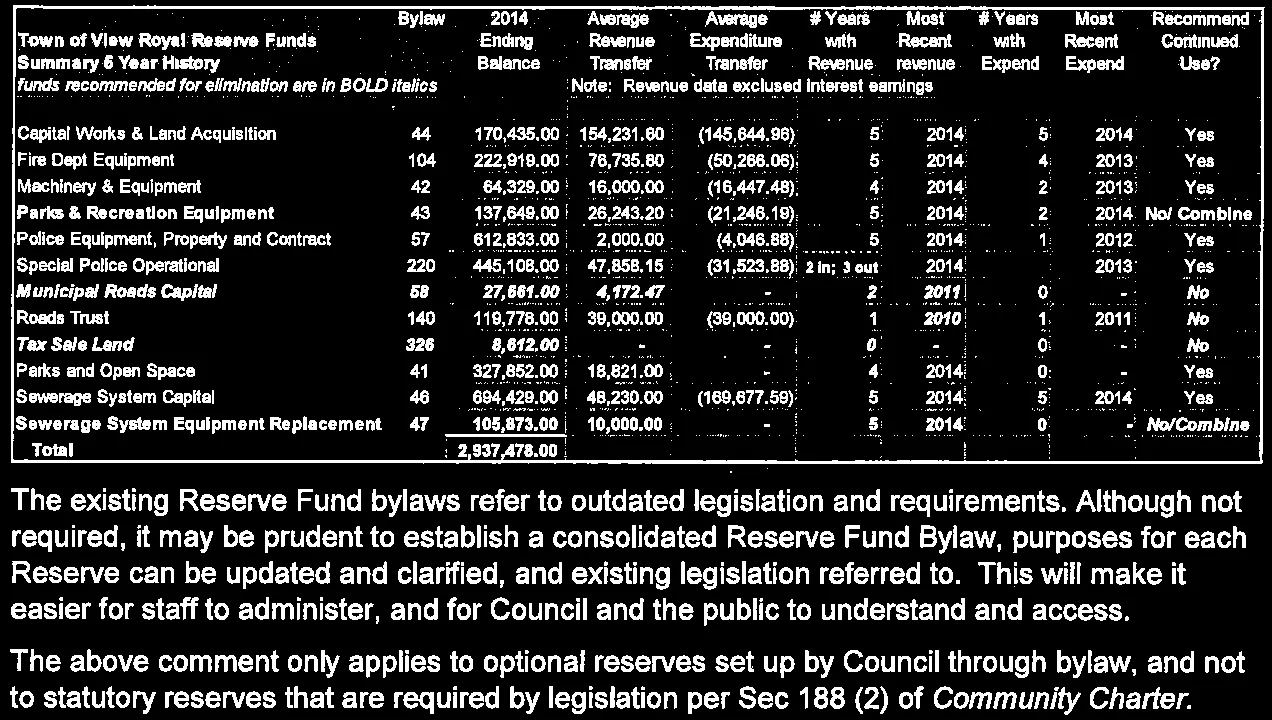
| Town of View Royal Reserve Funds Summary 6 Year History | Bylaw | 2014 Ending Balance | Average Revenue Transfer | Average Expenditure Transfer | # Years with Revenue | Most Recent revenue | # Years with Expend | Most Recent Expend | Recommend Continued Use? |
|---|---|---|---|---|---|---|---|---|---|
| funds recommended for elimination are in BOLD italics | Note: Revenue data excluded interest earnings | ||||||||
| Capital Works & Land Acquisition | 44 | 170,435.00 | 154,231.60 | (145,644.98) | 5 | 2014 | 5 | 2014 | Yes |
| Fire Dept Equipment | 104 | 222,919.00 | 76,735.80 | (50,266.05) | 5 | 2014 | 4 | 2013 | Yes |
| Machinery & Equipment | 42 | 64,329.00 | 16,000.00 | (16,447.48) | 4 | 2014 | 2 | 2013 | Yes |
| Parks & Recreation Equipment | 43 | 137,649.00 | 26,243.20 | (21,246.19) | 5 | 2014 | 2 | 2014 | No/ Combine |
| Police Equipment, Property and Contract | 57 | 612,833.00 | 2,000.00 | (4,046.88) | 5 | 2014 | 1 | 2012 | Yes |
| Special Police Operational | 220 | 445,108.00 | 47,858.15 | (31,523.88) | 2 in; 3 out | 2014 | - | 2013 | Yes |
| Municipal Roads Capital | 58 | 27,661.00 | 4,172.47 | - | 2 | 2011 | 0 | - | No |
| Roads Trust | 140 | 119,778.00 | 39,000.00 | (39,000.00) | 1 | 2010 | 1 | 2011 | No |
| Tax Sale Land | 326 | 8,612.00 | - | - | 0 | - | 0 | - | No |
| Parks and Open Space | 41 | 327,852.00 | 18,821.00 | - | 4 | 2014 | 0 | - | Yes |
| Sewerage System Capital | 46 | 694,429.00 | 48,230.00 | (169,677.59) | 5 | 2014 | 5 | 2014 | Yes |
| Sewerage System Equipment Replacement | 47 | 105,873.00 | 10,000.00 | - | 5 | 2014 | 0 | - | No/Combine |
| Total | 2,937,478.00 |
The existing Reserve Fund bylaws refer to outdated legislation and requirements. Although not required, it may be prudent to establish a consolidated Reserve Fund Bylaw, purposes for each Reserve can be updated and clarified, and existing legislation referred to. This will make it easier for staff to administer, and for Council and the public to understand and access.
The above comment only applies to optional reserves set up by Council through bylaw, and not to statutory reserves that are required by legislation per Sec 188 (2) of Community Charter.
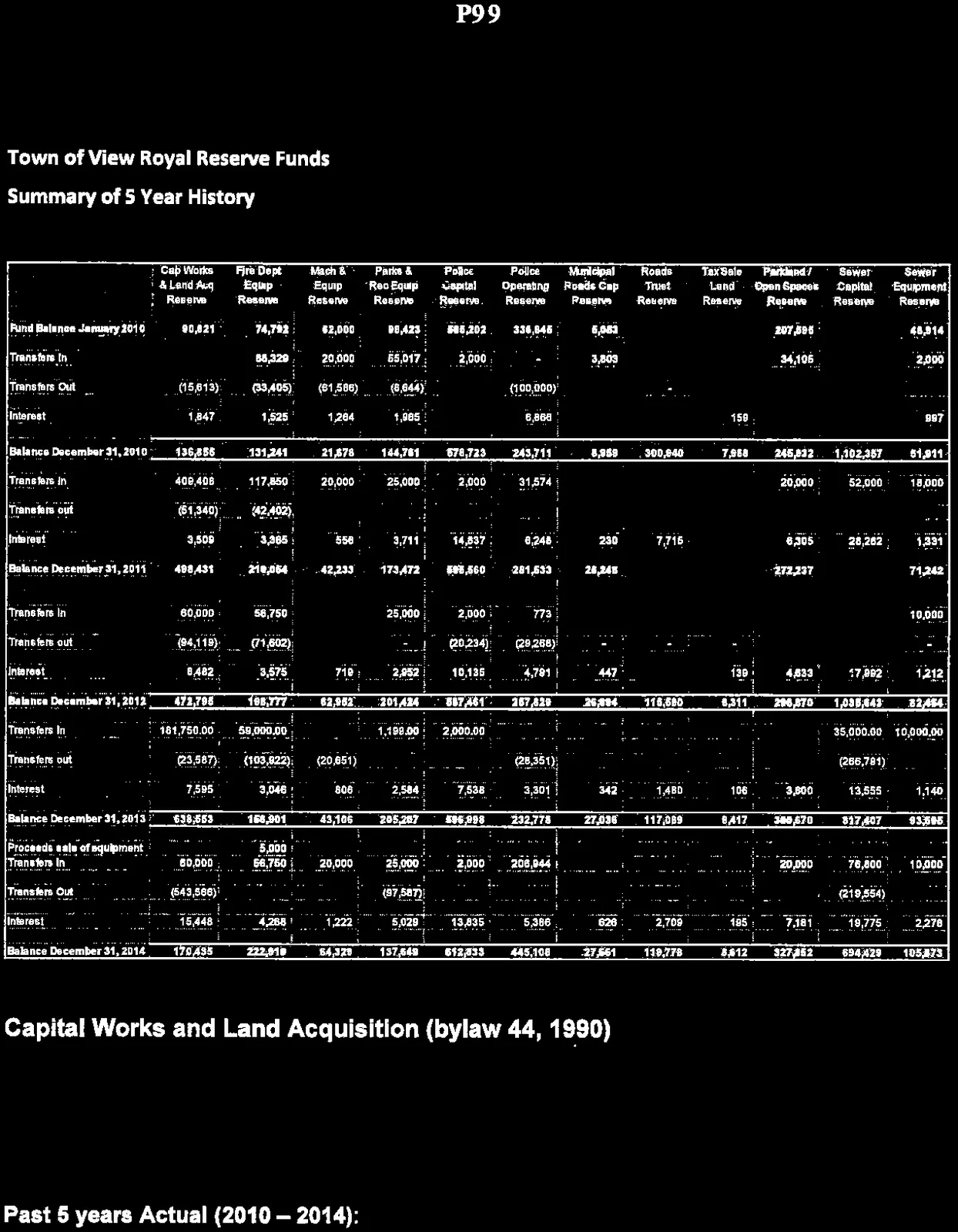
| Town of View Royal Reserve Funds Summary of 5 Year History | Cap Works & Land Acq Reserve | Fire Dept Equip Reserve | Mach & Equip Reserve | Parks & Rec Equip Reserve | Police Capital Reserve | Police Operating Reserve | Municipal Roads Cap Reserve | Roads Trust Reserve | Tax Sale Land Reserve | Parkland / Open Spaces Reserve | Sewer Capital Reserve | Sewer Equipment Reserve |
|---|---|---|---|---|---|---|---|---|---|---|---|---|
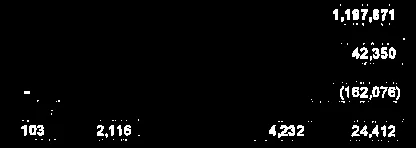
| Fund Balance January 2010 | 80,821 | 74,792 | 52,000 | 95,423 | 566,202 | 335,845 | 5,063 | 103,924 | 7,809 | 207,595 | 1,187,971 | 48,914 |
| Transfers In | 88,329 | 20,000 | 55,017 | 2,000 | 3,803 | 195,000 | 34,105 | 42,350 | 2,000 | |||
| Transfers Out | (15,813) | (33,405) | (61,586) | (8,644) | (100,000) | (162,076) | ||||||
| Interest | 1,847 | 1,525 | 1,264 | 1,985 | 11,521 | 6,866 | 103 | 2,116 | 159 | 4,232 | 24,412 | 997 |
| Balance December 31, 2010 | 136,855 | 131,241 | 21,678 | 144,781 | 579,723 | 243,711 | 8,969 | 300,940 | 7,968 | 245,932 | 1,102,357 | 51,911 |
| Transfers In | 409,408 | 117,850 | 20,000 | 25,000 | 2,000 | 31,574 | 20,000 | 52,000 | 18,000 | |||
| Transfers out | (51,340) | (42,402) | (195,000) | (125,360) | ||||||||
| Interest | 3,509 | 3,385 | 556 | 3,711 | 14,837 | 6,248 | 230 | 7,715 | 204 | 6,305 | 28,262 | 1,331 |
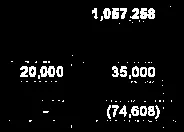
| Balance December 31, 2011 | 498,431 | 210,064 | 42,233 | 173,492 | 596,560 | 281,533 | 29,248 | 113,655 | 8,172 | 272,237 | 1,067,258 | 71,242 |
| Transfers In | 60,000 | 56,750 | 25,000 | 2,000 | 773 | 20,000 | 35,000 | 10,000 | ||||
| Transfers out | (94,119) | (71,502) | (20,234) | (29,265) | (74,608) | |||||||
| Interest | 8,482 | 3,575 | 719 | 2,952 | 10,135 | 4,791 | 447 | 1,934 | 139 | 4,833 | 17,992 | 1,212 |
| Balance December 31, 2012 | 472,795 | 198,777 | 62,952 | 201,434 | 587,461 | 257,829 | 26,694 | 115,590 | 8,311 | 296,070 | 1,035,643 | 82,454 |
| Transfers In | 181,750.00 | 59,000.00 | 1,199.00 | 2,000.00 | 35,000.00 | 10,000.00 | ||||||
| Transfers out | (23,587) | (103,922) | (20,651) | (28,351) | (266,781) | |||||||
| Interest | 7,595 | 3,046 | 806 | 2,584 | 7,536 | 3,301 | 342 | 1,480 | 106 | 3,600 | 13,555 | 1,140 |
| Balance December 31, 2013 | 638,553 | 158,901 | 43,106 | 205,207 | 596,998 | 232,778 | 27,036 | 117,069 | 8,417 | 300,670 | 817,407 | 93,595 |
| Proceeds sale of equipment | 5,000 | |||||||||||
| Transfers In | 60,000 | 56,750 | 20,000 | 25,000 | 2,000 | 206,944 | 20,000 | 76,800 | 10,000 | |||
| Transfers Out | (543,566) | (97,587) | (219,554) | |||||||||
| Interest | 15,448 | 4,268 | 1,222 | 5,029 | 13,835 | 5,386 | 526 | 2,709 | 195 | 7,181 | 19,775 | 2,278 |
| Balance December 31, 2014 | 170,435 | 222,919 | 64,329 | 137,649 | 612,833 | 445,108 | 27,561 | 119,778 | 8,612 | 327,852 | 694,429 | 105,873 |
The following comments describe each of the Town’s existing funds.
Capital Works and Land Acquisition (bylaw 44, 1990)
The purpose of this reserve fund is for the purchase of capital works and land.
Reserve Fund Balance December 31, 2014 - $170,435
This has been used as the primary capital reserve fund for replacement and upgrade of the Town’s infrastructure.
Past 5 years Actual (2010 – 2014): The reserve fund has been used every year for the past 5 years, and the Town has been contributing a minimum of $60,000 per year into the reserve, and some years considerably more.
5 Year Financial Plan (2015-2019): Transfers of $60,000 per year from General Operating fund Capital Expenditures - $129,500 in 2015; $60,000 per year 2016-2019
Comments:
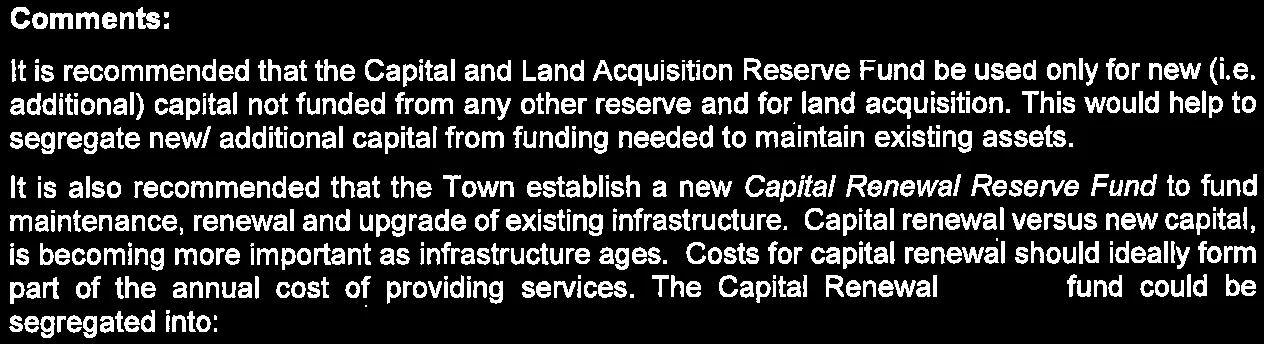
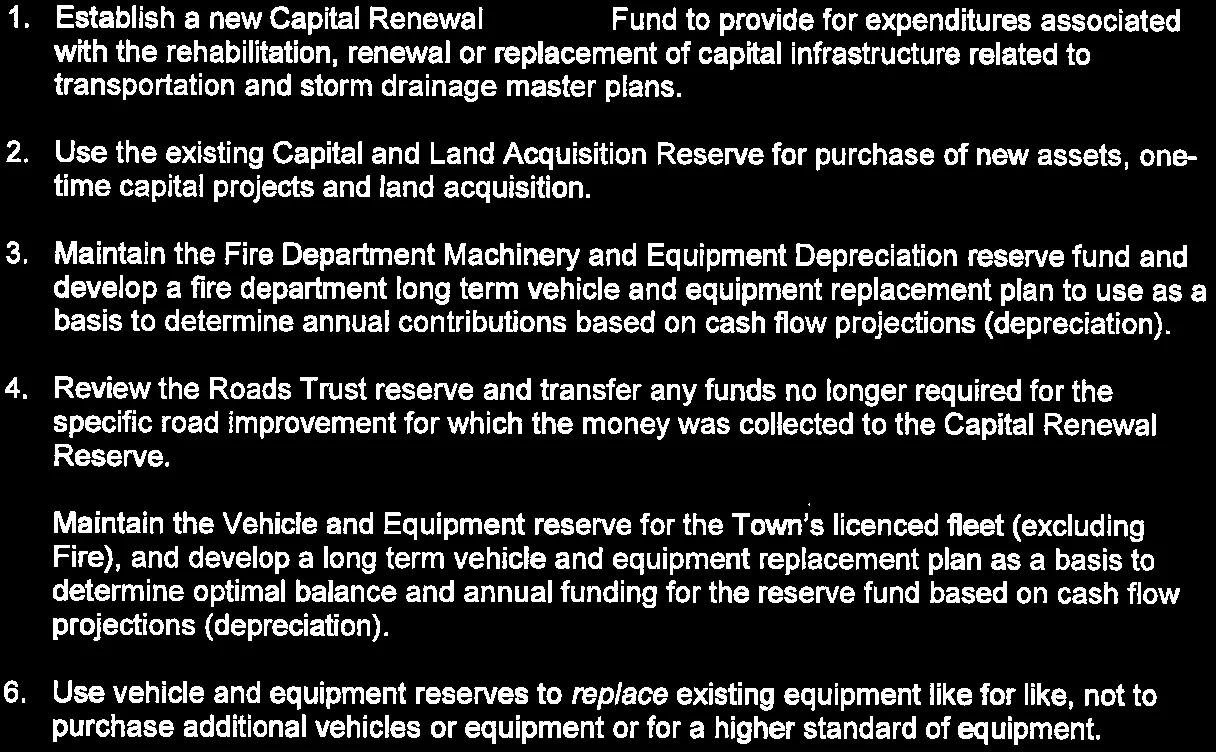
It is also recommended that the Town establish a new Capital Renewal Reserve Fund to fund maintenance, renewal and upgrade of existing infrastructure. Capital renewal versus new capital, is becoming more important as infrastructure ages. Costs for capital renewal should ideally form part of the annual cost of providing services. The Capital Renewal fund could be segregated into:
- Transportation
- Storm Drains
- Other as needed
And tied into the master plans currently being updated, facility assessments, and a long term capital plan. Some municipalities are dedicating a portion of assessment growth to help fund this reserve, in recognition that growth impacts existing infrastructure.
Fire Department Machinery and Equipment Depreciation (Bylaw 104, 1991)
The purpose of this reserve fund is for the purchase of Fire Department Machinery and Equipment. According to the bylaw an amount sufficient to provide for depreciation and obsolescence of Fire Department machinery and equipment is to be set aside annually in this reserve.
Balance December 31, 2014 - $222,919
Past 5 years Actual (2010 – 2014): The reserve fund has been used every year for the past 5 years. The Town has been contributing a minimum of $56,750 per year into the reserve, and some years considerably more. Proceeds from sale of fire equipment have also been placed in this fund. Capital Expenditures: In 4 of the last 5 years (none in 2014)
5 Year Financial Plan (2015-2019): Transfers of $56,750 per year from General Operating fund Capital Expenditures - $150,000 in 2015 (Fire Breathing Apparatus); $112,500 in 2017 (Fire Engine #38 Replacement $450K - $337.5 debt; $112.5 Reserve)
Comments:
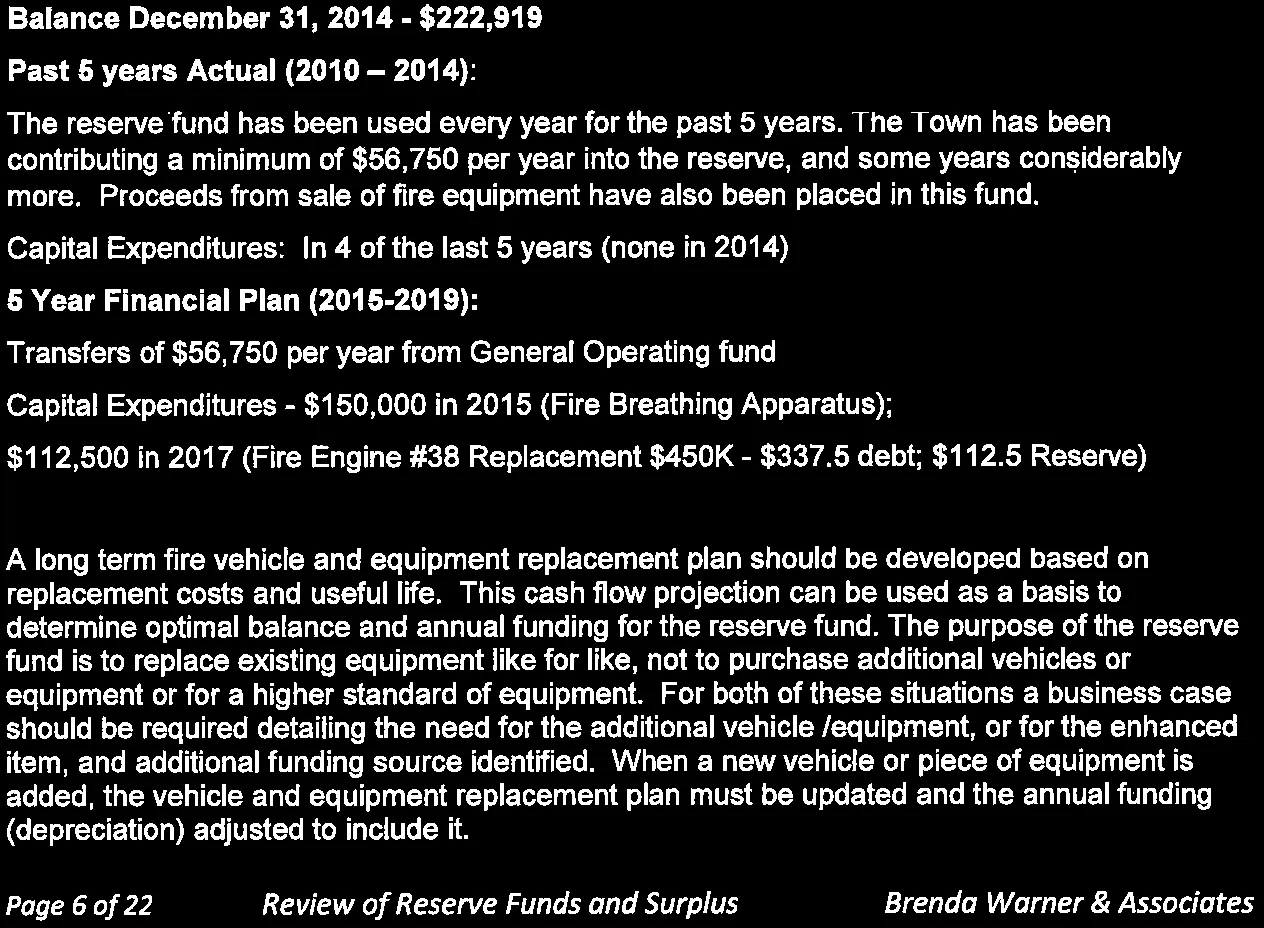
Due to the high cost and specialized nature of fire vehicles and equipment, it is recommended that this reserve fund be retained.
Road Bonds (Bylaw 140, established 1992)
The monies in the fund are to be used only for the purposes of Capital Projects for which the monies were deposited, but may include the extension or renewal of existing capital works in the specific area. Funding — monies received from Developers or Property Owners or others for site specific road improvements
Balance December 31, 2014 - $119,778
Past 5 years Actual (2010 – 2014): Revenue of $195,000 received in 2010; Expenditures of $195,000 made in 2011.
5 Year Financial Plan (2015-2019): No revenue or expenditures are included in the 2015-2019 financial plan, other than interest income.
Comments:
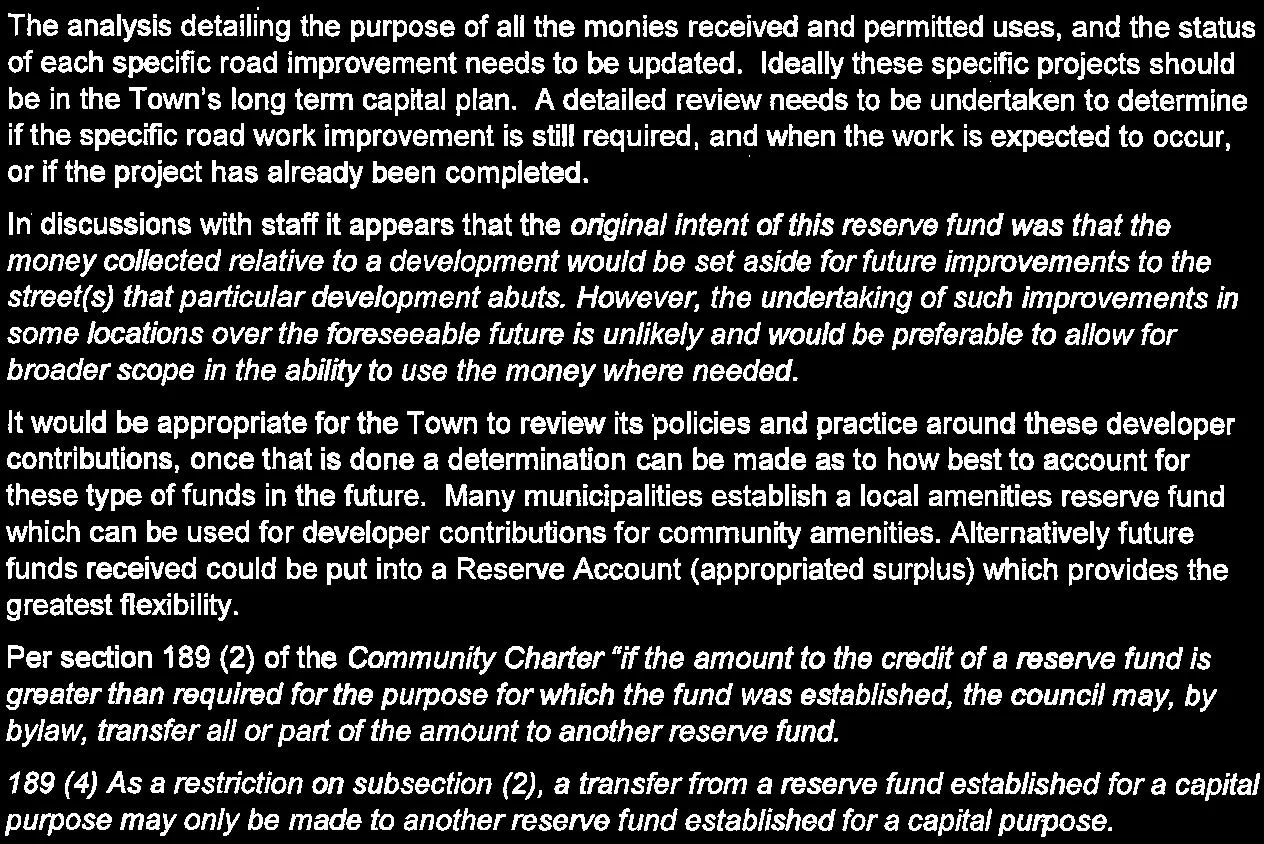
In discussions with staff it appears that the original intent of this reserve fund was that the money collected relative to a development would be set aside for future improvements to the street(s) that particular development abuts. However, the undertaking of such improvements in some locations over the foreseeable future is unlikely and would be preferable to allow for broader scope in the ability to use the money where needed.
It would be appropriate for the Town to review its policies and practice around these developer contributions, once that is done a determination can be made as to how best to account for these type of funds in the future. Many municipalities establish a local amenities reserve fund which can be used for developer contributions for community amenities. Alternatively future funds received could be put into a Reserve Account (appropriated surplus) which provides the greatest flexibility.
Per section 189 (2) of the Community Charter “if the amount to the credit of a reserve fund is greater than required for the purpose for which the fund was established, the council may, by bylaw, transfer all or part of the amount to another reserve fund.
189 (4) As a restriction on subsection (2), a transfer from a reserve fund established for a capital purpose may only be made to another reserve fund established for a capital purpose.
It is recommended that the Road Bonds reserve be reviewed in detail and any funds no longer required for the specific road improvement for which the money was collected be transferred to the Capital Renewal Reserve.
Machinery & Equipment Depreciation (Bylaw 42, 1990 amended by Bylaw 204, 1994, Bylaw 348, 1998)
The monies in the fund are to be expended solely for the purchase of machinery and equipment.
Balance December 31, 2014 - $64,329
Past 5 years Actual (2010 – 2014): $20,000 per year for 4 years from the General Operating Fund, there was no transfer in 2013 Capital Expenditures: 2 of the last 5 years - $61,586 in 2010; $20,651 in 2013
5 Year Financial Plan (2015-2019): Transfers of $20,000 per year from General Operating fund No capital expenditures planned
Comments:
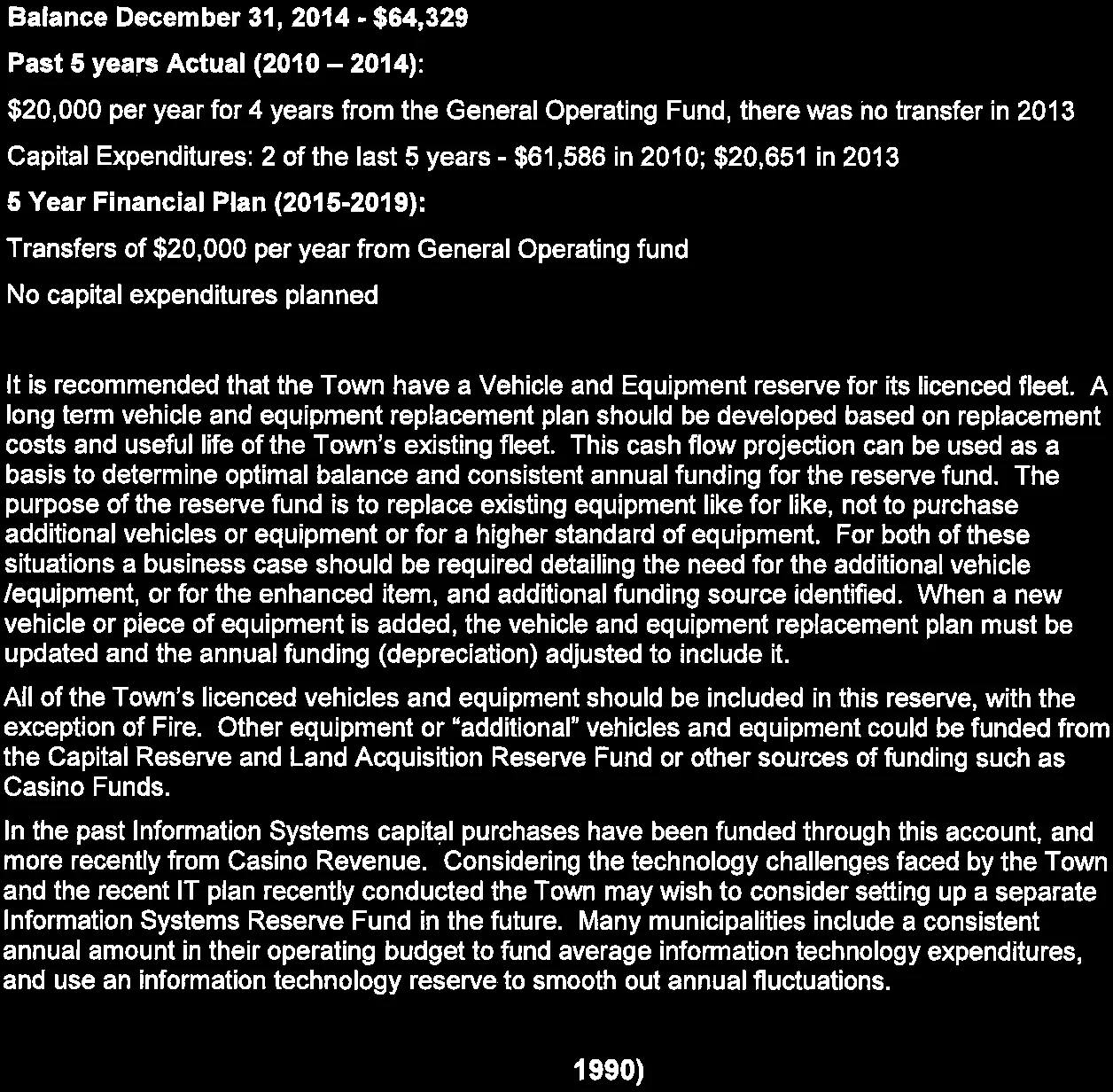
All of the Town’s licenced vehicles and equipment should be included in this reserve, with the exception of Fire. Other equipment or “additional” vehicles and equipment could be funded from the Capital Reserve and Land Acquisition Reserve Fund or other sources of funding such as Casino Funds.
In the past Information Systems capital purchases have been funded through this account, and more recently from Casino Revenue. Considering the technology challenges faced by the Town and the recent IT plan recently conducted the Town may wish to consider setting up a separate Information Systems Reserve Fund in the future. Many municipalities include a consistent annual amount in their operating budget to fund average information technology expenditures, and use an information technology reserve to smooth out annual fluctuations.
Parks & Recreation Equipment (Bylaw 43, 1990)
The purpose of this reserve is to fund the purchase of parks and recreation equipment.
Balance December 31, 2014 - $137,649
Past 5 years Actual (2010 – 2014): A minimum of $25,000 per year from the General Operating Fund Capital Expenditures: 2 of the last 5 years - $8,644 in 2010; $97,587 in 2014
5 Year Financial Plan (2015-2019): Transfers of $25,000 per year from General Operating fund Capital Expenditures: $60,000 in 2016; $20,000 in 2017
Comments:
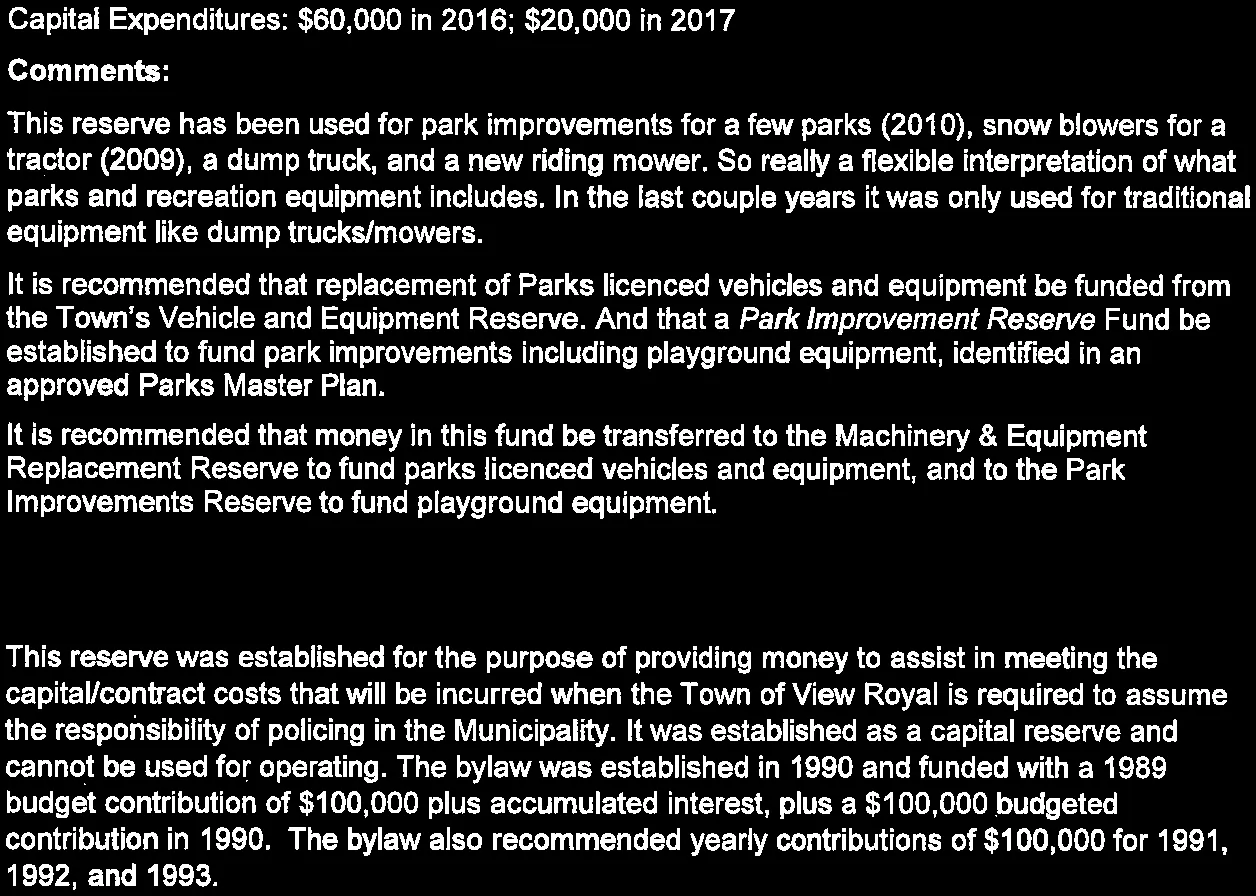
It is recommended that replacement of Parks licenced vehicles and equipment be funded from the Town’s Vehicle and Equipment Reserve. And that a Park Improvement Reserve Fund be established to fund park improvements including playground equipment, identified in an approved Parks Master Plan.
It is recommended that money in this fund be transferred to the Machinery & Equipment Replacement Reserve to fund parks licenced vehicles and equipment, and to the Park Improvements Reserve to fund playground equipment.
Police Equipment, Property and Contract (Bylaw 57, 1990)
This reserve was established for the purpose of providing money to assist in meeting the capital/contract costs that will be incurred when the Town of View Royal is required to assume the responsibility of policing in the Municipality. It was established as a capital reserve and cannot be used for operating. The bylaw was established in 1990 and funded with a 1989 budget contribution of $100,000 plus accumulated interest, plus a $100,000 budgeted contribution in 1990. The bylaw also recommended yearly contributions of $100,000 for 1991, 1992, and 1993.
Balance December 31, 2014 - $612,833
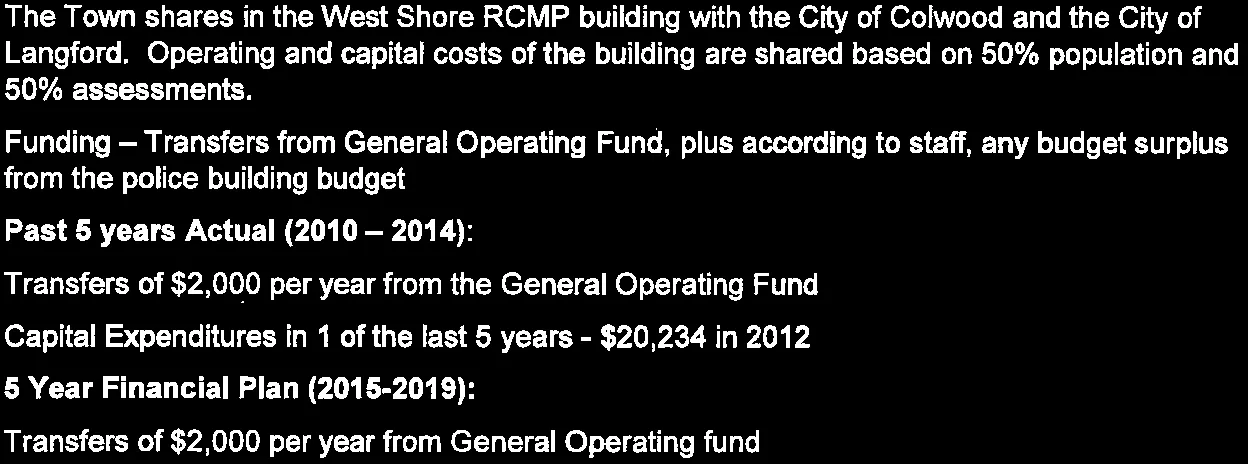
The Town shares in the West Shore RCMP building with the City of Colwood and the City of Langford. Operating and capital costs of the building are shared based on 50% population and 50% assessments. Funding — Transfers from General Operating Fund, plus according to staff, any budget surplus from the police building budget
Past 5 years Actual (2010 – 2014): Transfers of $2,000 per year from the General Operating Fund Capital Expenditures in 1 of the last 5 years - $20,234 in 2012
5 Year Financial Plan (2015-2019): Transfers of $2,000 per year from General Operating fund Capital Expenditures - $13,000 in 2015
Comments:
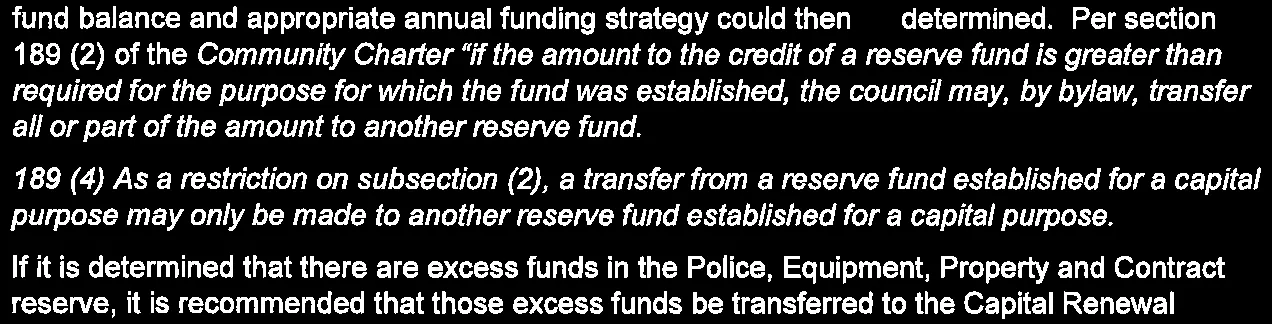
189 (4) As a restriction on subsection (2), a transfer from a reserve fund established for a capital purpose may only be made to another reserve fund established for a capital purpose.
If it is determined that there are excess funds in the Police, Equipment, Property and Contract reserve, it is recommended that those excess funds be transferred to the Capital Renewal reserve.
Special Police Operational (Bylaw 220, 1994)
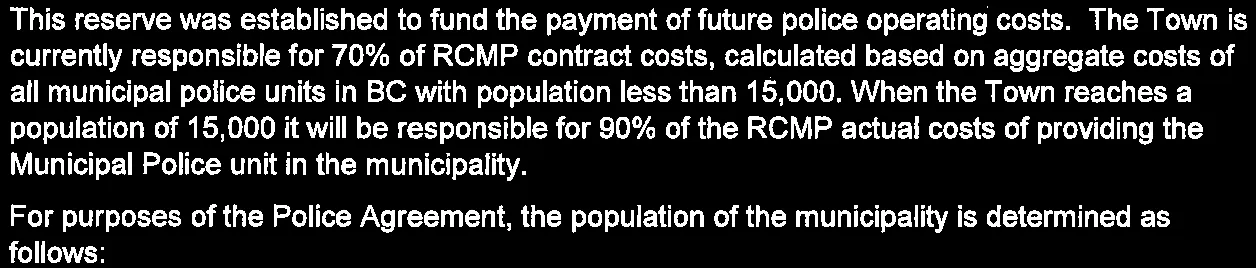
This reserve was established to fund the payment of future police operating costs. The Town is currently responsible for 70% of RCMP contract costs, calculated based on aggregate costs of all municipal police units in BC with population less than 15,000. When the Town reaches a population of 15,000 it will be responsible for 90% of the RCMP actual costs of providing the Municipal Police unit in the municipality.
For purposes of the Police Agreement, the population of the municipality is determined as follows:
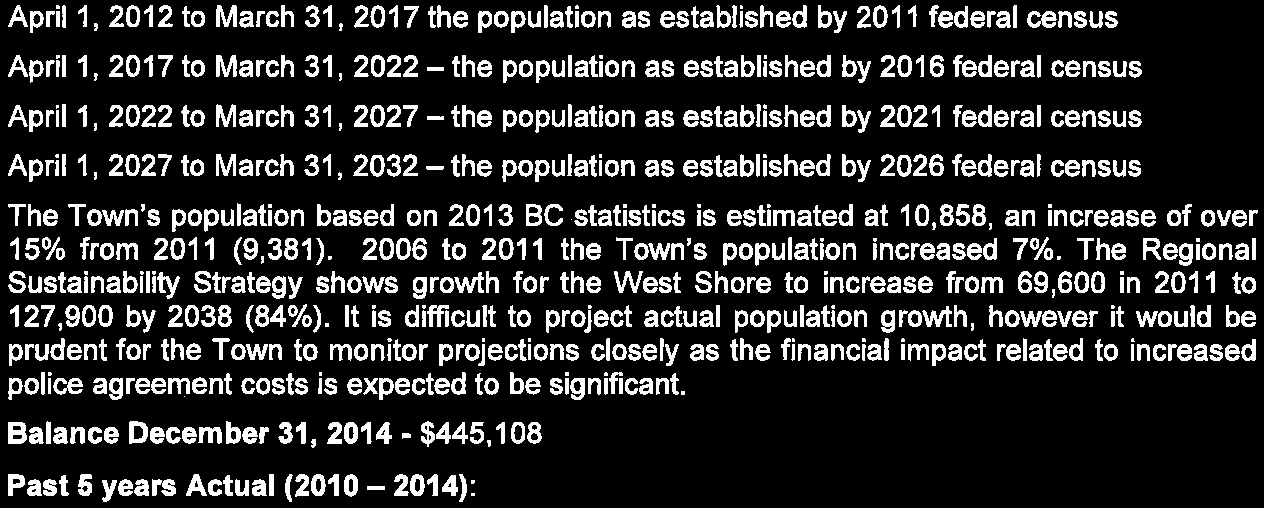
The Town’s population based on 2013 BC statistics is estimated at 10,858, an increase of over 15% from 2011 (9,381). 2006 to 2011 the Town’s population increased 7%. The Regional Sustainability Strategy shows growth for the West Shore to increase from 69,600 in 2011 to 127,900 by 2038 (84%). It is difficult to project actual population growth, however it would be prudent for the Town to monitor projections closely as the financial impact related to increased police agreement costs is expected to be significant.
Balance December 31, 2014 - $445,108
Past 5 years Actual (2010 – 2014): Over the past 5 years, $239,291 has been transferred into the fund and $157,619 has been transferred out. Operating surplus from the police budget is transferred to this reserve. In 2014 the transfer was $206,943.
5 Year Financial Plan (2015-2019): No revenue or expenditures are planned in this reserve fund, except for interest income
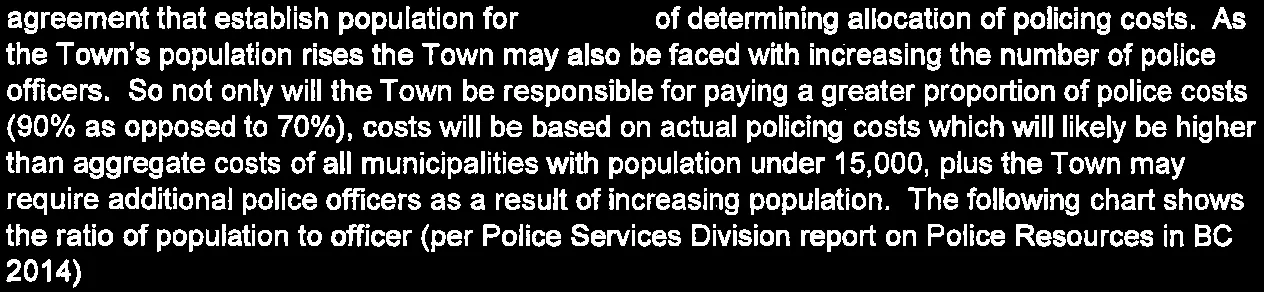
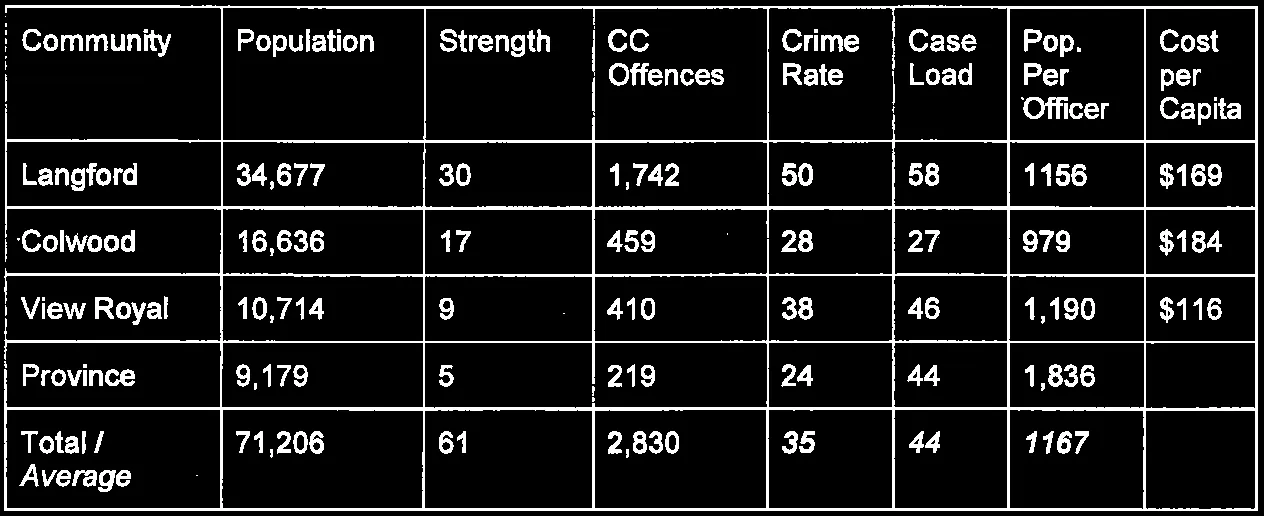
Comments: A projection of population should be reviewed on a regular basis to anticipate when the Town is expected to reach a population of 15,000. This can be compared to the dates in the police agreement that establish population for purposes of determining allocation of policing costs. As the Town’s population rises the Town may also be faced with increasing the number of police officers. So not only will the Town be responsible for paying a greater proportion of police costs (90% as opposed to 70%), costs will be based on actual policing costs which will likely be higher than aggregate costs of all municipalities with population under 15,000, plus the Town may require additional police officers as a result of increasing population. The following chart shows the ratio of population to officer (per Police Services Division report on Police Resources in BC 2014)
| Community | Population | Strength | CC Offences | Crime Rate | Case Load | Pop. Per Officer | Cost per Capita |
|---|---|---|---|---|---|---|---|
| Langford | 34,677 | 30 | 1,742 | 50 | 58 | 1156 | $169 |
| Colwood | 16,636 | 17 | 459 | 28 | 27 | 979 | $184 |
| View Royal | 10,714 | 9 | 410 | 38 | 46 | 1,190 | $116 |
| Province | 9,179 | 5 | 219 | 24 | 44 | 1,836 | |
| Total / Average | 71,206 | 61 | 2,830 | 35 | 44 | 1167 |
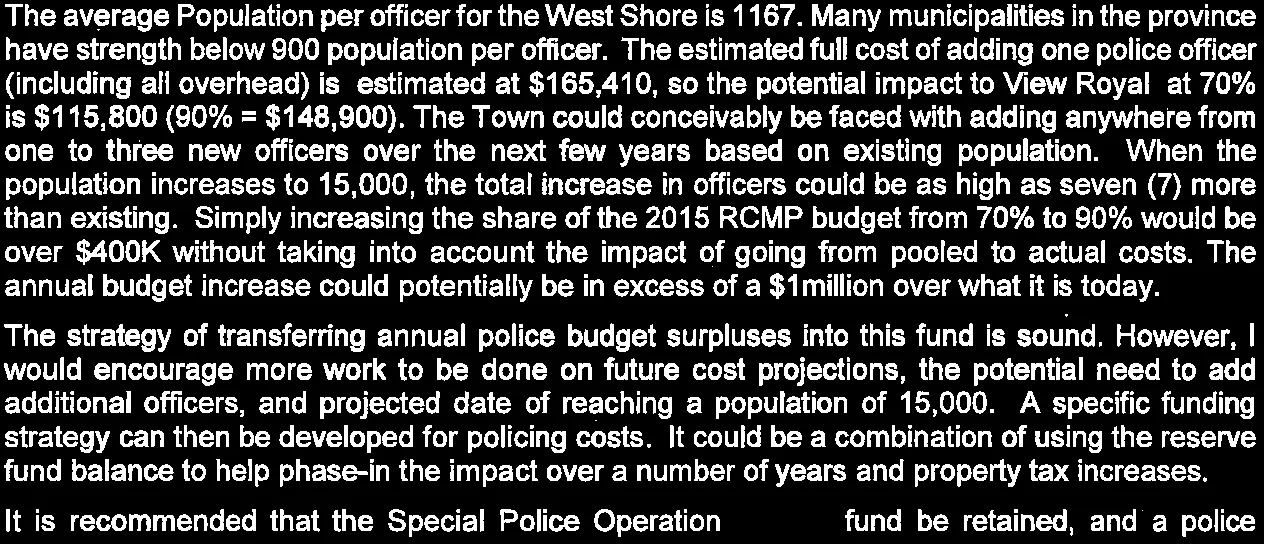
The average Population per officer for the West Shore is 1167. Many municipalities in the province have strength below 900 population per officer. The estimated full cost of adding one police officer (including all overhead) is estimated at $165,410, so the potential impact to View Royal at 70% is $115,800 (90% = $148,900). The Town could conceivably be faced with adding anywhere from one to three new officers over the next few years based on existing population. When the population increases to 15,000, the total increase in officers could be as high as seven (7) more than existing. Simply increasing the share of the 2015 RCMP budget from 70% to 90% would be over $400K without taking into account the impact of going from pooled to actual costs. The annual budget increase could potentially be in excess of a $1million over what it is today.
The strategy of transferring annual police budget surpluses into this fund is sound. However, I would encourage more work to be done on future cost projections, the potential need to add additional officers, and projected date of reaching a population of 15,000. A specific funding strategy can then be developed for policing costs. It could be a combination of using the reserve fund balance to help phase-in the impact over a number of years and property tax increases.
It is recommended that the Special Police Operation reserve fund be retained, and a police funding strategy be developed.
Municipal Roads Capital (Bylaw 58, 1990)
The purpose of this reserve is to fund costs of capital highway projects. Established with provincial funds.
Balance December 31, 2014 - $27,661
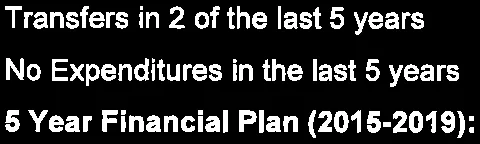
Past 5 years Actual (2010 – 2014): Transfers in 2 of the last 5 years No Expenditures in the last 5 years
5 Year Financial Plan (2015-2019): No revenue or expenditures planned in the next 5 years, except interest income
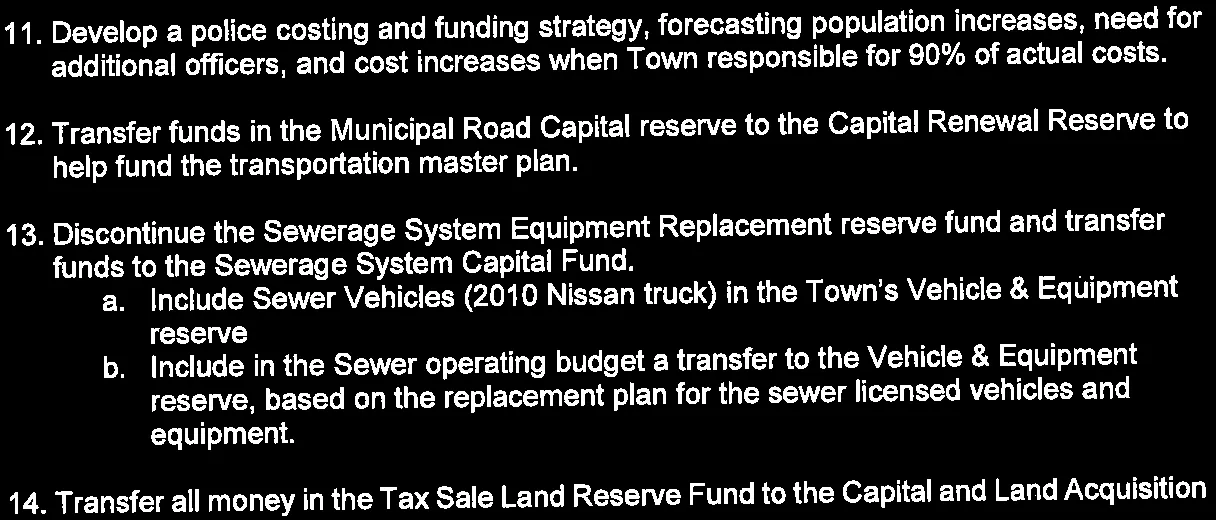
Comments: It is recommended that funds in the Municipal Road Capital reserve be transferred to the Capital Renewal Reserve to help fund the transportation master plan.
Sewerage System Capital (Bylaw 46, 1990)
The purpose of this reserve is to fund capital purchases for the sewerage system. This is the primary capital reserve fund for replacement and upgrade of the Town’s sewer infrastructure.
Balance December 31, 2014 - $694,429
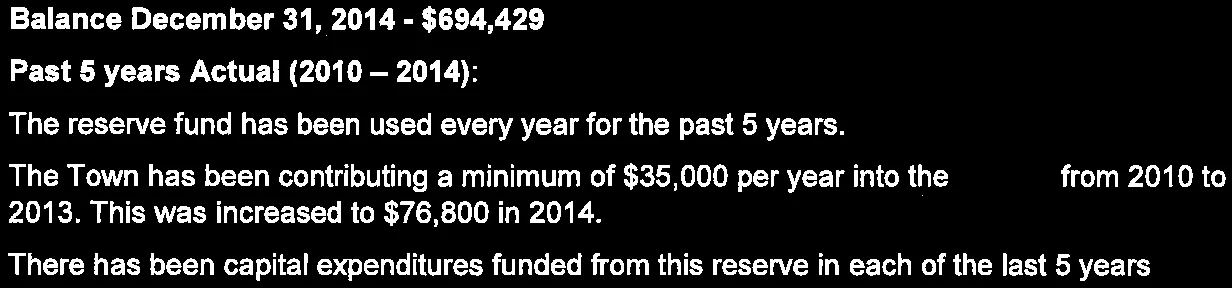
Past 5 years Actual (2010 – 2014): The reserve fund has been used every year for the past 5 years. The Town has been contributing a minimum of $35,000 per year into the reserve from 2010 to 2013. This was increased to $76,800 in 2014. There has been capital expenditures funded from this reserve in each of the last 5 years
5 Year Financial Plan (2015-2019): Transfers of $76,800 per year from Sewer Operating fund Capital Expenditures are planned in each of the next 5 years
Comments: This is the primary reserve fund for sewer capital. The updated Sewer Master plan can be used as a basis for developing a long term capital plan and determining optimal balance and transfers to the reserve fund, based on projected replacement costs for all sewer assets. It is recommended that the Sewerage System Capital reserve fund be retained.
Sewerage System Equipment Replacement (Bylaw 47, 1990)
The purpose of this reserve is to fund capital purchases for the sewer system equipment replacements.
Balance December 31, 2014 - $105,873
Past 5 years Actual (2010 – 2014): The Town transferred on average $10,000 per year into the reserve There has been no capital expenditures funded from this reserve in last 5 years
5 Year Financial Plan (2015-2019): Transfers of $10,000 per year from Sewer Operating fund No Capital Expenditures are planned in the next 5 years
Comments:
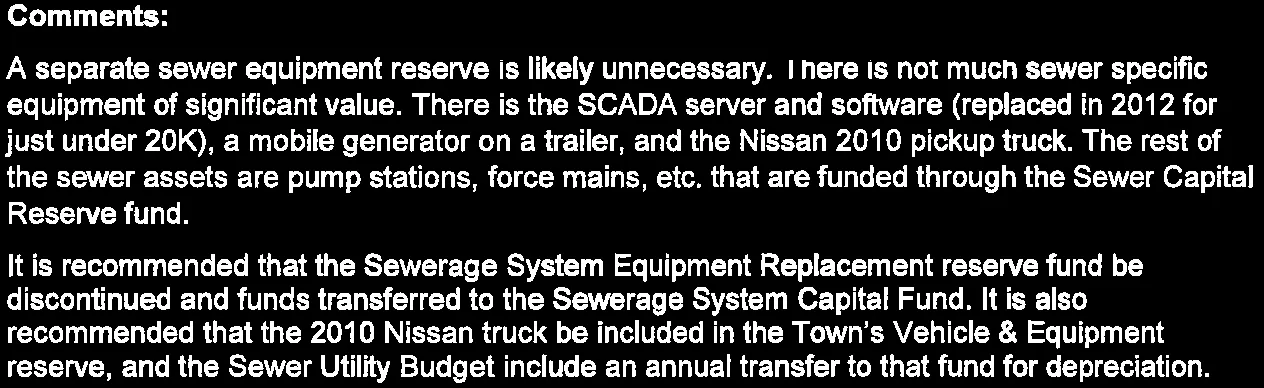
It is recommended that the Sewerage System Equipment Replacement reserve fund be discontinued and funds transferred to the Sewerage System Capital Fund. It is also recommended that the 2010 Nissan truck be included in the Town’s Vehicle & Equipment reserve, and the Sewer Utility Budget include an annual transfer to that fund for depreciation.
Tax Sale Land (Bylaw 326, 1998)
Tax Sale Land Reserve Fund Establishment Bylaw, 1998, No. 326 established a reserve fund for money received through the Annual Tax Sale. The use of these funds was previously limited by Section 498(4) (a) and (b) of the Municipal Act. This includes first bringing sinking funds up to requirements, and then reduction of debenture debt, capital expenditures, transfer to a debt retirement, reserve or local improvement fund or expenditures of a special nature.
The provisions relating to a tax sale reserve fund in the Municipal Act have been repealed and under the Community Charter money received from the sale of tax sale properties are no longer required to be set aside in a separate reserve fund.
Balance December 31, 2014 - $8,612
Past 5 years Actual (2010 – 2014): The reserve fund has not been used every year for the past 5 years.
5 Year Financial Plan (2015-2019): No transfers or Capital Expenditures are planned in the next 5 years
Comments: It is recommended that all money to the credit of the Tax Sale Land Reserve Fund be transferred to the Capital and Land Acquisition Reserve and the Tax Sale Land Reserve Fund Establishment Bylaw, 1998, No. 326 can be repealed.
STATUTORY RESERVES
Required Reserves - Per section 188 (2) of the Community Charter if a municipality receives monies from certain sources it MUST establish a reserve fund for:
- Development Cost Charges Sec 188 2(a)
- Parkland Acquisition Sec 188 2 (b)
- Special Purpose — Acquire Hwy Sec 188 2(c)
- Off Street Parking — Sec 188 2(d)
- Land Sales Sec 188 2(e)
The Town has established statutory Reserve Funds for Development Cost Charges and Parkland Acquisition (Parks & Open Space), but does not have a separate reserve fund for land sales. The Community Charter (Sec 188 (2) (e) requires that money received from the sale of land and improvements must be placed to the credit of a reserve fund for the purposes of paying any debt remaining in relation to the property and of acquiring land, improvements and other assets of a capital nature. The Town could use the Capital and Land Reserve for this purpose or it could establish a separate Land Sale Reserve Fund.
Parks and Open Space (Bylaw 41, 1990)
The monies set aside and any interest earned thereon shall be expended solely for the purchase of land for parks and open space.
According to staff the funds in this reserve have come partially from developers who give cash in lieu of parkland and partially from transfers from the General Operating Fund.
This is a statutory reserve fund. Monies received from developers in-lieu of parkland must be placed to the credit of a reserve fund for the purpose of acquiring park lands.
Balance December 31, 2014 - $327,852
Past 5 years Actual (2010 – 2014): Transfers into the fund were made in 4 of the last 5 years No expenditures were funded from this reserve
5 Year Financial Plan (2015-2019): Transfers of $20,000 per year from the General Operating Fund
Comments: This reserve fund must be retained for monies received from developers’ in-lieu of parkland, and can be used solely for the purpose of acquiring park lands. It cannot be used for park improvements.
The 2015-2019 financial plan includes transfers of $20,000 per year into this reserve from the general operating fund (property taxes).
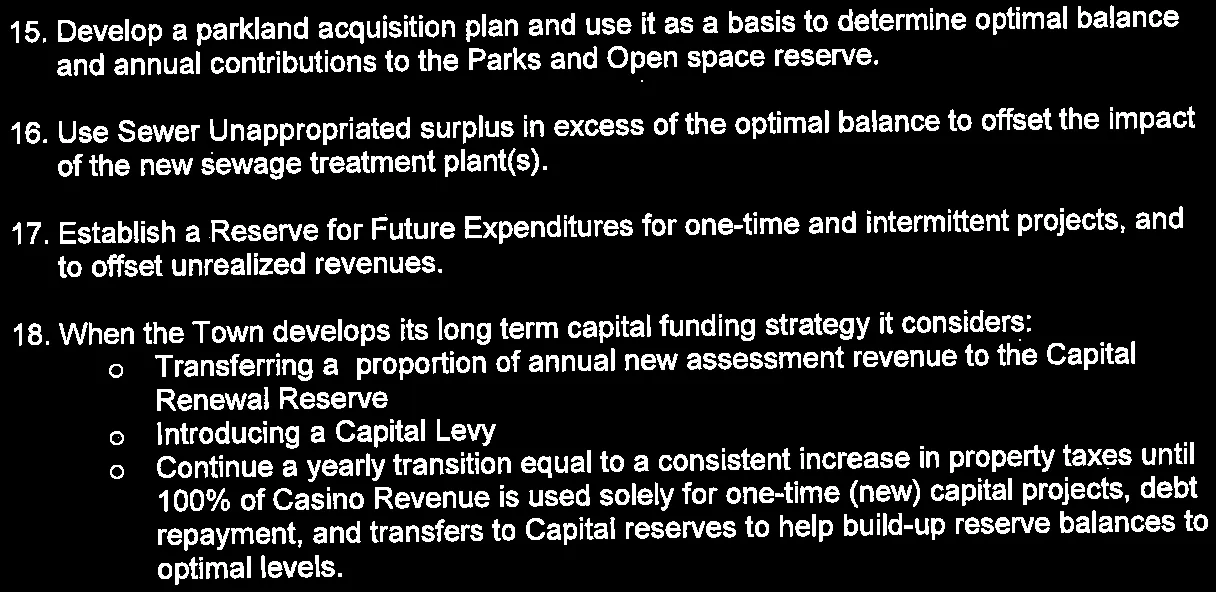
It is recommended that a park and open space acquisition plan be developed and used as a basis to determine optimal balance and annual contributions to the Parks and Open space reserve.
It is also recommended that the Town establish a Park improvement Reserve Fund and that annual contributions and optimal balances are determined based on an approved parks master plan (currently under development).
OTHER FUNDS
Casino Grant Fund
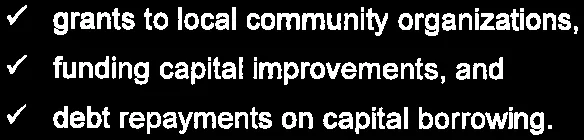
Casino Grant funding is the second largest individual source of funding received in the form of a grant from the Province related to the Great Canadian Casino, located in the Town of View Royal. The Town has entered into a partnership agreement with several adjoining local governments to share 55% of this grant; the Town of View Royal retains 45% for its own use. Monies received under this agreement must be used to benefit the community. The Town of View Royal uses its 45% to fund activities in the community such as:
According to the Town's 2015 Revenue Policy, the Town's objective is to reduce its Casino Grant funding contributions to municipal operations and focus the casino grant funding priority on municipal infrastructure.
In 2010, the Town started to transition the funding of membership in the Greater Victoria Public Library (GVPL from the Casino Grant funding to Property Value Taxes with the goal of a yearly transition equal to 1.5% increase in the Property Value Tax each year until Property Value Tax funds 100% of the GVPL. In 2015 the transfer was $90,000. Assuming this practice is continued the GVPL will be fully funded from Property Value Tax funds in 2017. (Note – in 2016 budget deliberations the transfer was reduced to $60,000).
Balance December 31, 2014 - $790,641
Past 5 Year Actuals – Revenue has been declining from $2,020,473 in 2010 to $1,744,749 in 2014. (2015 - $1,838,325)
5 year Financial Plan (2015-2019) – Annual Revenue was projected based on 2014 actual - $1,750,000. (Based on 2015 actual the projection has been increased to $1,840,000).
Comments: The Town is fortunate to have Casino Grant funding. The Town has been using casino funds to fund ongoing operating programs, one-time capital projects, and also ongoing capital maintenance, as well as debt payments.
Casino revenue has been declining, and if another casino is added to the region it could significantly impact future Casino Revenues in View Royal. Relying on casino revenue to fund services (including maintenance and upgrades of existing infrastructure and equipment) represents a significant financial risk to the Town. Council has recognized this risk and since 2010 has started to transition funding of membership in the Greater Victoria Library (GVPL) from Casino Grant Funding to Property Value Taxes with the goal of a yearly transition equal to 1.5% of property taxes. We would encourage Council to continue this practice until 100% of Casino Revenue is used solely for one-time (new) capital projects, debt repayment, and to build-up capital reserves to optimal levels.
Since it is recommended that all casino funds be allocated (to debt repayment, one-time capital and capital reserves), there does not appear to be any advantage to setting up a separate Casino Reserve Fund, so it is recommended that it be treated as a Reserve Account. A Reserve Fund requires a bylaw and would earn interest, a reserve account is simply an appropriation of surplus.
Community Works Gas Tax
The Community Works Fund (CWF) is delivered to all local governments in British Columbia through a direct annual allocation to support local priorities.
CWF is based on a per capita formula with a funding floor, and delivered twice annually. Local governments make local choices about which eligible projects to fund and report annually on these projects and their outcomes.
The Town receives approximately $430,000 annually from the Community Works Gas Tax Agreement, to fund eligible projects. Funding and expenditures must be tracked and reported on separately.
Balance December 31, 2014 - $175,795
Comments:
The Town could either establish a Reserve Fund or treat it as a Reserve Account. A Reserve Fund requires a bylaw and would earn interest, a Reserve Account is simply an appropriation of surplus. Since there is no advantage or necessity to have a separate reserve fund, it is recommended that it be set up as a Reserve Account.
UNAPPROPRIATED SURPLUS
The Town's December 31, 2014 financial statements report the following unappropriated surplus balances: General Operating Fund: $1,364,780 Sewer Fund: $1,540,042
The Town has traditionally used unappropriated surplus to fund one-time expenditures and for admin contingency.
Comments:
The Town may also require emergency funds from time to time, from any one of its Unappropriated Surplus balances, for unforeseen costs. When this occurs, the Town needs to rely upon sufficient balances being available in the applicable Unappropriated Surplus area (general operating or sewer).
The Government Finance Officers (GFOA) best practices guide states that it is essential that governments maintain adequate levels of unrestricted general fund balances to mitigate risks and provide a back-up for revenue shortfalls.
And that at a minimum, general-purpose governments, regardless of size maintain unrestricted fund balance in their general fund of no less than two months of regular general fund operating revenues or regular general fund operating expenditures. If fund balance falls below a government's policy level, then it is important to have a solid plan to replenish fund balance levels.
The GFOA Best Practices statement for enterprise funds such as the water or sewer utilities states that “under no circumstances should the target for working capital be less than forty-five (45) days’ worth of annual operating expenses and other working capital needs of the enterprise fund.” A typical standard operating reserve within the utility industry is 45 days of operating expenses for sewer and 60 days for water. The reason a water utility usually has a higher minimum operating balance than a sewer utility is that most water utilities are more dependent on water consumption as a factor in their rate revenue, whereas sewer utilities often have a flat monthly charge, particularly for single family residential customers. A riskier revenue stream translates into a higher minimum operating reserve balance. In the case of View Royal, sewer revenue has substantial dependence on metered water consumption. We therefore suggest a minimum 60 day (2 month) operating reserve for the sewer utility.
The Town currently funds CRD sewer costs as a property tax, based on assessed property values. Some municipalities (for example Saanich and Victoria) have moved to funding CRD sewer costs as a sewer user fee based on metered water use. Basing all sewer charges on water consumption is considered a best practice, transparent to all residents, and a more equitable system than based on assessed property value. This system has the most direct relationship to the actual sewage use, and is the closest to a user pay relationship. In addition, it will allow users to potentially reduce their CRD sewer costs by reducing water consumption. Tax exempt properties (such as hospitals) will also be obligated to pay for their share of the utility costs.
If the Town is considering this in the future, it could utilize a portion of the Sewer unappropriated surplus to phase-in the impact to users of moving to water use, as well as the cost of the new sewage treatment plant(s).
The Town could also transfer any excess funds from unappropriated sewer surplus to the Sewer Capital Fund to build up the sewer capital fund to optimal levels.
It is recommended that any excess unappropriated sewer surplus funds be used for the sewer utility. These funds were collected from sewer users through sewer user charges for the purpose of funding the sewer system so should be used for the purpose collected.
It is recommended that the Sewer Unappropriated surplus in excess of the optimal balance be used to offset the impact of the new sewage treatment plant(s).
NEW OPERATING RESERVE
Reserve for Future Expenditures
It is considered a best practice for municipalities to establish a Reserve for Future Expenditures fund (often called a Financial Stability Fund) for the following purposes:
To Offset Unrealized Revenues - Some of the Town’s revenue sources, (i.e. development fees, building permits), are cyclical in nature and thus are subject to downturns in the economy. The Town tries to anticipate economic downturns during budget processes but despite best efforts may be exposed to the possibility of unrealized or declining revenues.
TARGET BALANCES FOR RESERVES
The attached Appendix A to the Reserve and Surplus Policy recommends minimum and target (optimal) balances for each reserve. Until the Town’s comprehensive asset plan is completed it is difficult to determine optimal balance amounts for major capital reserves, however it is possible to identify a methodology.
Capital Renewal and Equipment Reserves
There are two components of the target (optimal) balance for capital reserves:
- the minimum balance, or “capital contingency” plus
- the cash requirement needed to fund planned capital projects
Minimum Capital Renewal Reserve Balances (i.e. Capital Contingency)
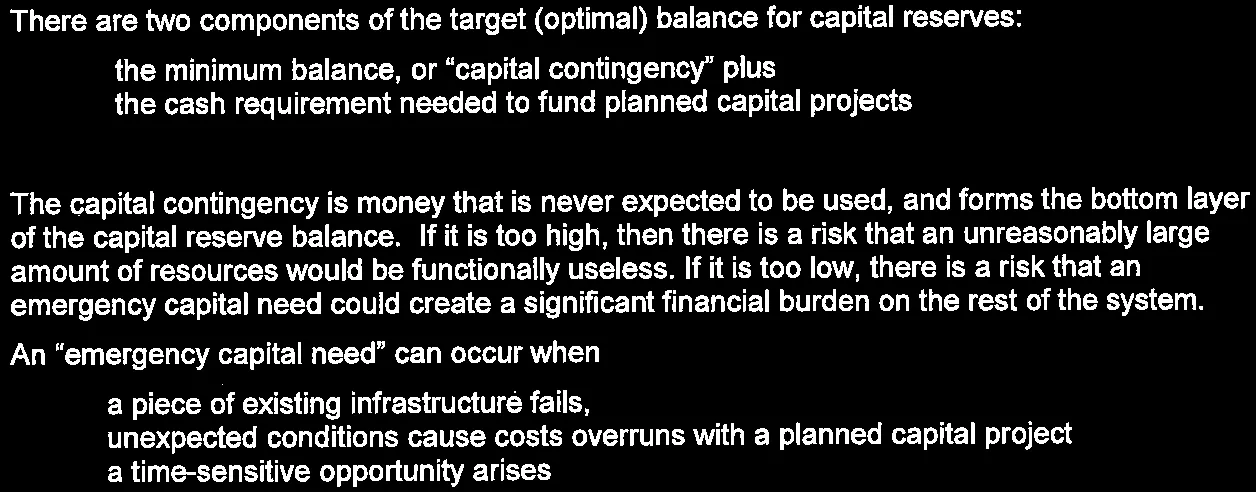
An “emergency capital need” can occur when
- a piece of existing infrastructure fails,
- unexpected conditions cause costs overruns with a planned capital project
- a time-sensitive opportunity arises
Requiring a timely and unexpected commitment of funds. Having an adequate capital contingency can help the Town avoid debt and disruptive impacts to current taxpayers or ratepayers.
The utility industry has a long history of planning for capital programs and contingencies which can be helpful in developing target contingencies for the Town's sewer infrastructure as well other municipal assets.
There are two ways to develop a capital contingency amount:
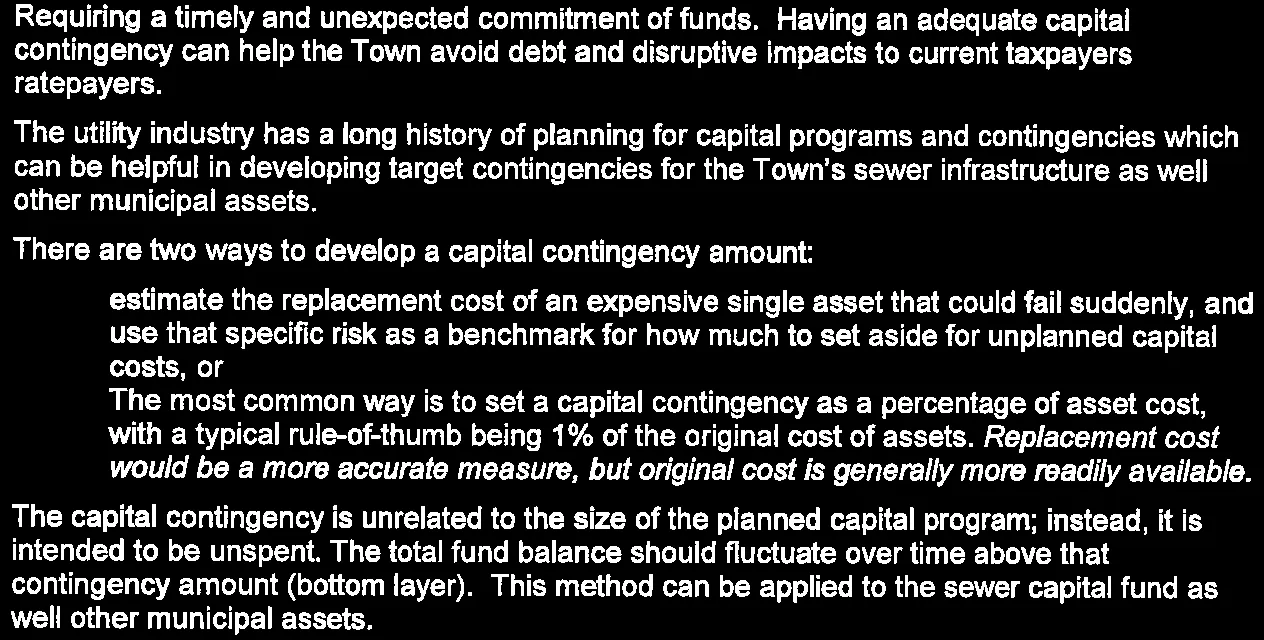
The capital contingency is unrelated to the size of the planned capital program; instead, it is intended to be unspent. The total fund balance should fluctuate over time above that contingency amount (bottom layer). This method can be applied to the sewer capital fund as well other municipal assets.
Optimal Capital Reserve Balances
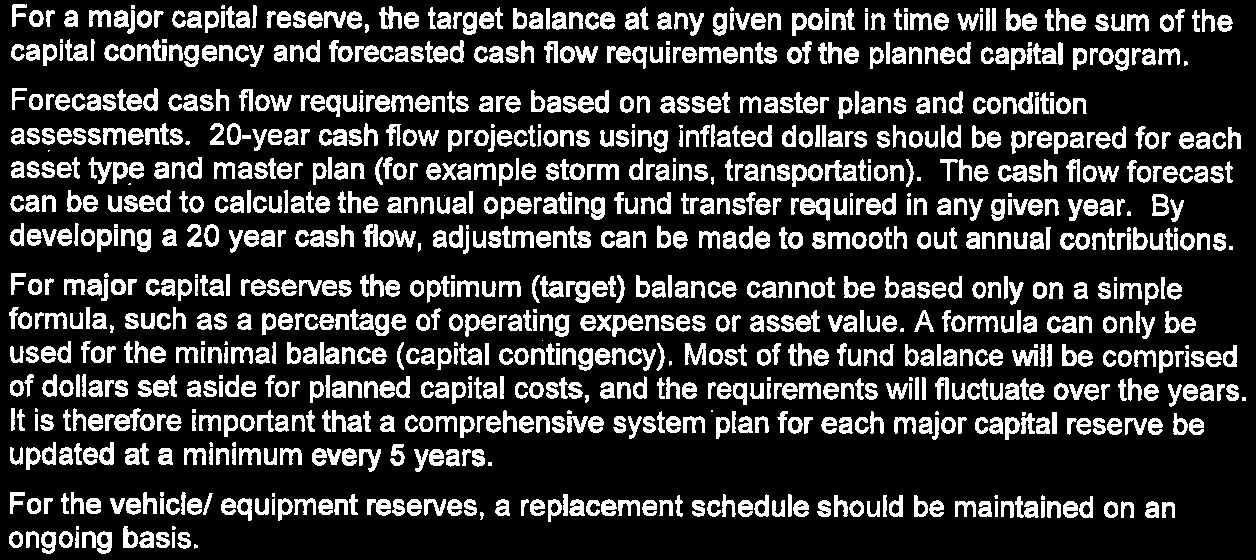
Forecasted cash flow requirements are based on asset master plans and condition assessments. 20-year cash flow projections using inflated dollars should be prepared for each asset type and master plan (for example storm drains, transportation). The cash flow forecast can be used to calculate the annual operating fund transfer required in any given year. By developing a 20 year cash flow, adjustments can be made to smooth out annual contributions.
For major capital reserves the optimum (target) balance cannot be based only on a simple formula, such as a percentage of operating expenses or asset value. A formula can only be used for the minimal balance (capital contingency). Most of the fund balance will be comprised of dollars set aside for planned capital costs, and the requirements will fluctuate over the years. It is therefore important that a comprehensive system plan for each major capital reserve be updated at a minimum every 5 years.
For the vehicle/ equipment reserves, a replacement schedule should be maintained on an ongoing basis.
New Capital and Land
Minimum and optimal balances for “new” and enhanced infrastructure would be contingent on Council priorities and approved plans.
Parks & Open Space
A planned park acquisition program should include a list of either target properties or criteria for target acquisitions. An optimal reserve fund level could be tied to the estimated cost of acquiring a specific piece of property, or ideally to a long term parks acquisition plan. Since contributions to this fund is mostly from payments in lieu of parkland by developers it will be difficult to project an optimal balance.
Operating Reserves and Unappropriated Surplus
Minimum and optimal balances for operating reserves and unappropriated surplus are based on recommended best practices, and alignment with other municipalities.
CAPITAL FUNDING
The cost of maintaining, repairing, restoring, replacing existing infrastructure is part of the annual cost of providing services to the community and ideally should be funded from ongoing, stable revenue sources such as property taxes and user fees.
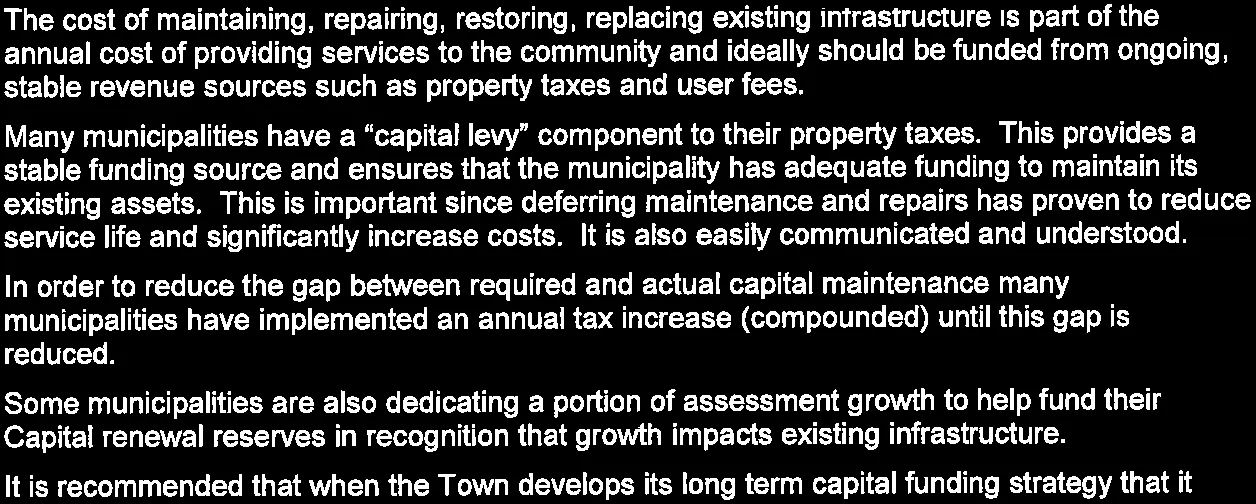
In order to reduce the gap between required and actual capital maintenance many municipalities have implemented an annual tax increase (compounded) until this gap is reduced.
Some municipalities are also dedicating a portion of assessment growth to help fund their Capital renewal reserves in recognition that growth impacts existing infrastructure.
It is recommended that when the Town develops its long term capital funding strategy that it consider:
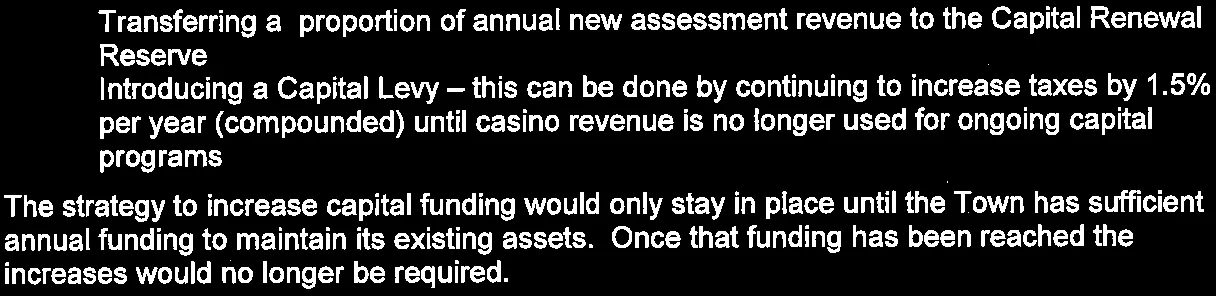
The strategy to increase capital funding would only stay in place until the Town has sufficient annual funding to maintain its existing assets. Once that funding has been reached the increases would no longer be required.
TRANSFERS TO RESERVES
Property taxes currently fund $183,750 in transfers to Reserve Funds (3% of property taxes)
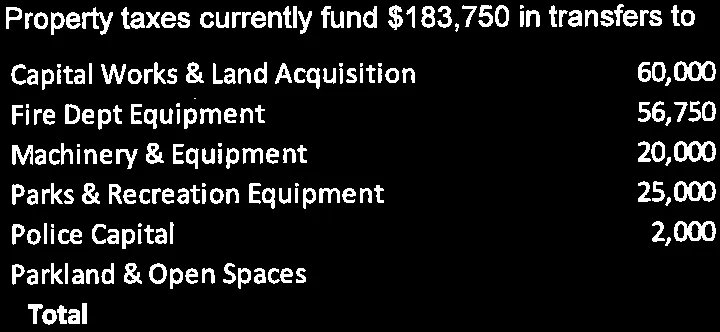
Sewer fees currently fund $86,800 in transfers to Reserves: Sewer Capital: 76,800 Sewer Equipment: 10,000 Total: 86,800
When the Reserve Fund Policy is approved, transfers to reserve funds should be reviewed and adjusted in the 2017 budget to reflect the approved Reserve Fund policy and asset master plans as they are developed.
Summary of Recommendations
That the Town:
Document Images
(40)