Parks Master Plan Consultation Strategy October 2015
A document describing how the public and stakeholders will be engaged during the development of the Parks Master Plan.
Parks Master Plan Consultation Strategy
October 2015
Prepared by Vancouver Island University – Master of Community Planning Students:
Devan Cronshaw - Graham Sakaki - Megan Walker - Ted Hou Yuan - Teunesha Evertse - Rushi Gadoya - Sadie Beaudoin-Lobb - Chloe Tunis - Lindsay Malbon - Taylor Alexander - Benafshaw Dashti - Darren Lucas - Guidan Chen - Peter Johnston - Katie Burridge - Keltie Chamberlain - Lisa Gibson-Webster - Doug Wortley - Sherif Abdelaziz - Stephanie Allen - Christopher Stephens - Kyle Wardstrom
Introduction
In 2007, a Draft Parks and Trails Master Plan was developed, but never adopted. The plan placed emphasis on park and trail enhancement, sustainability, and protection, as well as affording local residents and visitors the opportunity to live, play, and learn in these spaces.
The key features of the 2007 Draft Parks and Trails Master Plan included:
- Analysis of current parks and trails to find gaps and opportunities
- Investigation of the structure and context of different parks and their connection with regional trails and parks
- An action plan to address community wants and emerging park trends
- Creation of a visionary mandate for all parks in View Royal
- Upgrades and improvements for existing trails and parks
- An action plan for improvements, funding, and an execution strategies
The plan was not adopted as the capital works budget requirements were deemed to be unfeasible. Despite these issues, the plan had solid foundational principles and the basic structure of the plan provides important information for decision-makers. The intention for this planning process is to update and build on the foundation of this draft to develop a vibrant and effective parks plan for the Town of View Royal.
A Consultation Strategy will address how engagement with staff, specific stakeholders, and the wider public will unfold to ensure that the new Parks Master Plan represents the goals and concerns of the community, communicates realistic expectations of what is feasible, and gauges the community’s willingness to consider funding the implementation of the plan. Vancouver Island University Students from the Master of Community Planning Program will be providing assistance in a variety of roles relating to the Parks Master Plan Update over two semesters.
Public participation is vital to ensure the final Parks Master Plan reflects the goals and values that the residents of the Town of View Royal deem most important. The consultation process will span three months and will use a variety of engagement methods. It will ensure there are diverse opportunities for all community members who wish to be involved to participate throughout the process.
The project Terms of Reference approved by Council identify a number of expected outcomes that need to be included within the plan. As a result, key topics for engagement will be: (1) the generation of creative but realistic ideas for park development, improvements, and acquisition; (2) the development of waterfront road-ends; (3) prioritization of ideas that match phasing to available funding; and (4) gauging of community’s willingness to fund actions identified by the plan.
The main objective of the public consultation period is to ensure that the community can help shape the final Parks Master Plan, ultimately leading to a final document that the community supports. Through a process of analyzing the current parks inventory, associated management costs, research and consulting on future park needs, and understanding the future budget constraints and/or opportunities we will be able to put forward materials highlighting the current strengths and weaknesses. From this current data, we will solicit input from the stakeholders, public, staff, and Council to generate ideas and prioritize future goals. This will lead to a draft master plan that: (1) represents the values and goals of the community; (2) is financially feasible; (3) identifies priorities for investment in park infrastructure; and (4) assists staff in maintaining existing and future parks.
Level of Consultation
The level of consultation needed directed by the level of perceived impact of the Parks Master Plan on stakeholders’ interests. The consultation strategy must include opportunities for deep engagement with stakeholders that have a stronger sense of interest or perceived impact by the Plan. It must also attempt to solicit input from those with less sense of interest or ability to participate. For sake of process efficiency, as well as ensuring stakeholders hear one another’s concerns whenever possible, we propose to engage most stakeholders primarily through events geared towards the general public. However, to build trust and ensure specific stakeholders are engaged in the process, direct outreach and engagement efforts have also been included in this plan.
Overall, the proposed consultation level we are recommending is Involve, based on the International Association of Public Participation’s (IAP2) public participation spectrum of Inform > Consult > Involve > Collaborate > Empower. Involve looks to “work directly with the public throughout the entire process to ensure that public concerns and aspirations are consistently understood and considered.” The promise to the public is: “We will work with you to ensure
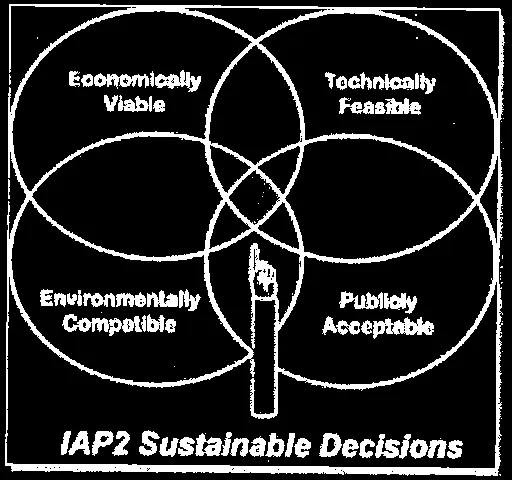
that your concerns and aspirations are directly reflected in the alternatives developed and provide feedback on how public input influenced the decision.” ‘Involve’ also means we must provide clear information so the public can understand the issues and provide informed feedback.
Due to past failures of projects aimed at redeveloping waterfront road-ends, this particular issue will need a deeper level of engagement, running parallel to, but integrated into the overall Parks Master Plan process. The process will seek to find common ground, and collaboratively develop project proposals that will meet the public interest while also meeting the needs of the adjacent property owners. The proposed approach is described in the Project Methods section of the Consultation Strategy.
Who Needs to Be Consulted?
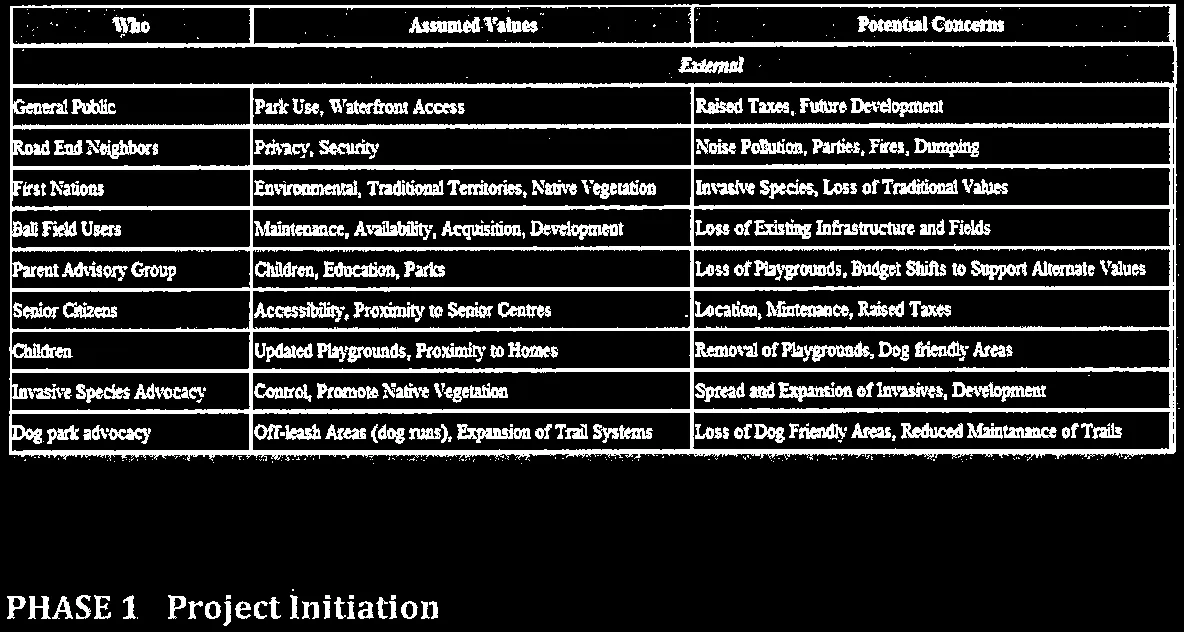
The following table outlines the groups that need to be engaged and their assumed values and interests in the process. The consultation methods and activities are listed in the following section. Internal stakeholders will be invited to participate in broad consultation activities where appropriate, and will be engaged directly if needed.
Table 1 – Who We Need to Consult With and Perceived Values
| Who | Assumed Values | Potential Concerns |
|---|---|---|
| External | ||
| General Public | Park Use, Waterfront Access | Raised Taxes, Future Development |
| Road End Neighbors | Privacy, Security | Noise Pollution, Parties, Fires, Dumping |
| First Nations | Environmental, Traditional Territories, Native Vegetation | Invasive Species, Loss of Traditional Values |
| Ball Field Users | Maintenance, Availability, Acquisition, Development | Loss of Existing Infrastructure and Fields |
| Parent Advisory Group | Children, Education, Parks | Loss of Playgrounds, Budget Shifts to Support Alternate Values |
| Senior Citizens | Accessibility, Proximity to Senior Centres | Location, Maintenance, Raised Taxes |
| Children | Updated Playgrounds, Proximity to Homes | Removal of Playgrounds, Dog friendly Areas |
| Invasive Species Advocacy | Control, Promote Native Vegetation | Spread and Expansion of Invasives, Development |
| Dog park advocacy | Off-leash Areas (dog runs), Expansion of Trail Systems | Loss of Dog Friendly Areas, Reduced Maintenance of Trails |
PHASE 1 | Project Initiation
Early project work has already commenced with two research assistants at Vancouver Island University compiling background information, updating park asset inventories, doing demographic analysis and other related tasks. Prior to public engagement work, Town staff and the VIU team will develop a communications strategy that we will use to engage the community and media in the project, with an emphasis on using social media, the Town’s website and other means to inform and engage stakeholders in the process.
PHASE 2 | Project Methods
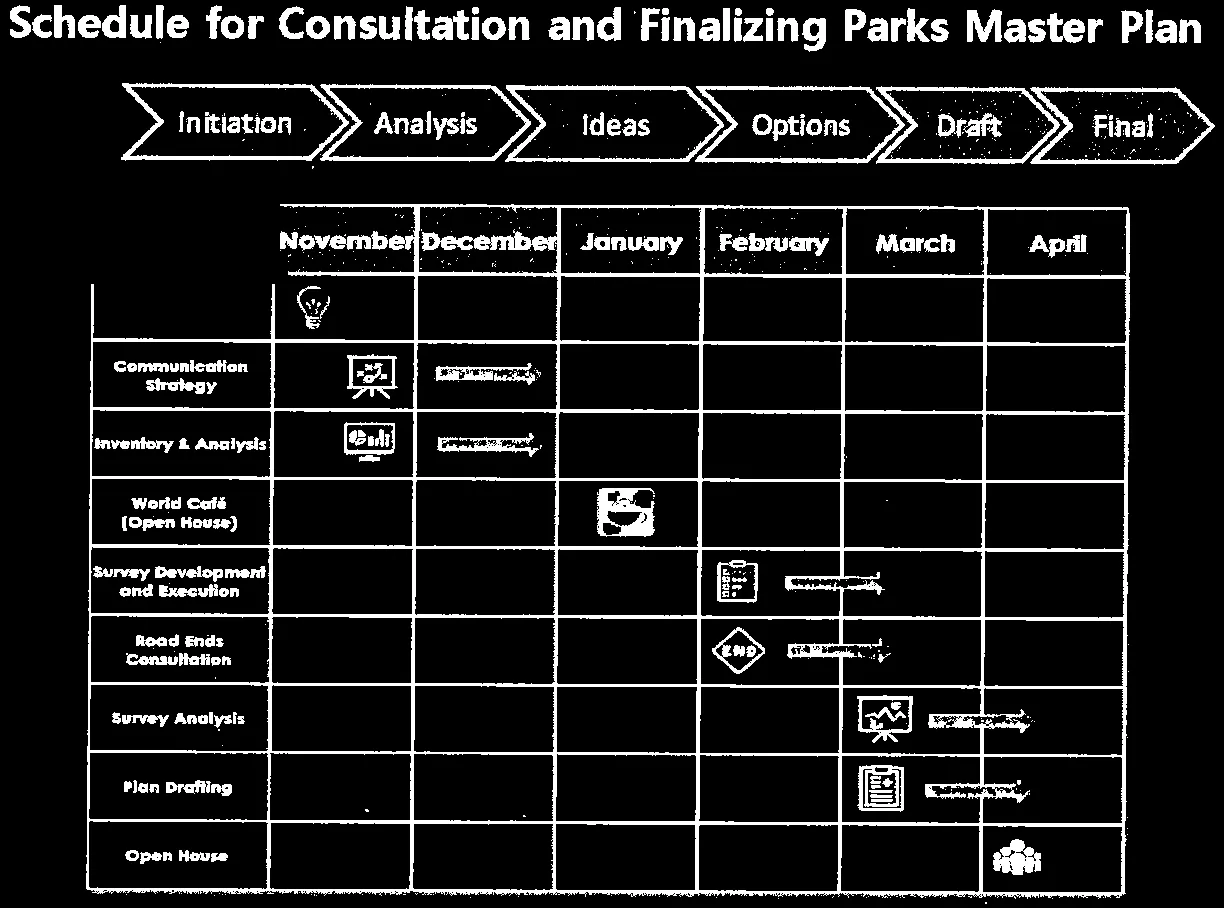
The Consultation Strategy will allow a structured yet fun principle-centered planning process that provides multiple opportunities for various parts of the community to engage in articulating their wants and needs for the View Royal parks system and at the same time, provides VIU students the opportunity to acquire planning skills on the ground in a real world project. One of the challenges of the previous draft plan was that very few community members participated in the project. A schedule of events and activities is included below.
I. Communications Strategy
Town staff, students and faculty at VIU will develop a communications strategy with the idea of creating a ‘commotion’ around the project to build interest and excitement in participating. The strategy will explore both traditional means of communicating with residents (mail, notices in local papers and on notice board, website), but will also include social media (Facebook, Twitter, Instagram) and will seek opportunities for media coverage for the project as well.
II. World Café Open House
A world café is a set of rotating discussion tables with specific questions being asked by a facilitator at each table. This methodology allows multiple topics and interests to be explored at the same time. Students will set up and facilitate the session. Invitations to multiple groups will be extended.
III. Web Based Survey
An online survey will be developed (paper copies will be available for those who do not wish to do an online survey) after the World Café session to clarify public input and to seek input on funding priorities for the parks system.
IV. Door to Door
Undeveloped waterfront road ends are a topic that Council would like additional feedback on. The students will explore the issues around these spaces with the residents most impacted and will include recommendations in the plan for future action.
V. Open House
Once major elements of the plan are drafted, the team will host a final open house to check in with the community on the draft plan. During this time period, staff will also be engaged (particularly parks and engineering staff).
PHASE 3 | Project Conclusion
The work of the students will conclude with the final open house and presentation of a draft plan to the community. After that event, staff will make any final revisions to the plan and will bring the draft plan forward to Council for approval.
Schedule
While the scope of work is ambitious, the schedule recognizes that this project has the advantage of a large consulting team. In fact, the entire cohort of twenty-two Masters Students at Vancouver Island University is active participants along with faculty in three different courses.
SUMMARY
The outcomes expected from this consultation process will inform the development of a Parks Master Plan and will respond to the Terms of Reference previously approved by Council. Research and engagement with community, Town staff, Council, and stakeholders will be used to provide the Town of View Royal with community priorities and information that will enhance the parks system in creative and achievable ways.
Document Images
(15)