STAFF REPORT: REQUEST FOR DECISION – URBAN FOREST STRATEGY ADOPTION AND CANOPY COVER TARGETING
A request for Council to adopt the Urban Forest Strategy and set a canopy cover target (30%, 35%, or 40%) for the next 20 years.
TOWN OF VIEW ROYAL COUNCIL REPORT
TO: Council DATE: February 17, 2026 FROM: Ivan Leung, P.Eng, Director of Engineering MEETING DATE: March 17, 2026
REQUEST FOR DECISION – URBAN FOREST STRATEGY ADOPTION AND CANOPY COVER TARGETING
RECOMMENDATION:
THAT the Urban Forest Strategy be adopted with a canopy cover target set by Council.
ALTERNATIVE OPTIONS:
Option #2: THAT the Urban Forest Strategy be received for information.
PURPOSE:
The purpose of this report is to (1) obtain adoption of the Urban Forest Strategy that will inform on future urban forest programming, levels of service and resourcing, and (2) to respond to Council approved direction:
THAT the Committee recommend to Council that staff report back on the Urban Forest Strategy programming required to achieve 35% and 40% canopy cover target scenarios.
Council are empowered to set the level of service (canopy cover target) for the Town. Staff’s previous recommendation, presented at the December 9, 2025 Committee of the Whole meeting, was to maintain a “Net Neutral” (29%) canopy target for the next five years. Council are now offered information on requirements to achieve 30%, 35% and 40% canopy cover targets within the next 20 years. Staff would subsequently submit operational budgets reflective of the financial needs identified in this report to achieve the target set by Council.
EXECUTIVE SUMMARY
Planting trees alone is insufficient to support higher canopy targets. This is primarily due to there being not enough potential planting sites within the Town’s urban area to physically reach these targets.
Therefore, a shift to a ‘proactive’ urban forest management approach is required. In addition to the 14 strategies that culminate 51 Actions identified in the Urban Forest Strategy, there are an additional three strategies required to feasibly achieve higher canopy cover targets:
- Helping existing trees live longer: by extending the life of existing trees by decades, less tree planting effort would be spent on replacing trees (canopy recovery), and therefore more tree planting effort would be spent on enhancing and improving canopy cover (canopy increase). Necessary investments include:
- Dedicated urban forest staff
- Additional operational budgets to proactively conduct important pruning cycles, establishment watering, and inventory management
- Increases in operational budgets to strengthen invasive species management and tree planting restoration.
- Creating new planting space: changes to bylaws such as the Subdivision and Development Servicing Bylaw, Tree Protection Bylaw and master plans such as the Parks Master Plan, will be necessary to create new planting space opportunities. This includes but is not limited to:
- Expanded and extensive planting in parks and open spaces
- Emphasizing the creation of new planting space in future transportation and parks capital projects
- Significant planting on private lands: the success of higher canopy cover targets is predicated on a significant uptake on private landowner participation. This includes but is not limited to:
- Expansion of the Town’s resident tree planting program budget
- Integration of tree requirements into development processes (OCP Policy development)
Programming Cost Summary
| 29% (Existing) | Canopy Cover Target 30% | Canopy Cover Target 35% | Canopy Cover Target 40% | |
|---|---|---|---|---|
| # Municipal Trees Planted / Year | 40 | 260 | 625 | 1,300 |
| # Private Trees Planted / Year | Not Accurately Recorded | 410 | 1,515 | 2,060 |
| Full Implementation Cost (2045) | $343,000 (2025 Budget) | $790,000 / yr | $1,140,000 / yr | $1,720,000 / yr |
BACKGROUND
To fully understand the requirements and impacts of 35% and 40% canopy cover target programming, additional analysis was conducted and findings summarized in an additional Urban Forest Strategy Memo (Attachment 1), including:
- Preparing and modelling alternative canopy cover scenarios to analyze whether the Town has sufficient space available at present to accommodate the targets
- Preparing financial and operational forecasts associated with the targets, which required additional analysis on life cycle costing, inflationary impacts, locally calibrated activity costs and re-assessment of resourcing levels
- Producing a jurisdictional comparison with other local governments on canopy target – to – operational design – to – resourcing ratios to demonstrate and calibrate the resourcing and operational budgets required to reasonably administer a 35% to 40% canopy cover target.
- This jurisdictional scan was deemed an important requirement in the analysis because it provides Council with an ‘apples to apples’ comparison of local government’s current canopy cover and the aspirational targets developed.
Model Results
The additional modelling concluded that there is currently not enough planting opportunities to support the achievement of 30%, 35% and 40% canopy cover targets. This means that merely planting trees alone is not sufficient in meeting these canopy targets.
This does not mean that these targets cannot be achieved. With elevated resources, staffing and operational budgets, these targets are feasible.
Recommended Additional Program Requirements for Higher Canopy Cover Targets
To achieve higher canopy cover targets, a major addition to the Urban Forest Strategy is to emphasize more investment on maintenance, rather than replacement. In addition to the strategies and action items identified in the Urban Forest Strategy, three additional strategies are required to be enacted to achieve higher canopy cover targets:
- Increasing the average life of existing trees (targeting from 40 years to 80 years). Doing so would mean that additional tree plantings would contribute directly increase canopy cover, instead of canopy recovery. By 2045, additional in field works to extend tree life will need to include:
- Regularly watering young trees for the first three years. The current level of service is very inconsistent, based on availability of irrigation systems and participation of private residents
- Substantial pivot from reactive pruning to planned pruning. Reactive pruning to be reduced by 33%, planned pruning to be increased over 22 times existing levels of service, and a new structural pruning service to be established
- Establishment of a soil amendment and mulching program within tree root zones (currently no level of service provided)
- Update the tree inventory at set intervals to track urban forest health and determination of areas that require more / less investment.
- Bolstered administration including but not limited to (Table 1):
Table 1: Staffing Requirements
| Position | Responsibility | Lift in Level of Service |
|---|---|---|
| Town Arborist | Administers the Urban Forest Strategy: serve as lead for urban forest lifecycle management, contract administration, development review, performance tracking, stewardship programming and grant applications. | 1 FTE (from currently none) |
| Town Natural Areas Technician | Expanding from part time to full time enables developing forest management plans for flagship parks, prioritizing invasive species control and native planting efforts, and expanding existing stewardship programming. | 1 FTE (from currently part time) |
| Canada Summer Jobs Intern | Obtaining subsidized Canada Summer Job interns to provide program support during the peak growing season. The Town currently apply for the subsidy for Parks and Engineering support, so the Town will either need to (1) expand the summer student program, or (2) reduce summer student allocations from engineering / parks to support an urban forest intern | 1 Temporary FT (from currently none) |
| Expanded / Increase level of service from Greater Victoria Green Teams | Expand the program and budget to lead volunteer-based work parties that restore degraded forest natural areas and planting native trees and shrubs | Upon consultation with Town Arborist and Natural Areas Technician (currently 10 events/yr) |
| Contracted Services | In lieu of staffing requirements needed to conduct the maintenance activities, contracted services would be required to undertake the urban forest maintenance work | Operational Budget Lift |
Creating new planting space by amending bylaws and changing policy language. The Town will need to:
- Plant in turf sites that do not meet the current requirements of the current Subdivision and Development Services Bylaw. This includes expanding boulevard areas, increasing the densification of tree planting within boulevards, and creating new spaces within the road right of way for greenspace where possible (narrow down roadways to expand boulevard areas and create opportunities for rain gardens and other natural assets). This could result in additional needs including:
- increase boulevard and water use budgets
- relocate Town and non-Town owned underground utilities to facilitate tree planting in boulevard areas
- Plant in urban, open space park lands. Examples include but are not limited to View Royal Park, Chilco Park, Francis View Park, and several public trails that have limited tree cover
- This will require policy changes in the Parks and Trails Master Plan and other Park Master Plans to make investments in planting trees the top priority.
- Plant in turf sites that do not meet the current requirements of the current Subdivision and Development Services Bylaw. This includes expanding boulevard areas, increasing the densification of tree planting within boulevards, and creating new spaces within the road right of way for greenspace where possible (narrow down roadways to expand boulevard areas and create opportunities for rain gardens and other natural assets). This could result in additional needs including:
Influence private landowners to plant more trees on their properties. Planting trees within private properties yield the best chances of improving canopy coverage. As a result, the Town will need to:
- Significantly expand the resident tree planting program to meet the private tree planting targets for 30%, 35% and 40% canopy cover targets (610, 1515 and 2060 private trees to be planted per year respectively). For reference, the Towns current tree planting program budget would need to at least double to achieve the tree planting target for a 30% canopy cover.
- Additional engagement, advertising and public education will be required to obtain the uptake in participation needed to meet this target. Such engagement would require bolstered administration and staffing levels
- Significantly expand the resident tree planting program to meet the private tree planting targets for 30%, 35% and 40% canopy cover targets (610, 1515 and 2060 private trees to be planted per year respectively). For reference, the Towns current tree planting program budget would need to at least double to achieve the tree planting target for a 30% canopy cover.
Operational Financial Requirements and Comparisons to Others
A comparison of operational costs needing to be fully implemented by 2046 for each canopy cover scenario is identified below:
Table 2: Program Cost Comparison
| Cost Item | Current | Canopy Cover Target 30% | Canopy Cover Target 35% | Canopy Cover Target 40% |
|---|---|---|---|---|
| Lifecycle Management Costs¹ | $195,000 | $504,000 | $825,000 | $1,325,000 |
| Program Administration Costs² | $87,000 | $140,000 | $140,000 | $140,000 |
| Recurring Activity Costs³ | $61,000 | $146,000 | $172,000 | $250,000 |
| TOTAL | $343,000 | $790,000 | $1,140,000 | $1,720,000 |
¹ Lifecycle Management Costs: Pruning, planting, watering, removals ² Program Administration Costs: Staffing ³ Recurring Activity Costs: Invasive species management, tree programs, etc.
There are three important items of note upon review of Table 2:
- The estimates do not include tree planting costs, as these costs are noted to be ‘capital costs’ and not ‘operational’
- There appears to be ‘economy of scale’ savings in staffing for the 35% and 40% targets.
- Some canopy cover target scenarios could actually achieve a higher target over a longer period of time. For example, by adopting a 35% canopy cover program now, a 40% canopy cover can theoretically be achieved by around 2056.
Figure 1: Canopy Pathways
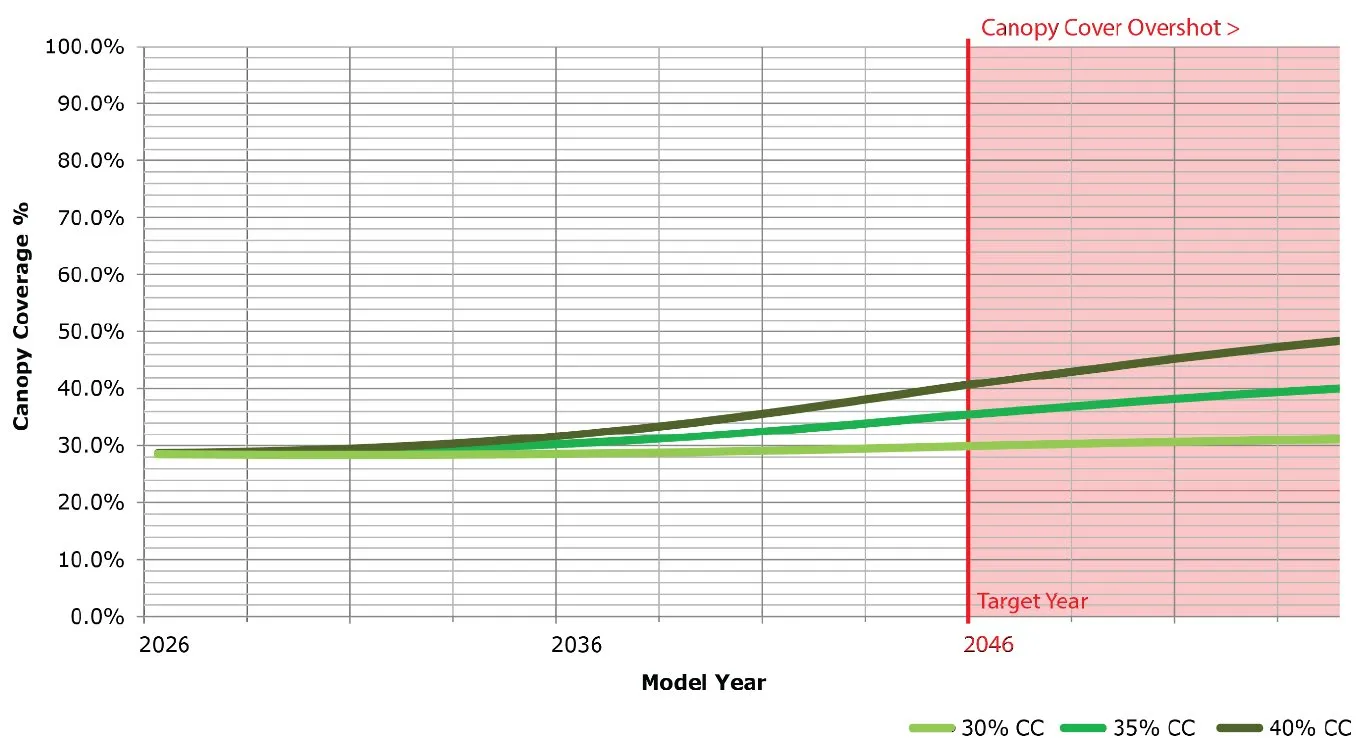
The memo provides a comparison of the Town’s urban forest program with several other local governments of varying sizes. There are a few key items to note upon comparing the Town’s program with others:
The Town has the highest existing total canopy cover compared to others at 60%. However, canopy cover of urban areas only is the actual KPI being used (29%), and it is categorically vital to ensure that this metric is being used consistently when comparing one municipality to the other. For example:
- The City of Langford has identified a canopy cover, outside of its parks area, of 48%, which includes currently rural lands and lands currently not built out. This is significantly different than the Town, which is much more built out in comparison. Also of note is that the City of Langford’s target is currently regressive in nature (targeting a reduction down to 40-45% canopy coverage). It is not appropriate to compare targets with Langford’s Urban Forest Management Plan as a result.
The City of Victoria has similar land size (14 square kms vs. 19 square kms) and existing urban canopy covers (29% vs. 30%) as the Town. Victoria has a target of 40% urban canopy cover by 2050, and has planting rates comparable to what would be required for the Town to achieve a 40% target. Furthermore, Victoria has experienced success in increasing their canopy cover over the past decade. On paper, it could be assumed that Victoria could serve as a benchmark in level of service for the Town to achieve a 40% target, given similar size, existing canopy covers and targets. However, the reality is that this may be financially unachievable by the Town as it would require the Town to increase its current budget and staffing by a magnitude of 16 times (a total urban forest budget of almost 3 times more than the Town’s entire Parks operational budget).
As mentioned in the memo, it is not inherently bad or poor practice for the Town to be situated in a lower target / lower resourcing category of its urban forestry program: it demonstrates the symbiotic relationship between realistic targeting given allowable levels of service, and many other municipalities follow this strategy. Should Council wish to adopt higher canopy cover targets, then Town impacts are as follows:
- High target, low resourcing: targets are difficult to achieve in practice and are more aspirational in nature. Few to no municipalities fall within this category and is not an option identified in the urban forest strategy.
- High target, high resourcing: This is indicative of larger centres which generally have greater capacity of resources to support the aspirational target. Should the Town wish to adopt 35% to 40% canopy cover targets, then the Town would fall under this category.
- Low target, higher resourcing: the goal of this strategy is to protect what is already in place by directing resources to other program areas besides canopy growth. The Town’s 30% canopy cover target falls within this category, and the high cost to target ratio is due to the staffing and programming thresholds required to be met. This is also why there are economy of scale cost savings between the 30% and 35% targets.
- All municipalities except for the Town of Gibsons employ at least one dedicated urban forestry staff to administer their program. The Town of Gibsons have not historically planted trees in an intentional capacity.
Figure 2: Canopy Cover Target to Budget Ratios
[Diagram: A quadrant chart titled "Canopy Cover Target to Budget Ratios" plotting "Program Budget ($1,000s)" on the X-axis against "Targeted Change (%)" on the Y-axis. The chart includes data points for Gibsons, Comox, Courtenay, Port Moody, Langford, Oak Bay, North Vancouver (City), and Victoria, as well as View Royal current, 30%, 35%, and 40% targets. Quadrants are labeled: Higher Target, Lower Resourcing; Higher Target, Higher Resourcing; Lower Target, Lower Resourcing; and Lower Target, Higher Resourcing.]
SUMMARY ANALYSIS
Impacts and implications can be summarized as follows:
Community Impact: There is not enough planting opportunities within the Town to merely plant trees to achieve higher canopy cover targets. Therefore, in order to reach 30%, 35% and 40% canopy cover targets:
- The Town must foster preventative maintenance activities to make trees live longer.
- The Town must change its bylaws and master plans to prioritize tree planting, and to create more space to plant trees.
- The Town must foster urban forest stewardship to its residents to influence the significant increase in private property tree planting required.
- The Town must employ dedicated staffing to administer the expansive program.
Financial Implication:
- A 30% canopy cover target program would effectively require more than double the existing budget ($790,000)
- A 35% canopy cover target program would effectively require more than triple the existing budget ($1.14M)
- A 40% canopy cover target program would effectively require more than five times the existing budget ($1.72M)
ALIGNMENT
The recommended option aligns with the Town’s following core guiding documents as follows:
Strategic Plan: Strategic Priority C: Goal 3a – Develop an Urban Forest Strategy Goal 3b – Update Tree Protection Bylaw to mitigate loss of tree canopy in land development and set tree canopy target
Official Community Plan: Council’s decision on establishing a canopy cover target will directly impact the OCP. Once the target has been set, revised policy wording within the OCP will be included to help integrate tree requirements into development processes.
PUBLIC PARTICIPATION GOAL
The desired level of public participation for the recommended option is: [ ] Inform [ ] Consult [ ] Involve [ ] Collaborate [ ] Empower [X] N/A
TIME CRITICAL:
Time is of the essence in order to (1) incorporate policy wording into the Official Community Plan, and (2) incorporate urban forestry programming into the Financial Plan.
| CONCURRENCE: | Initials | Comments |
|---|---|---|
| Chief Administrative Officer | SS | I concur with the recommendation. |
| REVIEWED BY: | Initials |
|---|---|
| Director of Corporate Administration/Deputy CAO | N/R |
| Director of Finance & Technology | N/R |
| Director of Development Services | N/R |
| Director of Engineering | IL |
| Director of Protective Services | N/R |
ATTACHMENTS:
- Memo: Urban Forestry Operating & Financial Plan
- Urban Forest Strategy
Document Images
(1)