Attachment 1 - Official Community Plan Summary Report
A summary report of the 'View Royal 2050' OCP update process, including vision, goals, and key policy chapters.
View Royal 2050
Draft Official Community Plan
In 2025, the Town of View Royal initiated View Royal 2050, a process to develop a new Official Community Plan (OCP). The plan will guide and manage View Royal’s growth over the next 20 years in a way that reflects the community’s aspirations and values.
Through five engagement touchpoints, we heard from community members about what matters most for the Town’s long-term direction. Residents shared their thoughts on future growth, housing needs, transportation, parks and green spaces, climate action, economic opportunities, and the environment. What we heard from the community has been used to inform the draft OCP.
How we got here: View Royal 2050 Process
The process to update the OCP is structured in three phases to support a comprehensive process that balances technical analysis with community feedback to shape a vision and policies that reflect the needs and aspirations of View Royal residents.
The project is nearing the end of Phase 2, which will conclude with the final OCP being brought forward to Council for consideration of adoption.
- PHASE 1: Vision, land use, housing & special planning areas (JAN - NOV 2025)
- PHASE 2: General policies, regional context statement, & implementation strategy (OCT 2025 - OCT 2026)
- PHASE 3: Development permit areas & guidelines (TBD 2026/2027)
The draft OCP is the result of five rounds of engagement focused on different components of the Plan. Early engagement explored the community’s vision and guiding principles, followed by input on growth, housing, and land use. Subsequent rounds invited feedback on draft vision statements and goals, future options for the Western Gateway Corridor, and draft policy directions.
Community members participated through online surveys, open houses, workshops, pop ups, and stakeholder meetings. Feedback from each phase was summarized in What We Heard reports and presented to Council and the OCP Advisory Committee to help refine the evolving draft. The draft OCP being presented to the community reflects this cumulative input and the policy direction shaped through each stage of engagement.
In the coming months, the process will move into the final stages, including a Public Hearing anticipated in late spring or early summer. Following the Public Hearing, the final OCP will be brought forward to Council for consideration of adoption this summer.
OCP QUICK FACTS
What is an OCP? An OCP is a municipal bylaw that sets the long-term vision for the community. It guides growth, development, and public investment based on input from residents and stakeholders.
How is an OCP used? Under the Local Government Act, municipalities must adopt an OCP and ensure that bylaws and municipal decisions align with it. The OCP helps guide Council decision-making about land use, transportation, housing, and community development.
What is the difference between an OCP & Zoning Bylaw? The OCP sets the vision, objectives, and policies that guide how the community grows and changes. The Zoning Bylaw implements those policies by regulating land use, density, building height, and development standards.
View Royal 2050 Engagement Snapshot
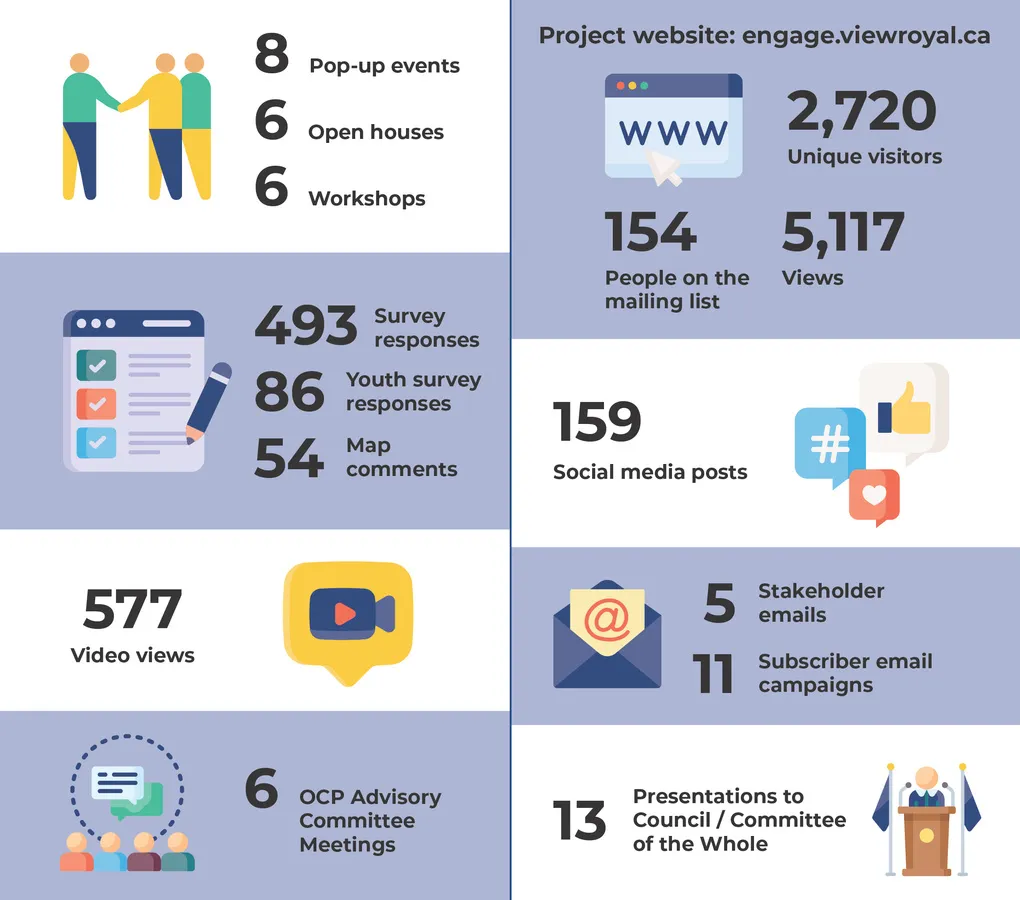
- 8 Pop-up events
- 6 Open houses
- 6 Workshops
- 2,720 Unique visitors to project website (engage.viewroyal.ca)
- 154 People on the mailing list
- 5,117 Views
- 493 Survey responses
- 86 Youth survey responses
- 54 Map comments
- 159 Social media posts
- 577 Video views
- 5 Stakeholder emails
- 11 Subscriber email campaigns
- 6 OCP Advisory Committee Meetings
- 13 Presentations to Council / Committee of the Whole
Vision Statement & Goals
The draft OCP includes a new vision and 12 supporting goals that set a clear direction for the community’s future. The vision describes the kind of community View Royal aspires to be, while the goals outline broad priorities that guide policies, land use decisions, and long-term investments. The vision and goals were informed through community engagement and feedback on draft statements. Council considered this input and provided further direction reflected in the vision statement and goals being presented in the draft OCP.
VISION STATEMENT
View Royal is a thriving, welcoming, inclusive community where people live close to nature, services, and amenities that foster health and well-being.
GOALS
- Mobility & Connectivity: Provide a variety of transportation options within a well-connected network to support mobilizing all ages and abilities.
- Diverse & Affordable Housing: Provide diverse, attainable, and affordable housing types and tenures for all residents.
- Growth Management & Community Character Preservation: Allow for thoughtful, fiscally responsible growth and development throughout the community that complements View Royal’s existing character.
- Natural Amenities: Preserve, protect, and expand the Town’s natural assets and amenities.
- Community Well-being: Enhance community well-being by providing safe, inclusive, and accessible spaces, while integrating arts and culture into everyday life.
- Community Safety & Security: Foster a safe and secure community that is prepared for emergencies.
- Climate Action & Resilience: Undertake climate adaptation and mitigation initiatives to support the community’s resiliency.
- Economic Development: Identify and incentivize opportunities for tourism and mixed-use and non-residential development to support local and regional economic priorities.
- Reconciliation: Build strong relationships with the Xʷsepsəm and Songhees Nations to collaborate on key priorities and decision-making, and continue to advance the Town’s reconciliation efforts.
- Community Input and Governance: Ensure View Royal community members are meaningfully involved in the advancement of community goals and priorities.
- Regional Partnerships: Continue to strengthen the Town’s relationships with partners and stakeholders, including member municipalities, on regional matters.
- Sustainable Service Delivery & Asset Management: Maintain and manage the full lifecycle costs of the Town’s assets to ensure the long-term provision of sustainable service delivery to meet the needs of the community.
Policy Chapters
The draft OCP includes 10 policy chapters that provide high-level direction on key areas within the responsibilities of local government. These chapters address a range of topics, including land use, housing, transportation and mobility, community infrastructure and services, economic development, the natural environment, climate action and sustainability, parks, trails and recreation, community well-being and culture, and reconciliation.
The policy chapters were informed through community engagement, including feedback on draft objectives for each policy chapter and key new policy directions that will guide how View Royal grows and changes over the next 20 years.
LAND USE OBJECTIVES AND POLICIES
The Land Use chapter outlines how View Royal will develop over time and how land may be used. A number of land use designations are identified that apply to different areas of the community, each with their own set of guidance related to the overarching intent of the designation and permitted heights and densities. This section also includes general policies for growth and development that will be reviewed as part of the development approvals process.
Objectives
The Land Use chapter includes seven objectives that aim to:
- Create a more complete and sustainable community by directing growth to corridors and mobility hubs
- Encourage the development of new compact housing in areas that are close to amenities, services, and transit
- Support high-quality development that will improve overall community building design, safety, and establish public spaces
- Continue to improve connections between neighbourhoods and mobility hubs
- Manage development to protect the natural environment, parks, trails, shoreline, and waterbodies
- Establish a functional interconnected green space trail network in the Western Gateway Corridor
- Design more space for public and private uses
Policies
The Land Use chapter includes 16 subsections that guide land use, growth, and development in the town. The project team has identified several key “big moves” where additional feedback is being sought.
Big Move: Mobility Hubs Policies
The draft OCP proposes two new mobility hubs that connect multiple transportation options and support medium and higher density development. These are located at the Hospital Transit-Oriented Area and the Atkins park and ride near Island Highway and the Galloping Goose Trail.
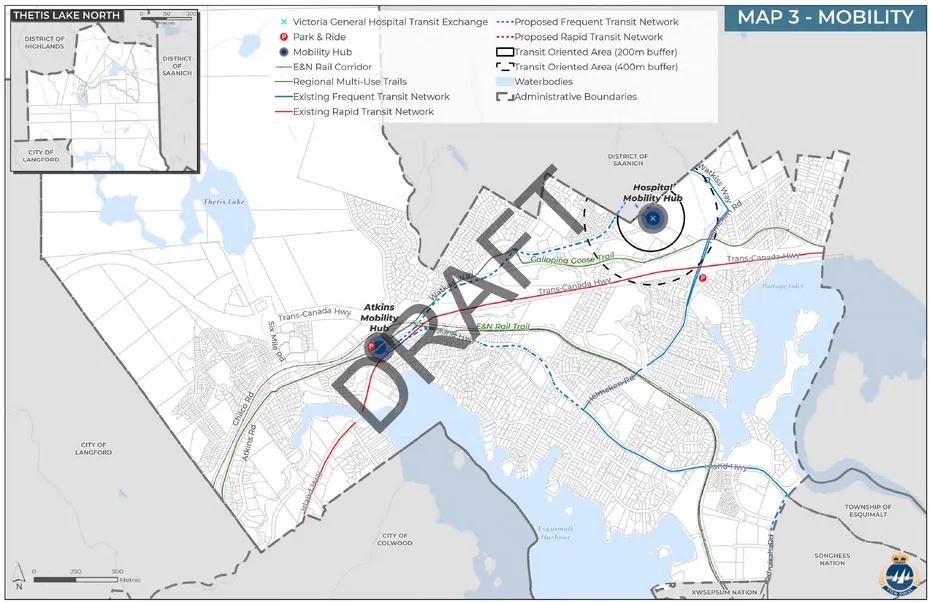
Policy A: Establish the Atkins Park and Ride and the Hospital Transit-Oriented Area as View Royal's mobility hubs that create conditions for the following:
- Centralized access to a range of services and amenities;
- Connections to and/or the provision of transportation services such as bus stops, sidewalks, bike lanes, trail connections, car share options, amongst others;
- Encourage and support local economic development; and
- Integrate and enhance public spaces that meet local community needs.
Policy B: Encourage transit supported uses and medium to high densities, including mixed use community-wide destination retail, small format retail, health services, community and social services, recreation facilities, education, and arts and cultural spaces.
Policy C: Promote walkability and a strong public realm by:
- Providing convenient links to transit, cycling routes, and local and regional multi-use trails;
- Including bike parking, passenger loading, accessible parking, and access to shared mobility options; and
- Integrating public spaces and amenities into site design such as landscaping features, wide sidewalks, public art, and seating elements.
Big Move: Redevelopment Policy
The draft OCP includes a range of policies to guide the redevelopment of land, including criteria, development considerations, and potential incentives.
Policy H: Notwithstanding the permitted height within the Land Use Designations, consideration for increased building heights for rezoning and amendments to the Official Community Plan where proposed developments achieve one or more of the following may be considered:
- Advance overall plan objectives;
- Are on sites with substantial grade differences;
- Meet specified density bonus zoning provisions;
- Achieve retention of high value trees or natural features and increased on-site open space;
- Demonstrate site design and architectural excellence; or
- Provide a significant public benefit including securing non-market or supportive housing and/or parks or community facilities.
Big Move: Western Gateway Employment District Corridor Policies
The draft OCP introduces a new land use designation, the Western Gateway Employment District Corridor, intended to support a long-term employment hub. It allows a mix of uses, including technology, tourism, retail and services, and light industrial activities.
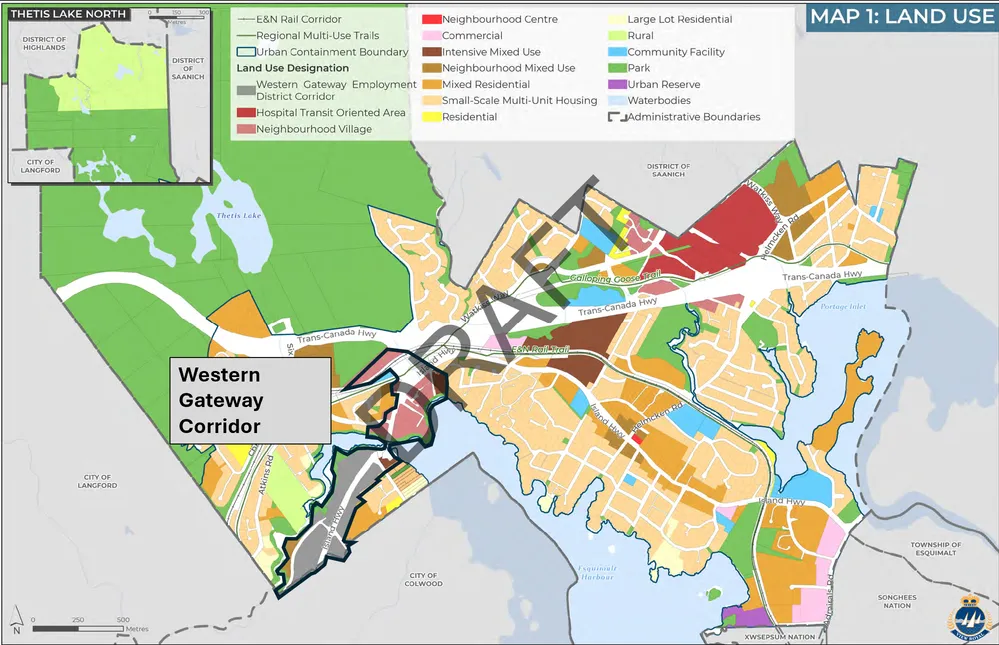
Policy A: Collaborate with the City of Colwood to establish the Western Gateway Employment District Corridor as a regional employment hub, prioritizing economic development and attracting business development.
Policy B: Encourage redevelopment of lands designated as Western Gateway Employment District Corridor to promote medium-density mixed-use development, with an emphasis on commercial, light industrial, arts and culture, and hospitality uses and high-quality urban design. Development in the Western Gateway Employment District Corridor should aim to achieve:
- A mix of employment uses including office, retail, hotel, research labs, community/civic use, and light industrial (e.g. light manufacturing and processing of goods, distribution).
- Strong public realm design and a pedestrian-friendly streetscape that is designed to attract visitors to the area through orienting buildings towards the street, using landscaping features such as plantings and seating to welcome in users to the space, providing sidewalk and trail connections to transportation options, Millstream Creek, the waterfront, and other key businesses in the corridor, and supporting the nearby Atkins Mobility Hub.
- Compatibility with nearby residential development through thoughtful design and landscape buffers, where appropriate.
- Long-term protection of Millstream Creek and shoreline by dedicating park land for green space and/or recreational trails whenever possible.
- Enhanced economic development opportunities for the Town, particularly local businesses and investments in emerging industries.
Policy C: Enable the provision and viability of industrial development through establishing conditions that allow for flexibility in the design and configuration of buildings with industrial uses, such as exploring opportunities to support stacked development and buildings with high ceiling heights on the first two storeys, amongst others.
Big Move: Hospital Transit-Oriented Area Policies
The draft OCP includes new policies for the Hospital Transit-Oriented Area, building on the land use designation adopted in December 2025 to be compliant with new provincial housing legislation. These policies support the area’s development as a mixed use hub with medical services, commercial uses, housing, and amenities.
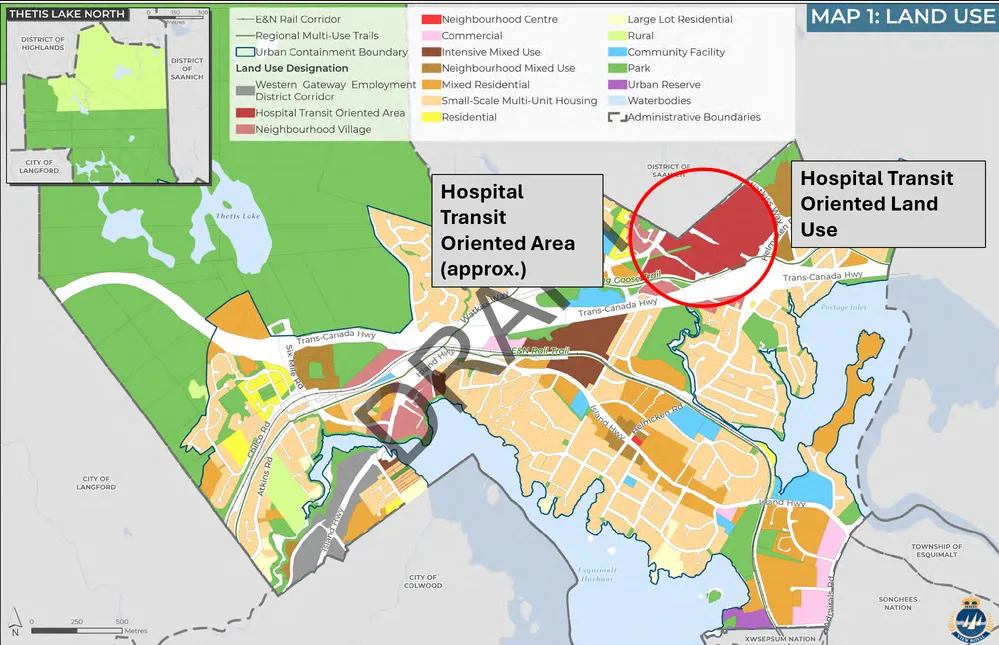
Policy A: Encourage redevelopment of lands designated as Hospital Transit-Oriented Area.
Policy B: Prioritize high-density, mixed use development in the Hospital Transit-Oriented Area that aims to provide, or create conditions for, the following:
- New residential dwellings, medical-related office spaces, tourist accommodations, and retail uses that benefit from and support the Victoria General Hospital.
- Diverse employment and commercial services that strengthen the local economy and support or complement existing local businesses and services.
- Rapid and frequent transit service routes.
- Ground floor commercial space.
- Underground or sub-surface parking facilities that promote a safe and enjoyable pedestrian environment.
- Improved access and traffic circulation within the area.
- Construction of, or partnership with the Town to provide, active transportation infrastructure to connect new development to the Hospital bus terminal, Galloping Goose Regional Trail, Trans-Canada Highway, the Eagle Creek development west of Victoria General Hospital, and the established residential area southeast of Helmcken Road.
Policy C: Promote increased housing options to diversify housing stock, including opportunities for supportive housing or affordable housing developments.
Big Move: Neighbourhood Village Policies
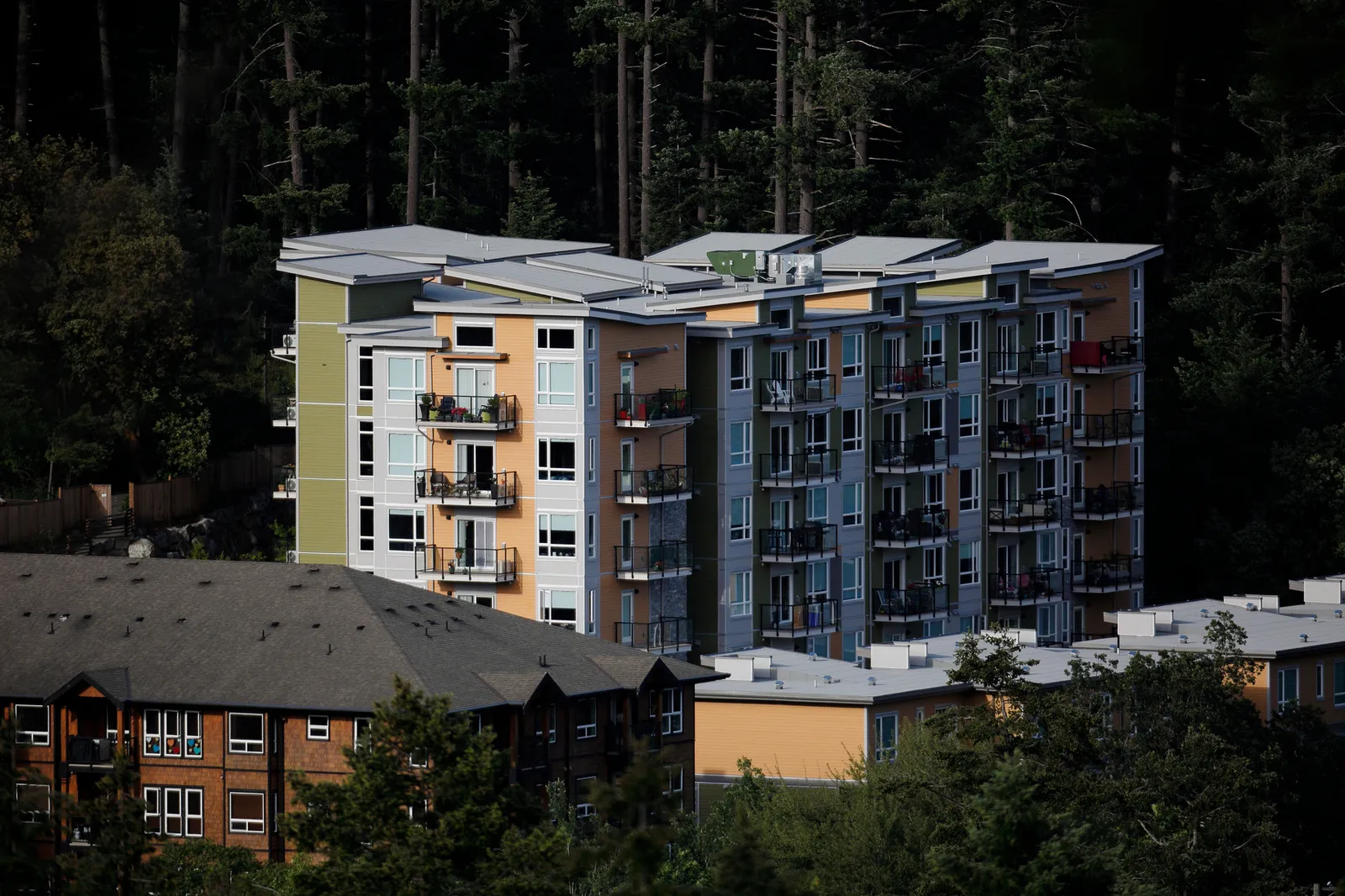
The draft OCP includes new policies for the Neighbourhood Village, building on the land use designation adopted in December 2025 to be compliant with new provincial housing legislation. These policies support mixed-use buildings, such as multi-unit housing and community serving commercial and civic uses such as schools, offices, restaurants, grocery stores, and community spaces.
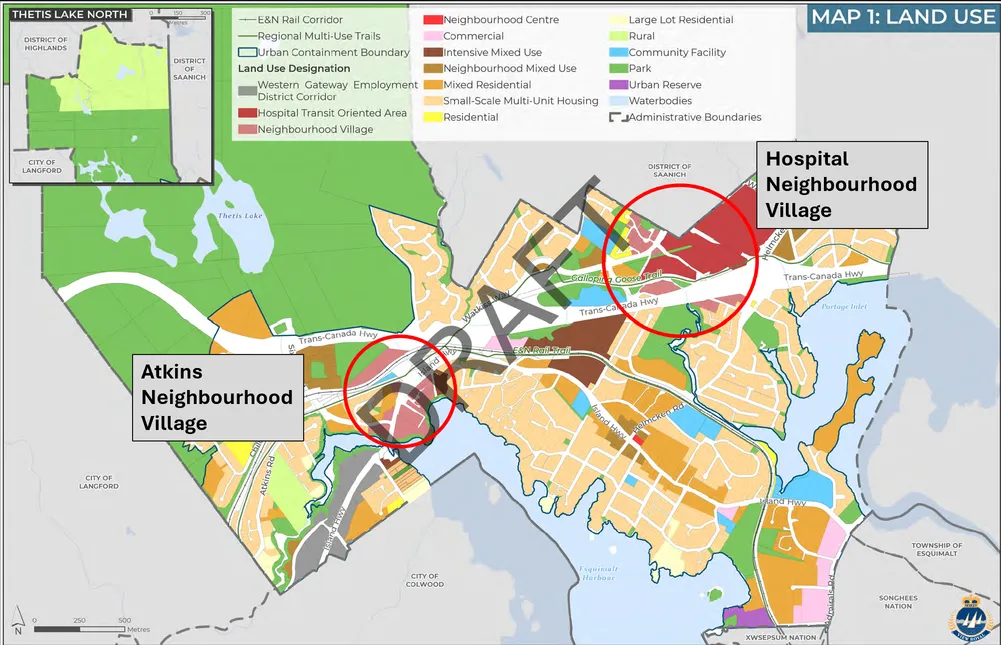
Policy A: Encourage redevelopment of lands within the Neighbourhood Village designation to support a variety of uses, including multi-unit mid-rise residential buildings, and commercial and civic uses that support the broader area.
Policy B: Support commercial and civic uses such as schools, offices, restaurants, retail, grocery store, and community spaces.
Policy D: Create strong and safe linkages to the surrounding neighbourhoods, parks, and trails at the following locations:
- The Neighbourhood Village designated area surrounding the Atkins Mobility Hub linking the Western Gateway Employment District Corridor and Price Bay.
- The Neighbourhood Village designation within the Hospital Transit-Oriented Area providing access to Craigflower Creek, the Galloping Goose Regional Trail, View Royal Park, and other existing parks.
HOUSING OBJECTIVES AND POLICIES
Housing in View Royal is increasingly affected by rising costs, demographic changes, and limited land for new development, creating a need for more diverse and attainable housing options. The Town’s housing needs report estimates that up to 4,189 additional homes may be needed by 2050 to meet current and future demand, much of which will be delivered through redevelopment and infill within existing neighbourhoods.
Objectives
The Housing chapter includes a series of five objectives that aim to:
- Support a wider range and supply of housing options across the community.
- Encourage housing that allows residents to age in place and supports accessibility.
- Protect and maintain long term rental housing.
- Provide housing options that meet the needs of residents at different life stages, abilities, and incomes.
- Work with partners to support affordable and non-market housing.
Policies
The Housing chapter includes policies that support suitable, attainable, and affordable housing forms for all View Royal residents. The project team has identified several key “big moves” where additional feedback is being sought.
Big Move: General Housing Policy
Policy B: Prioritize the review of development applications that meet one or more of the following criteria for approval by Council or Staff for permit issuance:
- Below-market housing development;
- Purpose-built rental housing;
- Supportive housing;
- Age-friendly housing;
- Provide significant public benefit, including parks, and/or community facilities;
- Housing led by non-profit organizations; or
- Advance the overall OCP objectives.
Big Move: Housing Supply Policies
Policy A: Continue to consider opportunities to facilitate an increase in housing supply by expediting development approval and permitting processes through the delegation of authority from Council to Staff, where appropriate, such as the authority to issue development permits and minor development variance permits, as specified in the Local Government Act.
Policy E: Consider identifying sites with a high likelihood of redevelopment for potential pre-zoning for multi-unit residential in the next Zoning Bylaw to support the Town’s goal of increasing and diversifying the community’s housing supply.
Policy G: Consider exempting residential developments, where two units or less are proposed, from form and character development permit requirements, including: duplex and garden suites.
Big Move: Family Housing Policy
Policy A: Support family-oriented housing by requiring new multi-unit residential developments of four or greater storeys, with the exception of seniors housing, supportive housing, and affordable rental housing projects, to allocate a proportion of units as follows:
- a minimum of 30% of units with two bedrooms or more; and
- a minimum of 10% of units with three bedrooms or more
Big Move: Accessibility in Housing Policy
Policy B: Aim to achieve 10% of units in all new multi-unit housing developments of four or more storeys to be dedicated as accessible adaptable units, particularly in below-market developments, and at least be designed and constructed in accordance with the BC Building Code, or an equivalent standard. These units should be provided on the ground floor or first storey whenever possible.

TRANSPORTATION AND MOBILITY
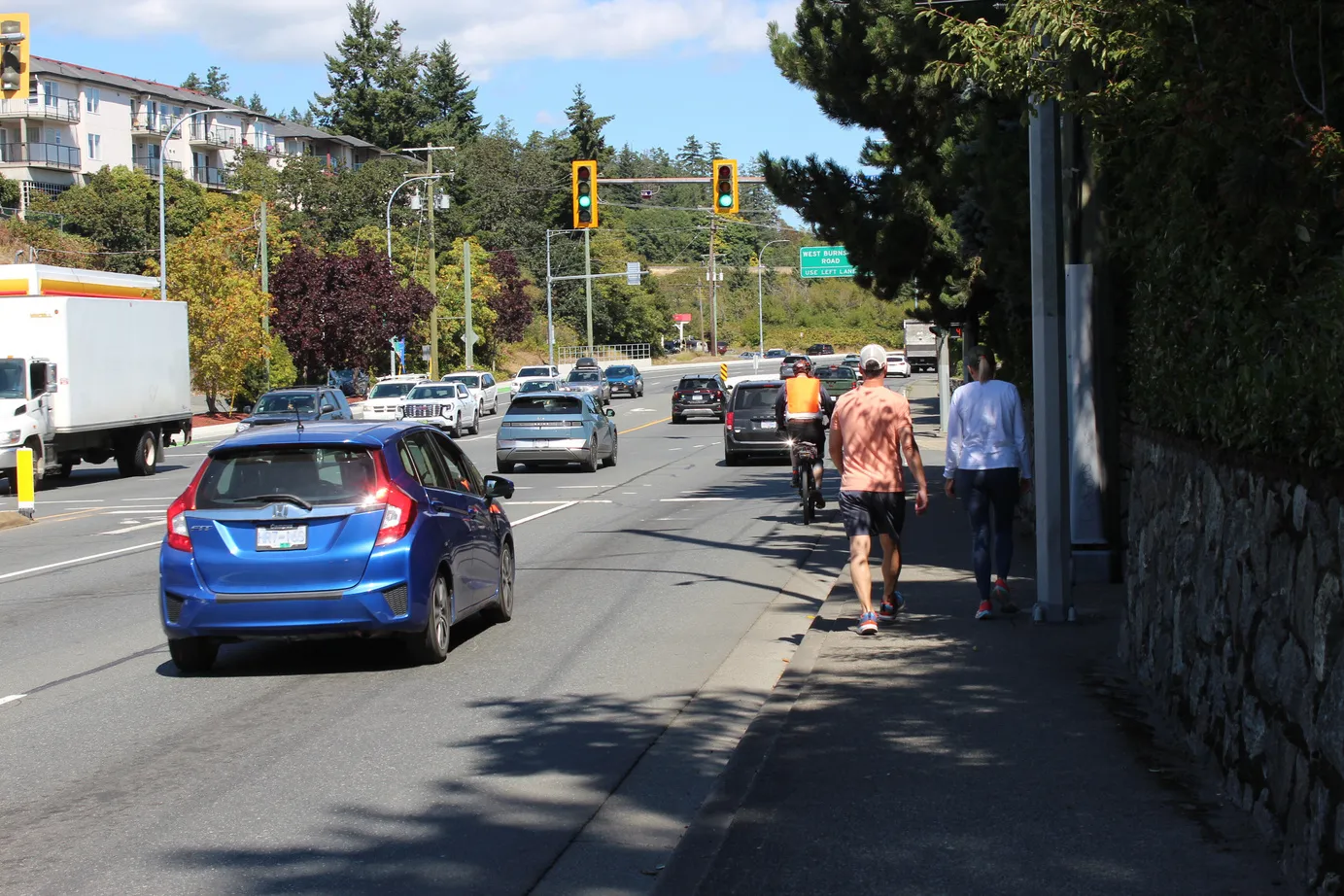
View Royal’s central location connects it to the region through major roads, transit routes, and regional trails. The OCP aims to improve mobility by supporting walking, cycling, transit, and development along key corridors and mobility hubs.
Objectives
The Transportation and Mobility chapter includes a series of six objectives that aim to:
- Improve walking, cycling, and transit networks as part of a connected multi-modal transportation system.
- Strengthen transportation connections to regional destinations such as parks, trails, schools, employment areas, and hospitals.
- Support a transportation system that is safe, accessible, and efficient for people of all ages and abilities.
- Prioritize the mobility needs of View Royal residents while managing the impacts of regional traffic.
- Encourage affordable and convenient transportation options, with greater emphasis on walking, cycling, and transit.
- Reduce greenhouse gas emissions by supporting active transportation and transit.
Policies
The Transportation and Mobility chapter includes policies that aim to enhance mobility options for getting around View Royal and travel through the community by employing strategies that encourage alternate transportation behaviours and choices. The project team has identified several key “big moves” where additional feedback is being sought.
Big Move: General Policy
Policy A: To support safe and efficient multi-modal systems for the movement of people throughout View Royal, in accordance with the priorities and strategies established in the Transportation Master Plan and Active Transportation Network Plan, priority of transportation infrastructure investments should be based on the following modal hierarchy:
- Foundation Access – Pedestrians, people using mobility aids, and emergency personnel and equipment
- High-Capacity, Low-Impact Mobility – Transit
- Active and Low-Speed Mobility – Cycling and micro-mobility devices
- Efficient Share Use – Shared vehicles
- Economic Backbone – Commercial vehicles
- Low Priority – Private vehicles
Big Move: Parking and Transportation Demand Management Policy
Policy C: Support reduced off-street vehicle parking supply where additional sustainable transportation infrastructure and services are provided and accessible parking supply is not impacted.
COMMUNITY INFRASTRUCTURE AND SERVICES
Community infrastructure such as water, sewer, drainage, and waste services are essential systems that support daily life in View Royal. The OCP aims to ensure these services are planned and maintained in a fiscally responsible and environmentally sustainable way as the community grows.
Objectives
The Community Infrastructure and Services chapter includes a series of six objectives that aim to:
- Guide infrastructure investments using asset management programs that maximize the value and lifespan of public assets.
- Plan infrastructure and service delivery in a fiscally responsible way that balances costs for current and future generations.
- Maintain a high level of service for essential infrastructure systems.
- Coordinate infrastructure upgrades and investments with community growth and land use planning.
- Protect the natural environment and human health when planning and delivering infrastructure services.
- Consider climate change impacts when designing, upgrading, and maintaining infrastructure.
Policies
The Community Infrastructure and Services chapter includes policies to ensure infrastructure and assets are planned, delivered, and maintained in an environmentally and fiscally responsible way. The project team has identified several key “big moves” where additional feedback is being sought.
Big Move: Infrastructure Standards Policy
Policy C: Consider the full life cycle of infrastructure services, including operations, maintenance and service levels, when designing new systems and upgrades.
Big Move: Infrastructure for a Healthy Environment Policies
Policy A: When considering infrastructure renewal priorities, considerations will be given to upgrades to infrastructure and services that will enhance the resiliency to the risks and impacts of climate change and disasters.
Policy B: Continue to explore opportunities to establish a natural asset inventory while supporting the protection, maintenance, and enhancement of existing natural assets and amenities.
ECONOMIC DEVELOPMENT
A strong and diverse local economy is vital to View Royal's long-term resilience. Supporting existing and new businesses will provide employment opportunities to residents and to those in the broader region. View Royal has a significant potential to become a regional economic hub, supported by the development of the Western Gateway Corridor, and Hospital Transit-Oriented Area, and corridors. The OCP aims to create conditions that support building on the Town's central regional location, its transportation connections, and opportunities for growth.
Objectives
The Economic Development chapter includes a series of seven objectives that aim to:
- Encourage local investment and economic growth in key areas of the town.
- Support development that helps make View Royal a destination.
- Leverage View Royal’s central location to attract new businesses and entrepreneurs.
- Support the evolving needs of local businesses, including traditional storefronts and flexible business models.
- Strengthen the relationship between economic activity, community well being, and access to services.
- Promote recreational tourism by building on the town’s parks, trails, and regional connections.
- Foster partnerships with businesses, institutions, and governments to support long term economic development.
Policies
The Economic Development chapter includes policies that aim to support the future creation of an economic development vision for View Royal, in addition to supporting new and existing businesses. The project team has identified several key “big moves” where additional feedback is being sought.
Big Moves: Strengthening the Local Economy Policies
Policy D: Explore opportunities for expanding the health services industry throughout View Royal, but particularly in the area surrounding Victoria General Hospital, to create a medical services hub through provision of medical offices, pharmacies, research labs, and related services.
Policy J: Understand the economic and land use conditions necessary to support the viability of light industry and similar employment uses on lands designated as Western Gateway Employment District Corridor on Map 1 to identify what action the Town can take to facilitate these conditions, given the benefits that light industry will generate for the local economy, such as a diversified tax base and living wages for residents.
Policy N: Explore incentives to attract hotel development, including but not limited to, density bonusing, parking reductions, streamlined applications processes, and flexible zoning to allow for a variety of uses to support hotel development.
NATURAL ENVIRONMENT
View Royal contains a wide range of marine, freshwater, and forest ecosystems that support wildlife, recreation, and community well being. The OCP aims to protect these natural areas while reducing risks from natural hazards such as flooding, steep slopes, wildfires, and earthquakes.
Objectives
The Natural Environment chapter includes a series of five objectives that aim to:
- Balance community growth with the protection of View Royal’s natural environment.
- Reduce risks to public safety from natural hazards such as flooding, landslides, wildfires, and earthquakes.
- Protect sensitive ecosystems, shorelines, and watercourses.
- Protect and enhance the town’s urban forest and tree canopy.
- Work with Songhees and Xʷsepsəm Nations to incorporate First Nations knowledge into environmental planning.
Policies
The Natural Environment chapter includes policies that aim to strengthen the long term resilience of the Town’s natural environment and reduce community risk from natural hazards. The project team has identified several key “big moves” where additional feedback is being sought.
Big Moves: Environmental Protection and Restoration Policies
Policy B: Prioritize land acquisitions and/or dedications over section 219 covenants to conserve, protect, and restore natural areas for the future.
Policy D: Advocate for the management of natural assets, such as natural green space and watercourses, within the Town's boundaries that provide non-municipal services.
Policy L: Consider opportunities to reduce or ban the use of pesticides, herbicides, and other toxins like microplastics.
Big Moves: Urban Forest Policies
Policy D: Continue to build, enhance, and increase the Town's urban forest, to achieve a 30% canopy coverage target for the Town by 2045, in alignment with the Town's Urban Forest Strategy.
Policy G: Enhance the pedestrian transit service experience by prioritizing the installation of new boulevard trees and identify opportunities to protect existing trees within 400 m of a prescribed frequent transit stop, along highways, and arterial and collector roads in the town.
Big Moves: Natural Hazards Risk Mitigation and Emergency Response Practices Policies
Policy A: Continue to designate lands susceptible to natural hazards (wildfire, tsunamis, floods, steep slopes greater than 30%), such as those shown on Maps 13 and 14, as Development Permit Areas to protect the public and development from potential threats to safety.
Policy M: Support the identification and mapping of community assets and infrastructure that are susceptible to natural hazards, including municipally-owned buildings, roads, and bridges. Explore options to enhance the resilience of these assets and infrastructure to mitigate possible negative effects.
CLIMATE ACTION AND SUSTAINABILITY
Climate change is already affecting View Royal through impacts such as wildfire smoke, extreme heat, and rising sea levels. The OCP supports actions to reduce greenhouse gas emissions and build a more climate resilient community through decisions about land use, buildings, transportation, and infrastructure.
Objectives
The Climate Action and Sustainability chapter includes a series of six objectives that aim to:
- Support efforts to achieve net zero greenhouse gas emissions by 2050.
- Integrate climate considerations into municipal decision making and planning.
- Prepare for climate impacts such as coastal flooding and sea level rise.
- Encourage low carbon development that reduces emissions from transportation and buildings.
- Protect community health and well being in the face of climate change.
- Work with regional partners, First Nations, and other governments on climate action and resilience.
Policies
The Climate Action and Sustainability chapter includes policies to guide View Royal’s efforts in climate change adaptation, mitigation, awareness, and sustainability. The project team has identified several key “big moves” where additional feedback is being sought.
Big Moves: Reduction of Greenhouse Gas Emissions Policies
Policy A: Achieve or exceed the provincial targets for community-wide GHG emissions including a 45% reduction in emissions below 2007 levels by 2030 and a 100% reduction in emissions below 2007 levels by 2050.
Policy D: Explore the creation of a Corporate Energy and Emissions Strategy for the Town that identifies opportunities for reducing GHG emissions caused by Town operations, transport, facilities, and waste management.
Big Moves: Climate Adaptation Policies
Policy D: Prepare and maintain an Emergency Management Plan for the community to prepare for, prevent, mitigate, respond to, and recover from the effects of natural disasters, hazards, and climate change.
Policy G: Consider the development of a Comprehensive Sea Level Rise Adaptation Plan to guide the long-term resilience of View Royal through:
- Identifying assets, infrastructure, and populations vulnerable to sea level rise.
- Evaluating adaptation options across physical, ecological, and policy domains.
- Prioritizing actions based on risk, feasibility, and community values; and
- Establishing timelines and funding strategies for implementation.
PARKS, TRAILS AND RECREATION
Parks, trails, and recreation spaces play an important role in supporting active lifestyles, community well being, and access to nature in View Royal. The OCP will guide future parkland, trails, and recreation improvements as the community grows.
Objectives
The Parks, Trails and Recreation chapter includes a series of five objectives that aim to:
- Support parks, trails, and recreation facilities that promote healthy and active lifestyles.
- Provide accessible parks and recreation amenities that meet the needs of residents of all ages and abilities.
- Protect the ecological functions of parks and natural areas.
- Strengthen partnerships with local and regional organizations to expand recreation opportunities.
- Maintain a sustainable level of parks and recreation services that meets community needs.
Policies
The Parks, Trails and Recreation chapter includes policies that aim to further implement the vision of the Parks Master Plan and guide future parkland, trails, and recreation priorities as the community grows. The project team has identified several key “big moves” where additional feedback is being sought.
Big Moves: Parkland Acquisition Policies
Policy B: Pursue the acquisition of parkland through dedication at the time of rezoning or subdivision. Considerations should include parkland size, location, access, topography, presence of any hazardous conditions, treed areas, native ecosystem integrity, and maintenance requirements to determine if the proposed parkland is appropriate for public use.
Policy C: Explore how to integrate urban park types into existing parks system to enhance streetscapes, such as pocket parks, road ends, and plazas, particularly in or near areas of high pedestrian activity. In reviewing development proposals for waterfront sites, encourage new public water and shoreline accesses, parks, and boat launches depending on current Flood Hazard Land Management Guidelines to consider a 2.0 global sea level rise (approximately 200 years) relative to the year 2000 sea level.
COMMUNITY WELL-BEING AND CULTURE
Community well being in View Royal is shaped by the social, cultural, and economic conditions that support residents’ health, safety, and sense of belonging. The OCP aims to strengthen community well being by supporting inclusive spaces, cultural identity, heritage, accessibility, and opportunities for people of all ages to participate in community life.
Objectives
The Community Well-Being and Culture chapter includes a series of seven objectives that aim to:
- Recognize and celebrate View Royal’s heritage, culture, and identity, including those of the Songhees and Xʷsepsəm Nations.
- Support arts, culture, and community activities through programs, spaces, and events.
- Foster a diverse, equitable, and inclusive community for residents of all ages and backgrounds.
- Strengthen community connections and a shared sense of belonging.
- Promote community safety, health, and well-being through partnerships and community support.
- Support youth and families and encourage opportunities for future community leaders.
- Encourage civic participation and community involvement in local decision making.
Policies
The Community Well-being and Culture chapter includes policies to support community health, cultural identity, inclusion, heritage, and opportunities for residents of all ages, helping create a safe and connected community. The project team has identified several key “big moves” where additional feedback is being sought.
Big Moves: Community Health and Safety Policy
Policy B: Explore opportunities to increase the number of medical clinics and other health care services in the Town to support community needs.
Big Moves: Food Security Policy
Policy B: Encourage the development of small-scale, healthy and affordable food retail options such as year-round and seasonal farmers markets, small to mid-size locally-owned grocery stores, mobile food vendors, bakeries, and restaurants.
RECONCILIATION
View Royal is committed to reconciliation through ongoing relationship building, collaboration, and learning with the Xʷsepsəm and Songhees Nations. The OCP supports this commitment by encouraging planning and decision making that recognizes the enduring presence and stewardship of the lək̓ʷəŋən Peoples.
Objectives
The Reconciliation chapter includes a series of two objectives that aim to:
- Strengthen government-to-government relationships with the Xʷsepsəm and Songhees Nations.
- Integrate reconciliation into community planning and decision making.
- Recognize and respect the presence, history, and cultural contributions of Indigenous peoples in View Royal.
- Support Indigenous identity, representation, and cultural expression in the community.
Policies
The Reconciliation chapter includes policies to support ongoing reconciliation, collaboration, partnership, and relationship-building initiatives. The project team has identified several key “big moves” where additional feedback is being sought.
Big Moves: Commitment to Cultural Awareness and Learning Policy
Policy A: Align municipal policies with the United Nations Declaration on the Rights of Indigenous Peoples & the Provincial Declaration on the Rights of Indigenous Peoples Act to ensure Indigenous rights are explicitly recognized.
Big Moves: Supporting Economic Reconciliation and Right to Self-Determination Policies
Policy: Collaborate with Xʷsepsəm and Songhees Nations to identify and pursue opportunities for Indigenous led land and economic development initiatives, such as Nation-led housing, mixed use, and economic projects.
Policy: Support Indigenous-led economic initiatives through locally-forged business partnerships with Xʷsepsəm and Songhees nations and support Indigenous business development and Indigenous development corporations.