Official Community Plan - 8.3.6 REGIONAL TRANSPORTATION and 8.3.7 PARKING + TRANSPORTATION DEMAND MANAGEMENT
Policies on regional light rail, the E&N corridor, and managing on-site parking demand.
8.3.6 REGIONAL TRANSPORTATION
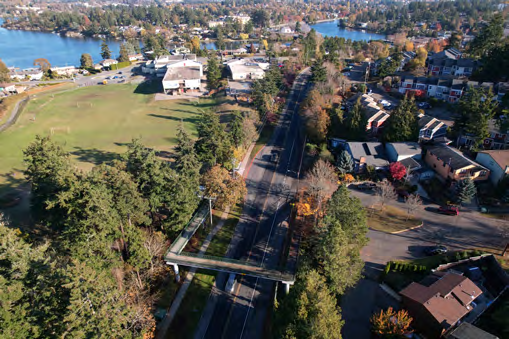
A. Continue to collaborate with Xʷsepsəm and Songhees Nations, Island Corridor Foundation, Capital Regional District, municipal partners, and senior levels of government to establish a vision for the future use of the E&N corridor.
B. Advocate and explore opportunities to support the Reconciliation Corridor Initiative for regional light rail transit through collaboration with Xʷsepsəm and Songhees Nations, the Island Corridor Foundation, Capital Regional District, the Province, and neighbouring municipalities.
C. Support the Capital Regional District’s Regional Transportation Service and due consideration of key corridors and priorities in View Royal as part of the Regional Multi-modal Network.
D. Continue to work with the Capital Regional District, neighbouring municipalities, BC Transit, the Province, First Nations and other partners to support integrated land use and transportation planning that maintains mobility, supports economic activity, and enhance community livability.
Added policy 8.3.6(D) in response to Council resolution C-134-26 passed at the Council meeting on June 16, 2026
8.3.7 PARKING + TRANSPORTATION DEMAND MANAGEMENT
A. Seek to meet site transportation demand through appropriate on-site parking supply and transportation demand management measures that reduce reliance on private vehicles.
B. Prioritize accessible parking and loading space requirements for residential, commercial, industrial, and institutional uses.
C. Ensure that commercial and light industrial uses provide parking and loading spaces that support the functional needs of businesses.
Transportation Demand Management
Transportation Demand Management comprises strategies that seek to improve the movement of people and goods, reduce dependence of the private car, and encourage travel via modes of alternate transport, such as transit, cycling, walking, rolling, and car share. Common desired outcomes of implementing transportation demand management strategies are reduced traffic congestion, lowered demand for parking, and cleaner air. Examples of transportation demand management strategies include shared mobility service programs such as e-scooter and e-bike rentals, transit subsidies, and car share programs, amongst others.
D. Optimize the use of the Town’s public curb spaces with consideration of different demands, including mobility, parking, commercial uses, public space, and waste collection, among others.
E. Manage on-street parking to best serve public needs, considering local parking demand, surrounding land use, and the need to accommodate other curbside functions.
F. Collaborate with major employers in View Royal, such as Victoria General Hospital and the Capital Regional District, to support sustainable transportation and mitigate traffic and parking impacts.
G. Work with regional partners to implement electric vehicle charging infrastructure, informed by the Capital Region EV Infrastructure Road Map and Capital Region Public Electric Vehicle Charging Guide, to increase the supply of EV charging infrastructure in new development, public parking lots, and on-street, where appropriate.