Official Community Plan - 12.0 Climate Action and Sustainability
View Royal's commitments and strategies to address the climate emergency and achieve carbon neutrality.
12.0 Climate Action and Sustainability
12.1 CONTEXT
The impacts of climate change are evident in View Royal through unprecedented events that are occurring more frequently, such as wildfire smoke, extreme heat, and localized flooding. In response, the Town declared a climate emergency on March 5, 2019, to stress the importance of the situation at hand. Since that time, the Town has worked collaboratively on climate initiatives, including a Community Climate Action Strategy, but further work is required to position the town as a local climate leader in the future. As a signatory to the BC Climate Action Charter in 2007, the Town is committed to becoming a carbon-neutral and climate-resilient community.
Climate change impacts underscore the need to proactively adapt and mitigate the effects of climate change. Municipal decisions regarding land use, development, transportation, infrastructure, and waste management significantly impact greenhouse gas emissions and the impacts are cumulative. By acknowledging these long-term climate impacts, the Town can make choices and take actions to help move the community towards climate sustainability by reducing greenhouse gas emissions and being prepared for future conditions.
Climate change is intertwined with all aspects of the community, making it one of the prominent themes in the Official Community Plan. This section outlines the objectives and policies to guide the Town’s efforts in climate change awareness, mitigation, and sustainability.
The following Official Community Plan Goals may be achieved through the objectives and policy direction provided in this section:
- Community Safety & Security
- Climate Action and Resilience
- Regional Partnerships
12.2 OBJECTIVES
12.2.1 NET-ZERO EMISSIONS
Advocate to senior levels of government and collaborate with neighbouring municipalities and community members to achieve a net-zero emissions level by 2050.
12.2.2 CLIMATE CONSCIOUS DECISION MAKING
Acknowledge the role that municipal decisions have in impacting and shaping local and regional climates and consider decision-making through a climate conscious approach. Allocate resources accordingly to undertake initiatives to adapt to the changing climate and mitigate risks.
12.2.3 COASTAL CLIMATE ADAPTATION AND RESILIENCE
Develop an understanding and approach to respond to the unique challenges that View Royal faces as a coastal community and the impacts of coastal flooding and sea-level rise due to climate change and global warming.
12.2.4 CLIMATE CONSCIOUS DEVELOPMENT
Approach development through a low-carbon climate lens that prioritizes climate resiliency, sustainable development, reduces greenhouse gas emissions related to transportation, land use, building, and service delivery.
12.2.5 COMMUNITY HEALTH AND WELL-BEING
Acknowledge the strong link between community health, well-being, and climate change and ensure that View Royal is prepared to mitigate any potential negative impacts on public health resulting from this linkage.
12.2.6 PARTNERSHIPS
Pursue constructive, impactful, and collaborative partnerships with the Capital Regional District, other local governments and First Nations in the region, senior levels of government, community groups, and other agencies to pursue comprehensive actions related to all facets of climate change mitigation, adaptation, and resilience.
12.3 POLICIES
12.3.1 TAKING ACTION
A. Continue the Town’s commitment as a signatory to the 2007 BC Climate Charter. B. Continue to understand the impacts and effects of climate change in recognition of the Town’s declaration of a climate emergency and identify opportunities to develop climate actions in strategic plans to work towards carbon neutrality.
12.3.2 REDUCTION OF GREENHOUSE GAS EMISSIONS
A. Work towards achieving the provincial targets for community-wide greenhouse gas emissions including a 45% reduction in emissions below 2007 levels by 2030, and a 100% reduction in emissions below 2007 levels by 2050. In Policy 12.3.2, added "Work towards..."
B. Collaborate with other municipalities in the Capital Regional District, senior levels of government, public agencies, and organizations to reduce greenhouse gas emissions through initiatives related to land use, building energy efficiency and transportation planning, infrastructure design, water and energy conservation, solid waste management, and green procurement of goods and services.
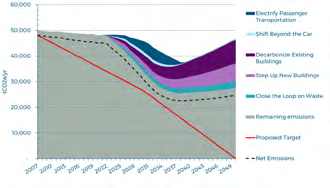
View Royal Community Climate Action Strategy 7 Plan Implementation By implementing this strategy, View Royal can reduce its emissions by an estimated 36% below 2007 levels by 2030, and work towards the new long-term target of a reduction of 100% below 2007 levels by 2050. In doing so, View Royal will place itself as a leader in taking significant action on climate change. See the following pages for a description of how each Big Move contributes to the reduction in emissions.
Note: net emissions include all sources and sinks. Natural lands within the municipal boundary help absorb carbon dioxide.
By implementing the Community Climate Action Strategy, View Royal can reduce its emissions by an estimated 36% below 2007 levels by 2030 and work towards a 100% decrease by 2050.
C. Advocate to senior levels of government to support View Royal’s climate goals and targets, and natural hazard (e.g. flooding, wildfire) mitigation and response objectives. This support may include legislation, policy, programs, and data that provides the Town with the funding and resources necessary to address the climate emergency.
D. Explore the creation of a Corporate Energy and Emissions Strategy for the Town that identifies opportunities for reducing greenhouse gas emissions caused by Town operations, transport, facilities, and waste management.
E. Investigate opportunities to transition the Town’s fleet of vehicles to electric and low emission vehicles.
F. Research a “buy-clean” procurement policy that prioritizes the purchase of low- and no-carbon materials and products for the Town.
G. Continue to support the Community Climate Action Strategy’s recommended initiatives to reduce greenhouse gas emissions, including the following: i) Encourage active and accessible transportation and transit; ii) Accelerate the adoption of zero emissions vehicles; iii) Enhance energy efficiency and low carbon heating in new buildings; iv) Support deep energy retrofits and fuel switching for buildings; and v) Divert organics from the landfill and capture value from waste.
12.3.3 BUILT ENVIRONMENT
A. Explore options to incorporate sustainability considerations into the Development Permit Area guidelines, Building Bylaw, and Zoning Bylaw, such as enhanced landscaping requirements to improve tree canopy coverage, more broadly permitting urban agriculture to advance food security goals, and increasing requirements for bike parking, amongst others.
B. Continue to support enhanced energy efficiency and low carbon heating in new buildings by requiring new development to meet or exceed the requirements of the BC Energy and Zero Carbon Step Codes.
C. Encourage new development to exceed the requirements of the BC Energy and Zero Carbon Step Codes.
D. Determine the viability of reusing building demolition materials for construction purposes.
E. Consider adopting policies and programs to encourage decarbonization of existing buildings, such as deep energy retrofits and fuel switching.
The BC Energy and Zero Carbon Step Codes are provincially-legislated measures that aim to achieve zero carbon and net-zero energy ready buildings.
12.3.4 INFORMATION AND EDUCATION
A. Support climate change education and identify opportunities to collaborate with youth on climate change planning and action through local youth organizations and school programs.
12.3.5 CLIMATE ADAPTATION
A. Continue to work with neighbouring municipalities, the Capital Regional District, and Xʷsepsəm and Songhees Nations on the development and implementation of strategies to mitigate the impacts caused by climactic events, such as sea-level rise, increased wildfire risk, altered seasonal temperatures and precipitation, air pollution, and waterborne contaminants.
B. Continue to develop and implement new regulations and policies to protect and enhance public safety during natural hazard events that may be a result of climate change.
C. Continue to develop and implement strategies to mitigate wildfire risk in View Royal by: i) Implementing recommendations from the Community Wildfire Resiliency Plan; ii) Supporting the View Royal FireSmart Program; iii) Integrating FireSmart principles into the Town’s bylaws and policies; and
Following a legal review, Policy 12.3.5(C)(ii) was revised by replacing "maintaining" with "supporting" to avoid mandatory language if the FireSmart Program is replaced or terminated.
iv) Applying a Wildfire Interface Hazard Development Permit Area to the Wildfire Urban Interface areas of the community where wildfire risk is high and incorporate FireSmart principles within the guidelines accordingly.
D. Prepare and maintain an Emergency Management Plan for the community to prepare for, prevent, mitigate, respond to, and recover from the effects of natural disasters, natural hazards, and climate change.
E. Explore opportunities to create a Climate Adaptation and Mitigation Strategy with the Xʷsepsəm and Songhees Nations to integrate traditional knowledge of land stewardship into climate action policy and decision-making, identify local and regional climate action, and partner on the implementation of these actions together.
F. Review and update to the Community Heat Resilience Plan to enhance the Town’s preparedness for extreme heat events.
G. Explore the development of a Comprehensive Sea Level Rise Adaptation Plan to guide the long-term resilience of View Royal by: i) Identifying assets, infrastructure, and populations vulnerable to sea level rise; ii) Evaluating adaptation options across physical, ecological, and policy domains; iii) Prioritizing actions based on risk, feasibility, and community values; and iv) Establishing timelines and funding strategies for implementation.
H. Determine how the findings of the Coastal Hazard Mapping and Risk Assessment Report will be integrated into Town regulations and policies to proactively address the risk of sea level rise and coastal flooding in View Royal.