Official Community Plan - 13.2 OBJECTIVES and 13.3 POLICIES (Parks)
Guidelines for parkland acquisition, improvements, and the enhancement of recreational connections.
13.2 OBJECTIVES
13.2.1 HEALTHY, EQUITABLE, AND SAFE PARKS, TRAILS, AND RECREATION FACILITIES
Continue to promote parks, trails, and recreation facilities as contributors to the overall health and well-being of residents and visitors, and explore opportunities to expand, design, and maintain these amenities for all ages and abilities to support a healthy and active lifestyle.
13.2.2 ACCESSIBLE PARKS, TRAILS, AND RECREATION FACILITIES
Continue to explore opportunities to provide parks, trails, and recreation amenities that meet the diverse social, recreational, and wellness needs of current and future residents. Consideration of the type and location of these amenities should be considered at a community-wide and neighbourhood level, and within the Town’s financial and service capacity.
13.2.3 PROTECT ECOLOGICAL AND ENVIRONMENTAL FUNCTIONS
Continue to recognize and protect the role parks play in maintaining the ecological integrity of our environment and contributing to climate change adaptation, mitigation, and resilience.
13.2.4 PARTNERSHIP AND COLLABORATION
Continue to strengthen existing partnerships and consider opportunities for new partnerships with local and regional governments and non-profit organizations to expand local and regional recreational opportunities.
13.2.5 LEVEL OF SERVICE
Achieve a sustainable level of service delivery for parks, trails, and recreation services that reasonably addresses community demand for access to public spaces, and is within the Town’s financial and resource capacity levels.
13.3 POLICIES
13.3.1 GENERAL
A. Apply an equitable, diverse, and inclusive approach to the delivery of parks, trails, and recreation services in View Royal through the consideration of resident ages, and abilities in the identification of priorities and the design of such spaces and infrastructure. B. Ensure parks, trails, and recreation planning are integrated with broader community planning efforts in the Town, including land use and transportation decisions, and public realm design. C. Continue to identify and understand gaps in the Town’s parks, trails, and recreation offerings, and consider opportunities to enhance these amenities so that they are more adequate, usable, and accessible for all residents. D. Aim to achieve a minimum of 5.0 hectares (12.4 acres) of parkland per 1,000 people, residents living within a 400m radius, or a 5-minute walk of usable park space excluding regional parks and schools, while considering other significant factors affecting acquisition and access to parkland, such as transportation corridors and the Trans-Canada Highway. E. Continue to explore opportunities to remove barriers and improve access for people of all abilities to parks, recreational facilities, public waterfront areas, viewpoints, and greenways while remaining sensitive to the preservation of natural habitat areas. F. Support the safety and comfort of parks and recreation facility users by applying design principles and practices that address crime prevention in public spaces.
13.3.2 PARKLAND ACQUISITION
A. Prioritize parkland acquisition in neighbourhoods where supply is deficient. Special attention should be given to areas with high concentrations of underserved demographic groups, children and teenagers, and other groups with unique recreation and access needs. B. Pursue the acquisition of parkland through dedication at the time of rezoning or subdivision. Considerations should include land size, location, access, topography, presence of any hazardous conditions, treed areas, native ecosystem integrity, historic contamination risk and liability, cultural significance, and maintenance requirements to determine if the proposed parkland is appropriate for Town ownership. C. Explore how to integrate urban park types into the existing parks system to enhance streetscapes, such as pocket parks, road ends, and plazas, particularly in or near areas of high pedestrian activity. D. In reviewing development proposals for waterfront sites, encourage new public water and shoreline accesses, parks, and boat launches with consideration to current Flood Hazard Land Use Management Guidelines that recommend preparing for a 2.0m global sea level rise (approximately 200 years) relative to the year 2000 sea level.
13.3.3 PARK IMPROVEMENTS
A. Partner with community organizations, West Shore Parks and Recreation, and the Capital Regional District where possible to acquire, improve, and manage parkland amenities. B. Continue to maintain and enhance existing parks to a high standard and consider the development of new facilities as needed. C. Support investment in View Royal Park as the Town’s primary park to enhance access to recreation activities that attract a broad range of users. D. Explore opportunities to provide weather protection infrastructure in public parks and gathering spaces, including shade and rain coverage features. E. Prioritize parkland improvements where green space is not readily available, and in areas with high concentrations of underserved demographic groups, children and teenagers, and other groups with unique recreation and access needs. F. Emphasize aspects of historical and cultural significance in View Royal parks, as well as through collaboration with the Xʷsepsəm and Songhees Nations.
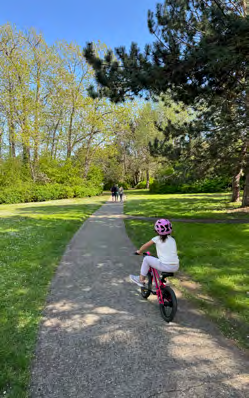
13.3.4 RECREATION
A. Continue to support the Town’s inter-municipal facility sharing agreement for the West Shore Recreation Centre. Explore options for increasing local benefits from this partnership. B. Explore opportunities for partnerships with the Capital Regional District, School District 61, West Shore Parks and Recreation, community organizations, and other users to deliver additional recreational opportunities for View Royal residents. C. Support non-motorized water recreation in View Royal and continue to explore opportunities to improve access to the water for non-motorized vessels in Esquimalt Harbour and Portage Inlet at key waterfront locations. D. Enhance recreation amenities within parks without compromising critical habitat or sensitive species. E. Work with the Canadian Forces Base Esquimalt to develop and implement signage promoting safe boating practices in Esquimalt Harbour.
Non-motorized vessels are human-propelled watercraft such as kayaks, stand-up paddleboards, and canoes, amongst others.
13.3.5 IMPROVING CONNECTIONS BETWEEN PARKS AND RECREATION FACILITIES
A. Ensure all community members have equitable access to parks, green spaces, recreation facilities, schools and residential areas by enhancing linear parks, public trails, active transportation corridors, transit opportunities, and sidewalk connections.
13.3.6 PARKS AND THE NATURAL ENVIRONMENT
A. Preserve and restore environmentally sensitive areas within parks wherever possible. B. Acknowledge the role that natural assets such as trees and wetlands play in providing ecosystem services, stormwater management, temperature regulation, and climate resilience in View Royal parks by maintaining and enhancing these natural assets. C. Explore opportunities to educate the community on natural systems that exist within parks through interpretive signage and information boards. D. Protect ecosystems in natural parks through sensitive management and minimal construction, ensuring that any works shall be carried out in an environmentally sensitive manner with proper consultation with a qualified professional. E. Rehabilitate areas affected by invasive plants and species using climate adaptive native vegetation and trees in View Royal parks. Where feasible, implement preventative measures to protect native habitats. F. Consider the criteria required to develop construction standards for trails and structures to avoid and mitigate harmful impacts on the natural environment.