New Growth Tree Service - Tree Inventory and Status Update
An arborist report detailing the health and protection status of trees on the property at 241 Glenairlie Drive.
Tree Inventory and Status Update: 241 Glenairlie Drive
Kyle Porter 250 217 2274 kyle@vret.ca 241 Glenairlie Dr, Victoria, B.C.
The client has requested an inventory and status update on the trees standing in the lot of 241 Glenairlie Drive. A site visit was conducted on the 29th of March 2026, by Jess-C Hall. Four trees of interest were found on the lot, listed below in Table 1. They do not have ID tags and have been numbered in Table 1, and in the corresponding aerial photo in Figure 1. It should be known that this property falls under the tree protection bylaw set out by View Royal.
Table 1
| Species | Number | DbH (cm) | Protected | Status |
|---|---|---|---|---|
| Gary Oak | 1 | 30, 23, 17 | Yes | Healthy |
| Big Leaf Maple | 2 | 48 | Yes | Potentially compromised |
| Big Leaf Maple | 3 | 78 | Yes | Hazardous |
| Cherry | 4 | 12 | No | Healthy |
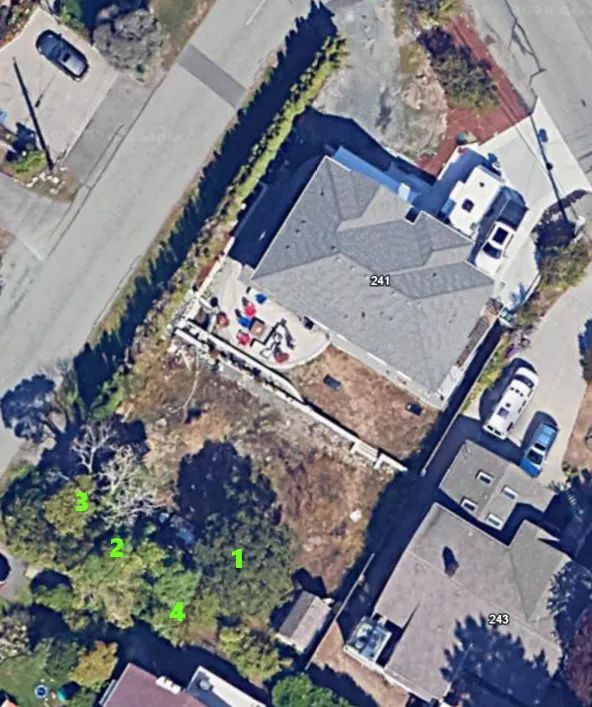
The tree temporarily designated as tree 1, is a multi-stemmed Gary oak. The site visit occurred before the foliage had developed, despite this it shows no significant signs of decline or damage. It is both a protected species and exceeds the size cut off for protected status. Transplanting this tree would not be recommended, Gary oaks have extensive root structures, and the damage caused by transplanting would likely cause diseases later in its life. Planting a younger oak in ideal soil conditions would yield better results.
The tree temporarily designated as tree 4, is a small cherry on the property line. Likely, this tree was a volunteer. Left alone it is likely to quickly develop into a medium size tree, and is likely to cause damage to the fencing it is growing up against. Under View Royals tree protection bylaw, it is not protected.
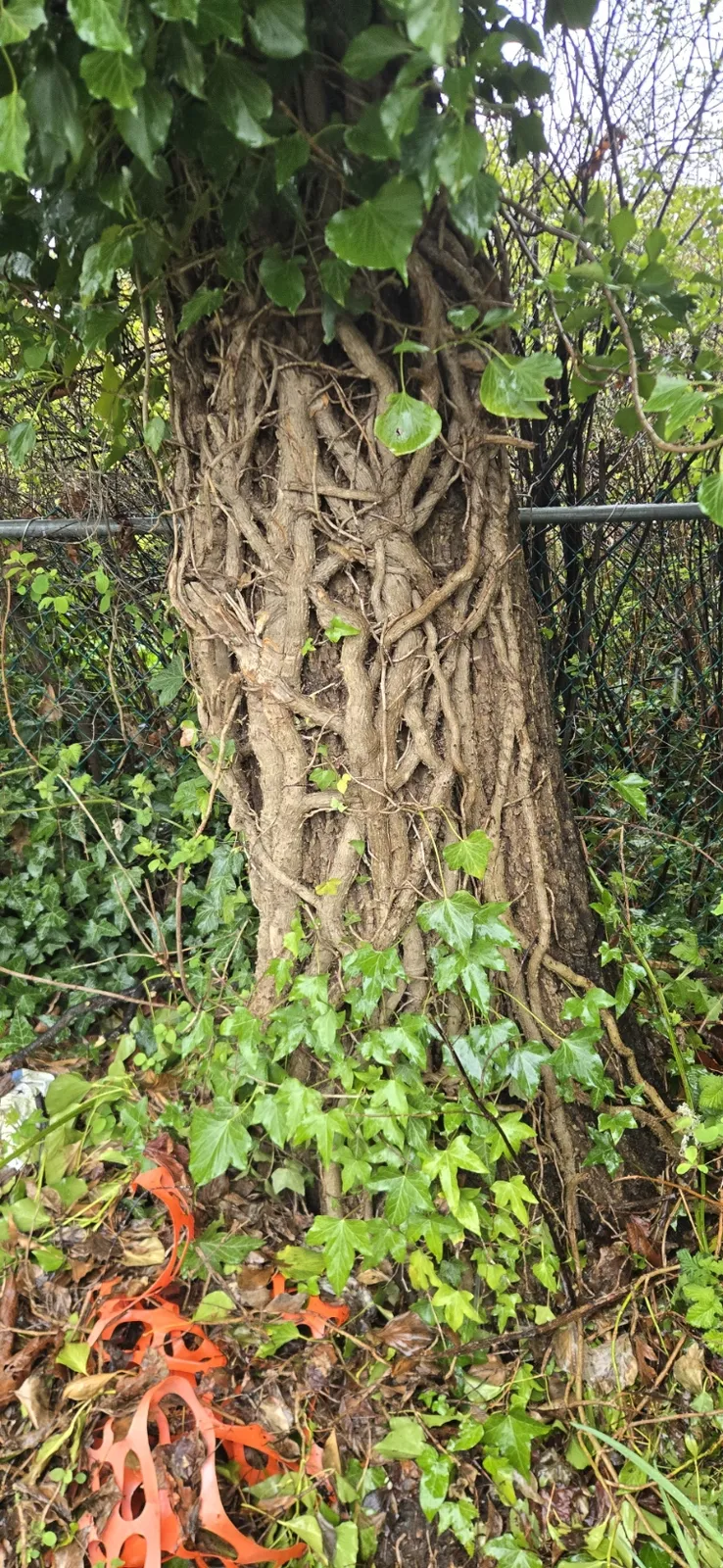
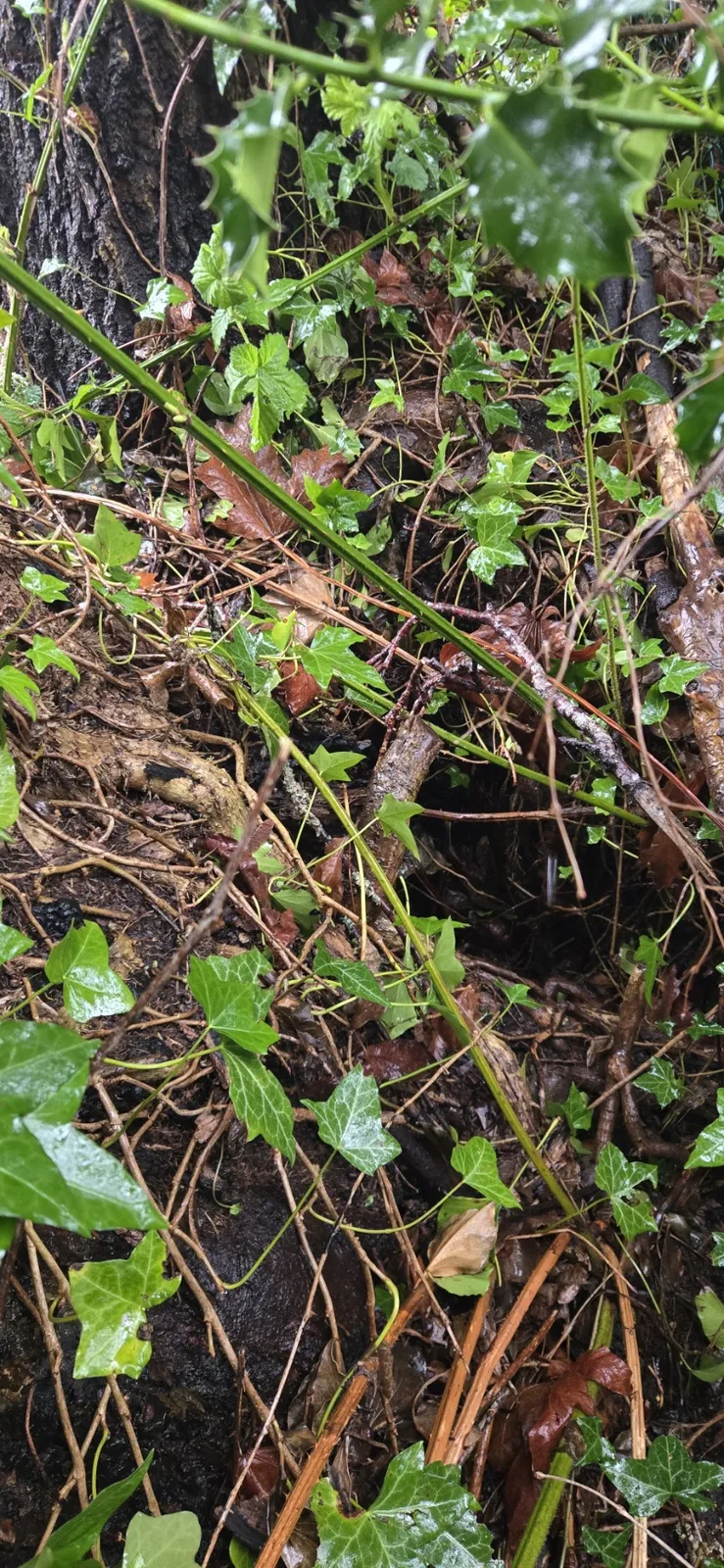
The tree temporarily designated as tree 2 is a mature big leaf maple, it is heavily infested with English ivy as seen in Figure 2. When this ivy is left untreated it can cause complications in trees, and obscure other issues. The DbH measurements taken were estimations because of the thick ivy coverage. The stem of tree 2 and 3 are quite close and likely have intermingling roots. The hole shown in Figure 4, is between these trees, and may be evidence of compromised roots. An informal pull test was completed, and with the weight of one person was able to cause movement at the base of the tree. Even with this preliminary evidence, this tree poses more risk than the value it brings. The damage this individual could cause falling on the neighbour’s property would likely outweigh the cost of removing, and replacing the tree altogether. This would create an opportunity for installing a better, longer living tree in soil uncontaminated by invasive vines.
The tree temporarily designated as tree 3 is a mature big leaf maple shown in Figure 3, and despite its heavy infestation of English ivy clear signs of decline are plainly visible. It has major scaffolding branches that are dead, a large canker on the stem, and a heavy lean, potentially caused by it heaving. A large gap has formed between trees 2 and 3, shown in Figure 4. And, given that the gap is not covered up by the ivy, this must have been a recent change.
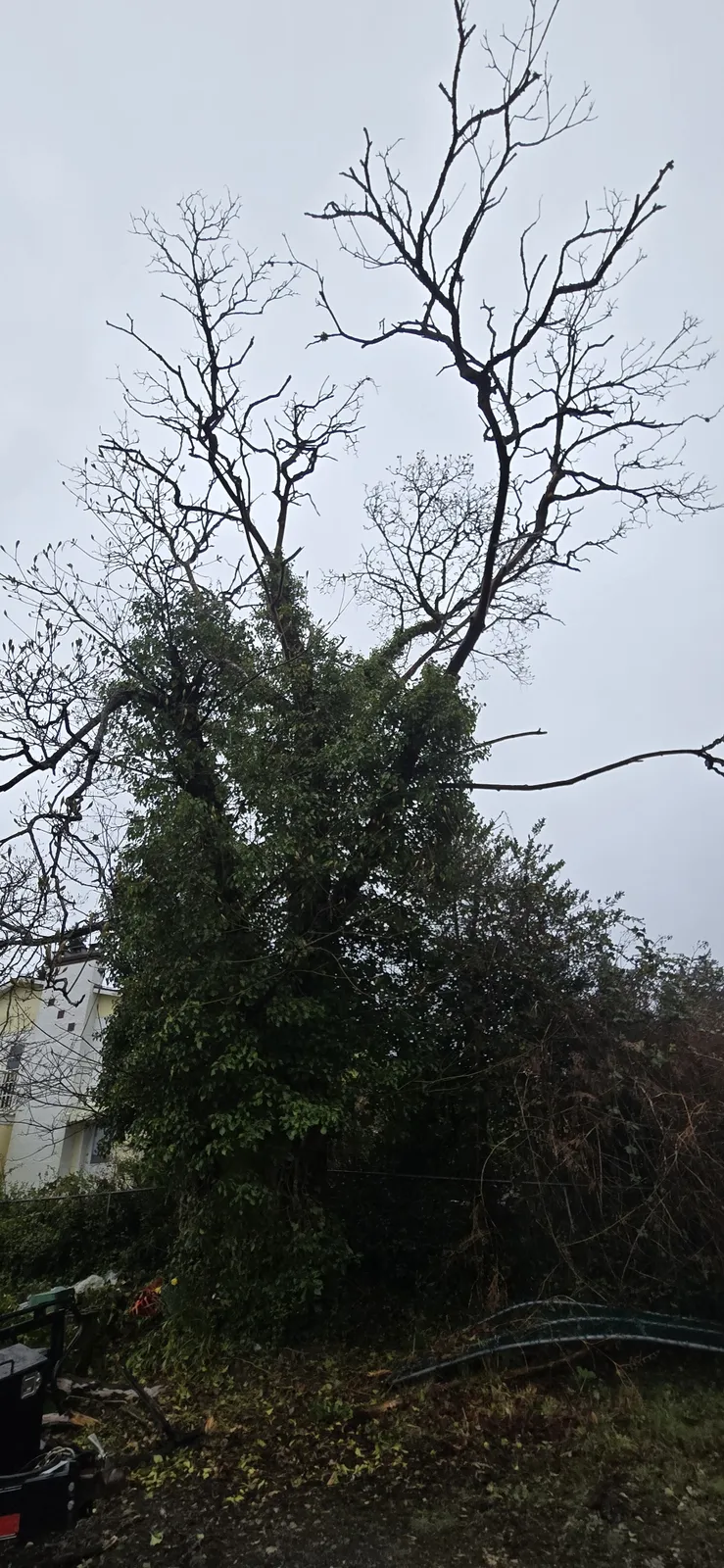
Given the advanced state of decline, it is likely that the large dead scaffolds may shed in the near future. Given the state of the tree’s lean, it is likely to come down in the near future. Should any people occupy the space near the tree, or should any property be stored near the tree, the risk of damage or injury is high.
Sincerely,
Jess-C W Hall ISA Certification No: PN-9528A ISA Tree Risk Assessment Qualified
Disclaimer
Trees are dynamic living systems, and are affected by their environment above and below ground, by visible and discrete factors; This makes offering guarantees or concrete projections impossible. This report is intended to be interpreted in its entirety with all pages present, without paraphrasing, or editing of any kind. This report is not intended to predict the behaviour of trees during strong or unusual weather phenomena, some examples include but are not limited to: hurricanes, unseasonable precipitation, drought, and lightning strikes. If major changes occur after the issuing of this report a new assessment should be completed.
Document Images
(1)