Correspondence (i): Letter dated May 2, 2018 from Dr. M. Fyfe, Island Health
Letter highlighting regulatory considerations for food premises and community care facilities at the site.
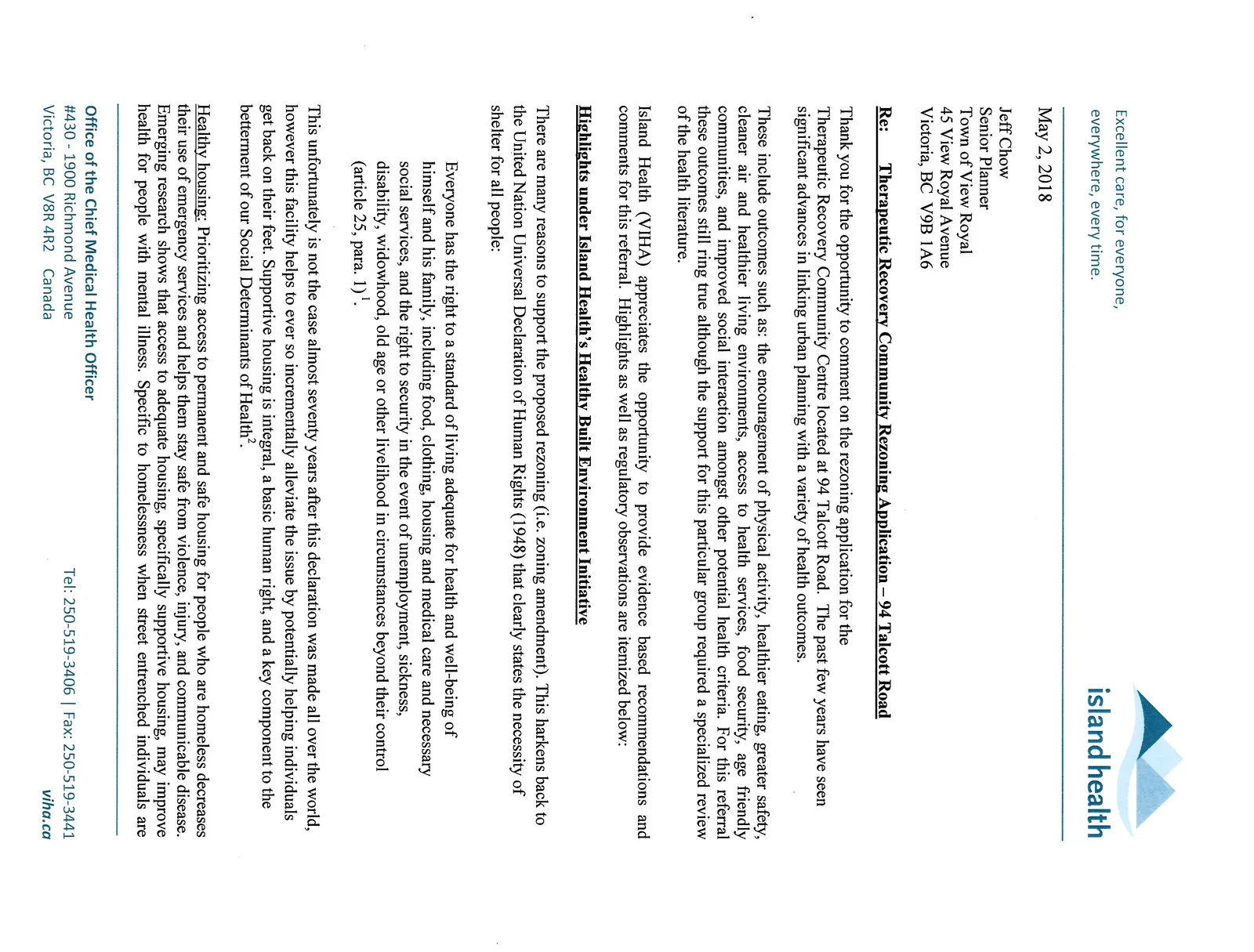
May 2, 2018
Jeff Chow Senior Planner Town of View Royal 45 View Royal Avenue Victoria, BC V9B 1A6
Re: Therapeutic Recovery Community Rezoning Application – 94 Talcott Road
Thank you for the opportunity to comment on the rezoning application for the Therapeutic Recovery Community Centre located at 94 Talcott Road. The past few years have seen significant advances in linking urban planning with a variety of health outcomes.
These include outcomes such as: the encouragement of physical activity, healthier eating, greater safety, cleaner air and healthier living environments, access to health services, food security, age friendly communities, and improved social interaction amongst other potential health criteria. For this referral these outcomes still ring true although the support for this particular group required a specialized review of the health literature.
Island Health (VIHA) appreciates the opportunity to provide evidence based recommendations and comments for this referral. Highlights as well as regulatory observations are itemized below:
Highlights under Island Health’s Healthy Built Environment Initiative
There are many reasons to support the proposed rezoning (i.e. zoning amendment). This harkens back to the United Nations Universal Declaration of Human Rights (1948) that clearly states the necessity of shelter for all people:
Everyone has the right to a standard of living adequate for health and well-being of himself and his family, including food, clothing, housing and medical care and necessary social services, and the right to security in the event of unemployment, sickness, disability, widowhood, old age or other livelihood in circumstances beyond their control (article 25, para. 1)¹.
This unfortunately is not the case almost seventy years after this declaration was made all over the world, however this facility helps to ever so incrementally alleviate the issue by potentially helping individuals get back on their feet. Supportive housing is integral, a basic human right, and a key component to the betterment of our Social Determinants of Health².
Healthy housing:
Prioritizing access to permanent and safe housing for people who are homeless decreases their use of emergency services and helps them stay safe from violence, injury, and communicable disease. Emerging research shows that access to adequate housing, specifically supportive housing, may improve health for people with mental illness. Specific to homelessness when street entrenched individuals are provided with housing, they are better able to access the health services needed in order to take care of any existing illness and to stay healthy³.
Neighbourhood Design:
Where this facility is located, in close proximity to the Galloping Goose trail, hospital and services further support access to region as a whole using physical activity as a key mode of transit. Having access to a variety of amenities within close proximity of home makes active transportation more convenient. The outcome can be better mental and physical health³.
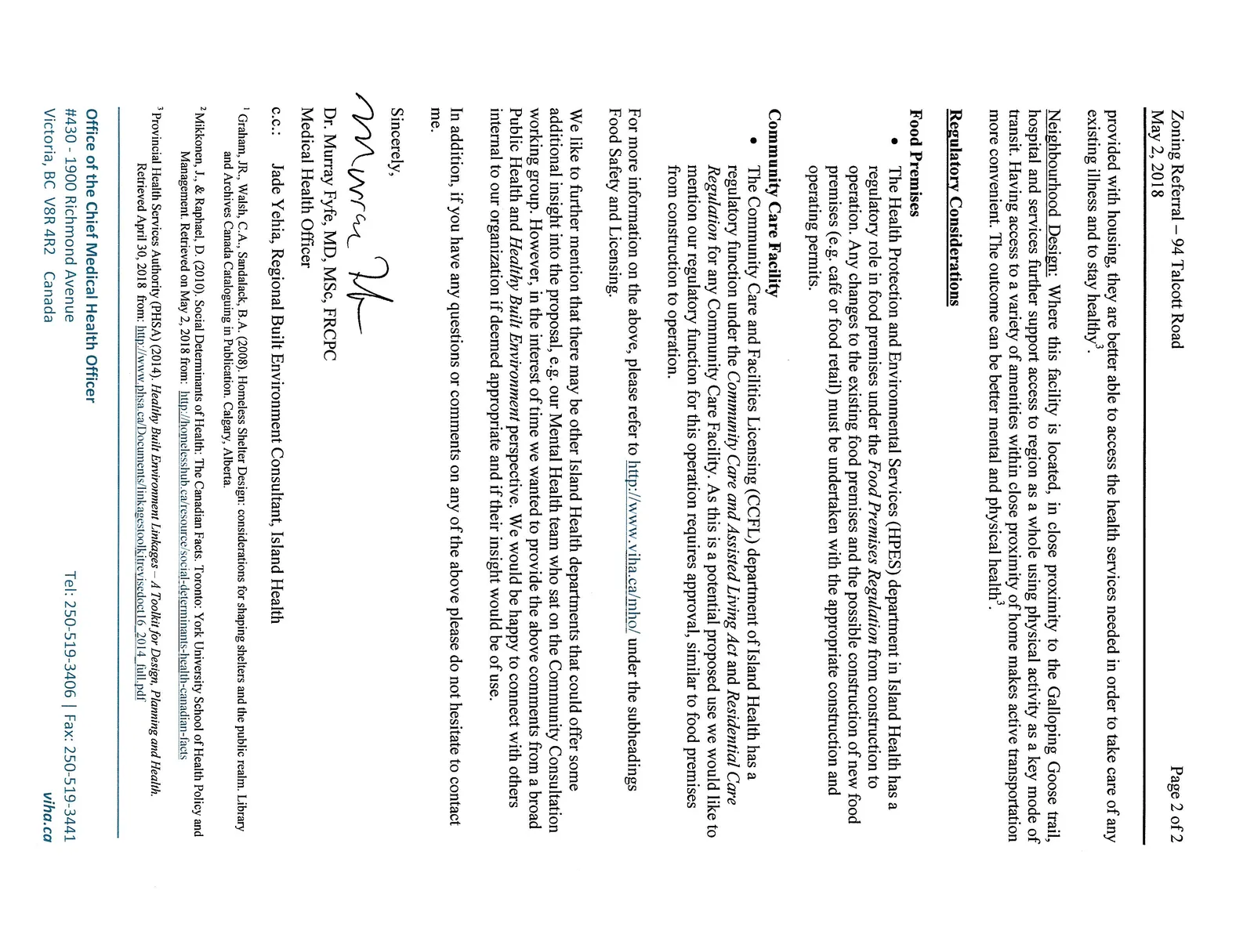
Regulatory Considerations
Food Premises
- The Health Protection and Environmental Services (HPES) department in Island Health has a regulatory role in food premises under the Food Premises Regulation from construction to operation. Any changes to the existing food premises and the possible construction of new food premises (e.g. café or food retail) must be undertaken with the appropriate construction and operating permits.
Community Care Facility
- The Community Care and Facilities Licensing (CCFL) department of Island Health has a regulatory function under the Community Care and Assisted Living Act and Residential Care Regulation for any Community Care Facility. As this is a potential proposed use we would like to mention our regulatory function for this operation requires approval, similar to food premises from construction to operation.
For more information on the above, please refer to http://www.viha.ca/mho/ under the subheadings Food Safety and Licensing.
We like to further mention that there may be other Island Health departments that could offer some additional insight into the proposal, e.g. our Mental Health team who sat on the Community Consultation working group. However, in the interest of time we wanted to provide the above comments from a broad Public Health and Healthy Built Environment perspective. We would be happy to connect with others internal to our organization if deemed appropriate and if their insight would be of use.
In addition, if you have any questions or comments on any of the above please do not hesitate to contact me.
Sincerely,
Dr. Murray Fyfe, MD, MSc, FRCPC Medical Health Officer
c.c.: Jade Yehia, Regional Built Environment Consultant, Island Health
¹ Graham, JR., Walsh, C.A., Sandalack, B.A. (2008). Homeless Shelter Design: considerations for shaping shelters and the public realm. Library and Archives Canada Cataloguing in Publication. Calgary, Alberta.
² Mikkonen, J., & Raphael, D. (2010). Social Determinants of Health: The Canadian Facts. Toronto: York University School of Health Policy and Management. Retrieved on May 2, 2018 from: http://homelesshub.ca/resource/social-determinants-health-canadian-facts
³ Provincial Health Services Authority (PHSA) (2014). Healthy Built Environment Linkages – A Toolkit for Design, Planning and Health. Retrieved April 30, 2018 from: http://www.phsa.ca/Documents/linkagestoolkitrevisedoct16_2014_full.pdf
Document Images
(2)