Island Corridor Foundation Financial Statements December 31, 2011 (Unaudited)
Review engagement report and financial statements for the foundation's 2011 fiscal year.
Island Corridor Foundation Financial Statements December 31, 2011 (Unaudited)
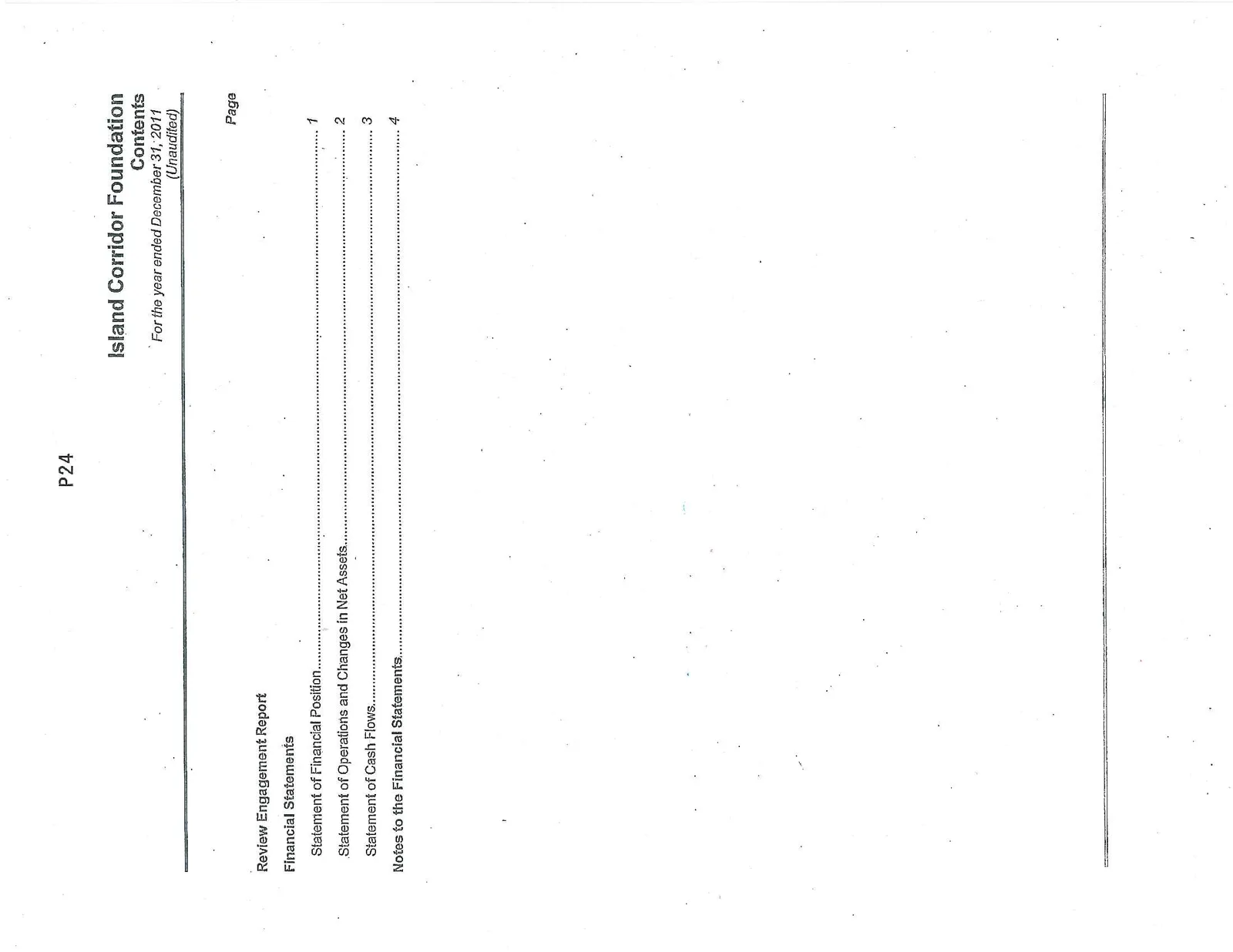
Contents
For the year ended December 31, 2011 (Unaudited)
| Page | |
|---|---|
| Review Engagement Report | |
| Financial Statements | |
| Statement of Financial Position | 1 |
| Statement of Operations and Changes in Net Assets | 2 |
| Statement of Cash Flows | 3 |
| Notes to the Financial Statements | 4 |
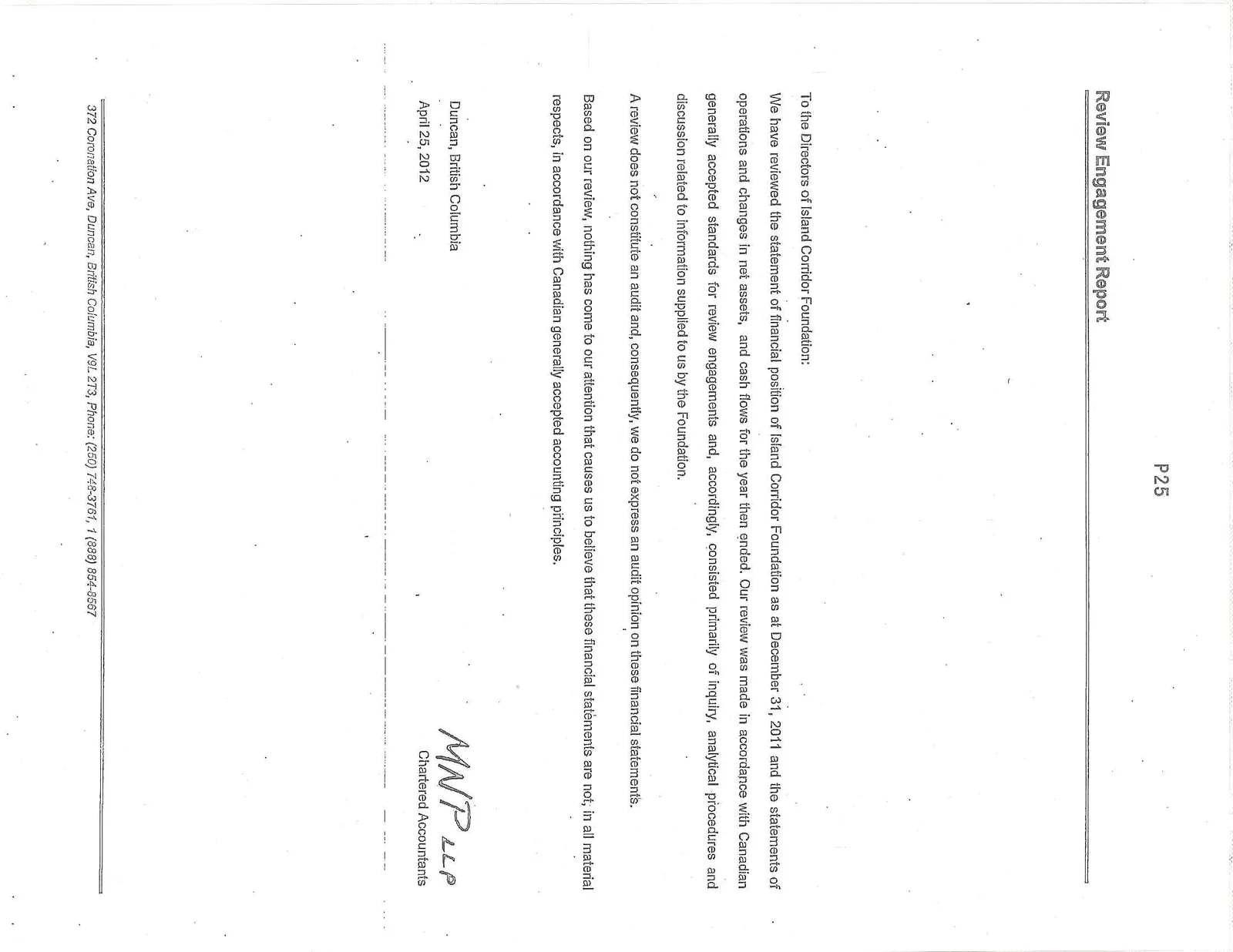
Review Engagement Report
To the Directors of Island Corridor Foundation:
We have reviewed the statement of financial position of Island Corridor Foundation as at December 31, 2011 and the statements of operations and changes in net assets, and cash flows for the year then ended. Our review was made in accordance with Canadian generally accepted standards for review engagements and, accordingly, consisted primarily of inquiry, analytical procedures and discussion related to information supplied to us by the Foundation.
A review does not constitute an audit and, consequently, we do not express an audit opinion on these financial statements.
Based on our review, nothing has come to our attention that causes us to believe that these financial statements are not, in all material respects, in accordance with Canadian generally accepted accounting principles.
Duncan, British Columbia April 25, 2012
MNP LLP Chartered Accountants
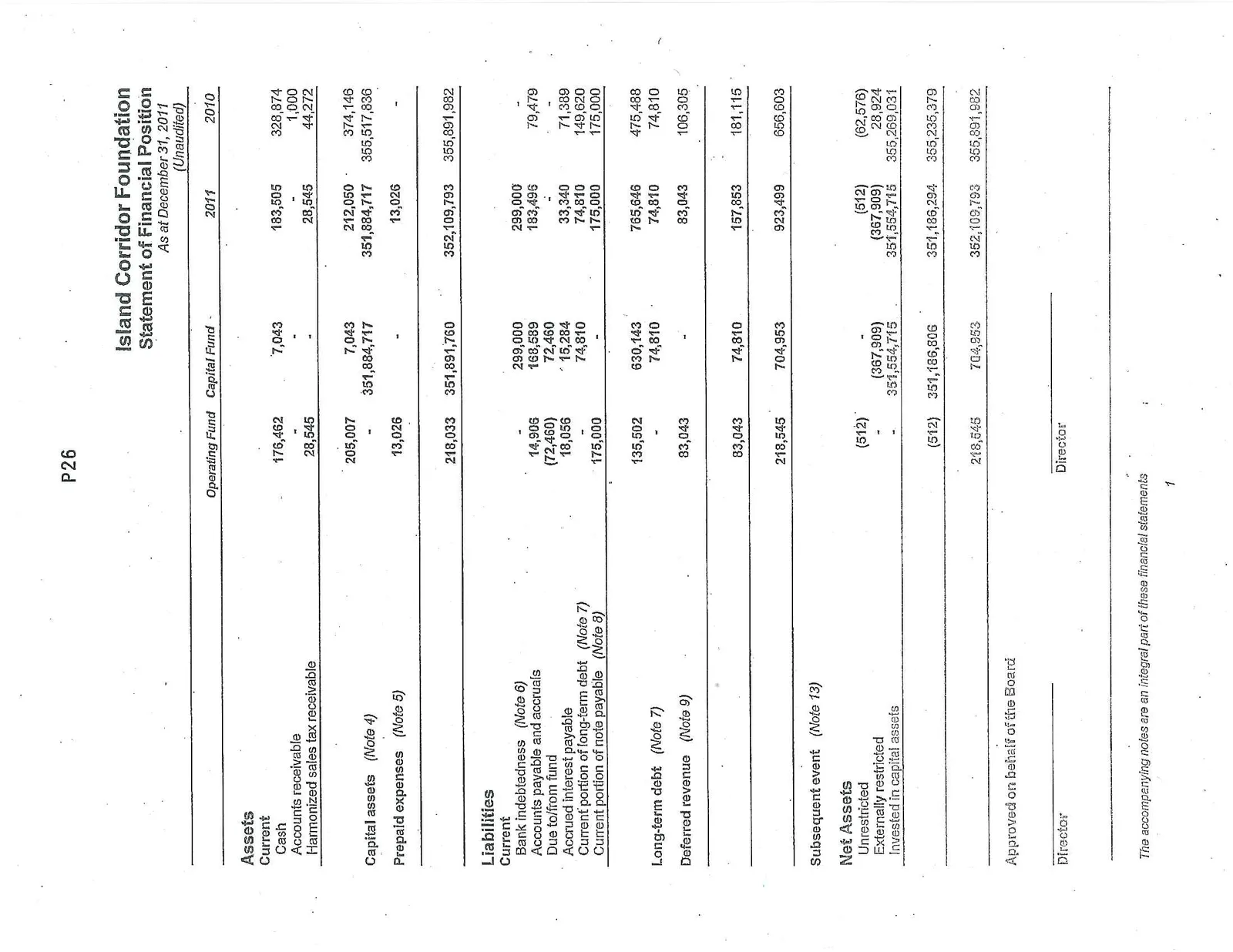
Statement of Financial Position
As at December 31, 2011 (Unaudited)
| Operating Fund | Capital Fund | 2011 | 2010 | |
|---|---|---|---|---|
| Assets | ||||
| Current | ||||
| Cash | 176,462 | 7,043 | 183,505 | 328,874 |
| Accounts receivable | - | - | - | 1,000 |
| Harmonized sales tax receivable | 28,545 | - | 28,545 | 44,272 |
| 205,007 | 7,043 | 212,050 | 374,146 | |
| Capital assets (Note 4) | - | 351,884,717 | 351,884,717 | 355,517,836 |
| Prepaid expenses (Note 5) | 13,026 | - | 13,026 | - |
| 218,033 | 351,891,760 | 352,109,793 | 355,891,982 | |
| Liabilities | ||||
| Current | ||||
| Bank indebtedness (Note 6) | - | 299,000 | 299,000 | - |
| Accounts payable and accruals | 14,906 | 168,589 | 183,495 | 79,479 |
| Due to/from fund | (72,460) | 72,460 | - | - |
| Accrued interest payable | 18,056 | 15,284 | 33,340 | 71,389 |
| Current portion of long-term debt (Note 7) | - | 74,810 | 74,810 | 149,620 |
| Current portion of note payable (Note 8) | 175,000 | - | 175,000 | 175,000 |
| 135,502 | 630,143 | 765,646 | 475,488 | |
| Long-term debt (Note 7) | - | 74,810 | 74,810 | 74,810 |
| Deferred revenue (Note 9) | 83,043 | - | 83,043 | 106,305 |
| 83,043 | 74,810 | 157,853 | 181,115 | |
| 218,545 | 704,953 | 923,499 | 656,603 | |
| Subsequent event (Note 13) | ||||
| Net Assets | ||||
| Unrestricted | (512) | - | (512) | (62,576) |
| Externally restricted | - | (367,909) | (367,909) | 28,924 |
| Invested in capital assets | - | 351,554,715 | 351,554,715 | 355,269,031 |
| (512) | 351,186,806 | 351,186,294 | 355,235,379 | |
| 218,545 | 704,953 | 352,109,793 | 355,891,982 |
Approved on behalf of the Board
Director ____________________ Director ____________________
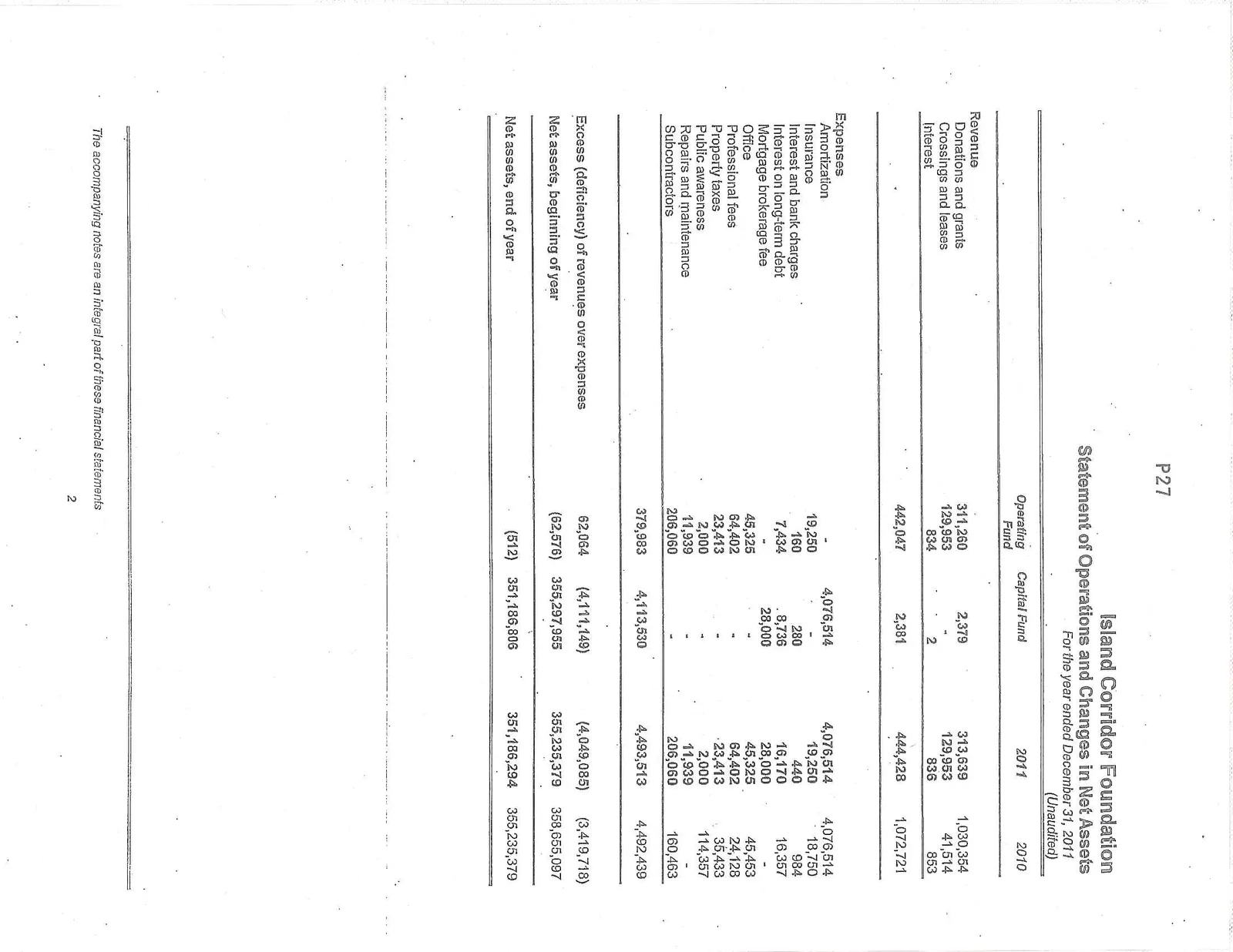
Statement of Operations and Changes in Net Assets
For the year ended December 31, 2011 (Unaudited)
| Operating Fund | Capital Fund | 2011 | 2010 | |
|---|---|---|---|---|
| Revenue | ||||
| Donations and grants | 311,260 | 2,379 | 313,639 | 1,030,354 |
| Crossings and leases | 129,953 | - | 129,953 | 41,514 |
| Interest | 834 | 2 | 836 | 853 |
| 442,047 | 2,381 | 444,428 | 1,072,721 | |
| Expenses | ||||
| Amortization | - | 4,076,514 | 4,076,514 | 4,076,514 |
| Insurance | 19,250 | - | 19,250 | 18,750 |
| Interest and bank charges | 160 | 280 | 440 | 984 |
| Interest on long-term debt | 7,434 | 8,736 | 16,170 | 16,357 |
| Mortgage brokerage fee | - | 28,000 | 28,000 | - |
| Office | 45,325 | - | 45,325 | 45,453 |
| Professional fees | 64,402 | - | 64,402 | 24,128 |
| Property taxes | 23,413 | - | 23,413 | 35,433 |
| Public awareness | 2,000 | - | 2,000 | 114,357 |
| Repairs and maintenance | 11,939 | - | 11,939 | - |
| Subcontractors | 206,060 | - | 206,060 | 160,463 |
| 379,983 | 4,113,530 | 4,493,513 | 4,492,439 | |
| Excess (deficiency) of revenues over expenses | 62,064 | (4,111,149) | (4,049,085) | (3,419,718) |
| Net assets, beginning of year | (62,576) | 355,297,955 | 355,235,379 | 358,655,097 |
| Net assets, end of year | (512) | 351,186,806 | 351,186,294 | 355,235,379 |
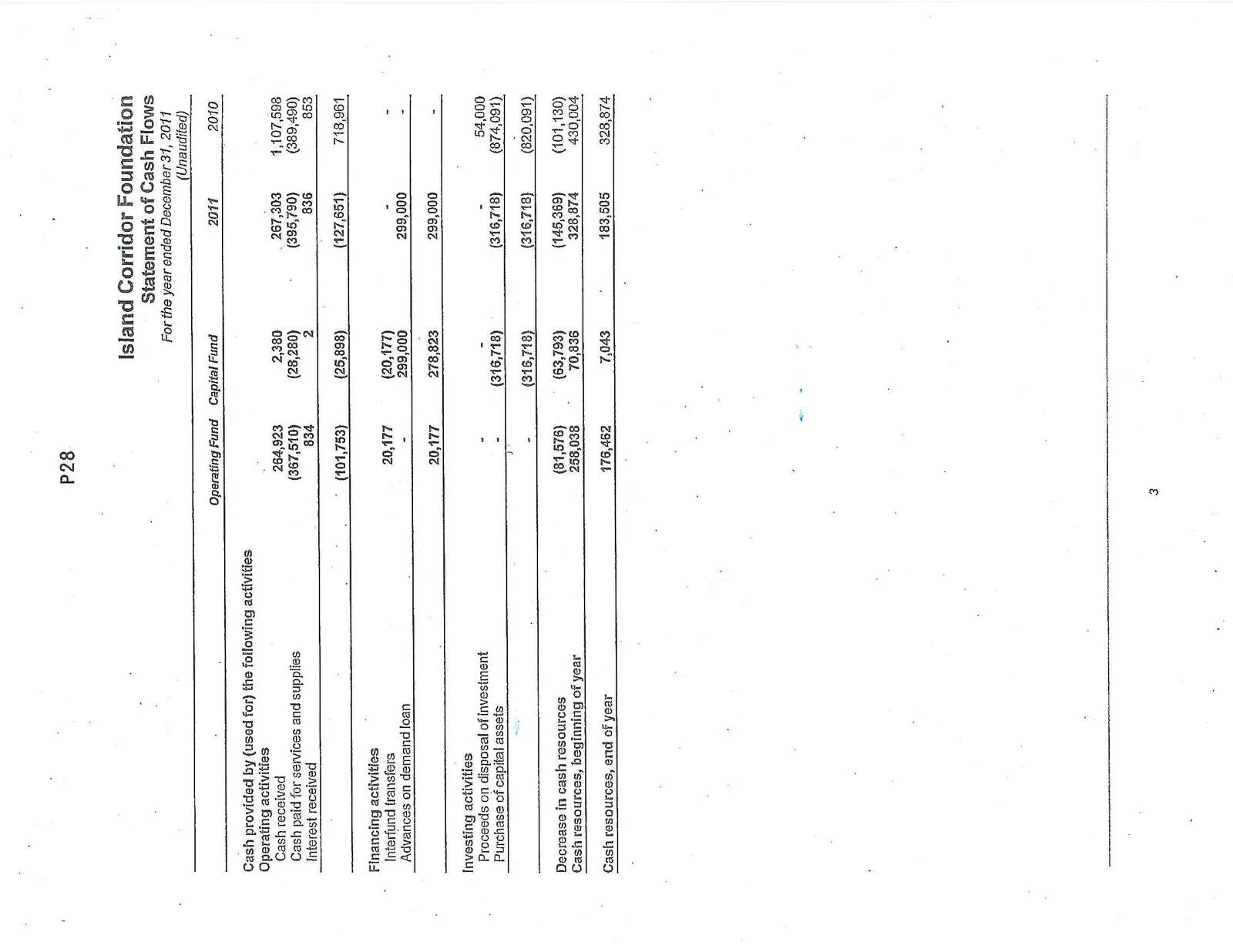
Statement of Cash Flows
For the year ended December 31, 2011 (Unaudited)
| Operating Fund | Capital Fund | 2011 | 2010 | |
|---|---|---|---|---|
| Cash provided by (used for) the following activities | ||||
| Operating activities | ||||
| Cash received | 264,923 | 2,380 | 267,303 | 1,107,598 |
| Cash paid for services and supplies | (367,510) | (28,280) | (395,790) | (389,490) |
| Interest received | 834 | 2 | 836 | 853 |
| (101,753) | (25,898) | (127,651) | 718,961 | |
| Financing activities | ||||
| Interfund transfers | 20,177 | (20,177) | - | - |
| Advances on demand loan | - | 299,000 | 299,000 | - |
| 20,177 | 278,823 | 299,000 | - | |
| Investing activities | ||||
| Proceeds on disposal of investment | - | - | - | 54,000 |
| Purchase of capital assets | - | (316,718) | (316,718) | (874,091) |
| - | (316,718) | (316,718) | (820,091) | |
| Decrease in cash resources | (81,576) | (63,793) | (145,369) | (101,130) |
| Cash resources, beginning of year | 258,038 | 70,836 | 328,874 | 430,004 |
| Cash resources, end of year | 176,462 | 7,043 | 183,505 | 328,874 |
Notes to the Financial Statements
For the year ended December 31, 2011 (Unaudited)
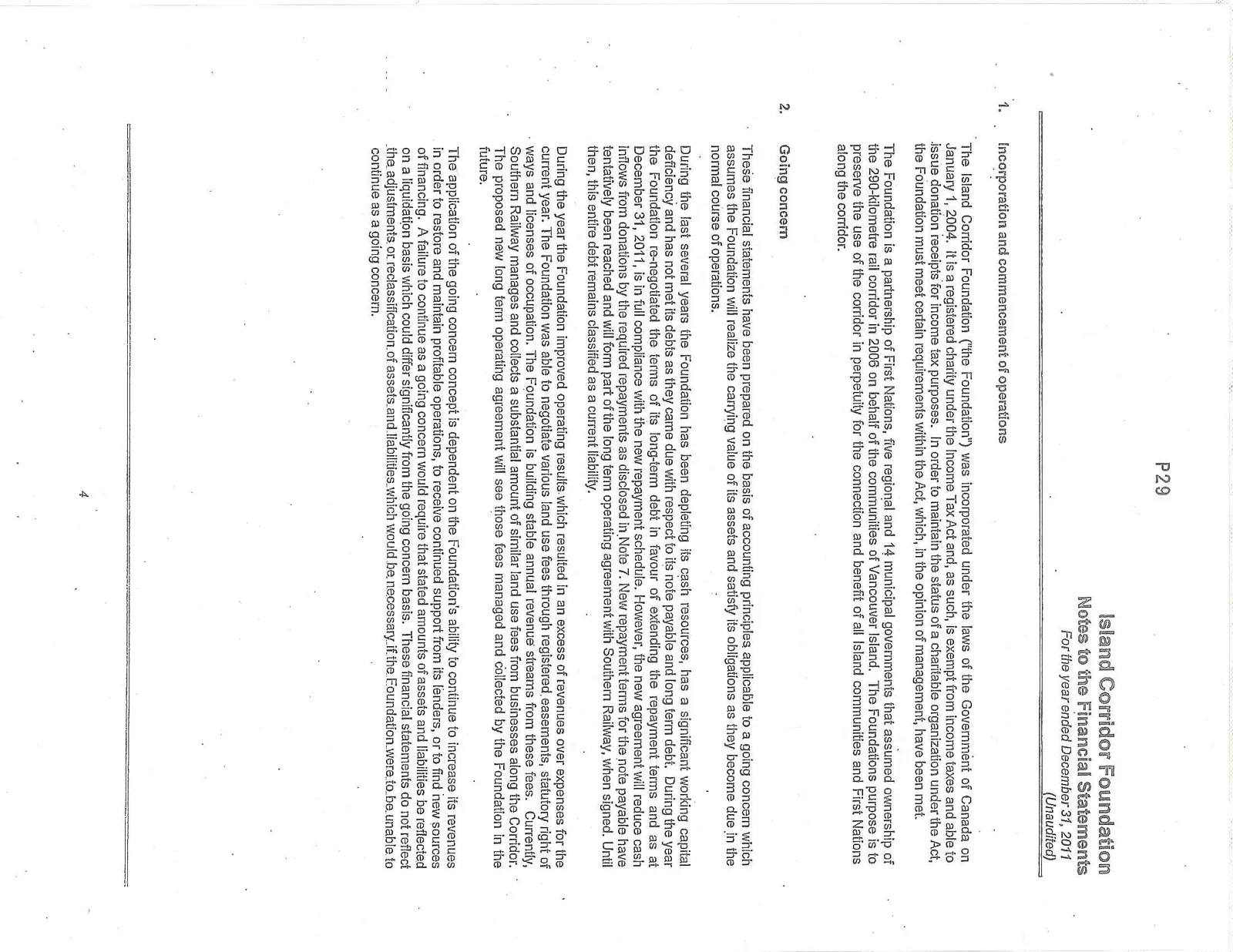
1. Incorporation and commencement of operations
The Island Corridor Foundation ("the Foundation") was incorporated under the laws of the Government of Canada on January 1, 2004. It is a registered charity under the Income Tax Act and, as such, is exempt from income taxes and able to issue donation receipts for income tax purposes. In order to maintain the status of a charitable organization under the Act, the Foundation must meet certain requirements within the Act, which, in the opinion of management, have been met.
The Foundation is a partnership of First Nations, five regional and 14 municipal governments that assumed ownership of the 290-kilometre rail corridor in 2006 on behalf of the communities of Vancouver Island. The Foundations purpose is to preserve the use of the corridor in perpetuity for the connection and benefit of all Island communities and First Nations along the corridor.
2. Going concern
These financial statements have been prepared on the basis of accounting principles applicable to a going concern which assumes the Foundation will realize the carrying value of its assets and satisfy its obligations as they become due in the normal course of operations.
During the last several years the Foundation has been depleting its cash resources, has a significant working capital deficiency and has not met its debts as they came due with respect to its note payable and long-term debt. During the year the Foundation re-negotiated the terms of its long-term debt in favour of extending the repayment terms and as at December 31, 2011, is in full compliance with the new repayment schedule. However, the new agreement will reduce cash inflows from donations by the required repayments as disclosed in Note 7. New repayment terms for the note payable have tentatively been reached and will form part of the long term operating agreement with Southern Railway, when signed. Until then, this entire debt remains classified as a current liability.
During the year the Foundation improved operating results which resulted in an excess of revenues over expenses for the current year. The Foundation was able to negotiate various land use fees through registered easements, statutory right of ways and licenses of occupation. The Foundation is building stable annual revenue streams from these fees. Currently, Southern Railway manages and collects a substantial amount of similar land use fees from businesses along the Corridor. The proposed new long term operating agreement will see those fees managed and collected by the Foundation in the future.
The application of the going concern concept is dependent on the Foundation's ability to continue to increase its revenues in order to restore and maintain profitable operations, to receive continued support from its lenders, or to find new sources of financing. A failure to continue as a going concern would require that stated amounts of assets and liabilities be reflected on a liquidation basis which could differ significantly from the going concern basis. These financial statements do not reflect the adjustments or reclassification of assets and liabilities which would be necessary if the Foundation were to be unable to continue as a going concern.
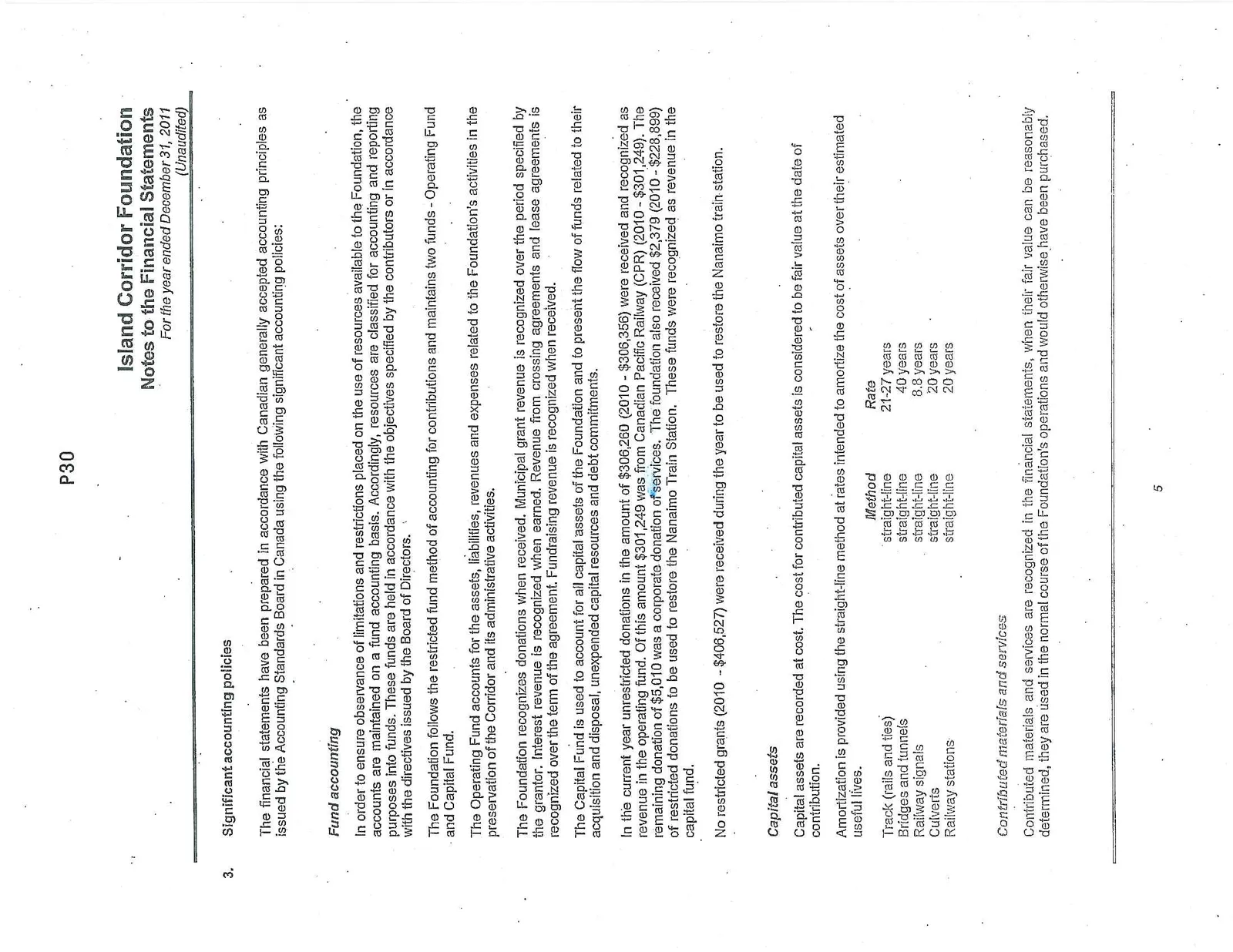
3. Significant accounting policies
The financial statements have been prepared in accordance with Canadian generally accepted accounting principles as issued by the Accounting Standards Board in Canada using the following significant accounting policies:
Fund accounting In order to ensure observance of limitations and restrictions placed on the use of resources available to the Foundation, the accounts are maintained on a fund accounting basis. Accordingly, resources are classified for accounting and reporting purposes into funds. These funds are held in accordance with the objectives specified by the contributors or in accordance with the directives issued by the Board of Directors.
The Foundation follows the restricted fund method of accounting for contributions and maintains two funds - Operating Fund and Capital Fund.
The Operating Fund accounts for the assets, liabilities, revenues and expenses related to the Foundation's activities in the preservation of the Corridor and its administrative activities.
The Foundation recognizes donations when received. Municipal grant revenue is recognized over the period specified by the grantor. Interest revenue is recognized when earned. Revenue from crossing agreements and lease agreements is recognized over the term of the agreement. Fundraising revenue is recognized when received.
The Capital Fund is used to account for all capital assets of the Foundation and to present the flow of funds related to their acquisition and disposal, unexpended capital resources and debt commitments.
In the current year unrestricted donations in the amount of $306,260 (2010 - $306,356) were received and recognized as revenue in the operating fund. Of this amount $301,249 was from Canadian Pacific Railway (CPR) (2010 - $301,249). The remaining donation of $5,010 was a corporate donation of services. The foundation also received $2,379 (2010 - $228,899) of restricted donations to be used to restore the Nanaimo Train Station. These funds were recognized as revenue in the capital fund.
No restricted grants (2010 - $406,527) were received during the year to be used to restore the Nanaimo train station.
Capital assets Capital assets are recorded at cost. The cost for contributed capital assets is considered to be fair value at the date of contribution.
Amortization is provided using the straight-line method at rates intended to amortize the cost of assets over their estimated useful lives.
| Method | Rate | |
|---|---|---|
| Track (rails and ties) | straight-line | 21-27 years |
| Bridges and tunnels | straight-line | 40 years |
| Railway signals | straight-line | 8.8 years |
| Culverts | straight-line | 20 years |
| Railway stations | straight-line | 20 years |
Contributed materials and services Contributed materials and services are recognized in the financial statements, when their fair value can be reasonably determined, they are used in the normal course of the Foundation's operations and would otherwise have been purchased.
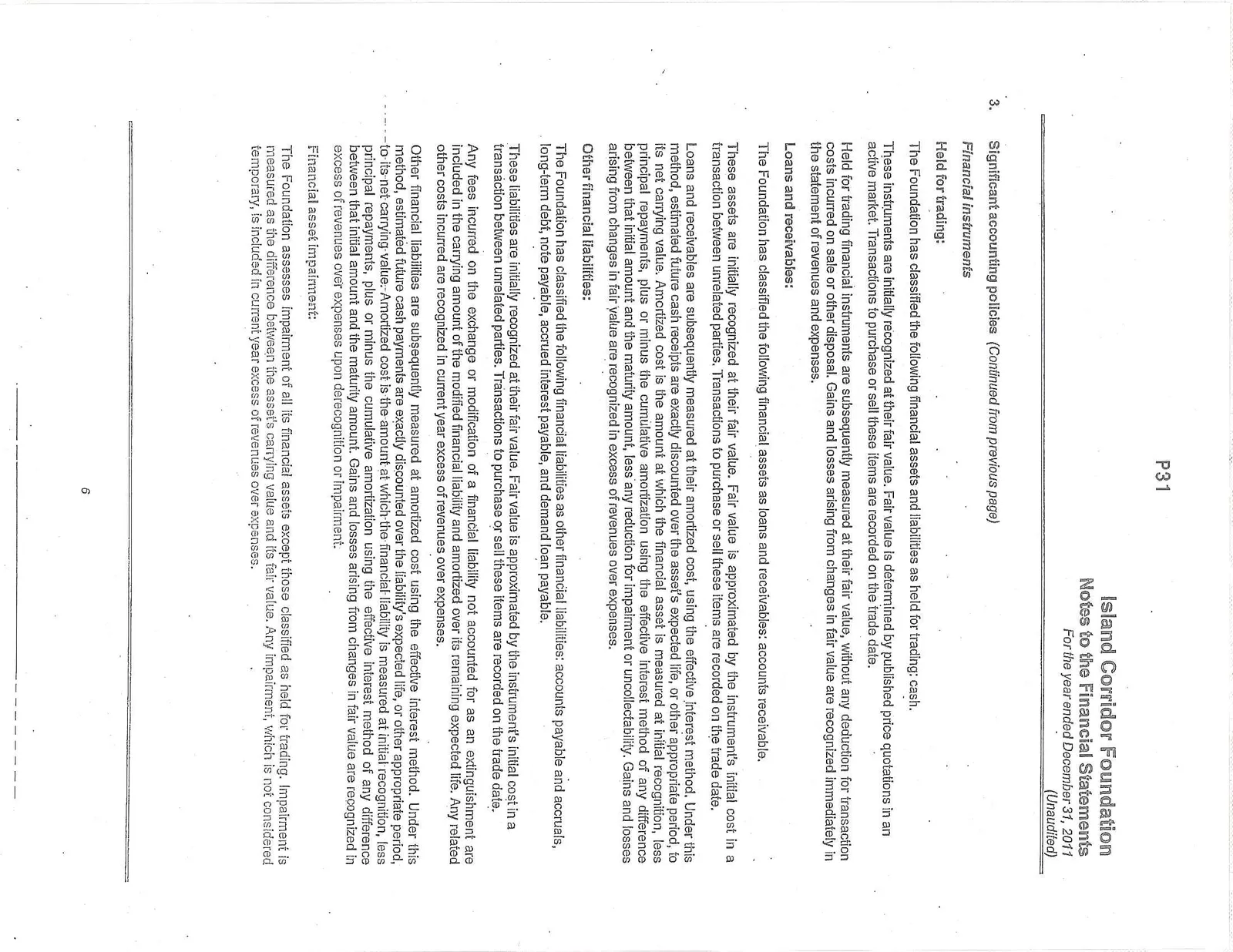
3. Significant accounting policies (Continued from previous page)
Financial instruments
Held for trading: The Foundation has classified the following financial assets and liabilities as held for trading: cash.
These instruments are initially recognized at their fair value. Fair value is determined by published price quotations in an active market. Transactions to purchase or sell these items are recorded on the trade date.
Held for trading financial instruments are subsequently measured at their fair value, without any deduction for transaction costs incurred on sale or other disposal. Gains and losses arising from changes in fair value are recognized immediately in the statement of revenues and expenses.
Loans and receivables: The Foundation has classified the following financial assets as loans and receivables: accounts receivable.
These assets are initially recognized at their fair value. Fair value is approximated by the instrument's initial cost in a transaction between unrelated parties. Transactions to purchase or sell these items are recorded on the trade date.
Loans and receivables are subsequently measured at their amortized cost, using the effective interest method. Under this method, estimated future cash receipts are exactly discounted over the asset's expected life, or other appropriate period, to its net carrying value. Amortized cost is the amount at which the financial asset is measured at initial recognition, less principal repayments, plus or minus the cumulative amortization using the effective interest method of any difference between that initial amount and the maturity amount, less any reduction for impairment or uncollectability. Gains and losses arising from changes in fair value are recognized in excess of revenues over expenses.
Other financial liabilities: The Foundation has classified the following financial liabilities as other financial liabilities: accounts payable and accruals, long-term debt, note payable, accrued interest payable, and demand loan payable.
These liabilities are initially recognized at their fair value. Fair value is approximated by the instrument's initial cost in a transaction between unrelated parties. Transactions to purchase or sell these items are recorded on the trade date.
Any fees incurred on the exchange or modification of a financial liability not accounted for as an extinguishment are included in the carrying amount of the modified financial liability and amortized over its remaining expected life. Any related other costs incurred are recognized in current year excess of revenues over expenses.
Other financial liabilities are subsequently measured at amortized cost using the effective interest method. Under this method, estimated future cash payments are exactly discounted over the liability's expected life, or other appropriate period, to its net carrying value. Amortized cost is the amount at which the financial liability is measured at initial recognition, less principal repayments, plus or minus the cumulative amortization using the effective interest method of any difference between that initial amount and the maturity amount. Gains and losses arising from changes in fair value are recognized in excess of revenues over expenses upon derecognition or impairment.
Financial asset impairment: The Foundation assesses impairment of all its financial assets except those classified as held for trading. Impairment is measured as the difference between the asset's carrying value and its fair value. Any impairment, which is not considered temporary, is included in current year excess of revenues over expenses.
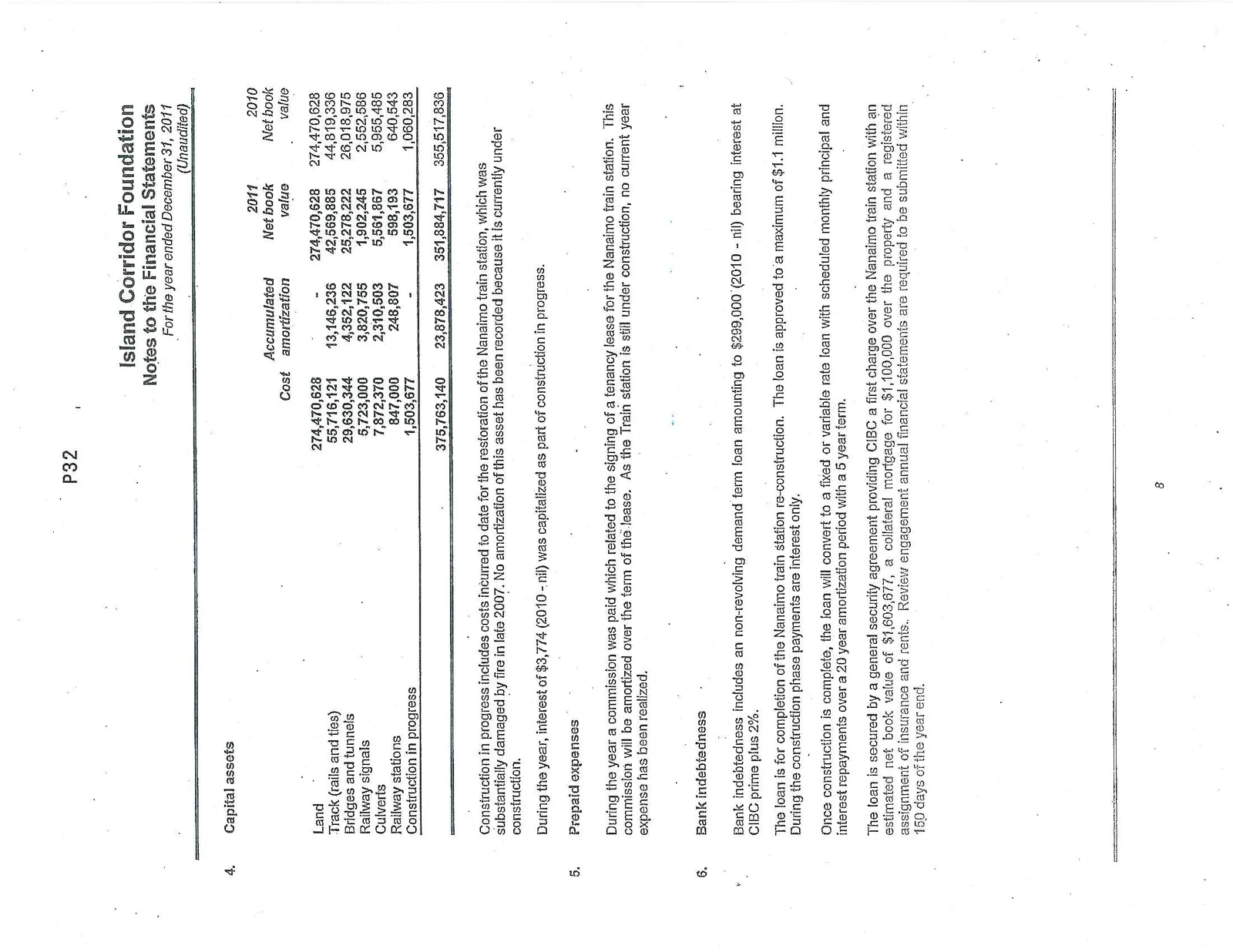
4. Capital assets
| Cost | Accumulated amortization | 2011 Net book value | 2010 Net book value | |
|---|---|---|---|---|
| Land | 274,470,628 | - | 274,470,628 | 274,470,628 |
| Track (rails and ties) | 55,716,121 | 13,146,236 | 42,569,885 | 44,819,336 |
| Bridges and tunnels | 29,630,344 | 4,352,122 | 25,278,222 | 26,018,975 |
| Railway signals | 5,723,000 | 3,820,755 | 1,902,245 | 2,552,586 |
| Culverts | 7,872,370 | 2,310,503 | 5,561,867 | 5,955,485 |
| Railway stations | 847,000 | 248,807 | 598,193 | 640,543 |
| Construction in progress | 1,503,677 | - | 1,503,677 | 1,060,283 |
| 375,763,140 | 23,878,423 | 351,884,717 | 355,517,836 |
Construction in progress includes costs incurred to date for the restoration of the Nanaimo train station, which was substantially damaged by fire in late 2007. No amortization of this asset has been recorded because it is currently under construction.
During the year, interest of $3,774 (2010 - nil) was capitalized as part of construction in progress.
5. Prepaid expenses
During the year a commission was paid which related to the signing of a tenancy lease for the Nanaimo train station. This commission will be amortized over the term of the lease. As the Train station is still under construction, no current year expense has been realized.
6. Bank indebtedness
Bank indebtedness includes a non-revolving demand term loan amounting to $299,000 (2010 - nil) bearing interest at CIBC prime plus 2%.
The loan is for completion of the Nanaimo train station re-construction. The loan is approved to a maximum of $1.1 million. During the construction phase payments are interest only.
Once construction is complete, the loan will convert to a fixed or variable rate loan with scheduled monthly principal and interest repayments over a 20 year amortization period with a 5 year term.
The loan is secured by a general security agreement providing CIBC a first charge over the Nanaimo train station with an estimated net book value of $1,603,677, a collateral mortgage for $1,100,000 over the property and a registered assignment of insurance and rents. Review engagement annual financial statements are required to be submitted within 150 days of the year end.
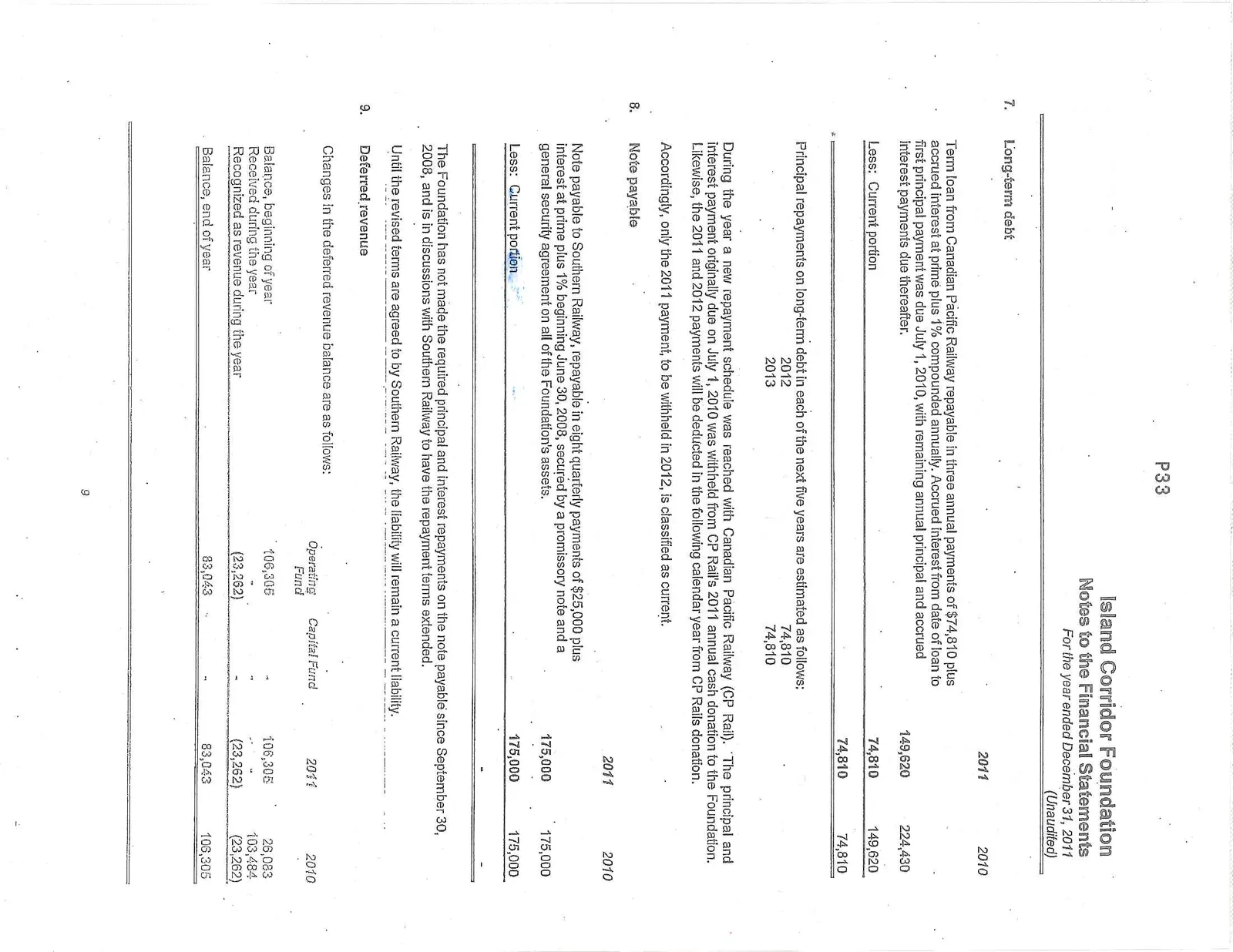
7. Long-term debt
| 2011 | 2010 | |
|---|---|---|
| Term loan from Canadian Pacific Railway repayable in three annual payments of $74,810 plus accrued interest at prime plus 1% compounded annually. Accrued interest from date of loan to first principal payment was due July 1, 2010, with remaining annual principal and accrued interest payments due thereafter. | 149,620 | 224,430 |
| Less: Current portion | 74,810 | 149,620 |
| 74,810 | 74,810 |
Principal repayments on long-term debt in each of the next five years are estimated as follows: 2012: 74,810 2013: 74,810
During the year a new repayment schedule was reached with Canadian Pacific Railway (CP Rail). The principal and interest payment originally due on July 1, 2010 was withheld from CP Rail's 2011 annual cash donation to the Foundation. Likewise, the 2011 and 2012 payments will be deducted in the following calendar year from CP Rails donation.
Accordingly, only the 2011 payment, to be withheld in 2012, is classified as current.
8. Note payable
| 2011 | 2010 | |
|---|---|---|
| Note payable to Southern Railway, repayable in eight quarterly payments of $25,000 plus interest at prime plus 1% beginning June 30, 2008, secured by a promissory note and a general security agreement on all of the Foundation's assets. | 175,000 | 175,000 |
| Less: Current portion | 175,000 | 175,000 |
| - | - |
The Foundation has not made the required principal and interest repayments on the note payable since September 30, 2008, and is in discussions with Southern Railway to have the repayment terms extended.
Until the revised terms are agreed to by Southern Railway, the liability will remain a current liability.
9. Deferred revenue
Changes in the deferred revenue balance are as follows:
| Operating Fund | Capital Fund | 2011 | 2010 | |
|---|---|---|---|---|
| Balance, beginning of year | 106,305 | - | 106,305 | 26,083 |
| Received during the year | - | - | - | 103,484 |
| Recognized as revenue during the year | (23,262) | - | (23,262) | (23,262) |
| Balance, end of year | 83,043 | - | 83,043 | 106,305 |
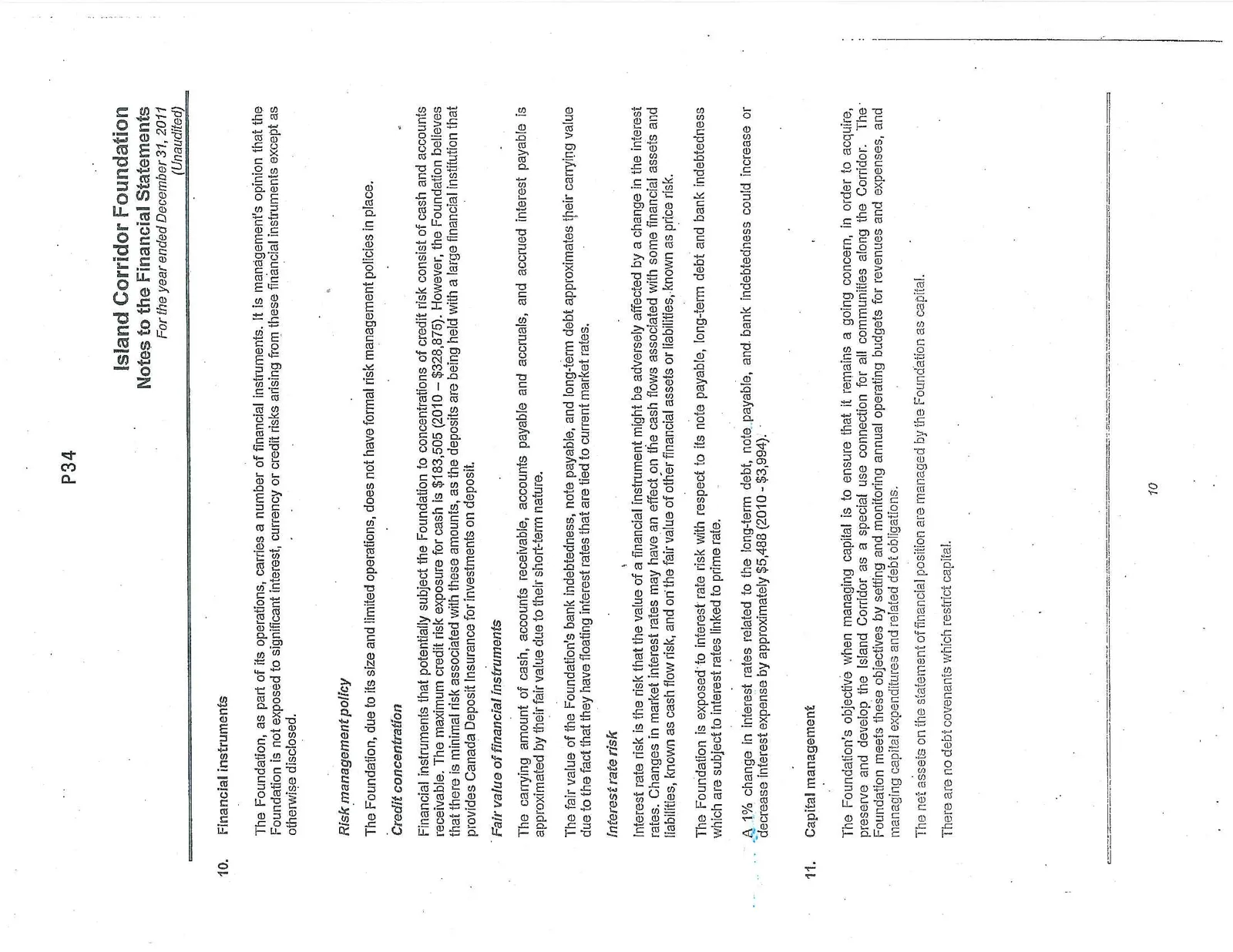
10. Financial instruments
The Foundation, as part of its operations, carries a number of financial instruments. It is management's opinion that the Foundation is not exposed to significant interest, currency or credit risks arising from these financial instruments except as otherwise disclosed.
Risk management policy The Foundation, due to its size and limited operations, does not have formal risk management policies in place.
Credit concentration Financial instruments that potentially subject the Foundation to concentrations of credit risk consist of cash and accounts receivable. The maximum credit risk exposure for cash is $183,505 (2010 - $328,874). However, the Foundation believes that there is minimal risk associated with these amounts, as the deposits are being held with a large financial institution that provides Canada Deposit Insurance for investments on deposit.
Fair value of financial instruments The carrying amount of cash, accounts receivable, accounts payable and accruals, and accrued interest payable is approximated by their fair value due to their short-term nature.
The fair value of the Foundation's bank indebtedness, note payable, and long-term debt approximates their carrying value due to the fact that they have floating interest rates that are tied to current market rates.
Interest rate risk Interest rate risk is the risk that the value of a financial instrument might be adversely affected by a change in the interest rates. Changes in market interest rates may have an effect on the cash flows associated with some financial assets and liabilities, known as cash flow risk, and on the fair value of other financial assets or liabilities, known as price risk.
The Foundation is exposed to interest rate risk with respect to its note payable, long-term debt and bank indebtedness which are subject to interest rates linked to prime rate.
A 1% change in interest rates related to the long-term debt, note payable, and bank indebtedness could increase or decrease interest expense by approximately $5,488 (2010 - $3,994).
11. Capital management
The Foundation's objective when managing capital is to ensure that it remains a going concern, in order to acquire, preserve and develop the Island Corridor as a special use connection for all communities along the Corridor. The Foundation meets these objectives by setting and monitoring annual operating budgets for revenues and expenses, and managing capital expenditures and related debt obligations.
The net assets on the statement of financial position are managed by the Foundation as capital.
There are no debt covenants which restrict capital.
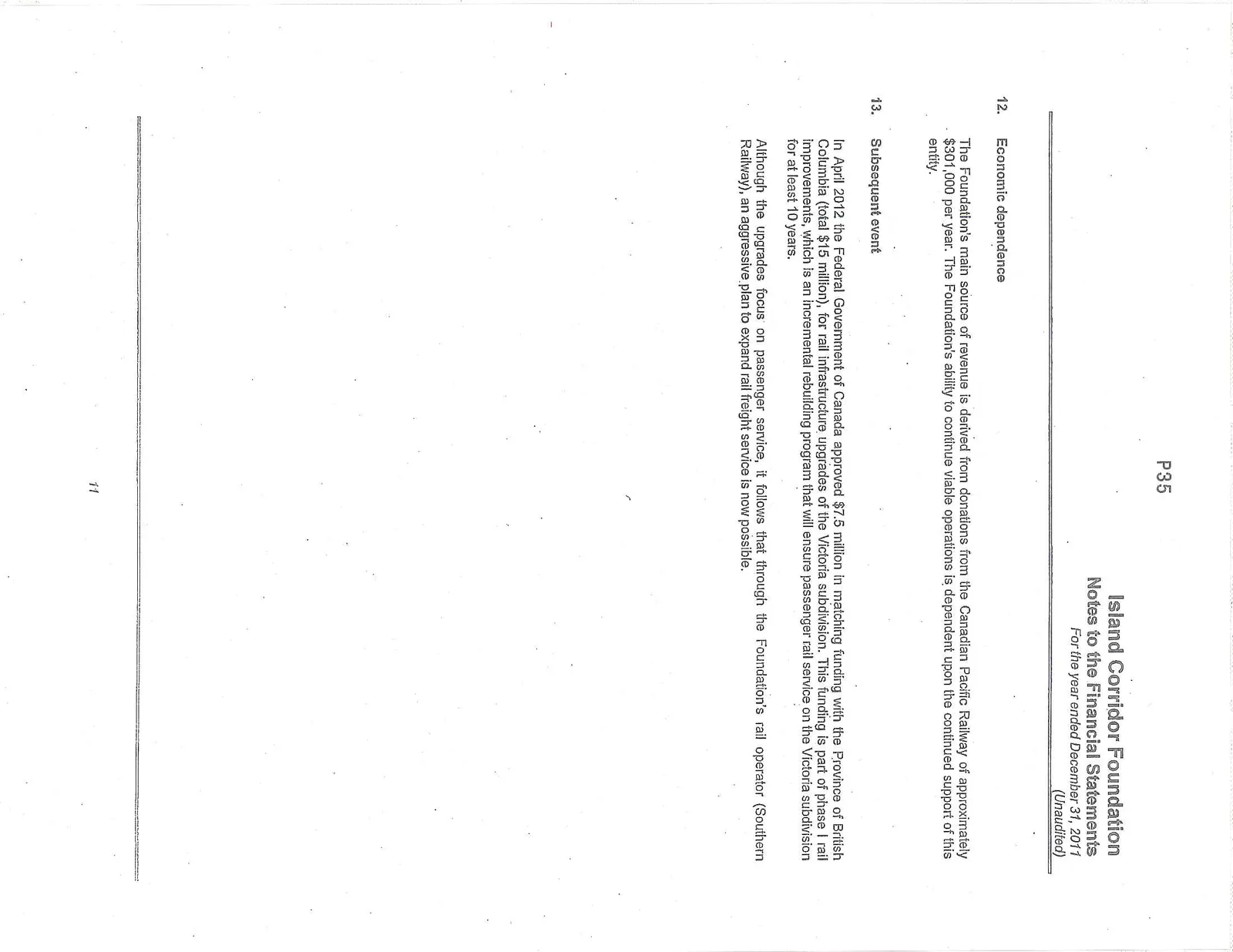
12. Economic dependence
The Foundation's main source of revenue is derived from donations from the Canadian Pacific Railway of approximately $301,000 per year. The Foundation's ability to continue viable operations is dependent upon the continued support of this entity.
13. Subsequent event
In April 2012 the Federal Government of Canada approved $7.5 million in matching funding with the Province of British Columbia (total $15 million), for rail infrastructure upgrades of the Victoria subdivision. This funding is part of phase I rail improvements, which is an incremental rebuilding program that will ensure passenger rail service on the Victoria subdivision for at least 10 years.
Although the upgrades focus on passenger service, it follows that through the Foundation's rail operator (Southern Railway), an aggressive plan to expand rail freight service is now possible.
Document Images
(13)