Faith in Action - A Multifaith Initiative in Support of the Poor
A collective letter from faith leaders and a resolution calling on governments to rebuild social safety nets and end hunger.
November, 2012
To leaders in municipal and provincial governments:
As faith leaders, we are deeply concerned about the de facto public policy that for the indefinite future, care for those with insufficient food will remain the sole responsibility of volunteers.
What concerns us about such a policy is that it assumes that care for the poorest is the exclusive responsibility of a very small segment of our society – those who volunteer – and that this policy implies that there is no need for the wider society to take responsibility for feeding those without food.
Any society which encourages the vast majority of its members to believe they have no responsibility for the poorest is a society in danger of destructive divisions.
One of the unintended consequences of leaving basic food provision to volunteers is that the wider society no longer asks questions about why there are so many people with insufficient food in our city. The growing gap between the rich and poor in Canada indicates that we are dealing with a systemic problem. If our society doesn't ask why that is happening, then the ranks of those without food will simply grow, and the quality of life will deteriorate for all of us.
Religious teachings inform us that justice – ensuring fairness and dignity for all – is a priority for any society that wishes to remain healthy and productive. This ancient wisdom applies not only to those who volunteer or who attend religious worship, but also to all members of society.
Therefore, we call on our elected representatives to make ending hunger a matter of government policy, and not just the duty of those who volunteer. All levels of government need to work together and accept their responsibilities to provide policy leadership to feed, clothe and house all our citizens to an adequate standard.
Together let us create a world where no child goes to bed hungry at night and everyone has an opportunity to achieve their full potential as human and spiritual beings. By doing so we will create a community in which all of us will be proud to be Canadians and citizens of Victoria.
Signed,
The Rev. Alanna Menu Centennial United Church
Pastor Brenda Nestegaard Paul Grace Lutheran Church
The Rev. Dr. Ian Victor, Lead Minister, St. Andrew's Presbyterian Church
The Rev. Dr. Larry Scyner, Priest-in-charge, St. John the Divine
Canon Karen Fast, Associate Priest, St. John the Divine
The Rev. Dr. Allan Saunders, Lead Minister, First Metropolitan United Church
Rabbi Harry Brechner Congregation Emmanu-El
The Rev. Dr. Harold Munn, Anglican Mentor-in-Residence, Vancouver School of Theology (retired Rector of St. John the Divine)
Father Dean N. Henderson Catholic Chaplain University of Victoria/Camosun College
Stuart R. Andrie, Ministry Coordinator Office of Justice and Life, Diocese of Victoria
The Rev. Dennis Hayden, St. Luke, Cedar Hill
Westshore Compassion Group Anglican Church of the Advent, Colwood BC
Rolf Hasenack, OP Pastor, Saanich Peninsula Parish,
Father William Haan, St. Joseph the Worker Parish
Ross White Cadboro Bay United Church
Murray Luft, Dialogue on Justice, Peace and Faith Group
Sisters of St. Ann, Social Justice Committee
RATIONALE
How is it that in a province as wealthy as British Columbia, there are almost 100,000 people using food banks every month, with a third of these clients under the age of 18? In every community in BC, food banks are having a hard time meeting the complex nutritional needs of the diverse population they serve: working people, single parents, people living with disabilities, seniors, and the addicted and/or mentally ill, many of whom are still inadequately housed.
Thirty years ago in Canada, food banks did not exist. The social safety net Canadians began to put in place after the Great Depression and World War II, insured that most poor people had adequate income support and affordable housing. Soup kitchens were enough temporary support for the mostly unemployable men who had fallen through the gaps.
Certainly much has changed in 30 years, but Faith in Action wonders:
Has the chief tool we use to manage hunger in our community today- the food bank- become part of the problem?
It was never meant to be this way...
Once viewed as an emergency stopgap measure only, the compassionate people who started us down this path believed that when the economy recovered, food banks would close their doors.
Instead, food banks have continued to operate and to expand their services. They have become the chief way we recycle food waste in our communities. There is a huge charitable industry that ramps up two or three times a year to gather donations: all this effort makes us feel good, but is this charitable food redistribution network the most effective way to feed hungry people?
Food Banks Canada reported that in 2010, 35% of Canadian food banks ran out of food. In addition, 50% cut back on the size of their hampers because of rising demand and inadequate supply. Clearly, food banks are not a solution to hunger.
And how does it feel to be on the receiving end of this charity?
Seldom do we consider this question. Food banks divide the community into "us"- those who give- and "them"- those who receive. And in spite of our efforts to reduce the stigma of using food banks, it exists. In fact, we know many poor people choose to go hungry rather than accept charitable food handouts.
Worse- who is deciding who is eligible and who is not, for this free food? Private charity, not government, and while food banks try to be fair, with a lack of oversight and public accountability, there is no transparency. The people who depend on their services, are not in a position to complain, criticize or appeal.
Surely the most vulnerable deserve our fiercest protection and support!
Faith in Action believes that it is time to stop pretending that charity is the best way to end hunger in our communities.
An adequate standard of living is a human right in our democracy. This right is expressed in the Universal Declaration of Human Rights (1948) and the International Covenant on Economic, Social and Cultural Rights (1976), both of which Canada has ratified. The International Covenant on Economic, Social and Cultural Rights commits Canada, and the provinces, to "the right of everyone to an adequate standard of living for himself/herself and his/her family, including adequate food, clothing and housing."
How then could we ever expect that private charity might be able to serve as the foundation for basic human rights when we know that it is voluntary, unpredictable, and unable to cope effectively with a national crisis? Truly it is time for a reality check.
What food banks actually do is provide "us" with a moral safety valve. Their existence means we can avoid examining the economic structures that create great poverty as well as great wealth in our province. We can ignore the root causes of poverty and income inequality and hold fast to this cherished belief: if only more people gave to the food banks or did more volunteering, all would be well.
But shouldn't ending hunger in our community be everyone's collective responsibility? Not just those who choose to donate to food charities?
FAITH IN ACTION THINKS SO AND THAT'S WHY WE ARE CHALLENGING ALL MUNICIPAL COUNCILS TO ELIMINATE THE NEED FOR FOOD BANKS OVER THE NEXT 5 YEARS, BY CALLING ON ALL LEVELS OF GOVERNMENT TO REBUILD CANADA'S SOCIAL SAFETY NET AND END SYSTEMIC POVERTY.
Are we striving for a just society where all citizens are valued and contribute to its success? Or are we just a society content to let the poor make do with our leftovers?
By supporting this resolution, you'll be standing with the men and women who have been working for decades to make your community the best it can be for all its citizens. It seems fitting that we conclude this rationale with a table grace used by J. S. Woodworth, minister, Member of Parliament, and pioneer in Canada's struggle for social and democratic rights:
We give thanks for this food, for we recognize it comes to us through the efforts of our brothers and sisters, here and throughout the world; may what we desire ourselves, we wish for all, and to this end, take our share in the world's work and struggles.
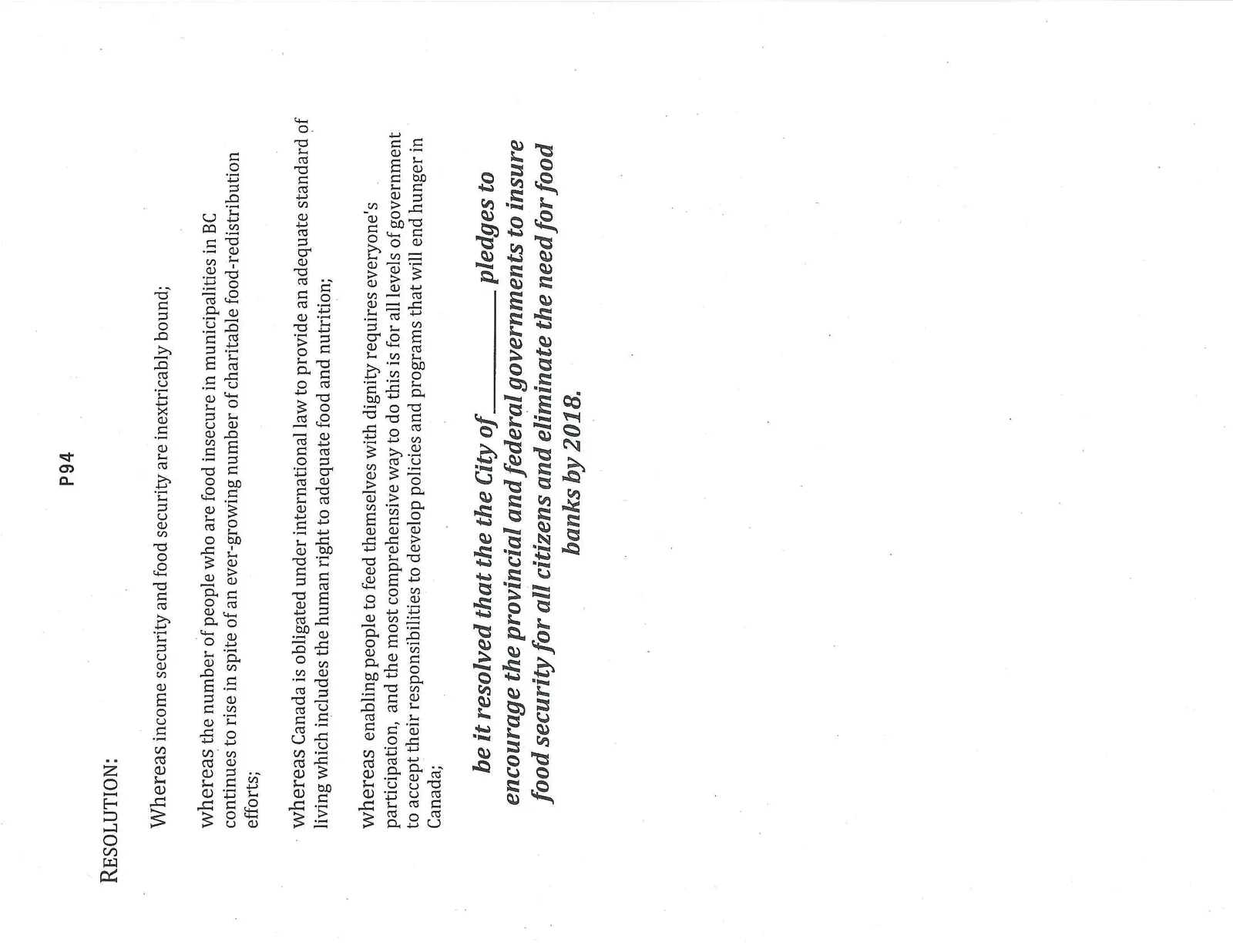
RESOLUTION:
Whereas income security and food security are inextricably bound;
whereas the number of people who are food insecure in municipalities in BC continues to rise in spite of an ever-growing number of charitable food-redistribution efforts;
whereas Canada is obligated under international law to provide an adequate standard of living which includes the human right to adequate food and nutrition;
whereas enabling people to feed themselves with dignity requires everyone's participation, and the most comprehensive way to do this is for all levels of government to accept their responsibilities to develop policies and programs that will end hunger in Canada;
be it resolved that the the City of ________ pledges to encourage the provincial and federal governments to insure food security for all citizens and eliminate the need for food banks by 2018.
Document Images
(6)