Victoria Family Court and Youth Justice Committee 2012 Annual Report
Comprehensive annual report for 2012 detailing committee activities, finances, and member agency projects.
Victoria Family Court and Youth Justice Committee Annual Report 2012
Presented January 16, 2013
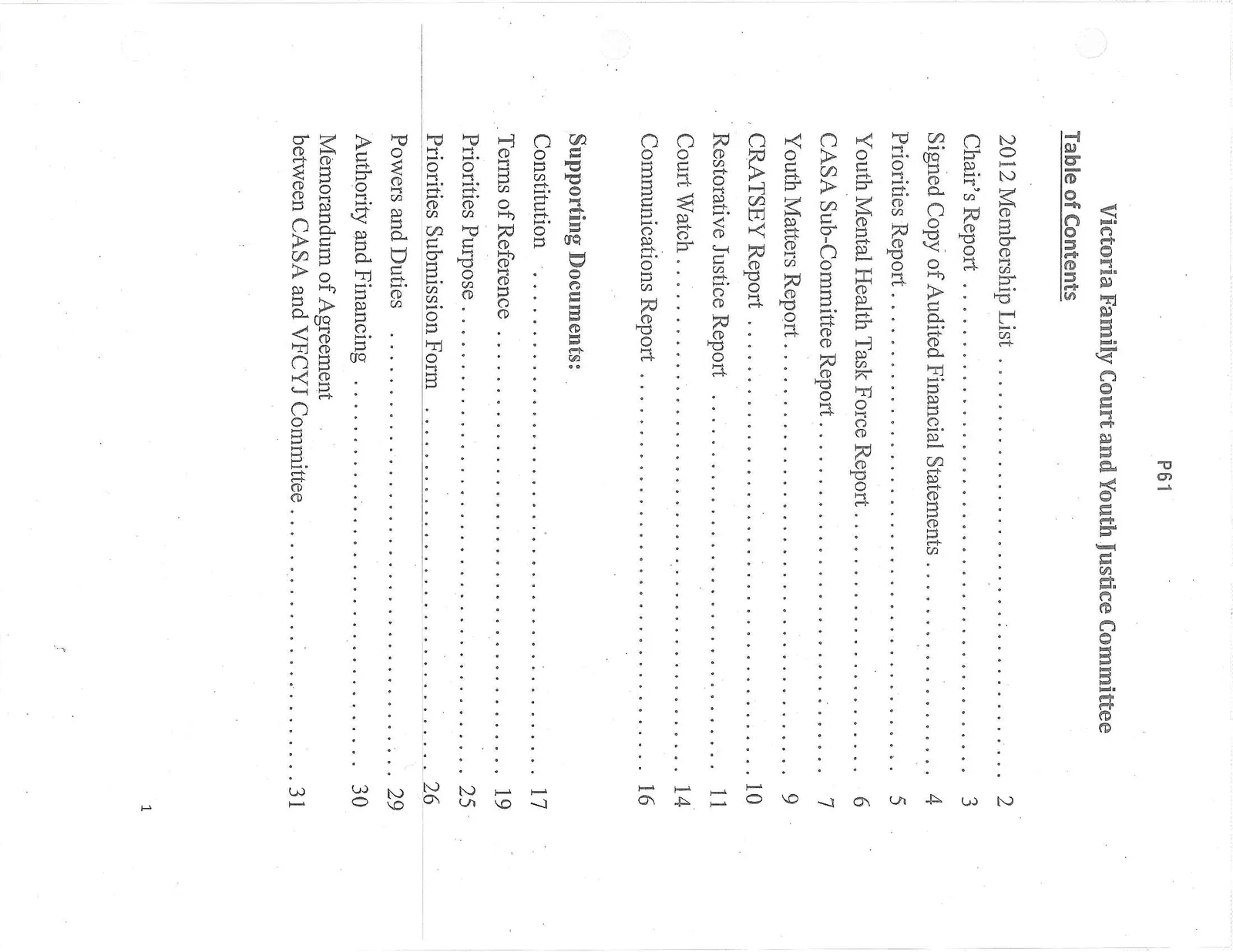
Table of Contents
- 2012 Membership List ... 2
- Chair's Report ... 3
- Signed Copy of Audited Financial Statements ... 4
- Priorities Report ... 5
- Youth Mental Health Task Force Report ... 6
- CASA Sub-Committee Report ... 7
- Youth Matters Report ... 9
- CRATSEY Report ... 10
- Restorative Justice Report ... 11
- Court Watch ... 14
- Communications Report ... 16
Supporting Documents:
- Constitution ... 17
- Terms of Reference ... 19
- Priorities Purpose ... 25
- Priorities Submission Form ... 26
- Powers and Duties ... 29
- Authority and Financing ... 30
- Memorandum of Agreement between CASA and VFCYJ Committee ... 31
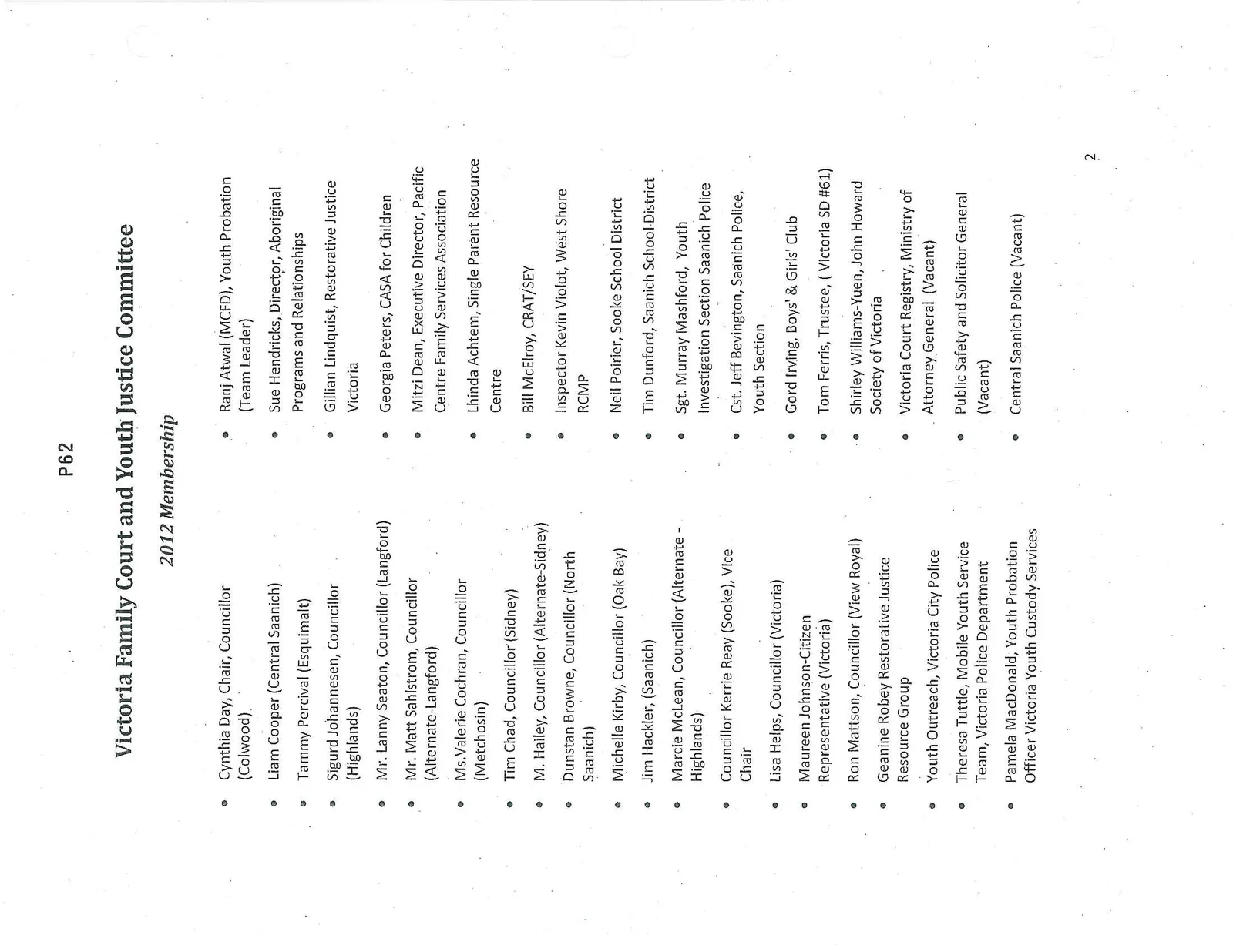
2012 Membership
- Cynthia Day, Chair, Councillor (Colwood)
- Liam Cooper (Central Saanich)
- Tammy Percival (Esquimalt)
- Sigurd Johannesen, Councillor (Highlands)
- Mr. Lanny Seaton, Councillor (Langford)
- Mr. Matt Sahlstrom, Councillor (Alternate-Langford)
- Ms. Valerie Cochran, Councillor (Metchosin)
- Tim Chad, Councillor (Sidney)
- M. Hailey, Councillor (Alternate-Sidney)
- Dunstan Browne, Councillor (North Saanich)
- Michelle Kirby, Councillor (Oak Bay)
- Jim Hackler, (Saanich)
- Marcie McLean, Councillor (Alternate-Highlands)
- Councillor Kerrie Reay (Sooke), Vice Chair
- Lisa Helps, Councillor (Victoria)
- Maureen Johnson-Citizen Representative (Victoria)
- Ron Mattson, Councillor (View Royal)
- Geanine Robey Restorative Justice Resource Group
- Youth Outreach, Victoria City Police
- Theresa Tuttle, Mobile Youth Service Team, Victoria Police Department
- Pamela MacDonald, Youth Probation Officer Victoria Youth Custody Services
- Ranj Atwal (MCFD), Youth Probation (Team Leader)
- Sue Hendricks, Director, Aboriginal Programs and Relationships
- Gillian Lindquist, Restorative Justice Victoria
- Georgia Peters, CASA for Children
- Mitzi Dean, Executive Director, Pacific Centre Family Services Association
- Lhinda Achtem, Single Parent Resource Centre
- Bill McElroy, CRAT/SEY
- Inspector Kevin Violot, West Shore RCMP
- Neil Poirier, Sooke School District
- Tim Dunford, Saanich School District
- Sgt. Murray Mashford, Youth Investigation Section Saanich Police
- Cst. Jeff Bevington, Saanich Police, Youth Section
- Gord Irving, Boys' & Girls' Club
- Tom Ferris, Trustee, (Victoria SD #61)
- Shirley Williams-Yuen, John Howard Society of Victoria
- Victoria Court Registry, Ministry of Attorney General (Vacant)
- Public Safety and Solicitor General (Vacant)
- Central Saanich Police (Vacant)
Chair's Report
The Victoria Family Court and Youth Justice Committee (VFCYJ) is comprised of representatives appointed by all 13 Capital Regional District Municipalities, the three Capital Regional District School Districts, and representatives appointed by the Capital Regional District Board, youth and family outreach organizations, Provincial Ministries and police officers. It is large group of individuals who believe that we can make a difference for families that are or might be experiencing the criminal justice and court systems or interacting with family law issues.
We are mandated to exist and empowered to comment on the circumstances for youth and families through both provincial and federal legislation (see terms of reference and supporting documents). Despite municipalities' desires to avoid the downloading of federal and provincial responsibility for the health and welfare of youth and their families, municipalities realize that they hold the unique position of being closest to the community. School Districts also know the situation for youth intimately and together with our police service agencies, recreation services, family and youth service agencies and Ministry and post-secondary education partners, we endeavor to be that agency which can speak authentically to the situation for youth and families.
It is a credit to the region that so many representatives are willing to travel across many boundaries and commit their valuable time to ensure that we come together to take stock of the resources, their appropriateness and effectiveness and to share information and make recommendations for improvements. We make the same observations in all 13 municipalities and school districts this year: services are being cut back; youth are in need of transportation, food, shelter, safety and emotional support. While youth are mobile and transient in that they may be in Sooke one month and Sidney the next, regional services may not be accessible. Cutbacks are focusing reduced resources on the most critical cases. We know (from numerous accredited statistical studies presented to the committee) that this can produce the fewest measureable improvements. Among the cutbacks this year, we saw resources for girls in custody move off the island to the mainland and lost both dedicated youth police officers from the Victoria Police.
I am pleased that the start-up grants we provided to Restorative Justice have been successful in laying the foundation for further advanced training initiatives, fostering more Restorative Justice to take place. One of the youth's trained for the Theatre Outreach Project (another FCYJC grant project) is now working part time in Restorative Justice, and the Girls' Circles (funding was provided last year) are continuing using textbook resources supplied last year. Regular reports from our one and only Mobile Youth Services Team police officer continue to be invaluable in understanding the issues youth are encountering.
Some children don't get the family they need and deserve. We need to reach youth at risk as soon as possible to effect a positive change; to assist them in reaching their full potential. We have used our scarce resources wisely and with continuing support from our appointing agencies through the Capital Regional District, we have again ended this year in a good financial position. I am pleased that we have so many agencies actively participating in the committee and I look forward to more improvements in 2013.
Respectfully submitted, Cynthia Day, Chair
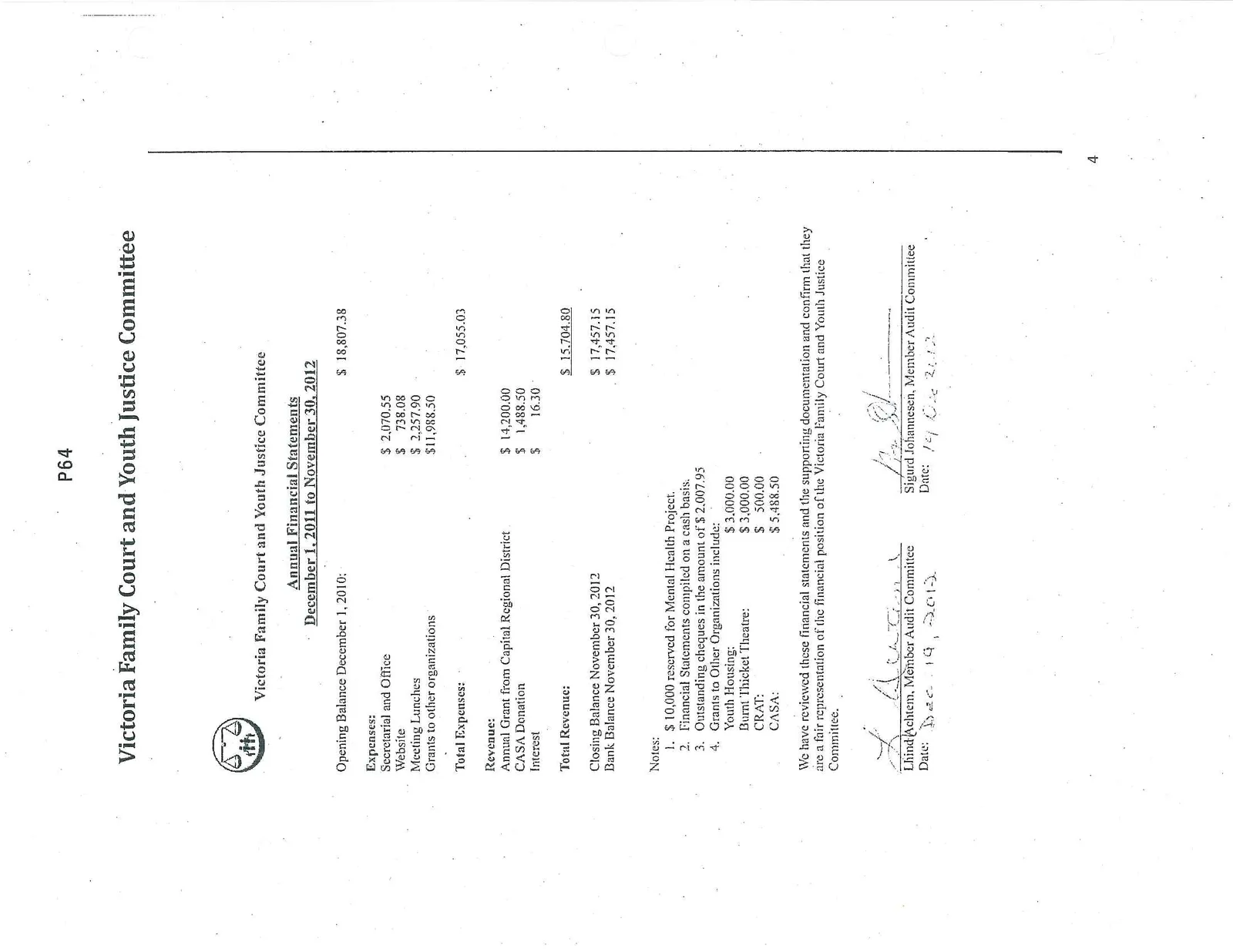
Annual Financial Statements
December 1, 2011 to November 30, 2012
| Item | Amount |
|---|---|
| Opening Balance December 1, 2010: | $ 18,807.38 |
| Expenses: | |
| Secretarial and Office | $ 2,070.55 |
| Website | $ 738.08 |
| Meeting Lunches | $ 2,257.90 |
| Grants to other organizations | $11,988.50 |
| Total Expenses: | $ 17,055.03 |
| Revenue: | |
| Annual Grant from Capital Regional District | $ 14,200.00 |
| CASA Donation | $ 1,488.50 |
| Interest | $ 16.30 |
| Total Revenue: | $ 15,704.80 |
| Closing Balance November 30, 2012 | $ 17,457.15 |
| Bank Balance November 30, 2012 | $ 17,457.15 |
Notes:
- $ 10,000 reserved for Mental Health Project.
- Financial Statements compiled on a cash basis.
- Outstanding cheques in the amount of $ 2,007.95
- Grants to Other Organizations include:
- Youth Housing: $ 3,000.00
- Burnt Thicket Theatre: $ 3,000.00
- CRAT: $ 500.00
- CASA: $ 5,488.50
Priorities Committee
The Priorities Committee consists of the Chair, Vice-Chair, Treasurer, and another member appointed by the Chair from the committee to review applications received. Lhinda Achtem has been kind enough to offer her services to our Priorities Committee for several years. Our goals are outlined in the Priorities Purpose document as created by past member Sandy McPherson, a councillor from the District of Highlands.
The committee works to ensure that when a proposal comes forward to the committee, all the necessary information is in place to allow for an informed decision. The application is reviewed via email and a recommendation (with additional information if needed) is brought to the main committee for a decision, usually through a formal report. The Priorities Committee has received five applications for funding assistance in 2012.
In January the committee recommended support of $3,000.00 for the West Shore Youth Housing Task Force to develop their study on the need for youth housing in the West Shore. The report has been made available to the committee and is included in our website as a resource for the community.
In February, the committee recommended support of $3,000.00 for the Play She Has a Name provided that they were able to secure at least $7,000.00 from other sources. The group was successful and brought needed awareness to the issues of Human Trafficking.
In October, the committee recommended support of $500.00 (of a total budget of $1,800.00) for Pacific Centre Family Services Association to conduct Youth Outreach sessions as a follow up to the Bright Ideas Conference recommendations.
In November, the committee members assisted with letters of support for a grant application to the proceeds of crime funds to put on a one day symposium geared towards parents and specialists in response to the Trauma, Turmoil and Tragedy paper authored by the Children's Advocate.
In December the committee supported sending three participants to the Vancouver Island Parent Conference for a cost of $210.00 ($70.00 per person).
The committee has also been consulted by the Saanich School District (#63) regarding the funding provided last year. Due to teacher's job action, not all of the envisioned works were done and they requested approval to use the remaining funds to facilitate Girl's Circles in two middle schools in the 2012/13 school year. The committee approved and we anticipate a presentation being made to the committee in April, 2013 when we meet on the peninsula.
Respectfully submitted,
Cynthia Day, Chair Priorities Committee
Youth Mental Health Task Force
Originally championed by the late Dr. Basil Boulton, The Youth Mental Health Task Force has not formally constituted itself this year, instead the Family Court and Youth Justice Committee has continued to lobby for mental health services for youth in the school setting. To this end the Chair attended several engagement sessions with the Sooke School District (#62) to advocate for dedicated youth mental health service space in the two new schools being built in the West Shore.
Youth Mental Health remains a focus for service space in both schools and we are hopeful that youth service will be provided in both new schools as part of the plan from day one on. The Victoria Family Court and Youth Justice Committee continues to hold $10,000 in reserve to assist with the implementation of these spaces in partnership with VIHA and others who will need to partner in the provision of services.
We anticipate that 2013 will be a more active year and welcome the participation of all members of the Victoria Family Court and Youth Justice Committee and municipalities in this important project that could set the direction for service in the future. There have been two successful resolutions at the Union of British Columbia Municipalities on this initiative and I believe the work will be of benefit far beyond our own region.
Respectfully submitted, Cynthia Day, Chair Youth Mental Health Task Force
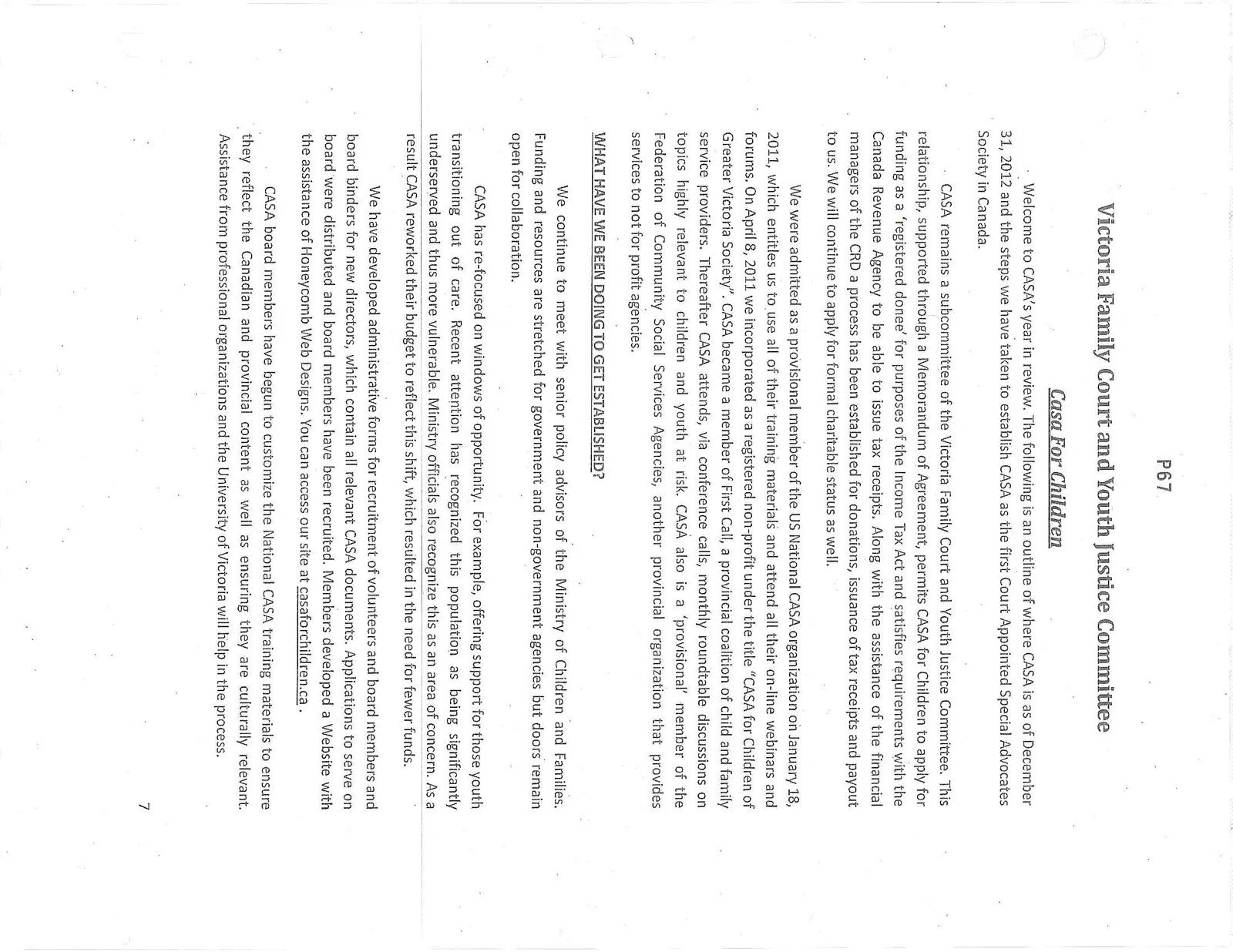
Casa For Children
Welcome to CASA's year in review. The following is an outline of where CASA is as of December 31, 2012 and the steps we have taken to establish CASA as the first Court Appointed Special Advocates Society in Canada.
CASA remains a subcommittee of the Victoria Family Court and Youth Justice Committee. This relationship, supported through a Memorandum of Agreement, permits CASA for Children to apply for funding as a ‘registered donee’ for purposes of the Income Tax Act and satisfies requirements with the Canada Revenue Agency to be able to issue tax receipts. Along with the assistance of the financial managers of the CRD a process has been established for donations, issuance of tax receipts and payout to us. We will continue to apply for formal charitable status as well.
We were admitted as a provisional member of the US National CASA organization on January 18, 2011, which entitles us to use all of their training materials and attend all their on-line webinars and forums. On April 8, 2011 we incorporated as a registered non-profit under the title “CASA for Children of Greater Victoria Society”. CASA became a member of First Call, a provincial coalition of child and family service providers. Thereafter CASA attends, via conference calls, monthly roundtable discussions on topics highly relevant to children and youth at risk. CASA also is a ‘provisional’ member of the Federation of Community Social Services Agencies, another provincial organization that provides services to not for profit agencies.
WHAT HAVE WE BEEN DOING TO GET ESTABLISHED?
We continue to meet with senior policy advisors of the Ministry of Children and Families. Funding and resources are stretched for government and non-government agencies but doors remain open for collaboration.
CASA has re-focused on windows of opportunity. For example, offering support for those youth transitioning out of care. Recent attention has recognized this population as being significantly underserved and thus more vulnerable. Ministry officials also recognize this as an area of concern. As a result CASA reworked their budget to reflect this shift, which resulted in the need for fewer funds.
We have developed administrative forms for recruitment of volunteers and board members and board binders for new directors, which contain all relevant CASA documents. Applications to serve on board were distributed and board members have been recruited. Members developed a Website with the assistance of Honeycomb Web Designs. You can access our site at casaforchildren.ca .
CASA board members have begun to customize the National CASA training materials to ensure they reflect the Canadian and provincial content as well as ensuring they are culturally relevant. Assistance from professional organizations and the University of Victoria will help in the process.
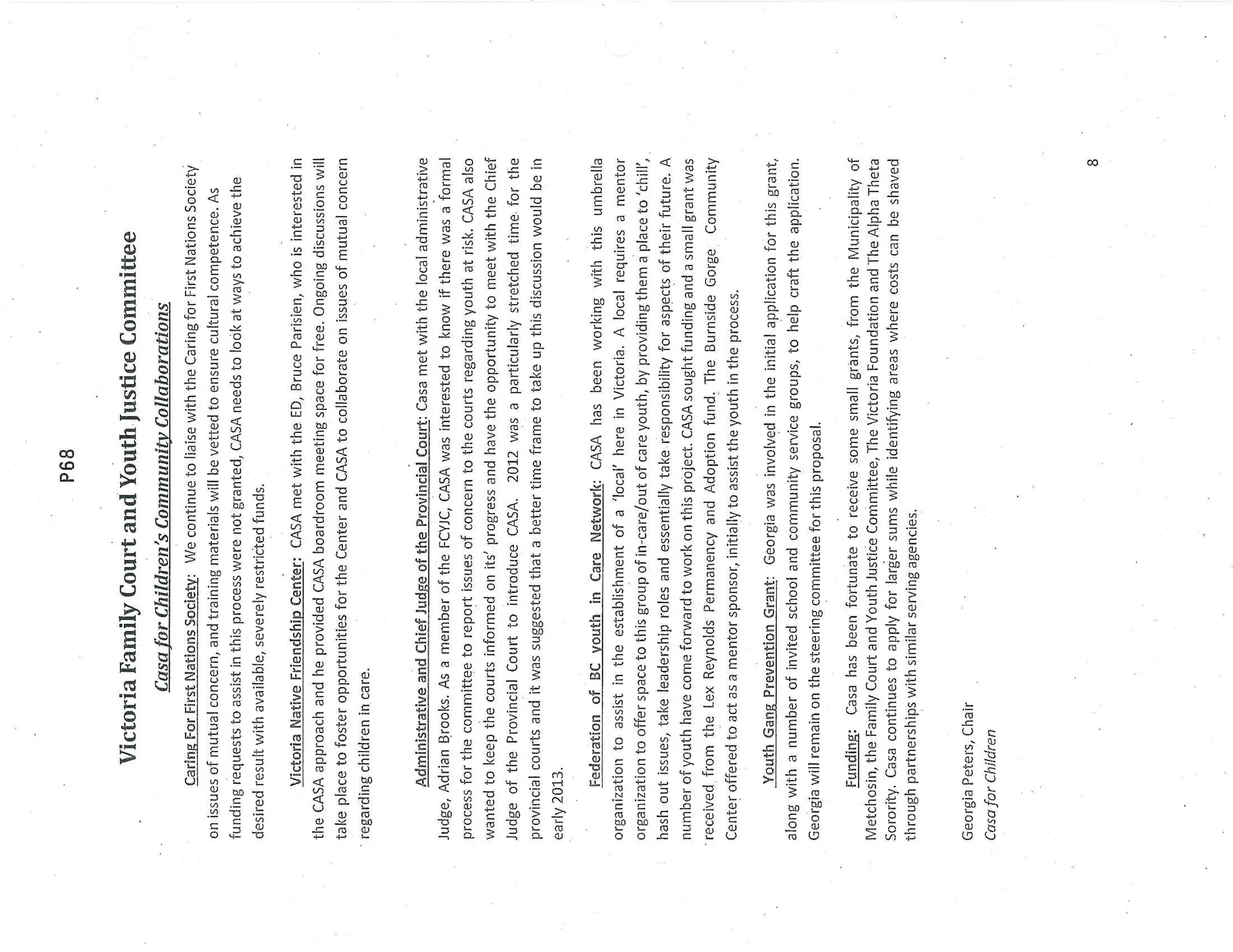
Casa for Children's Community Collaborations
Caring For First Nations Society: We continue to liaise with the Caring for First Nations Society on issues of mutual concern, and training materials will be vetted to ensure cultural competence. As funding requests to assist in this process were not granted, CASA needs to look at ways to achieve the desired result with available, severely restricted funds.
Victoria Native Friendship Center: CASA met with the ED, Bruce Parisien, who is interested in the CASA approach and he provided CASA boardroom meeting space for free. Ongoing discussions will take place to foster opportunities for the Center and CASA to collaborate on issues of mutual concern regarding children in care.
Administrative and Chief Judge of the Provincial Court: Casa met with the local administrative Judge, Adrian Brooks. As a member of the FCYJC, CASA was interested to know if there was a formal process for the committee to report issues of concern to the courts regarding youth at risk. CASA also wanted to keep the courts informed on its' progress and have the opportunity to meet with the Chief Judge of the Provincial Court to introduce CASA. 2012 was a particularly stretched time for the provincial courts and it was suggested that a better time frame to take up this discussion would be in early 2013.
Federation of BC youth in Care Network: CASA has been working with this umbrella organization to assist in the establishment of a 'local' here in Victoria. A local requires a mentor organization to offer space to this group of in-care/out of care youth, by providing them a place to ‘chill’, hash out issues, take leadership roles and essentially take responsibility for aspects of their future. A number of youth have come forward to work on this project. CASA sought funding and a small grant was received from the Lex Reynolds Permanency and Adoption fund. The Burnside Gorge Community Center offered to act as a mentor sponsor, initially to assist the youth in the process.
Youth Gang Prevention Grant: Georgia was involved in the initial application for this grant, along with a number of invited school and community service groups, to help craft the application. Georgia will remain on the steering committee for this proposal.
Funding: Casa has been fortunate to receive some small grants, from the Municipality of Metchosin, the Family Court and Youth Justice Committee, The Victoria Foundation and The Alpha Theta Sorority. Casa continues to apply for larger sums while identifying areas where costs can be shaved through partnerships with similar serving agencies.
Georgia Peters, Chair Casa for Children
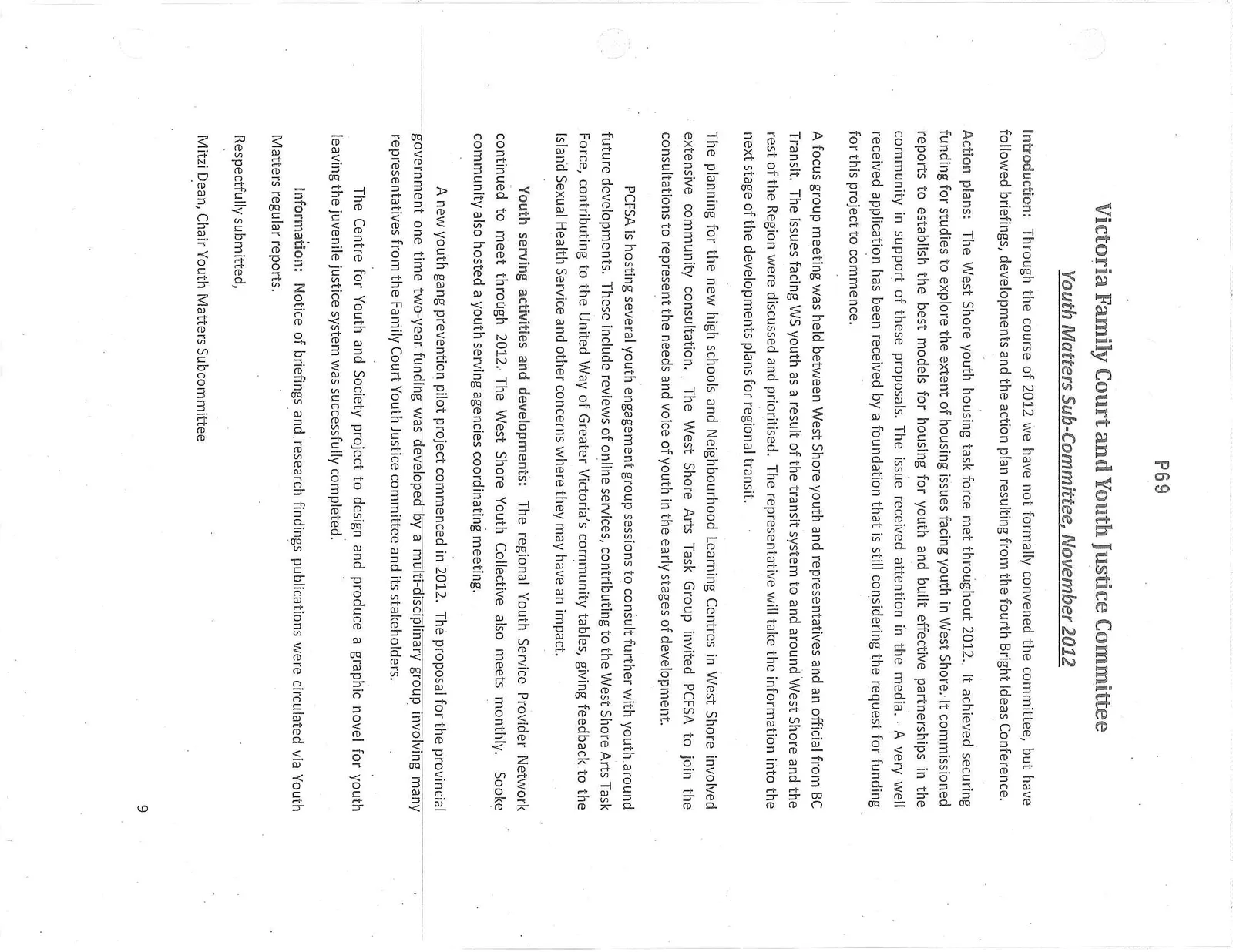
Youth Matters Sub-Committee, November 2012
Introduction: Through the course of 2012 we have not formally convened the committee, but have followed briefings, developments and the action plan resulting from the fourth Bright ideas Conference.
Action plans: The West Shore youth housing task force met throughout 2012. It achieved securing funding for studies to explore the extent of housing issues facing youth in West Shore. It commissioned reports to establish the best models for housing for youth and built effective partnerships in the community in support of these proposals. The issue received attention in the media. A very well received application has been received by a foundation that is still considering the request for funding for this project to commence.
A focus group meeting was held between West Shore youth and representatives and an official from BC Transit. The issues facing WS youth as a result of the transit system to and around West Shore and the rest of the Region were discussed and prioritised. The representative will take the information into the next stage of the developments plans for regional transit.
The planning for the new high schools and Neighbourhood Learning Centres in West Shore involved extensive community consultation. The West Shore Arts Task Group invited PCFSA to join the consultations to represent the needs and voice of youth in the early stages of development.
PCFSA is hosting several youth engagement group sessions to consult further with youth around future developments. These include reviews of online services, contributing to the West Shore Arts Task Force, contributing to the United Way of Greater Victoria's community tables, giving feedback to the Island Sexual Health Service and other concerns where they may have an impact.
Youth serving activities and developments: The regional Youth Service Provider Network continued to meet through 2012. The West Shore Youth Collective also meets monthly. Sooke community also hosted a youth serving agencies coordinating meeting.
A new youth gang prevention pilot project commenced in 2012. The proposal for the provincial government one time two-year funding was developed by a multi-disciplinary group involving many representatives from the Family Court Youth Justice committee and its stakeholders.
The Centre for Youth and Society project to design and produce a graphic novel for youth leaving the juvenile justice system was successfully completed.
Information: Notice of briefings and research findings publications were circulated via Youth Matters regular reports.
Respectfully submitted,
Mitzi Dean, Chair Youth Matters Subcommittee
Capital Region Action Team for Sexually Exploited Youth (CRAT-SEY)
CRAT met 4 times during the year. Most of our activities were devoted to providing resources in the community to increase awareness of the issue of sexually exploited youth. In January, the CRAT Chair and the Mobile Youth Support Team (MYST) coordinator, Constable Theresa Tuttle appeared before Sooke Municipal Council to raise their awareness about sexually exploited youth in Sooke. This appearance was the result of Sooke Council's consideration of dropping out of the MYST funding arrangement. Sooke decided to remain a part of MYST.
In late 2011, CRAT got a grant of $5500 to run a day long workshop about Human Trafficking and Sexual Exploitation. We put on this workshop at the Pacific Fleet Club, who donated the space, on April 19. Over 160 people attended. Presentations were made by the RCMP, Office of Trafficking in Persons, MYST, Taking Care of Ourselves, Taking Care of Others (TCO2), Children of the Streets Society, Prostitutes Empowerment and Education Research Society (PEERS), South Island Pride Centre, Boys and Girls Club and a youth who had first hand experience with sexual exploitation. There were requests to run another workshop in the fall of 2013 and funding has been requested for that.
We sponsored TCO2 to make presentations April 30-May 2 and May 31 and June 1. They made 13 presentations to a total of 100 adults and 855 youth. This is far below the usual average of 3000 who have attended the presentations in past years. Bookings were down throughout the Province, probably because of the ongoing job action in the schools.
The Chair attended a presentation of the play "She Has A Name" about human trafficking, which was partly sponsored by the Victoria Family Court and Youth Justice Committee ($3000) and CRAT ($1000). The play was staged 3 times during the Victoria Fringe festival and was well received by audiences.
CRAT provided funds to cover food costs for a Grief session at the WestShore Child, Youth and Family Centre on Wale Road. Some 25-30 youth attended as a result of the death of a WestShore youth in a traffic accident. This was an opportunity for the youth in the WestShore to find out what kind of counselling services were available for them. Family members also attended and were given priority.
The Chair is helping to coordinate the WestShore Emergency Youth Housing Task Force, which has found a potential site in Colwood. Discussions are ongoing. If successful, we could have 12 units of housing for West Shore youth, which will go a long way toward reducing the risk factors of youth being sexually exploited.
CRAT and its membership are increasingly concerned about the cutbacks which have had a major impact on service providers, particularly those who work with sexually exploited youth. There are increasing gaps in service and youth who need help are finding it increasingly difficult to find. We are working on developing a strategic session to determine the future of CRAT and to set strategic goals for the future.
Submitted by Bill McElroy, Chair, December, 2012
RESTORATIVE JUSTICE 2012
Restorative Justice (RJ) services and programs have continued to grow at a dizzying pace in Greater Victoria. Seed funding from the Victoria Family Court & Youth Justice Committee for 3 distinct projects has been foundational in helping to ensure the success of RJ in the region.
Advanced Training: In 2011, the VFCYJC funded the Restorative Justice Resource Group's advanced training initiative which consisted of an in-depth needs assessment as well as the planning and development of 3 advanced training modules for experienced volunteers to train in facilitating complex files. Additionally, the training by Mediator and JI Trainer Gordon White with coaching support by Jeannie Owens-Wallace, Gillian Lindquist and Liz Cox, was envisioned as a first step in training our own trainers to deliver autonomously this curriculum and others in the future.
Last year, it was reported to the VFCYJC that thanks to the success of this initial training, Restorative Justice Victoria was able to secure additional funding from the Law Foundation to deliver a second cycle of training and, to expand upon this offering with Peacemaking Circles and Victim-Offender Mediation. The Crown Case Referral Capacity Building Project was a one-time project designed to meet a specific need arising from the rapid increase in Crown referrals of more complex cases to VRJS, and other regional restorative justice programs, and the associated need for advanced training of volunteers who facilitate restorative justice processes. The goal was to have an immediate, direct, and tangible impact on the provision of legal services in Victoria. All trainings were successfully delivered in 2012 resulting in the following project outcomes:
- 109 participants in the trainings
- Participants attended from 12 regional restorative justice programs
- Evaluations indicated high success and satisfaction rates amongst participants (4.48 out of 5 and 4.82 out of 5)
- Development of curriculum for 3 advanced trainings in the community justice conferencing model
- Training of 3 trainers to deliver these materials in-house on an on-going basis for the benefit of VRJS and other regional restorative justice program
The ripple effect does not stop here. Late last Spring, RJ Victoria Executive Director and Program Coordinator, Gillian Lindquist was selected to be part of a province-wide workshop for restorative justice practitioners. She was chosen as one of four trainers for this project, which is incredibly innovative as it is the first province-wide training in our field and will enhance significantly, the capacity of RJ programs across the province to take on more serious and complex cases. We, the Restorative Justice community, are grateful not only for the initial support of VFCYJC but for the subsequent benefits we have enjoyed as a result of this support.
Girls' Circle: RJ Victoria has been facilitating Girls' Circles in middle schools to support at-risk female youth in grades 6, 7 and 8. Many young women in Victoria and Esquimalt are engaged in behaviours that put them at risk of sexual abuse, violence, substance abuse, sexually transmitted diseases, dropping out, and teen pregnancy. Girls' Circle provides an opportunity for vulnerable young women to create authentic relationships within a context of their own setting and community. It focuses on the strengths of participants and is non-judgmental, caring, confidential and fun. The ultimate goal is for participants to develop a set of coping and adjusting skills that will enable them to become productive members of society.
Restorative Justice (Continued)
The seed funding for developing the curriculum for Girls' Circle and purchasing resources and supplies first came from the VFCYJC (as reported in 2011). Since the initial model was put in place, Restorative Justice Victoria has been able to obtain on-going funding for Girls' Circles in middle schools. Initially this was from Zonta, whose funding support continues, and now also includes Coast Capital.
Youth Theatre Outreach Project Spin off: Nathalie Down: In 2009, the VFCYJC funded the Introduction to RJ & Facilitator Training for a group of 9 young people ranging from high school to university aged, the ‘RJ Youth Outreach Group’. The mandate behind the development of the RJ Youth Outreach Group was threefold:
to engage local youth (ages 15-25) with an interest in social justice issues, theatre, and peer education, in order to train them in restorative principles and practices and provide them with meaningful contact with front-line stakeholders (police, victims, offenders, facilitators, etc);
to create a play about Restorative Justice (based on the group's experiences during training) to tour to local schools as a dynamic way of informing young people (primarily in middle schools and high schools) who are generally unaware of the existence of RJ and its function in today's justice system;
to encourage wider community participation in the project: seeking partnerships with local sponsors and in-kind donors, encouraging local media to get interested in a ‘good news’ story, performing for the general public, and offering workshops to accompany the production.
The project was a great success, having spread the message of RJ and peaceful alternatives to conflict to middle schools in Victoria and Vancouver Island, to the general public and to the Restorative Practices International Conference in 2009.
Out of that initial group of young people, one in particular – Nathalie Down – decided to pursue further work in Restorative Justice and to make it her career path. Coming into the project as a first year undergraduate, Nathalie has since completed a double major in Women's Studies and Environmental Studies at UVic and was the first graduate of the Social Justice Studies diploma program at UVic.
Says Nathalie about her involvement in, and passion for, Restorative Justice:
I incorporated restorative justice research into all of my studies and papers, as I felt called down the RJ path from the time I first learned about it. I've volunteered with RJ ever since the theatre project working as a facilitator, community member and mentor on countless cases, including some of the most high profile ones and have also served on several committees. I have attended all the RJ advanced trainings. I am also the lead facilitator for this years Girls' Circle program at Central Middle School. I'm developing an innovative curriculum based on a Critical Girls Studies pedagogy which includes movement, theatre, media skills and critical thinking tools.
Restorative Justice (Continued)
My special interest is in the healing potential of RJ in cases of sexual violence. The project I am seeking funding for is called Healing Visions - Restorative Justice for Us, By Us. This project would be community-based and bring together survivors of sexual violence to train in RJ and then work together to envision safe, ethical and meaningful RJ processes for addressing cases of sexual assault. As a survivor of violence myself, and also having worked closely as a mentor for a young woman deciding to use RJ instead of court in her own rape case, I believe there is incredible untapped healing and transformation potential in RJ for both victims and offenders.
Another project which I have recently become involved in thanks to the RJ Theatre Outreach project is a decolonizing community-based theatre project called ‘From the Heart: Enter the Journey of Reconciliation’ based on the book Unsettling the Settler, designed to encourage greater education, understanding, healing and unity between settler and First Nations communities.
Next for me is either a Masters degree or a Law Degree focused on RJ.
I am happy to report that as of December 2012, some funding was allotted to hire this amazing young woman part time as a case support worker and volunteer mentor on a contract basis at Restorative Justice Victoria. Thanks once again to the VFCYJC, seed funding has produced a domino effect – this time in giving RJ Victoria and the greater community the talents of a devoted young woman who has found her career path.
Geanine Robey, Restorative Justice Resource Group
Report from the Court Watch Subcommittee
For several years now Norm McCrimmon has monitored the Victoria Youth Court. One issue of concern was the transfer of female youth in detention to the lower mainland and its effect on the handling of local cases at a distance. This topic was discussed at one of the Family and Youth Court Committee meetings. The professional representatives on the Committee pointed out the implications of this strategy and noted there were some advantages as a result of these changes. It is possible that female youth can be dealt with in a more timely manner.
In the longer run many of us would be interested in knowing if the Youth Criminal Justice Act has improved procedures for responding problem juveniles. One assessment of the national data on juvenile justice suggests that the number of cases being processed through the system has gone down. However, others who have been analyzing these data suggest that the declining use of incarceration for juveniles is part of a trend that started before the enactment of the latest legislation. Thus, while these changes are correlated with the application of the legislation, it does not necessarily mean that the Youth Criminal Justice Act caused these changes.
One Youth Court judge commented to our Committee that the requirement to consider alternative measures may have restricted the use of the “short, sharp, shock” strategy that has sometimes been used in the past. There is no clear evidence that all alternative measures are desirable or superior to some strategies that have been used in the past. While there is considerable evidence that incarceration is usually an unpromising choice, it is not obvious that the “short, sharp, shock,” (a couple of days in lock-up) is always a poor choice. We should not assume that any alternative measure is automatically good. Sometimes doing nothing more than a bawling out is a wise choice.
Restorative justice appears to be one of the promising alternative measures. Systematic evaluations of RJ in Australia, Great Britain, and the U. S. suggests that it can, and has, reduced delinquency. One “process evaluation” done by an M. A. student at the U of Victoria suggests that some local RJ projects are doing what they claim to be doing. For example, the majority of juveniles felt that adults listened to their concerns. However, this type of process evaluation does not tell us if RJ actually reduces crime.
Because of the promising results in other Anglophone countries, RJ clearly shows potential. Other alternative measures, especially those which have not been subject to systematic scientific assessments, may simply be supported by enthusiasm. For example, we know that one of the skills learned by the majority of youth is to manipulate adults. Thus, pretending to display remorse and pretending that you feel badly after stealing from the wealthy owners of Wal-Mart may convince a group of sympathetic adults; but it is not really restorative justice.
On the other hand, young folks who learn to con adults, as the majority do, are less likely to end up being in trouble with the law. This is compatible with new evidence that those who cheat in secondary school, do well in university, and those who cheat in university, are more successful getting into professional graduate programs. And those who cheat to get into professional schools have quite successful careers.
Report from the Court Watch Subcommittee (Continued)
One of the tasks facing society and juvenile justice systems is distinguishing between success in 1) reducing prosocial behaviour and 2) simply training young people to succeed in a world that provides material rewards for unethical behaviour if you can do it without getting caught.
However, one should not be overly critical of our attempts to provide alternatives. Some of the sentencing practices in the past have been clearly dysfunctional. We can do better. Trying out alternatives may lead to mistakes but, on balance, we can do less damage than we have done in the past.
A quite different question our Family and Youth Court Committee might ask is whether monitoring the juvenile justice system has any impact. Mr. McCrimmon has been observing the court room setting for several years. Admittedly, the use of email and other communication among the crown, defense, and others, has probably made the system work more smoothly, but an outside observer is unable to monitor this important informal aspect of the system.
When I was researching smaller court systems in smaller communities in northern British Columbia, the quarterly visits by the judge and court team sometimes coincided with lunch with the local Youth Court Committee. The feedback provided to the circuit court judge may have given some insight into the local situation. Did this awareness produce better justice?
Have the several years of observation done by Mr. McCrimmon been of value to those who staff the Youth Court? When I was researching courts in Alberta, I was continually meeting my former criminology students who were now police officers, social workers, defense lawyers, and prosecutors (no judges). This led to better information sharing and provided many insights into the dynamics of the system. Mr. McCrimmon has now spent more time observing in the Victoria system than I have in any of the court systems I have studied in many different countries. Is anyone interested in the insights he may have gained?
In fact, will anyone read this annual report of the Victoria Court Watch Sub-Committee? Submitted by Jim Hackler after sharing with Norm McCrimmon
Not much has changed from last year and the content of the entry for the 2011 annual report generally applies for 2012. One new matter would be the transfer of female youth in detention to the lower mainland and its effect on the handling of local cases at a distance. As you previously advised, the committee seemed satisfied that this move has not created any significant problems. As you mentioned, female youth cases seem to be dealt with in a more timely manner. Also, the office move appears set for February 1, 2013. There appears to be some difficulty in finding separate accommodation for each of the 6 "friends of the court" groups. Some office sharing may be required.
Cheers, Norm McCrimmon Court Monitor
Communications Report 2012
The communications committee has focused on getting the history of the committee into digital format, in as much as possible, for inclusion on our website. The website development has been slow, with so much historical information to be included and a strong desire to have it done right the first time. The website will be going live early in 2013.
Other communications issues include informing municipalities, school districts and resource agencies (who may not be aware of our mandate) of who we are and what we do. To this end we have planned to hold meetings in the West Shore and on the Peninsula, assisting the committee in becoming known in all areas of the Capital Regional District.
Updating our committee structure in 2010 helped to get the word out about our committee, and we now maintain a contact list to assist with getting participation and coordination. Holding our Annual General Meeting at a pre scheduled January date also helps the agencies to be prepared to participate and aligns well with new appointments. Packages have been prepared for new members of the committee to familiarize them with our mandate, and these will be distributed again to new members.
The committee also asks various agencies and individuals to come and speak to the committee. Presentations have included:
- Scott Rothermel, School District 62, Liaison Officer, Email: srothermel@sd62.bc.ca
- Gillian Lindquist, Coordinator, Girls Circle, Email: gillianlindquist@vrjs.org Tel: 250-383-5801
- Bill McElroy, West Shore Housing Brief Email: bill@mcelroys.ca
- Mike Mulligan, Defence Lawyer, Mulligan, Tam and Pearson Email: mulligan@mtplaw.com Tel # is 250-480-4040
- Mitzi Dean, Bright Ideas Follow Up Recommendations, Pacific Centre Family Services Association, Email: mdean@pcfsa.org Tel: 250-478-8357
- Mia Bailly, Gang Prevention Coordinator, Pacific Centre Family Services Association Email: mbailly@pcfsa.org Tel: 250-478-8357
This report also forms the basis of our largest communications outreach exercise. Each member of the committee will be asked to present this report to their appointing agency, as it represents our best snapshot of what the committee does, why and how.
Respectfully submitted, Cynthia Day
Constitution
The Family Court Committee shall consist of: a) One elected representative appointed by each of the following jurisdictions:
- City of Victoria
- City of Langford
- City of Colwood
- Municipality of Oak Bay
- Municipality of Saanich
- Municipality of Esquimalt
- Municipality of Central Saanich
- Municipality of North Saanich
- Town of View Royal
- Town of Sidney
- District of Sooke
- District of Highlands
- District of Metchosin
- School District #61
- School District #62
- School District #63 b) Notwithstanding a) above, each jurisdiction may appoint a non-elected alternate representative to the Committee. c) Up to seven members at large shall be appointed by the Capital Regional District for a minimum of two years.
From among the voting members, the Capital Regional District shall appoint a Chairperson, Vice-Chairperson, and Treasurer according to Sub-section 3 of Clause 4 of the Provincial Court Act. Nominations to be submitted by the Family Court Committee for ratification.
Representatives of the Ministries of the Attorney General, Education, Children and Family Development, Public Safety and Solicitor General, Health, Housing and Social Development and police forces and First Nations may be invited to attend as non-voting resource members.
It shall be the duty of the Family Court and Youth Justice Committee to submit annual reports and budgets to the Capital Regional District, the participating municipalities and to the Ministry of the Attorney General as per Clause C of Sub-section 4 of the Provincial Court Act.
The Family Court and Youth Justice Committee shall develop terms of reference for the conduct of its affairs.
Approved by Committee January 18, 2010
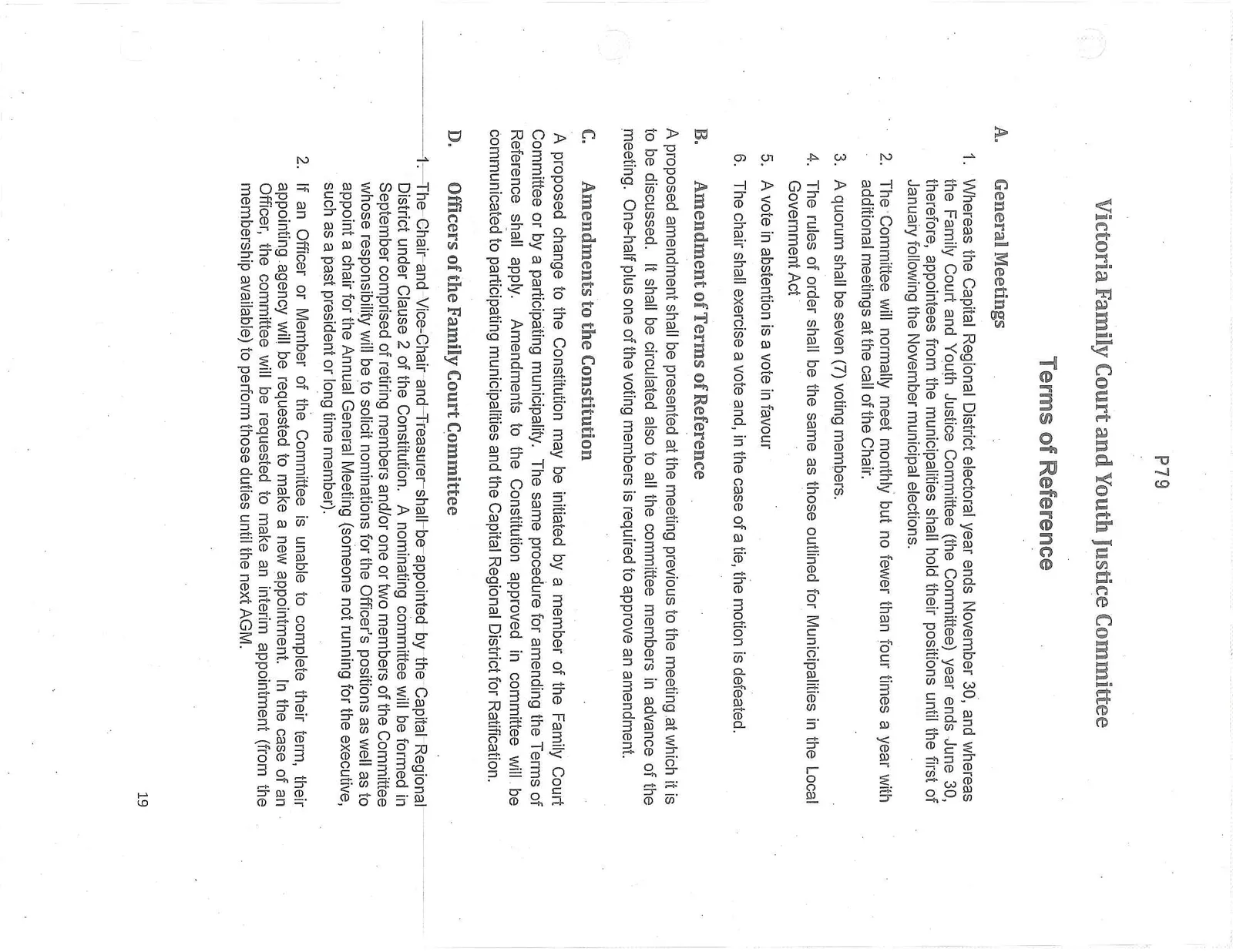
Terms of Reference
A. General Meetings
- Whereas the Capital Regional District electoral year ends November 30, and whereas the Family Court and Youth Justice Committee (the Committee) year ends June 30, therefore, appointees from the municipalities shall hold their positions until the first of January following the November municipal elections.
- The Committee will normally meet monthly but no fewer than four times a year with additional meetings at the call of the Chair.
- A quorum shall be seven (7) voting members.
- The rules of order shall be the same as those outlined for Municipalities in the Local Government Act.
- A vote in abstention is a vote in favour.
- The chair shall exercise a vote and, in the case of a tie, the motion is defeated.
B. Amendment of Terms of Reference
A proposed amendment shall be presented at the meeting previous to the meeting at which it is to be discussed. It shall be circulated also to all the committee members in advance of the meeting. One-half plus one of the voting members is required to approve an amendment.
C. Amendments to the Constitution
A proposed change to the Constitution may be initiated by a member of the Family Court Committee or by a participating municipality. The same procedure for amending the Terms of Reference shall apply. Amendments to the Constitution approved in committee will be communicated to participating municipalities and the Capital Regional District for Ratification.
D. Officers of the Family Court Committee
- The Chair and Vice-Chair and Treasurer shall be appointed by the Capital Regional District under Clause 2 of the Constitution. A nominating committee will be formed in September comprised of retiring members and/or one or two members of the Committee whose responsibility will be to solicit nominations for the Officer's positions as well as to appoint a chair for the Annual General Meeting (someone not running for the executive, such as a past president or long time member).
- If an Officer or Member of the Committee is unable to complete their term, their appointing agency will be requested to make a new appointment. In the case of an Officer, the committee will be requested to make an interim appointment (from the membership available) to perform those duties until the next AGM.
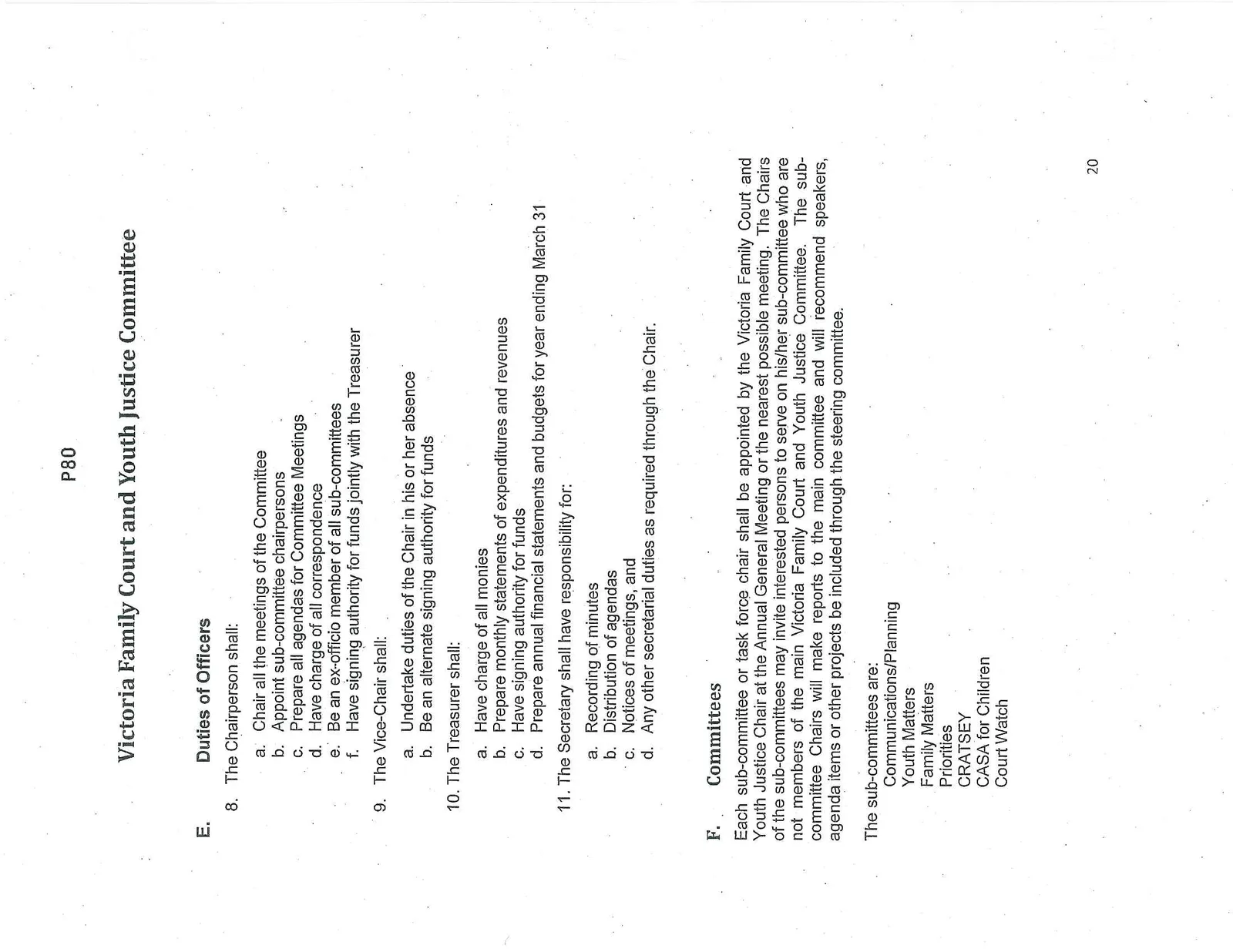
E. Duties of Officers
- The Chairperson shall: a. Chair all the meetings of the Committee b. Appoint sub-committee chairpersons c. Prepare all agendas for Committee Meetings d. Have charge of all correspondence e. Be an ex-officio member of all sub-committees f. Have signing authority for funds jointly with the Treasurer
- The Vice-Chair shall: a. Undertake duties of the Chair in his or her absence b. Be an alternate signing authority for funds
- The Treasurer shall: a. Have charge of all monies b. Prepare monthly statements of expenditures and revenues c. Have signing authority for funds d. Prepare annual financial statements and budgets for year ending March 31
- The Secretary shall have responsibility for: a. Recording of minutes b. Distribution of agendas c. Notices of meetings, and d. Any other secretarial duties as required through the Chair.
F. Committees
Each sub-committee or task force chair shall be appointed by the Victoria Family Court and Youth Justice Chair at the Annual General Meeting or the nearest possible meeting. The Chairs of the sub-committees may invite interested persons to serve on his/her sub-committee who are not members of the main Victoria Family Court and Youth Justice Committee. The sub-committee Chairs will make reports to the main committee and will recommend speakers, agenda items or other projects be included through the steering committee.
The sub-committees are:
- Communications/Planning
- Youth Matters
- Family Matters
- Priorities
- CRATSEY
- CASA for Children
- Court Watch
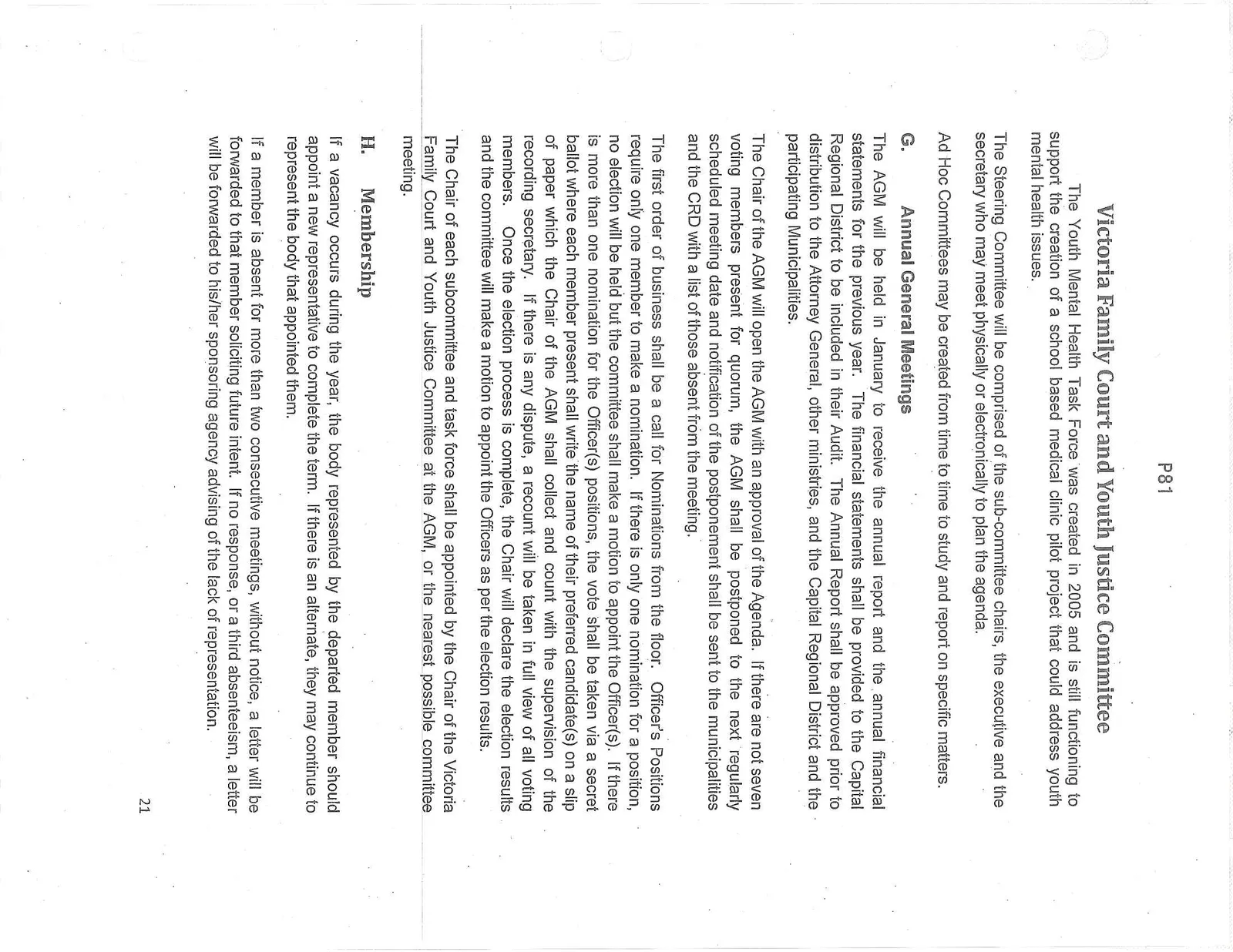
The Youth Mental Health Task Force was created in 2005 and is still functioning to support the creation of a school based medical clinic pilot project that could address youth mental health issues.
The Steering Committee will be comprised of the sub-committee chairs, the executive and the secretary who may meet physically or electronically to plan the agenda.
Ad Hoc Committees may be created from time to time to study and report on specific matters.
G. Annual General Meetings
The AGM will be held in January to receive the annual report and the annual financial statements for the previous year. The financial statements shall be provided to the Capital Regional District to be included in their Audit. The Annual Report shall be approved prior to distribution to the Attorney General, other ministries, and the Capital Regional District and the participating Municipalities.
The Chair of the AGM will open the AGM with an approval of the Agenda. If there are not seven voting members present for quorum, the AGM shall be postponed to the next regularly scheduled meeting date and notification of the postponement shall be sent to the municipalities and the CRD with a list of those absent from the meeting.
The first order of business shall be a call for Nominations from the floor. Officer's Positions require only one member to make a nomination. If there is only one nomination for a position, no election will be held but the committee shall make a motion to appoint the Officer(s). If there is more than one nomination for the Officer(s) positions, the vote shall be taken via a secret ballot where each member present shall write the name of their preferred candidate(s) on a slip of paper which the Chair of the AGM shall collect and count with the supervision of the recording secretary. If there is any dispute, a recount will be taken in full view of all voting members. Once the election process is complete, the Chair will declare the election results and the committee will make a motion to appoint the Officers as per the election results.
The Chair of each subcommittee and task force shall be appointed by the Chair of the Victoria Family Court and Youth Justice Committee at the AGM, or the nearest possible committee meeting.
H. Membership
If a vacancy occurs during the year, the body represented by the departed member should appoint a new representative to complete the term. If there is an alternate, they may continue to represent the body that appointed them.
If a member is absent for more than two consecutive meetings, without notice, a letter will be forwarded to that member soliciting future intent. If no response, or a third absenteeism, a letter will be forwarded to his/her sponsoring agency advising of the lack of representation.
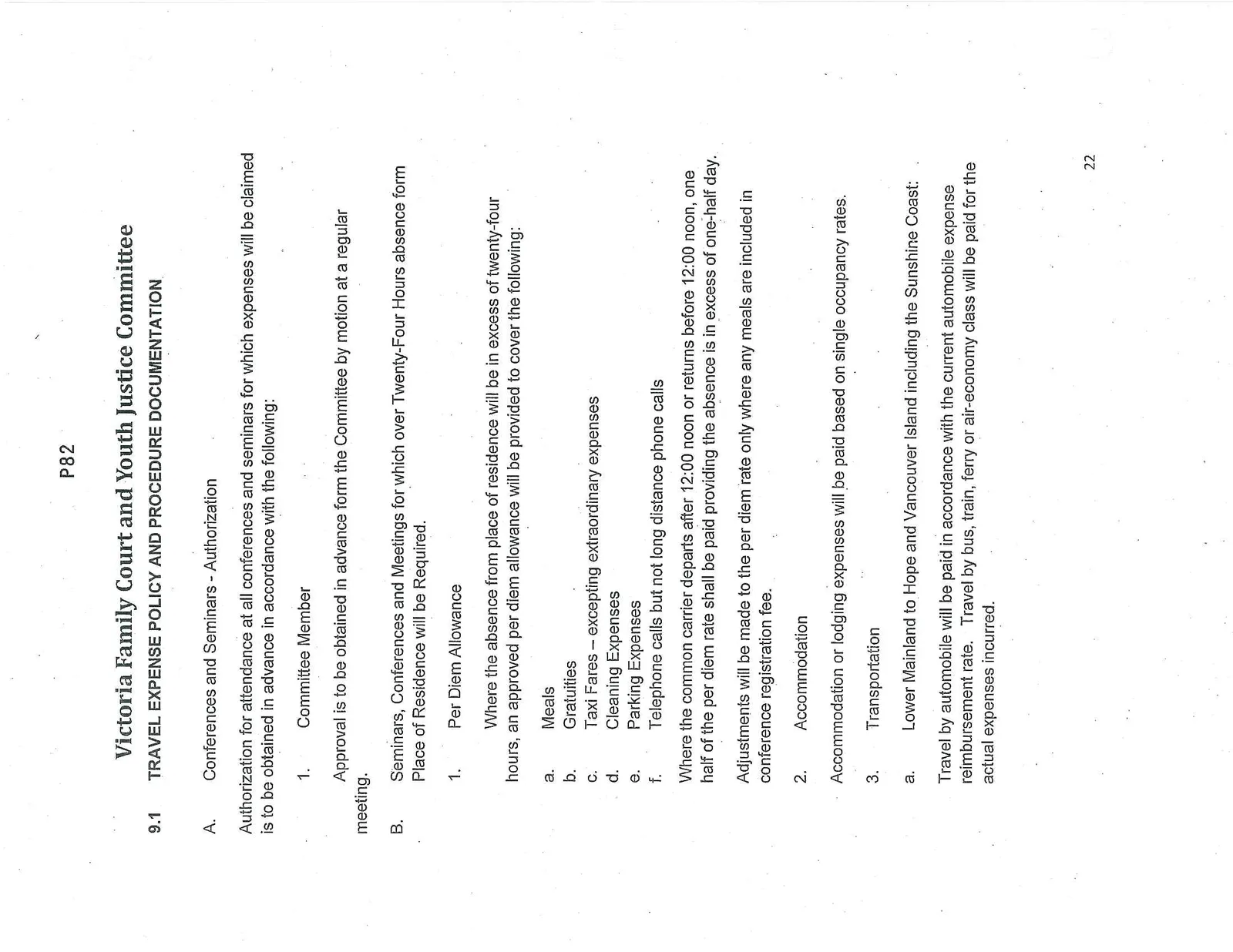
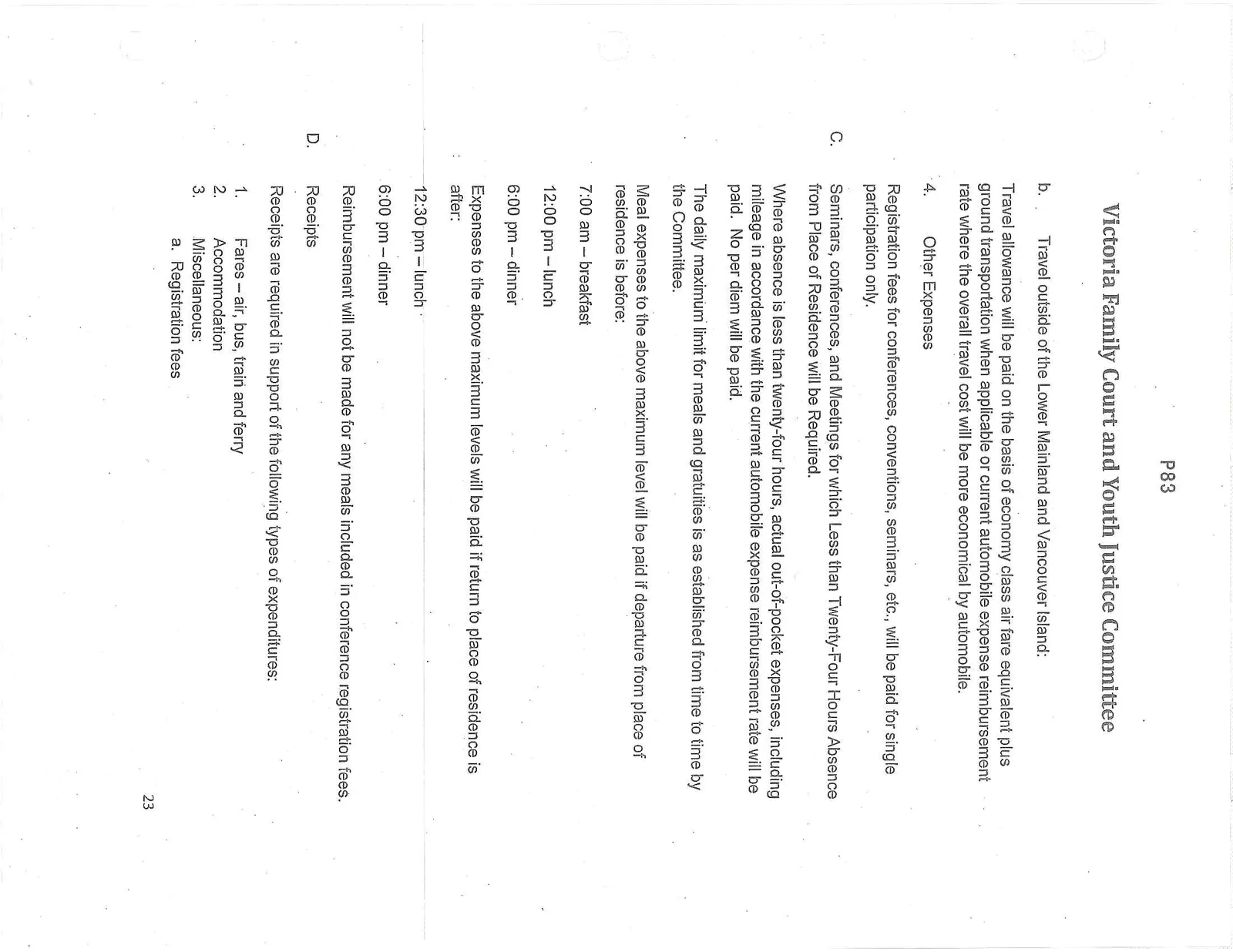
TRAVEL EXPENSE POLICY AND PROCEDURE DOCUMENTATION
9.1
A. Conferences and Seminars - Authorization
Authorization for attendance at all conferences and seminars for which expenses will be claimed is to be obtained in advance in accordance with the following:
- Committee Member Approval is to be obtained in advance form the Committee by motion at a regular meeting.
B. Seminars, Conferences and Meetings for which Over Twenty-Four Hours absence form Place of Residence will be Required.
Per Diem Allowance Where the absence from place of residence will be in excess of twenty-four hours, an approved per diem allowance will be provided to cover the following: a. Meals b. Gratuities c. Taxi Fares – excepting extraordinary expenses d. Cleaning Expenses e. Parking Expenses f. Telephone calls but not long distance phone calls Where the common carrier departs after 12:00 noon or returns before 12:00 noon, one half of the per diem rate shall be paid providing the absence is in excess of one-half day. Adjustments will be made to the per diem rate only where any meals are included in conference registration fee.
Accommodation Accommodation or lodging expenses will be paid based on single occupancy rates.
Transportation a. Lower Mainland to Hope and Vancouver Island including the Sunshine Coast: Travel by automobile will be paid in accordance with the current automobile expense reimbursement rate. Travel by bus, train, ferry or air-economy class will be paid for the actual expenses incurred.
b. Travel outside of the Lower Mainland and Vancouver Island: Travel allowance will be paid on the basis of economy class air fare equivalent plus ground transportation when applicable or current automobile expense reimbursement rate where the overall travel cost will be more economical by automobile.
- Other Expenses Registration fees for conferences, conventions, seminars, etc., will be paid for single participation only.
C. Seminars, Conferences, and Meetings for which Less than Twenty-Four Hours Absence from Place of Residence will be Required.
Where absence is less than twenty-four hours, actual out-of-pocket expenses, including mileage in accordance with the current automobile expense reimbursement rate will be paid. No per diem will be paid.
The daily maximum limit for meals and gratuities is as established from time to time by the Committee.
Meal expenses to the above maximum level will be paid if departure from place of residence is before: 7:00 am – breakfast 12:00 pm – lunch 6:00 pm – dinner
Expenses to the above maximum levels will be paid if return to place of residence is after: 12:30 pm – lunch 6:00 pm – dinner
Reimbursement will not be made for any meals included in conference registration fees.
D. Receipts
Receipts are required in support of the following types of expenditures:
Fares – air, bus, train and ferry
Accommodation
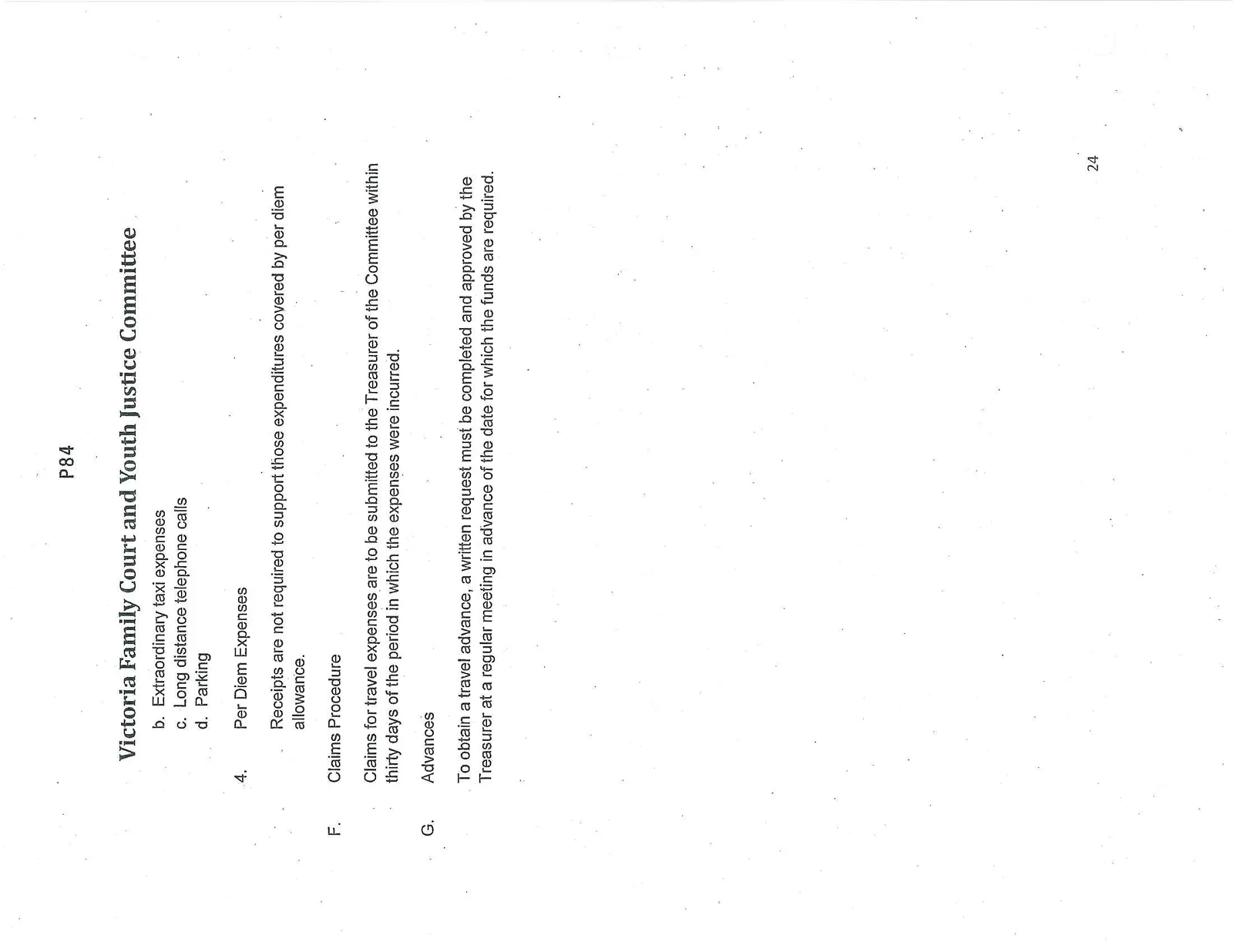
Miscellaneous: a. Registration fees b. Extraordinary taxi expenses c. Long distance telephone calls d. Parking
Per Diem Expenses Receipts are not required to support those expenditures covered by per diem allowance.
F. Claims Procedure
Claims for travel expenses are to be submitted to the Treasurer of the Committee within thirty days of the period in which the expenses were incurred.
G. Advances
To obtain a travel advance, a written request must be completed and approved by the Treasurer at a regular meeting in advance of the date for which the funds are required.
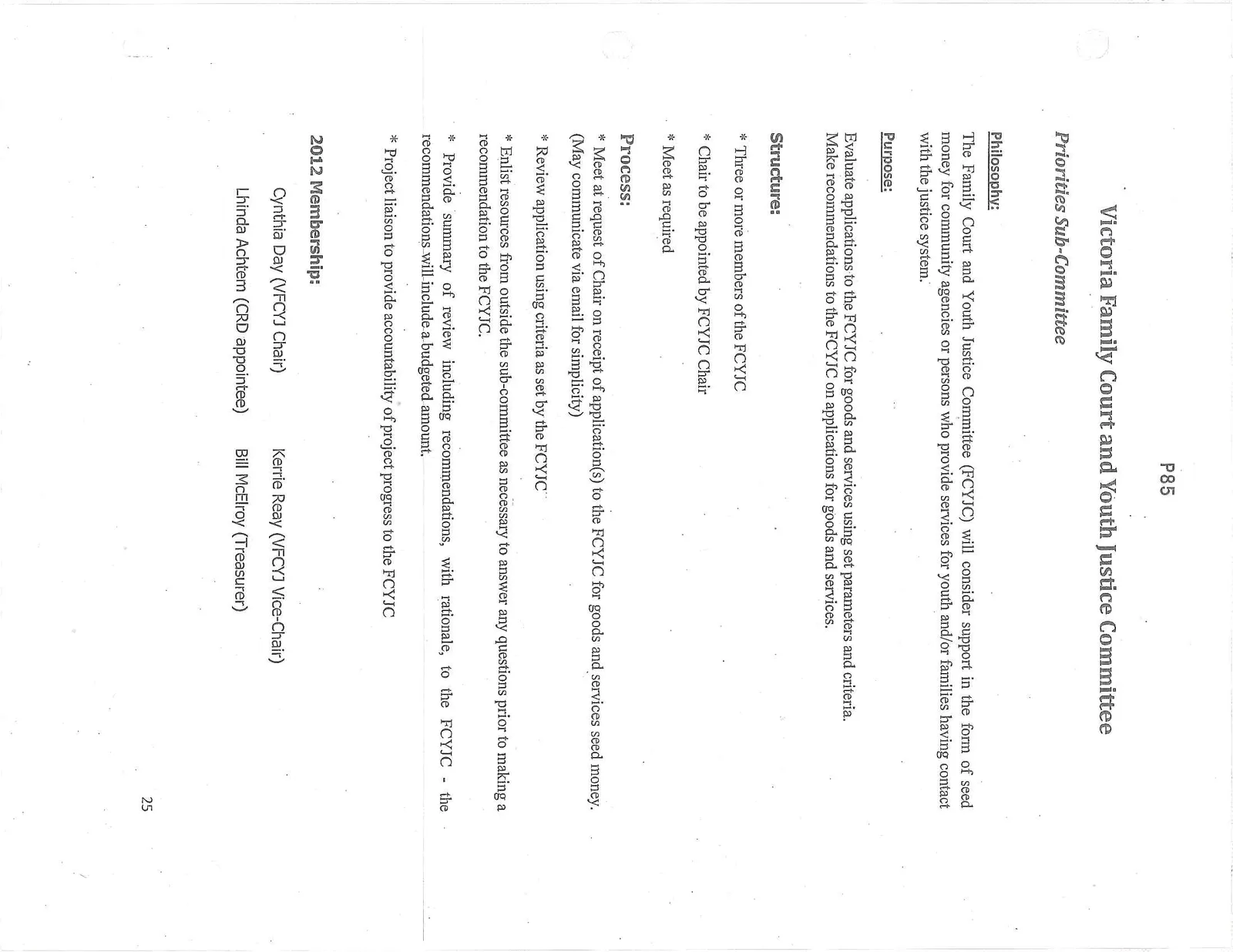
Priorities Sub-Committee
Philosophy: The Family Court and Youth Justice Committee (FCYJC) will consider support in the form of seed money for community agencies or persons who provide services for youth and/or families having contact with the justice system.
Purpose: Evaluate applications to the FCYJC for goods and services using set parameters and criteria. Make recommendations to the FCYJC on applications for goods and services.
Structure:
- Three or more members of the FCYJC
- Chair to be appointed by FCYJC Chair
- Meet as required
Process:
- Meet at request of Chair on receipt of application(s) to the FCYJC for goods and services seed money. (May communicate via email for simplicity)
- Review application using criteria as set by the FCYJC
- Enlist resources from outside the sub-committee as necessary to answer any questions prior to making a recommendation to the FCYJC.
- Provide summary of review including recommendations, with rationale, to the FCYJC - the recommendations will include a budgeted amount.
- Project liaison to provide accountability of project progress to the FCYJC
2012 Membership:
- Cynthia Day (VFCYJ Chair)
- Kerrie Reay (VFCYJ Vice-Chair)
- Lhinda Achtem (CRD appointee)
- Bill McElroy (Treasurer)
Form for Goods and Services Submissions
(Grants and extraordinary committee expenses) Please send your submission to CDay@colwood.ca for distribution
- Date of Application: ____________________________________________________
- Name of organization / person(s) applying: ____________________________________________________________________________________ Contact person for follow-up: ____________________________________________________
- Background of organization / person(s) or applicable history of related projects: ________________________________________________________________________________________________________________________________________________________________________________________________________________________________________________________________________________________________________________________
- Clear goals and objectives of the project – clear indications of relevance to the Family Court and Youth Justice Committee mandate: ________________________________________________________________________________________________________________________________________________________________________________________________________________________________________________________________________________________________________________________________________________________________________________________________________________________
- Any features of the project you believe are pertinent to this application: ____________________________________________________________________________________________________________________________________________________________________________________
- Will the project dovetail with other similar work? (ie. in the Greater Victoria area or within your organization) __________________________________________________________________________________________________________________________________________________________________________________________________________________________________________________________________
- Budget: to include clear accounting with potential line items and accompanying narrative, please include funding from other sources and feel free to attach a spreadsheet if needed: __________________________________________________________________________________________________________________________________________________________________________________________________________________________________________________________________
- Other funding avenues/partners being explored: ____________________________________________________________________________________________________________________________________________________________________________________
- Catchment area served – target population: ____________________________________________________________________________________________________________________________________________________________________________________
- Needs/problems to be addressed through the project work: __________________________________________________________________________________________________________________________________________________________________________________________________________________________________________________________________
- Deliverables (goods and services to be provided): __________________________________________________________________________________________________________________________________________________________________________________________________________________________________________________________________
- Timeframes (eg. Intended start date of project, length of time from start of project to deliverables, one time project or on-going?) __________________________________________________________________________________________________________________________________________________________________________________________________________________________________________________________________
- Evaluation framework, (How will you know if your project has been a success and how will the Family Court Committee know?): __________________________________________________________________________________________________________________________________________________________________________________________________________________________________________________________________
This form is intended for your convenience and that of the FCYJC. Please use it for your submission and as a guide. Please feel free to use more space for comments if required. Form updated; Jan, 2010(C. Day)
POWERS AND DUTIES OF THE FAMILY COURT COMMITTEE
The Family Court Committee may:
- be a force in educating the public on issues related to Family Court
- sit in on court hearings to monitor the actions of all officials concerned with the welfare of youth and assist judges upon request
- report to the Capital Regional District Board and member municipalities problems which are of concern
- enter and monitor both open and secure custody facilities
- comment upon legislation concerning families and youth and –
- make recommendations to appropriate legislative bodies concerning any matters deemed to be covered by our several mandates
In addition, the Family Court Committee must report annually to the Ministry of the Attorney General and its member municipalities.
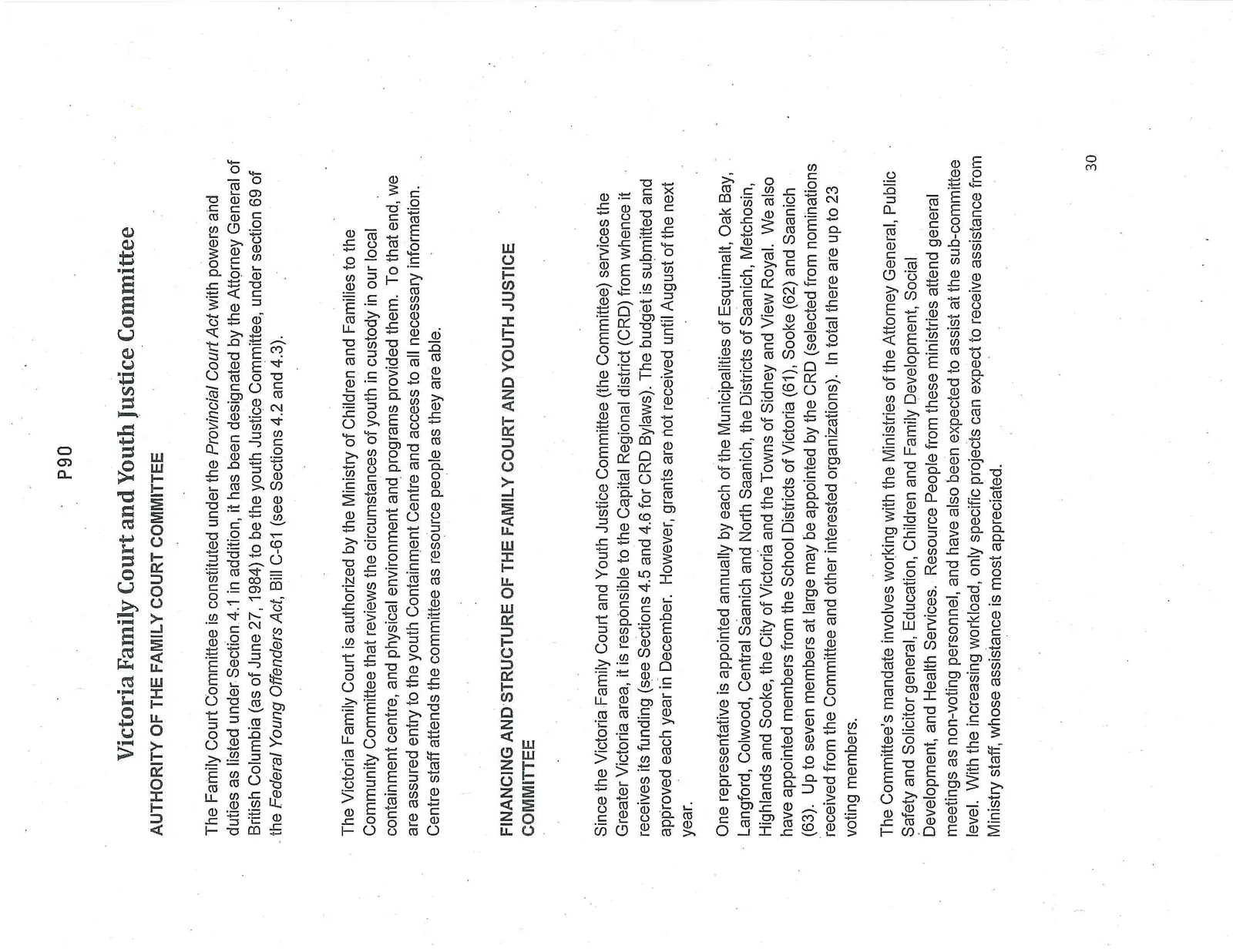
AUTHORITY OF THE FAMILY COURT COMMITTEE
The Family Court Committee is constituted under the Provincial Court Act with powers and duties as listed under Section 4.1 in addition, it has been designated by the Attorney General of British Columbia (as of June 27, 1984) to be the youth Justice Committee, under section 69 of the Federal Young Offenders Act, Bill C-61 (see Sections 4.2 and 4.3).
The Victoria Family Court is authorized by the Ministry of Children and Families to the Community Committee that reviews the circumstances of youth in custody in our local containment centre, and physical environment and programs provided them. To that end, we are assured entry to the youth Containment Centre and access to all necessary information. Centre staff attends the committee as resource people as they are able.
FINANCING AND STRUCTURE OF THE FAMILY COURT AND YOUTH JUSTICE COMMITTEE
Since the Victoria Family Court and Youth Justice Committee (the Committee) services the Greater Victoria area, it is responsible to the Capital Regional district (CRD) from whence it receives its funding (see Sections 4.5 and 4.6 for CRD Bylaws). The budget is submitted and approved each year in December. However, grants are not received until August of the next year.
One representative is appointed annually by each of the Municipalities of Esquimalt, Oak Bay, Langford, Colwood, Central Saanich and North Saanich, the Districts of Saanich, Metchosin, Highlands and Sooke, the City of Victoria and the Towns of Sidney and View Royal. We also have appointed members from the School Districts of Victoria (61), Sooke (62) and Saanich (63). Up to seven members at large may be appointed by the CRD (selected from nominations received from the Committee and other interested organizations). In total there are up to 23 voting members.
The Committee's mandate involves working with the Ministries of the Attorney General, Public Safety and Solicitor general, Education, Children and Family Development, Social Development, and Health Services. Resource People from these ministries attend general meetings as non-voting personnel, and have also been expected to assist at the sub-committee level. With the increasing workload, only specific projects can expect to receive assistance from Ministry staff, whose assistance is most appreciated.
Memorandum of Agreement Between Victoria Family Court and Youth Justice Committee and Court Appointed Special Advocate (CASA) Victoria
Program The intent of this memo of agreement is to specify the relationship between the Victoria Family Court and Youth Justice Committee (FCYJ) and CASA Victoria in order to provide high quality services to vulnerable children and their families within the Greater Victoria area. The FCYJ is incorporated under the Capital Regional District (CRD). Pursuant to FCYJ policy CASA has submitted an application which was approved September 8, 2010 following recommendations from a Task Force comprising the FCYJ Youth Justice Sub-Committee and CASA representatives.
The CASA Mission Statement states that: CASA: Greater Victoria advocates for the best interests of at risk children who are before the provincial court pursuant to the Child, Family and Community Service Act. The safety and well being of children is the major concern and a stable family is the preferred environment for the care and upbringing of children. The child's best interest and where feasible the views of the child will be heard and represented to the court. This will be achieved through trained volunteers with notice and disclosure to all parties.
This is consistent with the mandate of the FCYJ Committee to serve youth at risk through issues handled in court under the Child, Family and Community Service Act (CFCSA).
CASA Victoria started through a community needs project by volunteer members of Leadership Victoria who consulted with many local groups and individuals followed by a conference of community leaders who confirmed the need for a CASA program in Victoria. CASA is a well established in the USA and the development of CASA Victoria has been supported throughout by the National CASA organization.
The FCYJ and CASA Victoria agree to the following:
- CASA will operate as an independent sub-group of the FCYJ but be part of the FCYJ family. Eventually CASA may develop its own Board of Directors under the Society Act (B.C.) but initially will be guided by a CASA Development Group comprised of members of the community.
- Following agreements, CASA will pilot the program in an agreed upon jurisdiction. At the end of the pilot term, CASA will undertake an evaluation of the pilot for presentation to the FCYJC prior to expanding into other jurisdictions.
- CASA will report monthly to FCYJ meetings. A delegate from CASA will be selected by CASA and will be appointed to the FCYJ Committee by the Capital Regional District.
- CASA will keep its own accounts and operate its own budget. Seed money may be allocated by FCYJ at their discretion. CASA will seek other sources of funding that do not conflict with FCYJ. CASA will prepare an annual report for inclusion in the FCYJC Annual Report.
Document Images
(32)