Attachment 6. Tree Retention Report
Arborist report from Talbot Mackenzie & Associates assessing existing trees and recommending protection measures.
May 22, 2012
Omicron Developments Inc. Fifth floor, Three Bentall Centre 595 Burrard Street, PO Box 49369 Vancouver, BC V7X 1L4
Attention: Peter Laughlin
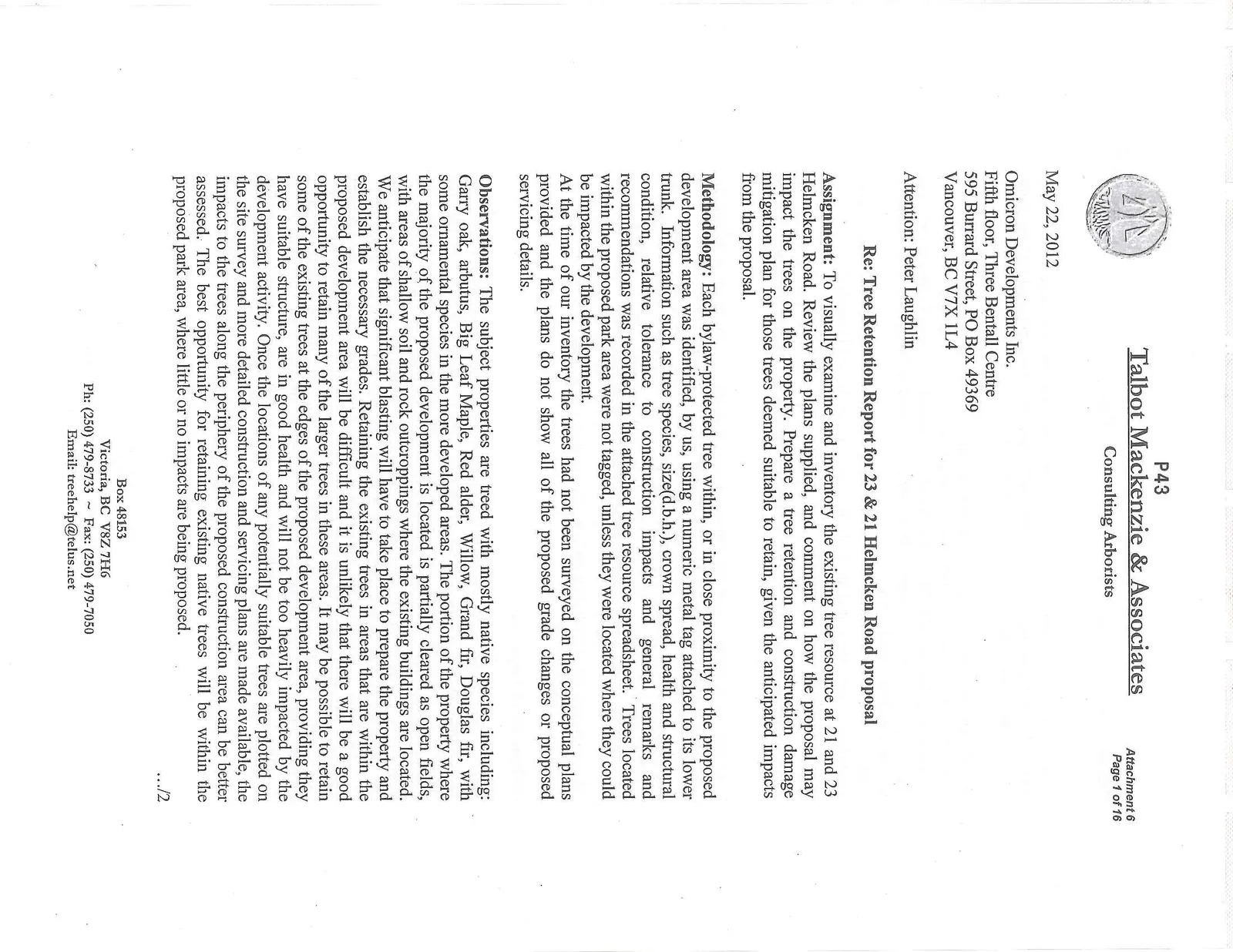
Re: Tree Retention Report for 23 & 21 Helmcken Road proposal
Assignment:
To visually examine and inventory the existing tree resource at 21 and 23 Helmcken Road. Review the plans supplied, and comment on how the proposal may impact the trees on the property. Prepare a tree retention and construction damage mitigation plan for those trees deemed suitable to retain, given the anticipated impacts from the proposal.
Methodology:
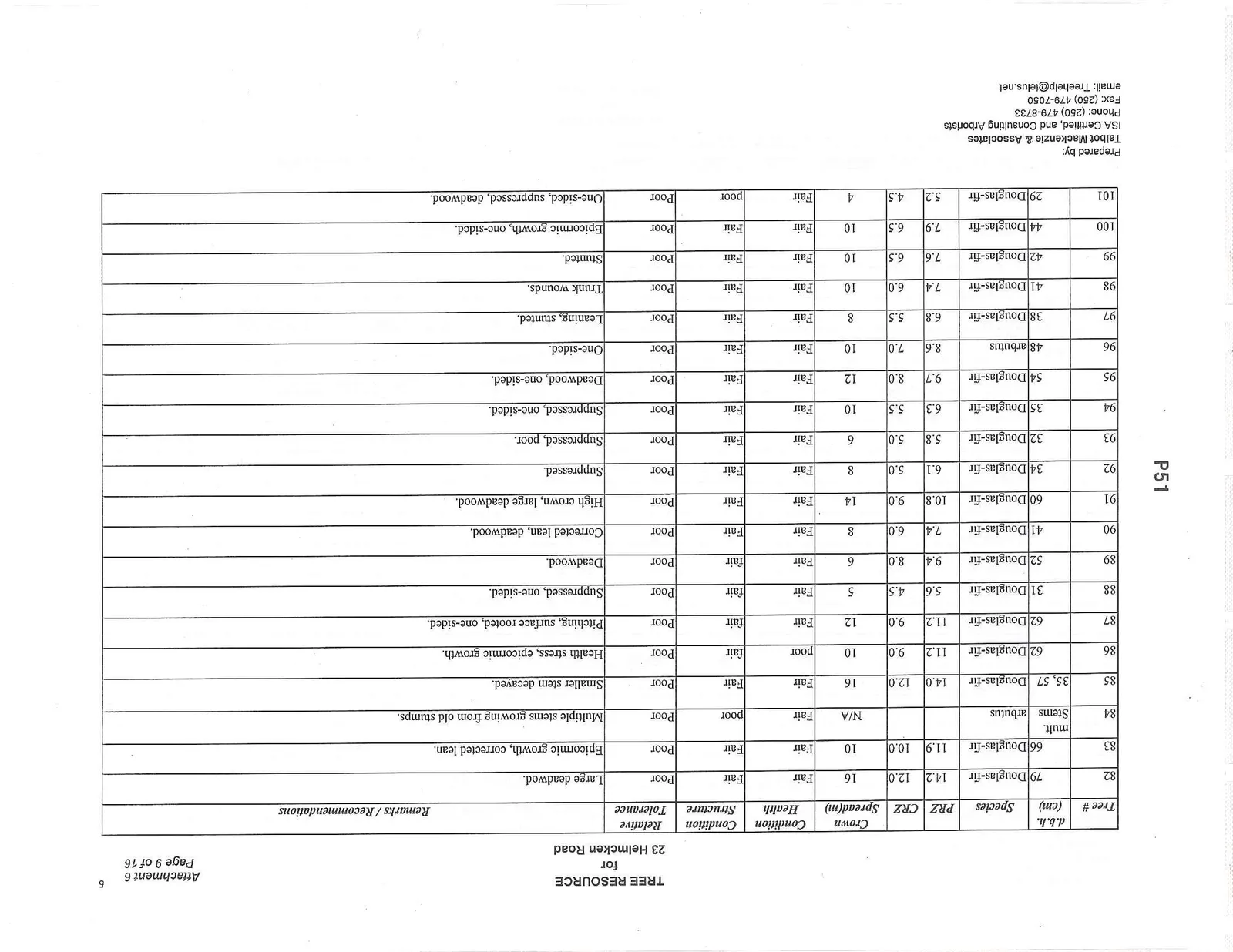
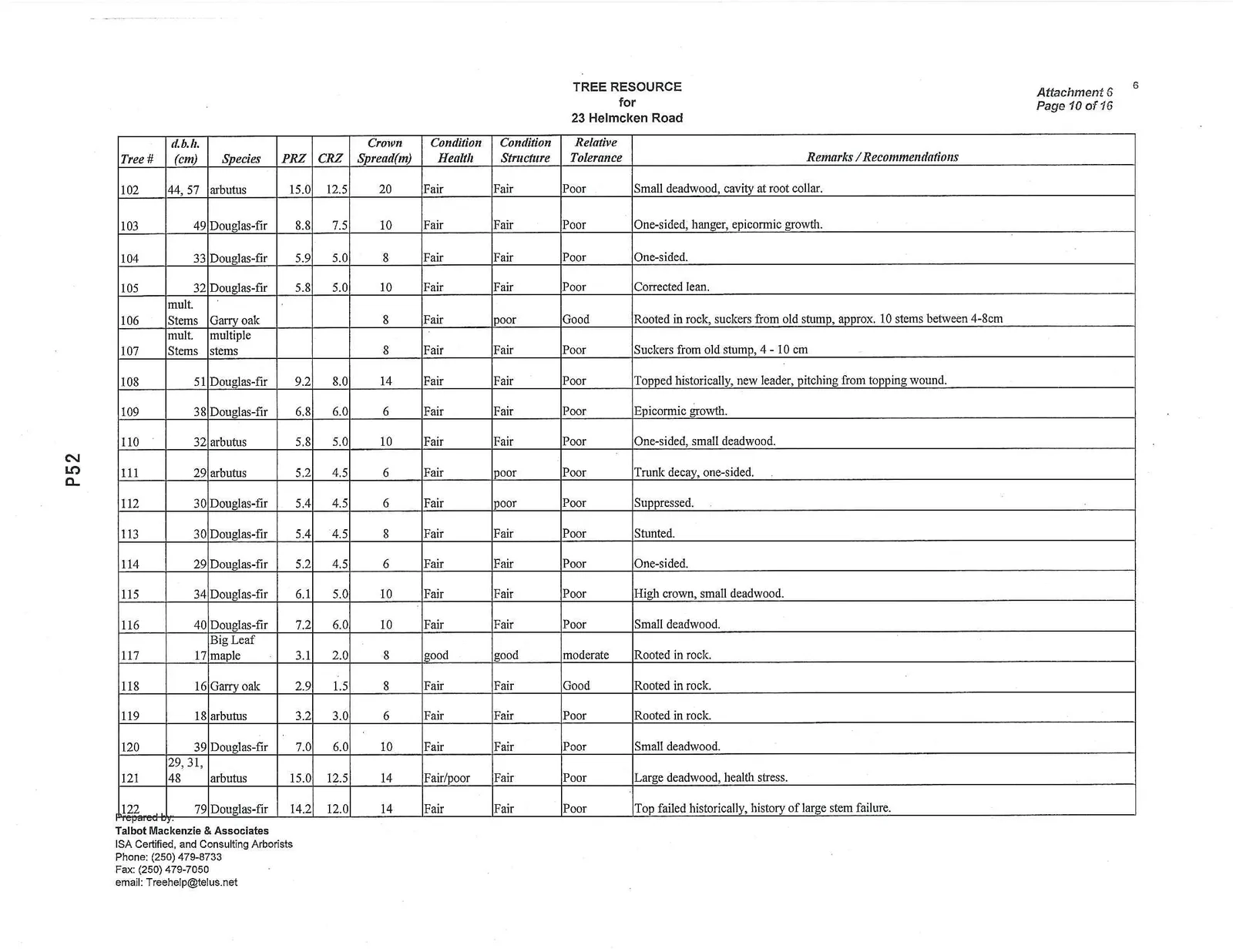
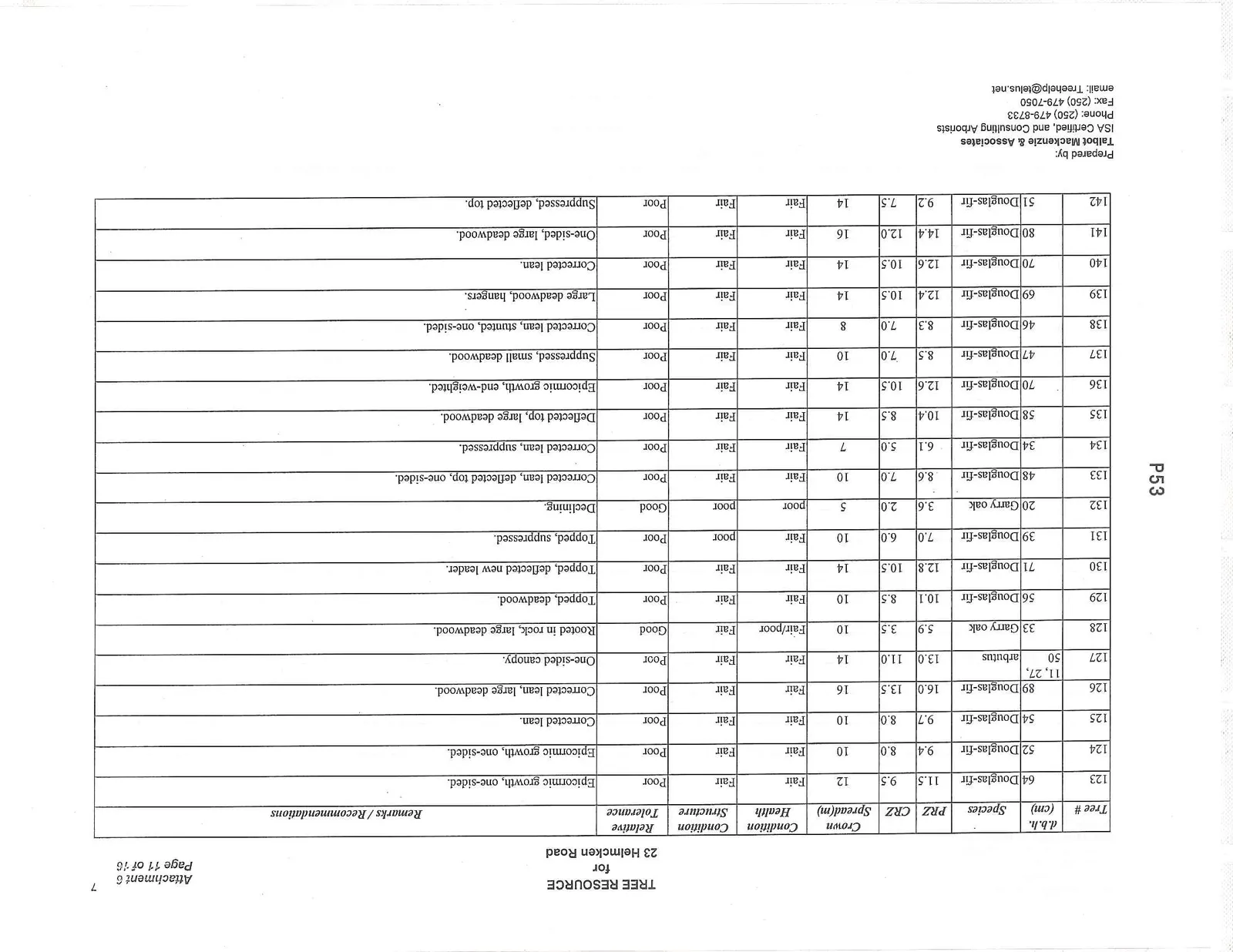
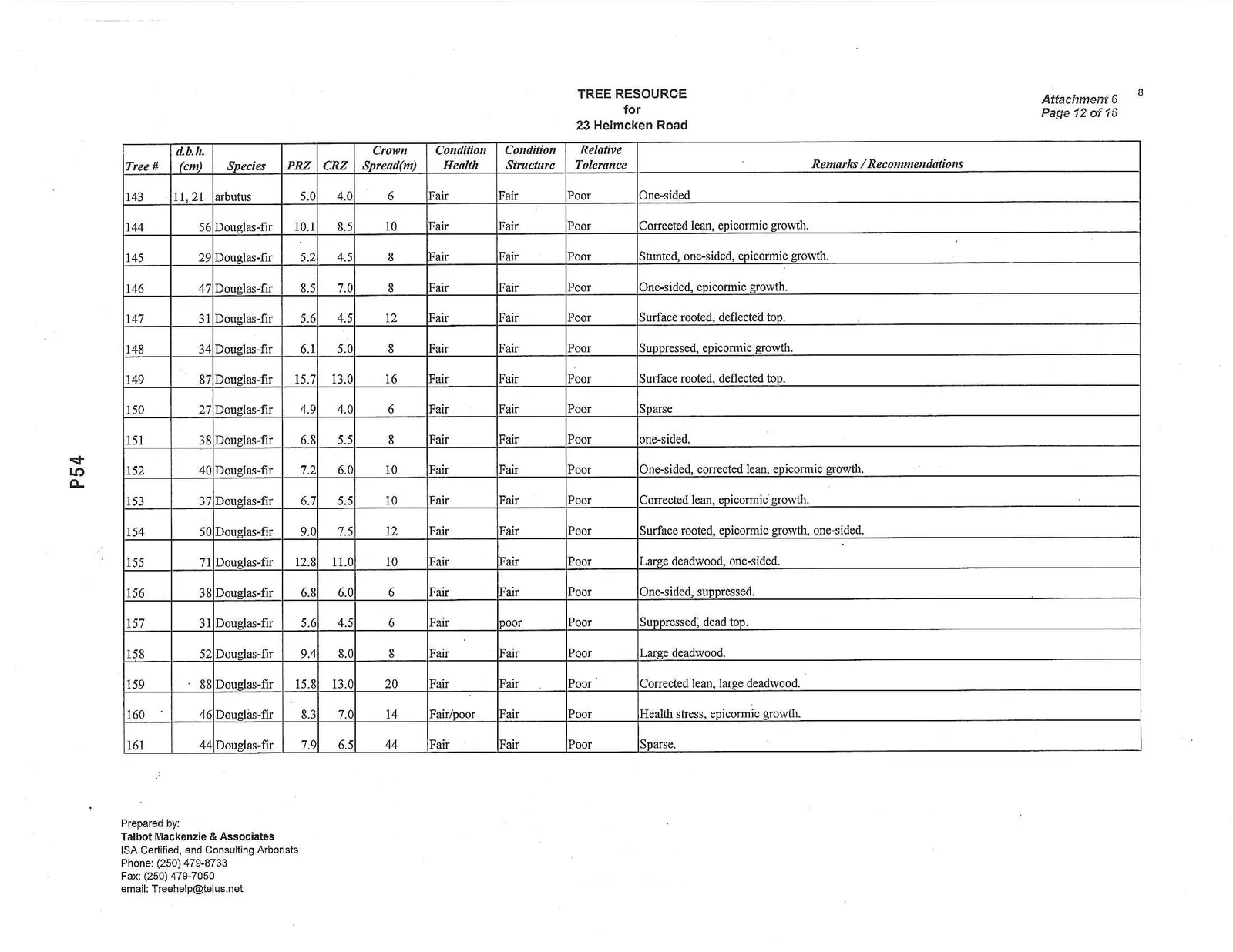
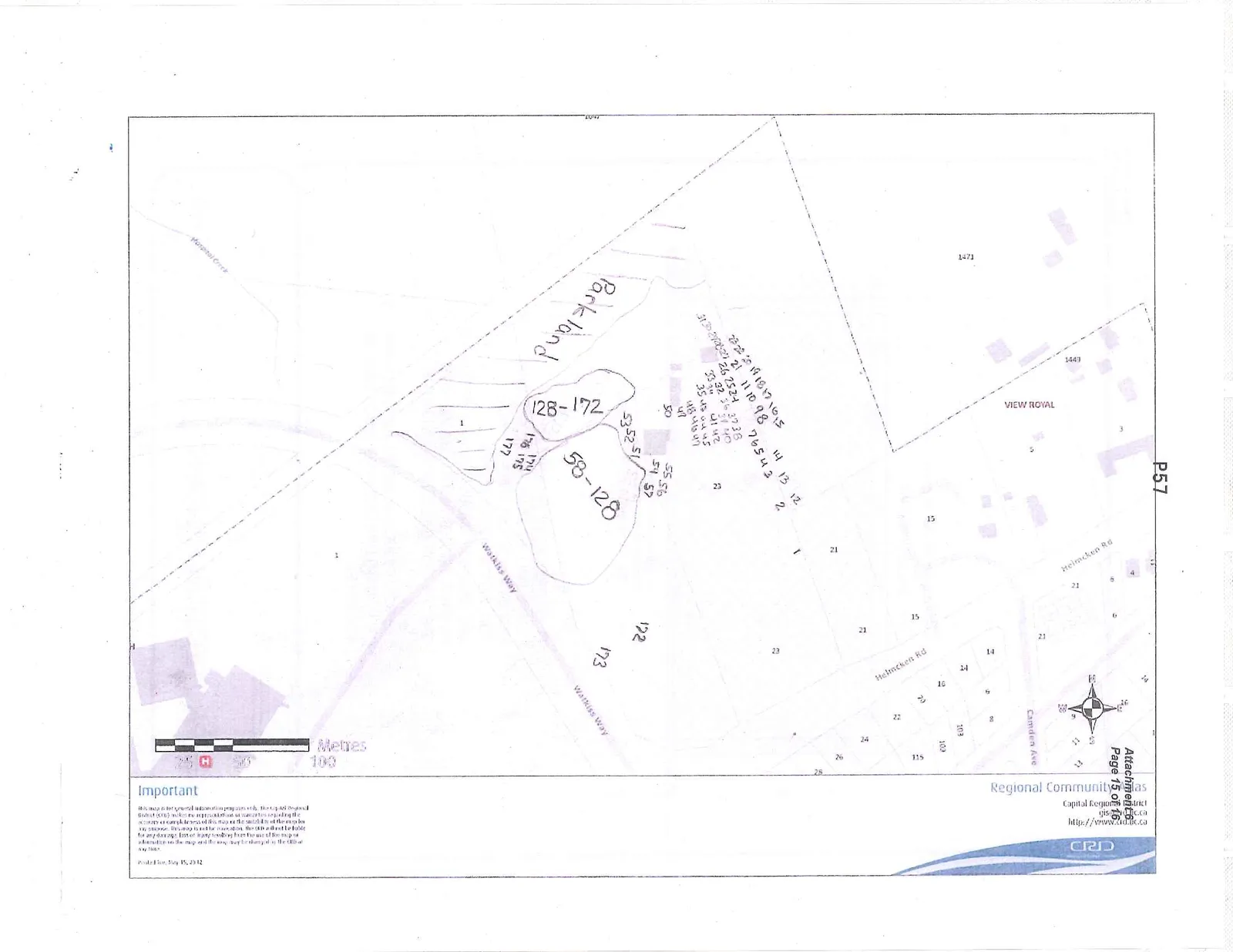
Each bylaw-protected tree within, or in close proximity to the proposed development area was identified, by us, using a numeric metal tag attached to its lower trunk. Information such as tree species, size(d.b.h.), crown spread, health and structural condition, relative tolerance to construction impacts and general remarks and recommendations was recorded in the attached tree resource spreadsheet. Trees located within the proposed park area were not tagged, unless they were located where they could be impacted by the development.
At the time of our inventory the trees had not been surveyed on the conceptual plans provided and the plans do not show all of the proposed grade changes or proposed servicing details.
Observations:
The subject properties are treed with mostly native species including: Garry oak, arbutus, Big Leaf Maple, Red alder, Willow, Grand fir, Douglas fir, with some ornamental species in the more developed areas. The portion of the property where the majority of the proposed development is located is partially cleared as open fields, with areas of shallow soil and rock outcroppings where the existing buildings are located. We anticipate that significant blasting will have to take place to prepare the property and establish the necessary grades. Retaining the existing trees in areas that are within the proposed development area will be difficult and it is unlikely that there will be a good opportunity to retain many of the larger trees in these areas. It may be possible to retain some of the existing trees at the edges of the proposed development area, providing they have suitable structure, are in good health and will not be too heavily impacted by the development activity. Once the locations of any potentially suitable trees are plotted on the site survey and more detailed construction and servicing plans are made available, the impacts to the trees along the periphery of the proposed construction area can be better assessed. The best opportunity for retaining existing native trees will be within the proposed park area, where little or no impacts are being proposed.
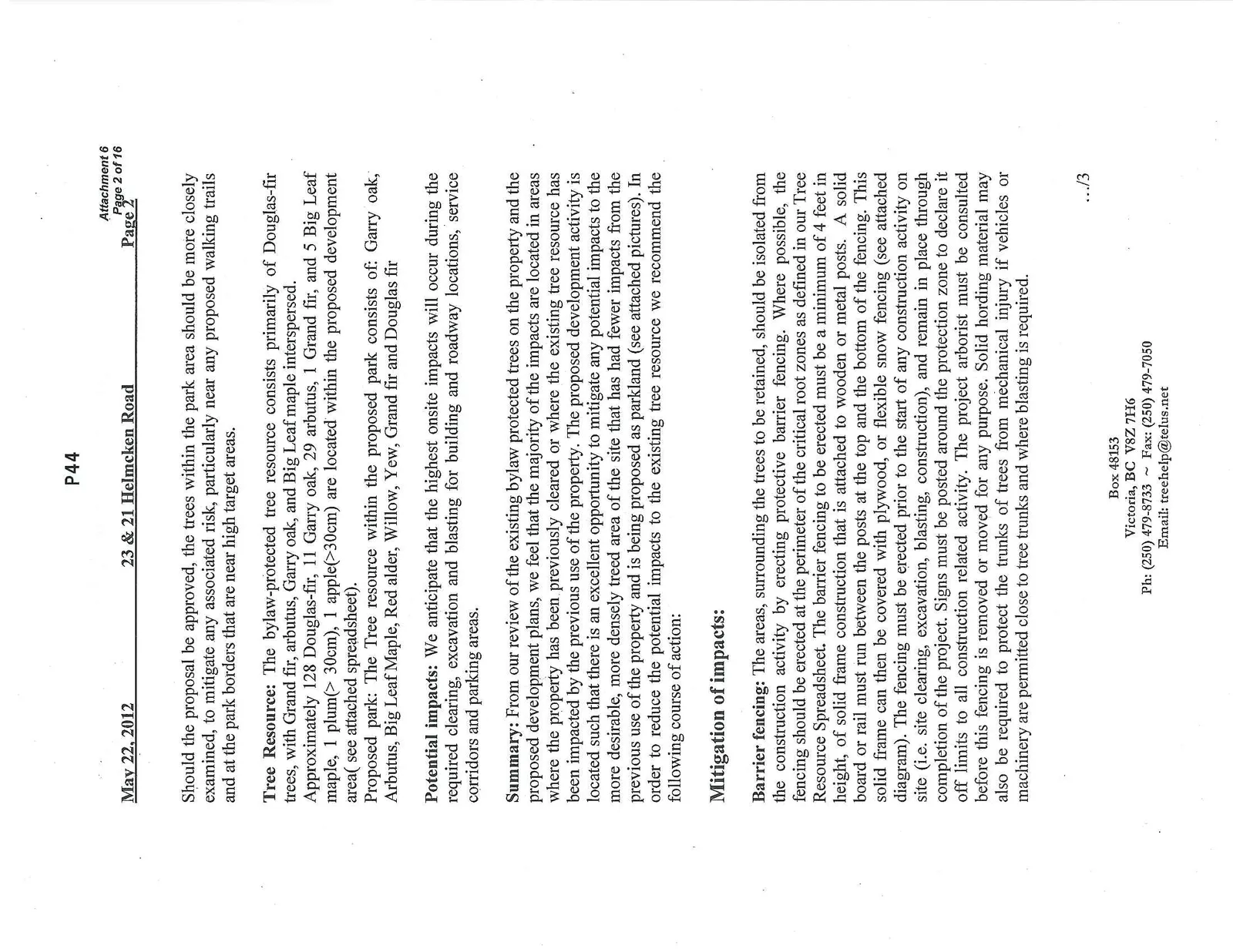
Should the proposal be approved, the trees within the park area should be more closely examined, to mitigate any associated risk, particularly near any proposed walking trails and at the park borders that are near high target areas.
Tree Resource:
The bylaw-protected tree resource consists primarily of Douglas-fir trees, with Grand fir, arbutus, Garry oak, and Big Leaf maple interspersed. Approximately 128 Douglas-fir, 11 Garry oak, 29 arbutus, 1 Grand fir, and 5 Big Leaf maple, 1 plum(> 30cm), 1 apple(>30cm) are located within the proposed development area( see attached spreadsheet).
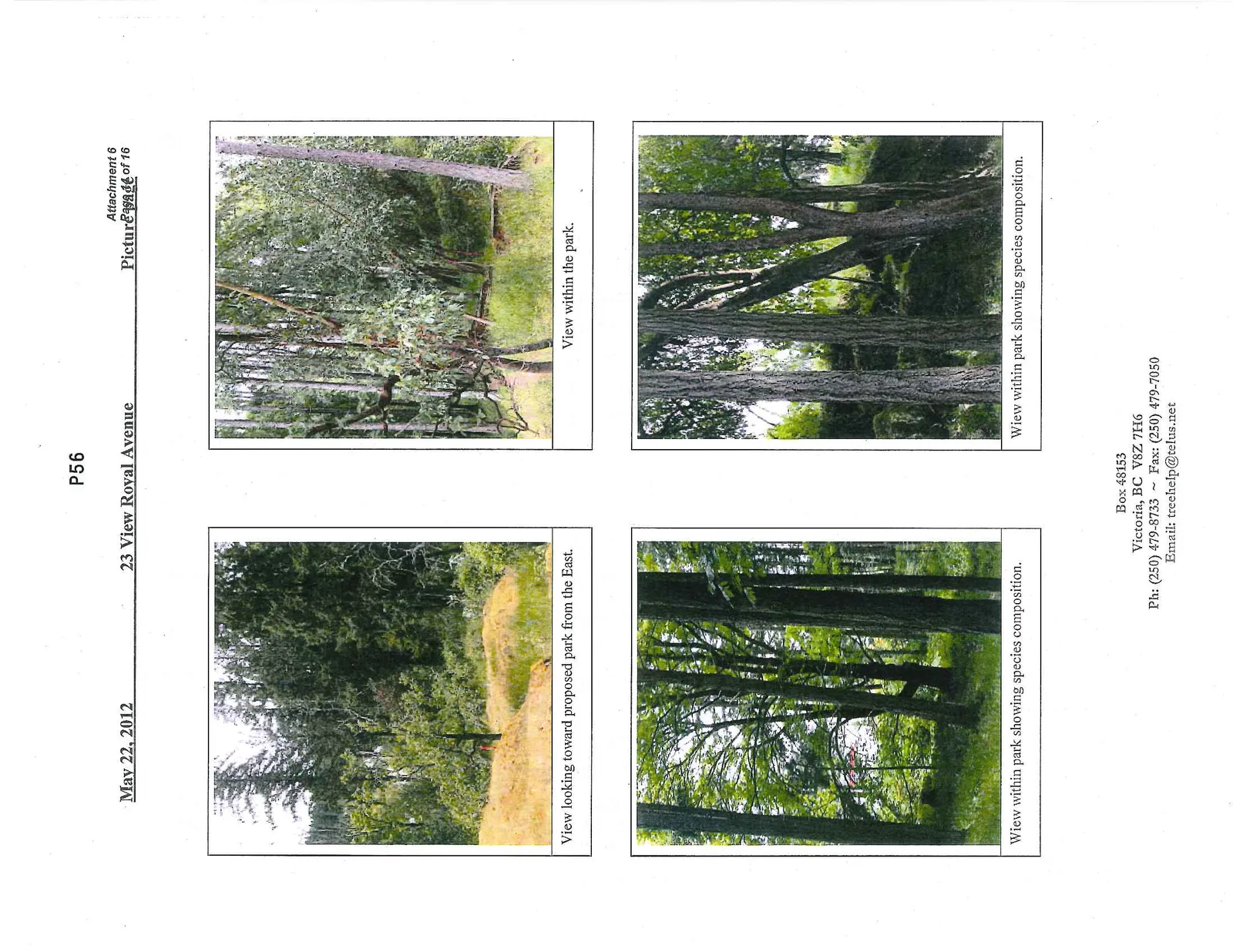
Proposed park: The Tree resource within the proposed park consists of: Garry oak, Arbutus, Big Leaf Maple, Red alder, Willow, Yew, Grand fir and Douglas fir
Potential impacts:
We anticipate that the highest onsite impacts will occur during the required clearing, excavation and blasting for building and roadway locations, service corridors and parking areas.
Summary:
From our review of the existing bylaw protected trees on the property and the proposed development plans, we feel that the majority of the impacts are located in areas where the property has been previously cleared or where the existing tree resource has been impacted by the previous use of the property. The proposed development activity is located such that there is an excellent opportunity to mitigate any potential impacts to the more desirable, more densely treed area of the site that has had fewer impacts from the previous use of the property and is being proposed as parkland (see attached pictures). In order to reduce the potential impacts to the existing tree resource we recommend the following course of action:
Mitigation of impacts:
Barrier fencing:
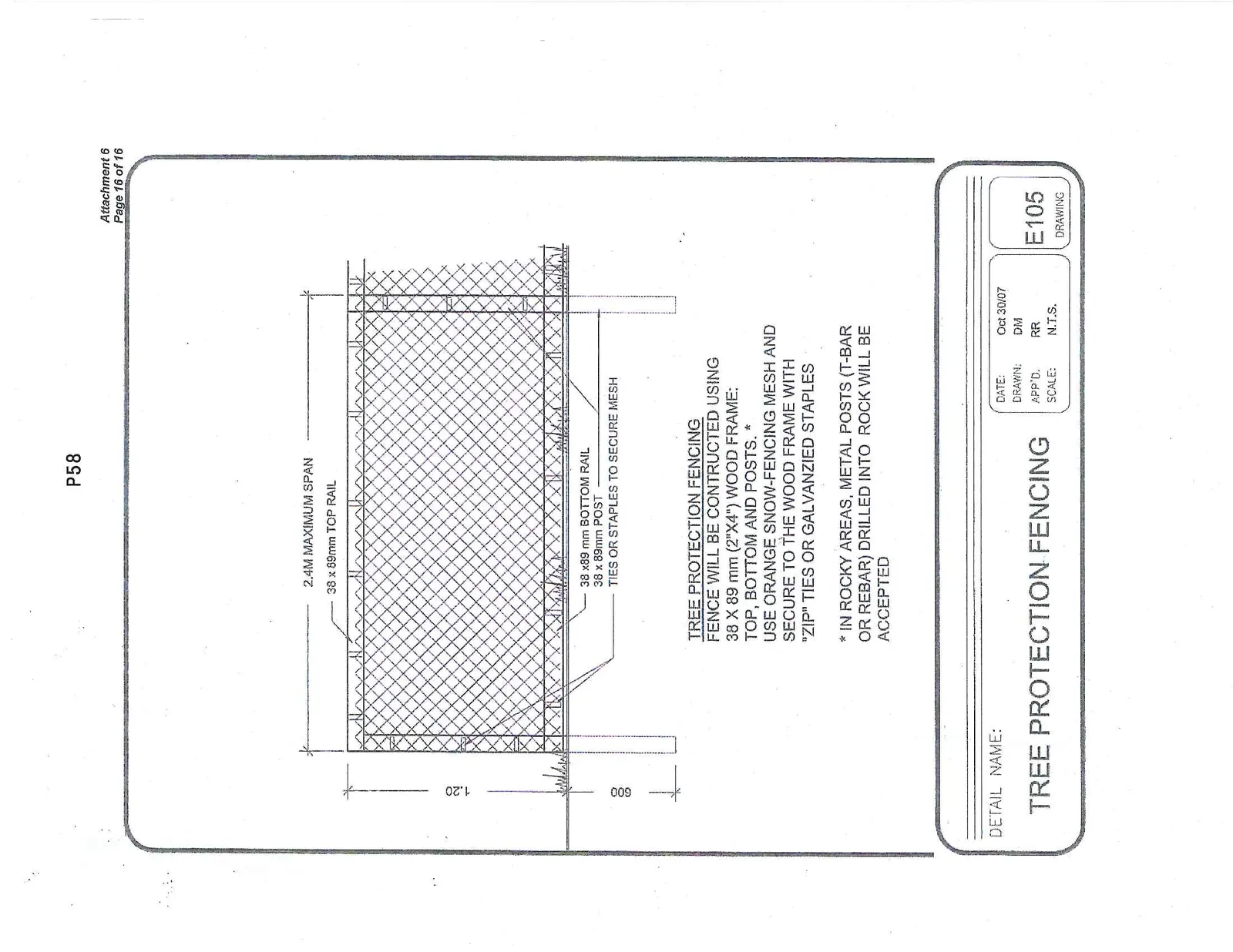
The areas, surrounding the trees to be retained, should be isolated from the construction activity by erecting protective barrier fencing. Where possible, the fencing should be erected at the perimeter of the critical root zones as defined in our Tree Resource Spreadsheet. The barrier fencing to be erected must be a minimum of 4 feet in height, of solid frame construction that is attached to wooden or metal posts. A solid board or rail must run between the posts at the top and the bottom of the fencing. This solid frame can then be covered with plywood, or flexible snow fencing (see attached diagram). The fencing must be erected prior to the start of any construction activity on site (i.e. site clearing, excavation, blasting, construction), and remain in place through completion of the project. Signs must be posted around the protection zone to declare it off limits to all construction related activity. The project arborist must be consulted before this fencing is removed or moved for any purpose. Solid hording material may also be required to protect the trunks of trees from mechanical injury if vehicles or machinery are permitted close to tree trunks and where blasting is required.
Demolition:
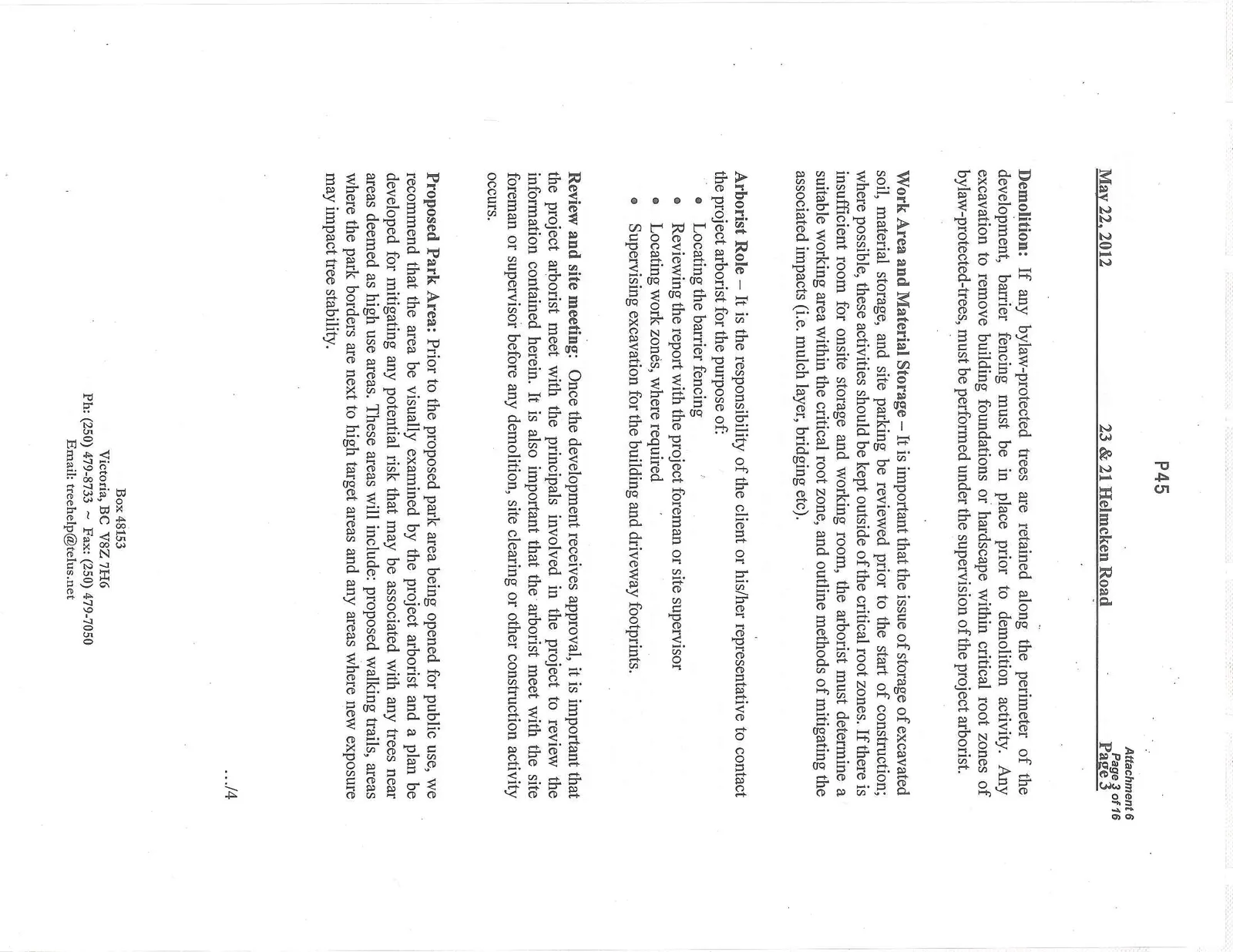
If any bylaw-protected trees are retained along the perimeter of the development, barrier fencing must be in place prior to demolition activity. Any excavation to remove building foundations or hardscape within critical root zones of bylaw-protected-trees, must be performed under the supervision of the project arborist.
Work Area and Material Storage:
It is important that the issue of storage of excavated soil, material storage, and site parking be reviewed prior to the start of construction; where possible, these activities should be kept outside of the critical root zones. If there is insufficient room for onsite storage and working room, the arborist must determine a suitable working area within the critical root zone, and outline methods of mitigating the associated impacts (i.e. mulch layer, bridging etc).
Arborist Role:
It is the responsibility of the client or his/her representative to contact the project arborist for the purpose of:
- Locating the barrier fencing
- Reviewing the report with the project foreman or site supervisor
- Locating work zones, where required
- Supervising excavation for the building and driveway footprints.
Review and site meeting:
Once the development receives approval, it is important that the project arborist meet with the principals involved in the project to review the information contained herein. It is also important that the arborist meet with the site foreman or supervisor before any demolition, site clearing or other construction activity occurs.
Proposed Park Area:
Prior to the proposed park area being opened for public use, we recommend that the area be visually examined by the project arborist and a plan be developed for mitigating any potential risk that may be associated with any trees near areas deemed as high use areas. These areas will include: proposed walking trails, areas where the park borders are next to high target areas and any areas where new exposure may impact tree stability.
Yours truly, Talbot Mackenzie & Associates
Tom Talbot & Graham Mackenzie ISA Certified, & Consulting Arborists
Disclosure Statement
Arborists are professionals who examine trees and use their training, knowledge and experience to recommend techniques and procedures that will improve their health and structure or to mitigate associated risks.
Trees are living organisms, whose health and structure change, and are influenced by age, continued growth, climate, weather conditions, and insect and disease pathogens. Indicators of structural weakness and disease are often hidden within the tree structure or beneath the ground. It is not possible for an Arborist to identify every flaw or condition that could result in failure or can he/she guarantee that the tree will remain healthy and free of risk.
Remedial care and mitigation measures recommended are based on the visible and detectable indicators present at the time of the examination and cannot be guaranteed to alleviate all symptoms or to mitigate all risk posed.
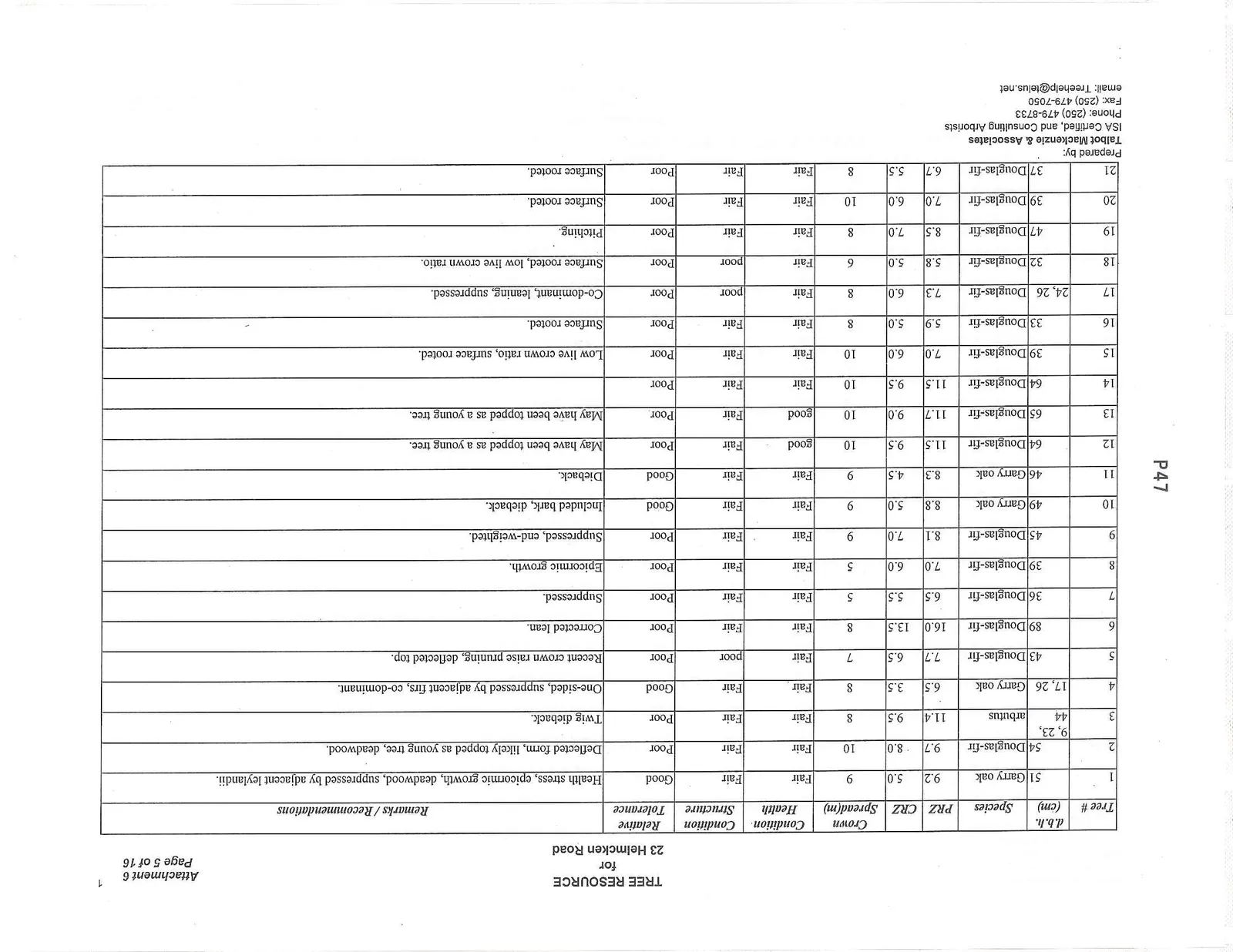
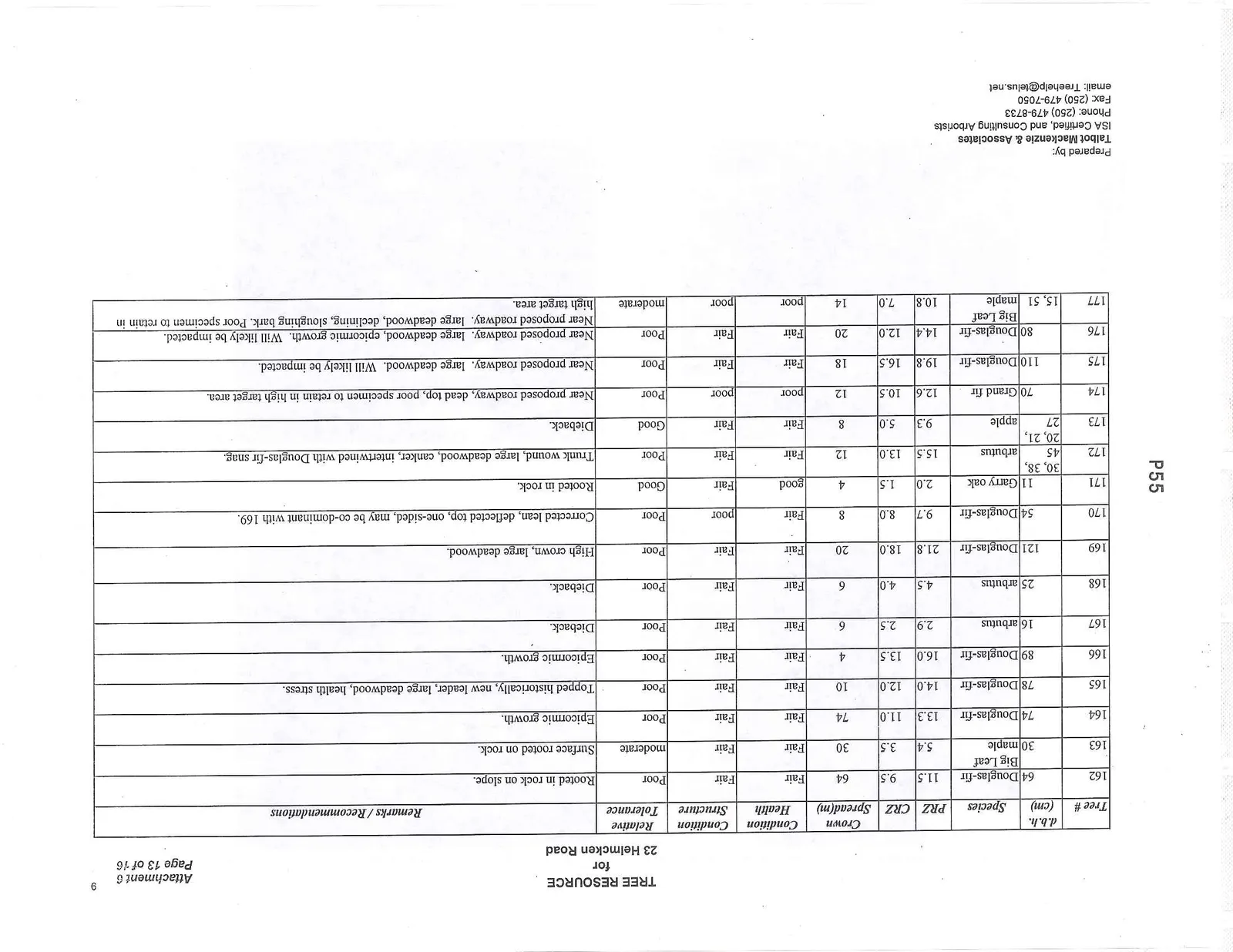
TREE RESOURCE
for 23 Helmcken Road
| Tree # | d.b.h. (cm) | Species | PRZ | CRZ | Crown Spread(m) | Condition Health | Condition Structure | Relative Tolerance | Remarks / Recommendations |
|---|---|---|---|---|---|---|---|---|---|
| 1 | 51 | Garry oak | 9.2 | 5.0 | 9 | Fair | Fair | Good | Health stress, epicormic growth, deadwood, suppressed by adjacent leylandii. |
| 2 | 54 | Douglas-fir | 9.7 | 8.0 | 10 | Fair | Fair | Poor | Deflected form, likely topped as young tree, deadwood. |
| 3 | 9, 23, 44 | arbutus | 11.4 | 9.5 | 8 | Fair | Poor | Poor | Twig dieback. |
| 4 | 17, 26 | Garry oak | 6.5 | 3.5 | 8 | Fair | Fair | Good | One-sided, suppressed by adjacent firs, co-dominant. |
| 5 | 43 | Douglas-fir | 7.7 | 6.5 | 7 | Fair | poor | Poor | Recent crown raise pruning, deflected top. |
| 6 | 89 | Douglas-fir | 16.0 | 13.5 | 8 | Fair | Fair | Poor | Corrected lean. |
| 7 | 36 | Douglas-fir | 6.5 | 5.5 | 5 | Fair | Fair | Poor | Suppressed. |
| 8 | 39 | Douglas-fir | 7.0 | 6.0 | 5 | Fair | Fair | Poor | Epicormic growth. |
| 9 | 45 | Douglas-fir | 8.1 | 7.0 | 9 | Fair | Fair | Poor | Suppressed, end-weighted. |
| 10 | 49 | Garry oak | 8.8 | 5.0 | 9 | Fair | Fair | Good | Included bark, dieback. |
| 11 | 46 | Garry oak | 8.3 | 4.5 | 9 | Fair | Fair | Good | Dieback. |
| 12 | 64 | Douglas-fir | 11.5 | 9.5 | 10 | good | Fair | Poor | May have been topped as a young tree. |
| 13 | 65 | Douglas-fir | 11.7 | 9.0 | 10 | good | Fair | Poor | May have been topped as a young tree. |
| 14 | 64 | Douglas-fir | 11.5 | 9.5 | 10 | Fair | Fair | Poor | |
| 15 | 39 | Douglas-fir | 7.0 | 6.0 | 10 | Fair | Fair | Poor | Low live crown ratio, surface rooted. |
| 16 | 33 | Douglas-fir | 5.9 | 5.0 | 8 | Fair | Fair | Poor | Surface rooted. |
| 17 | 24, 26 | Douglas-fir | 7.3 | 6.0 | 8 | Fair | poor | Poor | Co-dominant, leaning, suppressed. |
| 18 | 32 | Douglas-fir | 5.8 | 5.0 | 6 | Fair | poor | Poor | Surface rooted, low live crown ratio. |
| 19 | 47 | Douglas-fir | 8.5 | 7.0 | 8 | Fair | Fair | Poor | Pitching. |
| 20 | 39 | Douglas-fir | 7.0 | 6.0 | 10 | Fair | Fair | Poor | Surface rooted. |
| 21 | 37 | Douglas-fir | 6.7 | 5.5 | 8 | Fair | Fair | Poor | Surface rooted. |
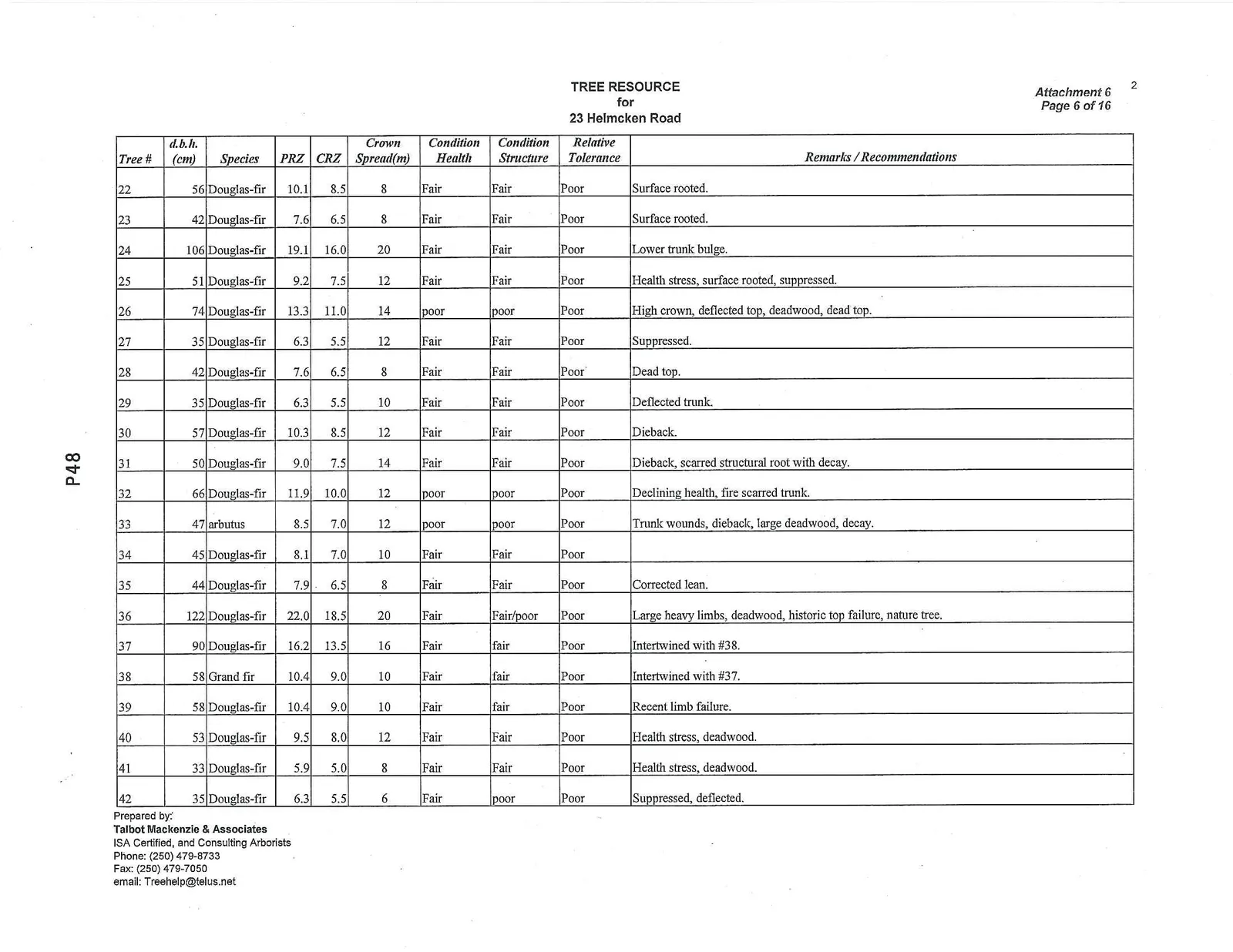
| 22 | 56 | Douglas-fir | 10.1 | 8.5 | 8 | Fair | Fair | Poor | Surface rooted. |
| 23 | 42 | Douglas-fir | 7.6 | 6.5 | 8 | Fair | Fair | Poor | Surface rooted. |
| 24 | 106 | Douglas-fir | 19.1 | 16.0 | 20 | Fair | Fair | Poor | Lower trunk bulge. |
| 25 | 51 | Douglas-fir | 9.2 | 7.5 | 12 | Fair | Fair | Poor | Health stress, surface rooted, suppressed. |
| 26 | 74 | Douglas-fir | 13.3 | 11.0 | 14 | poor | poor | Poor | High crown, deflected top, deadwood, dead top. |
| 27 | 35 | Douglas-fir | 6.3 | 5.5 | 12 | Fair | Fair | Poor | Suppressed. |
| 28 | 42 | Douglas-fir | 7.6 | 6.5 | 8 | Fair | Fair | Poor | Dead top. |
| 29 | 35 | Douglas-fir | 6.3 | 5.5 | 10 | Fair | Fair | Poor | Deflected trunk. |
| 30 | 57 | Douglas-fir | 10.3 | 8.5 | 12 | Fair | Fair | Poor | Dieback. |
| 31 | 50 | Douglas-fir | 9.0 | 7.5 | 14 | Fair | Fair | Poor | Dieback, scarred structural root with decay. |
| 32 | 66 | Douglas-fir | 11.9 | 10.0 | 12 | poor | poor | Poor | Declining health, fire scarred trunk. |
| 33 | 47 | arbutus | 8.5 | 7.0 | 12 | poor | poor | Poor | Trunk wounds, dieback, large deadwood, decay. |
| 34 | 45 | Douglas-fir | 8.1 | 7.0 | 10 | Fair | Fair | Poor | |
| 35 | 44 | Douglas-fir | 7.9 | 6.5 | 8 | Fair | Fair | Poor | Corrected lean. |
| 36 | 122 | Douglas-fir | 22.0 | 18.5 | 20 | Fair | Fair/poor | Poor | Large heavy limbs, deadwood, historic top failure, nature tree. |
| 37 | 90 | Douglas-fir | 16.2 | 13.5 | 16 | Fair | fair | Poor | Intertwined with #38. |
| 38 | 58 | Grand fir | 10.4 | 9.0 | 10 | Fair | fair | Poor | Intertwined with #37. |
| 39 | 58 | Douglas-fir | 10.4 | 9.0 | 10 | Fair | fair | Poor | Recent limb failure. |
| 40 | 53 | Douglas-fir | 9.5 | 8.0 | 12 | Fair | Fair | Poor | Health stress, deadwood. |
| 41 | 33 | Douglas-fir | 5.9 | 5.0 | 8 | Fair | Fair | Poor | Health stress, deadwood. |
| 42 | 35 | Douglas-fir | 6.3 | 5.5 | 6 | Fair | poor | Poor | Suppressed, deflected. |
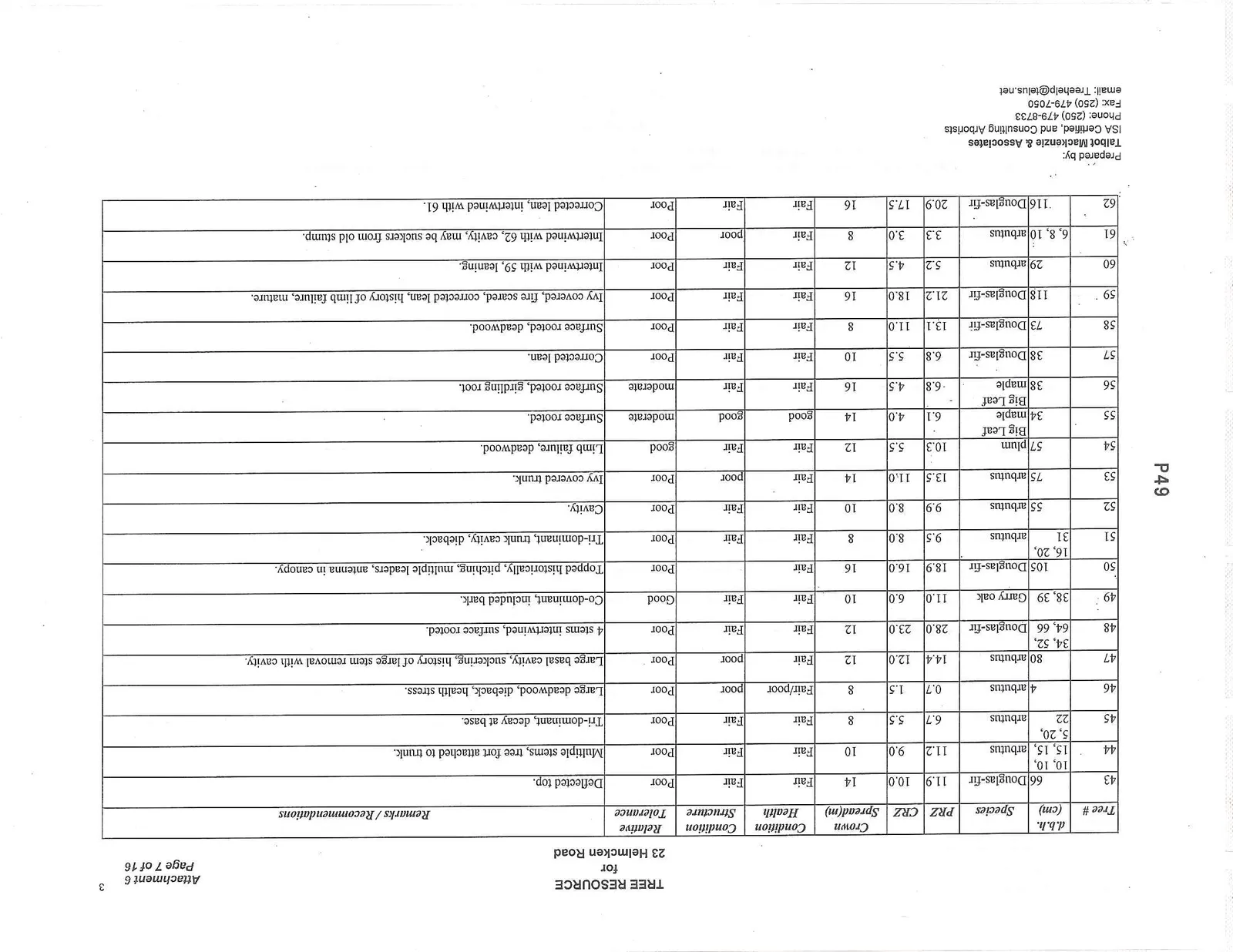
| 43 | 66 | Douglas-fir | 11.9 | 10.0 | 14 | Fair | Fair | Poor | Deflected top. |
| 44 | 10, 10, 15, 15, 5, 20, 22 | arbutus | 11.2 | 9.0 | 10 | Fair | Fair | Poor | Multiple stems, tree fort attached to trunk. |
| 45 | arbutus | 6.7 | 5.5 | 8 | Fair | Fair | Poor | Tri-dominant, decay at base. | |
| 46 | 4 | arbutus | 0.7 | 1.5 | 8 | Fair/poor | poor | Poor | Large deadwood, dieback, health stress. |
| 47 | 80 | arbutus | 14.4 | 12.0 | 12 | Fair | poor | Poor | Large basal cavity, suckering, history of large stem removal with cavity. |
| 48 | 34, 52, 64, 66 | Douglas-fir | 28.0 | 23.0 | 12 | Fair | Fair | Poor | 4 stems intertwined, surface rooted. |
| 49 | 38, 39 | Garry oak | 11.0 | 6.0 | 10 | Fair | Fair | Good | Co-dominant, included bark. |
| 50 | 105 | Douglas-fir | 18.9 | 16.0 | 16 | Fair | Fair | Poor | Topped historically, pitching, multiple leaders, antenna in canopy. |
| 51 | 16, 20, 31 | arbutus | 9.5 | 8.0 | 8 | Fair | Fair | Poor | Tri-dominant, trunk cavity, dieback. |
| 52 | 55 | arbutus | 9.9 | 8.0 | 10 | Fair | Fair | Poor | Cavity. |
| 53 | 75 | arbutus | 13.5 | 11.0 | 14 | Fair | poor | Poor | Ivy covered trunk. |
| 54 | 57 | plum | 10.3 | 5.5 | 12 | Fair | Fair | good | Limb failure, deadwood. |
| 55 | 34 | Big Leaf maple | 6.1 | 4.0 | 14 | good | good | moderate | Surface rooted. |
| 56 | 38 | Big Leaf maple | 6.8 | 4.5 | 16 | Fair | Fair | moderate | Surface rooted, girdling root. |
| 57 | 38 | Douglas-fir | 6.8 | 5.5 | 10 | Fair | Fair | Poor | Corrected lean. |
| 58 | 73 | Douglas-fir | 13.1 | 11.0 | 8 | Fair | Fair | Poor | Surface rooted, deadwood. |
| 59 | 118 | Douglas-fir | 21.2 | 18.0 | 16 | Fair | Fair | Poor | Ivy covered, fire scarred, corrected lean, history of limb failure, mature. |
| 60 | 29 | arbutus | 5.2 | 4.5 | 12 | Fair | Fair | Poor | Intertwined with 59, leaning. |
| 61 | 6, 8, 10 | arbutus | 3.3 | 3.0 | 8 | Fair | poor | Poor | Intertwined with 62, cavity, may be suckers from old stump. |
| 62 | 116 | Douglas-fir | 20.9 | 17.5 | 16 | Fair | Fair | Poor | Corrected lean, intertwined with 61. |
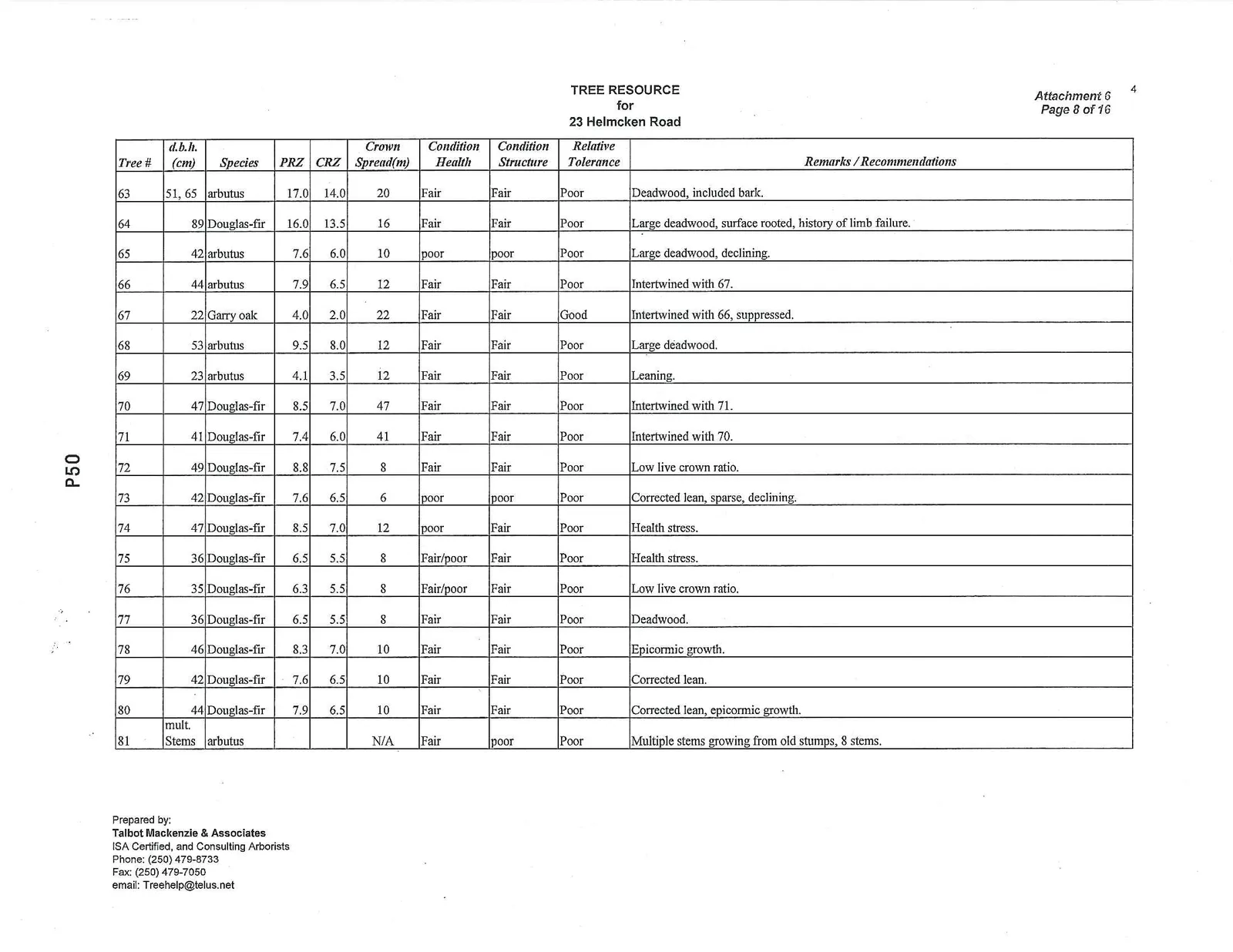
| 63 | 51, 65 | arbutus | 17.0 | 14.0 | 20 | Fair | Fair | Poor | Deadwood, included bark. |
| 64 | 89 | Douglas-fir | 16.0 | 13.5 | 16 | Fair | Fair | Poor | Large deadwood, surface rooted, history of limb failure. |
| 65 | 42 | arbutus | 7.6 | 6.0 | 10 | poor | poor | Poor | Large deadwood, declining. |
| 66 | 44 | arbutus | 7.9 | 6.5 | 12 | Fair | Fair | Poor | Intertwined with 67. |
| 67 | 22 | Garry oak | 4.0 | 2.0 | 22 | Fair | Fair | Good | Intertwined with 66, suppressed. |
| 68 | 53 | arbutus | 9.5 | 8.0 | 12 | Fair | Fair | Poor | Large deadwood. |
| 69 | 23 | arbutus | 4.1 | 3.5 | 12 | Fair | Fair | Poor | Leaning. |
| 70 | 47 | Douglas-fir | 8.5 | 7.0 | 47 | Fair | Fair | Poor | Intertwined with 71. |
| 71 | 41 | Douglas-fir | 7.4 | 6.0 | 41 | Fair | Fair | Poor | Intertwined with 70. |
| 72 | 49 | Douglas-fir | 8.8 | 7.5 | 8 | Fair | Fair | Poor | Low live crown ratio. |
| 73 | 42 | Douglas-fir | 7.6 | 6.5 | 6 | poor | poor | Poor | Corrected lean, sparse, declining. |
| 74 | 47 | Douglas-fir | 8.5 | 7.0 | 12 | poor | Fair | Poor | Health stress. |
| 75 | 36 | Douglas-fir | 6.5 | 5.5 | 8 | Fair/poor | Fair | Poor | Health stress. |
| 76 | 35 | Douglas-fir | 6.3 | 5.5 | 8 | Fair/poor | Fair | Poor | Low live crown ratio. |
| 77 | 36 | Douglas-fir | 6.5 | 5.5 | 8 | Fair | Fair | Poor | Deadwood. |
| 78 | 46 | Douglas-fir | 8.3 | 7.0 | 10 | Fair | Fair | Poor | Epicormic growth. |
| 79 | 42 | Douglas-fir | 7.6 | 6.5 | 10 | Fair | Fair | Poor | Corrected lean. |
| 80 | 44 | Douglas-fir | 7.9 | 6.5 | 10 | Fair | Fair | Poor | Corrected lean, epicormic growth. |
| 81 | mult. Stems | arbutus | N/A | N/A | Fair | poor | Poor | Multiple stems growing from old stumps, 8 stems. | |
| 82 | 79 | Douglas-fir | 14.2 | 12.0 | 16 | Fair | Fair | Poor | Large deadwood. |
| 83 | 66 | Douglas-fir | 11.9 | 10.0 | 10 | Fair | Fair | Poor | Epicormic growth, corrected lean. |
| 84 | mult. Stems | arbutus | N/A | N/A | Fair | poor | Poor | Multiple stems growing from old stumps. | |
| 85 | 35, 57 | Douglas-fir | 14.0 | 12.0 | 16 | Fair | Fair | Poor | Smaller stem decayed. |
| 86 | 62 | Douglas-fir | 11.2 | 9.0 | 10 | poor | fair | Poor | Health stress, epicormic growth. |
| 87 | 62 | Douglas-fir | 11.2 | 9.0 | 12 | Fair | fair | Poor | Pitching, surface rooted, one-sided. |
| 88 | 31 | Douglas-fir | 5.6 | 4.5 | 5 | Fair | fair | Poor | Suppressed, one-sided. |
| 89 | 52 | Douglas-fir | 9.4 | 8.0 | 6 | Fair | fair | Poor | Deadwood. |
| 90 | 41 | Douglas-fir | 7.4 | 6.0 | 8 | Fair | Fair | Poor | Corrected lean, deadwood. |
| 91 | 60 | Douglas-fir | 10.8 | 9.0 | 14 | Fair | Fair | Poor | High crown, large deadwood. |
| 92 | 34 | Douglas-fir | 6.1 | 5.0 | 8 | Fair | Fair | Poor | Suppressed. |
| 93 | 32 | Douglas-fir | 5.8 | 5.0 | 6 | Fair | Fair | Poor | Suppressed, poor. |
| 94 | 35 | Douglas-fir | 6.3 | 5.5 | 10 | Fair | Fair | Poor | Suppressed, one-sided. |
| 95 | 54 | Douglas-fir | 9.7 | 8.0 | 12 | Fair | Fair | Poor | Deadwood, one-sided. |
| 96 | 48 | arbutus | 8.6 | 7.0 | 10 | Fair | Fair | Poor | One-sided. |
| 97 | 38 | Douglas-fir | 6.8 | 5.5 | 8 | Fair | Fair | Poor | Leaning, stunted. |
| 98 | 41 | Douglas-fir | 7.4 | 6.0 | 10 | Fair | Fair | Poor | Trunk wounds. |
| 99 | 42 | Douglas-fir | 7.6 | 6.5 | 10 | Fair | Fair | Poor | Stunted. |
| 100 | 44 | Douglas-fir | 7.9 | 6.5 | 10 | Fair | Fair | Poor | Epicormic growth, one-sided. |
| 101 | 29 | Douglas-fir | 5.2 | 4.5 | 4 | Fair | poor | Poor | One-sided, suppressed, deadwood. |
| 102 | 44, 57 | arbutus | 15.0 | 12.5 | 20 | Fair | Fair | Poor | Small deadwood, cavity at root collar. |
| 103 | 49 | Douglas-fir | 8.8 | 7.5 | 10 | Fair | Fair | Poor | One-sided, hanger, epicormic growth. |
| 104 | 33 | Douglas-fir | 5.9 | 5.0 | 8 | Fair | Fair | Poor | One-sided. |
| 105 | 32 | Douglas-fir | 5.8 | 5.0 | 10 | Fair | Fair | Poor | Corrected lean. |
| 106 | mult. Stems | Garry oak | 8 | Fair | poor | Good | Rooted in rock, suckers from old stump, approx. 10 stems between 4-8cm | ||
| 107 | mult. Stems | multiple stems | 8 | Fair | Fair | Poor | Suckers from old stump, 4-10 cm | ||
| 108 | 51 | Douglas-fir | 9.2 | 8.0 | 14 | Fair | Fair | Poor | Topped historically, new leader, pitching from topping wound. |
| 109 | 38 | Douglas-fir | 6.8 | 6.0 | 6 | Fair | Fair | Poor | Epicormic growth. |
| 110 | 32 | arbutus | 5.8 | 5.0 | 10 | Fair | Fair | Poor | One-sided, small deadwood. |
| 111 | 29 | arbutus | 5.2 | 4.5 | 6 | Fair | poor | Poor | Trunk decay, one-sided. |
| 112 | 30 | Douglas-fir | 5.4 | 4.5 | 6 | Fair | poor | Poor | Suppressed. |
| 113 | 30 | Douglas-fir | 5.4 | 4.5 | 8 | Fair | Fair | Poor | Stunted. |
| 114 | 29 | Douglas-fir | 5.2 | 4.5 | 6 | Fair | Fair | Poor | One-sided. |
| 115 | 34 | Douglas-fir | 6.1 | 5.0 | 10 | Fair | Fair | Poor | High crown, small deadwood. |
| 116 | 40 | Douglas-fir | 7.2 | 6.0 | 10 | Fair | Fair | Poor | Small deadwood. |
| 117 | 17 | Big Leaf maple | 3.1 | 2.0 | 8 | good | good | moderate | Rooted in rock. |
| 118 | 16 | Garry oak | 2.9 | 1.5 | 8 | Fair | Fair | Good | Rooted in rock. |
| 119 | 18 | arbutus | 3.2 | 3.0 | 6 | Fair | Fair | Poor | Rooted in rock. |
| 120 | 39 | Douglas-fir | 7.0 | 6.0 | 10 | Fair | Fair | Poor | Small deadwood. |
| 121 | 29, 31, 48 | arbutus | 15.0 | 12.5 | 14 | Fair/poor | Fair | Poor | Large deadwood, health stress. |
| 122 | 79 | Douglas-fir | 14.2 | 12.0 | 14 | Fair | Fair | Poor | Top failed historically, history of large stem failure. |
| 123 | 64 | Douglas-fir | 11.5 | 9.5 | 12 | Fair | Fair | Poor | Epicormic growth, one-sided. |
| 124 | 52 | Douglas-fir | 9.4 | 8.0 | 10 | Fair | Fair | Poor | Epicormic growth, one-sided. |
| 125 | 54 | Douglas-fir | 9.7 | 8.0 | 10 | Fair | Fair | Poor | Corrected lean. |
| 126 | 89 | Douglas-fir | 16.0 | 13.5 | 16 | Fair | Fair | Poor | Corrected lean, large deadwood. |
| 127 | 11, 27, 50 | arbutus | 13.0 | 11.0 | 14 | Fair | Fair | Poor | One-sided canopy. |
| 128 | 33 | Garry oak | 5.9 | 3.5 | 10 | Fair/poor | Fair | Good | Rooted in rock, large deadwood. |
| 129 | 56 | Douglas-fir | 10.1 | 8.5 | 10 | Fair | Fair | Poor | Topped, deadwood. |
| 130 | 71 | Douglas-fir | 12.8 | 10.5 | 14 | Fair | Fair | Poor | Topped, deflected new leader. |
| 131 | 39 | Douglas-fir | 7.0 | 6.0 | 10 | Fair | poor | Poor | Topped, suppressed. |
| 132 | 20 | Garry oak | 3.6 | 2.0 | 5 | poor | poor | Good | Declining. |
| 133 | 48 | Douglas-fir | 8.6 | 7.0 | 10 | Fair | Fair | Poor | Corrected lean, deflected top, one-sided. |
| 134 | 34 | Douglas-fir | 6.1 | 5.0 | 7 | Fair | Fair | Poor | Corrected lean, suppressed. |
| 135 | 58 | Douglas-fir | 10.4 | 8.5 | 14 | Fair | Fair | Poor | Deflected top, large deadwood. |
| 136 | 70 | Douglas-fir | 12.6 | 10.5 | 14 | Fair | Fair | Poor | Epicormic growth, end-weighted. |
| 137 | 47 | Douglas-fir | 8.5 | 7.0 | 10 | Fair | Fair | Poor | Suppressed, small deadwood. |
| 138 | 46 | Douglas-fir | 8.3 | 7.0 | 8 | Fair | Fair | Poor | Corrected lean, stunted, one-sided. |
| 139 | 69 | Douglas-fir | 12.4 | 10.5 | 14 | Fair | Fair | Poor | Large deadwood, hangers. |
| 140 | 70 | Douglas-fir | 12.6 | 10.5 | 14 | Fair | Fair | Poor | Corrected lean. |
| 141 | 80 | Douglas-fir | 14.4 | 12.0 | 16 | Fair | Fair | Poor | One-sided, large deadwood. |
| 142 | 51 | Douglas-fir | 9.2 | 7.5 | 14 | Fair | Fair | Poor | Suppressed, deflected top. |
| 143 | 11, 21 | arbutus | 5.0 | 4.0 | 6 | Fair | Fair | Poor | One-sided |
| 144 | 56 | Douglas-fir | 10.1 | 8.5 | 10 | Fair | Fair | Poor | Corrected lean, epicormic growth. |
| 145 | 29 | Douglas-fir | 5.2 | 4.5 | 8 | Fair | Fair | Poor | Stunted, one-sided, epicormic growth. |
| 146 | 47 | Douglas-fir | 8.5 | 7.0 | 8 | Fair | Fair | Poor | One-sided, epicormic growth. |
| 147 | 31 | Douglas-fir | 5.6 | 4.5 | 12 | Fair | Fair | Poor | Surface rooted, deflected top. |
| 148 | 34 | Douglas-fir | 6.1 | 5.0 | 8 | Fair | Fair | Poor | Suppressed, epicormic growth. |
| 149 | 87 | Douglas-fir | 15.7 | 13.0 | 16 | Fair | Fair | Poor | Surface rooted, deflected top. |
| 150 | 27 | Douglas-fir | 4.9 | 4.0 | 6 | Fair | Fair | Poor | Sparse |
| 151 | 38 | Douglas-fir | 6.8 | 5.5 | 8 | Fair | Fair | Poor | one-sided. |
| 152 | 40 | Douglas-fir | 7.2 | 6.0 | 10 | Fair | Fair | Poor | One-sided, corrected lean, epicormic growth. |
| 153 | 37 | Douglas-fir | 6.7 | 5.5 | 10 | Fair | Fair | Poor | Corrected lean, epicormic growth. |
| 154 | 50 | Douglas-fir | 9.0 | 7.5 | 12 | Fair | Fair | Poor | Surface rooted, epicormic growth, one-sided. |
| 155 | 71 | Douglas-fir | 12.8 | 11.0 | 10 | Fair | Fair | Poor | Large deadwood, one-sided. |
| 156 | 38 | Douglas-fir | 6.8 | 6.0 | 6 | Fair | Fair | Poor | One-sided, suppressed. |
| 157 | 31 | Douglas-fir | 5.6 | 4.5 | 6 | Fair | poor | Poor | Suppressed, dead top. |
| 158 | 52 | Douglas-fir | 9.4 | 8.0 | 8 | Fair | Fair | Poor | Large deadwood. |
| 159 | 88 | Douglas-fir | 15.8 | 13.0 | 20 | Fair | Fair | Poor | Corrected lean, large deadwood. |
| 160 | 46 | Douglas-fir | 8.3 | 7.0 | 14 | Fair/poor | Fair | Poor | Health stress, epicormic growth. |
| 161 | 44 | Douglas-fir | 7.9 | 6.5 | 44 | Fair | Fair | Poor | Sparse. |
| 162 | 64 | Douglas-fir | 11.5 | 9.5 | 64 | Fair | Fair | Poor | Rooted in rock on slope. |
| 163 | 30 | Big Leaf maple | 5.4 | 3.5 | 30 | Fair | Fair | moderate | Surface rooted on rock. |
| 164 | 74 | Douglas-fir | 13.3 | 11.0 | 74 | Fair | Fair | Poor | Epicormic growth. |
| 165 | 78 | Douglas-fir | 14.0 | 12.0 | 10 | Fair | Fair | Poor | Topped historically, new leader, large deadwood, health stress. |
| 166 | 89 | Douglas-fir | 16.0 | 13.5 | 4 | Fair | Fair | Poor | Epicormic growth. |
| 167 | 16 | arbutus | 2.9 | 2.5 | 6 | Fair | Fair | Poor | Dieback. |
| 168 | 25 | arbutus | 4.5 | 4.0 | 6 | Fair | Fair | Poor | Dieback. |
| 169 | 121 | Douglas-fir | 21.8 | 18.0 | 20 | Fair | Fair | Poor | High crown, large deadwood. |
| 170 | 54 | Douglas-fir | 9.7 | 8.0 | 8 | Fair | poor | Poor | Corrected lean, deflected top, one-sided, may be co-dominant with 169. |
| 171 | 11 | Garry oak | 2.0 | 1.5 | 4 | good | Fair | Good | Rooted in rock. |
| 172 | 30, 38, 45 | arbutus | 15.5 | 13.0 | 12 | Fair | Fair | Poor | Trunk wound, large deadwood, canker, intertwined with Douglas-fir snag. |
| 173 | 20, 21, 27 | apple | 9.3 | 5.0 | 8 | Fair | Fair | Good | Dieback. |
| 174 | 70 | Grand fir | 12.6 | 10.5 | 12 | poor | poor | Poor | Near proposed roadway, dead top, poor specimen to retain in high target area. |
| 175 | 110 | Douglas-fir | 19.8 | 16.5 | 18 | Fair | Fair | Poor | Near proposed roadway, large deadwood. Will likely be impacted. |
| 176 | 80 | Douglas-fir | 14.4 | 12.0 | 20 | Fair | Fair | Poor | Near proposed roadway, large deadwood, epicormic growth. Will likely be impacted. |
| 177 | 15, 51 | Big Leaf maple | 10.8 | 7.0 | 14 | poor | poor | moderate | Near proposed roadway, large deadwood, declining, sloughing bark. Poor specimen to retain in high target area. |
Document Images
(13)