Letter dated December 5, 2023 from D. Wilson, Re: Rezoning Application for 339, 341 and 345 Island Highway
Detailed letter outlining multiple concerns including information gaps, tax revenue estimates, population impact, and traffic shortcutting issues.
To: View Royal Mayor and Council December 5, 2023
Thank you for this opportunity to comment at this Public Hearing on Rezoning Application No. 2023-01 for 339, 341, and 345 Island Highway.
Timely Access to Information on this Rezoning Application
The first comment I must make is that decisions of this nature need to be made after carefully examining a broad range of information and considering an equally broad range of impacts that are likely to occur from the development. Unfortunately, the public are not entirely in a position to provide comments at this time. Now, eight hours before this Public Hearing, the agenda contains only a staff report dated November 28, 2023 which has no information whatsoever about this development project.
Contrast this with the last Public Hearing for a major project rezoning at 167, 169 and 171 Island Highway on February 1, 2022. The agenda for that Hearing had a 110-page detailed report on the project as well as (very) short staff summary presentation document.
The failure to make a similar level of information available for advance review is an abuse of process. How is council supposed to examine final details of the rezoning agreement, ensure that they understand the content and then hold a vote on this major rezoning decision if the report is not provided in the agenda? The public, who have only one hearing to provide informed comments, are being asked to participate without any real access to accurate finalized documentation on the development.
I believe that the View Royal council should cancel this December 5th meeting and reschedule for a time when adequate information on this rezoning application are available to council and the public in advance of the meeting.
Unexamined Issues
Rezoning Application No. 2023-01 was discussed by council during the November 7, 2023 Council Meeting. During the meeting I heard a broad spectrum of council views on this development. This prompted me to review the video of the discussion and what stood out was the unresolved information gaps that council mentioned. In an attempt at achieving some measure of brevity I will comment on two of those issues. One is the quite incomplete understanding of what the balance is between benefits and liabilities in this project. The other is the frequently mentioned but unresolved issue of traffic shortcutting through View Royal Avenue and Prince Robert Drive to access the new residences.
Information Gap Examples
During the Staff presentation on November 7th a recommendation list was presented on slides 14, 15 and 16. The list contains elements of the agreement that have been negotiated. That seems to cover off one councillor’s request, made during the meeting, for a listing of the project benefits. Unfortunately, the balance between benefits and liabilities is not addressed by a simple list.
Not all of the items on that list are amenities that provide a benefit for View Royal. For instance, the first item on the list is the installation of a traffic control light at the intersection of Prince Robert Drive and Island Hwy. If there were no development there would be no need for a traffic light so this is not a benefit, it is a consequence. In fact, signalizing this intersection has a net negative impact by increasing stop and go traffic, increasing pollution from idling vehicles and also creating a perpetual cost to View Royal for operation and maintenance.
Some items on the list are amenities only in the sense that they are features of the project for the exclusive use of the development residents, for instance, a BBQ space or an indoor community space. It’s like listing plumbing as an amenity.
Good questions about how much ongoing benefit versus ongoing impact the Town will accrue from the development were brought up during the November 7th meeting. Councillors were seeking to understand where that balance lies in this development and, I believe, they should have that information before moving forward with rezoning.
A question was raised about how much tax revenue would flow from the completed development. I believe the same question was asked during an earlier meeting. To my knowledge, no one has provided information of this nature and, if it has been provided, that information should be public. An effort to provide a contextualized estimate in comparison to the current year budget and tax revenue would have been enlightening. It would be diligent to evaluate this information prior to rezoning.
The question of how many people will live in the development came up on November 7th. The current average household size in View Royal is 2.3 people (2021 Census) and this would mean a development population of 547 people or 4.7% of our 2021 population (11575). During the meeting the proponent’s representative shared the view that the population of the development, based on experience from other developments, would be about 1.6 to 1.8 people per unit for a total population of 380 to 428 people (respectively 3.3 and 3.7% of the town population). Given the broad differences between the estimates it seems premature to rezone the property without a better understanding of this impact.
Estimating the future services and infrastructure costs of the development and understanding how that will affect the town finances should be a minimum level of knowledge prior to making a rezoning decision. For one example, an estimate of police service costs based on development population is often mentioned; in View Royal, for every 875 people, we pay for one Mountie, his horse, the hay and the barn. Just one of the many foreseeable costs of growth. Those costs should be tallied and presented to council and the public to evaluate prior to rezoning.
To take the example of population-driven RCMP costs a step further, View Royal has a commitment to participate in the creation of a new RCMP building. Sometime during that project View Royal is likely to cross the threshold of 15,000 population and incur additional cost. Knowing when that will happen will reduce the likelihood of that cost coming due without adequate planning. With the 2021 census showing 11575 residents of View Royal we only need 3425 new residents to reach that threshold. The broad estimates of population for this development, a range of 380 to 547 people, means that it will use up between 11% and 16% of the growth room remaining before hitting 15000 population. Given the other 732 dwellings (1600 people?) currently under construction in View Royal, the need to use and learn from our own growth metrics is moving toward a critical juncture.
The question of population in this development also brings up simple questions. For instance, this development will have 238 bicycle parking spots. If we are following our Official Community Plan goals for greener living and active transportation shouldn’t a development have much closer to one secure bicycle parking spot per resident? Regardless of which population estimate you consider for this development, there is nowhere near one bicycle parking spot per person.
Parking for vehicles is another issue that has not been examined closely. I can state with great confidence that on-street parking in the vicinity is extremely limited. The CRD Origin Destination Household Travel Survey was published in September of this year. The survey revealed that vehicle ownership in the CRD is growing faster than five years ago and there are now 1.55 vehicles for every household. In the context of this development, it means that a shortfall of parking spaces is likely as there are only 1.25 parking spaces per household. This results in as many as 72 orphan vehicles, a significant impact on the surrounding neighbourhoods that should have been resolved far before this point. In View Royal it is often the vegetated verges and boulevards that take the brunt of poor planning for parking. It leaves the town less green, less walkable, less of a human living space and more of an industrial organism and you won’t find that objective in the OCP vision statement.
During the November 7th meeting one councillor asked the proponent’s representative about building the project in adherence to Step Code 3 rather than the requisite Step Code 2. The answer from the proponent seemed to be affirmative but no documentation of this is evident as we go into the Public Hearing. This is a major gap in agreement that should have been properly documented prior to this Hearing and, as such, this issue alone should prevent the council from rezoning until it is addressed.
These are just examples that are relatively easy to see and describe. It is unfortunate that View Royal has not developed internal processes to examine and, in a balanced manner, report on these and many other impacts that are part of the benefit versus liability equation. No time like the present.
The Shortcutting Issue
Each time that I have heard council discuss the issues and merits of Rezoning Application No. 2023-01 the issue of shortcut traffic on Prince Robert Drive and View Royal Avenue has come up. Councillors have, repeatedly, identified this as a significant issue related to this development that will require mitigation.
I was, therefore, quite taken aback when, in the November 7th council meeting, I heard a completely different view expressed. It seemed out of step to hear a councillor reject the need for orderly road network planning due to a stated belief that these are town roads everyone contributes towards, everyone should be able to use the roads how they wish, when they wish, in whatever way they need to.
This view does not reflect the View Royal Transportation Master Plan, the goals of the Traffic Calming Policy or, for that matter, the vision of the OCP. Examples of traffic calming, closure and restricted entry/exit rules are easy to find in the View Royal road network.
To be clear, I live on View Royal Avenue and I do not wish to be affected by additional traffic originating from this development. Prince Robert Drive and View Royal Avenue are not classified as, or intended to be, commuter routes. For anyone that believes differently, I offer the following information.
The View Royal road classification scheme follows a commonly used Mobility\Access Relationship which ensures that roads with higher speeds and volumes offer fewer access opportunities while roads that have high numbers of access points, such as local residential roads, have lower speeds and traffic volume is minimized through good road network design planning.
I believe that the town should review the impacts of development at various scales in order to avoid missing impacts that are important to the current residents of View Royal. Impacts that occur at the neighbourhood scale are not always visible when only considering issues at the whole-town scale. It provides valuable context and perspective that is notably absent from the current practice.
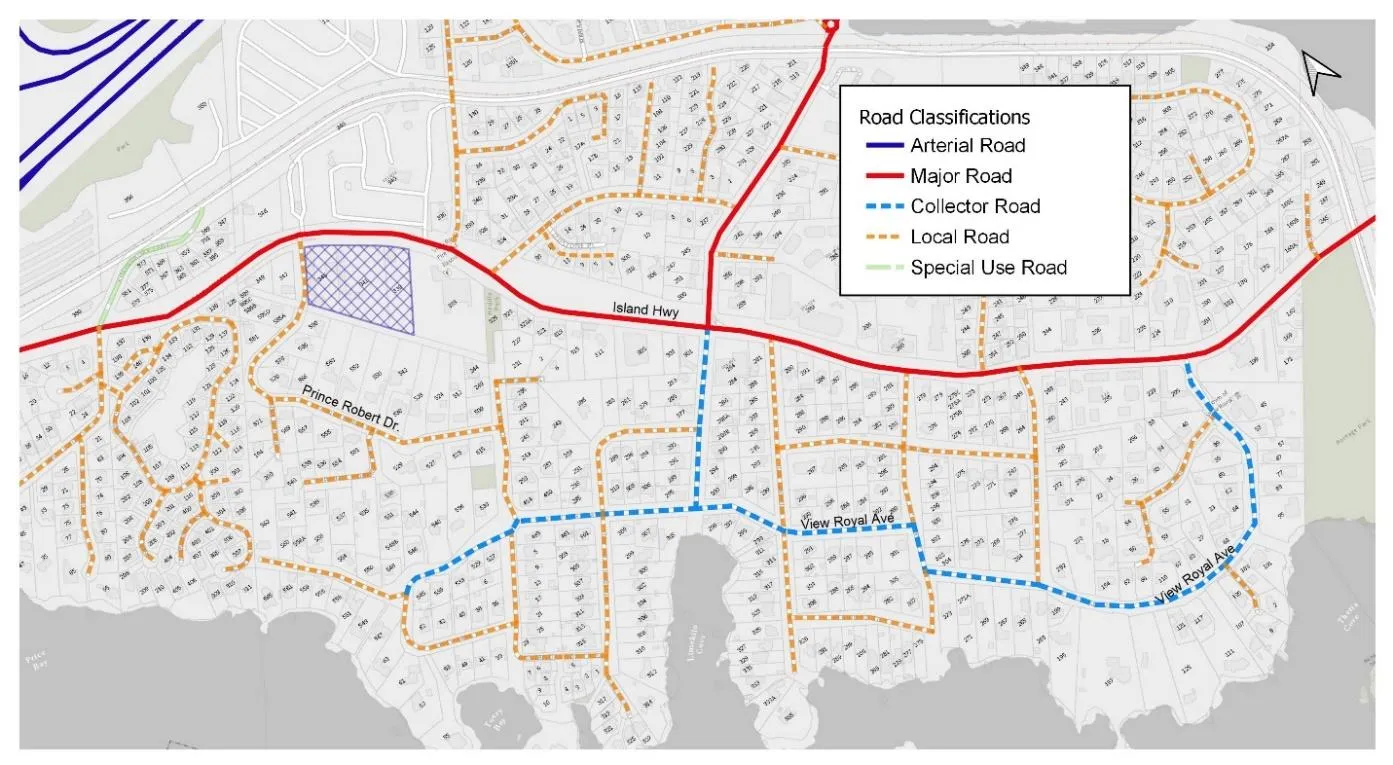
The road classifications around Prince Robert Dr. and View Royal Ave. are shown above.
Prince Robert Drive is a Local Road and View Royal Avenue is a Collector Road. The speed limit is reduced to 30km/hour and there are hundreds of access points. There are about 329 residential properties that must, with no alternative, use this local and collector road network south of Island Highway. The development would add 238 more residences with no agreement for traffic mitigation measures.
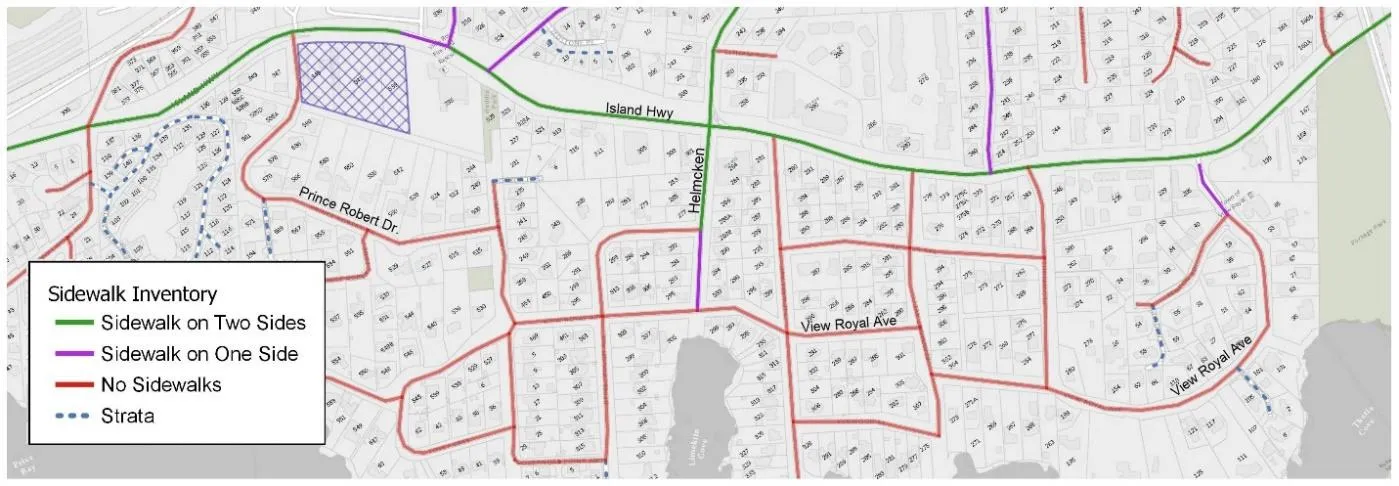
Sidewalks are extremely rare on the roads south of Island Hwy.
It is 1950m through our neighbourhood from the intersection of Prince Robert and Island Hwy to the signal lights at View Royal Avenue and Island Hwy. The only sidewalk is at the NE end of that route in two 20m segments. At both ends of the route there are steep hills of 18% to 22% grade which are significant reasons for concern that additional traffic will exceed the safety limit of these roads. Both hills are on curves with poor sight lines, no shoulders, and very limited room for pedestrians.
There are currently about 128 residential properties along the route mentioned above, that’s just over half the number of residences the proposed development will add, a 185% increase.
To focus in further, there are currently only 30 residential properties who have driveways onto Prince Robert Drive. This project will increase that number to 268, an 890% increase, yet no traffic mitigation for Prince Robert Drive has been identified or agreed on. No plan for orphan car parking exists.
Examples of traffic mitigation are found near Prince Robert Drive. There are bollards at the west end of View Royal Avenue that stop traffic from cutting through Gibraltar Bay. Across Island Hwy from the development site the entrance to Jedburgh Rd is restricted to right turns only, a long-standing mitigation against shortcutting on that street. In 2017 a project for 8 new homes triggered the construction of 170m of sidewalk on Jedburgh to provide the only All Ages and Abilities walking access on that street.
Looking further away, the end of Wilfert Rd. was gated off from traffic. There is also a lane that would provide a handy shortcut from Island Hwy. to Canadian Tire via Glentana Rd. if the lane was not gated.
Other types of mitigation include constructing features to enhance safety when traffic volumes warrant the expense. A project (C-080) to complete that sidewalk on Jedburgh through to Helmcken Rd. is in the current financial plan. The cost estimate for the 125m of sidewalk is $300,000. The missing 1900m of sidewalk on Prince Robert – View Royal Ave would cost $4.5 million based on that estimate. Mitigating now against a predictable increase in traffic with a No Through Street would be more cost effective.
The View Royal Traffic Calming Policy sets out the criteria and process for undertaking mitigation measures when proper mitigation has been ignored during the development planning stage. It does include using No Through Streets as a mitigation measure.
But here are my concerns about waiting. I want this to be very clear. The mitigation should be agreed upon now, before rezoning, and the proponent should pay the costs. The Traffic Calming Policy is a document that holds no hope for the current residents. It puts residents in the position of having to beg and lobby to undertake studies, to beg council to fund a mitigation project, to beg town staff to prioritize the project. If a No Through Street was eventually identified as the correct mitigation the project would “be included as part of the 5-year financial plan to be considered as budgets and other priorities allow” which is pretty weak tea when a practical mitigation solution should have been, and still could be, part of the development plan (and cost) in the first place.
There is a lot of concern about Missing Middle and All Ages and Abilities transportation. But the Middle is not Missing in the Harbour Precinct. A significant number of families with young children have sprouted up in our neighbourhood. Low traffic volumes and minimal on-street parking are an economical way to support this trend. Pro-active planning to prevent foreseeable and unwanted impacts from this development are needed before rezoning is granted.
Sincerely,
Doug Wilson View Royal Avenue