DRAFT Financial Statements of CREST INCORPORATED Year ended December 31, 2013
Detailed draft audited financial statements for the CREST organization for 2013.
Financial Statements of CAPITAL REGION EMERGENCY SERVICE TELECOMMUNICATIONS (CREST) INCORPORATED
Year ended December 31, 2013
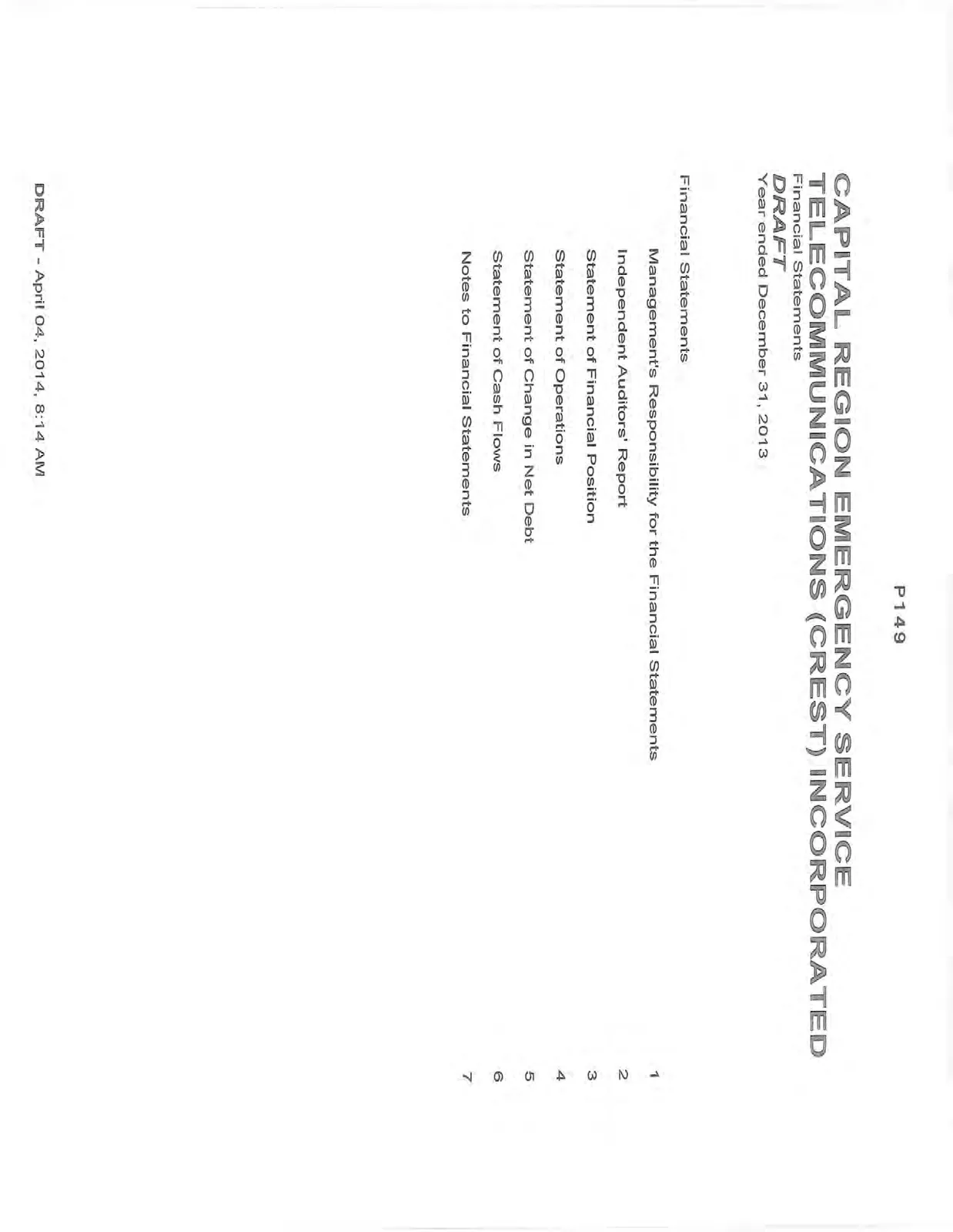
Financial Statements
- Management's Responsibility for the Financial Statements
- Independent Auditors' Report
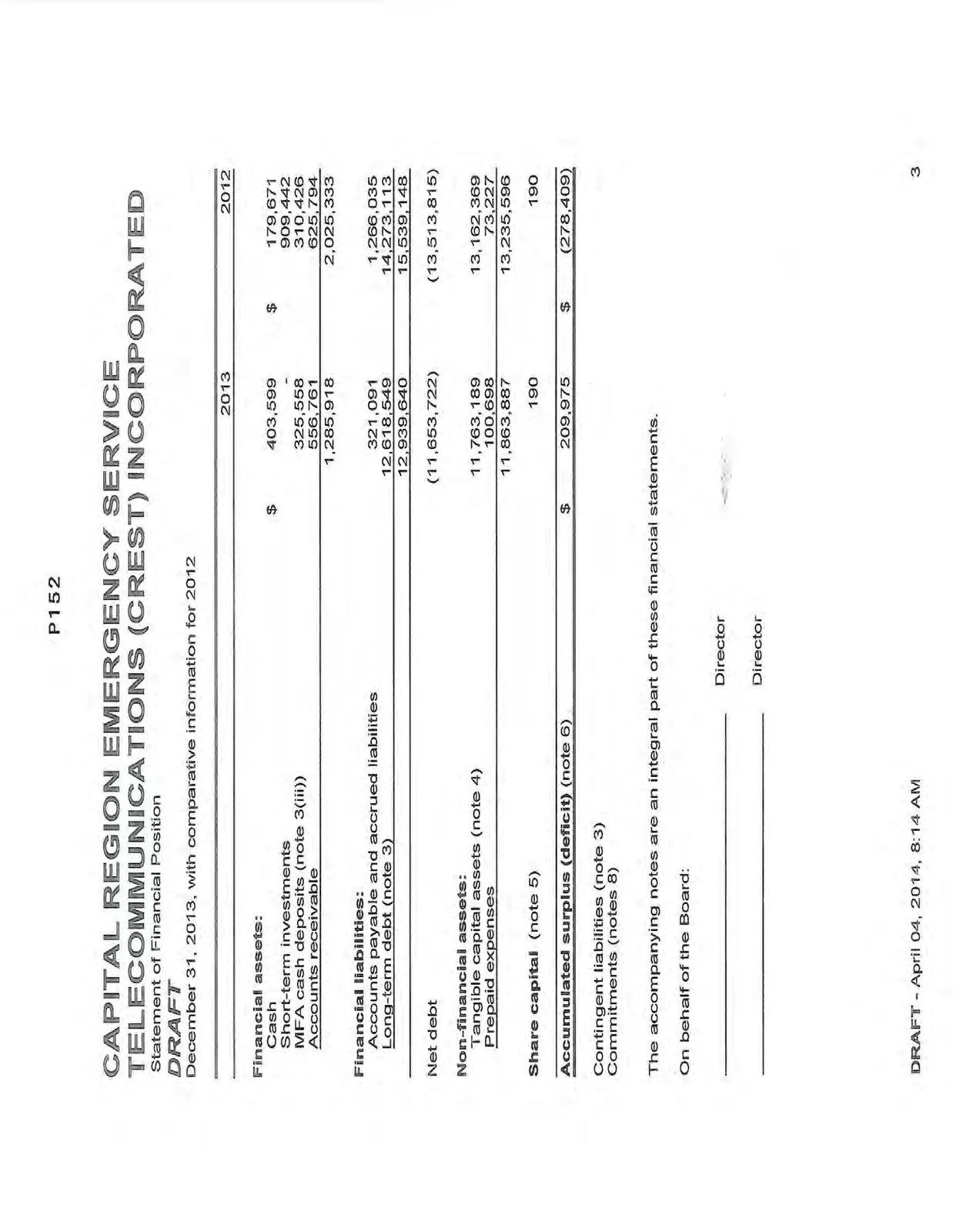
- Statement of Financial Position
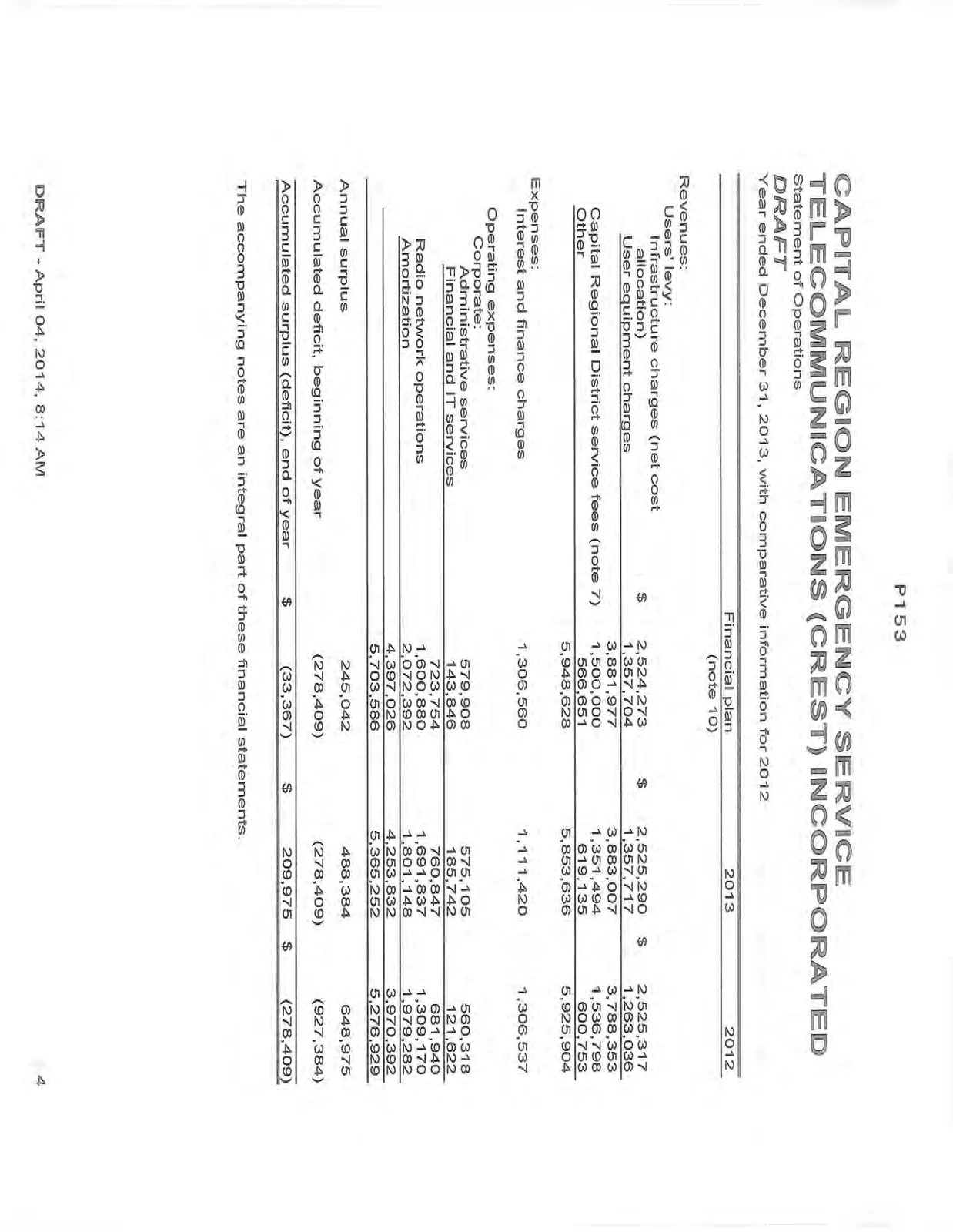
- Statement of Operations
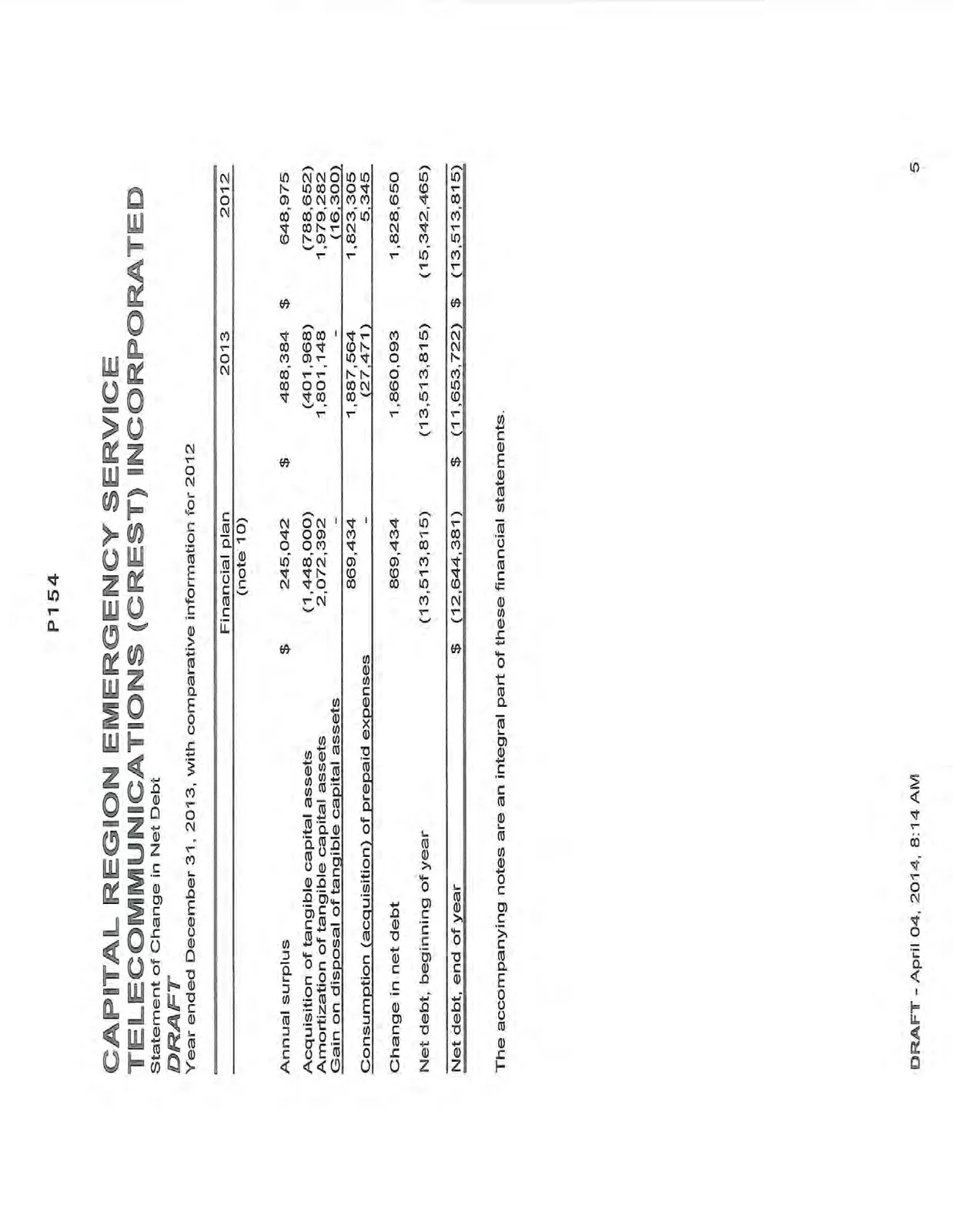
- Statement of Change in Net Debt
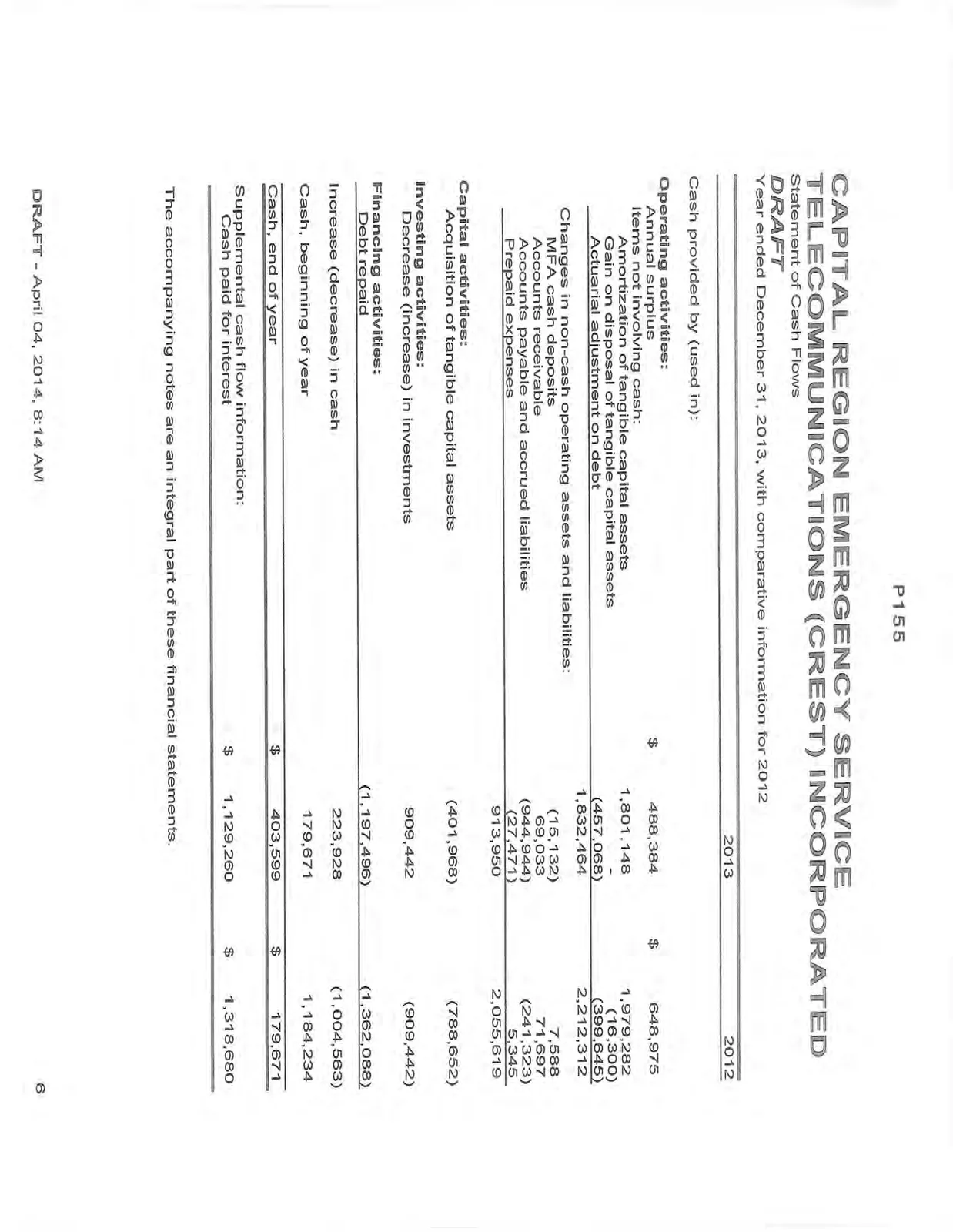
- Statement of Cash Flows
- Notes to Financial Statements
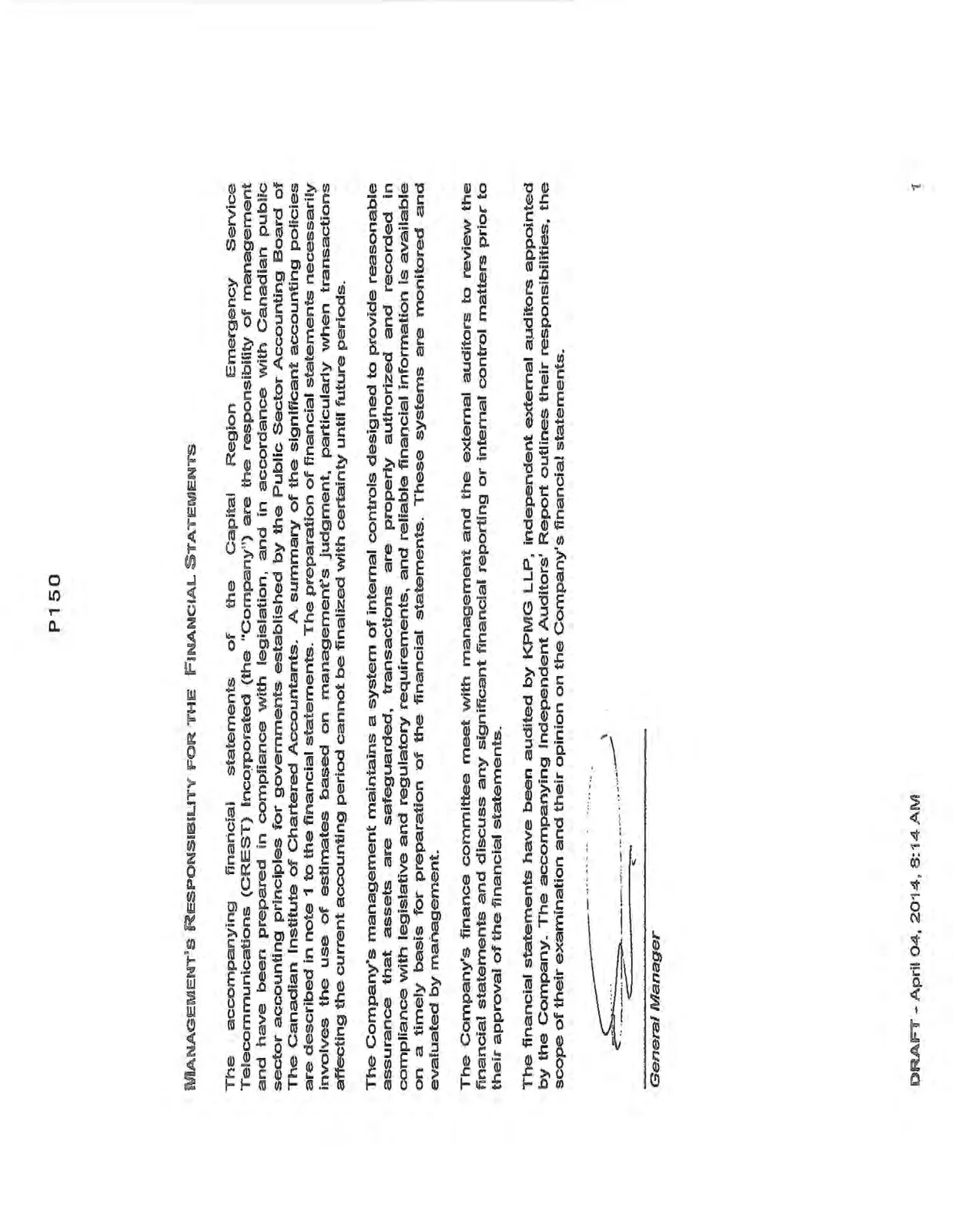
Management's Responsibility for the Financial Statements
The accompanying financial statements of the Capital Region Emergency Service Telecommunications (CREST) Incorporated (the "Company") are the responsibility of management and have been prepared in compliance with legislation, and in accordance with Canadian public sector accounting principles for governments established by the Public Sector Accounting Board of The Canadian Institute of Chartered Accountants. A summary of the significant accounting policies are described in note 1 to the financial statements. The preparation of financial statements necessarily involves the use of estimates based on management's judgment, particularly when transactions affecting the current accounting period cannot be finalized with certainty until future periods.
The Company's management maintains a system of internal controls designed to provide reasonable assurance that assets are safeguarded, transactions are properly authorized and recorded in compliance with legislative and regulatory requirements, and reliable financial information is available on a timely basis for preparation of the financial statements. These systems are monitored and evaluated by management.
The Company's finance committee meet with management and the external auditors to review the financial statements and discuss any significant financial reporting or internal control matters prior to their approval of the financial statements.
The financial statements have been audited by KPMG LLP, independent external auditors appointed by the Company. The accompanying Independent Auditors' Report outlines their responsibilities, the scope of their examination and their opinion on the Company's financial statements.
General Manager
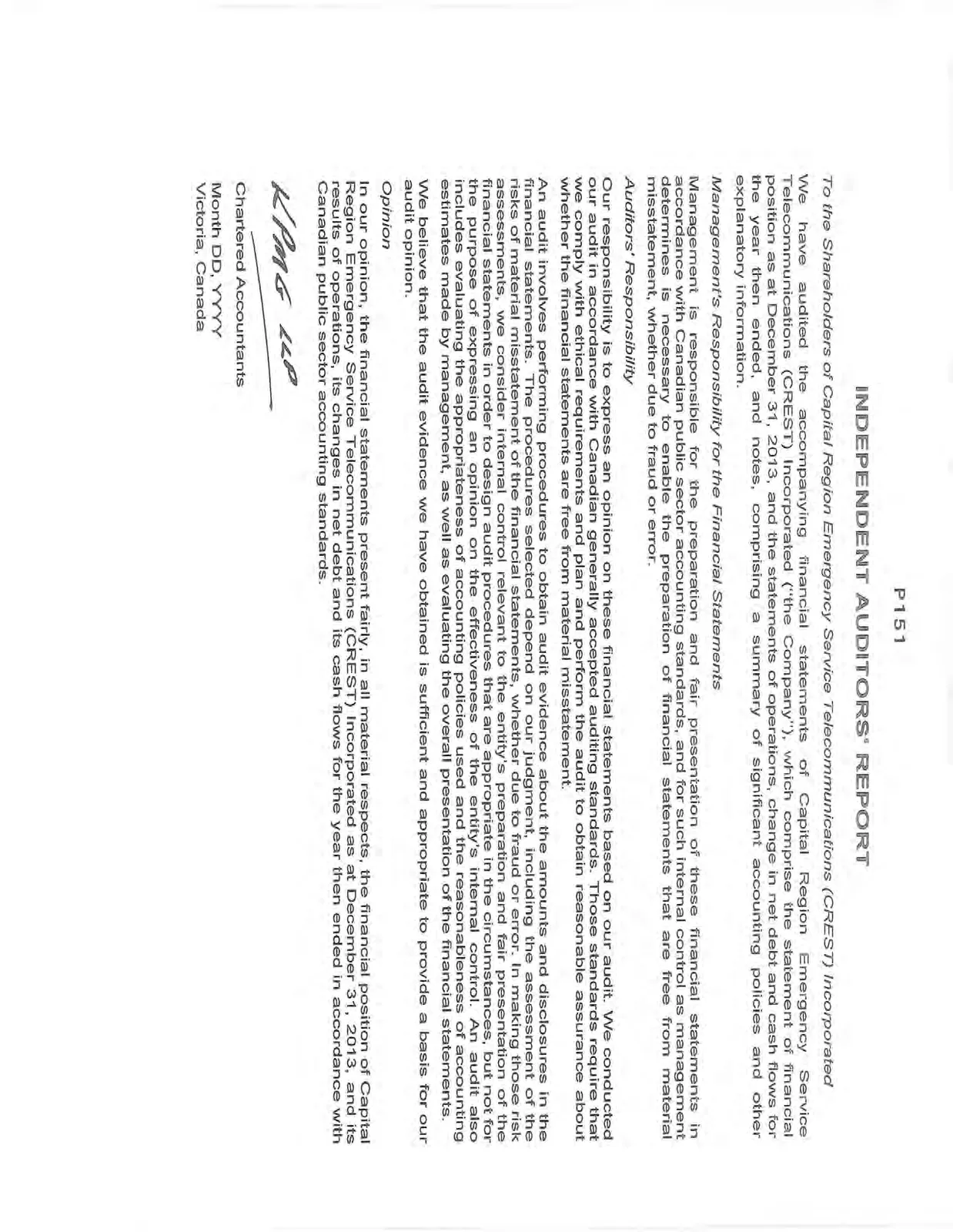
Independent Auditors' Report
To the Shareholders of Capital Region Emergency Service Telecommunications (CREST) Incorporated
We have audited the accompanying financial statements of Capital Region Emergency Service Telecommunications (CREST) Incorporated ("the Company"), which comprise the statement of financial position as at December 31, 2013, and the statements of operations, change in net debt and cash flows for the year then ended, and notes, comprising a summary of significant accounting policies and other explanatory information.
Management's Responsibility for the Financial Statements
Management is responsible for the preparation and fair presentation of these financial statements in accordance with Canadian public sector accounting standards, and for such internal control as management determines is necessary to enable the preparation of financial statements that are free from material misstatement, whether due to fraud or error.
Auditors' Responsibility
Our responsibility is to express an opinion on these financial statements based on our audit. We conducted our audit in accordance with Canadian generally accepted auditing standards. Those standards require that we comply with ethical requirements and plan and perform the audit to obtain reasonable assurance about whether the financial statements are free from material misstatement.
An audit involves performing procedures to obtain audit evidence about the amounts and disclosures in the financial statements. The procedures selected depend on our judgment, including the assessment of the risks of material misstatement of the financial statements, whether due to fraud or error. In making those risk assessments, we consider internal control relevant to the entity's preparation and fair presentation of the financial statements in order to design audit procedures that are appropriate in the circumstances, but not for the purpose of expressing an opinion on the effectiveness of the entity's internal control. An audit also includes evaluating the appropriateness of accounting policies used and the reasonableness of accounting estimates made by management, as well as evaluating the overall presentation of the financial statements.
We believe that the audit evidence we have obtained is sufficient and appropriate to provide a basis for our audit opinion.
Opinion
In our opinion, the financial statements present fairly, in all material respects, the financial position of Capital Region Emergency Service Telecommunications (CREST) Incorporated as at December 31, 2013, and its results of operations, its changes in net debt and its cash flows for the year then ended in accordance with Canadian public sector accounting standards.
KPMG LLP Chartered Accountants Month DD, YYYY Victoria, Canada
Statement of Financial Position
December 31, 2013, with comparative information for 2012
| 2013 | 2012 | |
|---|---|---|
| Financial assets: | ||
| Cash | $ 403,599 | $ 179,671 |
| Short-term investments | - | 909,442 |
| MFA cash deposits (note 3(iii)) | 325,558 | 310,426 |
| Accounts receivable | 556,761 | 625,794 |
| 1,285,918 | 2,025,333 | |
| Financial liabilities: | ||
| Accounts payable and accrued liabilities | 321,091 | 1,266,035 |
| Long-term debt (note 3) | 12,618,549 | 14,273,113 |
| 12,939,640 | 15,539,148 | |
| Net debt | (11,653,722) | (13,513,815) |
| Non-financial assets: | ||
| Tangible capital assets (note 4) | 11,763,189 | 13,162,369 |
| Prepaid expenses | 100,698 | 73,227 |
| 11,863,887 | 13,235,596 | |
| Share capital (note 5) | 190 | 190 |
| Accumulated surplus (deficit) (note 6) | $ 209,975 | $ (278,409) |
Contingent liabilities (note 3) Commitments (note 8)
The accompanying notes are an integral part of these financial statements.
On behalf of the Board: Director Director
Statement of Operations
Year ended December 31, 2013, with comparative information for 2012
| Financial plan (note 10) | 2013 | 2012 | |
|---|---|---|---|
| Revenues: | |||
| Users' levy: | |||
| Infrastructure charges (net cost allocation) | $ 2,524,273 | $ 2,525,290 | $ 2,525,317 |
| User equipment charges | 1,357,704 | 1,357,717 | 1,263,036 |
| 3,881,977 | 3,883,007 | 3,788,353 | |
| Capital Regional District service fees (note 7) | 1,500,000 | 1,351,494 | 1,536,798 |
| Other | 566,651 | 619,135 | 600,753 |
| 5,948,628 | 5,853,636 | 5,925,904 | |
| Expenses: | |||
| Interest and finance charges | 1,306,560 | 1,111,420 | 1,306,537 |
| Operating expenses: | |||
| Corporate: | |||
| Administrative services | 579,908 | 575,105 | 560,318 |
| Financial and IT services | 143,846 | 185,742 | 121,622 |
| 723,754 | 760,847 | 681,940 | |
| Radio network operations | 1,600,880 | 1,691,837 | 1,309,170 |
| Amortization | 2,072,392 | 1,801,148 | 1,979,282 |
| 4,397,026 | 4,253,832 | 3,970,392 | |
| 5,703,586 | 5,365,252 | 5,276,929 | |
| Annual surplus | 245,042 | 488,384 | 648,975 |
| Accumulated deficit, beginning of year | (278,409) | (278,409) | (927,384) |
| Accumulated surplus (deficit), end of year | $ (33,367) | $ 209,975 | $ (278,409) |
The accompanying notes are an integral part of these financial statements.
Statement of Change in Net Debt
Year ended December 31, 2013, with comparative information for 2012
| Financial plan (note 10) | 2013 | 2012 | |
|---|---|---|---|
| Annual surplus | $ 245,042 | $ 488,384 | $ 648,975 |
| Acquisition of tangible capital assets | (1,448,000) | (401,968) | (788,652) |
| Amortization of tangible capital assets | 2,072,392 | 1,801,148 | 1,979,282 |
| Gain on disposal of tangible capital assets | - | - | (16,300) |
| 869,434 | 1,887,564 | 1,823,305 | |
| Consumption (acquisition) of prepaid expenses | - | (27,471) | 5,345 |
| Change in net debt | 869,434 | 1,860,093 | 1,828,650 |
| Net debt, beginning of year | (13,513,815) | (13,513,815) | (15,342,465) |
| Net debt, end of year | $ (12,644,381) | $ (11,653,722) | $ (13,513,815) |
The accompanying notes are an integral part of these financial statements.
Statement of Cash Flows
Year ended December 31, 2013, with comparative information for 2012
| 2013 | 2012 | |
|---|---|---|
| Cash provided by (used in): | ||
| Operating activities: | ||
| Annual surplus | $ 488,384 | $ 648,975 |
| Items not involving cash: | ||
| Amortization of tangible capital assets | 1,801,148 | 1,979,282 |
| Gain on disposal of tangible capital assets | - | (16,300) |
| Actuarial adjustment on debt | (457,068) | (399,645) |
| 1,832,464 | 2,212,312 | |
| Changes in non-cash operating assets and liabilities: | ||
| MFA cash deposits | (15,132) | 7,588 |
| Accounts receivable | 69,033 | 71,697 |
| Accounts payable and accrued liabilities | (944,944) | (241,323) |
| Prepaid expenses | (27,471) | 5,345 |
| 913,950 | 2,055,619 | |
| Capital activities: | ||
| Acquisition of tangible capital assets | (401,968) | (788,652) |
| Investing activities: | ||
| Decrease (increase) in investments | 909,442 | (909,442) |
| Financing activities: | ||
| Debt repaid | (1,197,496) | (1,362,088) |
| Increase (decrease) in cash | 223,928 | (1,004,563) |
| Cash, beginning of year | 179,671 | 1,184,234 |
| Cash, end of year | $ 403,599 | $ 179,671 |
| Supplemental cash flow information: | ||
| Cash paid for interest | $ 1,129,260 | $ 1,318,680 |
The accompanying notes are an integral part of these financial statements.
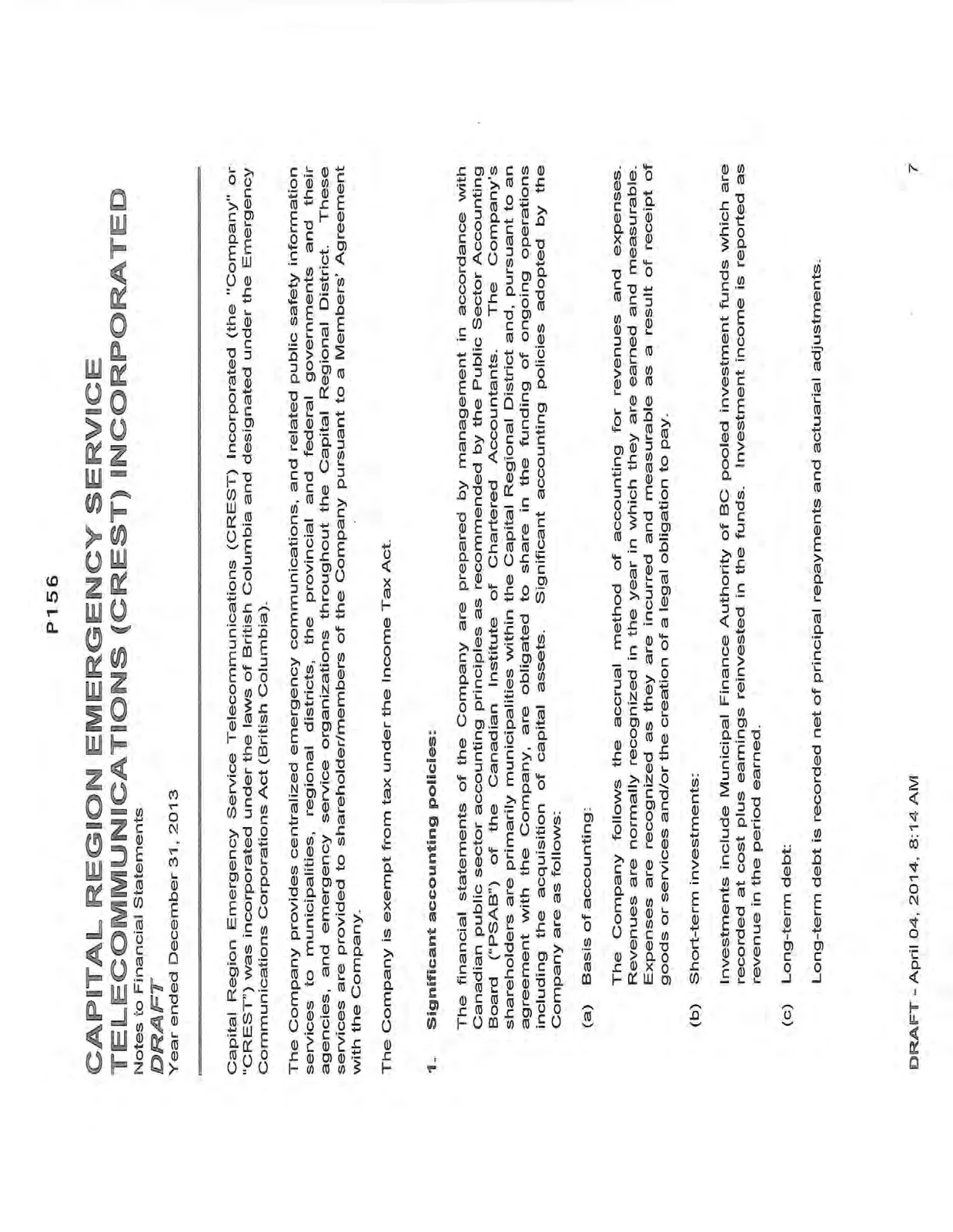
Notes to Financial Statements
Year ended December 31, 2013
Capital Region Emergency Service Telecommunications (CREST) Incorporated (the "Company") or "CREST") was incorporated under the laws of British Columbia and designated under the Emergency Communications Corporations Act (British Columbia).
The Company provides centralized emergency communications, and related public safety information services to municipalities, regional districts, the provincial and federal governments and their agencies, and emergency service organizations throughout the Capital Regional District. These services are provided to shareholder/members of the Company pursuant to a Members' Agreement with the Company.
The Company is exempt from tax under the Income Tax Act.
1. Significant accounting policies:
The financial statements of the Company are prepared by management in accordance with Canadian public sector accounting principles as recommended by the Public Sector Accounting Board ("PSAB") of the Canadian Institute of Chartered Accountants. The Company's shareholders are primarily municipalities within the Capital Regional District and, pursuant to an agreement with the Company, are obligated to share in the funding of ongoing operations including the acquisition of capital assets. Significant accounting policies adopted by the Company are as follows:
(a) Basis of accounting:
The Company follows the accrual method of accounting for revenues and expenses. Revenues are normally recognized in the year in which they are earned and measurable. Expenses are recognized as they are incurred and measurable as a result of receipt of goods or services and/or the creation of a legal obligation to pay.
(b) Short-term investments:
Investments include Municipal Finance Authority of BC pooled investment funds which are recorded at cost plus earnings reinvested in the funds. Investment income is reported as revenue in the period earned.
(c) Long-term debt:
Long-term debt is recorded net of principal repayments and actuarial adjustments.
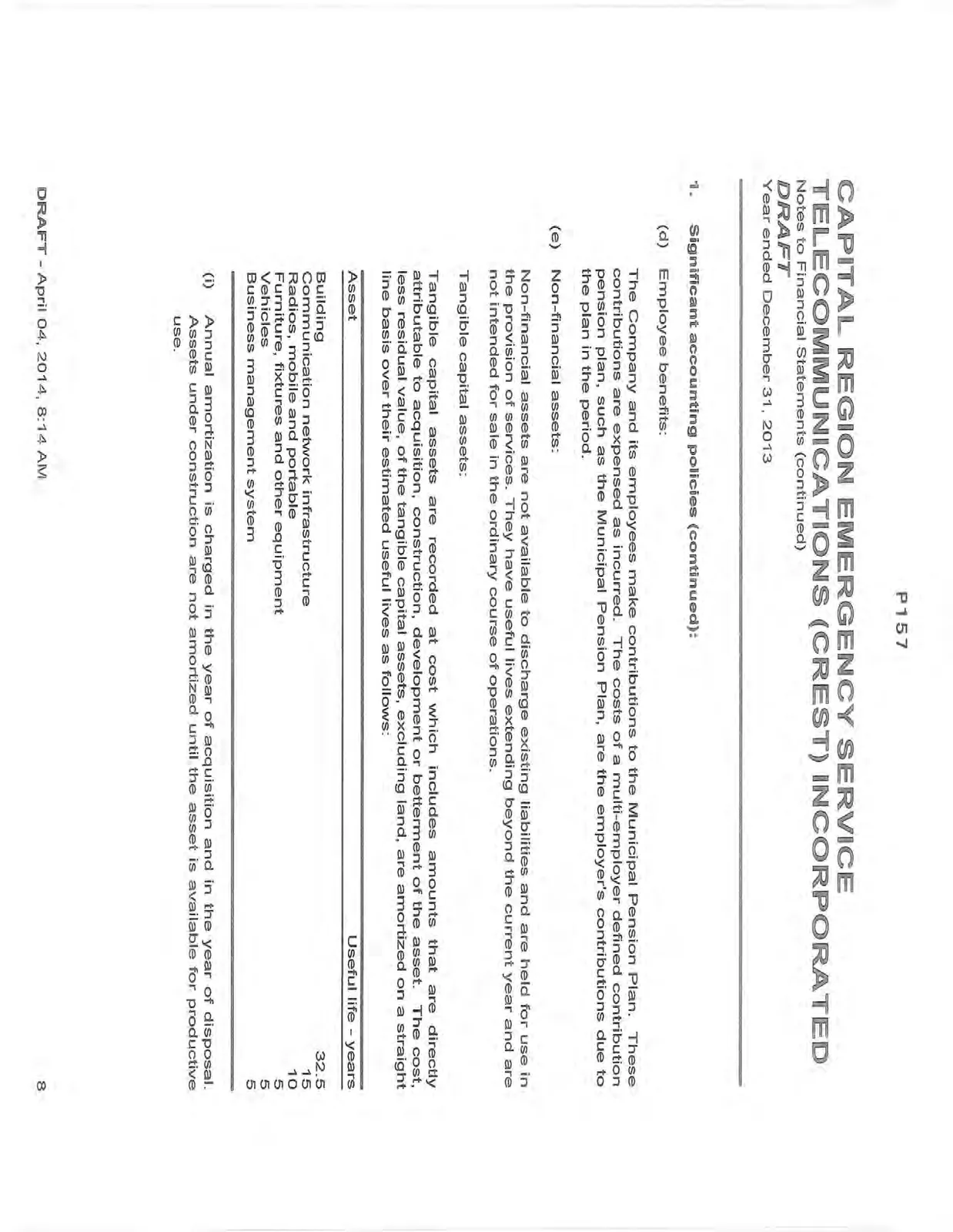
(d) Employee benefits:
The Company and its employees make contributions to the Municipal Pension Plan. These contributions are expensed as incurred. The costs of a multi-employer defined contribution pension plan, such as the Municipal Pension Plan, are the employer's contributions due to the plan in the period.
(e) Non-financial assets:
Non-financial assets are not available to discharge existing liabilities and are held for use in the provision of services. They have useful lives extending beyond the current year and are not intended for sale in the ordinary course of operations.
Tangible capital assets:
Tangible capital assets are recorded at cost which includes amounts that are directly attributable to acquisition, construction, development or betterment of the asset. The cost, less residual value, of the tangible capital assets, excluding land, are amortized on a straight line basis over their estimated useful lives as follows:
| Asset | Useful life - years |
|---|---|
| Building | 32.5 |
| Communication network infrastructure | 15 |
| Radios, mobile and portable | 10 |
| Furniture, fixtures and other equipment | 5 |
| Vehicles | 5 |
| Business management system | 5 |
(i) Annual amortization is charged in the year of acquisition and in the year of disposal. Assets under construction are not amortized until the asset is available for productive use.
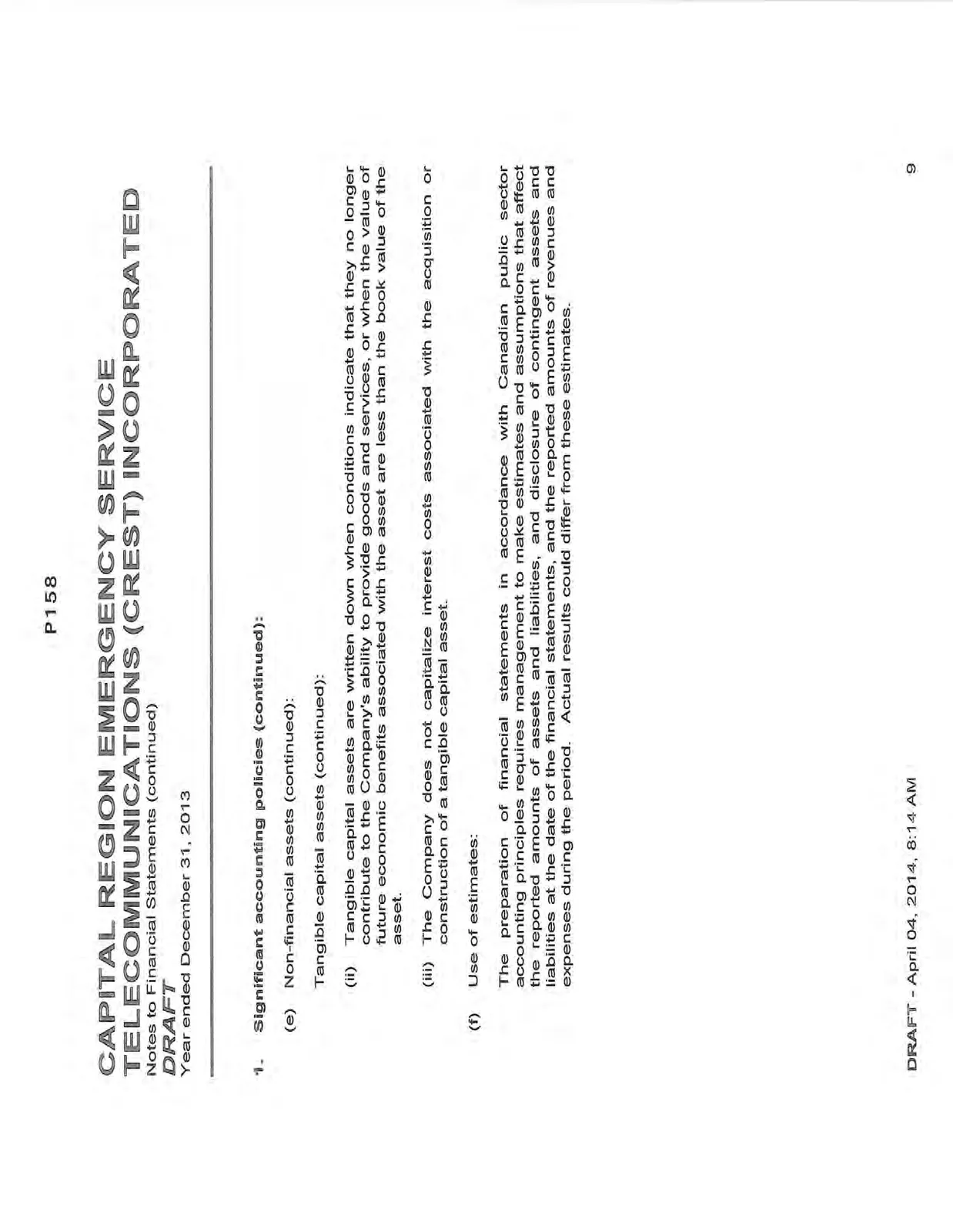
(ii) Tangible capital assets are written down when conditions indicate that they no longer contribute to the Company's ability to provide goods and services, or when the value of future economic benefits associated with the asset is less than the book value of the asset.
(iii) The Company does not capitalize interest costs associated with the acquisition or construction of a tangible capital asset.
(f) Use of estimates:
The preparation of financial statements in accordance with Canadian public sector accounting principles requires management to make estimates and assumptions that affect the reported amounts of assets and liabilities, and disclosure of contingent assets and liabilities at the date of the financial statements, and the reported amounts of revenues and expenses during the period. Actual results could differ from these estimates.
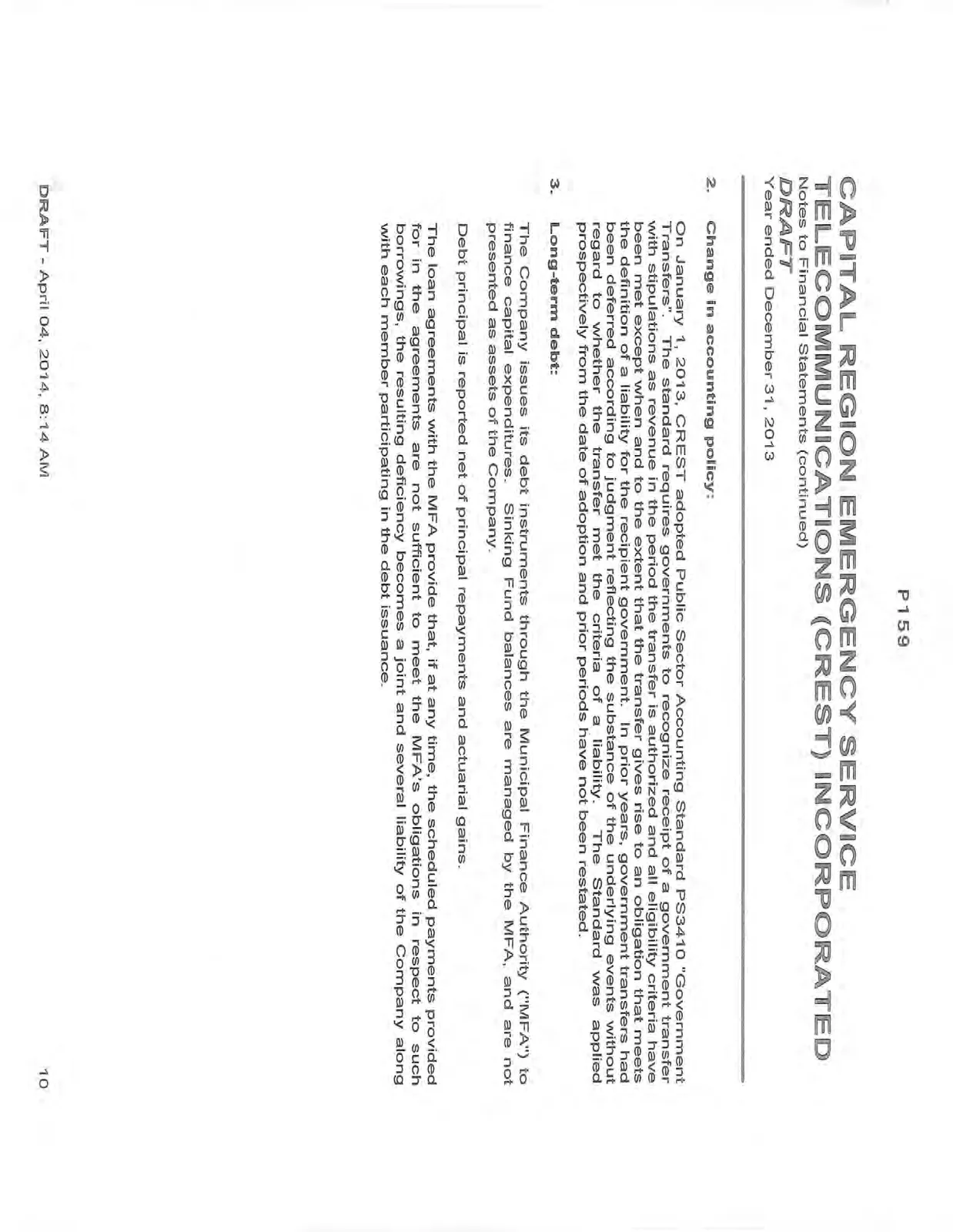
2. Change in accounting policy:
On January 1, 2013, CREST adopted Public Sector Accounting Standard PS3410 "Government Transfers". The standard requires governments to recognize receipt of a government transfer with stipulations as revenue in the period the transfer is authorized and all eligibility criteria have been met except when and to the extent that the transfer gives rise to an obligation that meets the definition of a liability for the recipient government. In prior years, government transfers had been deferred according to judgment reflecting the substance of the underlying events without regard to whether the transfer met the criteria of a liability. The Standard was applied prospectively from the date of adoption and prior periods have not been restated.
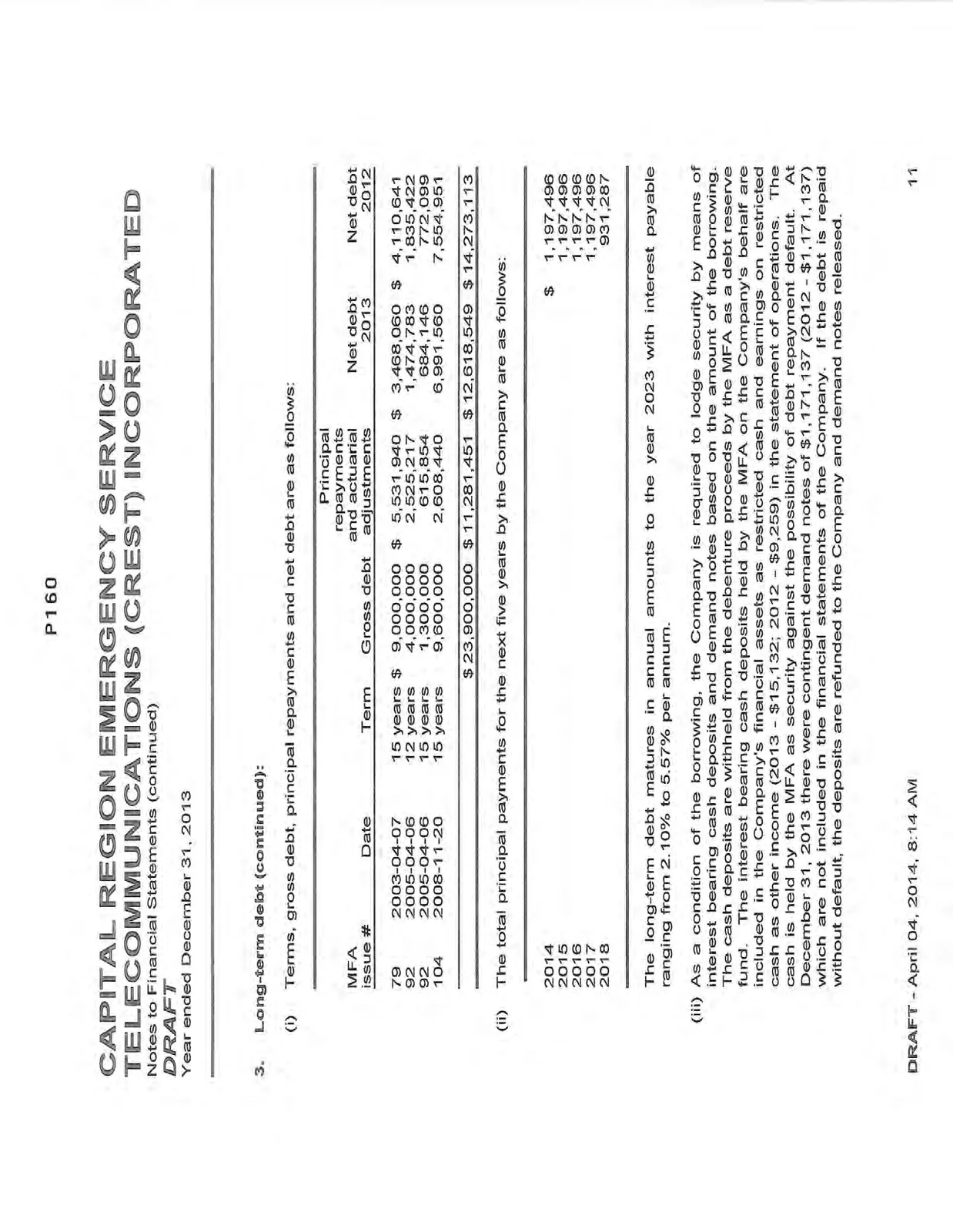
3. Long-term debt:
The Company issues its debt instruments through the Municipal Finance Authority ("MFA") to finance capital expenditures. Sinking Fund balances are managed by the MFA, and are not presented as assets of the Company.
Debt principal is reported net of principal repayments and actuarial gains.
The loan agreements with the MFA provide that, if at any time, the scheduled payments provided for in the agreements are not sufficient to meet the MFA's obligations in respect to such borrowings, the resulting deficiency becomes a joint and several liability of the Company along with each member participating in the debt issuance.
(i) Terms, gross debt, principal repayments and net debt are as follows:
| MFA issue # | Date | Term | Gross debt | Principal repayments and actuarial adjustments | Net debt 2013 | Net debt 2012 |
|---|---|---|---|---|---|---|
| 79 | 2003-04-07 | 15 years | $ 9,000,000 | $ 5,531,940 | $ 3,468,060 | $ 4,110,641 |
| 92 | 2005-04-06 | 12 years | 4,000,000 | 2,525,217 | 1,474,783 | 1,835,422 |
| 92 | 2005-04-06 | 15 years | 1,300,000 | 615,854 | 684,146 | 772,099 |
| 104 | 2008-11-20 | 15 years | 9,600,000 | 2,608,440 | 6,991,560 | 7,554,951 |
| $ 23,900,000 | $ 11,281,451 | $ 12,618,549 | $ 14,273,113 |
(ii) The total principal payments for the next five years by the Company are as follows:
| 2014 | $ 1,197,496 |
| 2015 | 1,197,496 |
| 2016 | 1,197,496 |
| 2017 | 1,197,496 |
| 2018 | 931,287 |
The long-term debt matures in annual amounts to the year 2023 with interest payable ranging from 2.10% to 5.57% per annum.
(iii) As a condition of the borrowing, the Company is required to lodge security by means of interest bearing cash deposits and demand notes based on the amount of the borrowing. The cash deposits are withheld from the debenture proceeds by the MFA as a debt reserve fund. The interest bearing cash deposits held by the MFA on the Company's behalf are included in the Company's financial assets as restricted cash and earnings on restricted cash as other income (2013 - $15,132; 2012 - $9,259) in the statement of operations. The cash is held by the MFA as security against the possibility of debt repayment default. At December 31, 2013 there were contingent demand notes of $1,171,137 (2012 - $1,171,137) which are not included in the financial statements of the Company. If the debt is repaid without default, the deposits are refunded to the Company and demand notes released.
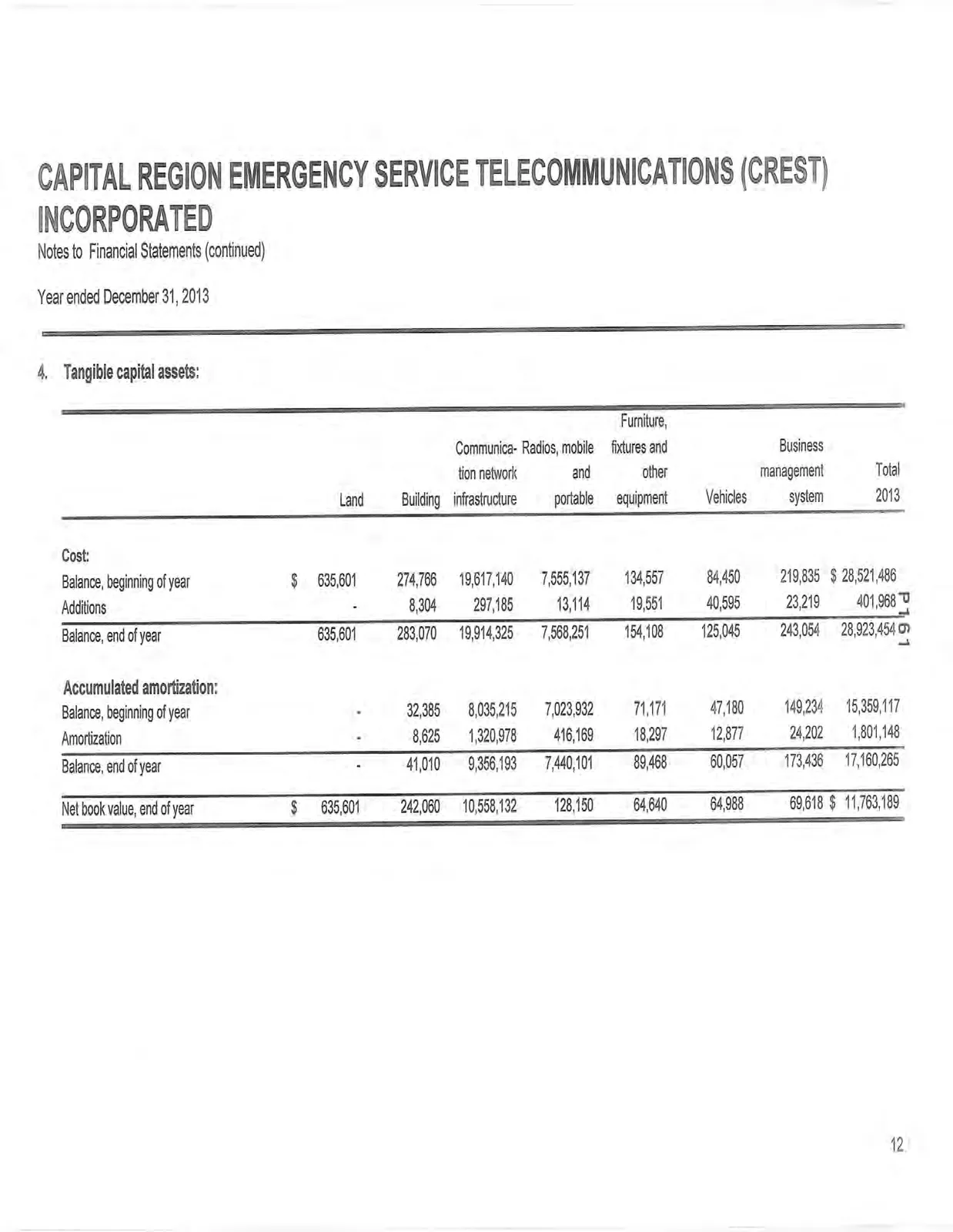
4. Tangible capital assets:
| Cost | Land | Building | Communica-tion network infrastructure | Radios, mobile and portable | Furniture, fixtures and other equipment | Vehicles | Business management system | Total 2013 |
|---|---|---|---|---|---|---|---|---|
| Balance, beginning of year | $ 635,601 | 274,766 | 19,617,140 | 7,555,137 | 134,557 | 84,450 | 219,835 | $ 28,521,486 |
| Additions | - | 8,304 | 297,185 | 13,114 | 19,551 | 40,595 | 23,219 | 401,968 |
| Balance, end of year | 635,601 | 283,070 | 19,914,325 | 7,568,251 | 154,108 | 125,045 | 243,054 | 28,923,454 |
| Accumulated amortization: | ||||||||
| Balance, beginning of year | - | 32,385 | 8,035,215 | 7,023,932 | 71,171 | 47,180 | 149,234 | 15,359,117 |
| Amortization | - | 8,625 | 1,320,978 | 416,169 | 18,297 | 12,877 | 24,202 | 1,801,148 |
| Balance, end of year | - | 41,010 | 9,356,193 | 7,440,101 | 89,468 | 60,057 | 173,436 | 17,160,265 |
| Net book value, end of year | $ 635,601 | 242,060 | 10,558,132 | 128,150 | 64,640 | 64,988 | 69,618 | $ 11,763,189 |
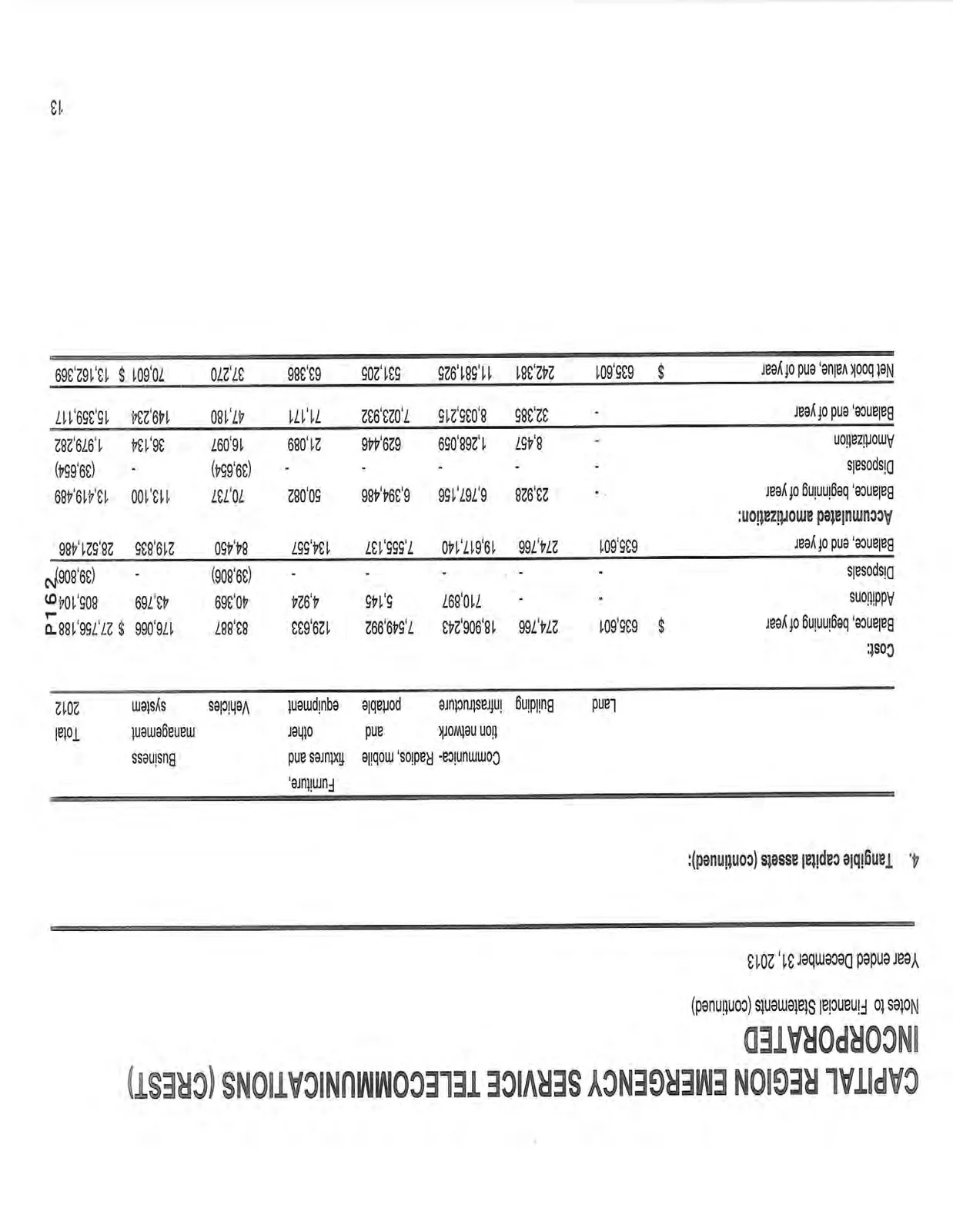
| Cost (continued) | Land | Building | Communica-tion network infrastructure | Radios, mobile and portable | Furniture, fixtures and other equipment | Vehicles | Business management system | Total 2012 |
|---|---|---|---|---|---|---|---|---|
| Balance, beginning of year | $ 635,601 | 274,766 | 18,906,243 | 7,549,992 | 129,633 | 83,887 | 176,066 | $ 27,756,188 |
| Additions | - | - | 710,897 | 5,145 | 4,924 | 40,369 | 43,769 | 805,104 |
| Disposals | - | - | - | - | - | (39,806) | - | (39,806) |
| Balance, end of year | 635,601 | 274,766 | 19,617,140 | 7,555,137 | 134,557 | 84,450 | 219,835 | 28,521,486 |
| Accumulated amortization: | ||||||||
| Balance, beginning of year | - | 23,928 | 6,767,156 | 6,394,486 | 50,082 | 70,737 | 113,100 | 13,419,489 |
| Disposals | - | - | - | - | - | (39,654) | - | (39,654) |
| Amortization | - | 8,457 | 1,268,059 | 629,446 | 21,089 | 16,097 | 36,134 | 1,979,282 |
| Balance, end of year | - | 32,385 | 8,035,215 | 7,023,932 | 71,171 | 47,180 | 149,234 | 15,359,117 |
| Net book value, end of year | $ 635,601 | 242,381 | 11,581,925 | 531,205 | 63,386 | 37,270 | 70,601 | $ 13,162,369 |
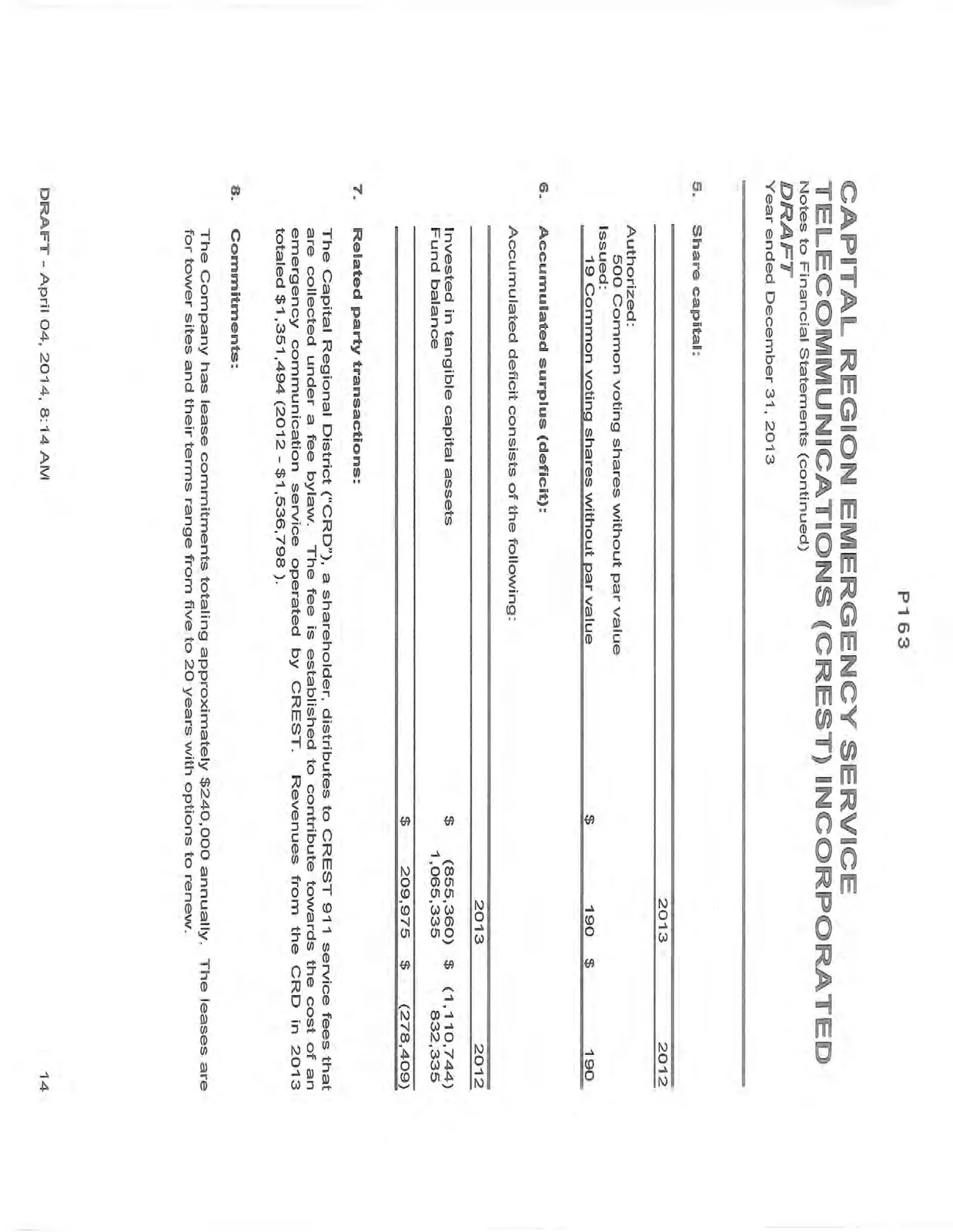
5. Share capital:
| 2013 | 2012 | |
|---|---|---|
| Authorized: | ||
| 500 Common voting shares without par value | ||
| Issued: | ||
| 19 Common voting shares without par value | $ 190 | $ 190 |
6. Accumulated surplus (deficit):
Accumulated deficit consists of the following:
| 2013 | 2012 | |
|---|---|---|
| Invested in tangible capital assets | $ (855,360) | $ (1,110,744) |
| Fund balance | 1,065,335 | 832,335 |
| $ 209,975 | $ (278,409) |
7. Related party transactions:
The Capital Regional District ("CRD"), a shareholder, distributes to CREST 911 service fees that are collected under a fee bylaw. The fee is established to contribute towards the cost of an emergency communication service operated by CREST. Revenues from the CRD in 2013 totaled $1,351,494 (2012 - $1,536,798).
8. Commitments:
The Company has lease commitments totaling approximately $240,000 annually. The leases are for tower sites and their terms range from five to 20 years with options to renew.
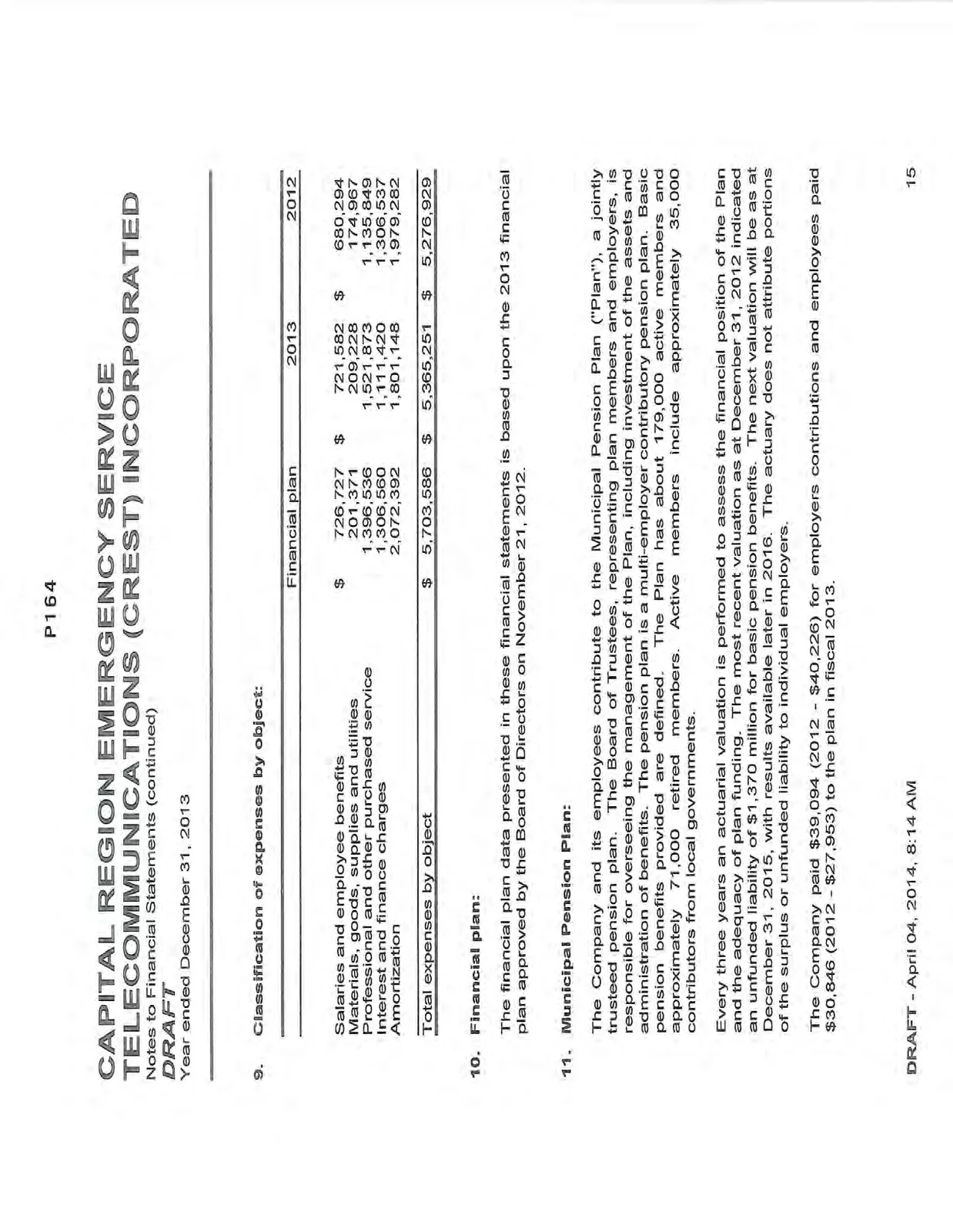
9. Classification of expenses by object:
| Financial plan | 2013 | 2012 | |
|---|---|---|---|
| Salaries and employee benefits | $ 726,727 | $ 721,582 | $ 680,294 |
| Materials, goods, supplies and utilities | 201,371 | 209,228 | 174,967 |
| Professional and other purchased service | 1,396,536 | 1,521,873 | 1,135,849 |
| Interest and finance charges | 1,306,560 | 1,111,420 | 1,306,537 |
| Amortization | 2,072,392 | 1,801,148 | 1,979,282 |
| Total expenses by object | $ 5,703,586 | $ 5,365,251 | $ 5,276,929 |
10. Financial plan:
The financial plan data presented in these financial statements is based upon the 2013 financial plan approved by the Board of Directors on November 21, 2012.
11. Municipal Pension Plan:
The Company and its employees contribute to the Municipal Pension Plan ("Plan"), a jointly trusteed pension plan. The Board of Trustees, representing plan members and employers, is responsible for overseeing the management of the Plan, including investment of the assets and administration of benefits. The pension plan is a multi-employer contributory pension plan. Basic pension benefits provided are defined. The Plan has about 179,000 active members and approximately 71,000 retired members. Active members include approximately 35,000 contributors from local governments.
Every three years an actuarial valuation is performed to assess the financial position of the Plan and the adequacy of plan funding. The most recent valuation as at December 31, 2012 indicated an unfunded liability of $1,370 million for basic pension benefits. The next valuation will be as at December 31, 2015, with results available later in 2016. The actuary does not attribute portions of the surplus or unfunded liability to individual employers.
The Company paid $39,094 (2012 - $40,226) for employers contributions and employees paid $30,846 (2012 - $27,953) to the plan in fiscal 2013.
Document Images
(17)