Minutes
Minutes of the Council meeting held June 21, 2022
July 19, 2022Pages 76–817 sections
Official record of the proceedings and decisions made during the regular Council meeting on June 21, 2022.
June 21, 2022
Siting, Height and Massing
| Guidelines | Proposal |
|---|---|
| i. Site design should respond to the topography and specific conditions of the site and retain/work with existing grades and natural features such as rock outcroppings, mature trees and sensitive ecosystems such as Garry Oak meadow, riparian areas and shorelines. | Units are ground oriented and are laid out along the driveway to follow the slope. 10m clearance areas between buildings and the Park are necessary due to interface fire hazards. Covenant areas are proposed in subsequent phases of the development where sensitive ecosystems have been identified. |
| ii. Residential development should be oriented towards the street, except where natural features (slopes, rocks, vegetation) prevent this configuration. | The layout is appropriate to meet interface fire hazards in this setting adjacent to Thetis Lake Regional Park. |
| iii. Massing and siting of infill housing shall respect established neighborhood patterns, including setbacks. | n/a |
| iv. Create visual interest by providing variations in height, rooflines, massing. | Visual interest would be provided through variations in roof cornice fascias, and a v-shaped footprint. |
| v. Attempt to maintain important public views to natural areas and scenic vistas through careful siting, building design and landscaping. | Key lookout locations on the site have been identified in future phases. A green buffer is proposed for future phases along the Trans Canada Highway to minimize the visual impact of the development. |
| vi. Building siting and placement of balconies, decks and windows should limit overlook and shadowing impacts on neighbours. | Overlook from this development is mitigated a larger distance to neighbouring buildings. No significant shadowing impacts are expected. |
| vii. Buildings over two storeys should utilize setbacks and/or terracing above the second level to reduce massing impacts on the street and surrounding neighbours, preserve view corridors and provide visual interest. | The V-shaped footprint reduces the massing impacts on the street, surrounding neighbours, and vistas from the street. |
Page 76–81
Landscaping
| Guidelines | Proposal |
|---|---|
| i. Retain mature trees and, wherever possible, established vegetation, especially around natural features (e.g. creeks, ponds, slopes and rocky outcroppings) for visual interest and to limit disruption of natural systems. | Extensive site grading means that existing trees cannot be retained. Instead, natural green spaces areas are preserved elsewhere on the site. |
| ii. Utilize native species wherever possible in site landscaping. Invasive or nuisance species (e.g. English Ivy, Broom) should not be used. Plants should be chosen for seasonal interest and compatibility with the local climate. Large expanses of lawn are not encouraged. | Landscaping consists of a combination of native and ornamental plant species for seasonal interest. Landscape areas abutting Thetis Lake Regional Park are fire-resistant native species. Ornamental tree species have been chosen for seasonal interest and their suitability to the site. The Starlight Dogwood is an American Pacific Dogwood hybrid that is drought tolerant and considered to be more resistant to fungal disease than native species. |
| iii. Space for private or communal gardening and the use of native plants, edible plants, berry bushes and fruit trees in landscaping is encouraged. | The siting, density, steepness and blasted rock that comprise the of this phase is |
| iv. Use a combination of soft and hard landscape elements to create functional and visually appealing private and semi-private outdoor space. | The site is sloped and rocks cuts and retaining walls are used to created terraced usable (green) space. |
| v. Define the transition from public to private space with hard and/or soft landscape elements such as low hedging, low solid or a combination of permeable/transparent fencing (such as wrought iron above a solid base). | The transition from public to private space is defined by formal landscaping. |
| vi. Landscaping of townhouse and apartment developments should contribute to a pedestrian-friendly streetscape, by providing street trees and other plantings to soften building edges, provide visual interest and establish a sense of pedestrian enclosure. | The road frontage of this site will be densely landscaped/ |
| vii. Low-rise apartments should consider the inclusion of common gathering areas with age-appropriate features and sited in such a way as to maximize exposure to sunlight. | The site is not |
| viii. Landscape design strategies should be incorporated that minimize stormwater runoff and promote the natural infiltration and cleaning of runoff. | There are limited opportunities for onsite infiltration due to the rocky site. |
| ix. Landscaping should incorporate an automatic irrigation system. | Specified in landscape plan. |
| x. All landscaping work and plant material shall conform to the most recent edition of the British Columbia Landscape Standard published by the British Columbia Society of Landscape Architects. | Specified in landscape plan. |
Page 76–81
Parking, Access and Circulation
| Guidelines | Proposal |
|---|---|
| i. Residential parking for townhouse and low-rise apartments should be located underground wherever possible. Residential surface parking shall be limited to detached and semi-detached dwellings. | Parking is underground |
| ii. Residential surface parking should incorporate permeable features such as pavers, pervious asphalt or concrete or reinforced paving/grass to increase permeability. Gravel driveways or parking areas are not permitted. | n/a – no surface parking |
| iii. The visual appeal of surface parking areas should be enhanced with landscaping, screening and decorative materials. | n/a – no surface parking |
| iv. Shared driveways are encouraged, where appropriate, to reduce impervious surfaces, preserve existing vegetation, provide larger areas for landscaping and limit the number of driveways crossing public sidewalks. | There is one central driveway. |
| v. Access to small lot residential lots should be through the lane, where a lane exists. | n/a |
| vi. Driveways, pathways and entrances on low-rise apartment sites should be accessible to all residents and visitors. | The building entrance is at street level and accessible to all residents and visitors. The steep site is not suitable for pathways. |
| vii. | |
| viii. Sidewalks should be provided on public streets. | Sidewalks and crosswalks on private property will provide a connection to a walkway on West Park Lane |
| ix. In apartment developments, sheltered bicycle parking for visitors should be provided at an accessible location near the primary entrance and located so as to ensure passive surveillance | The visitor bicycle rack is not covered but will have some vegetative cover from an adjacent tree. |
| x. Locate and screen off-site parking areas, garbage and recycling storage, vents, meters and transformers so as to minimize their visual impact on the public realm and neighboring properties. | Garbage and recycling will be in the undergournd parking area. Hydro transformers will be located and show on all site plans (including landscape and servicing). Please indicate on the plans if there is any rooftop mechanical equipment. Visible equipment such as air conditioners and heat pump components should be screened |
Page 76–81
Lighting
| Guidelines | Proposal |
|---|---|
| i. Building and site lighting should be sufficient to ensure pedestrian and motorist safety. | Lighting study to be provided at building permit stage. Fixture styles are provided. |
| ii. Outdoor lighting should be regulated to control the quantity, quality and direction of night lighting. Lighting fixtures that are “dark skies” friendly to limit light pollution at night are encouraged. | The development permit will require that lighting fixtures will be “dark skies” friendly. |
| iii. Where pole-mounted lighting is necessary, light standard luminaries shall be no more than 40,000 lumens and mounted on poles no more than 5 metres high. | The 6.7m pole height is appropriate to the scale of the parking and circulation areas so fewer luminaries will be necessary. |
| iv. Light fixtures should be consistent with the general design character of the building. | An exterior lighting design has not been provided |
Page 76–81
Safety
| Guidelines | Proposal |
|---|---|
| i. All developments should be designed for safety and security by incorporating Crime Prevention through Environmental Design principles and guidelines with particular attention to passive surveillance, good site lines, appropriate lighting, clear definition of private, semi-private and public space, and appropriate access control measures. | The design provides passive surveillance and good site lines. |
Page 76–81
Other
| Guidelines | Proposal |
|---|---|
| i. Implementation of “adaptable design standards” in residential development is encouraged to accommodate individuals with mobility challenges, and to facilitate “aging in place”. | None indicated. |
| ii. Incorporation of Green Building strategies such as Leadership in Energy and Environmental Design (LEED®) or Built Green standards in the design and construction all buildings is highly encouraged. | Step Code 3 indicated in applicant letter |
| iii. Incorporation of resource and energy efficiency into the siting, design, construction and maintenance of buildings and structures is highly encouraged. | Step Code 3 indicated in applicant letter. |
| iv. Where used, all signage should be architecturally compatible with the style, composition, materials, colours and details of the buildings, with no internal illumination, and method of installation hidden. | No sign is proposed |
Page 76–81
FORM AND CHARACTER DEVELOPMENT PERMIT
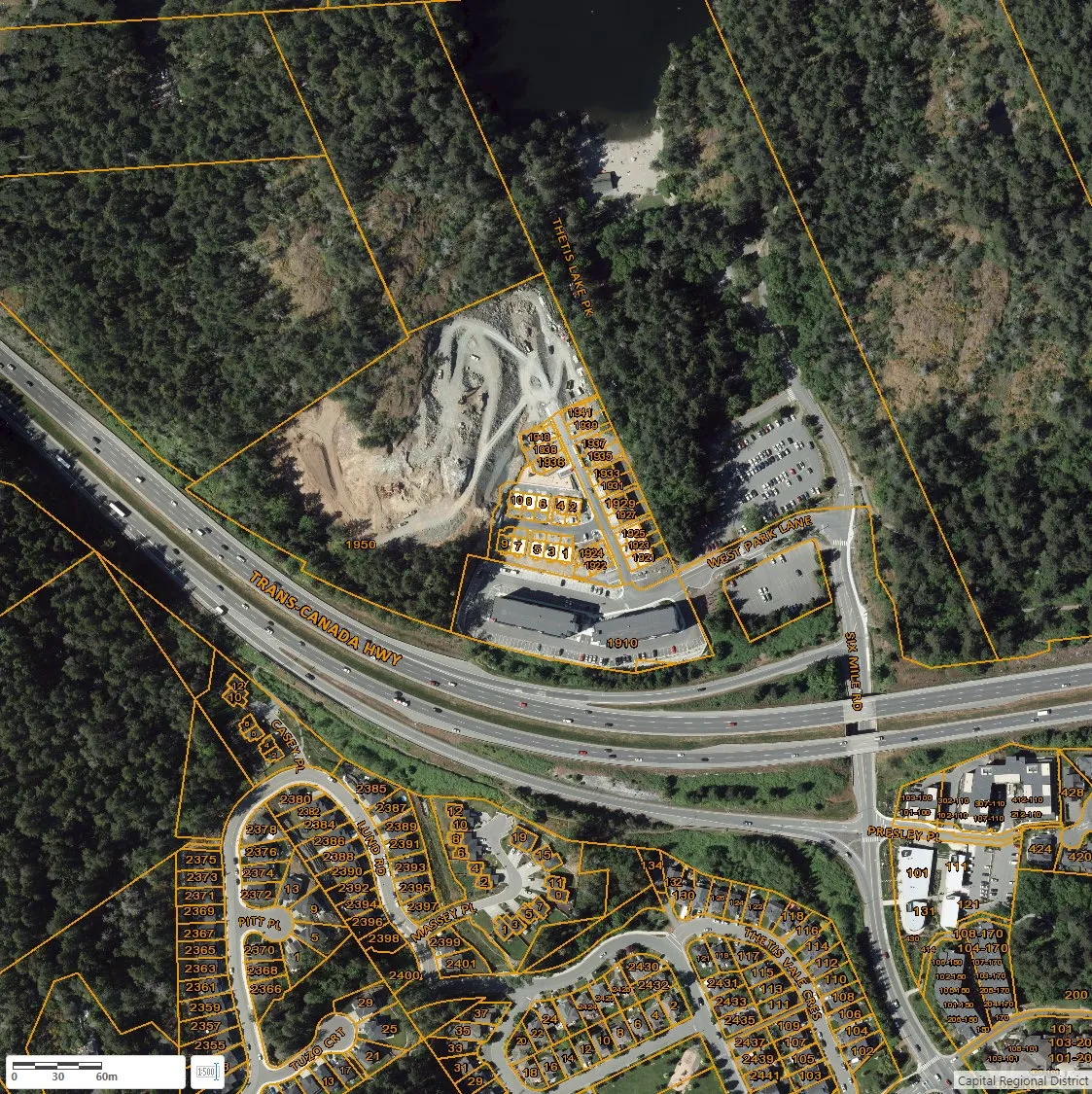
2000 West Park Lane
Council – July 19, 2022
PURPOSE OF REPORT
- To consider a development permit to construct a five-storey condominium apartment building with two levels of underbuilding parking comprising Phase 4 of the “West Park at Thetis” comprehensive development.
- To consider variances for retaining wall spacing and height and for setbacks in relation to a phased strata declaration.
Page 76–81
Document Images
(1)
Extracted from: 2022 07 19 Council agenda - Agenda - Pdf