Extreme Heat Risk Mapping, Assessment, and Planning 2022 Application Form
The completed application form for the Community Emergency Preparedness Fund grant to support extreme heat risk assessment.
Community Emergency Preparedness Fund
Extreme Heat Risk Mapping, Assessment, and Planning 2022 Application Form
Please complete and return the application form by June 24, 2022. All questions must be answered by typing directly in this form. If you have any questions, contact cepf@ubcm.ca or (250) 387-4470.
| SECTION 1: Applicant Information | AP (for administrative use only) |
|---|---|
| Name of Local Government or First Nation: Town of View Royal | Date of Application: 24 June, 2022 |
| Contact Person*: Troy Mollin | Position: Emergency Management Officer |
| Phone: 250-479-7322 | E-mail: tmollin@viewroyal.ca |
* Contact person must be an authorized representative of the applicant.
SECTION 2: For Regional Projects Only
Identification of Partnering Applicants. For all regional projects, please list all of the partnering eligible applicants included in this application. Refer to Section 2 in the Program & Application Guide for eligibility.
Rationale for Regional Projects. Please provide a rationale for submitting a regional application and describe how this approach will support cost-efficiencies in the total grant request and support a comprehensive, cooperative approach.
SECTION 3: Project Information
Name of the Project: a. Name of project: Extreme Heat: Understanding Risk b. Proposed start and end dates. Start: August 2022 End: August 2023
Project Cost & Grant Request: a. Total Project Cost: $30,000.00 b. Total Grant Request: $30,000.00
c. Have you applied for, or received, funding for this project from other sources? If yes, please indicate the source and the amount of funding received or applied for.
No
- Project Summary. Please provide a summary of your project in 150 words or less. The aim of this project is to understand the risks associated with extreme heat. Based on the United Nations Office of Disaster Risk Reduction's definition of "risk", this includes the hazard, as well as the associated vulnerabilities, exposures and capcities. The work will include investigating the present and projected future risks.
SECTION 4: Detailed Project Information
- Proposed Activities. a. What specific activities will be undertaken as part of the proposed project? Refer to Section 6 of the Program & Application Guide for eligibility. Mapping: Support the efforts of the Town of View Royal in developing and visualizing an Extreme Heat Index and informs/updates current Hazard, Risk, and Vulnerability Analysis. In addition, localized data acquisition, mapping and analysis will occur to contextualize information and to fill gaps that may still exist. Risk Assessment: A detailed extreme heat risk assessment, based on current academic research and tools, will be undertaken for the Town. The assessment will look at various components of risk, including the hazard itself, the local vulnerabilities, and capacities. Vulnerabilities will include social, enviornmental/natural and economic attributes. The capacities will identify both coping capacities, to live through extreme heat events; but also adaptive capacities, to avoid the effects of extreme heat. As part of the assessment, local knowledge will be gathered in the form of story harvesting. Within the Town this may include residents and staff with long historical knowledge of the area. Risk Reduction Strategies: Based on the outcomes of the mapping and risk assessment, a risk reduction report will be developed that includes recommendations on how the Town can reduce the impacts of a extreme heat emergency. The Town is currently developing an Extreme Heat Response Plan; the research and analysis may provide recommendations or modifications to improve this plan. b. How will the project address the risks posed to heat-sensitive populations (including special consideration or response actions to support heat-vulnerable populations)? This project intends on identifing and analyzing the contributing factors to extreme heat for the Town. With an understanding of the extreme heat risk profile, the Town will be in a position to take targeted action to reduce vulnerabilities, and increase capacities not only of the Town operations, but of its residents and businesses as well. It is anticiapted that with the information gained during the risk analysis, the Risk Reduction Report will identify areas of action for the Town including targeted programming and policies.
c. How will the proposed activities consider and adapt to the impacts of climate change in the project methodology and deliverables?
    The project will consider the impacts of a changing climate including changes in the hazard itself, and how that may impact the identified vulnerabiltiies and capacites. Furthermore, discussion will include what impact some of the Town own current and future actions and policies may have on the population's extreme heat risk.
- Proposed Outcomes & Deliverables. a. What are the specific proposed outcomes and/or deliverables for this project? The Town will secure a consultant to conduct and provide: 1. Project Management, including analysis of data availability and sources 2. Localized mapping of risk factors 3. Extreme Heat story harvesting 4. Extreme Heat Risk Assessment 5. Extreme Heat Risk Reduction Report b. How will the proposed activities increase understanding of the social, cultural, economic, and/or environmental impacts of extreme heat events to the community? This is the intent of the risk assessment component of the project. The assessment will gather and centralize available municipal, census, open-sourced data, and traditional knowledge so that a more fulsome analysis of the various types of impacts can be understood and anticipated, avoid creating new risk, reduce existing risk and manage residual risk. c. How will the proposed activities identify or achieve co-benefits (e.g. reducing greenhouse gas emissions, improving community health and wellbeing, enhancing biodiversity, etc.)? Climate Change, sustainable development, urban devleopment and disaster risk reduction are all intrinsiclly linked to extreme heat disasters. By identifying and analyzing the relative levels of vulnerability and capacity, approporate risk reduction strategies can be recommended. The project will draw upon the knowledge and tools of the United Nations' Paris Agreement, Sustainable Development Goals, New Urban Agenda, and Sendai Framework for Disaster Risk Reduction. View Royal has declared a climate emergency, and therefore has been working on an initiative to determine climate change adaptation and mitigation strategies. The Towns initiatives and this project will complement each other and strengthen outcomes. It can reasonably be expected that the recommendations will include measures to protect biodiversity and natural infrastructure, increase tools and resources available to maintain and improve health and wellbeing and reduce further climate changing behaviours and policies.
Transferability. Describe the extent to which the proposed project may be transferable to other local governments and/or First Nations. Work completed will be shared with neighbouring first nations and municipalities as they reside in the same geographic area and may benefit from understanding common themes around risk.
Partnerships. In addition to Question 1, if applicable, identify any partners (e.g., equity organizations, agricultural sector, critical infrastructure owners) you will collaborate with on the proposed project and specifically outline how you intend to work together. If outreach is required, it can be facilitated through a combination of online engagement tools and in person meetings.
Innovation. Describe how this project will be innovative. Traditionally many "hazard risk vulnerability assessments" in British Columbia have focused heavily on the hazard aspect of risk, with minimal work dedicated to vulnerabilities and capacities. Internationally there is a growing consensus that disasters are not natural, that it is "Our" decisions and actions that create the conditions (high vulnerability and low capacities) for a hazard to turn into a disaster. Furthermore, the tremendous role of local governments to impact change is being recognized. Using current international knowledge regarding risk, risk creation and risk reduction, this project will adapt and combine existing tools to reflect current best practices and the needs of the Town, and a changing risk profile.
Additional Information. Please share any other information you think may help support your submission. Our intended contractor has specific training in disaster risk reduction that is certified by the United Nations Office for Disaster Risk Reduction.
SECTION 5: Required Application Materials
Only complete applications will be considered for funding. The following separate attachments are required to be submitted as part of the application:
- Local government Council or Board resolution, Band Council resolution, or Treaty First Nation resolution, indicating support for the current proposed activities and willingness to provide overall grant management.
- Detailed budget for each component identified in the application. This must clearly identify the CEPF funding request, applicant contribution, and/or other grant funding.
- For regional projects only: Local government Council or Board resolution, Band Council resolution, or Treaty First Nation resolution from each partnering applicant that clearly states their approval for the primary applicant to apply for, receive, and manage the grant funding on their behalf.
Approved applicants are required to grant the Province of British Columbia free and clear access and distribution rights, specifically a perpetual, royalty-free, non-exclusive,
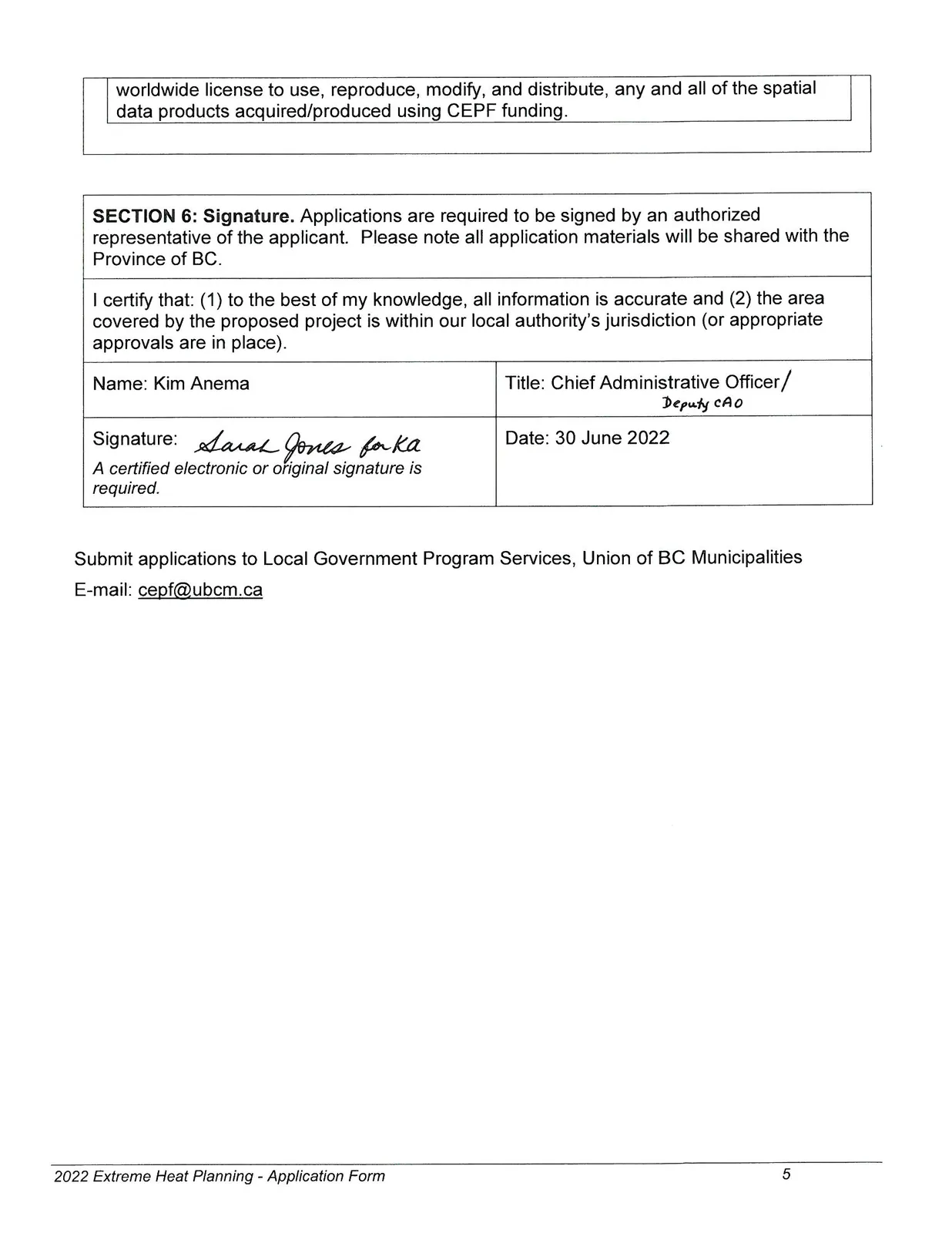
worldwide license to use, reproduce, modify, and distribute, any and all of the spatial data products acquired/produced using CEPF funding.
SECTION 6: Signature
Applications are required to be signed by an authorized representative of the applicant. Please note all application materials will be shared with the Province of BC.
I certify that: (1) to the best of my knowledge, all information is accurate and (2) the area covered by the proposed project is within our local authority's jurisdiction (or appropriate approvals are in place).
| Name: Kim Anema | Title: Chief Administrative Officer / Deputy CAO |
| Date: 30 June 2022 |
Submit applications to Local Government Program Services, Union of BC Municipalities E-mail: cepf@ubcm.ca