ATTACHMENT 8 - Construction Impact Assessment & Tree Management Plan
An arborist report evaluating the impact of the proposed construction on existing trees and detailing a management plan for retention and removal.
167, 169 & 171 Island Hwy, View Royal, BC
Construction Impact Assessment & Tree Management Plan
PREPARED FOR: GT Mann Contracting Ltd. 1551 Broadmead Ave Victoria, BC V8P 2V1
PREPARED BY: Talmack Urban Forestry Consultants Ltd. Graham Mackenzie – Consulting Arborist ISA Certified # PN-0428A Tree Risk Assessment Qualified
DATE OF ISSUANCE: June 18, 2021 Amended May 19, 2022
CONTENTS
- INTRODUCTION ............................................................................................................................ 1
- TREE INVENTORY METHODOLOGY ........................................................................................... 1
- EXECUTIVE SUMMARY ................................................................................................................ 1
- TREE INVENTORY DEFINITIONS ................................................................................................. 2
- SITE INFORMATION & PROJECT UNDERSTANDING ................................................................ 9
- FIELD OBSERVATIONS ................................................................................................................ 9
- TREE RISK ASSESSMENT ........................................................................................................... 9
- CONSTRUCTION IMPACT ASSESSMENT ................................................................................. 10 8.1. Retention and Removal of Municipal Trees .................................................................................. 10 8.2. retention and removal of private offsite trees ............................................................................... 10 8.3. retention and removal of onsite trees ........................................................................................... 11 8.4. tree replacement ........................................................................................................................... 11
- IMPACT MITIGATION .................................................................................................................. 11
- DISCLOSURE STATEMENT ........................................................................................................ 13
- IN CLOSING ................................................................................................................................. 14
- REFERENCES ............................................................................................................................. 15
TABLES Table 1. Tree Inventory ....................................................................................................................... 4
APPENDICES Appendix A Tree Management Plan (T1) Appendix B Site Photographs
1. INTRODUCTION
Talmack Urban Forestry Consultants was asked to complete a tree inventory, construction impact assessment and management plan for the trees at the following proposed project:
Site: 167, 169 & 171 Island Hwy, Municipality: View Royal, BC Client Name: GTMann Contracting Ltd. Dates of Site Visit: May 20, 2021 Site Conditions: 3 urban lots. No ongoing construction activity. Gradual increase in elevation from South to North. Weather During Site Visit: Clear and sunny
The purpose of this report is to address requirements of the Town of View Royal Tree Preservation Bylaw No. 695. The construction impact assessment section of this report (section 8), is based on plans reviewed to date, including the Architectural site, foundation, floor & Elevation plans (May 18, 2021) - Prepared by Urban West Architecture. At this time we have not reviewed a civil servicing plan (showing proposed underground utility connection locations), or a landscape plan.
2. TREE INVENTORY METHODOLOGY
Prior to our site visit, we were provided with surveyed tree locations from the project surveyor (Wey Mayenburg Land Surveying Inc.). For the purpose of this report, the size, health, and structural condition of trees was documented. For ease of identification in the field, numerated metal tags were attached to the lower trunks of onsite trees. Trees located on neighbouring properties, the municipal frontage or in areas where access was restricted, were not tagged (identified as NT 1 – NT 11). Each tree was visually examined on a limited visual assessment basis (level 1), in accordance with Tree Risk Assessment Qualification (TRAQ) methods (Dunster et al. 2017) and ISA Best Management Practices.
3. EXECUTIVE SUMMARY
Based on review of the architectural site, foundation, floor & Elevation plans provided, we anticipate that the majority of the onsite trees and some trees on neighbouring properties located close to the property line will require removal The tree management plan (T1) in appendix A) shows trees that we anticipate will require removal and those that we feel can be retained, providing their critical root zones can be adequately protected during construction. In order to complete the excavation for the underground portion of the building and retain trees on neighbouring properties it may require shoring techniques to minimise the requirements for any cut slopes. This will depend on the soil conditions, the depth of excavation and the requirements from the geotechnical engineer.
4. TREE INVENTORY DEFINITIONS
Tag: Tree identification number on a metal tag attached to tree with nail or wire, generally at eye level. Trees on municipal or neighboring properties are not tagged.
NT: No tag due to inaccessibility or ownership by municipality or neighbour.
DBH: Diameter at breast height – diameter of trunk, measured in centimetres at 1.4m above ground level. For trees on a slope, it is taken at the average point between the high and low side of the slope.
- Measured over ivy ~ Approximate due to inaccessibility or on neighbouring property
Dripline: Indicates the radius of the crown spread measured in metres to the dripline of the longest limbs.
Relative Tolerance Rating: Relative tolerance of the tree species to construction related impacts such as root pruning, crown pruning, soil compaction, hydrology changes, grade changes, and other soil disturbance. This rating does not take into account individual tree characteristics, such as health and vigour. Three ratings are assigned based on our knowledge and experience with the tree species: Poor (P), Moderate (M) or Good (G).
Critical Root Zone: A calculated radial measurement in metres from the trunk of the tree. It is the optimal size of tree protection zone and is calculated by multiplying the DBH of the tree by 10, 12 or 15 depending on the tree’s Relative Tolerance Rating. This methodology is based on the methodology used by Nelda Matheny and James R. Clark in their book “Trees and Development: A Technical Guide to Preservation of Trees During Land Development.”
- 15 x DBH = Poor Tolerance of Construction
- 12 x DBH = Moderate
- 10 x DBH = Good
To calculate the critical root zone, the DBH of multiple stems is considered the sum of 100% of the diameter of the largest stem and 60% of the diameter of the next two largest stems. It should be noted that these measures are solely mathematical calculations that do not consider factors such as restricted root growth, limited soil volumes, age, crown spread, health, or structure (such as a lean).
Health Condition:
- Poor - significant signs of visible stress and/or decline that threaten the long-term survival of the specimen
- Fair - signs of stress
- Good - no visible signs of significant stress and/or only minor aesthetic issues
Structural Condition:
- Poor - Structural defects that have been in place for a long period of time to the point that mitigation measures are limited
- Fair - Structural concerns that are possible to mitigate through pruning
- Good - No visible or only minor structural flaws that require no to very little pruning
Suitability ratings are described as follows:
Rating: Suitable.
- A tree with no visible or minor health or structural defects, is tolerant to changes to the growing environment and is a possible candidate for retention provided that the critical root zone can be adequately protected.
Rating: Conditional.
- A tree with good health but is a species with a poor tolerance to changes to its growing environment or has a structural defect(s) that would require that certain measures be implemented, in order to consider it suitable for retention (ie. retain with other codominant tree(s), structural pruning, mulching, supplementary watering, etc.)
Rating: Unsuitable.
- A tree with poor health, a major structural defect (that cannot be mitigated using ANSI A300 standards), or a species with a poor tolerance to construction impacts, and unlikely to survive long term (in the context of the proposed land use changes).
Retention Status:
- Remove - Not possible to retain given proposed construction plans
- Retain - It is possible to retain this tree in the long-term given the proposed plans and information available. This is assuming our recommended mitigation measures are followed
- **Retain *** - See report for more information regarding potential impacts
Table 1. Tree Inventory
| Prev Tag | Tag or ID # | Bylaw protected? | Common Name | Botanical Name | dbh (cm) | CRZ r (m) | Ht (m) | Dripline diameter (m) | Condition: Health | Condition: Structural | Relative tolerance | General field observations/remarks |
|---|---|---|---|---|---|---|---|---|---|---|---|---|
| 473 | yes | Grand fir | Abies grandis | 53 | 6.5 | 20 | 6 | Fair/good | Fair | Poor | Codomimant leaders form at 15 meters above grade, small deadwood in canopy. | |
| 869 | 474 | yes | Bigleaf maple | Acer macrophyllum | 51,18 | 7 | 20 | 9 | Fair/good | Fair/poor | Moderate | Secondary stem forms at .5m above grade - narrow angle of attachment, fruiting bodies between stem union. |
| 866 | yes | Western redcedar | Thuja plicata | 14 - 38 | 4 | 10 | 8 | Fair | Fair/good | Moderate | Hedge row consisting of 15 Western redcedar amd 24 Leyland Cypress. | |
| M1 | yes | Garry oak | Quercus garryanna | 6 | 1 | 5 | 1 | Good | Fair/good | Good | Juvenile tree, codomimant leaders form at 3m above grade. Hasn’t fully established - some root plate movement. | |
| M2 | yes | Garry oak | Quercus garryanna | 5 | 1 | 5 | 1 | Good | Good | Good | Juvenile tree, hasn’t fully established - some root plate movement. | |
| M3 | yes | Linden | Tilia cordata | 18 | 2 | 10 | 6 | Good | Fair | Moderate | Included bark at brands unions. | |
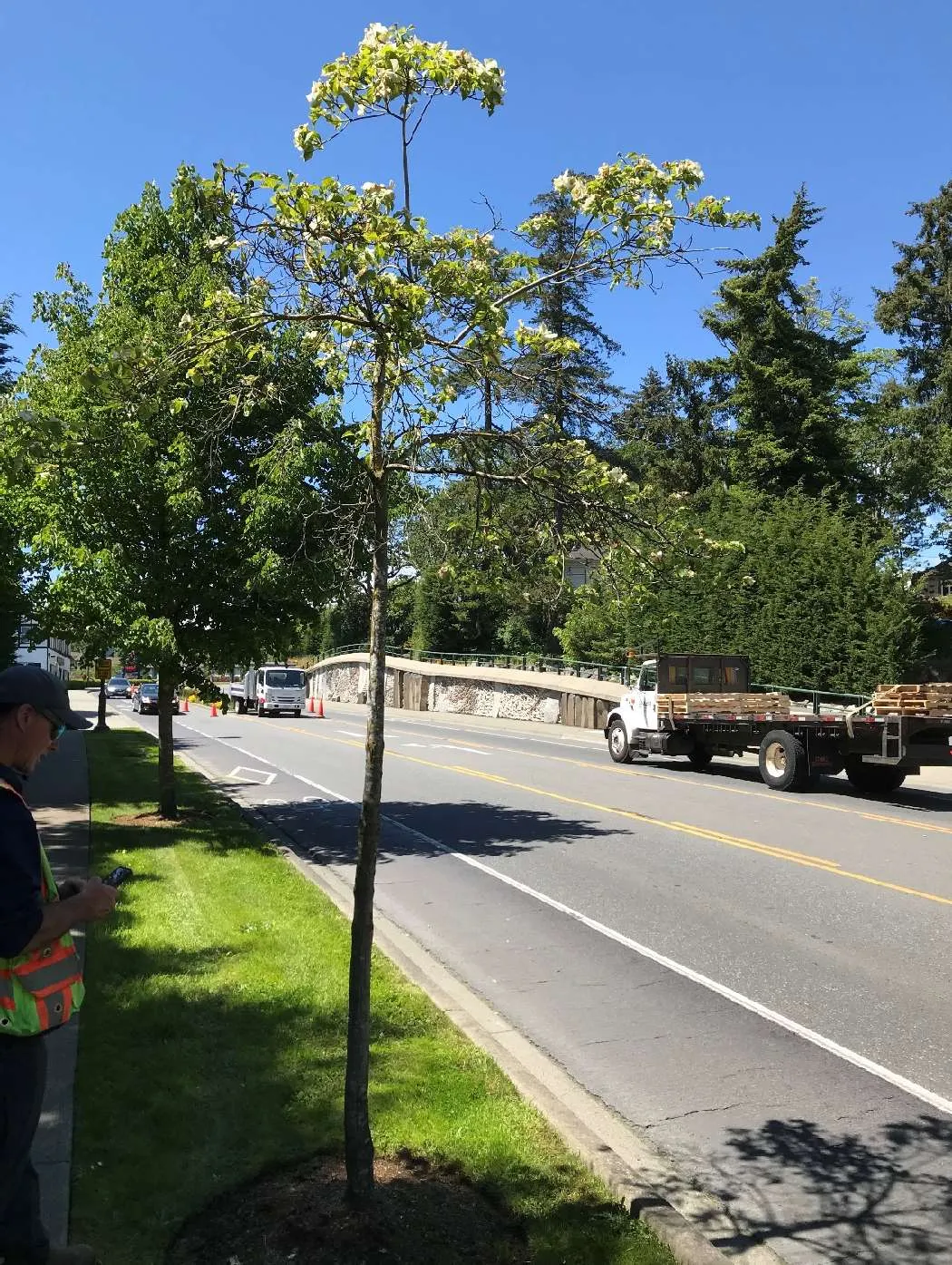
| M4 | yes | Eddies white wonder dogwood | Cornus nuttalli x florida | 7 | 1 | 4 | 3 | Fair/poor | Fair | Moderate | Health stress - sparse crown. | |
| M5 | yes | Linden | Tilia cordata | 18 | 2 | 10 | 6 | Good | Fair | Moderate | Included bark at brands unions. | |
| 873 | 475 | yes | Purple leaf plum | Prunus cerasifera | 26,14,9 | 3 | 8 | 8 | Good | Fair | Good | Growing within close proximity to existing retaining wall on North side, previous stem failures. |
| 876 | 476 | yes | Bigleaf maple | Acer macrophyllum | 52 | 6 | 15 | 12 | Good | Fair | Moderate | Codomimant leaders form at 8m above grade - included and active union, injured surface root. |
| 477 | yes | Garry oak | Quercus garryanna | 64 | 6 | 20 | 18 | Good | Fair/good | Good | Balanced crown, some endweighted limbs. | |
| 478 | yes | Douglas-fir | Pseudotsuga menziesii | 60 | 7 | 20 | 10 | Fair/poor | Fair | Poor | Health stress - twig amd branch dieback, surface rooted. | |
| 479 | yes | Arbutus | Arbutus menziesii | 24,14,13 | 4 | 10 | 8 | Fair/good | Fair | Poor | Multiple stems cluster, suppressed by 478 - asymmetric crown on West side due to shading. | |
| 480 | yes | Western red cedar | Thuja plicata | 50 | 5 | 20 | 8 | Poor | Fair/good | Moderate | Declining health - top dieback - 50%lcr. | |
| NT1 | yes | Spruce | Picea species | 25 | 3 | 15 | 5 | Fair | Fair/poor | Poor | Deflected top, secondary leader. | |
| 481 | yes | Golden Chain Tree | Laburnum | 16,16,15 | 3 | 10 | 7 | Fair | Fair/poor | Moderate | Deadwood, included bark in unions. | |
| 482 | yes | Plum | Prunus species | 28,25,20,18,16~15,~15,~12,~10 | 5 | 12 | 14 | Fair | Fair/poor | Good | Multiple stems, some leaning, deadwood, ivy on trunks, included bark. | |
| 483 | yes | Cherry | Prunus species | 44 | 4 | 20 | 12 | Fair/poor | Fair/poor | Moderate | Health stress, deadwood, tortrix infestation, leans east, supported by 484. | |
| 484 | yes | Grand fir | Abies grandis | 52 | 6 | 30 | 11 | Fair | Fair | Poor | Lower trunk wound. | |
| OS1 | yes | Grand fir | Abies grandis | 37 | 4 | 20 | 8 | Fair | Fair | Poor | Surface roots, sparse foliage lower crown. | |
| OS2 | yes | Douglas-fir | Pseudotsuga menziesii | 32 | 4 | 20 | 9 | Fair | Fair | Poor | Deadwood lower crown, branch failures (hangers). | |
| 485 | yes | Katsura | Cercidiphyllum japonica | 13,13,12,12,11 | 3 | 10 | 8 | Good | Fair/poor | Good | Multiple stems with narrow attachments arising in close proximity, included bark. | |
| NT2 | no | Red Alder | Unus rubra | 29 | 3.5 | 15 | 10 | Good | Fair | Poor | Large surface root. | |
| NT3 | no | Plum | Prunus species | 14,14,9 | 3 | 5 | 5 | Fair | Fair/poor | Moderate | Large surface root, topping/heading cuts historically. | |
| 486 | yes | Leyland Cypress | Cupressus × leylandii | 46,44,36 | 4 | 20 | 12 | Good | Fair/poor | Good | Tridominant, included bark. | |
| 487 | yes | Deodar Cedar | Cedrus deodara | 42 | 4 | 25 | 10 | Good | Fair | Moderate | Some yellowing/browning foliage, canopy competition with 488. | |
| 488 | yes | Leyland Cypress | Cupressus × leylandii | 50 | 5 | 20 | 10 | Good | Fair | Good | East end of hedge row, asymmetric crown due to competition. | |
| OS3 | yes | Bigleaf maple | Acer macrophyllum | 50,25 | 6 | 20 | 14 | Poor | Poor | Moderate | Extensive decay, undermined, large epicormic growth, supported by hedge row. Wildlife tree sign affixed. | |
| NT4 | no | Leyland Cypress | Cupressus × leylandii | 25 | 3 | 15 | 7 | Good | Fair | Good | Part of hedge row, asymmetric due to competition. | |
| 489 | yes | Leyland Cypress | Cupressus × leylandii | 38,24 | 4 | 20 | 9 | Good | Fair/poor | Good | Codominant, included bark primary union. | |
| OS4 | yes | European Hornbeam | Carpinus betulus | 57,33 at 0.75m | 6 | 15 | 12 | Good | Fair | Moderate | Multiple stems arising from close points of attachment characteristic of species. | |
| NT5 | no | Leyland Cypress | Cupressus × leylandii | 29 | 3 | 15 | 7 | Good | Fair | Good | Part of hedge row, asymmetric due to competition. | |
| 490 | yes | Leyland Cypress | Cupressus × leylandii | 36 | 3.5 | 15 | 8 | Good | Fair | Good | Part of hedge row, asymmetric due to competition. | |
| 491 | yes | Leyland Cypress | Cupressus × leylandii | 34 | 3.5 | 15 | 8 | Good | Fair | Good | Part of hedge row, asymmetric due to competition. | |
| 492 | yes | Leyland Cypress | Cupressus × leylandii | 37 | 3.5 | 15 | 8 | Good | Fair | Good | Part of hedge row, asymmetric due to competition. | |
| 493 | yes | Leyland Cypress | Cupressus × leylandii | 27,17 | 3.5 | 15 | 10 | Good | Fair/poor | Good | Part of hedge row, asymmetric due to competition. Codominant, included bark. | |
| 495 | yes | Leyland Cypress | Cupressus × leylandii | 39,22 | 4 | 15 | 12 | Good | Fair/poor | Good | Part of hedge row, asymmetric due to competition. Codominant, included bark. | |
| NT6 | no | Leyland Cypress | Cupressus × leylandii | 24 | 3 | 15 | 8 | Good | Fair | Good | Part of hedge row, asymmetric due to competition. | |
| 495 | yes | Leyland Cypress | Cupressus × leylandii | 29,25,22 | 4 | 15 | 9 | Good | Fair/poor | Good | Part of hedge row, asymmetric due to competition. Tridominant, included bark, roots heaving driveway? | |
| 496 | yes | Leyland Cypress | Cupressus × leylandii | 28,25 | 4 | 15 | 8 | Fair | Fair/poor | Good | Part of hedge row, asymmetric due to competition. Structure suggests previous topping. Codominant, included bark. | |
| NT7 | no | Leyland Cypress | Cupressus × leylandii | 26 | 3 | 10 | 7 | Fair/poor | Fair/poor | Good | Part of hedge row, asymmetric due to competition. Topped historically. | |
| 497 | yes | Leyland Cypress | Cupressus × leylandii | 38 | 3 | 15 | 7 | Good | Fair/poor | Good | Part of hedge row, asymmetric due to competition. Topped historically. | |
| 498 | yes | Leyland Cypress | Cupressus × leylandii | 32 | 3 | 15 | 7 | Good | Fair/poor | Good | Part of hedge row, asymmetric due to competition. Topped historically. | |
| 499 | yes | Leyland Cypress | Cupressus × leylandii | 25,16 | 3 | 15 | 7 | Good | Fair/poor | Good | Part of hedge row, asymmetric due to competition. Topped historically. | |
| 500 | yes | Leyland Cypress | Cupressus × leylandii | 32 | 3 | 15 | 8 | Good | Fair/poor | Good | Part of hedge row, asymmetric due to competition. Topped historically. | |
| NT8 | no | Leyland Cypress | Cupressus × leylandii | 27 | 3 | 15 | 7 | Good | Fair/poor | Good | Part of hedge row, asymmetric due to competition. Topped historically. | |
| NT9 | no | Leyland Cypress | Cupressus × leylandii | 28 | 3 | 15 | 7 | Good | Fair/poor | Good | Part of hedge row, asymmetric due to competition. Topped historically. | |
| 436 | yes | Leyland Cypress | Cupressus × leylandii | 30 | 3 | 15 | 8 | Good | Fair/poor | Good | Part of hedge row, asymmetric due to competition. Topped historically. | |
| NT10 | no | Leyland Cypress | Cupressus × leylandii | 29 | 3 | 15 | 8 | Good | Fair/poor | Good | Part of hedge row, asymmetric due to competition. Topped historically. | |
| 437 | yes | Leyland Cypress | Cupressus × leylandii | 38 | 4 | 15 | 8 | Good | Fair/poor | Good | Part of hedge row, asymmetric due to competition. Topped historically. | |
| 438 | yes | Leyland Cypress | Cupressus × leylandii | 40 | 4 | 15 | 8 | Good | Fair/poor | Good | North end of hedge row. Topped historically, long seam of included bark in attachment between codominant leaders. | |
| NT11 | yes | Leyland Cypress | Cupressus × leylandii | 22avg. | 3 | 15 | 7 | Fair | Fair/poor | Good | Seven stems in hedge row, asymmetric due to competition. Topped historically. |
*CRZ calculated above and drawn as follows on Tree Management Plan (T1): CRZ + 0.5 * d.b.h. (drawn from the center of the stem)
5. SITE INFORMATION & PROJECT UNDERSTANDING
The development site consists of three urban lots (167, 169 & 171 Island Hwy), in View Royal, B.C., which have existing residences situated on the lots. It is our understanding that the proposal is to remove the existing residences and create a multi-unit building with underground parking.
Below is a general observation of the tree resource, as it appeared at the time of our site visit:
6. FIELD OBSERVATIONS
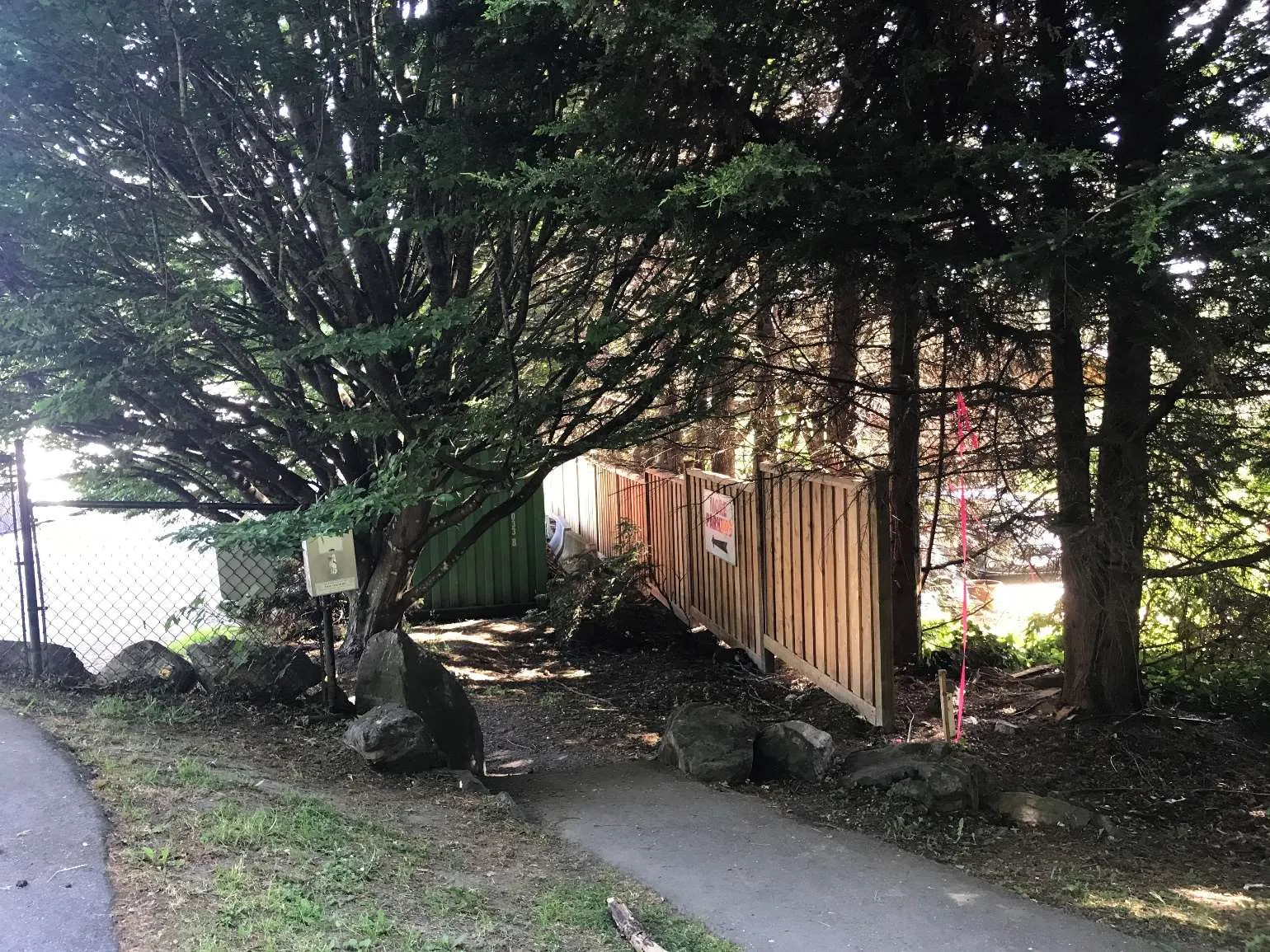
The onsite tree resource consists of a mixture of native and ornamental species. The site is bordered by municipal parkland to the South and East and a commercial property to the West.
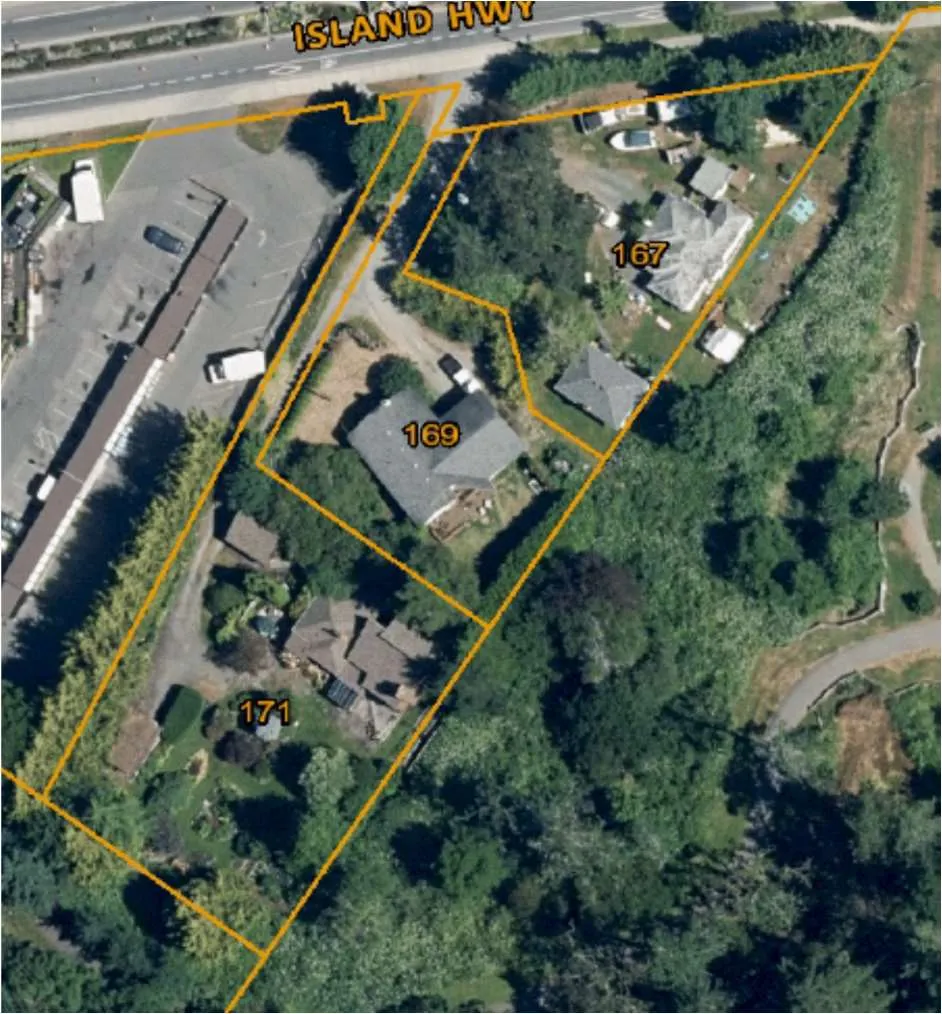
figure 1: Site context air photo: The boundaries of the subject site is outlined in Yellow.
7. TREE RISK ASSESSMENT
During our May 20, 2021 site visit and in conjunction with the tree inventory, onsite trees were assessed for risk, on a limited visual assessment basis (level 1), and in the context of the existing land uses. The time frame used for the purpose of our assessment is one year (from the date of the May 20, 2021 tree inventory). Unless otherwise noted herein, we did not conduct a detailed (level 2) or advanced (level 3) risk assessment, such as resistograph testing, increment core sampling, aerial examinations, or subsurface root/root collar examinations.
Existing Land Uses
We did not observe any trees that were deemed to be moderate, high or extreme risk (in the context of the existing land uses, that would require hazard abatement to eliminate present and/or future risks (within a 1-year timeframe). Targets considered during this TRAQ assessment include: occupants of the existing residence (constant use), occupants of vehicles travelling on Island Hwy (frequent use), pedestrians travelling along existing sidewalks (frequent use), hydro lines (constant use).
8. CONSTRUCTION IMPACT ASSESSMENT
8.1. RETENTION AND REMOVAL OF MUNICIPAL TREES
The following municipal trees (indicated by ID #) are located where it is possible for retention providing that its critical root zones are adequately protected during construction. The project arborist must be onsite to supervise and excavation or fill placement required within its critical root zone (shown on the tree management plan (T1) in appendix A):
Retain and protect 1 municipal trees
- M1 – M5
Note that the municipality will need to provide consent, prior the removal of any trees that are located on Municipal property.
8.2. RETENTION AND REMOVAL OF PRIVATE OFFSITE TREES
The following private offsite tree (indicated by ID #) are located where it will be heavily impacted by excavation and blasting required to construct the foundation of the proposed residence and is proposed for removal:
Remove 3 trees located on neighboring property.
- OS1 – OS3
Prior written consent from the neighbouring owner is required prior to the removal of any trees located on neignbouring properties. Unsurveyed trees may require surveying to verify ownership.
The following Private offsite tree (indicated by ID #) are located where it is possible for retention providing that its critical root zones are adequately protected during construction. The project arborist must be onsite to supervise and excavation or fill placement required within its critical root zone (shown on the tree management plan (T1) in appendix A):
Retain and protect 1 offsite tree
- OS4
8.3. RETENTION AND REMOVAL OF ONSITE TREES
The following bylaw protected size onsite trees (indicated by tag #) are located where they will be heavily impacted by excavation and blasting required to construct the foundation of the proposed residence and is proposed for removal:
Remove 32 bylaw protected trees
- 473 – 500, 436 – 438, Nt1
8.4. TREE REPLACEMENT
See landscape plan.
9. IMPACT MITIGATION
Tree Protection Barrier: The areas, surrounding the trees to be retained should be isolated from the construction activity by erecting protective barrier fencing (see Appendix A for municipal barrier specifications). Where possible, the fencing should be erected at the perimeter of the critical root zone. The barrier fencing to be erected must be a minimum of 4 feet in height, of solid frame construction that is attached to wooden or metal posts. A solid board or rail must run between the posts at the top and the bottom of the fencing. This solid frame can then be covered with flexible snow fencing. The fencing must be erected prior to the start of any construction activity on site (i.e. demolition, excavation, construction), and remain in place through completion of the project. Signs should be posted around the protection zone to declare it off limits to all construction related activity. The project arborist must be consulted before this fencing is removed or moved for any purpose.
Arborist Supervision: All excavation occurring within the critical root zones of protected trees should be completed under supervision by the project arborist. Any severed or severely damaged roots must be pruned back to sound tissue to reduce wound surface area and encourage rapid compartmentalization of the wound. In particular, the following activities should be completed under the direction of the project arborist:
- Excavation near the critical root zones of municipal trees M1 – M5.
- Excavation within the critical root zone of offsite tree OS4.
- Excavation within the critical root zone of hedge 866 if retained.
Shoring: In areas there trees are to be preserved near the excavation for the proposed underground parking, it will likely be necessary to use shoring techniques to minimize any cut slope into the critical root zones of trees to be retained.
Methods to Avoid Soil Compaction: In areas where construction traffic must encroach into the critical root zones of trees to be retained, efforts must be made to reduce soil compaction where possible by displacing the weight of machinery and foot traffic. This can be achieved by one of the following methods:
- Installing a layer of hog fuel or coarse wood chips at least 20 cm in depth and maintaining it in good condition until construction is complete.
- Placing medium weight geotextile cloth over the area to be used and installing a layer of crushed rock to a depth of 15 cm over top.
- Placing two layers of 19mm plywood.
- Placing steel plates.
Demolition of the Existing Buildings: The demolition of the existing houses, driveways, and any services that must be removed or abandoned, must take the critical root zone of the trees to be retained into account. If any excavation or machine access is required within the critical root zones of trees to be retained, it must be completed under the supervision and direction of the project arborist. If temporarily removed for demolition, barrier fencing must be erected immediately after the supervised demolition.
Paved Surfaces Above Tree Roots: If the new paved surfaces within the CRZ of tree to be retained require excavation down to bearing soil and roots are encountered in this area, this could impact their health and structural stability. If tree retention is desired, a raised and permeable paved surface should be constructed in the areas within the critical root zone of the trees. The “paved surfaces above root systems” diagram and specifications is attached.
The objective is to avoid root loss and to instead raise the paved surface and its base layer above the roots. This may result in the grade of the paved surface being raised above the existing grade (the amount depending on how close roots are to the surface and the depth of the paving material and base layers). Final grading plans should take this potential change into account. This may also result in soils which are high in organic content being left intact below the paved area.
To allow water to drain into the root systems below, we also recommend that the surface be made of a permeable material (instead of conventional asphalt or concrete) such as permeable asphalt, paving stones, or other porous paving materials and designs such as those utilized by Grasspave, Gravelpave, Grasscrete and open-grid systems.
Mulching: Mulching can be an important proactive step in maintaining the health of trees and mitigating construction related impacts and overall stress. Mulch should be made from a natural material such as wood chips or bark pieces and be 5-8cm deep. No mulch should be touching the trunk of the tree. See “methods to avoid soil compaction” if the area is to have heavy traffic.
Blasting: Care must be taken to ensure that the area of blasting does not extend beyond the necessary footprints and into the critical root zones of surrounding trees. The use of small low-concussion charges and multiple small charges designed to pre-shear the rock face will reduce fracturing, ground vibration, and overall impact on the surrounding environment. Only explosives of low phytotoxicity and techniques that minimize tree damage should be used. Provisions must be made to ensure that blasted rock and debris are stored away from the critical root zones of trees.
Scaffolding: This assessment has not included impacts from potential scaffolding including canopy clearance pruning requirements. If scaffolding is necessary and this will require clearance pruning of retained trees, the project arborist should be consulted. Depending on the extent of pruning required, the project arborist may recommend that alternatives to full scaffolding be considered such as hydraulic lifts, ladders or platforms. Methods to avoid soil compaction may also be recommended (see “Minimizing Soil Compaction” section).
Landscaping and Irrigation Systems: The planting of new trees and shrubs should not damage the roots of retained trees. The installation of any in-ground irrigation system must take into account the critical root zones of the trees to be retained. Prior to installation, we recommend the irrigation technician consult with the project arborist about the most suitable locations for the irrigation lines and how best to mitigate the impacts on the trees to be retained. This may require the project arborist supervise the excavations associated with installing the irrigation system. Excessive frequent irrigation and irrigation which wets the trunks of trees can have a detrimental impact on tree health and can lead to root and trunk decay.
Windthrow: Where forest edge trees are proposed to be removed, we recommend that trees that may experience an increase in wind exposure be re-examined, once tree clearing has taken place, to ensure that they are structurally stable, and suitable for retention as leading-edge trees.
Arborist Role: It is the responsibility of the client or his/her representative to contact the project arborist for the purpose of:
- Locating the barrier fencing
- Reviewing the report with the project foreman or site supervisor
- Locating work zones, where required
- Supervising any excavation within the critical root zones of trees to be retained
- Reviewing and advising of any pruning requirements for machine clearances
Review and site meeting: Once the project receives approval, it is important that the project arborist meet with the principals involved in the project to review the information contained herein. It is also important that the arborist meet with the site foreman or supervisor before any site clearing, tree removal, demolition, or other construction activity occurs and to confirm the locations of the tree protection barrier fencing.
10. DISCLOSURE STATEMENT
This arboricultural field review report was prepared by Talbot Mackenzie & Associates for the exclusive use of the Client and may not be reproduced, used or relied upon, in whole or in part, by a party other than the Client without the prior written consent of Talbot Mackenzie & Associates. Any unauthorized use of this report, or any part hereof, by a third party, or any reliance on or decisions to be made based on it, are at the sole risk of such third parties. Talbot Mackenzie & Associates accepts no responsibility for damages, if any, suffered by any third party as a result of decisions made or actions based on this report, in whole or in part.
Arborists are professionals who examine trees and use their training, knowledge, and experience to recommend techniques and procedures that will improve a tree’s health and structure or to mitigate associated risks. Trees are living organisms whose health and structure change and are influenced by age, continued growth, climate, weather conditions, and insect and disease pathogens. Indicators of structural weakness and disease are often hidden within the tree structure or beneath the ground. The arborist’s review is limited to a visual examination of tree health and structural condition, without excavation, probing, resistance drilling, increment coring, or aerial examination. There are inherent limitations to this type of investigation, including, without limitation, that some tree conditions will inadvertently go undetected. The arborist’s review followed the standard of care expected of arborists undertaking similar work in British Columbia under similar conditions. No warranties, either express or implied, are made as to the services provided and included in this report.
The findings and opinions expressed in this report are based on the conditions that were observed on the noted date of the field review only. The Client recognizes that passage of time, natural occurrences, and direct or indirect human intervention at or near the trees may substantially alter discovered conditions and that Talbot Mackenzie & Associates cannot report on, or accurately predict, events that may change the condition of trees after the described investigation was completed.
It is not possible for an Arborist to identify every flaw or condition that could result in failure nor can he/she guarantee that the tree will remain healthy and free of risk. The only way to eliminate tree risk entirely is to remove the entire tree. All trees retained should be monitored on a regular basis. Remedial care and mitigation measures recommended are based on the visible and detectable indicators present at the time of the examination and cannot be guaranteed to alleviate all symptoms or to mitigate all risk posed.
Immediately following land clearing, grade changes or severe weather events, all trees retained should be reviewed for any evidence of soil heaving, cracking, lifting or other indicators of root plate instability. If new information is discovered in the future during such events or other activities, Talbot Mackenzie & Associates should be requested to re-evaluate the conclusions of this report and to provide amendments as required prior to any reliance upon the information presented herein.
11. IN CLOSING
We trust that this report meets your needs. Should there be any questions regarding the information within this report, please do not hesitate to contact the undersigned.
Yours truly,
Talmack Urban Forestry Consultants Ltd. (Talbot Mackenzie & Associates)
Prepared by:
Graham Mackenzie ISA Certified Arborist PN – 0428A Tree Risk Assessment Qualification Email: tmtreehelp@gmail.com
12. REFERENCES
Dunster, J.A., E.T. Smiley, N. Matheny, and S. Lily. 2017. Tree Risk Assessment Manual, International Society of Arboriculture (ISA).
The Town of View Royal tree preservation bylaw 695.
APPENDIX A - TREE MANAGEMENT PLAN (T1)
Project arborist to supervise all excavation required within the CRZ of M5 for the installation of the proposed entrance roadway and new water service.
Project arborist to supervise all excavation required within the CRZ of OS4 for the proposed underground parkade.
Line of underground parkade below.
LEGEND
- Existing tree with ID #
- Tree protection fencing
- Critical root zone radius (m)
- Tree proposed for removal
- Non-bylaw undersize tree
- Unsurveyed tree
- Site boundary
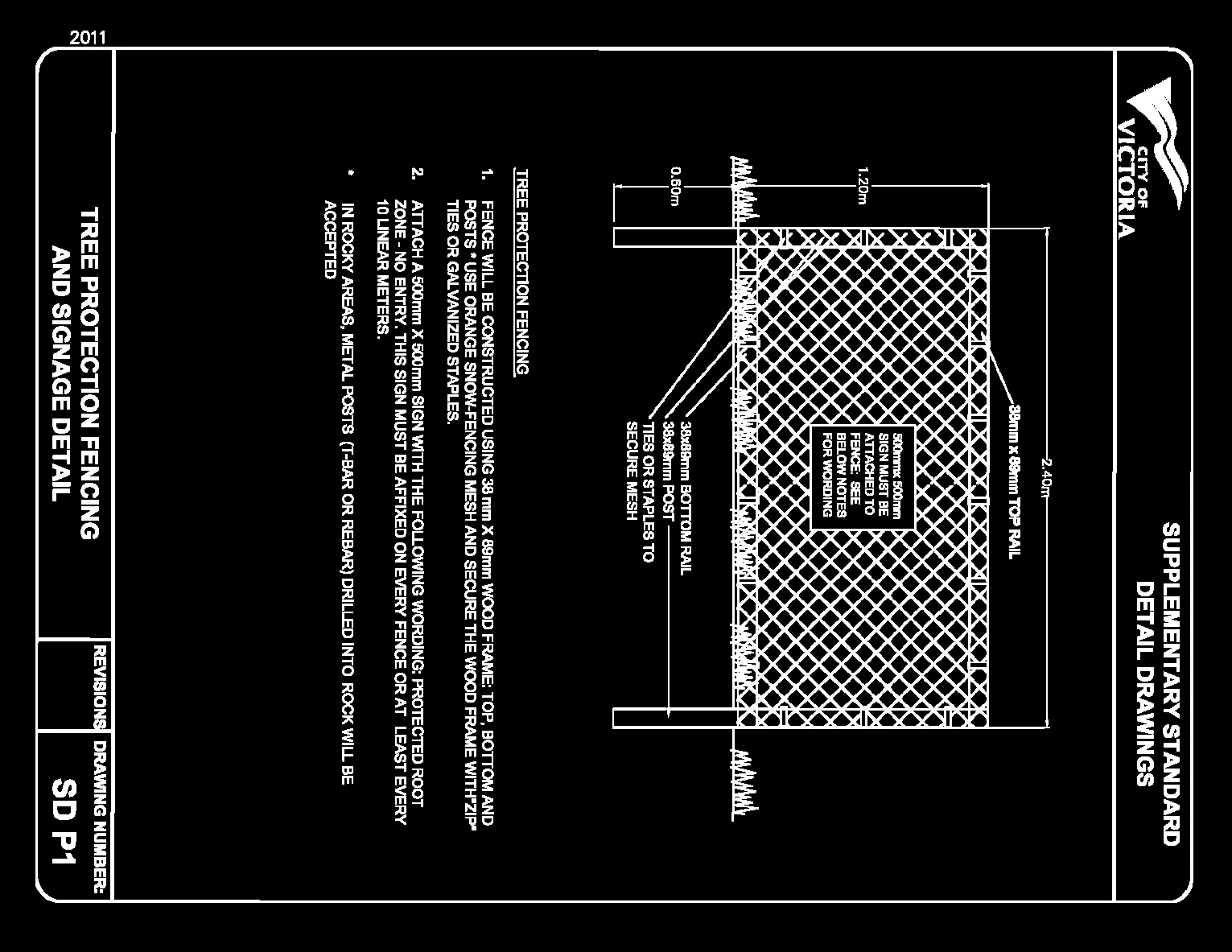
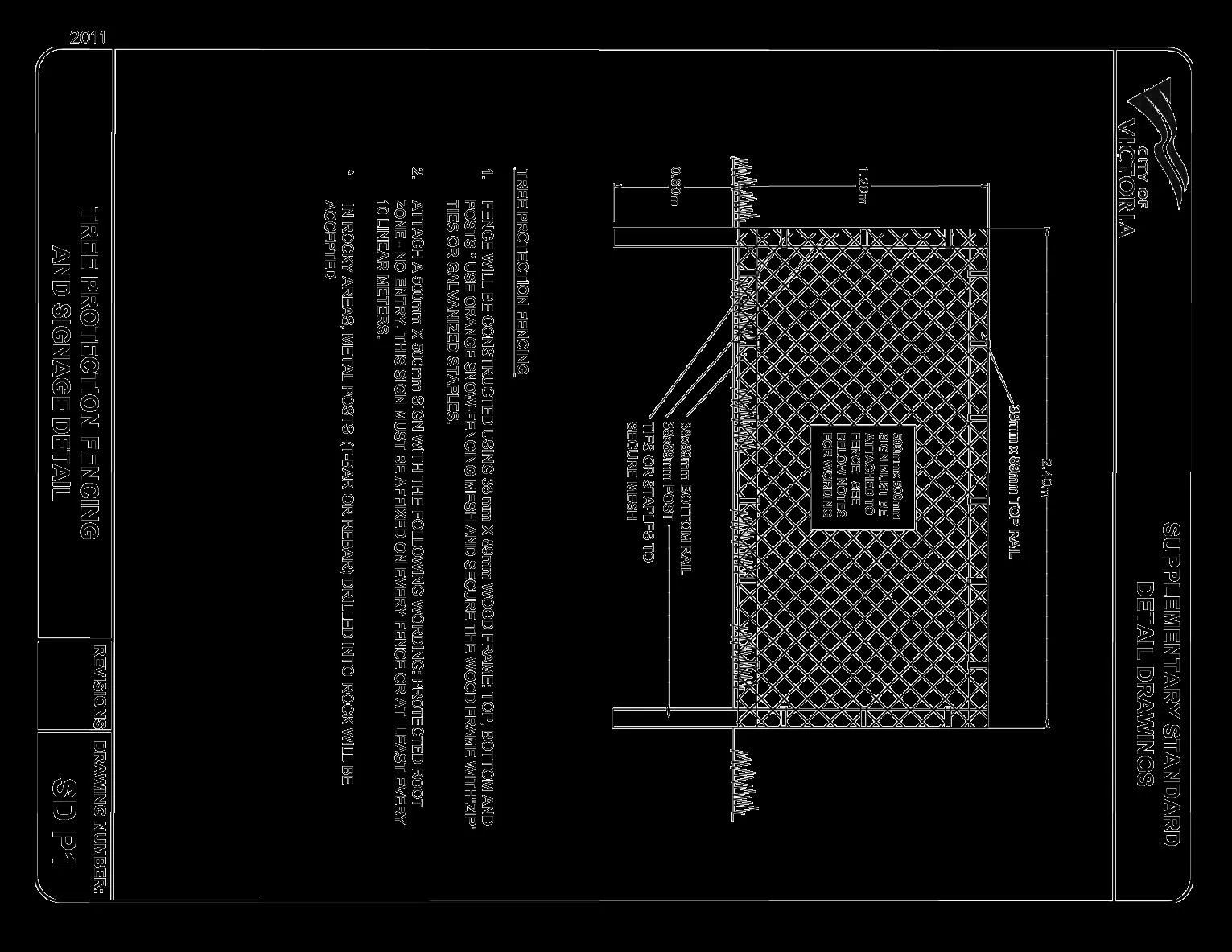
TREE PROTECTION FENCING
TREE PROTECTION FENCING NOTES:
- FENCE WILL BE CONSTRUCTED USING 38 mm X 89mm WOOD FRAME: TOP, BOTTOM AND POSTS * USE ORANGE SNOW-FENCING MESH AND SECURE THE WOOD FRAME WITH "ZIP" TIES OR GALVANIZED STAPLES.
- ATTACH A 500mm X 500mm SIGN WITH THE FOLLOWING WORDING: PROTECTED ROOT ZONE - NO ENTRY. THIS SIGN MUST BE AFFIXED ON EVERY FENCE OR AT LEAST EVERY 10 LINEAR METERS.
- IN ROCKY AREAS, METAL POSTS (T-BAR OR REBAR) DRILLED INTO ROCK WILL BE ACCEPTED.
TREE PROTECTION NOTES
Tree protection barrier: The areas, surrounding the trees to be retained, should be isolated from the construction activity by erecting protective barrier fencing. Where possible, the fencing should be erected at the perimeter of the critical root zone. The barrier fencing to be erected must be a minimum of 1200mm in height, of solid frame construction that is attached to wooden or metal posts. A solid board or rail must run between the posts at the top and the bottom of the fencing. This solid frame can then be covered with flexible snow fencing. The fencing must be erected prior to the start of any construction activity on site (i.e. demolition, excavation, construction), and remain in place through completion of the project. Signs should be posted around the protection zone to declare it off limits to all construction related activity. The project arborist must be consulted before this fencing is removed or moved for any purpose.
Arborist supervision: All excavation occurring within the critical root zones of protected trees must be completed under the supervision of the project arborist. Any severed or severely damaged roots must be pruned back to sound tissue to reduce wound surface area and encourage rapid compartmentalization of the wound.
Demolition: The demolition of the existing houses, driveways, and any services that must be removed or abandoned must take the critical root zone of the trees to be retained into account. If any excavation or machine access is required within the critical root zones of trees to be retained, it must be completed under the supervision of the project arborist. If temporarily removed for demolition, barrier fencing must be erected immediately after the supervised demolition.
Methods to avoid soil compation: In areas where construction traffic must encroach into the critical root zones of trees to be retained, efforts must be made to reduce soil compaction where possible by displacing the weight of machinery and foot traffic. This can be achieved by one of the following methods:
- Installing a layer of hog fuel or coarse wood chips at least 20cm in depth and maintaining it in good condition until construction is complete.
- Placing medium weight geotextile cloth over the area to be used and installing a layer of crushed rock to a depth of 15cm over top.
- Placing two layers of 19mm plywood.
- Placing steel plates.
Mulching: Mulching can be an important proactive step in maintaining the health or trees and mitigating construction related impacts and overall stress. Mulch should be made from a natural material such as wood chips or bark pieces and be 5-8cm deep. No mulch should be touching the trunk of the tree. See "methods to avoid soil compaction" if the area is to have heavy traffic.
Pruning: We recommend that any pruning of bylaw-protected trees be performed to ANSI A300 standards and Best Management Practices.
Paved surfaces above tree roots: Where paved areas cannot avoid encroachment within critical root zones of trees to be retained, construction techniques, such as floating permeable paving, may be required. The "paved surfaces above tree roots'' detail above offers a compromise to full depth excavation (which could impact the health or structural stability of the tree). The objective is to avoid root loss and to instead raise the paved surface above the existing grade (the amount depending on how close roots are to the surface and the depth of the paving material and base layers). Final grading plans should take this potential change into account. This may also result in soils which are high in organic content being left intact below the paved area. To allow water to drain into the root systems below, we also recommend that the surface be made of a permeable material (instead of conventional asphalt or concrete) such as permeable asphalt, paving stones, or other porous paving materials and designs such as those utilitzed by Grasspave, Gravelpave, Grasscrete and open-grid systems.
Blasting and rock removal: Care must be taken to ensure that the area of blasting does not extend beyond the necessary footprints and into the critical root zones of surrounding trees. The use of small low-concussion charges and multiple small charges designed to pre-shear the rock face will reduce fracturing, ground vibrations and overall impact to the surrounding environment. Only explosives of low phytotoxicity and techniques that minimize tree damage should be used. Provisions must be made to ensure that blasted rock and debris are stored away from the critical root zones of trees.
Scaffolding: This assessment has not included impacts from potential scaffolding including canopy clearance pruning requirements. If scaffolding is necessary and this will require clearance pruning of retained trees, the project arborist should be consulted. Depending on the extent of pruning required, the project arborist may recommend that alternatives to full scaffolding be considered such as hydraulic lifts, ladders or platforms. Methods to avoid soil compaction may also be recommended (see "Minimizing Soil Compaction" section).
Landscaping and irrigation systems: The planting of new trees and shrubs should not damage the roots of retained trees. The installation of any in-ground irrigation system must take into account the critical root zones of the trees to be retained. Prior to installation, we recommend the irrigation technical consult with the project arborist about the most suitable locations for the irrigation lines and how best to mitigate the impacts on the trees to be retained. This may require the project arborist supervise the excavations associated with installing the irrigation system. Excessive frequent irrigation and irrigation which wets the trunks of trees can have a detrimental impact on the tree health and can lead to root and trunk decay.
Arborists role: It is the responsibility of the client or his/her representative to contact the project arborist for the purpose of:
- Locating the barrier fencing.
- Reviewing the report with the project foreman or site supervisor.
- Locating work zones and machine access corridors where required.
- Supervising excavation for any areas within the critical root zones of trees to be retained including any proposed retaining wall footings and review any proposed fill areas near trees to be retained.
Tree Management Plan - T1 167 Island Highway View Royal, BC
DATE: May 19, 2022 PREPARED FOR: GT MANN SCALE: 1 : 500 @ 11" X 17" DRAWN BY: NT REVISION: 1 REFERENCE DWG's: 1Site plan by UWA, Topo survey by Wey
APPENDIX B - PHOTOGRAPHS
Document Images
(3)