OFFICIAL COMMUNITY PLAN UPDATE – LAND ECONOMICS STUDY UPDATE AND HOUSING CAPACITY ANALYSIS AND LAND USE SCENARIOS MEMO
Staff report presenting key highlights from the consultant studies regarding future commercial space demand and housing capacity up to 2050.
TOWN OF VIEW ROYAL COUNCIL REPORT
TO: Council DATE: May 2, 2025 FROM: Leanne Taylor, Director of Development Services MEETING DATE: May 13, 2025
OFFICIAL COMMUNITY PLAN UPDATE – LAND ECONOMICS STUDY UPDATE AND HOUSING CAPACITY ANALYSIS AND LAND USE SCENARIOS MEMO
RECOMMENDATION:
THAT the report dated May 2, 2025 from the Director of Development Services titled “Official Community Plan Update – Land Economics Study Update and Housing Capacity Analysis and Land Use Scenarios Memo” be received for information.
PURPOSE:
The purpose of this report is to present key highlights of the Land Economics Study Update and Housing Capacity Analysis and Land Use Scenarios Memo for Council’s information.
BACKGROUND:
In January 2025, the Town launched Phase 1 of the review and update of the Official Community Plan (OCP). Phase 1 focuses on visioning and guiding principles, land use, housing and special planning areas. From February to April, the Town led an inclusive and extensive engagement process to seek feedback from the public on a draft vision statement and goals, and community growth and development.
The Town’s consultant, Urban Systems, completed a Land Economics Update Study (Attachment 1), which updates data and projections in Land Economics Study: Evaluation of the New Prospects for New Urban Development prepared by Coriolis Consulting in 2021. Urban Systems also completed a Housing Capacity Analysis and Land Use Scenarios (Attachment 2) to provide an assessment of the community’s ability to meet its estimated housing need for 2050 based on current and projected development trends, market conditions, and small-scale, multi-unit (SSMUH) provisions. The analysis also includes two land use scenarios for consideration that aim to implement the vision and aspirations for growth and development in View Royal, expressed by the community.
The Land Economics Update Study and Housing Capacity Analysis were shared at the OCP Advisory Committee on May 5, 2025.
ANALYSIS:
Land Economics Update Study
The purpose of the Land Economics Update Study was to undertake the following, in accordance with the OCP project scope:
- updates to the commercial space demand projections for View Royal for 2025 to 2050 based on most recent population projections of municipalities and relevant trade area geographic extent;
- updates to the office space demand projections for View Royal for 2025 to 2050 based on recent office development trends;
- update the hotel demand projections based on recent hotel development trends for 2025 to 2050; and
- assess the development viability of different mixed-use scenarios (retail, office and light industrial) across case study sites in View Royal.
The Memo is attached to this report as Attachment 1. Some key findings are summarized as follows:
- The supportable total retail and service floor space in View Royal could increase between approximately 125,700 ft² and 211,150 ft² between 2025 and 2050, or an average annual retail and service growth of about 5,030 ft² to 8,450 ft² per year. This is a lower projection than stipulated in the Coriolis study as a result of updated population projections from BC Stats, which show a faster population growth to 2035 then slowing due to adjusted immigration projections.
- The anticipated office floor space growth in View Royal is projected to be between 85,000 ft² to 127,000 ft² between 2025 to 2050, or an average annual retail and service growth of about 3,400 ft² to 5,080 ft² per year. This updated projection is substantially lower than the Coriolis report due to the COVID-19 pandemic impacts and office market trends. There will likely be a demand for medical related office space (i.e., professional and personal services).
- Light industrial developments are challenging to build in this current market because of high inventory. Stacked light industrial-office buildings perform better than standalone light industrial developments, but they may have longer absorption periods and less premium lease rates for second floor office space.
- The projected demand for hotel rooms in View Royal is approximately 63 rooms between 2025 to 2050. The projected demand is lower than the Coriolis report due to a decrease in the annual growth projection for hotel rooms from 2% to 1.3%, based on current data. If growth continues on a similar pace as previously projected then View Royal could capture up to 101 rooms.
- To make smaller sites financially viable for wood-frame mixed-use development (office, retail and light industrial), increasing building heights up to six-storeys and the density (floor space ratio (FSR) - total floor area a building can occupy on a lot) are recommended.
- Out of the three mixed-use redevelopment options (office, retail and light industrial), ground floor office has the least viable results. However, if the office space is mixed with retail space, then it could improve the project performance.
- Having lower parking requirements along with transportation demand management practices (i.e., bus passes, car share, end-of-trip bicycle facilities, etc.) can alleviate the cost burden of providing additional parking stalls than the market requires on development projects.
Furthermore, the Memo mentions that the Town should focus on ensuring that new retail space emerges in quantities and locations where it is most supportable, instead of a blanket retail floor area requirement for mixed-use development. The implication of a blanket approach is the risk of oversaturating the market with unleasable ground floor space, and limiting opportunities to create cohesive, vibrant and well-anchored retail nodes and corridors. In addition, an over-delivery of ground-floor retail in sub-optimal locations will create projects that are economically unfeasible and could slow the pace of project delivery, according to the consultants.
Housing Capacity Analysis and Land Use Scenarios
Housing Capacity Analysis
A Housing Capacity Analysis considers a community's ability to accommodate current and future housing needs by assessing projected demand with the available land and existing zoning regulations. Urban Systems completed a Housing Capacity Analysis (Attachment 2) in accordance with the OCP project scope, to determine the projected housing need and capacity for the year 2050.
The 5- and 20-year housing needs calculated in the Town’s 2024 Interim Housing Needs Assessment is 842 units (forecasted 5-year need from 2021 – 2026) and 2889 units (forecasted 20-year need from 2021 – 2041), respectively. The intent of the Housing Needs Assessment is to meet housing needs related to extreme core housing, persons experiencing homelessness, suppressed household formation, anticipated growth, rental vacancy rate adjustment, and local demand in View Royal. Given the OCP time horizon is to 2050, the analysis calculated the projected housing need to 2050. The additional housing need from 2041 to 2050 (10 years) was calculated to be 1444.5 units. This number was derived from reducing the 20-year total of 2889 units to an average annual unit demand that was then multiplied out by either 10 or 29 year, as appropriate.
The projected housing need in the year 2050 is approximately 4,189 dwelling units. To meet this projected housing need, the Housing Capacity Analysis considered the following factors:
- compared the maximum potential uptake of small-scale multi-unit housing with the projected update based on current zoning permissions and market conditions;
- evaluated anticipated residential development from current in stream development applications for residential units; and
- studied additional potential development from identified test sites in the Land Economics Update Study with higher densities than what is currently permitted, including a large vacant lot on Hospital Way and within the prescribed Transit-Oriented Area.
The Analysis anticipates that the projected uptake of SSMUH is approximately 2,580 – 2,703 dwelling units, which will not meet the projected housing need of 4,189 dwelling units by 2050. Therefore, the study reviewed in stream residential building applications and viable test scenarios in the 2025 Land Economic Update Study and the 2021 Land Economics Study: Evaluation of the Prospects for new Urban Development. Based on the review, it is estimated that approximately 5,366 new dwelling units will be constructed in View Royal over the next 25 years. Further details on how this number was calculated can be found in Attachment 2.
The table below, which is provided in section 2.2 of the Housing Capacity Analysis, is a comparison between housing needs and anticipated housing development. The Town has enough land to meet and exceed its projected housing needs.
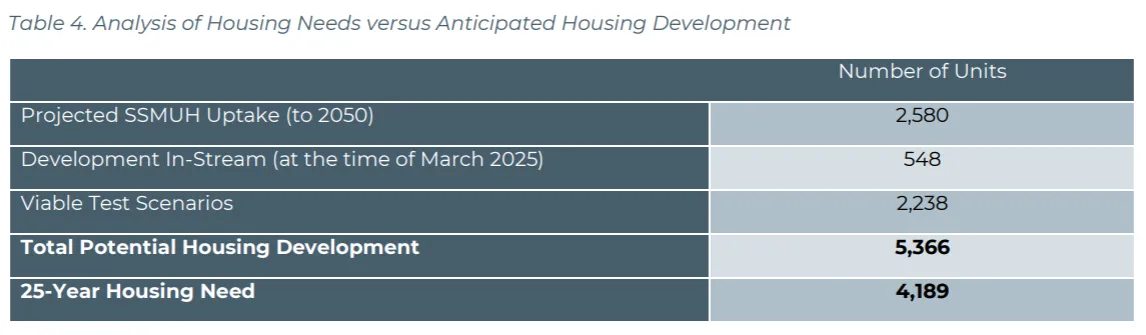
| Number of Units | |
|---|---|
| Projected SSMUH Uptake (to 2050) | 2,580 |
| Development In-Stream (at the time of March 2025) | 548 |
| Viable Test Scenarios | 2,238 |
| Total Potential Housing Development | 5,366 |
| 25-Year Housing Need | 4,189 |
The Analysis acknowledges that these numbers are subject to fluctuations based on evolving market conditions, policy decisions, global economic changes, and unforeseen circumstances that could impact housing needs and development trends.
Proposed Land Use Scenarios
Following the Housing Capacity Analysis, Urban Systems prepared two land use scenarios for the Town’s consideration as part of the OCP update. Following community and Council input, one scenario would be crafted to guide land use and development in View Royal to the year 2050.
Section 4.1 of the Housing Capacity Analysis and Land Use Scenarios in Attachment 2, includes proposed land use designations and scenarios. The two land use scenarios and designations reflect initial feedback received from residents through surveys and open houses, past direction from Council, Town staff, legislative requirements, existing market conditions and development activity, existing land use patterns and infrastructure servicing capacity. The following key themes that emerged from the visioning survey were also considered when drafting the land use scenarios:
- Parks, Trails and Greenspace: Preserving and expanding parks, trails and greenspaces was deemed essential for maintaining the quality of life and natural beauty of View Royal.
- Commercial Services and Mixed-Use Development: There is a strong desire for more mixed-use developments that integrate commercial and residential spaces and provide more commercial services and amenities.
- Improved Transportation Connections: Enhancing transportation links throughout View Royal, including better connectivity and public transit options, was a top priority for many people.
- Community Spaces: The community expressed a need for more public spaces where events and gatherings can be held, strengthening the sense of community.
- Walkable Neighbourhoods: Creating walkable neighbourhoods with essential services and amenities was an important consideration for residents.
In the Community Growth Survey, respondents demonstrated support for diversifying land use within existing neighbourhood villages and along corridors to provide more community amenities and housing options, which was also taken into consideration when drafting the scenarios.
Council may wish to provide some initial feedback on the proposed land use designations and scenarios; however, it is recommended that further revisions occur after the engagement process and the Town has heard from the community in a transparent process. Staff will prepare a “What We Heard Report” with the results and feedback from Council and the public, which will inform the 50% draft of the OCP.
Impacts and implications
Community Impact: Seeking community input on the proposed land use scenarios for future growth and development in the Town is a crucial phase of the OCP update.
Financial Implication: This work falls within the project scope and OCP budget.
Inter-governmental Relations Impact: Consultation will occur with neighbouring municipalities, Songhees and Esquimalt Nations, Capital Regional District, BC Transit, and School District #61.
PUBLIC PARTICIPATION GOAL:
The desired level of public participation for the recommended option is:
[x] Inform [x] Consult [ ] Involve [ ] Collaborate [ ] Empower [ ] N/A
TIME CRITICAL:
This report is time critical as the second round of engagement on the two land use scenarios will be launched in latter half of May.
| CONCURRENCE: | Initials | Comments |
|---|---|---|
| Chief Administrative Officer | SS | I concur with the recommendation. |
| REVIEWED BY: | Initials |
|---|---|
| Director of Corporate Administration/Deputy CAO | n/a |
| Director of Finance & Technology | n/a |
| Director of Development Services | LT |
| Director of Engineering | n/a |
| Director of Protective Services | n/a |
ATTACHMENTS:
- Land Economics Update Study
- Housing Capacity Analysis and Land Use Scenarios
Document Images
(1)