ATTACHMENT 4: COMMERCIAL DEVELOPMENT PERMIT AREA GUIDELINES
Excerpt from the View Royal Official Community Plan detailing the form and character guidelines for the Commercial Development Permit Area.
PART 4 – DEVELOPMENT PERMIT AREAS
Introduction
The Local Government Act provides municipalities with the authority to establish a development permitting system. Unless exempted by this Plan or a zoning bylaw, any proposed building and subdivision within a Development Permit Area (DPA), shown on Schedule P, requires a development permit issued by the Town of View Royal. In accordance with the Local Government Act, this Plan sets out the special conditions that justify each DPA.
Development permits are one of the most effective legal tools for the protection of environmentally sensitive areas, avoiding development in hazardous conditions, and setting out expectations regarding “form and character” of development. Local governments may designate Development Permit Areas (DPAs) in an OCP. When an area is designated, the local government must describe the special site conditions or objectives that justify the designation, and specify guidelines to achieve those objectives.
This section sets out a number of Development Permit Areas for View Royal, and provides the justification for their designation.
The Town may designate Development Permit Areas under Section 919.1(1) of the Local Government Act for the following purposes:
a. Protection of the natural environment, its ecosystems and biological diversity; b. Protection of development from hazardous conditions; c. Protection of farming; d. Revitalization of an area in which a commercial use is permitted; e. Establishment of objectives for the form and character of intensive residential development; f. Establishment of objectives for the form and character of commercial, industrial or multi-family residential development; g. Establishment of objectives to promote energy conservation; h. Establishment of objectives to promote water conservation; and i. Establishment of objectives to promote the reduction of greenhouse gas emissions.
In order to ensure that the goals and objectives of View Royal regarding new development and natural areas are met, the OCP designates certain areas of the Town as Development Permit Areas as shown on Schedule P.
With respect to guiding form and character of development and promotion of energy conservation, four areas are designated as Development Permit Areas, consistent with the Land Use Designations shown on Schedule L:
- Mixed Residential.
- Neighbourhood Mixed Use.
- Intensive Mixed Use.
- Commercial.
Two Development Permit Areas, as shown on Schedule Q, have also been established for the protection of the natural environment and the protection of development from hazardous conditions:
- Natural Watercourse and Shoreline Areas.
- Sensitive Terrestrial Ecosystem Areas.
Form and Character of Development
DEVELOPMENT PERMIT AREA: COMMERCIAL
Areas shown as Commercial on Schedule P of the OCP are designated Development Permit Areas as per the Local Government Act Section 919.1(1) (d) and (f) for the establishment of objectives and the provision of guidelines for the form and character of commercial development including: retail; office; technology; and service commercial in the Town of View Royal.
Justification
Commercial development includes retail, office, technology and service commercial. These uses provide services and employment opportunities for View Royal residents and contribute to a sustainable local economy. Much of View Royal’s commercial development is located in key gateway locations and should have a distinct and consistent character.
Objectives
The objectives of requiring a Development Permit in the areas identified as Commercial are to:
- Facilitate the orderly development of commercial areas and encourage consistency in the scale and design character.
- Ensure development is pedestrian-oriented.
- Promote the revitalization of key commercial gateways in View Royal.
- Achieve a high standard of design.
Exemptions
In all areas designated Commercial the following development is exempt from obtaining a Development Permit:
- A proposed development is limited to subdivision.
- Internal alterations to a building.
- Building additions, external building or site alterations, not exceeding an estimated construction value of $30,000, which are so similar in their effect on the form and character of development as to not warrant an application in the opinion of the Director of Development Services.
GUIDELINES – DESIGN CHARACTER
i. Buildings should address the public realm and contribute to a safe and comfortable pedestrian friendly streetscape. ii. Materials should be durable, high quality and should reflect the natural surroundings of View Royal and a “West Coast” design character; bringing in elements of wood, stone and a natural colour palette. Natural materials are preferred.
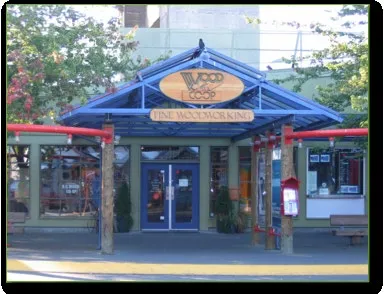
iii. Main entrances should be clearly visible from streets and internal vehicle and pedestrian circulation routes. Entrances may be emphasized with lighting, architectural detailing, colour, special paving, landscaping or other defining features. Weather protection should be provided at entrances. iv. Long blank walls should be avoided. Public frontages should present a consistent and visually appealing design through use of materials, windows, articulation and roof treatments. v. Unsightly roof elements, including mechanical equipment and vents, should be enclosed by roof parapets or other forms of solid screening. vi. Signage should be consistent with the overall design of the building. vii. Design details such as street light standards and street furniture should be of a consistent design and contribute to an attractive streetcscape. viii. Containers for garbage and recycling should be stored in a safe and convenient location and screened from view. ix. Commercial units should incorporate substantial amounts of glazing along pedestrian routes. x. Developments are encouraged to provide outdoor plazas to serve as gathering places for employees and patrons. Plazas should include various opportunities for seating and incorporate substantial landscaping. Additional elements such as pergolas, trellises, public art and water features are encouraged. xi. Identify appropriate areas for gateway features and provide features that express the natural, heritage, cultural or economic identity of View Royal.
GUIDELINES – SITING, HEIGHT AND MASSING
i. Buildings should be positioned to frame public streets and internal circulation routes. ii. New developments should respect the scale and general development pattern of adjacent land uses. iii. Create visual interest by providing variations in height, rooflines and massing. iv. Buildings should be oriented to maximize sunlight exposure on pedestrian routes and public plazas.
GUIDELINES – LANDSCAPING
i. Retain mature trees, vegetation and natural features wherever possible. ii. Landscaping should contribute to a pedestrian-friendly streetscape and may include street trees, planters, decorative paving, seating, and use of other materials or furniture to add interest and define the pedestrian realm.
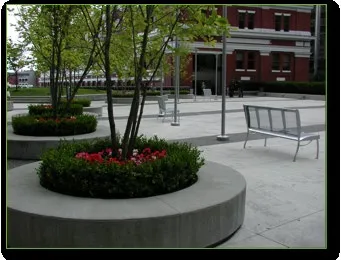
iii. Utilize native species wherever possible in site landscaping. Plants should be chosen for seasonal interest and compatibility with the local climate. iv. Drought-tolerant plant species are encouraged. v. Landscaping should incorporate an automatic irrigation system. vi. Tree species of sufficient height and canopy spread should be used to provide shade and improve the visual appearance of parking areas. vii. Buffers between commercial and residential uses viii. Landscape design strategies should be incorporated that minimize stormwater runoff, and promotes the natural infiltration and cleaning of runoff ix. All landscaping work and plant material shall conform to the most recent edition of the British Columbia Landscape Standard published by the British Columbia Society of Landscape Architects.
GUIDELINES – PARKING, ACCESS AND CIRCULATION
i. Provide strong and safe linkages to surrounding parks, trails, schools and other local destinations. ii. Pedestrian and cycling access routes should designed to provide easy and convenient access to transit services, cycling routes, trails and sidewalks. iii. Access and circulation should be safe and convenient for pedestrians, cyclists, people with reduced mobility and vehicles. iv. Provide safe and direct pedestrian access from parking areas to building entrances. v. Pedestrian routes and crossing areas should be defined with textured paving materials, patterns and/or colour. vi. Parking should be located underground, wherever possible. vii. Surface parking areas should be located behind buildings or in internal parking courts, and should incorporate substantial landscaping and trees in planting islands to increase permeability, provide shade and improve the visual appearance of parking areas. viii. On-site surface parking should incorporate permeable features such as pavers, pervious asphalt or pervious concrete to increase permeability and natural infiltration. ix. Servicing and loading areas should be located in a manner that does not negatively impact the pedestrian realm. x. Sheltered bicycle parking for visitors should be provided at an accessible location near the primary entrance and located so as to ensure passive surveillance.
GUIDELINES – LIGHTING
i. Building and site lighting should be sufficient to ensure pedestrian and vehicle safety. ii. Outdoor lighting should be regulated to control the quantity, quality and direction of night lighting. Lighting fixtures that are “dark skies” friendly to limit light pollution at night are encouraged. iii. On-site lighting standards should be pedestrian scale, while providing sufficient light for automobile traffic. iv. Lighting standards should be consistent with street furniture and garbage/ recycling containers. v. Outdoor electrical outlets should be provided at regular intervals to facilitate the installation of seasonal/decorative outdoor lighting. vi. Where pole mounted lighting is necessary, light standard luminaries should be no more than 40,000 lumens and mounted on poles no more than 5 metres high.
GUIDELINES – SAFETY
i. All developments should be designed for safety and security by incorporating Crime Prevention Through Environmental Design principles and guidelines with particular attention to passive surveillance, good site lines, appropriate lighting, clear definition of private, semi-private and public space, and appropriate access control measures.
GUIDELINES – OTHER
i. Incorporation of Green Building strategies such as Leadership in Energy and Environmental Design (LEED®) and Built Green standards in the design and construction all buildings is highly encouraged. ii. Incorporation of resource and energy efficiency into the siting, design, construction and maintenance of buildings and structures is highly encouraged.
Variances
i. Variances to building setbacks, building height, parking and landscape requirements may be considered where it can be shown that the variance does not impact substantial compliance with the intent of the guidelines. ii. Variances for parking standards may be considered where the request for such variances are supported by a satisfactory study prepared for the Town of View Royal by a qualified professional.
Document Images
(2)