STAFF REPORT: SSMUH HOUSING LEGISLATION AND INFRASTRUCTURE
A report from the Director of Engineering assessing infrastructure deficiencies, primarily sidewalks, that may warrant extensions to the SSMUH compliance deadline.
TOWN OF VIEW ROYAL STANDING COMMITTEE REPORT ON HOUSING
TO: Standing Committee on Housing DATE: April 12, 2024 FROM: Ivan Leung, P.Eng, Director of Engineering MEETING DATE: April 19, 2024
SSMUH HOUSING LEGISLATION AND INFRASTRUCTURE
PURPOSE:
The purpose of this report is to provide the Standing Committee with the following information:
- Assess whether there are any infrastructure related issues that may warrant an extension to the Small-Scale Multi-Unit Housing (“SSMUH”) compliance deadline;
- Identify properties within the SSMUH designation that do not currently have sidewalks fronting these properties, for the purposes of requesting for an extension to the SSMUH compliance deadline.
OPTIONS:
Option 1 (Recommended): THAT the report titled SSMUH Housing Legislation and Infrastructure be received for information.
Option 2: THAT the Standing Committee recommend to Council additional or alternative recommendations.
TIME CRITICAL:
The deadline for applying to request an extension to the SSMUH compliance deadline is June 1, 2024.
BACKGROUND AND SUMMARY OF ISSUE:
Council previously expressed concerns regarding the impacts of the Province’s Bill 44 to residential neighbourhoods in View Royal. Moreover, the Standing Committee on Housing expressed concerns that Bill 44 could add potential strain to the Town’s infrastructure. Questions that arose from the April 5, 2024 Standing Committee meeting included:
- Are there any ‘pinch-points’ in the Town’s underground infrastructure that could warrant an extension to the SSMUH compliance deadline until these issues are resolved?
- Would the increased density caused by SSMUH’s impact the level of service of the Town’s neighbourhood streets (specifically ‘rural’ and ‘residential’ classed streets)?
The Director of Engineering stated at the standing committee meeting that there are mechanisms to address growth related infrastructure needs. Examples included:
- Managing short term infrastructure needs through the Town’s DCC program. An example was given whereby sanitary sewer ‘pinch-points’ are generally resolved in the short term via DCC funded projects identified in the 5-year financial plan;
- Frontage improvements are a requirement of development, including development stemming from SSMUH’s. Such improvements are a requirement as a condition of building permit;
- The Town has the option to obtain a cash-in-lieu for development servicing instead of ‘piece-by-piece’ development construction. This option is strategic where development along an entire road corridor is expected, but is not within DCC programming. Collecting incremental cash-in-lieu allows the Town to construct a singular, uniform and connective servicing project all at once, thus reducing public disturbance and increasing quality of work.
The Standing Committee stated to the Director of Engineering that there is an emergent need to construct active transportation facilities prior to, or in the early stages of, the development of SSMUH properties. The Standing Committee specifically stated that the installation of continuous sidewalks prior to densification is important.
As a result, the Standing Committee directed staff to:
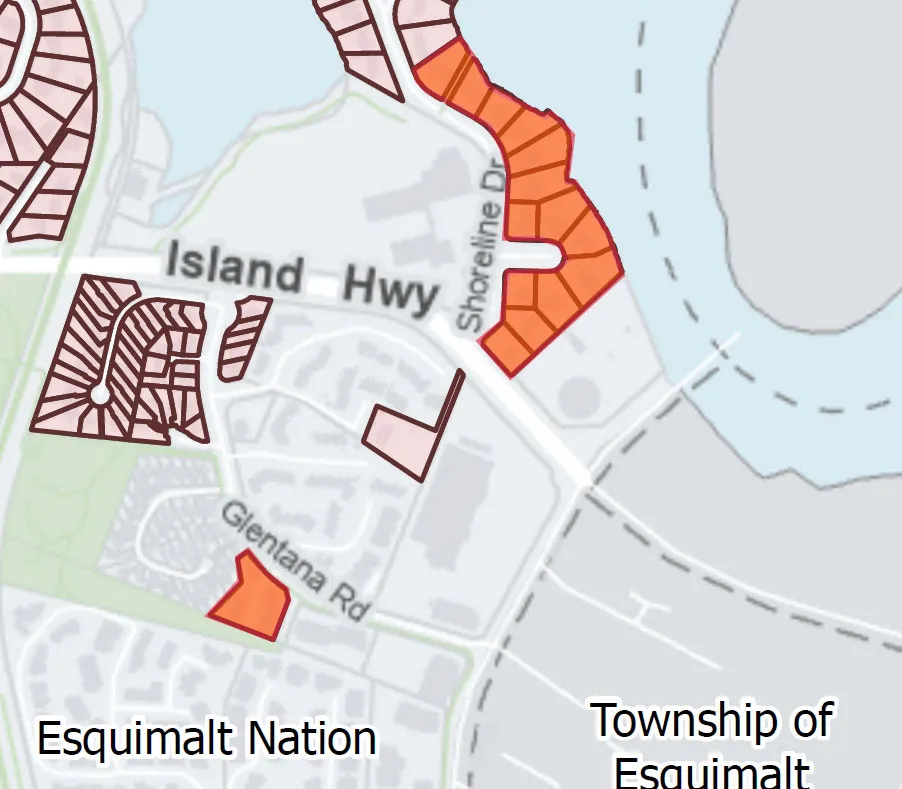
- Provide a map identifying SSMUH parcels that front residential roadways where a sidewalk facility does not currently exist;
- Identify ‘pinch-points’ in the underground infrastructure network.
DISCUSSION:
Mapping: SSMUH Properties Without Sidewalk Facilities
Utilizing GIS and asset management data, Attachment 1 identifies the SSMUH properties where sidewalk facilities do not currently exist.
Approximately 17km of new sidewalk would be required to serve the SSMUH properties identified in Attachment 1 (assuming only sidewalk on one side of the road). The Town’s current sidewalk inventory is approximately 26km.
The Subdivision and Development Servicing Bylaw No. 985 (“Bylaw 985”) will already require some SSMUH properties to install sidewalks as a condition of their development (properties feeding into urban collector roadways, properties within and near urban areas such as town and neighbourhood centres, and community corridors). However, there are neighbourhoods that are considered rural and do not require sidewalks in accordance with Bylaw 985. Requiring sidewalks in these rural neighbourhoods would create an up-class in road classification that would have further implications to operational and maintenance budgets. For example, the Harbour Neighbourhood alone would account for 35% of the 17km of additional sidewalks required – these would be considered unforeseen costs given current transportation master planning, DCC bylaws and asset management planning.
Underground Infrastructure
Generally, the Town is well positioned in the maintenance and replacement of its underground infrastructure related to growth:
- Many of the short-term issues will be (or already have been) addressed as a DCC project in current and previous financial planning;
- Development related drainage is controlled by Bylaw 985, requiring all post development flows to be reduced to pre-development levels. Further protections will be informed by a drainage master plan update, expected to commence in 2025 per the draft 2024-2028 Financial Plan;
- While it is unknown what the potable water capacity is in the Town (this is owned and operated by the Capital Regional District, “CRD”), there has been no correspondence from the CRD suggesting that there are short term capacity issues arising from the SSMUH housing legislation.
There does exist one ‘pinch-point’ in the sanitary sewer system currently beyond the Town’s control: the CRD’s shoreline trunk system is currently at capacity and unable to accept more demand until the asset is upgraded (1-to-2-year outlook). However, only a few SSMUH properties discharge into this system, and there are means and methods whereby the development of these properties could restrict sanitary peak flows to pre-development levels until the CRD’s asset is upgraded.
STANDING COMMITTEE REQUEST FOR EXTENSION:
The Standing Committee expressed an emergent need to install continuous, uniform and connected sidewalks prior to, or in the early stages of, the development of neighbourhoods impacted by the SSMUH legislation. This would ultimately classify all residential roads affected by the legislation as ‘urban’ roadways. This increased level of service would impact the Town’s capital, staffing and operational (taxation) budgets due to the requirement to install a significant and previously unforeseen quantity of sidewalks in the short term. As a result, Engineering does express issue with the proposed level of service increase in the absence of technical analysis.
Regardless, should the Committee recommend to Council to proceed with the increased level of service, then staff can apply for an extension to the SSMUH compliance deadline for the SSMUH parcels that currently do not have sidewalks fronting their properties (parcels are identified in Attachment 1). The deadline extension could be pinned to the completion of the Transportation Master Plan Update (extension category: “infrastructure upgrade needed to address risk to public health, safety or the environment). Staff’s reasoning for this is threefold:
- It would provide data driven analysis and planning to identify any issues with the current road classifications; it would provide Council with better evidence of any emerging gaps in the sidewalk network beyond the Active Transportation Network Plan findings;
- It would balance operational (taxation) impacts by informing on the actual requirements of the road network (not all residential roadways may require sidewalks);
- It would inform on changes to the DCC bylaw to ensure that the capital cost of growth-related infrastructure is compensated for by development.
There is also a small area in the shoreline trunk neighbourhood that currently has sanitary sewer capacity issues beyond the Town’s control. Engineering can support an application for extension for this area (under the extension category “ongoing infrastructure project”). However, the number of SSMUH properties impacted would be minimal, and there are means and methods for developers to mitigate this issue.
FINANCIAL IMPLICATIONS:
The requirement to install sidewalks on all residential road corridors where properties are impacted by the SSMUH legislation would have significant implications to taxation due to the need to monitor, maintain and replace these additional assets. Should the Committee (and Council) accept this increased level of service, it is recommended to wait until the Transportation Master Plan Update is completed (2025), which is also contingent upon an update to the Official Community Plan, to confirm if any roadways would require a class change.
Completion of the Transportation Master Plan would also mean the subsequent completion of a DCC Bylaw update. The DCC Bylaw update would ensure that the capital costs to install growth related infrastructure be predominantly borne by developers, thus further reducing costs to the Town.
| CONCURRENCE: | Initials | Comments |
|---|---|---|
| Chief Administrative Officer |
| REVIEWED BY: | Initials |
|---|---|
| Director of Corporate Administration | NR |
| Director of Finance | NR |
| Director of Development Services | LT |
| Director of Engineering and Parks | IL |
| Director of Protective Services | NR |
ATTACHMENTS:
- Figure 1: SSMUH Areas Currently Lacking Sidewalks
Document Images
(1)