Council Report: Development Permit 2024-01 – 2001-2014 West Park Lane – Phase 6
A report recommending approval of a development permit for 13 residential units in the West Park at Thetis development.
TOWN OF VIEW ROYAL COUNCIL REPORT
TO: Council
DATE: May 15, 2024
FROM: Jeff Chow, RPP, MCIP, Senior Planner
MEETING DATE: May 21, 2024
DEVELOPMENT PERMIT 2024-01 – 2001-2014 WEST PARK LANE – PHASE 6
RECOMMENDATION:
THAT Development Permit 2024-01 be approved as per the report dated May 15, 2024 from the Senior Planner titled “Development Permit 2024-01 – 2001-2014 West Park Lane – Phase 6.”
AND THAT Development Permit 2024-01 be issued upon receipt of a technical memorandum sealed by a Professional Engineer to confirm that the servicing demand for this phase and future phases is consistent with the original servicing plan, and this phase does not cause the original system to be over capacity.
ALTERNATIVES:
THAT Council decline Development Permit Application 2024-01.
Council’s discretion to grant or refuse a development permit must be based upon the applicable development permit area design guidelines only, and not on extraneous considerations. In accordance with case law, when declining a development permit, Council should provide reasons why the proposal is not considered to be generally consistent with the development permit area design guidelines (refer to pages 75-89 of Attachment 1).
TIME CRITICAL:
There are no time considerations for the Town.
EXECUTIVE SUMMARY:
A Development Permit (DP) application has been submitted for 13 residential dwelling units in three triplexes and two duplexes, which forms part of Phase 6 of the “West Park at Thetis” comprehensive residential development. The proposal generally complies with the Mixed Residential Development Permit Area form and character design guidelines. The site is also within the Sensitive Terrestrial Ecosystems Development Permit Area, but the relevant natural environment and hazard guidelines for the entire comprehensive development have been addressed in Development Permit 2020/10.
BACKGROUND:
This application for Phase 6 of the comprehensive development was introduced at the April 9, 2024 Committee of the Whole meeting (note: the apartment building comprising the final Phase 5 has been postponed until after this phase). Details of the proposal can be found in Attachment 1.
DISCUSSION:
The applicant has addressed the comments from the staff report and discussion at the April 9, 2024 Committee of the Whole meeting as follows:
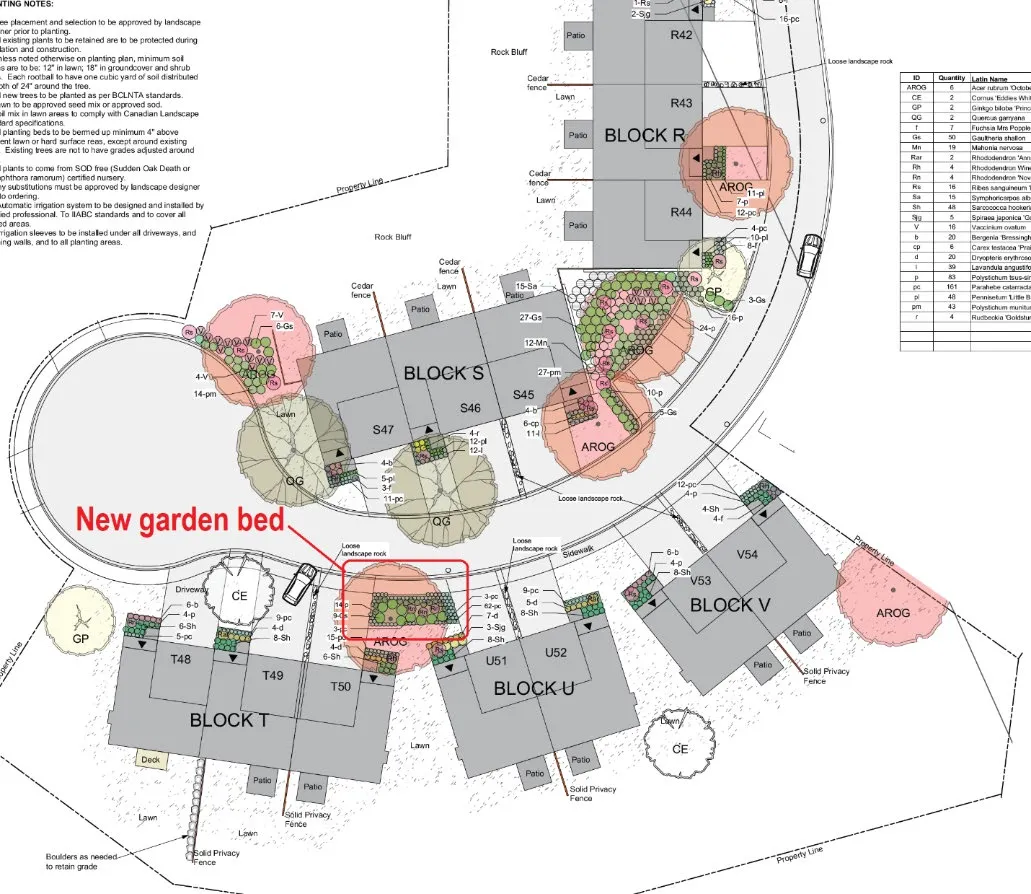
- Reduce the amount of lawn by adding more garden beds and trees so that would make the site will look less bare.
An additional planting bed has been provided between Blocks T and U to soften the edge of the driveway as shown in Figure 1. Trees have been rearranged to maximize building screening, except at Blocks U and V due the location of a pad mounted transformer and underground services.
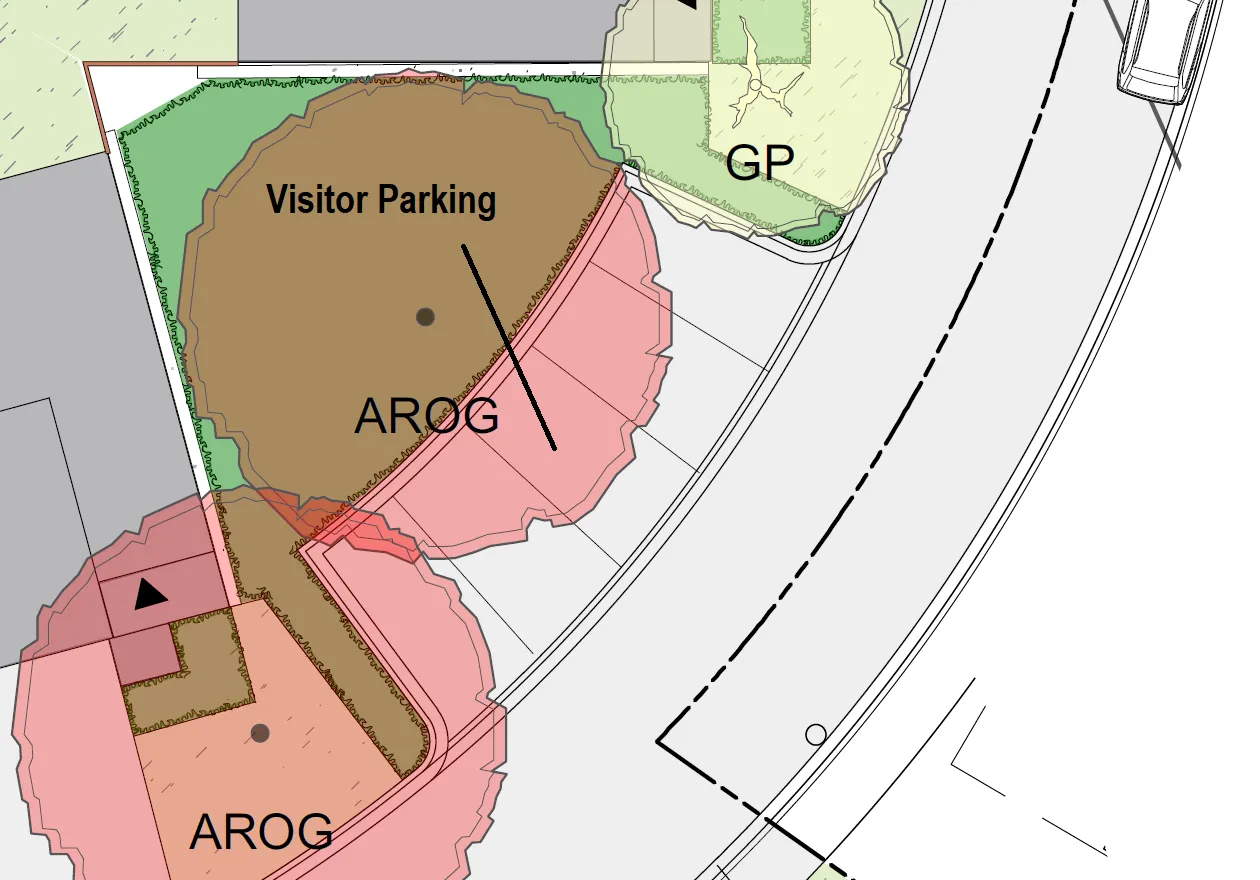
- Paving materials should be indicated on the plans. Consider permeable surface treatment (i.e., pavers) in the visitor parking to add visual texture and reduce impervious surfaces.
As shown in Figure 2, the visitor parking will have a mountable curb to delineate the driveway area from the parking spaces to visually break up the expanse of asphalt, which would be an improvement from earlier phases.
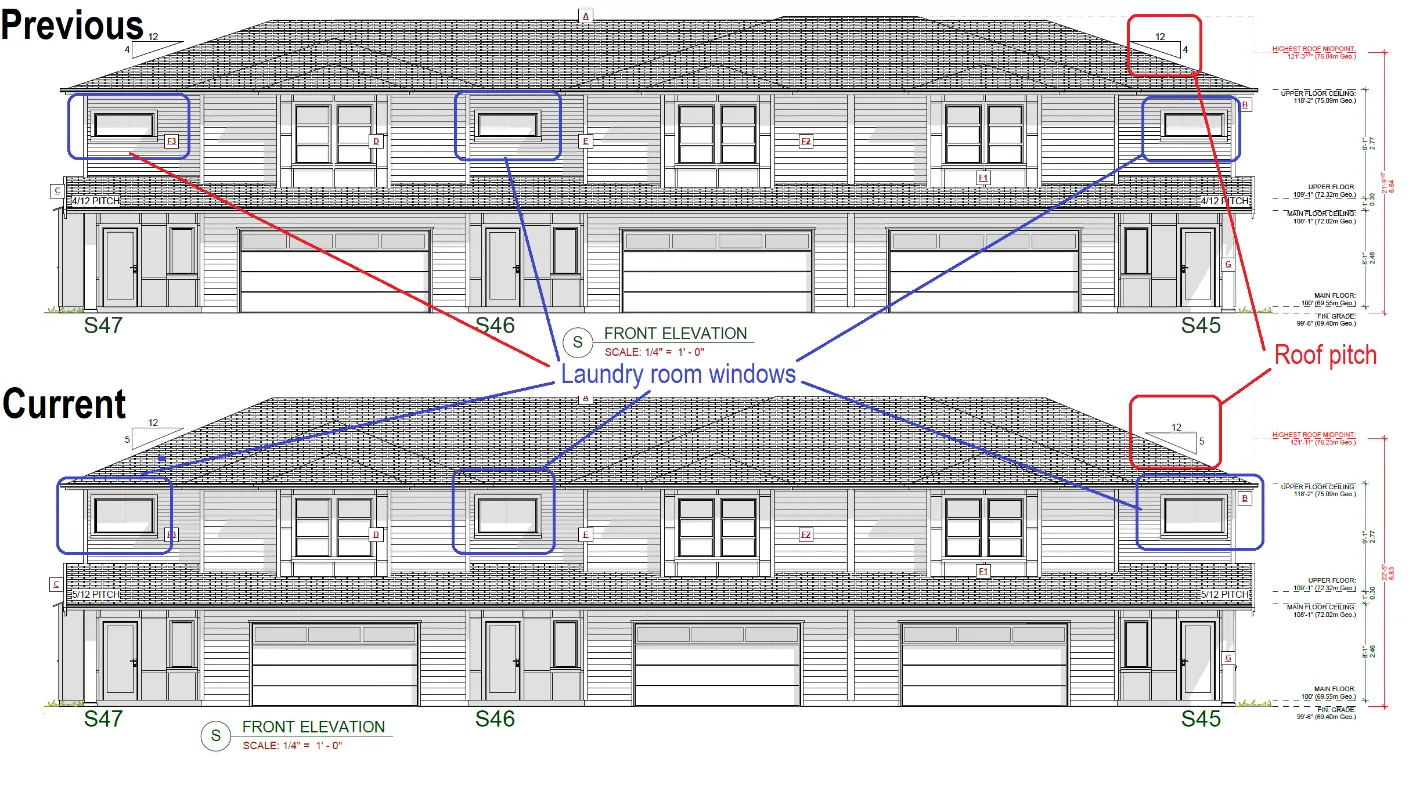
- Reconsider roof pitches as they are shallow for the building massing
Roof pitches have been modified from 4:12 to 5:12 so roofs are more pronounced and not as flat looking like previous phases (see Figure 3). This modification has increased the height of the tallest buildings in this phase from 6.7 to 6.83m, which would still be well below the maximum permitted building height of 9.0m.
- To minimize visual impacts of garages and wide driveways along the street frontage, the design would benefit from recessing the garage doors behind the main building line, accentuating the front entrances, and incorporating plantings to soften and frame driveways and garage entries.
For the applicant, this would be a significant departure from the building scheme of previous phases. Modifying the roof pitches and upper storey windows, and adding soft landscaping would serve as design improvements in the current phase.
- Adjustments to window placement and proportions for better curb appeal.
Laundry room windows have been enlarged to provide an enhanced appearance to Blocks R and S as shown in Figure 3.
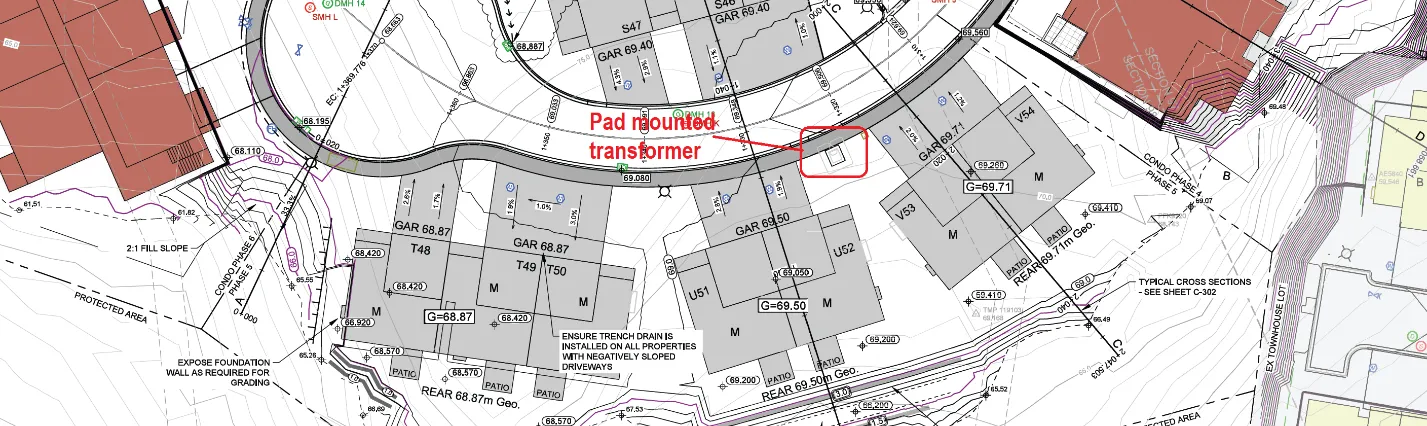
- The locations of pad mounted transformers must be shown or confirmed.
The one pad mounted transformer for this phase is between Block U and V and would not be a large, visually prominent unit.
- A perspective or rendering to illustrate how this phase would relate to the neighbourhood context.
While renderings of this phase were not completed in time for this report, staff note that the buildings in this phase are on a relatively flat section of the site that is separated from previous townhouse phases by height and distance.
- Confirmation of the height of two retaining walls shown at Block T. A Zoning Bylaw variance and report from a geotechnical engineer will be required for any retaining wall over 1.2m tall.
The retaining walls are proposed to be less than 1.2m tall. This will be verified at the building permit stage.
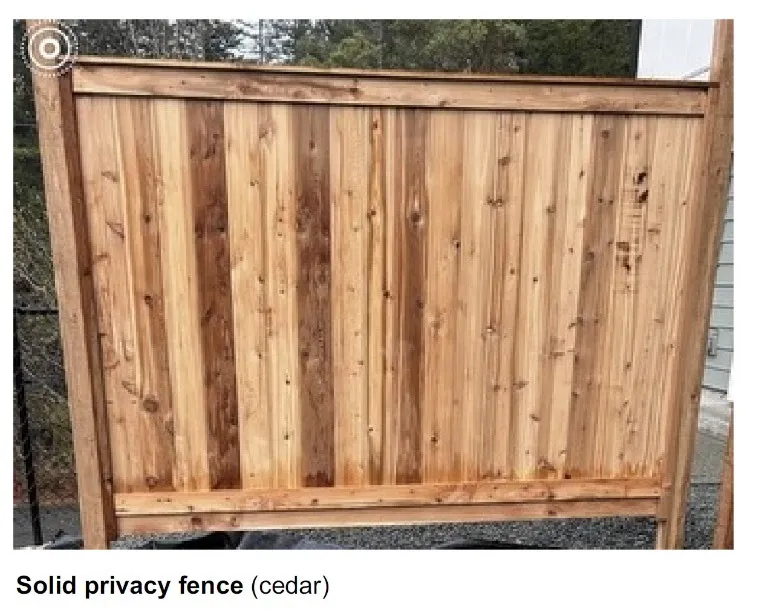
- Fence details on the plans.
A design for solid cedar privacy fences has been provided.
- Confirmation of total floor area, density and lot coverage calculations.
Table 4 of the staff report to the April 9, 2024 Committee of the Whole report has been updated with the new information in italics in the following table. It confirms that the proposed development complies with zoning requirements that apply to both parent parcel 1950 West Park Lane and the overall comprehensive development (including CRD lands at 1910/1920 West Park Lane).
Table 4. Overall Comprehensive Development Density Zoning Compliance
| Section | Description – CD-23 zone | Required | Proposed |
|---|---|---|---|
| 12.23.3. | Lot Size, minimum | 4000m² | 42,580 m² |
| 12.23.3. | Maximum number of residential units on all lands zoned CD-23* | Max 350 | Existing: 251 + Proposed Phase 6: 13 Total: 264 |
| 12.23.3. | Maximum Floor Space Ratio on **all lands zoned CD-23 *** Total CD-23 land area: 51,930m² |
0.78:1 | Existing: 17,450m² + Proposed Ph.6: 2,025m² Floor space: 19,475m² Total CD-23 FSR: 0.37:1 |
| 12.23.3. | Floor Space Ratio on 1950 West Park Lane** for Residential, Townhouse or Residential, Duplex use Lot area: 42,580m² |
0.5:1 | Existing: 7225m² + Proposed: 2025m² Floor space: 9250 m² Total lot FSR: 0.22:1 |
| 12.23.3. | Lot Coverage, maximum on 1950 West Park Lane** | 50% 21297.6m² |
24% 10028.87 m² (8532.92m² + 1495.95m²) |
*Comprised of 1910 & 1920 West Park Lane plus the West Park at Thetis development
**1950 West Park Lane is the parent parcel comprising the West Park at Thetis development
- An erosion and sediment control plan should be provided for this phase.
An erosion and sediment control plan will be required at the building permit stage.
- Noise attenuation for residents
The applicant confirms that the double-paned windows would be comprised of a 5mm pane and a 3mm pane, which would exceed the Building Code minimum of two 3mm panes and significantly improve sound-proofing. It is important to note that the Mixed Residential Development Permit Area regulates the form and character of multi-family residential development, and it does not contain guidelines to control noise levels.
- Slope stability around the site
The applicant has provided in Attachment 4, a series of geotechnical reports regarding work done in previous phases, maintenance requirements, and mitigation measures. The maintenance work includes hand scaling of loose rock at least every five years or following a seismic event. The most recent reports in February and April 2024 reports are for this phase and indicates maintenance has been recently conducted.
For this specific phase, previously approved Development Permit 2020/10 requires a geotechnical covenant be registered at the building permit stage to:
a. Provide certification from a geotechnical engineer that the site is safe for the intended use.
b. Require a maintenance and inspection program for all cut walls and retaining walls by the property owner.
The expectation is that the site is monitored periodically by the project geotechnical engineer.
- Servicing capacity
It is recommended that Development Permit 2024-01 be issued upon receipt of a technical memorandum sealed by a Professional Engineer to confirm that the servicing demand for this phase and future phases is consistent with the original servicing plan, and this phase does not cause the original system to be over capacity.
SUSTAINABILITY/CLIMATE CHANGE IMPACTS:
There are no significant sustainability or climate change impacts with this proposal. The Building Bylaw No. 1111, 2023 requires the buildings to be built at Level 4 Zero Carbon Step Code (full electrification of heating and cooking appliances).
FINANCIAL IMPLICATIONS:
No financial implications are anticipated for the Town.
CONCLUSION:
The proposal is consistent with the Mixed Residential Development Permit Area design guidelines and can be supported because the development is generally consistent with previous phases, with incremental improvements based on what has been constructed.
Staff recommends that Council approve Development Permit 2024-01 for 2001-2014 West Park Lane – Phase 6.
| CONCURRENCE: | Initials | Comments |
|---|---|---|
| Chief Administrative Officer | SS | I concur with the recommendation. |
| REVIEWED BY: | Initials |
|---|---|
| Director of Corporate Administration | Not requested |
| Director of Finance | Not requested |
| Director of Development Services | LT |
| Director of Engineering and Parks | BL |
| Director of Protective Services | Not requested |
ATTACHMENTS:
- Report from the Senior Planner presented at the April 9, 2024, Committee of the Whole meeting
- Revised building plans
- Revised landscape plans
- Geotechnical reports
Document Images
(1)