Planning, Development & Engagement Report – April 3, 2024
The initial staff report introduced to the Committee of the Whole regarding the Phase 6 construction at West Park at Thetis.
TOWN OF VIEW ROYAL PLANNING, DEVELOPMENT & ENGAGEMENT REPORT
TO: Committee of the Whole DATE: April 3, 2024 FROM: J. Chow, RPP, MCIP, Senior Planner MEETING DATE: April 9, 2024
DEVELOPMENT PERMIT 2024-01 – 2001-2014 WEST PARK LANE – PHASE 6
RECOMMENDATION:
THAT the report dated April 3, 2024, from the Senior Planner titled “Development Permit 2024-01 – 2001-2014 West Park Lane – Phase 6” be received for information.
PURPOSE:
The purpose of this report is to introduce a Development Permit application to construct 13 townhouse units as Phase 6 in the “West Park at Thetis” mixed residential development.
TIME CRITICAL:
There are no time critical issues for the Town.
EXECUTIVE SUMMARY:
A Development Permit (DP) application has been submitted for 13 residential dwellings units in three triplexes and two duplexes, which forms part of Phase 6 of the “West Park at Thetis” comprehensive residential development. The proposal generally complies with the Mixed Residential Development Permit Area form and character design guidelines; however, additional design considerations should be given based on what has been learned from previous phases. The site is also within the Sensitive Terrestrial Ecosystems Development Permit Area, but the relevant natural environment and hazard guidelines for the entire comprehensive development have been addressed in Development Permit 2020/10.
No variances are requested with this application, but the height of two proposed retaining walls at Block T should be confirmed. Additional data on zoning compliance is required prior to consideration by Council.
BACKGROUND:
Thetis Lake Campground operated for decades on the east half of the parent property until 2018. The west half of the property was primarily hilly, forested terrain, and features a rocky hilltop that is now preserved by a covenant.
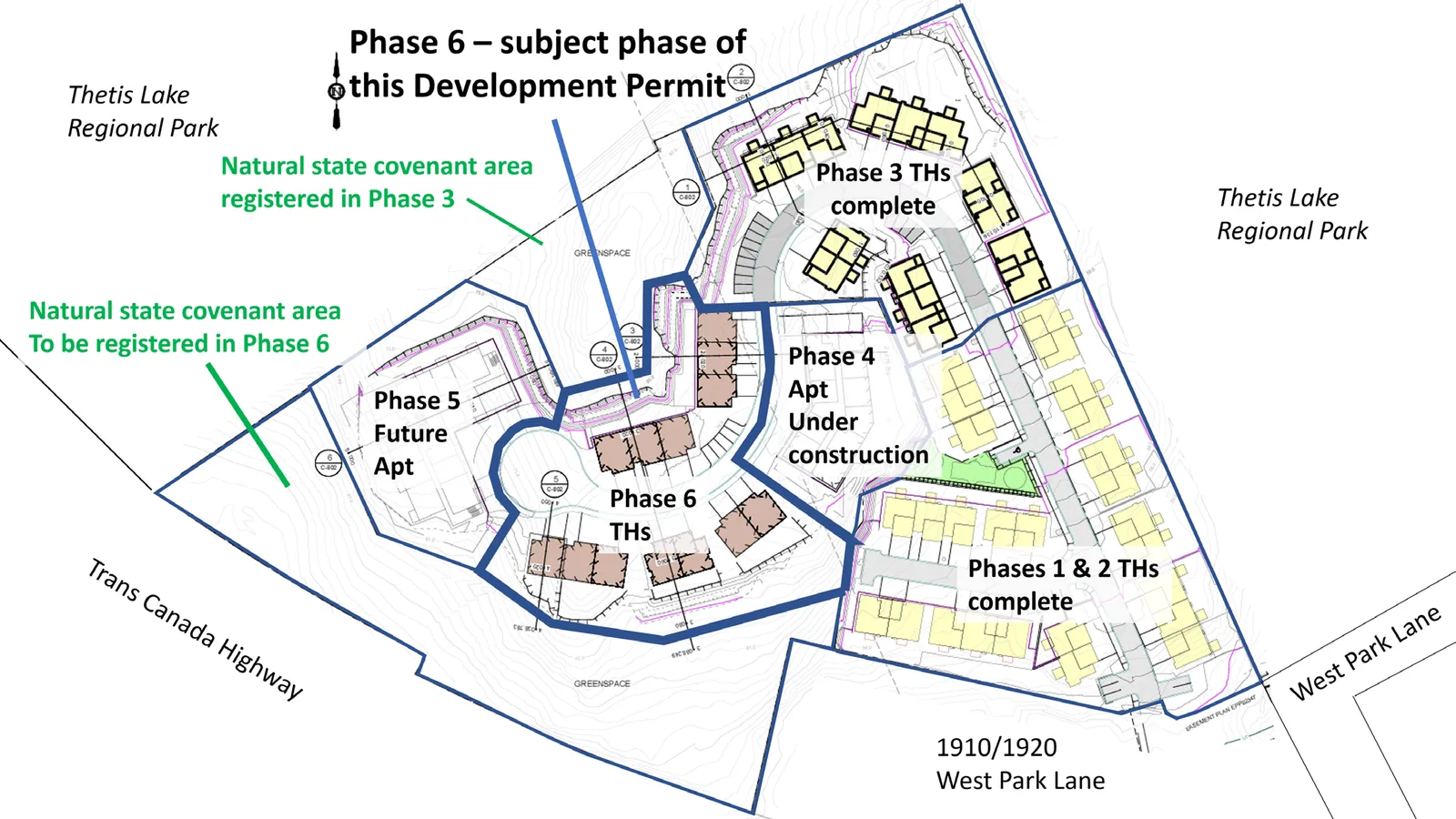
The parent property was rezoned to CD-23: Comprehensive Development (Thetis Lake) in 2017 to permit a total of 350 residential units. It was then subdivided into the “West Park at Thetis” comprehensive development site parcel and the adjacent parcel at 1910 and 1920 West Park Lane (Capital Regional District Housing Corporation rental apartment buildings). To date, 251 dwelling units have been constructed on the 4.26 ha comprehensive residential development site north of Trans Canada Highway backing on to Thetis Lake Regional Park (Attachment 1). This application is for Phase 6 of West Park at Thetis...
Previously issued development permits relevant to this phase include:
- Development Permit 2019/02 - permitted subdivision to create this parcel and set out requirements for:
- identification of environmentally sensitive areas to be protected;
- a security deposit for any unsafe conditions or damage to the natural environment; and
- interface fire hazard management.
- Development Permit 2020/10 - authorized site grading and clearing of this phase and future Phase 5. The DP also included requirements for:
- geotechnical oversight;
- covenants for safety inspection and maintenance of cut slopes and retaining walls; and
- safety, scale, and timing of site blasting work to minimize offsite impacts on the earthen dam at Thetis Lake Regional Park.
DISCUSSION:
Project Overview
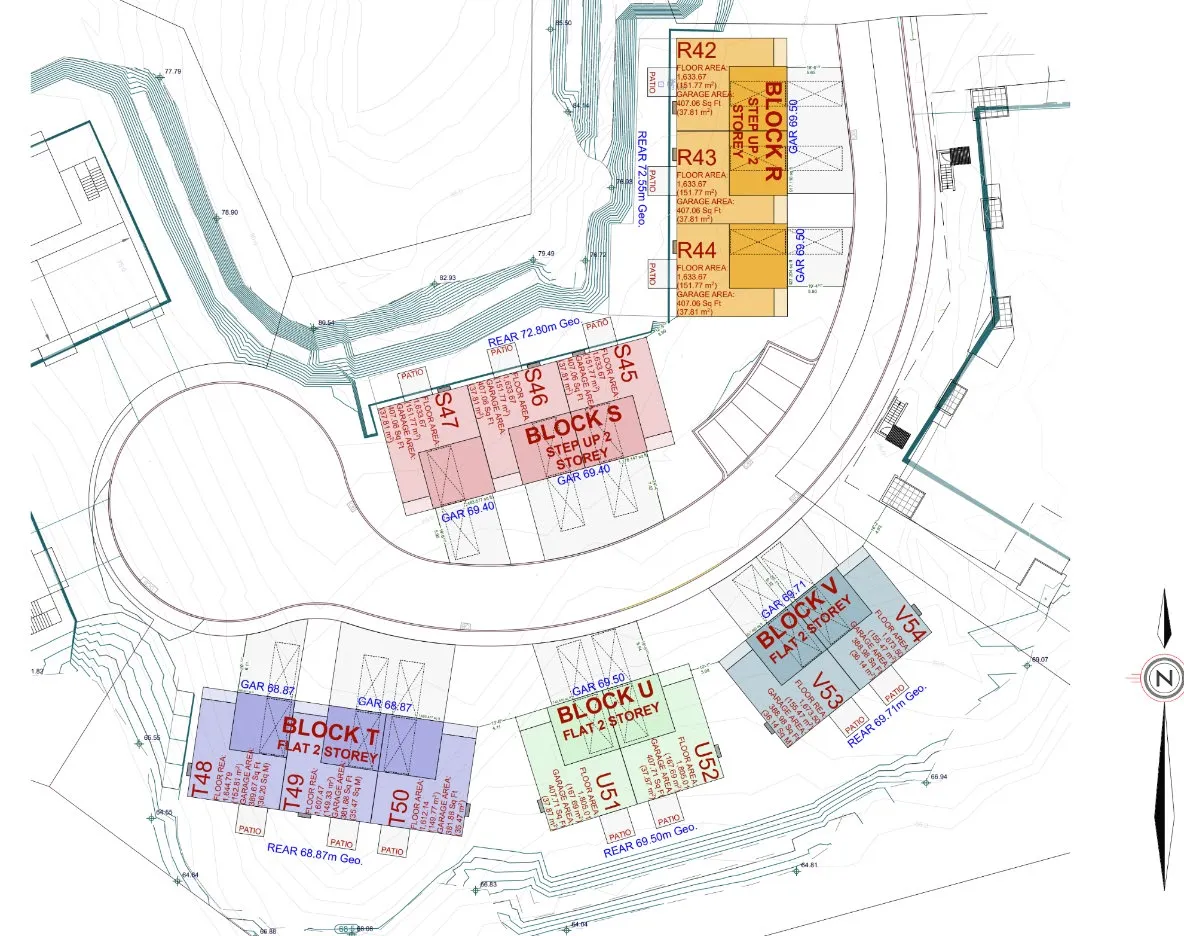
Phase 6 is comprised of 13 residential dwelling units in five buildings (three triplexes and two duplexes) in the center of the comprehensive development (refer to Figure 1). The buildings are two-storeys with garages and driveway parking (refer to Figure 2). Five on street visitor parking spaces would be provided. The form, character and massing of buildings is proposed to be similar to other dwellings in the earlier Phases 1 to 3.
Development Permit Area Design Guidelines
The development is subject to the guidelines of two development permit areas: Mixed Residential and Sensitive Terrestrial Ecosystems. The natural environment and hazard guidelines of the Sensitive Terrestrial Ecosystems development permit area have been addressed in Development Permit 2020/10 for the entire comprehensive development when it was cleared and graded, so this application will only need to consider the Mixed Residential Development Permit Area design guidelines.
Mixed Residential Development Permit Area Design Guidelines
The proposal complies with most of the Mixed Residential Development Permit Area design guidelines as detailed in Attachment 11. Comments are provided on the proposal and what has been learned from earlier phases to identify how the proposal can better meet the intent of the guidelines.
Specific details on how the proposal complies with the applicable development permit area design guidelines are as follows:
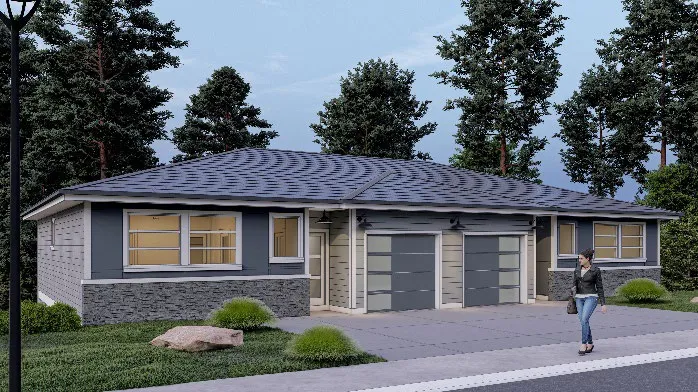
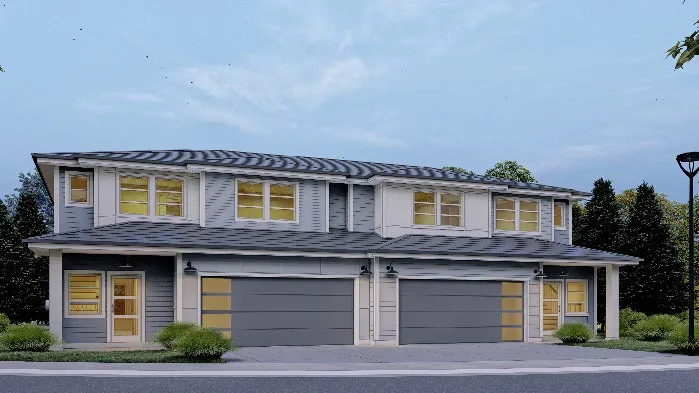
- The development will have a contemporary West Coast treatment through the arrangement of natural toned cementitious materials, mullioned window treatments, extensively glazed entry doors and windowed garage doors similar to previous phases that are shown in Figure 3.
- Cladding includes horizontal plank and board & batten to provide variety and texture. In Phase 6, stone type cladding elements are introduced on Blocks R, T and U, which provides higher quality finish (refer to Attachments 3, 5 and 6).
- The blocks are arranged to follow the central driveway, which has been designed to minimize steep gradients as it traverses the sloping topography.
- Building lighting will be dark skies friendly. Street lighting will be energy efficient LED.
Areas to improve alignment with the Development Permit Area design guidelines include:
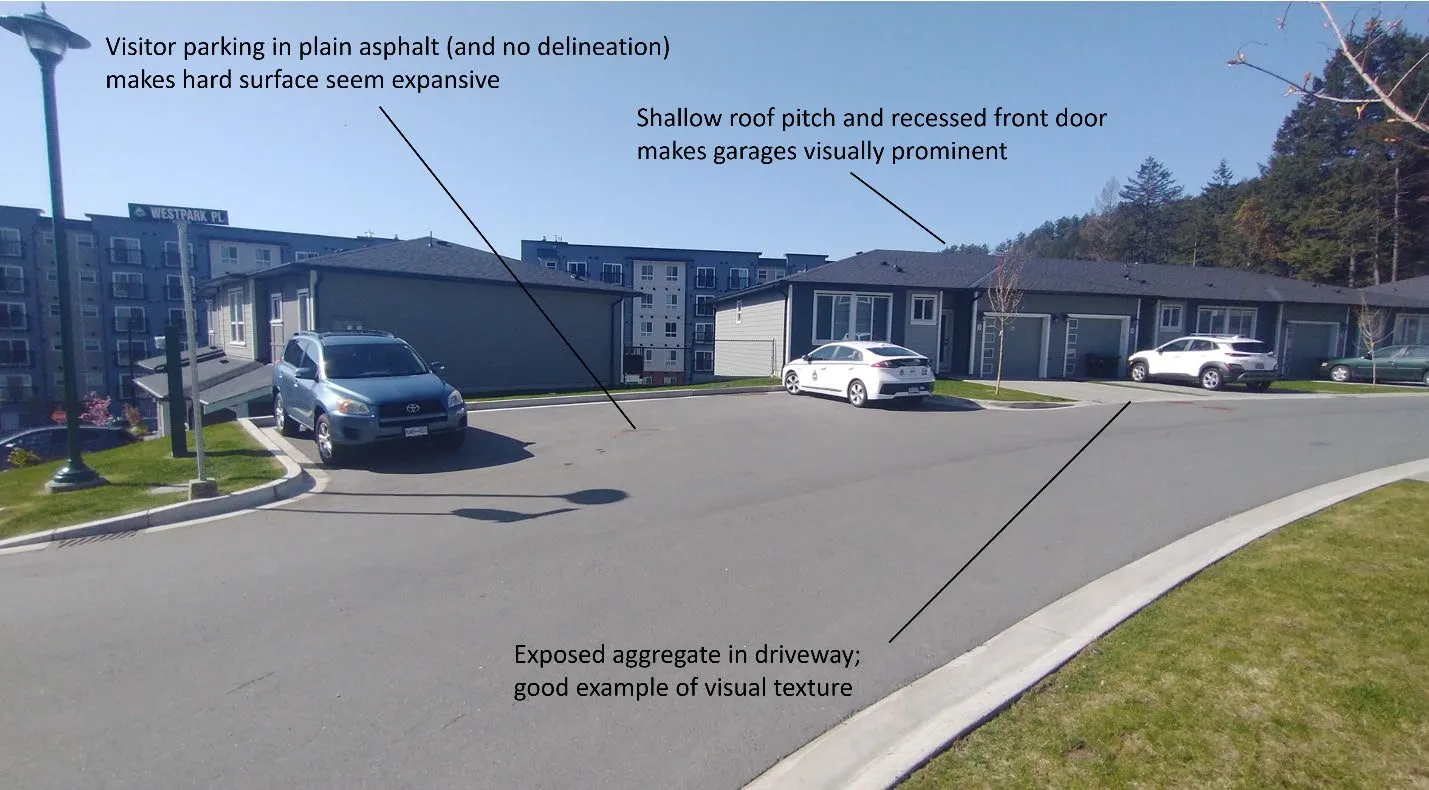
- Reducing the amount of lawn by adding more garden beds and trees so that the site will look less bare (Figure 4).
- Paving materials should be indicated. Consider permeable surface treatment (i.e., pavers) in visitor parking as shown in Figure 4 to add visual texture and reduce impervious surfaces.
- Reconsider roof pitches as they are shallow for the building massing (see Figures 3 and 4).
- To minimize visual impacts of garages and wide driveways along the street frontage, the design would benefit from recessing the garage doors behind the main building line, accentuating the front entrances, and incorporating plantings to soften and frame driveways and garage entries.
- Adjustments to window placement and proportions for better curb appeal.
- The locations of pad mounted transformers must be shown or confirmed.
- A perspective or rendering to illustrate how this phase would relate to the neighbourhood context.
Zoning
Tables 1-3 summarizes data for the current phase (Phase 6). Table 4 shows the running cumulative data for the overall development comprised of 1910/1920 West Park Lane, Phases 1-4 of “West Park at Thetis”. Phase 5, an apartment building, remains to be developed in the future.
Table 1. Phase 6 Building Setbacks
| CD-23 zone | Front Lot Line setback (West Park Lane) | Rear Lot Line setback | Side Lot Line setback (Thetis Lk Park) | Setback to Thetis Lake Park |
|---|---|---|---|---|
| Required | Min. 6.0m | min. 6.0m | Min. 4.5m | Min. 10.0m |
| Block R | >135m | >120.0m | >45.0m | >45.0m |
| Block S | >135m | >90.0m | >60.0m | >60.0m |
| Block T | >135m | >75.0m | >75.0m | >75.0m |
| Block U | >135m | >105.0m | >90.0m | >90.0m |
| Block V | >135m | >90.0m | >90.0m | >90.0m |
Table 2. Phase 6 Building Heights
| CD-23 zone | Max Permitted | Proposed |
|---|---|---|
| Block R | 9.0m / 2.5 storeys | 6.7m / 2 storeys |
| Block S | 9.0m / 2.5 storeys | 6.7m / 2 storeys |
| Block T | 9.0m / 2.5 storeys | 6.6m / 2 storeys |
| Block U | 9.0m / 2.5 storeys | 6.6m / 2 storeys |
| Block V | 9.0m / 2.5 storeys | 6.6m / 2 storeys |
Note: Height is measured from finished grade or natural grade, whichever is lower. In this phase finished grades are lower than natural grade due to site grading.
Table 3. Phase 6 Parking Summary
| Parking Requirement | Required Parking Spaces | Proposed Parking Spaces |
|---|---|---|
| • Two per duplex unit • 1.5 per townhouse unit |
4 duplex units: 8 9 townhouse units: 13.5 Total: 22 |
Total: 31 (including five visitor spaces) |
Table 4. Overall Comprehensive Development Density Zoning Compliance
| Section | Description – CD-23 zone | Required | Proposed |
|---|---|---|---|
| 12.23.3. | Lot Size, minimum | 4000m² | 42,580 m² |
| 12.23.3. | Maximum number of residential units on all lands zoned CD-23* | Max 350 | Existing: 251 + Proposed Phase 6: 13 Total: 264 |
| 12.23.3. | Maximum Floor Space Ratio on all lands zoned CD-23 * Total CD-23 land area: 51,930m² |
0.78:1 | Existing: 17,450m² + Proposed Ph.6: TBC Floor space: TBC Total CD-23 FSR: TBC |
| 12.23.3. | Floor Space Ratio on 1950 West Park Lane** for Residential, Townhouse or Residential, Duplex use Lot area: 42,580m² |
0.5:1 | Existing: 7225m² + Proposed: 0m² Floor space: TBC Total lot FSR: TBC |
| 12.23.3. | Lot Coverage, maximum on 1950 West Park Lane** | 50% (21297.6m²) |
TBC% (8532.92m² + Phase 6 tbc) |
*Comprised of 1910 & 1920 West Park Lane plus the West Park at Thetis development **1950 West Park Lane is the parent parcel comprising the West Park at Thetis development
Figures marked TBC (to be confirmed) in Table 4 should be provided prior to Council consideration of the development permit.
Two retaining walls are shown in the plans at Block T, but the heights are not shown. A variance (along with a report from a geotechnical engineer) may be required if the 1.2m maximum permitted height permitted by the Zoning Bylaw is exceeded.
Servicing (Underground Utilities and Site Access)
The servicing of this development was pre-installed as part of the original subdivision. As a result, the sanitary sewer, water, and drainage system has the capacity to accommodate this development. Staff will require, as a condition of development permit issuance, that a technical memo from the Applicant’s engineer be provided confirming that (1) the servicing demand for this phase and future phase(s) is consistent with the original servicing plan and (2) this phase does not cause the original system to be over capacity.
An erosion and sediment control plan will be required as a condition of building permitting for this phase.
Trees
Development Permit 2020/10 authorized pre-clearing and grading of Phases 4 to 6. Trees to be retained in the covenant areas, totalling 1 ha, had protective fencing when the site was cleared. The Town holds a security deposit in case of any damages to the natural environment including trees until the completion of final Phase 5.
Given the pre-clearing that previously took place, staff do not anticipate additional tree clearing being required for this phase.
SUSTAINABILITY/CLIMATE CHANGE IMPACTS:
The Building Bylaw requires that the development be designed and constructed to meet the minimum performance requirements and objectives specified in Step 3 of the Energy Step Code and Level 4 of the Zero Carbon Emissions Step Code. These step codes did not apply to earlier phases of the comprehensive residential development.
When the parent property was rezoned, the amenity contribution was 4.85 ha of natural, treed green space across the Trans Canada Highway that has since been incorporated into Mill Hill Regional Park. Furthermore, 1 ha of the 5 ha parent property is protected from development by a covenant.
FINANCIAL IMPLICATIONS:
There are no financial implications for the Town.
ALTERNATIVES:
If the staff comments on the form and character for the applicant’s consideration are not supported by the committee, then the application could proceed for Council decision once additional fence details, hydro transformer locations and zoning information are provided.
CONCLUSION:
The application is supportable because it generally complies with the development permit area design guidelines. and there are no variances requested with this application.
However, staff is recommending some specific refinements to building design and landscaping to further align the proposal with the applicable design guidelines. Additional details to be provided prior to Council consideration of the development permit include the following:
- Reduce the amount of lawn by adding more garden beds and trees so that would make the site will look less bare.
- Paving materials should be indicated on the plans. Consider permeable surface treatment (i.e., pavers) in visitor parking as shown in Figure 4 to add visual texture and reduce impervious surfaces.
- Reconsider roof pitches as they are shallow for the building massing
- To minimize visual impacts of garages and wide driveways along the street frontage, the design would benefit from recessing the garage doors behind the main building line, accentuating the front entrances, and incorporating plantings to soften and frame driveways and garage entries.
- Adjustments to window placement and proportions for better curb appeal.
- The locations of pad mounted transformers must be shown or confirmed.
- A perspective or rendering to illustrate how this phase would relate to the neighbourhood context.
- Confirmation of the height of two retaining walls shown at Block T. A Zoning Bylaw variance and report from a geotechnical engineer will be required for any retaining wall over 1.2m tall.
- Fence details on the plans.
- Confirmation on total floor area, density and lot coverage calculations.
- An erosion and sediment control plan should be provided for this phase.
| CONCURRENCE: | Initials | Comments |
|---|---|---|
| Chief Administrative Officer | SS | I concur with the recommendation. |
| REVIEWED BY: | Initials |
|---|---|
| Director of Corporate Administration | NR |
| Director of Finance | NR |
| Director of Development Services | LT |
| Director of Engineering and Parks | IL |
| Director of Protective Services | NR |
ATTACHMENTS:
- Location plan
- Letter from Applicant
- Block R Plans - Java Design, July 13, 2023 (6 pages)
- Block S Plans - Java Design, July 13, 2023 (6 pages)
- Block T Plans - Java Design, July 13, 2023 (7 pages)
- Block U Plans - Java Design, July 13, 2023 (6 pages)
- Block V Plans - Java Design, July 13, 2023 (6 pages)
- Exterior Materials and Lighting (6 pages)
- Planting Plan, KMZ Landscapes, June 5, 2023
- Civil plans - Associated Engineering, November 12, 2020 (5 pages)
- Review of Development Permit Area guidelines (7 pages)
Document Images
(1)