Feasibility Analysis: Deconstruction and Demolition Waste Management Bylaw
Report exploring potential local regulations for building material diversion from landfills.
TOWN OF VIEW ROYAL COUNCIL REPORT
TO: Council DATE: October 9, 2024 FROM: Leah Curtis, Community Planner MEETING DATE: October 15, 2024
Feasibility Analysis: Deconstruction and Demolition Waste Management Bylaw
RECOMMENDATION:
THAT Council does not proceed with a new Deconstruction and/or Demolition Waste Management Bylaw until a review of the Official Community Plan and the Town’s existing housing stock are completed;
AND THAT staff prepare a project summary for the creation of a deconstruction and/or demolition bylaw for the 2025 budget deliberations;
AND FURTHER THAT staff continue to work with the CRD to raise awareness and educate the public about waste diversion efforts.
ALTERNATIVE OPTIONS:
OPTION 1
THAT Council instruct staff to proceed with a Deconstruction and/or Demolition Waste Management Bylaw and prepare a project summary for the 2025 budget deliberations.
AND THAT staff continue to work with the CRD to raise awareness and educate the public about waste diversion efforts.
OPTION 2
THAT Council declines to proceed with a Deconstruction and/or Demolition Waste Management Bylaw.
AND THAT staff continue to work with the CRD to raise awareness and educate the public about waste diversion efforts.
PURPOSE:
To introduce the findings of a feasibility analysis for a deconstruction and/or demolition waste management bylaw.
BACKGROUND:
At the Committee of the Whole meeting on May 9, 2023, the Committee received a presentation on the City of Victoria’s Demolition and Deconstruction Bylaw. At this meeting, the Committee discussed refunds available, salvage versus rebuilding, repurposing wood, building age limit, diversion of wood materials from the landfill, other municipalities considering a similar bylaw, and fees.
Furthermore, Council passed the following motion at the October 3, 2023, Council meeting:
THAT a report be prepared on the considerations and implications of a potential demolition and deconstruction bylaw.
ANALYSIS:
Feasibility Analysis:
Capital Regional District (CRD)
In 2022, the CRD commissioned a study to assess the composition of waste being landfilled at Hartland. The study found that 13.8% of all waste landfilled at the Hartland Landfill was from construction and demolition (C&D) waste. Management of this waste stream is challenging, due to the expensive costs of managing C&D materials, health risks posted to humans and the environment and missed recovery opportunities for diverting valuable materials. The next Waste Composition Study is scheduled to take place in 2026.
The CRD has been looking for ways to increase the amount of construction, renovation and demolition materials being diverted from the Hartland Landfill. The CRD has been looking to accomplish this by banning certain C&D materials from general refuse, for example:
- Clean wood was banned as of January 1, 2024, and
- Treated wood (painted, stained engineered wood products) as well as asphalt shingles have been banned as of July 2, 2024.
In September of this year, the CRD Hartland Landfill tonnage report indicated that data suggests a 14% decrease in general refuse dumped in the landfill over the same month in 2023. At this time, no direct correlation between the program and a reduction in general refuse can be made. In the future, the CRD hopes to expand the program to include a ban on carpet and underlay from general refuse as well. The CRD has estimated that once these policy changes have been fully implemented, 40,500 tonnes of waste a year could be diverted. That being said, the Hartland Landfill continues to accept mixed C&D waste (garbage mixed with wood and/or asphalt shingles) for an increased tipping fee.
Municipalities with Deconstruction and/or Demolition Waste Management Bylaws
There are currently only a handful of municipalities that have adopted deconstruction and/or demolition waste management bylaws in the province. The majority of these municipalities are located in the lower mainland; and all of the municipalities have a much larger population and organizational capacity than the Town of View Royal.
Table 1: Municipalities that currently have Deconstruction and/or Demolition Waste Management Bylaws
| MUNICIPALITY | POPULATION – 2021 (ROUNDED) | DATE OF BYLAW ADOPTED |
|---|---|---|
| CITY OF BURNABY | 249,000 | May 2022 |
| CITY OF PORT MOODY | 34,000 | November 2022 |
| CITY OF RICHMOND | 210,000 | March 2016 |
| CITY OF SURREY | 568,000 | January 2018 |
| CITY OF NEW WESTMINSTER | 79,000 | December 2015 |
| DISTRICT OF SQUAMISH | 24,000 | June 2021 |
| DISTRICT OF NORTH VANCOUVER | 88,000 | June 2022 |
| CITY OF VANCOUVER | 662,000 | July 2014 |
| CITY OF VICTORIA | 92,000 | June 2022 Phase 1 began Sept 12, 2023 |
To further explore the feasibility of developing and implementing a deconstruction and/or demolition waste management bylaw for the Town of View Royal, Town staff met with staff from the City of Victoria, City of Vancouver and the District of North Vancouver to discuss their municipality’s deconstruction and/or demolition waste management bylaw, how their program works, and the level of success of their program (Attachment 1 provides a summary of discussion).
Town Staff also met with the CRD to determine if adopting a deconstruction and/or demolition waste management bylaw would assist them in reaching their waste management goals and targets. The CRD does not require that municipalities within the regional district harmonize their policies or bylaws. However, the CRD noted that they would have more success in achieving their waste reduction goals if municipalities within the regional district adopted similar policies in deconstruction and/or demolition waste management.
The City of Vancouver was the first municipality in the province to adopt a Green Demolition Bylaw back in 2014. Their bylaw was primarily focused on recycling building materials from pre-1950 residential buildings.
More recently, the City of Victoria, adopted their Demolition Waste and Deconstruction Bylaw in 2022. Victoria’s bylaw took a different approach and focused on waste reduction and the diversion of wood from landfill. The City of Victoria also took a phased approach to implementing their bylaw, in an effort not to saturate the market with salvaged building materials, give a window of opportunity for contractors to become familiar with the new process and anticipated fees, and create a more circular economy.
The District of North Vancouver worked in partnership with the City of Victoria to create their own Demolition Waste Reduction Bylaw. However, the District has not seen a lot of demolition permits that meet the requirements set out in their bylaw to regulate the disposal of demolition waste.
Existing Housing Stock
Most municipalities with deconstruction and/or demolition waste management bylaws have been focused on single-family homes or duplexes built from 1950 or before, or in the case of the City of Victoria 1960 or before. Municipalities have focused on single-family dwellings and duplexes because they are more likely to be demolished and replaced with higher density building types. Likewise, there are two reasons municipalities have created a cutoff period for these buildings:
- Old growth wood building materials – the construction industry stopped using old growth lumber in the 1940s.
- Hazardous materials – for example, it was common practice to use asbestos in construction materials due to its abundance, affordability and its unparalleled fire-resistant properties. As a result, any building constructed prior to 1990 has a high chance of containing asbestos in some form or another.
For the Town, determining how many residences fall within the targeted period of construction (pre-1950s or pre-1960) within View Royal is the first step. The 2021 Canadian Census data can provide some information as to the number of occupied private dwellings constructed in 1960 or before. However, it is important to note that only 25% of census respondents were required to answer this census question as it was a part of the long-form census. From the 25% required to answer the long-form census, View Royal had 670 homes constructed in 1960 or before (2021). Table 2 compares View Royal’s 2021 census results to those of other municipalities that have adopted deconstruction and/or demolition waste management bylaws.
Table 2: Total Occupied Private Dwellings by Period of Construction - 25% Sample Data (Statistics Canada, 2021)
| Period of Construction | Town of View Royal | City of Victoria | City of Vancouver | District of North Vancouver |
|---|---|---|---|---|
| Total | 4,915 | 49,225 | 303,335 | 32,700 |
| 1960 or before | 670 | 15,025 | 62,225 | 7,020 |
| 1961 to 1980 | 753 | 16,265 | 69,110 | 11,890 |
| 1981 to 1990 | 680 | 4,655 | 35,990 | 4,470 |
| 1991 to 2000 | 845 | 4,475 | 47,170 | 3,030 |
| 2001 to 2005 | 450 | 1,590 | 19,415 | 1,025 |
| 2006 to 2010 | 385 | 2,260 | 22,755 | 1,050 |
| 2011 to 2015 | 430 | 1,780 | 20,935 | 1,610 |
| 2016 to 2021 | 710 | 3,145 | 27,740 | 2,615 |
In 2012, the Town of View Royal prepared a Community Energy & Greenhouse Gas Emissions Plan. In the plan, it provides some information as to the location of buildings constructed before 1946 (see Figure 1). It was determined that at the time, the majority of buildings constructed before 1946 could be found within the Harbour, Wilfert and Hospital neighbourhoods. It should be noted that the plan does not differentiate whether these buildings are residential or commercial in use.
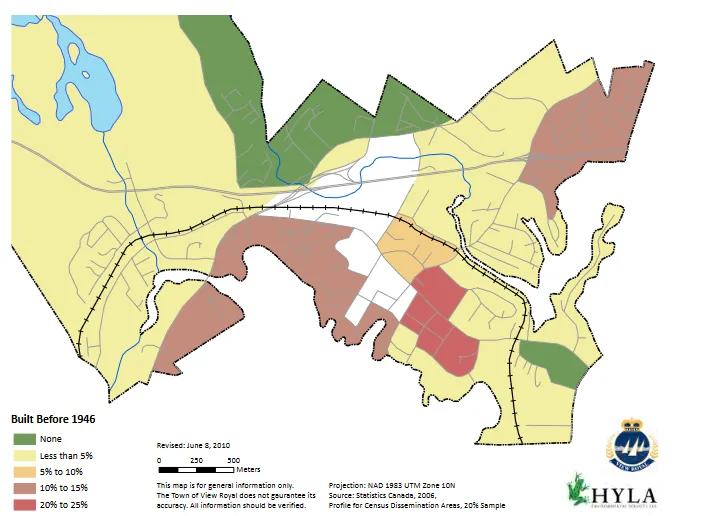
Further information on View Royal’s housing stock is required in order to analyze how many homes within the Town would be affected by a potential bylaw and if it is worthwhile for the Town to adopt a bylaw in addition to working with the CRD on regional-level policies. For example, if there are not many homes built before 1950, a demolition waste management bylaw may be a better option than a deconstruction bylaw.
Furthermore, the City of Victoria noted that there is currently only a small market for reclaimed materials in the area, and as a result, homeowners attempting to sell or donate their salvaged materials have found it challenging to do so. Particularly, building materials take up valuable space and selling salvaged materials is not always a quick process. It has been observed that the demand for reclaimed or salvaged materials responsible for driving desirable market conditions for these materials and business growth for deconstruction projects has not yet materialized in the region.
Demolition Permits & Deconstruction
The Town of View Royal requires all demolition work to be completed under an approved demolition permit. As part of the demolition application review process, the Building Inspector must take the building and/or structure’s age into consideration. If hazardous materials (i.e. asbestos) are suspected within the home, a Hazardous Material Assessment is required to be submitted as part of the application. If the assessment comes back clean, the demolition permit can be issued. However, if asbestos is found in the home, a plan to safely dispose of the hazardous materials is required. The process to remove asbestos safely and remove the materials to a special landfill is a costly process, as the building essentially needs to be deconstructed to remove the contaminated materials safely.
While reviewing Town records it was determined that over the past decade (Table 3), the Town has received an average of three (3) demolition permits a year for single-family residences. However, it is difficult to confirm whether these houses would have met the pre-1950 cut-off date as this information was not recorded.
Table 3: Number of Demolition Permits Received for Single-Family Dwellings within View Royal
| YEAR | NUMBER OF PERMITS |
|---|---|
| 2024 (YTD) | 3 |
| 2023 | 0 |
| 2022 | 5 |
| 2021 | 7 |
| 2020 | 1 |
| 2019 | 3 |
| 2018 | 3 |
| 2017 | 2 |
| 2016 | 1 |
| 2015 | 2 |
| 2014 | 3 |
Furthermore, it is difficult to confirm how much waste from these demolitions would have ended up in the landfill, as contractors and homeowners are not required to take their construction waste to Hartland Landfill. The City of Victoria and the CRD both noted that contractors sometimes will have their construction or demolition waste barged off island and transported elsewhere because it is cheaper than using the local landfill.
BC municipalities with deconstruction and/or demolition waste management bylaws have taken into consideration the size of their municipality (i.e., housing stock) and projections on how many demolitions permits to be anticipated each year. Furthermore, these municipalities have dedicated staff responsible for deconstruction and demolition waste management bylaw implementation and monitoring. By comparison to these municipalities, View Royal is much smaller in terms of population, housing stock and staff capacity and resources. The data that the Town currently has is limited, and in order to obtain a better understanding of the Town’s housing stock, extensive research would be required to determine how many homes within the community were built prior to 1950 or 1960.
Given CRD’s recent changes and future plans to divert waste from the Hartland Landfill, the small number of demolition permits issued each year in the Town, the amount of staff time and capacity that would be required to establish, implement and monitor a deconstruction and demolition waste program, and the need for further engagement with homebuilders and the development industry, Council may wish to consider not proceeding with a new Deconstruction and/or Demolition Waste Management Bylaw until a review of the Official Community Plan and the Town’s existing housing stock are completed. Furthermore, it is recommended that further discussions on this project occur during the 2025 budget deliberations.
Impacts and implications can be summarized as follows:
| Impact Category | Summary |
|---|---|
| Community Impact: | There are no community impacts with this report. |
| Financial Implication: | There are no financial implications at this time. |
| Inter-governmental Relations Impact: | There are no anticipated impacts to inter-governmental relations. However, the CRD would benefit from the Town encouraging the community to think about waste management and potentially prolong the life of the Hartland Landfill. |
ALIGNMENT:
The recommended option aligns with the Town’s following core guiding documents as follows:
- Strategic Plan: Goal 2e: Review implications of potential demolition and deconstruction bylaw.
- Official Community Plan:
- Policy IS 2.9 Waste Reuse: recognize waste as a viable resource. Work with the CRD, other agencies and businesses to develop strategies to reuse solid waste, liquid waste and wastewater generated in View Royal.
- Policy IS 4.4 Construction Waste: Support regional initiatives to reduce construction waste, and encourage sustainable waste reduction practices.
- Other Policy Documents: Community Climate Action Strategy Policy 5.1.4 – Collect construction, demolition, agricultural and industrial wood waste
PUBLIC PARTICIPATION GOAL:
The desired level of public participation for the recommended option is:
[X] Inform [ ] Consult [ ] Involve [ ] Collaborate [ ] Empower [ ] N/A
TIME CRITICAL:
There are no time critical considerations for the Town.
CONCURRENCE:
| CONCURRENCE: | Initials | Comments |
|---|---|---|
| Chief Administrative Officer | SS | I concur with the recommendation. |
REVIEWED BY:
| REVIEWED BY: | Initials |
|---|---|
| Director of Corporate Administration/Deputy CAO | N/A |
| Director of Finance & Technology | N/A |
| Director of Development Services | LT |
| Director of Engineering | IL |
| Director of Protective Services | N/A |
ATTACHMENTS:
- Attachment 1: Summary of Bylaws & Staff Meeting with City of Victoria, City of Vancouver and District of North Vancouver
Document Images
(1)