Annex C. Duty to Consult Determination
A guided template and context document regarding the legal duty to consult with Indigenous peoples on projects affecting Aboriginal or treaty rights.
Annex C. Duty to Consult Determination
Guided Template - Duty to Consult Determination (DTCD)
CONTEXT
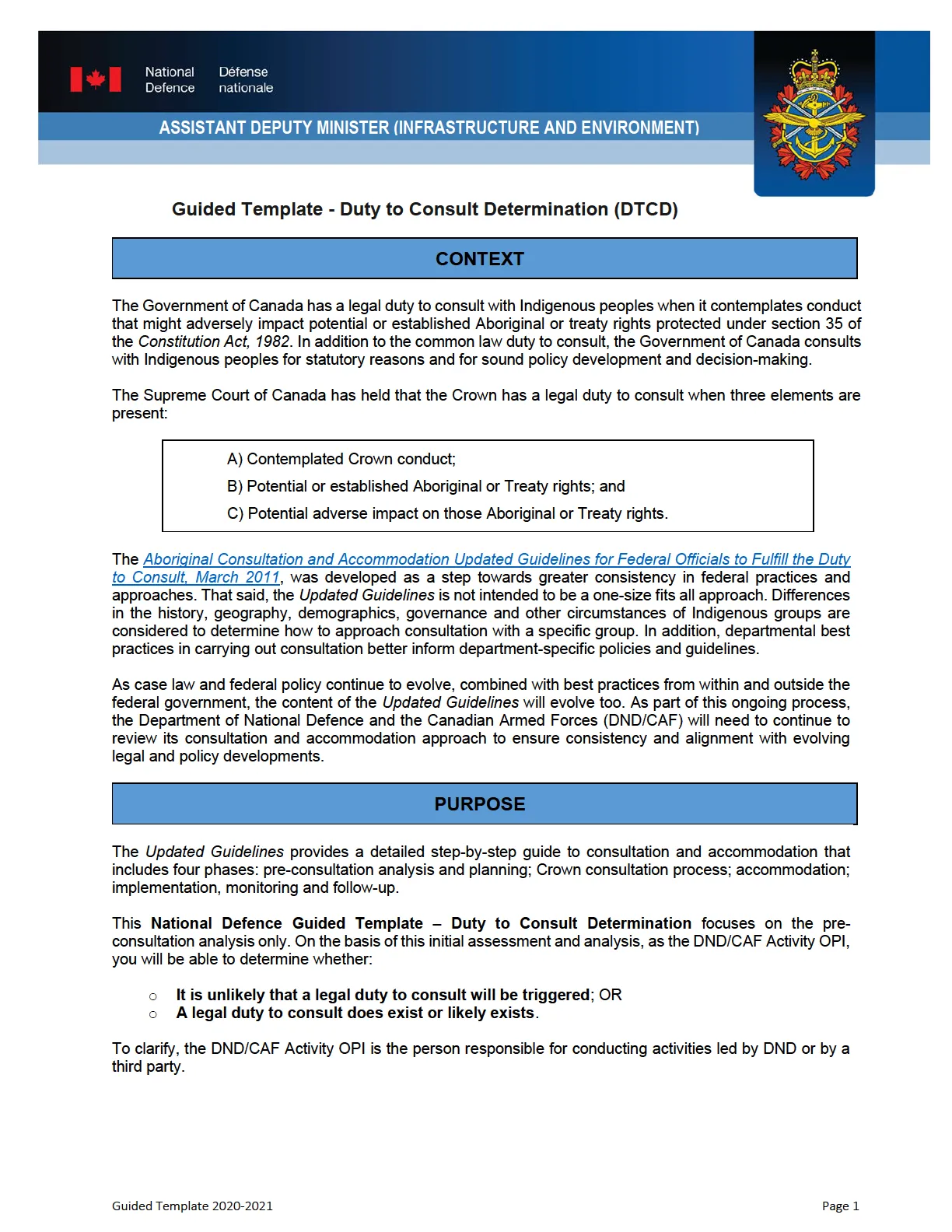
The Government of Canada has a legal duty to consult with Indigenous peoples when it contemplates conduct that might adversely impact potential or established Aboriginal or treaty rights protected under section 35 of the Constitution Act, 1982. In addition to the common law duty to consult, the Government of Canada consults with Indigenous peoples for statutory reasons and for sound policy development and decision-making.
The Supreme Court of Canada has held that the Crown has a legal duty to consult when three elements are present:
A) Contemplated Crown conduct; B) Potential or established Aboriginal or Treaty rights; and C) Potential adverse impact on those Aboriginal or Treaty rights.
The Aboriginal Consultation and Accommodation Updated Guidelines for Federal Officials to Fulfill the Duty to Consult, March 2011, was developed as a step towards greater consistency in federal practices and approaches. That said, the Updated Guidelines is not intended to be a one-size fits all approach. Differences in the history, geography, demographics, governance and other circumstances of Indigenous groups are considered to determine how to approach consultation with a specific group. In addition, departmental best practices in carrying out consultation better inform department-specific policies and guidelines.
As case law and federal policy continue to evolve, combined with best practices from within and outside the federal government, the content of the Updated Guidelines will evolve too. As part of this ongoing process, the Department of National Defence and the Canadian Armed Forces (DND/CAF) will need to continue to review its consultation and accommodation approach to ensure consistency and alignment with evolving legal and policy developments.
PURPOSE
The Updated Guidelines provides a detailed step-by-step guide to consultation and accommodation that includes four phases: pre-consultation analysis and planning; Crown consultation process; accommodation; implementation, monitoring and follow-up.
This National Defence Guided Template – Duty to Consult Determination focuses on the pre-consultation analysis only. On the basis of this initial assessment and analysis, as the DND/CAF Activity OPI, you will be able to determine whether:
- It is unlikely that a legal duty to consult will be triggered; OR
- A legal duty to consult does exist or likely exists.
To clarify, the DND/CAF Activity OPI is the person responsible for conducting activities led by DND or by a third party.
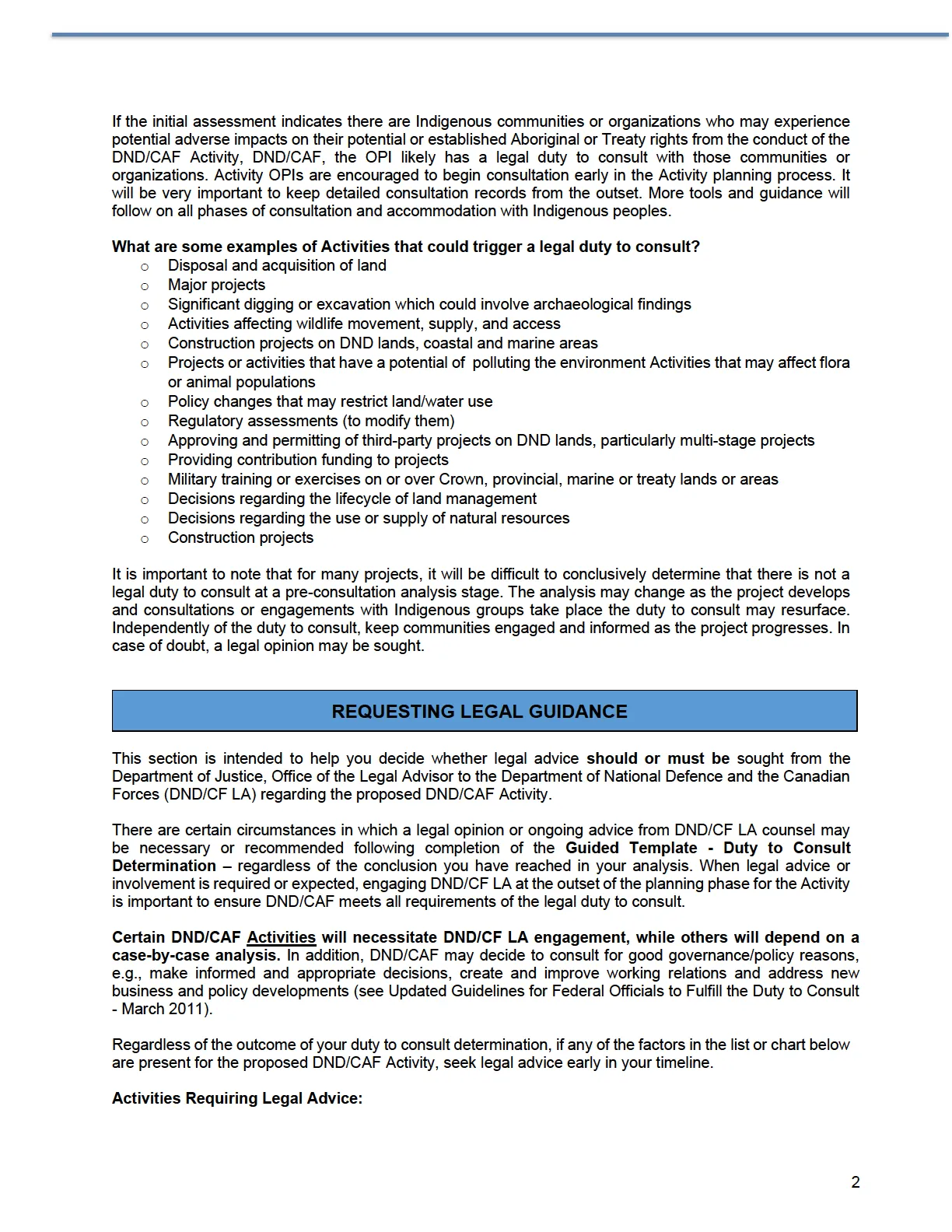
If the initial assessment indicates there are Indigenous communities or organizations who may experience potential adverse impacts on their potential or established Aboriginal or Treaty rights from the conduct of the DND/CAF Activity, DND/CAF, the OPI likely has a legal duty to consult with those communities or organizations. Activity OPIs are encouraged to begin consultation early in the Activity planning process. It will be very important to keep detailed consultation records from the outset. More tools and guidance will follow on all phases of consultation and accommodation with Indigenous peoples.
What are some examples of Activities that could trigger a legal duty to consult?
- Disposal and acquisition of land
- Major projects
- Significant digging or excavation which could involve archaeological findings
- Activities affecting wildlife movement, supply, and access
- Construction projects on DND lands, coastal and marine areas
- Projects or activities that have a potential of polluting the environment Activities that may affect flora or animal populations
- Policy changes that may restrict land/water use
- Regulatory assessments (to modify them)
- Approving and permitting of third-party projects on DND lands, particularly multi-stage projects
- Providing contribution funding to projects
- Military training or exercises on or over Crown, provincial, marine or treaty lands or areas
- Decisions regarding the lifecycle of land management
- Decisions regarding the use or supply of natural resources
- Construction projects
It is important to note that for many projects, it will be difficult to conclusively determine that there is not a legal duty to consult at a pre-consultation analysis stage. The analysis may change as the project develops and consultations or engagements with Indigenous groups take place the duty to consult may resurface. Independently of the duty to consult, keep communities engaged and informed as the project progresses. In case of doubt, a legal opinion may be sought.
REQUESTING LEGAL GUIDANCE
This section is intended to help you decide whether legal advice should or must be sought from the Department of Justice, Office of the Legal Advisor to the Department of National Defence and the Canadian Armed Forces (DND/CF LA) regarding the proposed DND/CAF Activity.
There are certain circumstances in which a legal opinion or ongoing advice from DND/CF LA counsel may be necessary or recommended following completion of the Guided Template - Duty to Consult Determination – regardless of the conclusion you have reached in your analysis. When legal advice or involvement is required or expected, engaging DND/CF LA at the outset of the planning phase for the Activity is important to ensure DND/CAF meets all requirements of the legal duty to consult.
Certain DND/CAF Activities will necessitate DND/CF LA engagement, while others will depend on a case-by-case analysis. In addition, DND/CAF may decide to consult for good governance/policy reasons, e.g., make informed and appropriate decisions, create and improve working relations and address new business and policy developments (see Updated Guidelines for Federal Officials to Fulfill the Duty to Consult - March 2011).
Regardless of the outcome of your duty to consult determination, if any of the factors in the list or chart below are present for the proposed DND/CAF Activity, seek legal advice early in your timeline.
Activities Requiring Legal Advice:
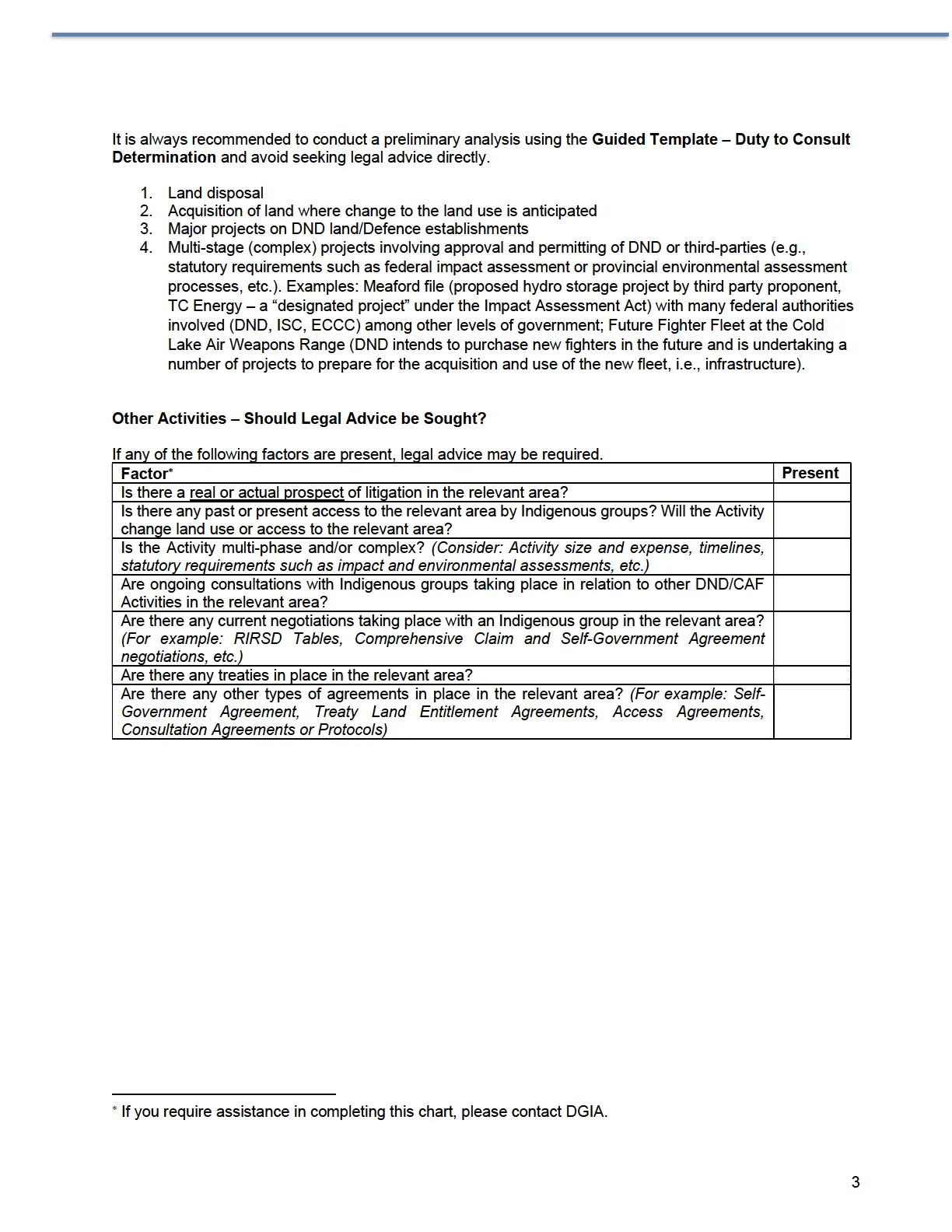
It is always recommended to conduct a preliminary analysis using the Guided Template – Duty to Consult Determination and avoid seeking legal advice directly.
- Land disposal
- Acquisition of land where change to the land use is anticipated
- Major projects on DND land/Defence establishments
- Multi-stage (complex) projects involving approval and permitting of DND or third-parties (e.g., statutory requirements such as federal impact assessment or provincial environmental assessment processes, etc.). Examples: Meaford file (proposed hydro storage project by third party proponent, TC Energy – a “designated project” under the Impact Assessment Act) with many federal authorities involved (DND, ISC, ECCC) among other levels of government; Future Fighter Fleet at the Cold Lake Air Weapons Range (DND intends to purchase new fighters in the future and is undertaking a number of projects to prepare for the acquisition and use of the new fleet, i.e., infrastructure).
Other Activities – Should Legal Advice be Sought?
If any of the following factors are present, legal advice may be required.
| Factor* | Present |
|---|---|
| Is there a real or actual prospect of litigation in the relevant area? | |
| Is there any past or present access to the relevant area by Indigenous groups? Will the Activity change land use or access to the relevant area? | |
| Is the Activity multi-phase and/or complex? (Consider: Activity size and expense, timelines, statutory requirements such as impact and environmental assessments, etc.) | |
| Are ongoing consultations with Indigenous groups taking place in relation to other DND/CAF Activities in the relevant area? | |
| Are there any current negotiations taking place with an Indigenous group in the relevant area? (For example: RIRSD Tables, Comprehensive Claim and Self-Government Agreement negotiations, etc.) | |
| Are there any treaties in place in the relevant area? | |
| Are there any other types of agreements in place in the relevant area? (For example: Self-Government Agreement, Treaty Land Entitlement Agreements, Access Agreements, Consultation Agreements or Protocols) |
* If you require assistance in completing this chart, please contact DGIA.
Document Images
(3)