Letter dated February 6, 2023 from D. Wilson, Re: OCP Restart Plan
A detailed 8-page critique of the OCP project, identifying errors in the Housing Needs Report (HNR) and Land Economics Study (LES), and calling for a redo of the HNR.
291 View Royal Ave. Victoria BC, V9B 1B1
February 6th, 2023
Mayor and Council Town of View Royal 45 View Royal Ave. Victoria BC, V9B 1A6
Dear Mayor and Council:
I am writing to you today about the agenda item recommending the restart of the Official Community Plan (OCP) project that will be addressed during the February 7, 2023 council meeting. On the agenda staff bring forward two recommendations.
The first recommendation is: THAT Council receive the report titled “Draft Official Community Plan Update – Restart Plan” from the Community Planner for information. I fully endorse that recommendation. Accepting this report will allow an open discussion that the residents of View Royal deserve to be privy to.
The second recommendation is: AND THAT Council restart the Official Community Plan update and move forward with the final phase of the project. I object to this recommendation in the strongest possible terms and ask that council reject this staff recommendation.
I would like to provide the reasons for my objection.
Staff have had the 2022 Draft OCP to work on for at least nine months but, to be fair, from a public viewpoint, the project was “paused” for much of that time. The draft OCP was placed on the agenda along with 11 pages of contextual information and a 95-page document (partial) change register with only 4 days from release to the expected vote. Moving a complex project forward with only a 4-day review time frame is an unbusinesslike ask that must be rejected.
Since the inception of this project the public have been told that this is only a minor update. Staff and elected officials often called it a tweak. Please refer to the Scope of Work statements in the February 7th agenda recommendation. When you compare the Scope of Work to the 2011 OCP Table of Contents it shows that every single section of the OCP is being changed except the Introduction and Part 5 Implementation. If you go to the 2022 Draft OCP you will see that the Introduction has actually changed as well. There is only one change to Part 5 and it is not subtle; Part 5, the only component of the OCP dealing with implementation and sustainability monitoring has been completely removed without even a mention in the document change register. Clearly, this project is not a minor update. The scope, the draft and the change register all refute that notion.
The recommendation on the agenda explains that the update needs immediate attention and gives us this under the heading “Time Critical”:
“The Town’s current OCP was adopted in 2011 and has not had a review or update since its adoption 12 years ago. There are areas where the OCP is working very well for the Town, but there are also areas that needed to be reviewed and updated to ensure the Plan is consistent with the adopted Parks Master Plan (2017), Community Climate Action Strategy (2022), Housing Needs Assessment Report (2020), and Land Economics Study (2021).”
I am alarmed to see that the staff would assert that the OCP must be updated to “ensure the Plan is consistent” with the Housing Needs Report (HNR). It was only a few weeks ago during the January 10 Committee of the Whole meeting that staff assured council, correctly, that legislation requires that the HNR content only needs to be “considered” when creating or amending an OCP. It cannot be both. On the other hand, contradictions seem to be one of the constants in this project.
I say I am alarmed but I am certainly not surprised that the HNR figures prominently in the OCP project. The OCP project Request for Proposals (RFP) clearly spells out that the HNR, previously called a Housing Needs and Gaps Analysis, will be a fundamental source for the project. The Startup section of the RFP tells prospective contractors, in the following order, that they will:
- Reference the recent Housing Needs and Gaps Analysis for context and information, using the review to assess, as a community, how we might address housing needs.
- Update the Housing chapter in the OCP to respond to Housing Gaps and Needs Study.
- Engage the community in discussion about future housing forms in neighbourhoods.
This objective to ensure the content of the HNR is in the OCP alarms me because the HNR is not a complete or accurate report. On December 14, 2021 I brought this to the attention of council and staff during a Petitions and Delegations session at the Council of the Whole meeting. In response I was told that it was created by a professional; that was one of two take-aways. The second takeaway is that staff and council have been informed and cannot in the future claim otherwise.
Mayor Tobias brought a similar concern forward in the January 10 Committee of the Whole meeting. Once again, a key element of the staff response was that it was produced by a qualified professional working for the contractor.
That person may be a qualified professional but today they do not appear on the register of the Planning Institute of BC (PIBC), the association that certifies Registered Professional Planners (RPP). In fact, membership in PIBC comes with the Right to Title, that is, to put the initials RPP after a member’s name, but the province did not confer Right to Practice on PIBC members. This means any person is allowed to undertake planning work in BC.
I must note here that the concept of professional reliance being used as a shield to curtail or deflect the discussion of legitimate concerns about work quality is repugnant to me. Professionals put the public interest first. Every time.
To date I cannot detect that there has been any review, investigation or even any real curiosity expressed about the quality of the HNR. To ensure that the content of this report is included in the OCP is folly. The HNR was accepted in 2020 by council, at the recommendation of staff, as a finalized report.
A cursory read reveals an array of errors that cannot be reconciled with any businesslike expectation of a finished document. Closer inspection reveals great challenges in accuracy and in data use that, left unexplained and unmitigated, condemns any OCP content that stems from it. The HNR has caused a significant loss of confidence in the OCP project among the residents of View Royal.
One other shortcoming of the View Royal HNR is that it offers very little context through comparison to other municipalities. This is certainly not one of the objectives or a requirement of an HNR but it is a feature in many HNR’s that have been developed in BC. Contextualizing information is important in the process of turning data into knowledge; I will comment more on context later.
Another foundation document used in the OCP update project is also listed under the “Time Critical” heading. This is the Land Economics Study (LES). The full title tells the reader a little bit more about the report; View Royal Land Economics Study: Evaluation of the Prospects for New Urban Development.
This study was provided by a contractor who was solicited through an RFP. The RFP clearly explains that the purpose of the LES report is to guide policy development and assist the Town in preparing to review the Official Community Plan in 2020. The RFP includes these reasons for undertaking the LES study:
- The Town’s Official Community Plan designates several areas for commercial or intensive mixed use, however there has not been significant development interest on parcels with these designations. Many properties are underutilized, or vacant.
- In addition to these designated commercial/mixed use areas, there are selected areas on major transportation routes that we anticipate will redevelop over the next 5-15 years. We are interested in understanding what ‘carrots and sticks’ the municipality might employ to encourage investment in these corridors.
- As we prepare to review the Official Community Plan in 2020-21, good information is needed to allow a productive community conversation about the future of these areas.
It seems clear from the RFP that the LES will focus on commercial/mixed use areas and the Terms of Reference section supplies maps that define the four study areas. Useful objectives are set out in the RFP and expressing that they are needed for productive community conversation is an encouraging and forward-looking statement about the processes to expect in the OCP update. But, again, context is important and, once again, I will reserve context comments until a bit later.
The LES has clearly played a large role in the draft OCP. It results in large increases in allowable density for virtually all land in View Royal. Under this completely new, almost town wide density-increase the building heights must rise to accommodate the new density. Because there will now be taller buildings along the corridors the draft OCP uses that height to justify the need for higher density in completely new transition zones surrounding the now higher study corridors, expanding into areas that are not in the existing corridors and not known publicly until the very day the draft OCP was released. To be clear, no public consultation took place using a map showing the new transition zones.
The LES, somewhat unsolicited, also sees strong possibilities for higher density in those crown jewels of View Royal, the R-1 Residential areas, but cautions that real developer profits may be difficult without at least a six-plex per lot. The draft OCP certainly contemplates significant access to these areas for infill development. Unfortunately, the description of what infill might actually mean seems very flexible at this point so we don’t know what the outcome might be. The draft OCP certainly does not provide a definitive statement on what this sudden six-fold density increase would look like. The public consultations I attended outright denied that this was contemplated.
On page 50 of the draft OCP it sets the goal to “preserve the valued ambiance, scale, and character of established residential neighbourhoods while enhancing connections between neighbourhoods and to mixed-use centres” through a policy of Targeted Residential Infill. Apparently, this seemingly contradictory state will be safeguarded by a guideline to be developed in the future. The draft OCP tells us this Targeted Residential Infill “should be designed to integrate into the existing neighbourhood and should adhere to Infill Guidelines to be developed by the Town following the adoption of this plan.”
Perhaps because I am aware that back in the 2011 OCP (Action LU5 page 184) a promise was made, but never fulfilled, to “prepare an infill development guidebook”, I felt like I heard the echo of a hard sales pitch – hey pal, you can trust me, sure you can. Given that the work is ten years overdue so far there is little confidence that the staff will follow through once this new OCP is accepted and becomes a bylaw. This leaves residents open to development of anything that staff deem “consistent” with the OCP. Recent legislation says we can be required to accept that decision with no recourse to a public hearing.
One also has to ask, has anyone determined what the build out of this LES study means to View Royal? There was definitely no context related to this in any of the public consultation that led to the draft OCP unless you took a deep dive into the LES. So much for the “productive community conversation” objective in the RFP. The LES makes some projections of build out. Quite smartly they give a low/high growth range of outcomes for commercial and apartments along a timeline out to 2040 (a distant future with real forecast shortcomings). The number of apartments that will be developed between 2019 and 2025 is given as a low estimate of 439 and a high estimate of 549. This is where I need to touch on accuracy as I edge toward the comments on context.
The LES provides the estimates I just showed in a clear crisp table that anyone can read. I appreciate that. The HNR does nothing of the sort. It does give quite a few different numbers for how many dwellings are needed or perhaps how many households there will be created between 2016 and 2025. The HNR variously states that as 643, 1205, 820 and 1055 and at the same time explicitly states that they do not provide a value judgment on, or recommend, any one particular number they have provided. Despite that, the number 643 somehow washes up as one recommendation on the Housing Needs Reports - Summary Form. But 1055 also pops up on that form and since the HNR makes no attempt to explain I am certainly not going to try, except to say the most likely reason is an observable series of errors.
But here is my point on accuracy. While the HNR and the LES were being produced there was a great deal of building being approved in View Royal and staff had complete access to the exact numbers of approved developments and permits that could have improved the projections of both documents. As it turns out, the Canada Census Profile for 2016 and 2021 shows us that View Royal gained 761 private dwellings occupied by usual residents in that 5-year period. This means that the actual measured growth of View Royal has, in 2021, outstripped both the low and high 2025 projections of the LES and at least the lowest of the HNR projections. And there are four years to go before 2025 with more building than I have ever seen in View Royal under way. This renders the HNR and the LES output redundant.
And this all brings me to the need to put it in context. The public consultation should have been done after the staff took all the data that was available, made sure it was as current as possible and then contextualized it to make it into knowledge that the residents could use to provide informed feedback. But this wasn’t done. The public consultation had a lot of questions about whether people support more housing, and by-and-large they do, but we were never told how much to expect or what specific changes were going happen or how or why the town staff were working so hard to further accelerate an already massive rate of growth.
We were never told that View Royal has been growing faster than every municipality in the CRD except Langford (and occasionally Sooke or Highlands). Since 1996. No one has explained why View Royal must strive for higher density at a faster rate than the other communities in the CRD. There is no explanation of what the increased densities that flow from the LES into the OCP will do to the growth rate of View Royal. Every community in the CRD is going to change; why is View Royal so determined to densify every square inch as fast as possible? Why didn’t the public consultation have that context to inform the responses?
Providing context through a comparison of growth rates is one way to paint a picture of View Royal. We are a rocket ship of development in the CRD. When the public consultation asks vaguely - are you in favour of more housing? - people mostly say yes. But they probably would not agree that we need to add ever greater density and further accelerate the pace of growth if they had this graph to provide context before that question was asked:
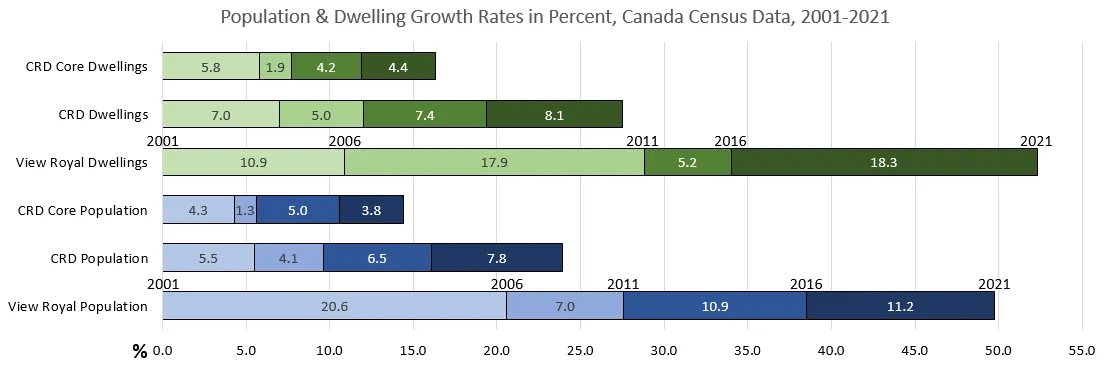
If people were told that the actual growth in View Royal had outstripped the projections for 2025 before the paint was dry on the reports that were supposed to predict growth, why would they support the need for Intensive Infill, expanded development corridors and high-density Transitions Zones? Without this context the public consultation robbed us of informed comment and the results are completely invalid.
Context can be provided in many ways. Ordinary two-dimensional maps are the most common communication device used to show elements of land use. During the public consultation process there were no maps of what was being planned. Even in the draft OCP the maps are small with vague purple blobs that, thirty-odd years into the GIS age, are so outmoded that they are useless. In 2021 I asked staff to provide maps to show the plan; the maps in the agenda document still do not fulfill that need.
However, there are some colourful but blurry drawings of apartment blocks and townhouses trailing off into a vague neighbourhood. More like stock pictures bought off the net, the land is flat, the streets are wide. But never a hint of where that might be located on a map of View Royal. This was the contextless view we were given of the Transition Zones, the much-enlarged areas of increased densities surrounding the now larger corridors than were envisioned in the 2011 OCP. During public consultation walkshops we were told that the development and density was limited to the existing corridors. Now the justification for the Transition Zones is the increase in height and density in those corridors. The public never saw this on a real map and never had the context to make an informed comment.
I could go on about context (as I’m sure you can tell) but I think I will bring in an expert who commented on this elsewhere. Alan Osborne, an experienced planner living in North Saanich helped his community resolve their differences over an OCP that had become contentious. Much like the public consultation in View Royal, people felt they had not been properly consulted. Mr. Osborne concluded his wise thoughts on the need for context in consultation during a talk to the parties involved by saying:
“When you present options without the context you’re relying on people to connect the dots, link the issues together, do their own research, and do their own analysis. That’s not realistic. As planners you should be doing this work: present the context, the challenges, identity the tough choices that need to be made and give your best assessment of the implications of each option. With this information residents would be in a position to provide informed input.”
Leaving that topic, I will try to summarize and then suggest a remedy to these issues. The summary, despite the long-winded walk that got us here, might be shorter and I hope it frames the two issues.
First, there is no confidence or evidence that the ever-increasing rate of development stemming from the LES is necessary or desired and, until it is explained, the draft OCP cannot be supported. The public were not properly informed prior to consultation and that cannot be resolved without re-consulting an informed populace.
Second, the supporting documents have challenges. The HNR more than the LES, in fact it is probably unfair to group the two together.
The job of the HNR was to accurately describe the past (up to 2016 from census data), measure and describe the present using permits and approved development figures, and then organize that data so it became knowledge. From that point a 5-year projection of population and dwelling growth is required and applying common time series forecast tools would have given that. The HNR never got past 2016.
The LES is a much better study. The question here is do we need to employ the recommended changes to created substantially more density at a faster rate? Unless the staff can clearly tell residents why View Royal needs to employ additional tactics to attract more development when we already launched into a pattern of high growth twenty years ago, we simply don’t need to chase the recommendations in the report. The report does what it was asked to do (and quite a bit more once they spotted the R-1 zones) but, unlike the HNR, there are no regulations that require it’s use. Perhaps using small pieces of the LES study to target desired growth types on specific lands would be more appropriate.
The draft OCP also has challenges. The high rate of inaccuracy found in the HNR has infected the draft. Bad “statistics”, incorrect data and data references are easy to find.
The document change register is a long-awaited improvement but there may be an issue here too. The rather meager part of the 2011 OCP that gives some hope of monitoring the implementation and progress of the OCP, Part 5 Implementation, has been deleted; I do not see it in the change register.
A quick note on implementation and monitoring measures inside the OCP. This will be mandatory when View Royal’s new Asset Management Framework is put in place – so why remove this lonely attempt at accountability now? Saanich is also updating their OCP. Here are two of their top five priorities to guide that project:
- Integrate updated demographic data and statistics
- Strengthen monitoring and implementation
Finally, I think it is time to address the remedies.
Good project management techniques include constant reassessment, correction of issues and errors in real time and the courage to recognize when a project must re-do elements that have not been successfully completed. Failing to correct error as soon as it is found puts the rest of the project at risk and each delay in remedial action adds to the eventual cost of that remedial action. The View Royal OCP project is at a decision point that needs to consider these hard facts of project life.
Stepping back to re-do segments of the project is necessary. Yes, it costs money. It would have cost less to correct earlier when the issues were identified. But here we are.
First, the HNR needs to be redone. This HNR cannot be recovered, certainly not by the original team. It does not take a year as staff noted on January 10th. The original HNR team notes that they created 60 HNR’s in a three-year period, about 18 days per HNR. Staff will need to organize and supply the data owned by the Town, a step that seems absent in both the HNR and the LES. Costs would likely be lower (perhaps 60%) if the contract is not given to a company that gives 60% of profits to advocacy groups (this is a project business decision not a charity decision).
With a new HNR in hand the vast differences between the 2011 OCP and the proposed future created by following the LES can be clearly mapped. This must highlight the enormous changes in density proposed throughout View Royal in the LES. From there the staff must provide evidence that this huge change is necessary and sustainable in the context of View Royal growing as a small part of the CRD and balanced against the resident’s desire (rights?) to preserve some semblance of the town they chose to live in.
Once all of that data is gathered and contextualized to turn it into sound knowledge, once a realistic and justifiable view of the future is developed, there must be an iterative process of public consultation. It may be hard to restore the public confidence in that process and that must be considered during planning; lost trust is difficult to regain.
If those steps are taken the project will be on a footing to continue. It will result in a new draft. It will take time and some money. The alternative is project failure and public discontent. The risk is turning the lack of public confidence in a project into lack of confidence in the council. That is a reputational risk for the Town that can be avoided.
Best regards,
Doug Wilson