TOWN OF VIEW ROYAL FINANCIAL PLAN ORIENTATION PRESENTATION
Slide presentation detailing the municipal budget process, legislation, financial sustainability principles, and the organization of the 2023-2027 budget package.
TOWN OF VIEW ROYAL FINANCIAL PLAN ORIENTATION
February 7, 2023
Purpose
To orient Council to the Proposed 2023-2027 Financial Plan package:
- Financial planning legislation
- Financial sustainability
- Budget development process
- Budget package organization

Legislation
Community Charter, S 165:
- Municipality must have a financial plan adopted annually by bylaw before the annual tax bylaw is adopted (May 15); can be amended any time
- Must cover 5 years
- Must be balanced – expenses cannot exceed revenue
- Must identify transfers for reserves and surplus
- If actual expenses exceed revenues, the deficit must be included in the next year’s financial plan as an expenditure
Financial sustainability
“Meeting the needs of the present without compromising the ability of future generations to meet their own needs.”
“a government's ability to manage its finances so it can meet its spending commitments, both now and in the future, and whether it ensures future generations of taxpayers do not face an unmanageable bill for government services provided to the current generation.”
Requires:
- Looking beyond the current year and past current electoral term
- Matching underlying nature of expenditure with source of funding
Source: https://www.gfoa.org/materials/role-of-the-finance-officer-in-supporting-fiscal-sustainability
Balanced budget
Legislation requires expenses (and transfers out) to not exceed revenue (and transfers in).
Structural balance means:
Recurring revenues are equal to recurring expenditures.
Revenue
| Recurring | Not recurring |
|---|---|
| Taxation | |
| User fees (garbage, sewer) | |
| Sales of services, penalties, license fees | Fines |
| Building/development permit fees? | Contributions from developers (DCCs, CAC, cash in lieu) |
| Grants? | Grants? |
| Investment income? | Investment income? |
| Casino revenue? | Casino revenue? |
| Surplus, windfalls, sale of assets |
Expenses
| Recurring | Not recurring |
|---|---|
| Labour | Elections – labour, supplies, etc. |
| Contracted or professional services | One-time projects – contracted or professional services |
| Utilities (water, sewer, power) | Acquisition of tangible capital assets |
| Supplies | Changes in levels of service? |
| Insurance, legal | Contingency |
| Debt service? | Debt issue or payout |
| Contributions to reserves? | Contributions to reserves? |
Principles
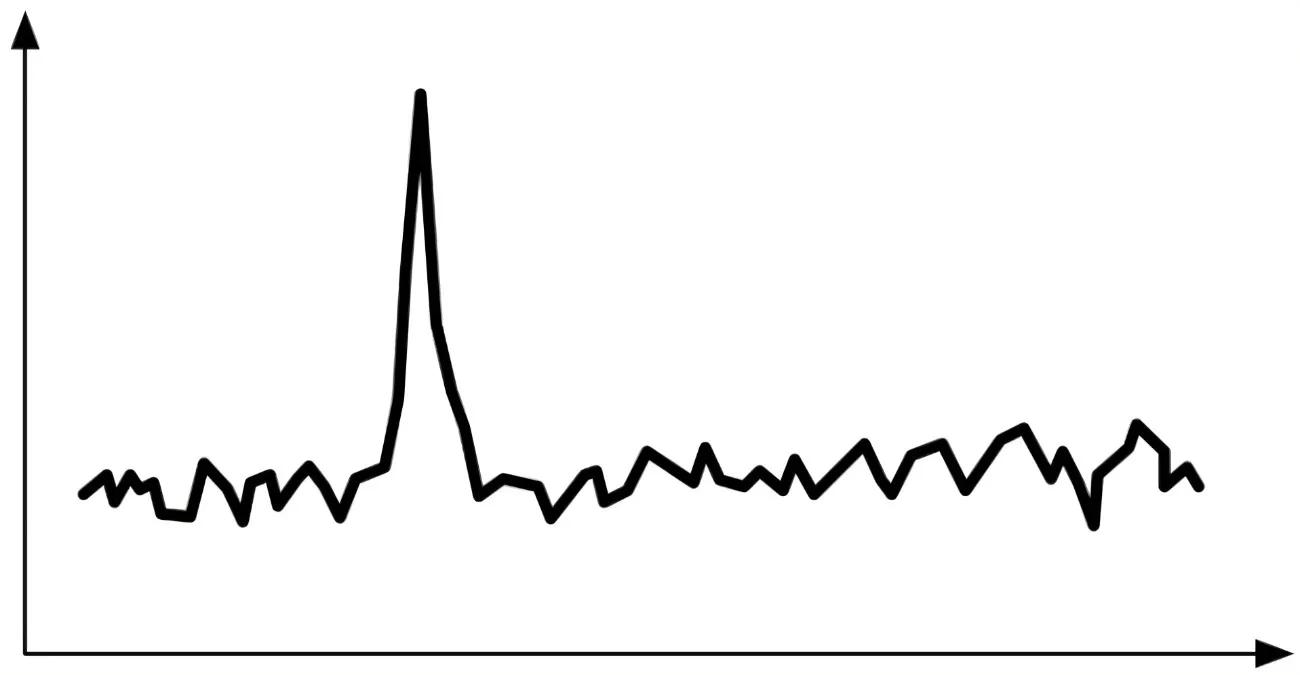
If expense is a one-time thing or infrequent, fund from non-recurring revenue.
Non-recurring revenue
The following diagram maps not recurring revenue sources to specific reserve targets:
- Contributions from developers -> Statutory reserves
- Sale of assets -> Multi-purpose reserves
- Casino revenue -> Capital reserves and Reserve accounts
- CWF (Community Works Fund) -> Reserve accounts
- Windfalls -> Multi-purpose reserves, Capital reserves, Reserve accounts, and Operating reserves
- Grants -> Deferred revenue
- Surplus -> Accumulated surplus
Surplus
What happens when we use surplus to reduce taxes?
Year 1 Budget
- Cost of services: $1,000
- Taxes: $1,000
- Surplus: $0
Year 1 Actual
- Cost of services: $900
- Taxes: $1,000
- Surplus: $100
Year 2 Budget
- Cost of services: $1,020
- Taxes: $920
- Surplus (deficit): $-100
Year 2 Actual
- Cost of services: $1,020
- Taxes: $920
- Surplus (deficit): $-100
Year 3 Budget
- Cost of services: $1,040
- Taxes: $1,040
- Surplus: $0
Year 3 Actual
- Cost of services: $1,040
- Taxes: $1,040
- Surplus: $0
Taxpayer point of view
- Year 1: $1,000
- Year 2: $920 (8% decrease)
- Year 3: $1,040 (13% increase)
Schedule and process
Staff project future costs based on best info at the time, considering:
- Market increases (inflation)
- Contractual requirements
- Growth
- Established levels of service
- Strategic plans
- Master plans
- Financial policies
- Historical experience
- Etc.
Proposed Financial Plan Inputs
A funnel diagram illustrates the Proposed Financial Plan is formed by:
- Council initiatives
- Strategic and master plans
- Financial policies
Timeline
- February: Workshops
- March: Grants in aid, Online Citizen Budget
- April: Results from online engagement, Approval in principle, Tax rates
- May: Bylaws adoption, Tax notice with informational insert
Budget Workshops
- Less presentation, more conversation

Speech bubbles icon - Noted

People with question bubble icon - Shared with all

Email icon - Clear direction

Compass icon
Budget package organization
Distributed February 7, 2023
- Introduction
- Council initiatives
- Schedule 1 Consolidated Financial Plan
- Schedule 2 Non-core Projects
- Schedule 3 Capital Projects
- Schedule 4 Projected Reserve Balances
- Schedule 5 Service Plans Budgets
- Project Summaries
- Glossary
Consolidated Financial Plan
The consolidated financial plan is built from several components represented as puzzle pieces:

Light blue puzzle piece labeled Core 
Yellow puzzle piece labeled Non-core 
Dark blue puzzle piece labeled Capital - A fifth piece represents "Ops cost of capital".
Organization of Schedule 1
Schedule 1.1 = Schedule 1.2 + Schedule 1.3
*
*
Schedule 2 Non-core Projects
Schedule 2.1: Listing of proposed projects
- By functional division
- In priority order:
- In progress
- Critical
- Required
- Strategic
- Discretionary
Schedule 2.2: Same projects
- By year
- By cross-ref number (N-xxx)
- Showing source(s) of funding
Schedule 3 Capital Projects
Schedule 3.1: Listing of proposed projects
- By functional division
- In priority order:
- In progress
- Critical
- Required
- Strategic
- Discretionary
Schedule 3.2: Same projects
- By year
- By cross-ref number (N-xxx)
- Showing source(s) of funding
Schedule 3.3
- Operational costs of capital projects
Schedule 4 Projected Reserve Balances
Listing of reserves:
- Capital reserve funds
- Operating reserve funds
- Statutory reserve funds
- Reserve accounts
- Multi-purpose reserve funds
Showing for each year:
- Contributions
- Uses
- Projected opening/closing balances
Schedule 5 Service Plans Budgets
Financial plan by functional division:
- Revenue
- Expense
- Total
For 2023, detailed columns:
- Core (and % change)
- Non-core
- Operational costs of capital
- Total budget (and % change)
2024-2027:
- Shows total budget and % change
Project Summary
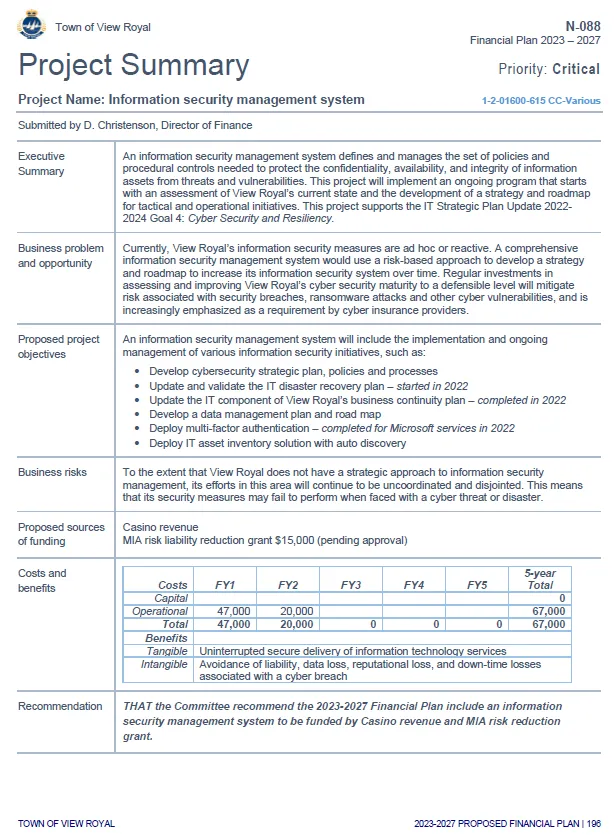
The Project Summary document provides details including:
- Cross reference number (e.g., N-088)
- What? (Project Name: Information security management system)
- Priority (e.g., Critical)
- Who? (Submitted by: D. Christenson, Director of Finance)
- Executive Summary (Coles notes describing the project and strategic alignment)
- Why? (Business problem and opportunity)
- What specifically? (Proposed project objectives)
- Down sides? (Business risks)
- Funding source? (e.g., Casino revenue, MIA grant)
- When and how much $? (Costs and benefits table over 5 years)
- Benefits? (Tangible and Intangible)
- Recommendation:
THAT the Committee recommend the 2023-2027 Financial Plan include an information security management system to be funded by Casino revenue and MIA risk reduction grant.
Upcoming budget sessions:
- Regular Council: 7 pm, February 14, 2023
- Special Committee of the Whole: 6 pm, February 15, 2023
- Special Committee of the Whole: 6 pm, February 16, 2023
- Special Committee of the Whole: 6 pm, February 21, 2023 IF REQUIRED