FACTSHEET: TOWN HALL ENERGY STUDY
Technical factsheet summarizing the findings of the 2023 energy study for the Town Hall building.
FACTSHEET: TOWN HALL ENERGY STUDY
(Data From: SES Consulting. (2023). Town Hall and Parks Shed Energy Study. Town of View Royal)
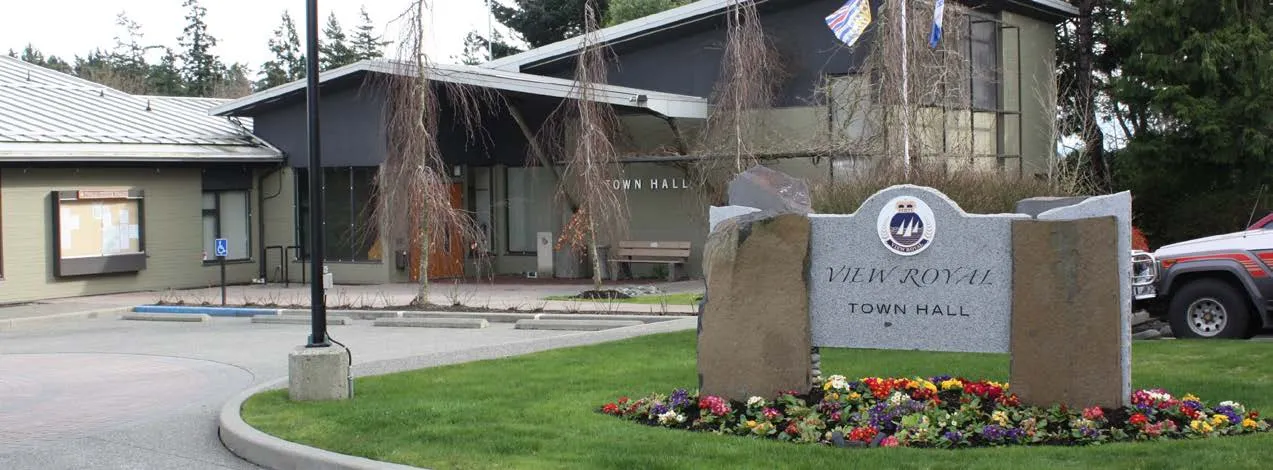
| Facility Name | View Royal Town Hall |
| Facility Address | 45 View Royal Avenue |
| Facility Size | 10,525 sq. ft. (includes Parks bldg.) |
| Year Built | 1997 |
The Town Hall building consists of two floors that houses the Corporate Services, Development Services, Finance and Engineering Departments. The building also has several multi-purpose rooms and the Council Chambers. The public generally utilize the space to attend Council meetings, obtain various permits and to pay property taxes.
The Town Hall building also consists of the Parks yard that house the Parks Department. One public vehicle charging station is located in the upper parking lot, while additional charging units are installed elsewhere the Town’s electric fleet vehicles.
End Use Breakdown (Current)
Electric Consumption
- Lighting: 23%
- Electric Heating: 23%
- Plug Load: 22%
- Domestic Hot Water: 16%
- Ventilation: 9%
- AC System: 7%
Combined Natural Gas and Electricity Consumption
- Electricity - Mechanical Equipment: 39%
- Gas Equipment: 28%
- Electricity - Lighting: 17%
- Plug Load: 16%
Greenhouse Gas (GHG) Emissions
- 2022 Baseline GHG: ~12 tCO2e
- Projected GHG (All Actions Complete): ~4 tCO2e (65% reduction)
The majority of GHG emissions at the Town Hall building is generated through its temperature control system. By converting to electric air source heat pumps (ASHP’s), renewable electricity would be used to replace natural gas usage for cooling and the majority of the heating. As a result, the building could see up to a 6.4 tonne reduction in GHG emissions alone with the ASHP replacement (a 53% reduction)
Energy Use
- 2022 Baseline Energy Usage: ~221 GJ (gas), ~453 GJ (electricity)
- Projected Energy Usage (All Actions Complete): ~61 GJ (gas) (72% reduction), ~444 GJ (electricity) (2% reduction)
The nominal reduction in electricity usage is due to the increased loading from the new ASHP’s. While this means only a nominal reduction in energy costs, the Town would be sheltered from additional future costs associated with natural gas (rising carbon taxes, unstable market conditions).
The replacement of the domestic hot water (DHW) tank to an integrated heat pump DHW heater offer efficiencies of 250%-400% as compared to electric DHW heaters. This accounts for the majority of energy savings, which generally offset the additional loading of the ASHP’s.
Key Actions to Reduce Energy Use
| Key Actions to Reduce Energy Use | Natural Gas Reduction (GJ) | Electricity Usage Reduction (kWh) | GHG Emission Reduction |
|---|---|---|---|
| Wifi Thermostats | 30 | 800 | 1.5 |
| Timer Switches | - | 1,100 | - |
| DHW HP | - | 14,000 | 0.1 |
| ASHP’s (x5) | 130 | (13,300) | 6.4 |
| TOTAL | 160 | 2,600 | 8.0 |
*All values are annual amounts
Reduction Outcomes
- Energy Footprint: 25%
- Electricity: 2%
- Natural Gas: 72%
- GHG’s: 65%
Alignment with Town Initiatives

C. Environmental Stewardship Decrease per capita GHG emissions for buildings and transportation by 2030 based on 2012 Community Energy and Emissions Inventory Report

GHG Reduction Initiatives for Existing Buildings
- Sets an example in advancing the target of reducing GHG’s of existing commercial buildings (7% of total reductions)
- Sets an example in the strive to achieve CAEE Existing building targets by retrofitting mechanical, electrical, plumbing, old A/C and chillers, water heaters with more efficient equipment
Decarbonize Existing Buildings Consistent with Town Objectives in:
- Improving Energy Efficiency
- Encouraging and enabling fuel switching
Document Images
(5)