Open Letter to BC Minister of Energy and Mines Bill Bennett
Formal letter from the District of Hudson's Hope to the provincial government detailing technical and economic objections to Site C.
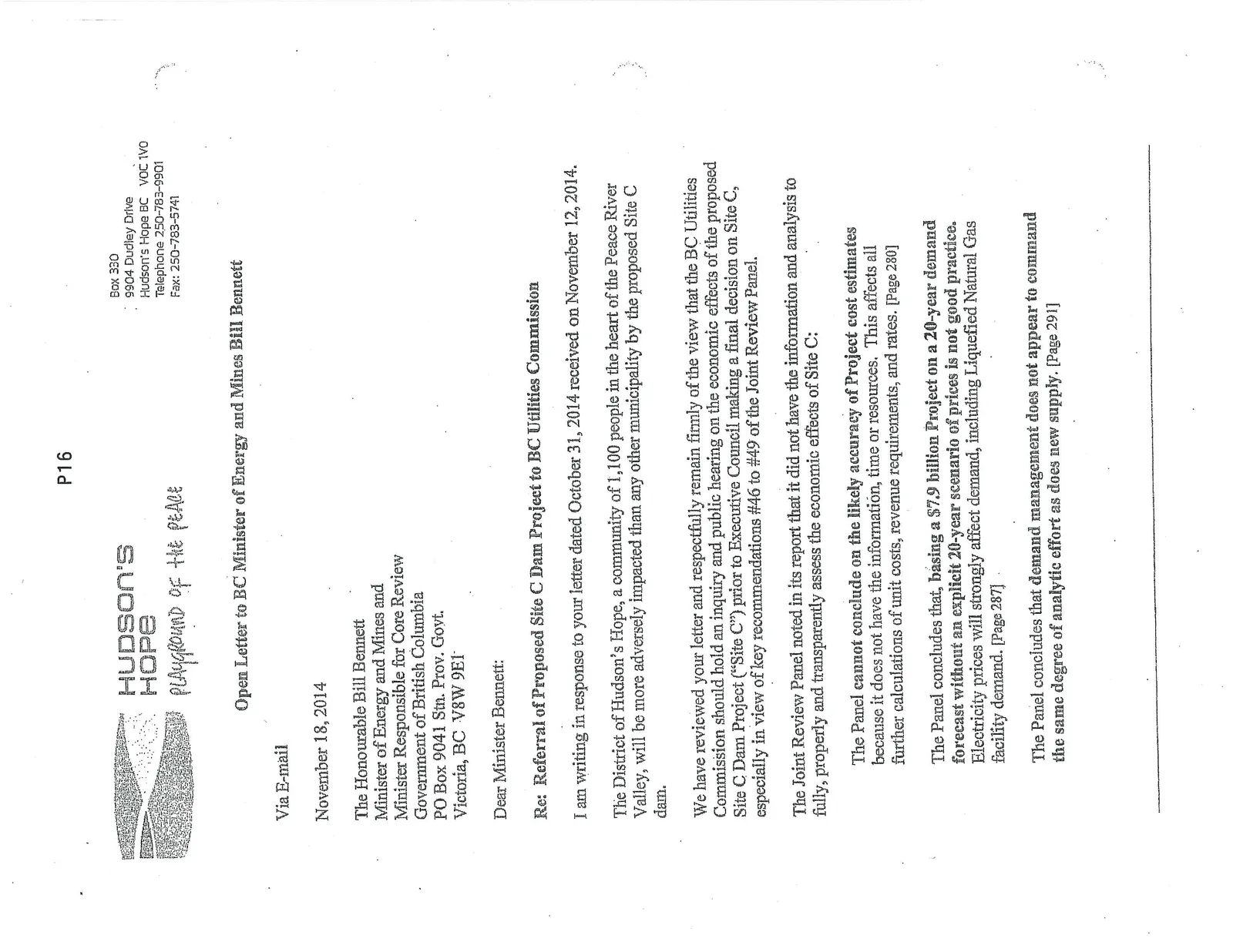
Open Letter to BC Minister of Energy and Mines Bill Bennett
Via E-mail
November 18, 2014
The Honourable Bill Bennett Minister of Energy and Mines and Minister Responsible for Core Review Government of British Columbia PO Box 9041 Stn. Prov. Govt. Victoria, BC V8W 9E1
Dear Minister Bennett:
Re: Referral of Proposed Site C Dam Project to BC Utilities Commission
I am writing in response to your letter dated October 31, 2014 received on November 12, 2014.
The District of Hudson’s Hope, a community of 1,100 people in the heart of the Peace River Valley, will be more adversely impacted than any other municipality by the proposed Site C dam.
We have reviewed your letter and respectfully remain firmly of the view that the BC Utilities Commission should hold an inquiry and public hearing on the economic effects of the proposed Site C Dam Project (“Site C”) prior to Executive Council making a final decision on Site C, especially in view of key recommendations #46 to #49 of the Joint Review Panel.
The Joint Review Panel noted in its report that it did not have the information and analysis to fully, properly and transparently assess the economic effects of Site C:
The Panel cannot conclude on the likely accuracy of Project cost estimates because it does not have the information, time or resources. This affects all further calculations of unit costs, revenue requirements, and rates. [Page 280]
The Panel concludes that, basing a $7.9 billion Project on a 20-year demand forecast without an explicit 20-year scenario of prices is not good practice. Electricity prices will strongly affect demand, including Liquefied Natural Gas facility demand. [Page 287]
The Panel concludes that demand management does not appear to command the same degree of analytic effort as does new supply. [Page 291]
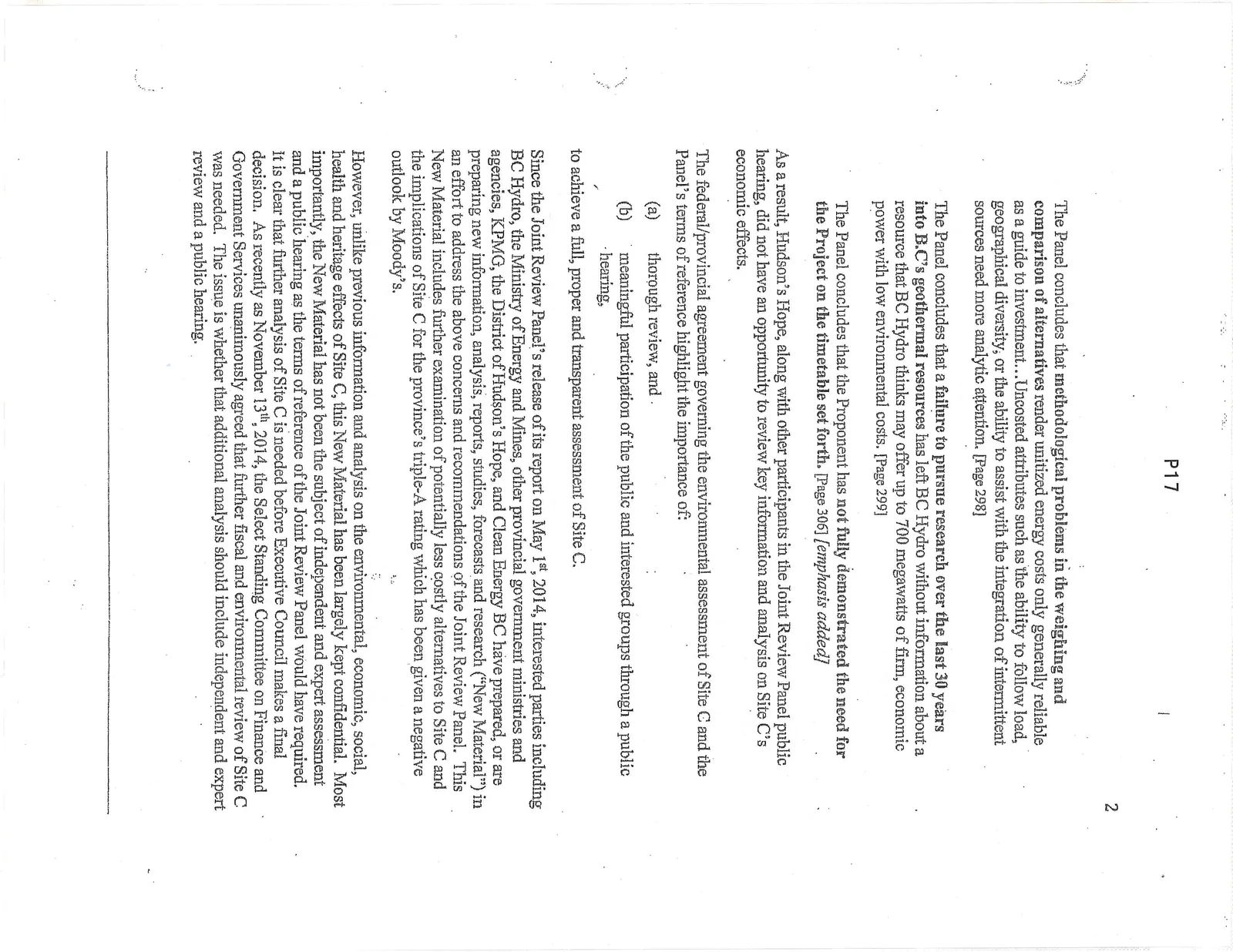
The Panel concludes that methodological problems in the weighing and comparison of alternatives render unitized energy costs only generally reliable as a guide to investment... Uncosted attributes such as the ability to follow load, geographical diversity, or the ability to assist with the integration of intermittent sources need more analytic attention. [Page 298]
The Panel concludes that a failure to pursue research over the last 30 years into B.C.’s geothermal resources has left BC Hydro without information about a resource that BC Hydro thinks may offer up to 700 megawatts of firm, economic power with low environmental costs. [Page 299]
The Panel concludes that the Proponent has not fully demonstrated the need for the Project on the timetable set forth. [Page 306] [emphasis added]
As a result, Hudson’s Hope, along with other participants in the Joint Review Panel public hearing, did not have an opportunity to review key information and analysis on Site C’s economic effects.
The federal/provincial agreement governing the environmental assessment of Site C and the Panel’s terms of reference highlight the importance of:
(a) thorough review, and (b) meaningful participation of the public and interested groups through a public hearing,
to achieve a full, proper and transparent assessment of Site C.
Since the Joint Review Panel’s release of its report on May 1st, 2014, interested parties including BC Hydro, the Ministry of Energy and Mines, other provincial government ministries and agencies, KPMG, the District of Hudson’s Hope, and Clean Energy BC have prepared, or are preparing new information, analysis, reports, studies, forecasts and research (“New Material”) in an effort to address the above concerns and recommendations of the Joint Review Panel. This New Material includes further examination of potentially less costly alternatives to Site C and the implications of Site C for the province’s triple-A rating which has been given a negative outlook by Moody’s.
However, unlike previous information and analysis on the environmental, economic, social, health and heritage effects of Site C, this New Material has been largely kept confidential. Most importantly, the New Material has not been the subject of independent and expert assessment and a public hearing as the terms of reference of the Joint Review Panel would have required. It is clear that further analysis of Site C is needed before Executive Council makes a final decision. As recently as November 13th, 2014, the Select Standing Committee on Finance and Government Services unanimously agreed that further fiscal and environmental review of Site C was needed. The issue is whether that additional analysis should include independent and expert review and a public hearing.
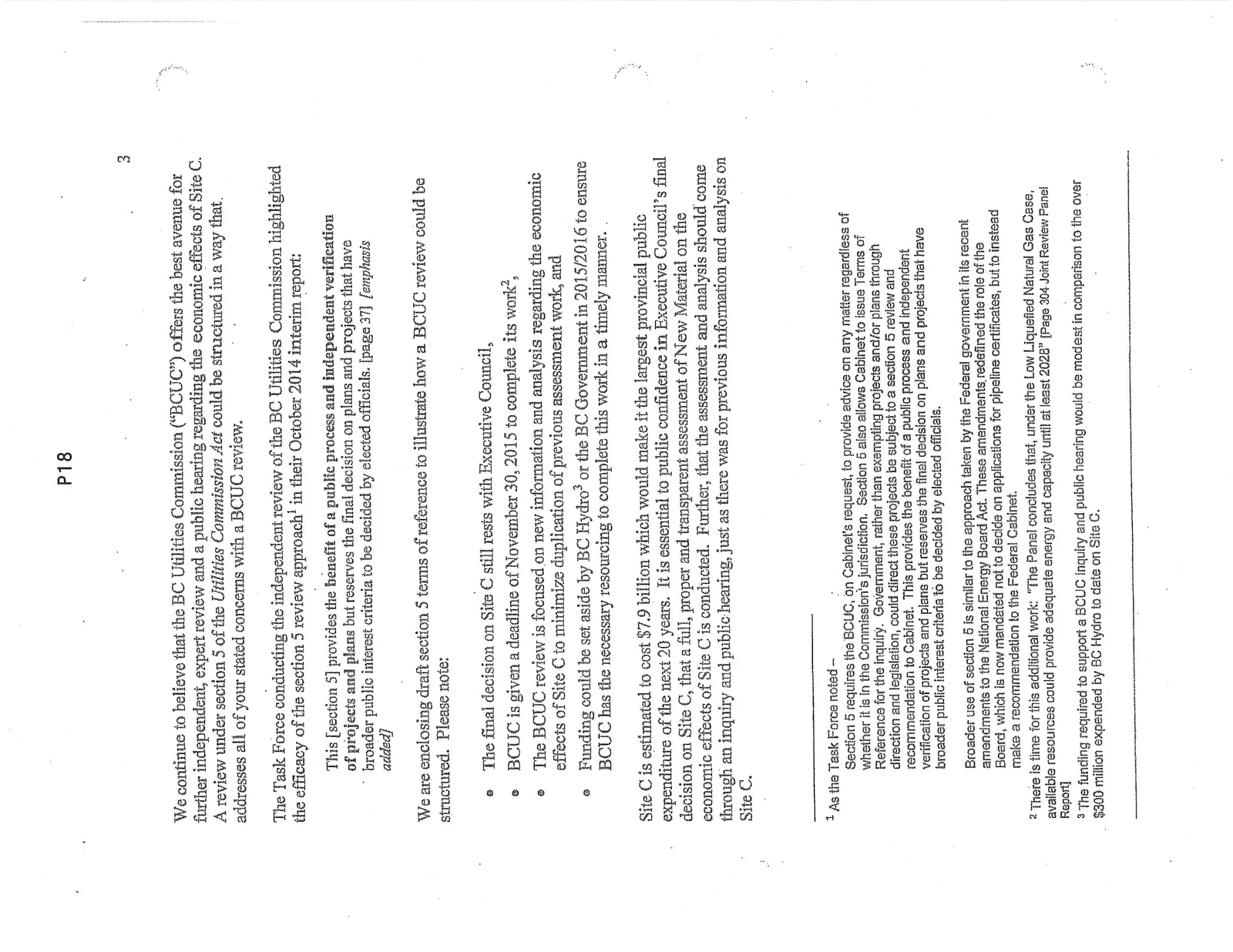
We continue to believe that the BC Utilities Commission (“BCUC”) offers the best avenue for further independent, expert review and a public hearing regarding the economic effects of Site C. A review under section 5 of the Utilities Commission Act could be structured in a way that addresses all of your stated concerns with a BCUC review.
The Task Force conducting the independent review of the BC Utilities Commission highlighted the efficacy of the section 5 review approach¹ in their October 2014 interim report:
This [section 5] provides the benefit of a public process and independent verification of projects and plans but reserves the final decision on plans and projects that have broader public interest criteria to be decided by elected officials. [page 37] [emphasis added]
We are enclosing draft section 5 terms of reference to illustrate how a BCUC review could be structured. Please note:
- The final decision on Site C still rests with Executive Council,
- BCUC is given a deadline of November 30, 2015 to complete its work²,
- The BCUC review is focused on new information and analysis regarding the economic effects of Site C to minimize duplication of previous assessment work, and
- Funding could be set aside by BC Hydro³ or the BC Government in 2015/2016 to ensure BCUC has the necessary resourcing to complete this work in a timely manner.
Site C is estimated to cost $7.9 billion which would make it the largest provincial public expenditure of the next 20 years. It is essential to public confidence in Executive Council’s final decision on Site C, that a full, proper and transparent assessment of New Material on the economic effects of Site C is conducted. Further, that the assessment and analysis should come through an inquiry and public hearing, just as there was for previous information and analysis on Site C.
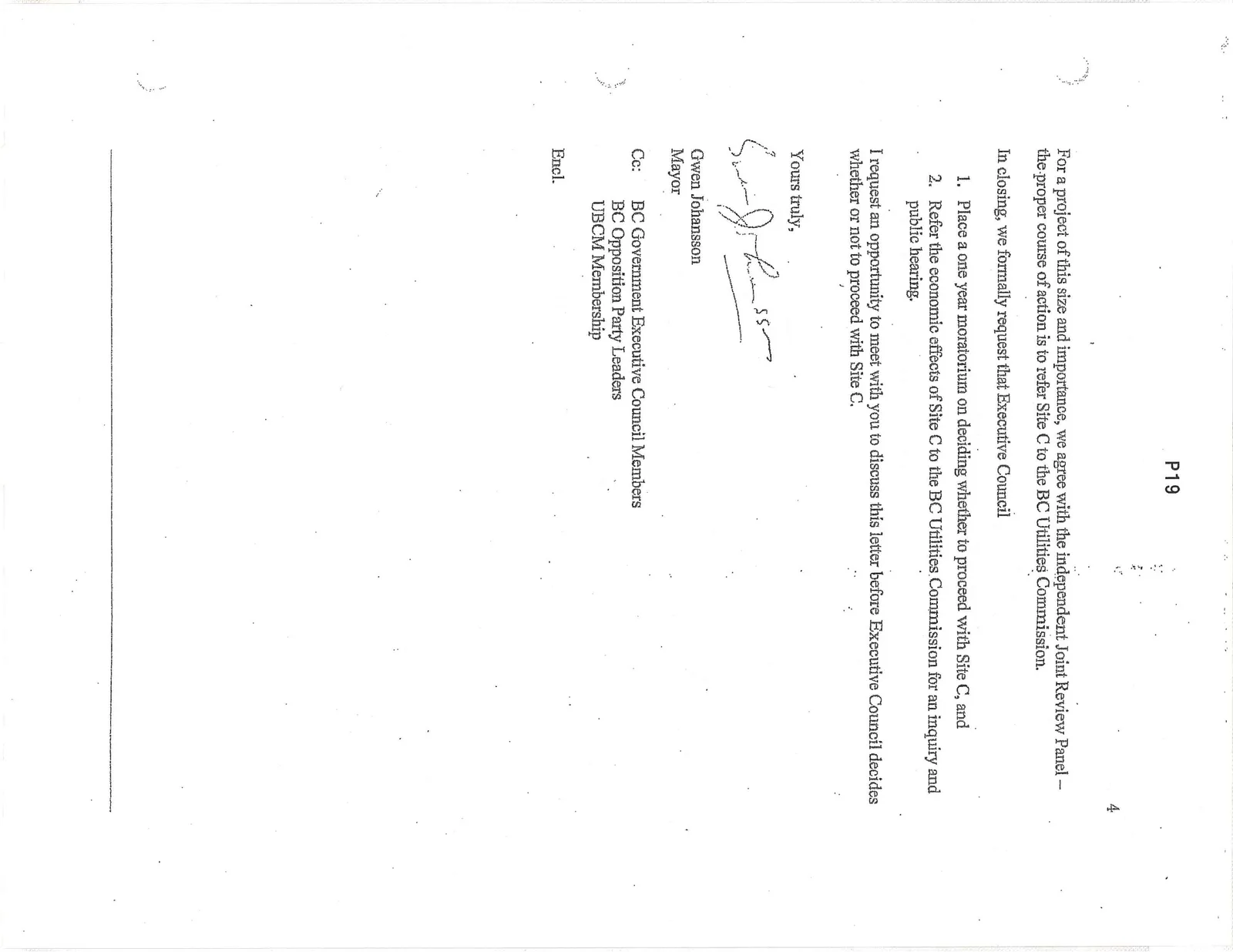
For a project of this size and importance, we agree with the independent Joint Review Panel – the proper course of action is to refer Site C to the BC Utilities Commission.
In closing, we formally request that Executive Council
- Place a one year moratorium on deciding whether to proceed with Site C, and
- Refer the economic effects of Site C to the BC Utilities Commission for an inquiry and public hearing.
I request an opportunity to meet with you to discuss this letter before Executive Council decides whether or not to proceed with Site C.
Yours truly,
Gwen Johansson Mayor
Cc: BC Government Executive Council Members BC Opposition Party Leaders UBCM Membership
Encl.
¹ As the Task Force noted – Section 5 requires the BCUC, on Cabinet’s request, to provide advice on any matter regardless of whether it is in the Commission’s jurisdiction. Section 5 also allows Cabinet to issue Terms of Reference for the inquiry. Government, rather than exempting projects and/or plans through direction and legislation, could direct these projects be subject to a section 5 review and recommendation to Cabinet. This provides the benefit of a public process and independent verification of projects and plans but reserves the final decision on plans and projects that have broader public interest criteria to be decided by elected officials.
Broader use of section 5 is similar to the approach taken by the Federal government in its recent amendments to the National Energy Board Act. These amendments redefined the role of the Board, which is now mandated not to decide on applications for pipeline certificates, but to instead make a recommendation to the Federal Cabinet.
² There is time for this additional work: "The Panel concludes that, under the Low Liquefied Natural Gas Case, available resources could provide adequate energy and capacity until at least 2028" [Page 304 Joint Review Panel Report]
³ The funding required to support a BCUC inquiry and public hearing would be modest in comparison to the over $300 million expended by BC Hydro to date on Site C.
Document Images
(4)