Tree Retention Report - 17 Jedburgh Road
Full arborist report detailing mitigation impacts, barrier fencing requirements, and building envelope tree removals.
December 11, 2014
John Koren 4889 Townsend Drive Victoria, BC V8Z 5P2
Re: Tree Retention Report – 17 Jedburgh Road
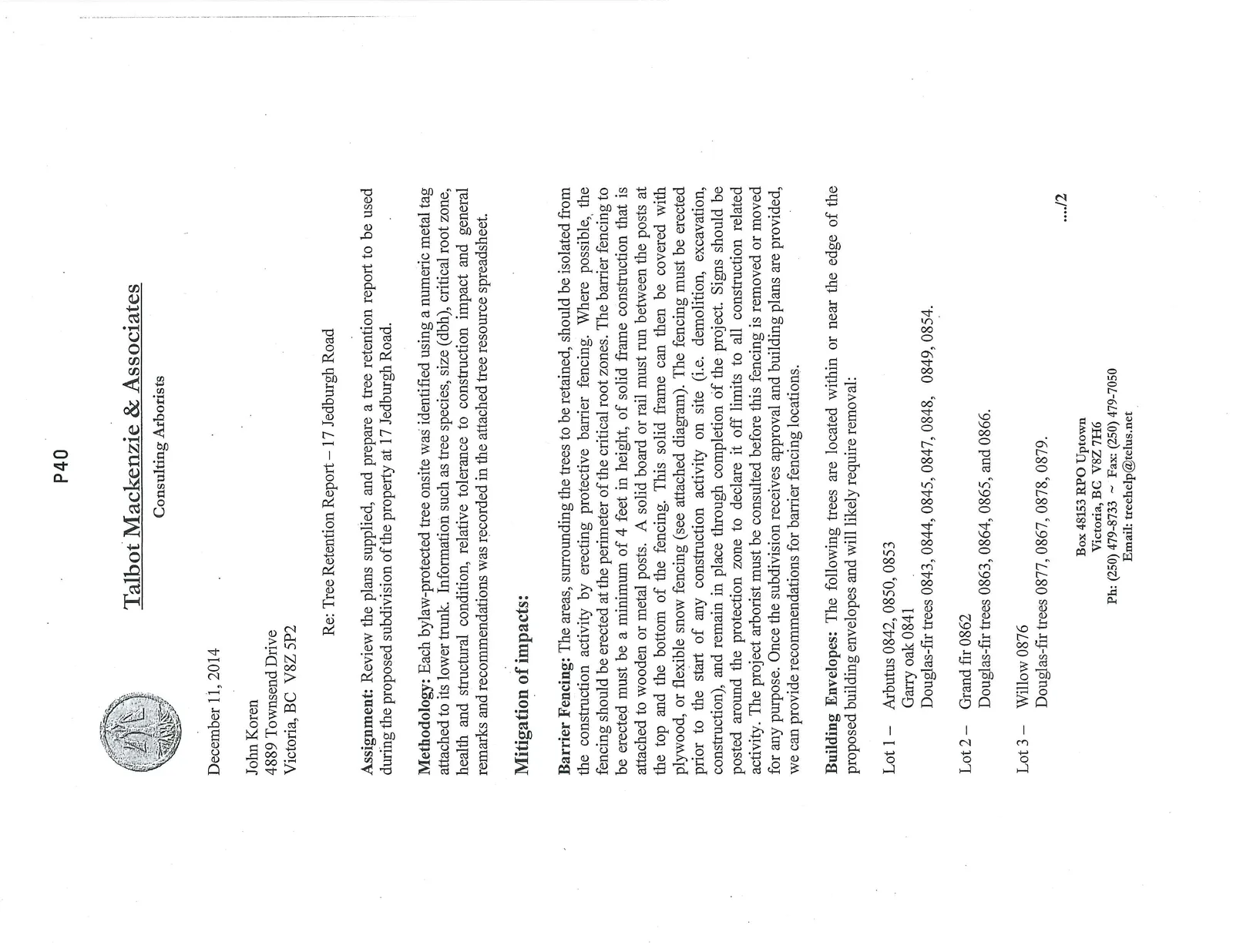
Assignment: Review the plans supplied, and prepare a tree retention report to be used during the proposed subdivision of the property at 17 Jedburgh Road.
Methodology: Each bylaw-protected tree onsite was identified using a numeric metal tag attached to its lower trunk. Information such as tree species, size (dbh), critical root zone, health and structural condition, relative tolerance to construction impact and general remarks and recommendations was recorded in the attached tree resource spreadsheet.
Mitigation of impacts:
Barrier Fencing:
The areas, surrounding the trees to be retained, should be isolated from the construction activity by erecting protective barrier fencing. Where possible, the fencing should be erected at the perimeter of the critical root zones. The barrier fencing to be erected must be a minimum of 4 feet in height, of solid frame construction that is attached to wooden or metal posts. A solid board or rail must run between the posts at the top and the bottom of the fencing. This solid frame can then be covered with plywood, or flexible snow fencing (see attached diagram). The fencing must be erected prior to the start of any construction activity on site (i.e. demolition, excavation, construction), and remain in place through completion of the project. Signs should be posted around the protection zone to declare it off limits to all construction related activity. The project arborist must be consulted before this fencing is removed or moved for any purpose. Once the subdivision receives approval and building plans are provided, we can provide recommendations for barrier fencing locations.
Building Envelopes:
The following trees are located within or near the edge of the proposed building envelopes and will likely require removal:
- Lot 1 –
- Arbutus 0842, 0850, 0853
- Garry oak 0841
- Douglas-fir trees 0843, 0844, 0845, 0847, 0848, 0849, 0854.
- Lot 2 –
- Grand fir 0862
- Douglas-fir trees 0863, 0864, 0865, and 0866.
- Lot 3 –
- Willow 0876
- Douglas-fir trees 0877, 0867, 0878, 0879.
- Lot 4 –
- Douglas-fir trees 0882, 0884,
- Willows numbered 0885.
- Lot 5 – Willows numbered 0885.
- Lot 6 – Willows numbered 0885.
- Lot 7 – Douglas-fir trees 0836, 0837.
Trees that may be possible to retain:
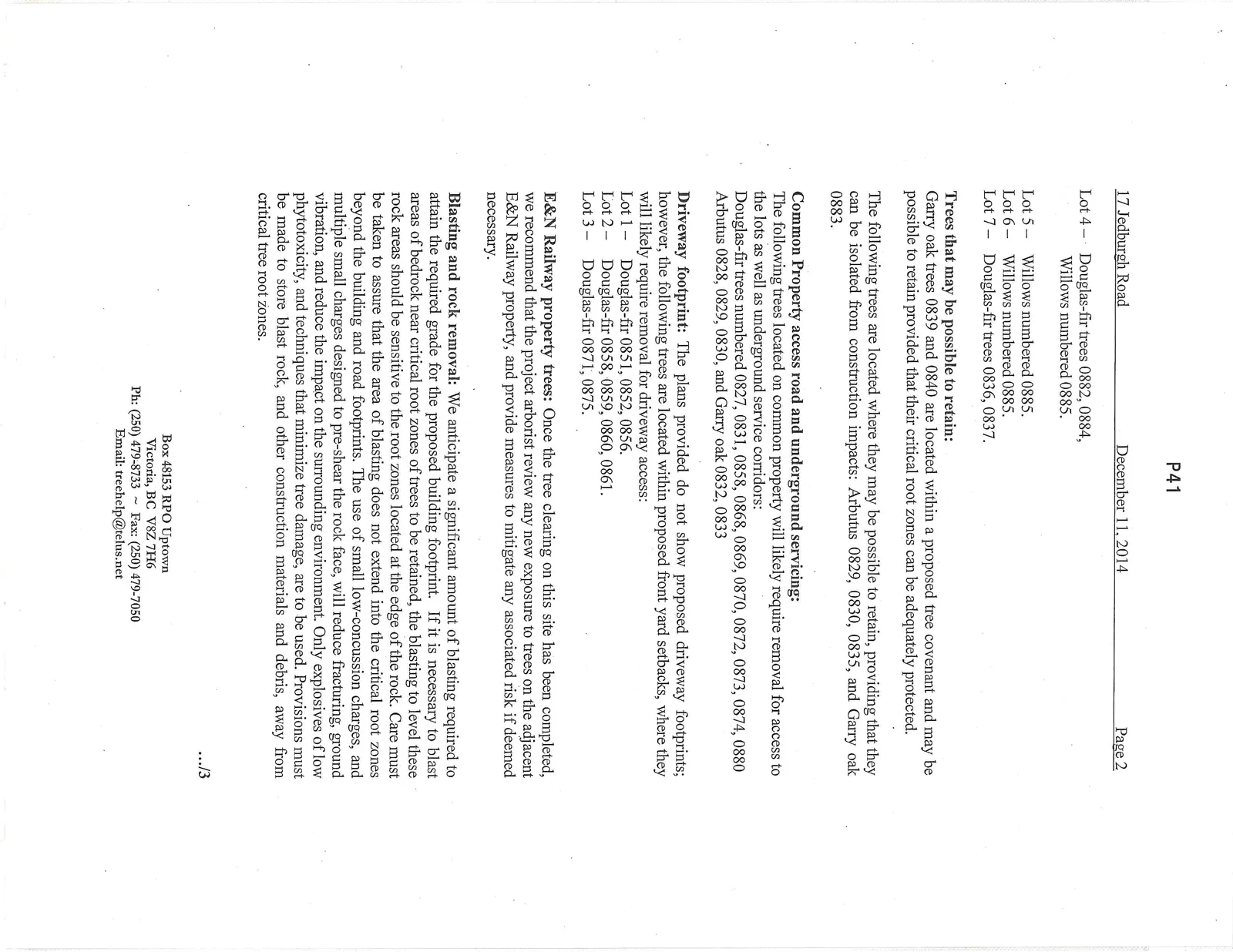
Garry oak trees 0839 and 0840 are located within a proposed tree covenant and may be possible to retain provided that their critical root zones can be adequately protected.
The following trees are located where they may be possible to retain, providing that they can be isolated from construction impacts: Arbutus 0829, 0830, 0835, and Garry oak 0883.
Common Property access road and underground servicing:
The following trees located on common property will likely require removal for access to the lots as well as underground service corridors:
- Douglas-fir trees numbered 0827, 0831, 0858, 0868, 0869, 0870, 0872, 0873, 0874, 0880
- Arbutus 0828, 0829, 0830, and Garry oak 0832, 0833
Driveway footprint:
The plans provided do not show proposed driveway footprints; however, the following trees are located within proposed front yard setbacks, where they will likely require removal for driveway access:
- Lot 1 – Douglas-fir 0851, 0852, 0856.
- Lot 2 – Douglas-fir 0858, 0859, 0860, 0861.
- Lot 3 – Douglas-fir 0871, 0875.
E&N Railway property trees:
Once the tree clearing on this site has been completed, we recommend that the project arborist review any new exposure to trees on the adjacent E&N Railway property, and provide measures to mitigate any associated risk if deemed necessary.
Blasting and rock removal:
We anticipate a significant amount of blasting required to attain the required grade for the proposed building footprint. If it is necessary to blast areas of bedrock near critical root zones of trees to be retained, the blasting to level these rock areas should be sensitive to the root zones located at the edge of the rock. Care must be taken to assure that the area of blasting does not extend into the critical root zones beyond the building and road footprints. The use of small low-concussion charges, and multiple small charges designed to pre-shear the rock face, will reduce fracturing, ground vibration, and reduce the impact on the surrounding environment. Only explosives of low phytotoxicity, and techniques that minimize tree damage, are to be used. Provisions must be made to store blast rock, and other construction materials and debris, away from critical tree root zones.
Arborists Role:
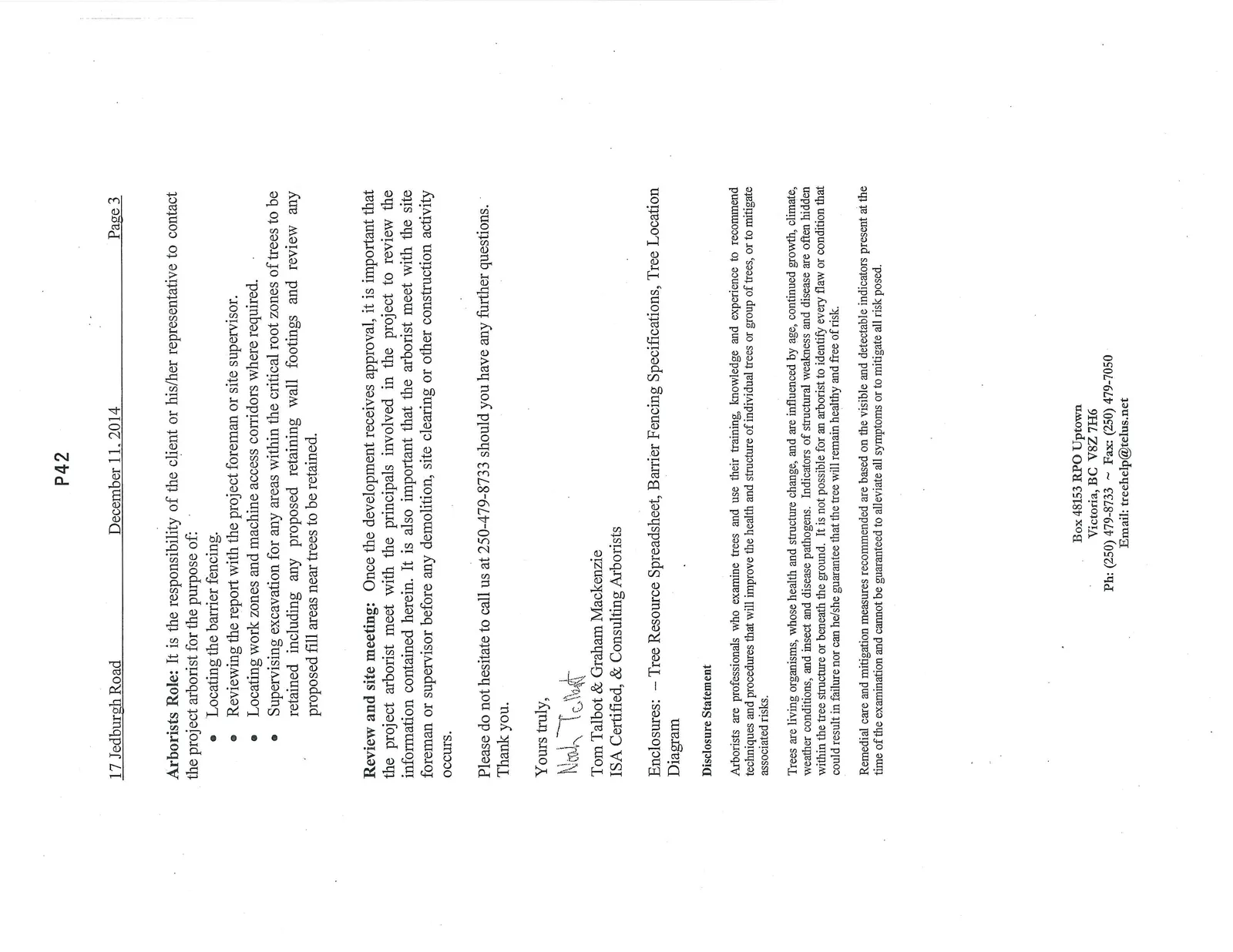
It is the responsibility of the client or his/her representative to contact the project arborist for the purpose of:
- Locating the barrier fencing.
- Reviewing the report with the project foreman or site supervisor.
- Locating work zones and machine access corridors where required.
- Supervising excavation for any areas within the critical root zones of trees to be retained including any proposed retaining wall footings and review any proposed fill areas near trees to be retained.
Review and site meeting:
Once the development receives approval, it is important that the project arborist meet with the principals involved in the project to review the information contained herein. It is also important that the arborist meet with the site foreman or supervisor before any demolition, site clearing or other construction activity occurs.
Please do not hesitate to call us at 250-479-8733 should you have any further questions. Thank you.
Yours truly,
Tom Talbot & Graham Mackenzie ISA Certified, & Consulting Arborists
Enclosures: -- Tree Resource Spreadsheet, Barrier Fencing Specifications, Tree Location Diagram
Disclosure Statement
Arborists are professionals who examine trees and use their training, knowledge and experience to recommend techniques and procedures that will improve the health and structure of individual trees or group of trees, or to mitigate associated risks.
Trees are living organisms, whose health and structure change, and are influenced by age, continued growth, climate, weather conditions, and insect and disease pathogens. Indicators of structural weakness and disease are often hidden within the tree structure or beneath the ground. It is not possible for an arborist to identify every flaw or condition that could result in failure nor can he/she guarantee that the tree will remain healthy and free of risk.
Remedial care and mitigation measures recommended are based on the visible and detectable indicators present at the time of the examination and cannot be guaranteed to alleviate all symptoms or to mitigate all risk posed.
Document Images
(3)