Attachment 2) Victoria Leaf Club - Electric Vehicle Infrastructure Questions & Answers
A detailed FAQ document regarding the technical and policy aspects of the proposed EV charging infrastructure resolution.
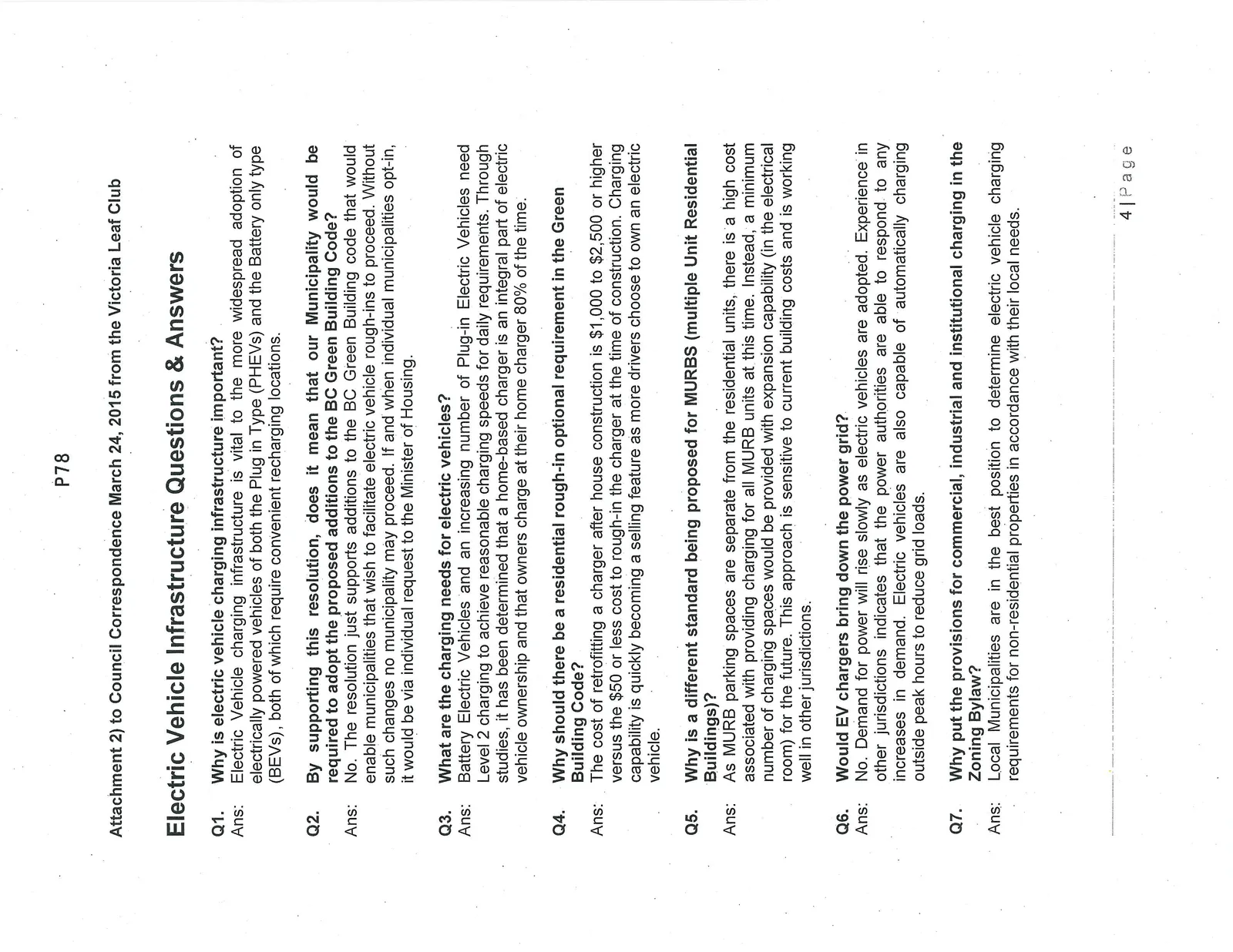
Electric Vehicle Infrastructure Questions & Answers
Q1. Why is electric vehicle charging infrastructure important? Ans: Electric Vehicle charging infrastructure is vital to the more widespread adoption of electrically powered vehicles of both the Plug in Type (PHEVs) and the Battery only type (BEVs), both of which require convenient recharging locations.
Q2. By supporting this resolution, does it mean that our Municipality would be required to adopt the proposed additions to the BC Green Building Code? Ans: No. The resolution just supports additions to the BC Green Building code that would enable municipalities that wish to facilitate electric vehicle rough-ins to proceed. Without such changes no municipality may proceed. If and when individual municipalities opt-in, it would be via individual request to the Minister of Housing.
Q3. What are the charging needs for electric vehicles? Ans: Battery Electric Vehicles and an increasing number of Plug-in Electric Vehicles need Level 2 charging to achieve reasonable charging speeds for daily requirements. Through studies, it has been determined that a home-based charger is an integral part of electric vehicle ownership and that owners charge at their home charger 80% of the time.
Q4. Why should there be a residential rough-in optional requirement in the Green Building Code? Ans: The cost of retrofitting a charger after house construction is $1,000 to $2,500 or higher versus the $50 or less cost to rough-in the charger at the time of construction. Charging capability is quickly becoming a selling feature as more drivers choose to own an electric vehicle.
Q5. Why is a different standard being proposed for MURBS (multiple Unit Residential Buildings)? Ans: As MURB parking spaces are separate from the residential units, there is a high cost associated with providing charging for all MURB units at this time. Instead, a minimum number of charging spaces would be provided with expansion capability (in the electrical room) for the future. This approach is sensitive to current building costs and is working well in other jurisdictions.
Q6. Would EV chargers bring down the power grid? Ans: No. Demand for power will rise slowly as electric vehicles are adopted. Experience in other jurisdictions indicates that the power authorities are able to respond to any increases in demand. Electric vehicles are also capable of automatically charging outside peak hours to reduce grid loads.
Q7. Why put the provisions for commercial, industrial and institutional charging in the Zoning Bylaw? Ans: Local Municipalities are in the best position to determine electric vehicle charging requirements for non-residential properties in accordance with their local needs.
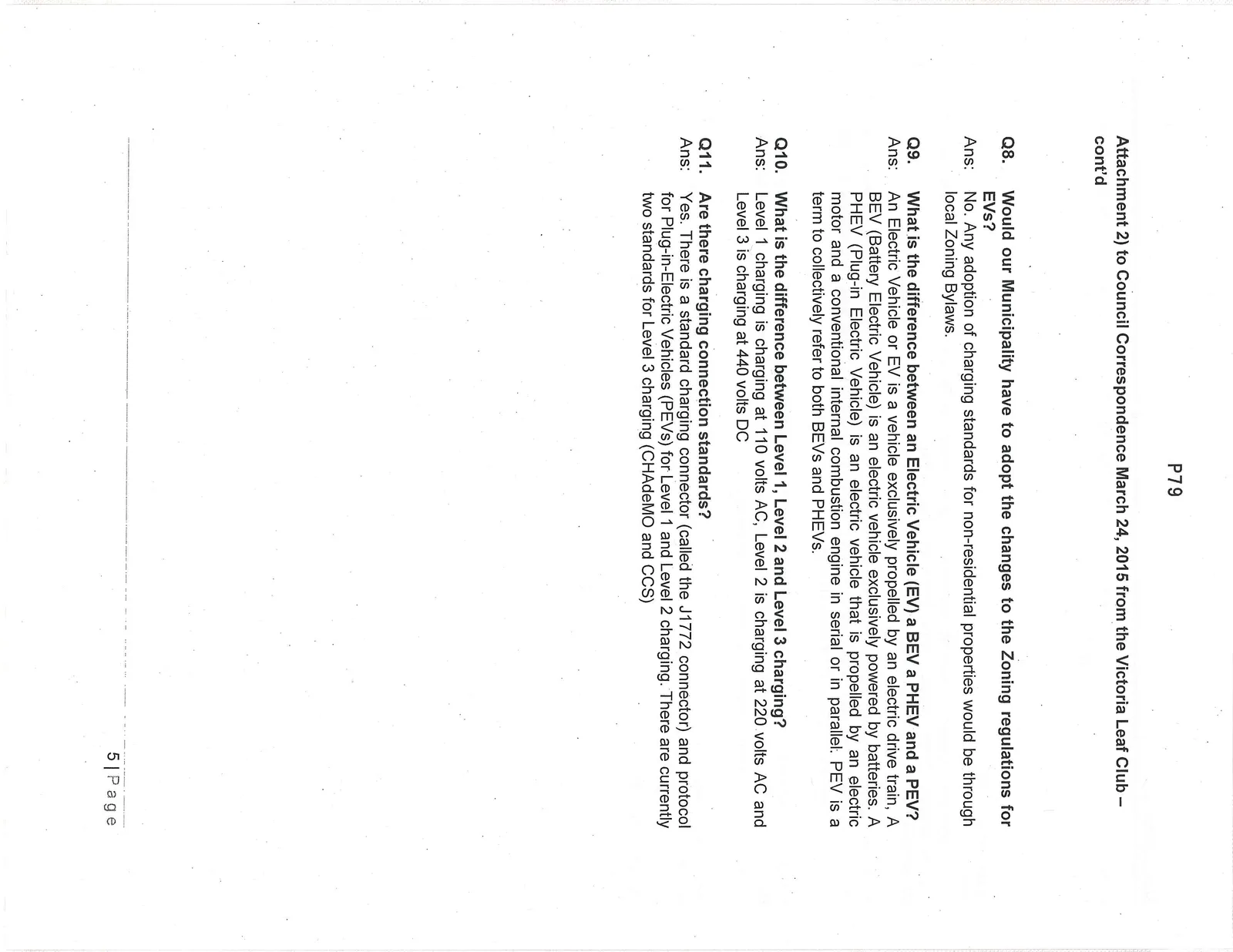
Q8. Would our Municipality have to adopt the changes to the Zoning regulations for EVs? Ans: No. Any adoption of charging standards for non-residential properties would be through local Zoning Bylaws.
Q9. What is the difference between an Electric Vehicle (EV) a BEV a PHEV and a PEV? Ans: An Electric Vehicle or EV is a vehicle exclusively propelled by an electric drive train. A BEV (Battery Electric Vehicle) is an electric vehicle exclusively powered by batteries. A PHEV (Plug-in Electric Vehicle) is an electric vehicle that is propelled by an electric motor and a conventional internal combustion engine in serial or in parallel. PEV is a term to collectively refer to both BEVs and PHEVs.
Q10. What is the difference between Level 1, Level 2 and Level 3 charging? Ans: Level 1 charging is charging at 110 volts AC, Level 2 is charging at 220 volts AC and Level 3 is charging at 440 volts DC.
Q11. Are there charging connection standards? Ans: Yes. There is a standard charging connector (called the J1772 connector) and protocol for Plug-in-Electric Vehicles (PEVs) for Level 1 and Level 2 charging. There are currently two standards for Level 3 charging (CHAdeMO and CCS).
Document Images
(2)