COUNCIL REPORT: Specimen Trees For View Royal Park
Report detailing options, costs, and locations for planting large specimen trees to enhance View Royal Park.
TOWN OF VIEW ROYAL
COUNCIL
TO: Council DATE: July 16, 2015 FROM: D. Podmoroff MEETING DATE: July 21, 2015 FILE NO.: 5830-01
Specimen Trees For View Royal Park
RECOMMENDATION:
THAT Council review the options and provide staff with direction on what Council would envision for specimen trees at View Royal Park;
CHIEF ADMINISTRATIVE OFFICER'S COMMENTS:
I concur with the recommendation.
PURPOSE OF REPORT:
To consider the following requirements for specimen tree selection for View Royal Park: tree size, species, how many, location of planting, location of supplier, irrigation and the costs associated with these specific items.
BACKGROUND:
View Royal Park is a significant park within the Town’s park system. A master plan has been created for the park's ongoing development as well as yearly funding for these improvements. As part of that plan, specimen trees that create a statement and welcoming environment for the park will be planted.
The current suggested plan is for two (2) large specimen trees at the main entrance to View Royal Park off of Pheasant Lane. There would be one tree on either side of the pathway, just inside the park creating a gateway entrance into the park. After investigating the logistics of two very large trees it becomes apparent that the cost is considerably more than the current budget of $5000.
PROJECT INFORMATION:
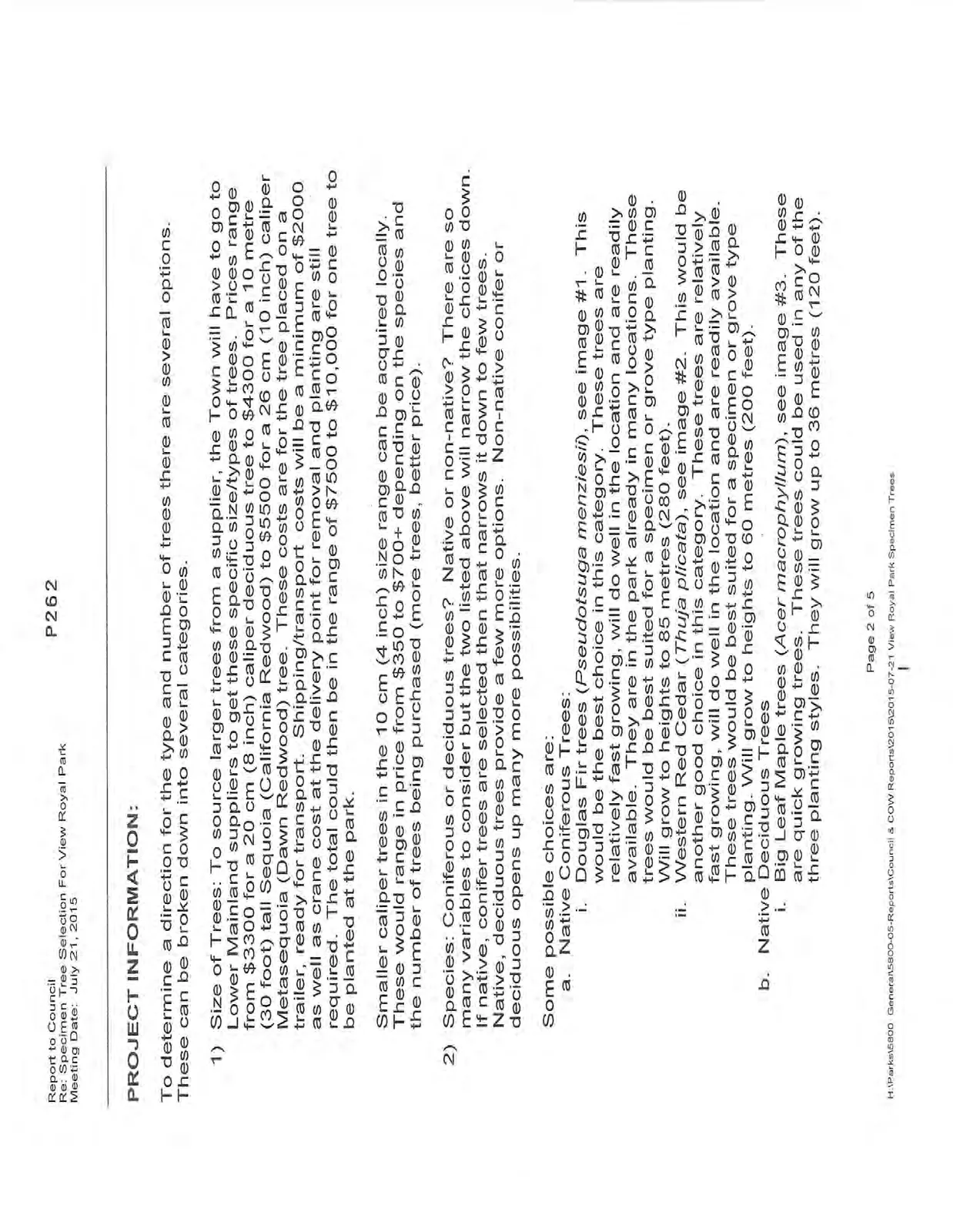
To determine a direction for the type and number of trees there are several options. These can be broken down into several categories.
- Size of Trees: To source larger trees from a supplier, the Town will have to go to Lower Mainland suppliers to get these specific size/types of trees. Prices range from $3300 for a 20 cm (8 inch) caliper deciduous tree to $4300 for a 10 metre (30 foot) tall Sequoia (California Redwood) to $5500 for a 26 cm (10 inch) caliper Metasequoia (Dawn Redwood) tree. These costs are for the tree placed on a trailer, ready for transport. Shipping/transport costs will be a minimum of $2000 as well as crane cost at the delivery point for removal and planting are still required. The total could then be in the range of $7500 to $10,000 for one tree to be planted at the park.
Smaller caliper trees in the 10 cm (4 inch) size range can be acquired locally. These would range in price from $350 to $700+ depending on the species and the number of trees being purchased (more trees, better price).
- Species: Coniferous or deciduous trees? Native or non-native? There are so many variables to consider but the two listed above will narrow the choices down. If native, conifer trees are selected then that narrows it down to few trees. Native, deciduous trees provide a few more options. Non-native conifer or deciduous opens up many more possibilities.
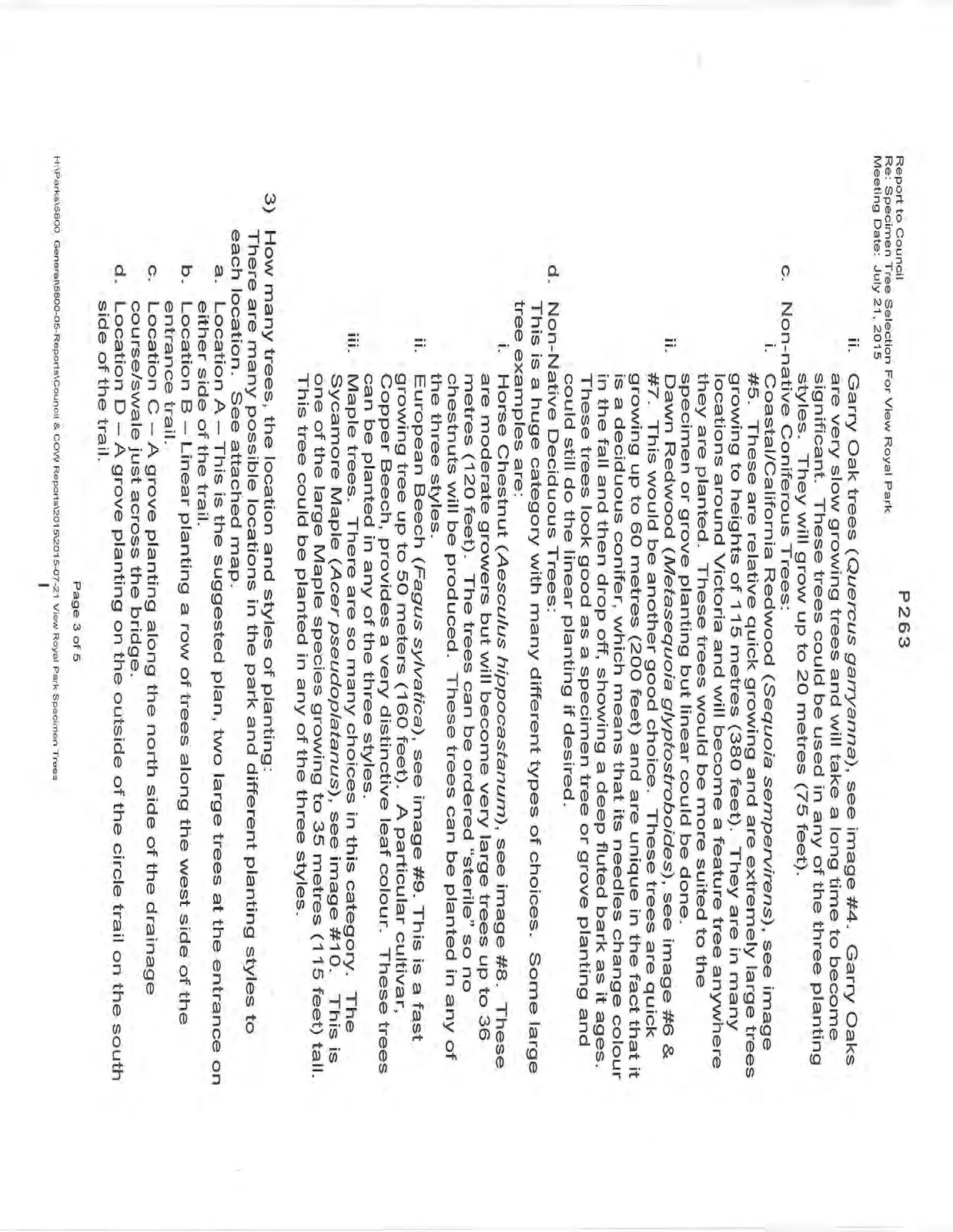
Some possible choices are: a. Native Coniferous Trees: i. Douglas Fir trees (Pseudotsuga menziesii), see image #1. This would be the best choice in this category. These trees are relatively fast growing, will do well in the location and are readily available. They are in the park already in many locations. These trees would be best suited for a specimen or grove type planting. Will grow to heights to 85 metres (280 feet). ii. Western Red Cedar (Thuja plicata), see image #2. This would be another good choice in this category. These trees are relatively fast growing, will do well in the location and are readily available. These trees would be best suited for a specimen or grove type planting. Will grow to heights to 60 metres (200 feet). b. Native Deciduous Trees: i. Big Leaf Maple trees (Acer macrophyllum), see image #3. These are quick growing trees. These trees could be used in any of the three planting styles. They will grow up to 36 metres (120 feet). ii. Garry Oak trees (Quercus garryana), see image #4. Garry Oaks are very slow growing trees and will take a long time to become significant. These trees could be used in any of the three planting styles. They will grow up to 20 metres (75 feet). c. Non-native Coniferous Trees: i. Coastal/California Redwood (Sequoia sempervirens), see image #5. These are relative quick growing and are extremely large trees growing to heights of 115 metres (380 feet). They are in many locations around Victoria and will become a feature tree anywhere they are planted. These trees would be more suited to the specimen or grove planting but linear could be done. ii. Dawn Redwood (Metasequoia glyptostroboides), see image #6 & #7. This would be another good choice. These trees are quick growing up to 60 metres (200 feet) and are unique in the fact that it is a deciduous conifer, which means that its needles change colour in the fall and then drop off, showing a deep fluted bark as it ages. These trees look good as a specimen tree or grove planting and could still do the linear planting if desired. d. Non-Native Deciduous Trees: This is a huge category with many different types of choices. Some large tree examples are: i. Horse Chestnut (Aesculus hippocastanum), see image #8. These are moderate growers but will become very large trees up to 36 metres (120 feet). The trees can be ordered "sterile" so no chestnuts will be produced. These trees can be planted in any of the three styles. ii. European Beech (Fagus sylvatica), see image #9. This is a fast growing tree up to 50 meters (160 feet). A particular cultivar, Copper Beech, provides a very distinctive leaf colour. These trees can be planted in any of the three styles. iii. Maple trees. There are so many choices in this category. The Sycamore Maple (Acer pseudoplatanus), see image #10. This is one of the large Maple species growing to 35 metres (115 feet) tall. This tree could be planted in any of the three styles.
- How many trees, the location and styles of planting: There are many possible locations in the park and different planting styles to each location. See attached map. a. Location A – This is the suggested plan, two large trees at the entrance on either side of the trail. b. Location B – Linear planting a row of trees along the west side of the entrance trail. c. Location C – A grove planting along the north side of the drainage course/swale just across the bridge. d. Location D – A grove planting on the outside of the circle trail on the south side of the trail. e. Location E – A specimen or grove planting on the outside of the circle trail on the south east side of the trail. f. Location F – The center of the circle pathway would be suitable for a specimen or grove planting.
Planting styles would be as follows: 1) Specimen – one or two trees planted in a location by themselves to create a feature or a gateway if planted at an entrance to the park. 2) Linear – planting in a row, spaced appropriately along the pathway to make an inviting corridor to walk along within the park. 3) Grove – planted in a cluster with proper spacing, in a circular, oval or random pattern to create a destination spot within the park. Amenities such as benches could be added at a later date.
The number of trees is limited to the budget funds. Smaller, less costly trees will be more abundant for a linear or grove planting. Larger trees will reduce that number to possibly one or two.
- Irrigation: Installing larger trees requires water for survival, therefore, an irrigation system is an absolute must.
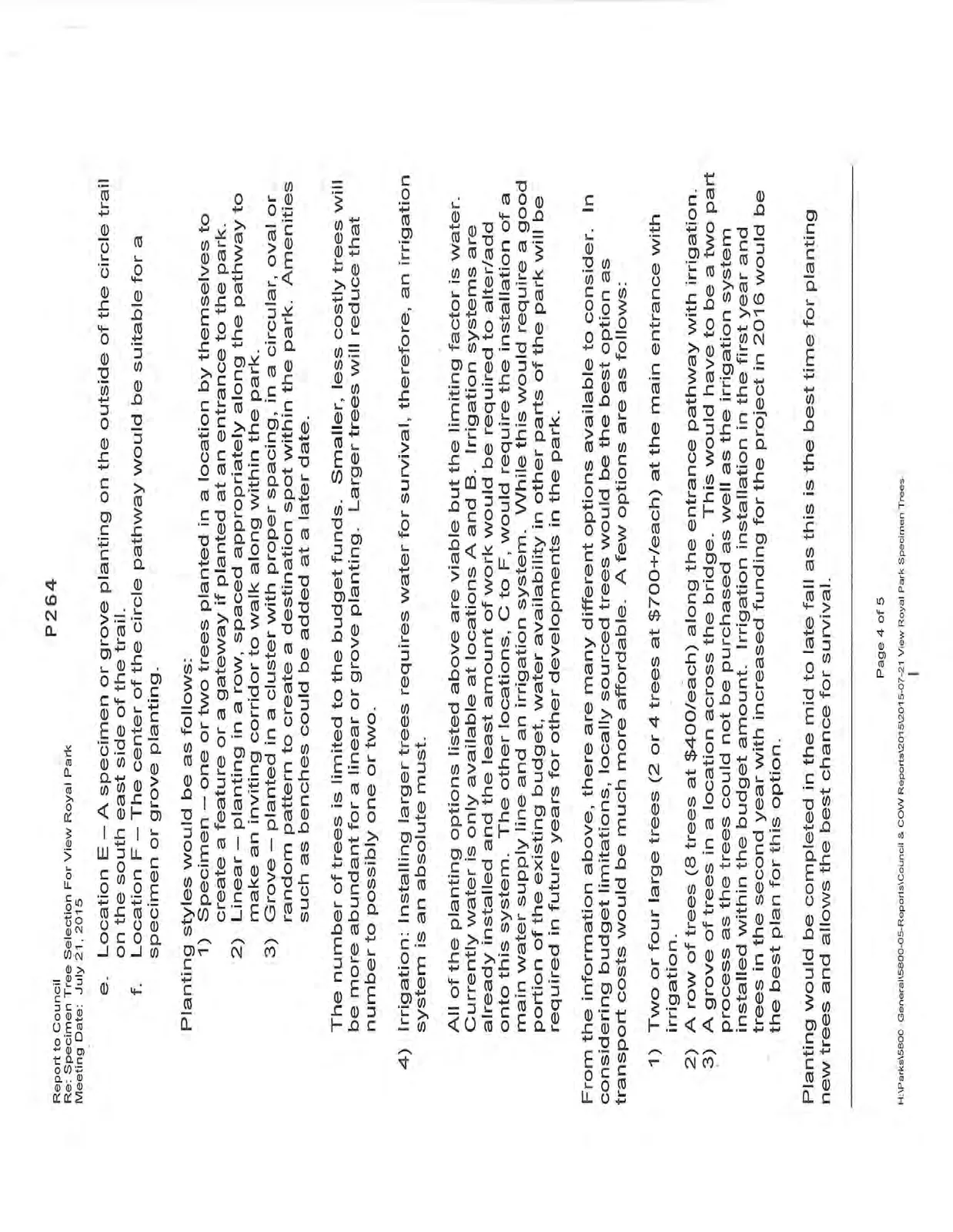
All of the planting options listed above are viable but the limiting factor is water. Currently water is only available at locations A and B. Irrigation systems are already installed and the least amount of work would be required to alter/add onto this system. The other locations, C to F, would require the installation of a main water supply line and an irrigation system. While this would require a good portion of the existing budget, water availability in other parts of the park will be required in future years for other developments in the park.
From the information above, there are many different options available to consider. In considering budget limitations, locally sourced trees would be the best option as transport costs would be much more affordable. A few options are as follows:
- Two or four large trees (2 or 4 trees at $700+/each) at the main entrance with irrigation.
- A row of trees (8 trees at $400/each) along the entrance pathway with irrigation.
- A grove of trees in a location across the bridge. This would have to be a two part process as the trees could not be purchased as well as the irrigation system installed within the budget amount. Irrigation installation in the first year and trees in the second year with increased funding for the project in 2016 would be the best plan for this option.
Planting would be completed in the mid to late fall as this is the best time for planting new trees and allows the best chance for survival.
BUDGET IMPLICATIONS:
Current funding allocation is $5,000. Depending on the option chosen, a phased approach may need to be taken.
ALTERNATIVES TO STAFF RECOMMENDATION:
Increase the funding to match the preferred chosen option.
RECOMMENDATION:
THAT Council review the options and provide staff with direction on what Council would envision for specimen trees at View Royal Park;
SUBMITTED BY: Dave Podmoroff, Parks Supervisor
REVIEWED BY: John Rosenberg, Director of Engineering
Document Images
(5)