Climate Change & Air Pollution Info Labels on Gas Pumps - A summary report for municipalities in British Columbia
A summary report providing background information and legal research supporting the implementation of climate change warning labels on gasoline pumps.
May 25, 2015
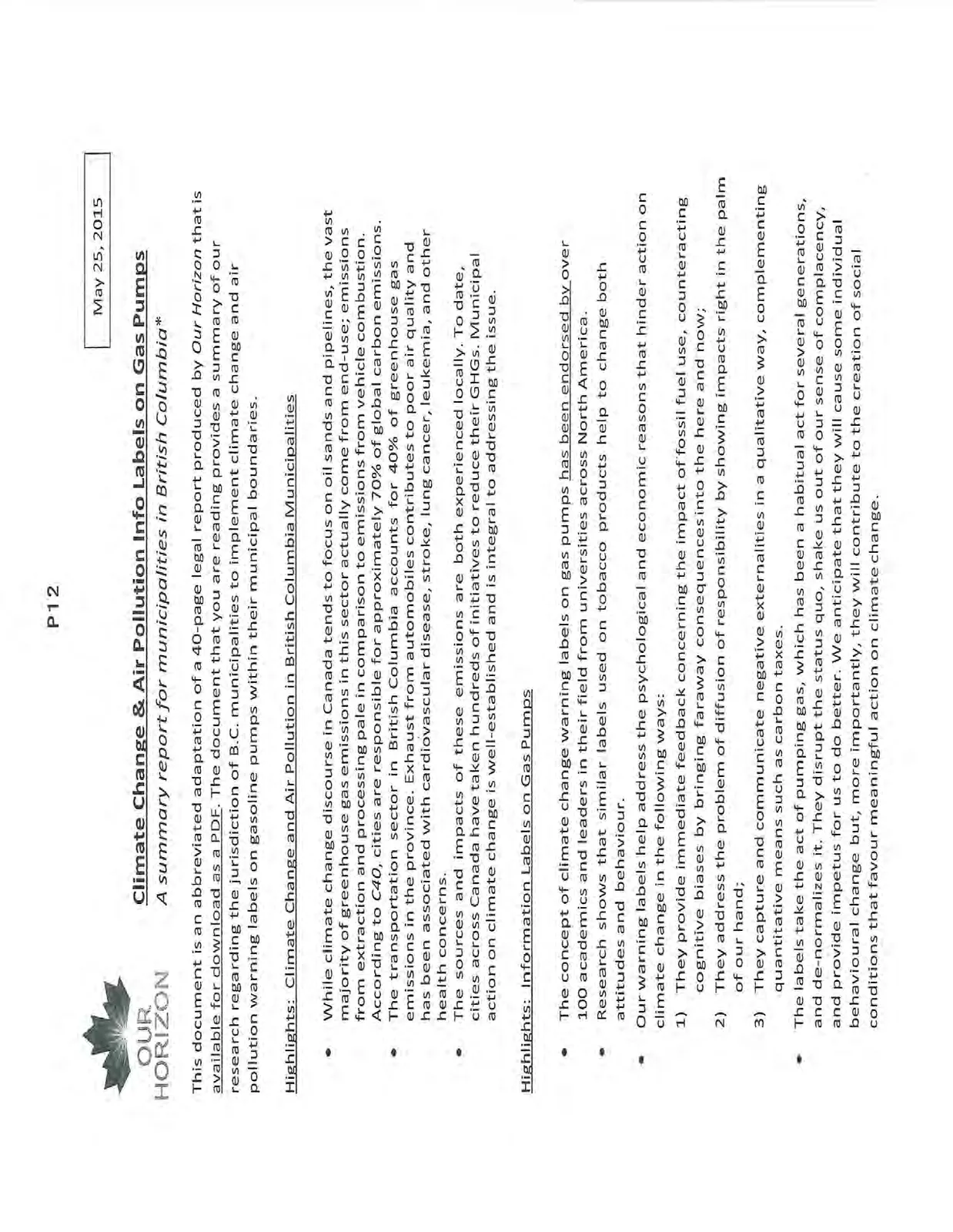
Climate Change & Air Pollution Info Labels on Gas Pumps
A summary report for municipalities in British Columbia*
This document is an abbreviated adaptation of a 40-page legal report produced by Our Horizon that is available for download as a PDF. The document that you are reading provides a summary of our research regarding the jurisdiction of B.C. municipalities to implement climate change and air pollution warning labels on gasoline pumps within their municipal boundaries.
Highlights: Climate Change and Air Pollution in British Columbia Municipalities
- While climate change discourse in Canada tends to focus on oil sands and pipelines, the vast majority of greenhouse gas emissions in this sector actually come from end-use; emissions from extraction and processing pale in comparison to emissions from vehicle combustion. According to C40, cities are responsible for approximately 70% of global carbon emissions.
- The transportation sector in British Columbia accounts for 40% of greenhouse gas emissions in the province. Exhaust from automobiles contributes to poor air quality and has been associated with cardiovascular disease, stroke, lung cancer, leukemia, and other health concerns.
- The sources and impacts of these emissions are both experienced locally. To date, cities across Canada have taken hundreds of initiatives to reduce their GHGs. Municipal action on climate change is well-established and is integral to addressing the issue.
Highlights: Information Labels on Gas Pumps
- The concept of climate change warning labels on gas pumps has been endorsed by over 100 academics and leaders in their field from universities across North America.
- Research shows that similar labels used on tobacco products help to change both attitudes and behaviour.
- Our warning labels help address the psychological and economic reasons that hinder action on climate change in the following ways:
- They provide immediate feedback concerning the impact of fossil fuel use, counteracting cognitive biases by bringing faraway consequences into the here and now;
- They address the problem of diffusion of responsibility by showing impacts right in the palm of our hand;
- They capture and communicate negative externalities in a qualitative way, complementing quantitative means such as carbon taxes.
- The labels take the act of pumping gas, which has been a habitual act for several generations, and de-normalizes it. They disrupt the status quo, shake us out of our sense of complacency, and provide impetus for us to do better. we anticipate that they will cause some individual behavioural change but, more importantly, they will contribute to the creation of social conditions that favour meaningful action on climate change.
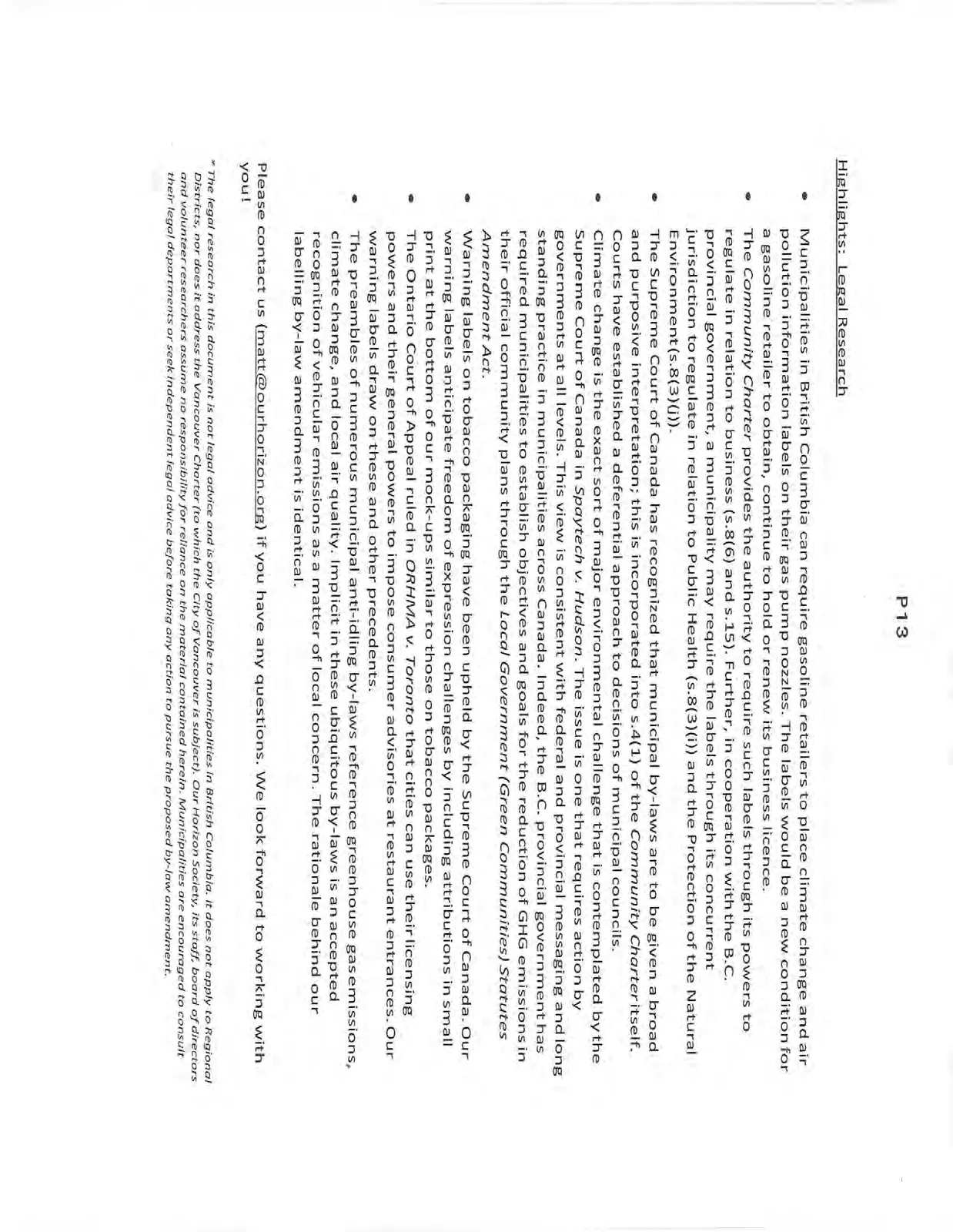
Highlights: Legal Research
- Municipalities in British Columbia can require gasoline retailers to place climate change and air pollution information labels on their gas pump nozzles. The labels would be a new condition for a gasoline retailer to obtain, continue to hold or renew its business licence.
- The Community Charter provides the authority to require such labels through its powers to regulate in relation to business (s.8(6) and s.15). Further, in cooperation with the B.C. provincial government, a municipality may require the labels through its concurrent jurisdiction to regulate in relation to Public Health (s.8(3)(i)) and the Protection of the Natural Environment (s.8(3)(j)).
- The Supreme Court of Canada has recognized that municipal by-laws are to be given a broad and purposive interpretation; this is incorporated into s.4(1) of the Community Charter itself. Courts have established a deferential approach to decisions of municipal councils.
- Climate change is the exact sort of major environmental challenge that is contemplated by the Supreme Court of Canada in Spraytech v. Hudson. The issue is one that requires action by governments at all levels. This view is consistent with federal and provincial messaging and long standing practice in municipalities across Canada. Indeed, the B.C. provincial government has required municipalities to establish objectives and goals for the reduction of GHG emissions in their official community plans through the Local Government (Green Communities) Statutes Amendment Act.
- Warning labels on tobacco packaging have been upheld by the Supreme Court of Canada. Our warning labels anticipate freedom of expression challenges by including attributions in small print at the bottom of our mock-ups similar to those on tobacco packages.
- The Ontario Court of Appeal ruled in ORHMA v. Toronto that cities can use their licensing powers and their general powers to impose consumer advisories at restaurant entrances. Our warning labels draw on these and other precedents.
- The preambles of numerous municipal anti-idling by-laws reference greenhouse gas emissions, climate change, and local air quality. Implicit in these ubiquitous by-laws is an accepted recognition of vehicular emissions as a matter of local concern. The rationale behind our labelling by-law amendment is identical.
Please contact us (matt@ourhorizon.org) if you have any questions. We look forward to working with you!
* The legal research in this document is not legal advice and is only applicable to municipalities in British Columbia. It does not apply to Regional Districts, nor does it address the Vancouver Charter (to which the City of Vancouver is subject). Our Horizon Society, its staff, board of directors and volunteer researchers assume no responsibility for reliance on the material contained herein. Municipalities are encouraged to consult their legal departments or seek independent legal advice before taking any action to pursue the proposed by-law amendment.
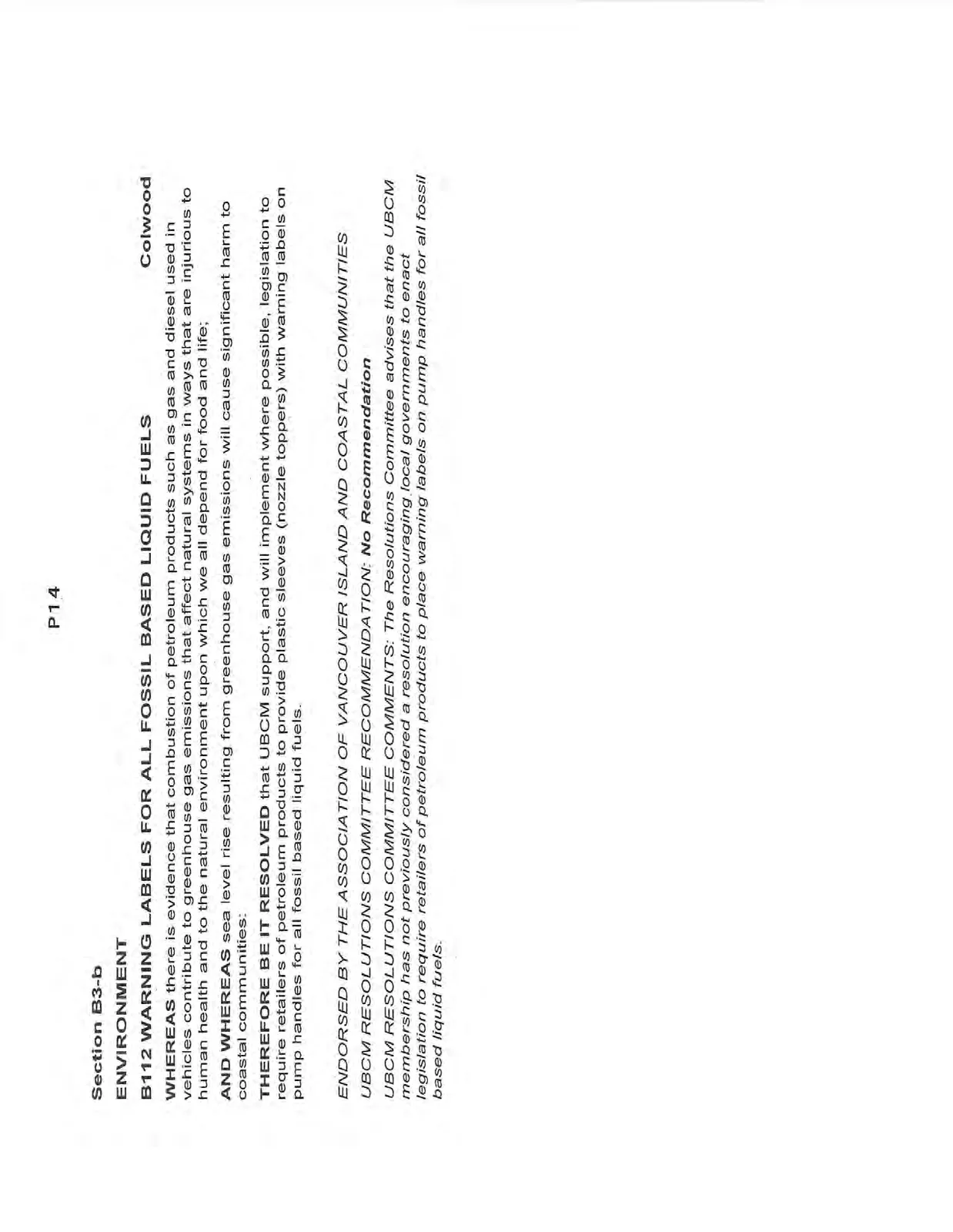
Section B3-b
ENVIRONMENT
B112 WARNING LABELS FOR ALL FOSSIL BASED LIQUID FUELS
Colwood
WHEREAS there is evidence that combustion of petroleum products such as gas and diesel used in vehicles contribute to greenhouse gas emissions that affect natural systems in ways that are injurious to human health and to the natural environment upon which we all depend for food and life;
AND WHEREAS sea level rise resulting from greenhouse gas emissions will cause significant harm to coastal communities;
THEREFORE BE IT RESOLVED that UBCM support, and will implement where possible, legislation to require retailers of petroleum products to provide plastic sleeves (nozzle toppers) with warning labels on pump handles for all fossil based liquid fuels.
ENDORSED BY THE ASSOCIATION OF VANCOUVER ISLAND AND COASTAL COMMUNITIES
UBCM RESOLUTIONS COMMITTEE RECOMMENDATION: No Recommendation
UBCM RESOLUTIONS COMMITTEE COMMENTS: The Resolutions Committee advises that the UBCM membership has not previously considered a resolution encouraging local governments to enact legislation to require retailers of petroleum products to place warning labels on pump handles for all fossil based liquid fuels.
Document Images
(3)