MEMORANDUM: Role of Fairness & Transparency Advisor
A memorandum from the Fairness & Transparency Advisor (FTA) discussing the structure of their advisory role and the definition of success for the project.
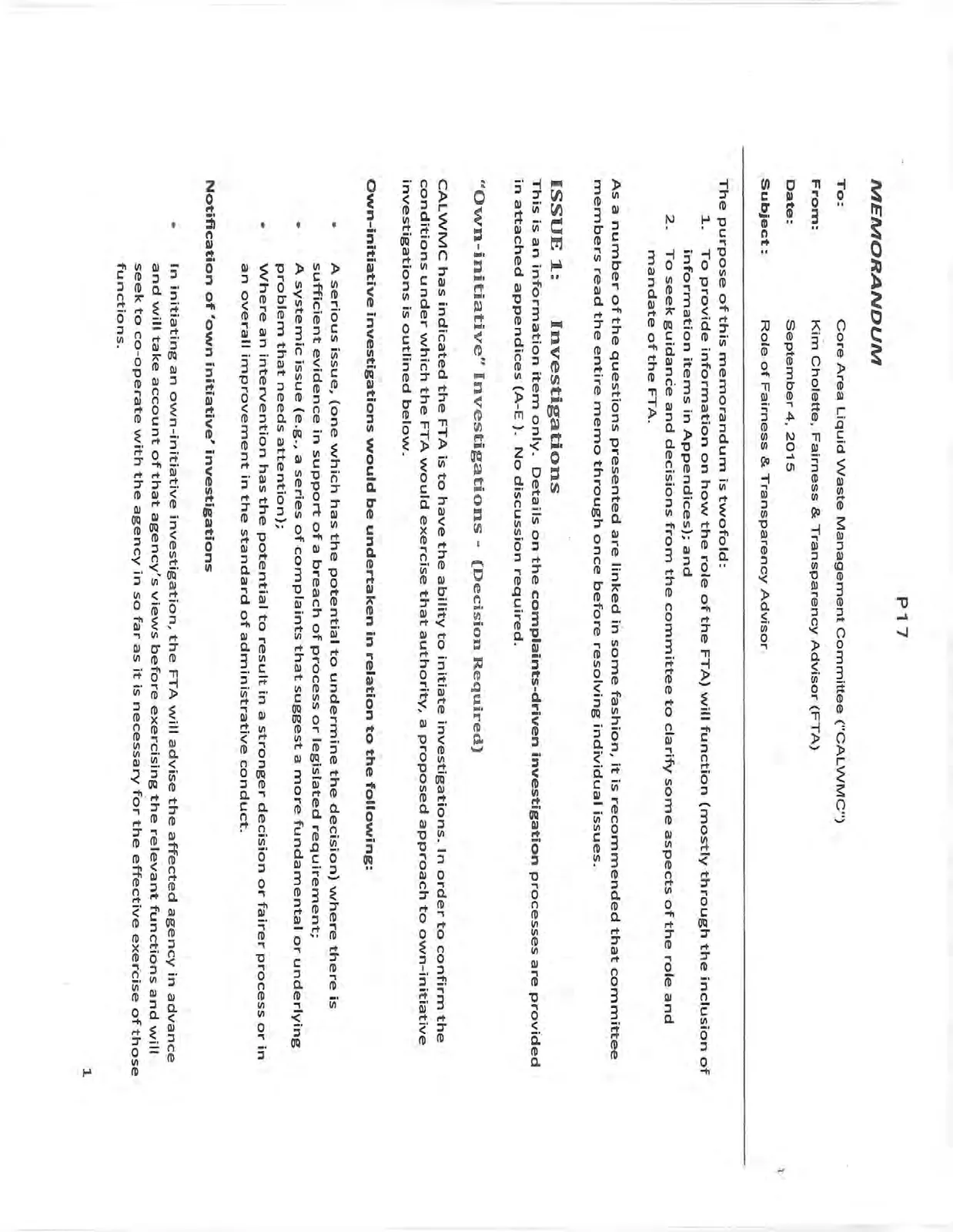
MEMORANDUM
To: Core Area Liquid Waste Management Committee ("CALWMC") From: Kim Cholette, Fairness & Transparency Advisor (FTA) Date: September 4, 2015 Subject: Role of Fairness & Transparency Advisor
The purpose of this memorandum is twofold:
- To provide information on how the role of the FTA will function (mostly through the inclusion of information items in Appendices); and
- To seek guidance and decisions from the committee to clarify some aspects of the role and mandate of the FTA.
As a number of the questions presented are linked in some fashion, it is recommended that committee members read the entire memo through once before resolving individual issues.
ISSUE 1: Investigations
This is an information item only. Details on the complaints-driven investigation processes are provided in attached appendices (A-E). No discussion required.
“Own-initiative” Investigations - (Decision Required)
CALWMC has indicated the FTA is to have the ability to initiate investigations. In order to confirm the conditions under which the FTA would exercise that authority, a proposed approach to own-initiative investigations is outlined below.
Own-initiative investigations would be undertaken in relation to the following:
- A serious issue, (one which has the potential to undermine the decision) where there is sufficient evidence in support of a breach of process or legislated requirement;
- A systemic issue (e.g., a series of complaints that suggest a more fundamental or underlying problem that needs attention);
- Where an intervention has the potential to result in a stronger decision or fairer process or in an overall improvement in the standard of administrative conduct.
Notification of ‘own initiative’ investigations
- In initiating an own-initiative investigation, the FTA will advise the affected agency in advance and will take account of that agency's views before exercising the relevant functions and will seek to co-operate with the agency in so far as it is necessary for the effective exercise of those functions.
Information gathering
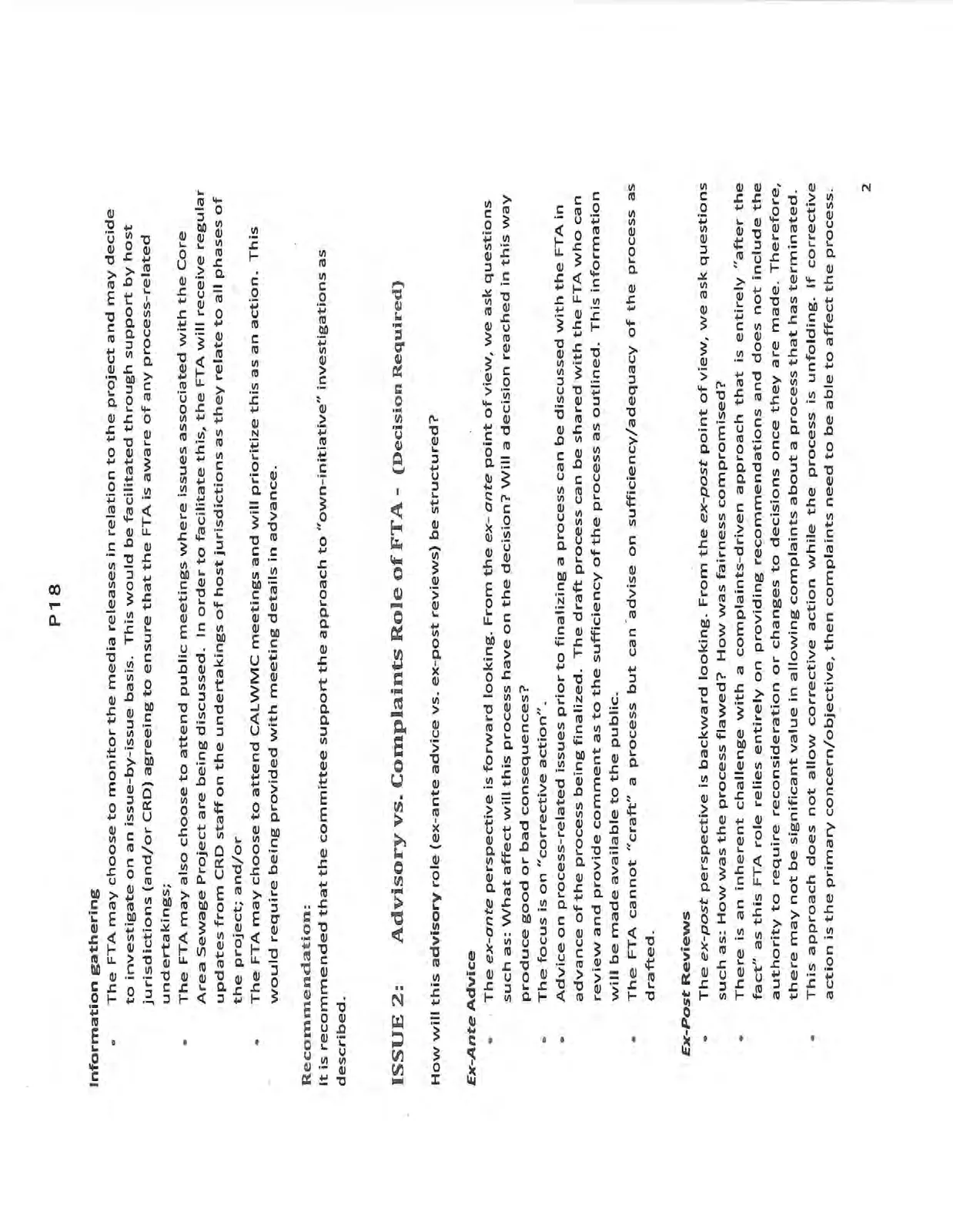
- The FTA may choose to monitor the media releases in relation to the project and may decide to investigate on an issue-by-issue basis. This would be facilitated through support by host jurisdictions (and/or CRD) agreeing to ensure that the FTA is aware of any process-related undertakings;
- The FTA may also choose to attend public meetings where issues associated with the Core Area Sewage Project are being discussed. In order to facilitate this, the FTA will receive regular updates from CRD staff on the undertakings of host jurisdictions as they relate to all phases of the project; and/or
- The FTA may choose to attend CALWMC meetings and will prioritize this as an action. This would require being provided with meeting details in advance.
Recommendation: It is recommended that the committee support the approach to "own-initiative" investigations as described.
ISSUE 2: Advisory vs. Complaints Role of FTA - (Decision Required)
How will this advisory role (ex-ante advice vs. ex-post reviews) be structured?
Ex-Ante Advice
- The ex-ante perspective is forward looking. From the ex-ante point of view, we ask questions such as: What affect will this process have on the decision? Will a decision reached in this way produce good or bad consequences?
- The focus is on "corrective action".
- Advice on process-related issues prior to finalizing a process can be discussed with the FTA in advance of the process being finalized. The draft process can be shared with the FTA who can review and provide comment as to the sufficiency of the process as outlined. This information will be made available to the public.
- The FTA cannot "craft" a process but can advise on sufficiency/adequacy of the process as drafted.
Ex-Post Reviews
- The ex-post perspective is backward looking. From the ex-post point of view, we ask questions such as: How was the process flawed? How was fairness compromised?
- There is an inherent challenge with a complaints-driven approach that is entirely "after the fact" as this FTA role relies entirely on providing recommendations and does not include the authority to require reconsideration or changes to decisions once they are made. Therefore, there may not be significant value in allowing complaints about a process that has terminated.
- This approach does not allow corrective action while the process is unfolding. If corrective action is the primary concern/objective, then complaints need to be able to affect the process.
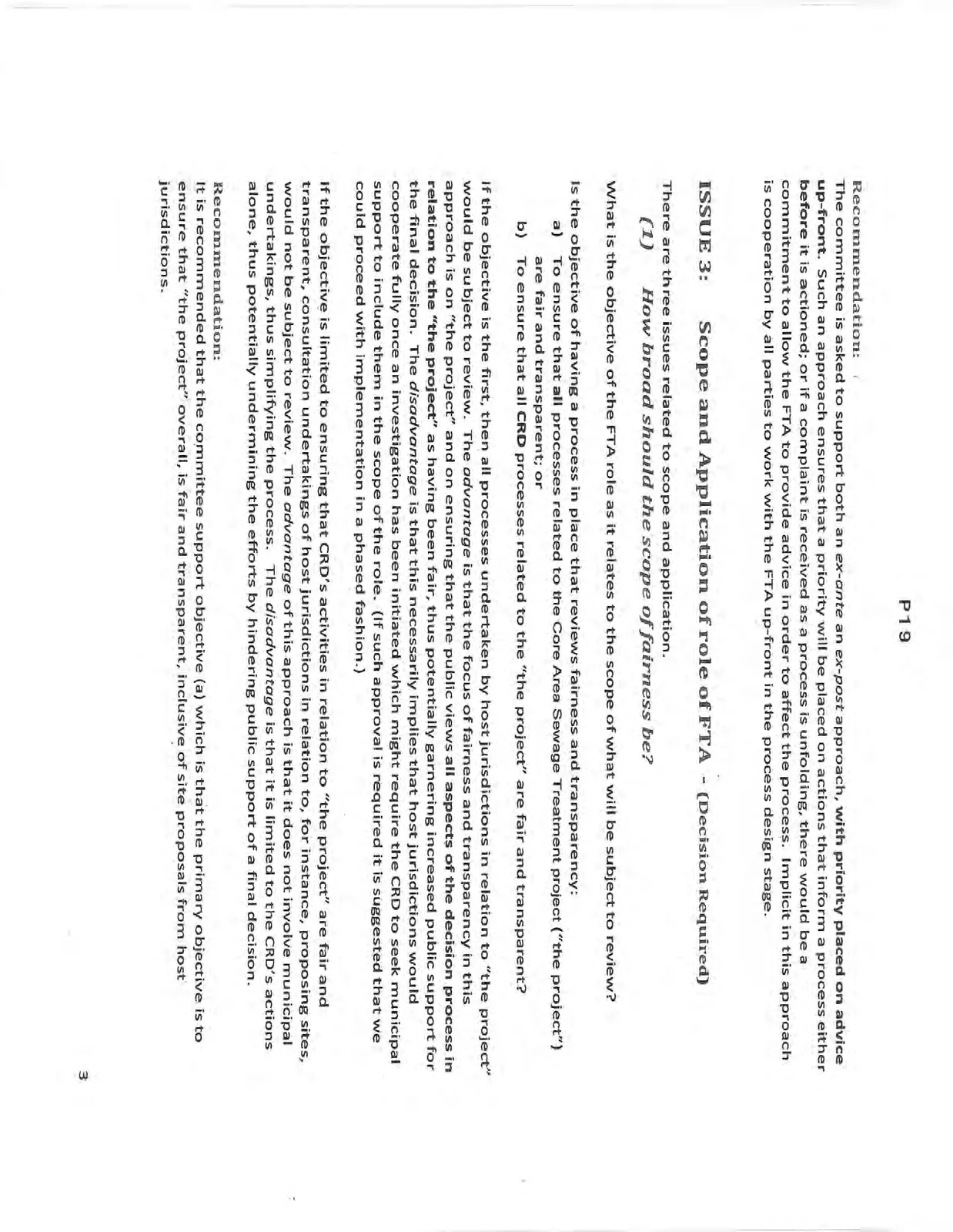
Recommendation: The committee is asked to support both an ex-ante an ex-post approach, with priority placed on advice up-front. Such an approach ensures that a priority will be placed on actions that inform a process either before it is actioned; or if a complaint is received as a process is unfolding, there would be a commitment to allow the FTA to provide advice in order to affect the process. Implicit in this approach is cooperation by all parties to work with the FTA up-front in the process design stage.
ISSUE 3: Scope and Application of role of FTA - (Decision Required)
There are three issues related to scope and application.
(1) How broad should the scope of fairness be?
What is the objective of the FTA role as it relates to the scope of what will be subject to review?
Is the objective of having a process in place that reviews fairness and transparency: a) To ensure that all processes related to the Core Area Sewage Treatment project ("the project") are fair and transparent; or b) To ensure that all CRD processes related to the "the project" are fair and transparent?
If the objective is the first, then all processes undertaken by host jurisdictions in relation to "the project" would be subject to review. The advantage is that the focus of fairness and transparency in this approach is on "the project" and on ensuring that the public views all aspects of the decision process in relation to the "the project" as having been fair, thus potentially garnering increased public support for the final decision. The disadvantage is that this necessarily implies that host jurisdictions would cooperate fully once an investigation has been initiated which might require the CRD to seek municipal support to include them in the scope of the role. (If such approval is required it is suggested that we could proceed with implementation in a phased fashion.)
If the objective is limited to ensuring that CRD's activities in relation to "the project" are fair and transparent, consultation undertakings of host jurisdictions in relation to, for instance, proposing sites, would not be subject to review. The advantage of this approach is that it does not involve municipal undertakings, thus simplifying the process. The disadvantage is that it is limited to the CRD's actions alone, thus potentially undermining the efforts by hindering public support of a final decision.
Recommendation: It is recommended that the committee support objective (a) which is that the primary objective is to ensure that "the project" overall, is fair and transparent, inclusive of site proposals from host jurisdictions.
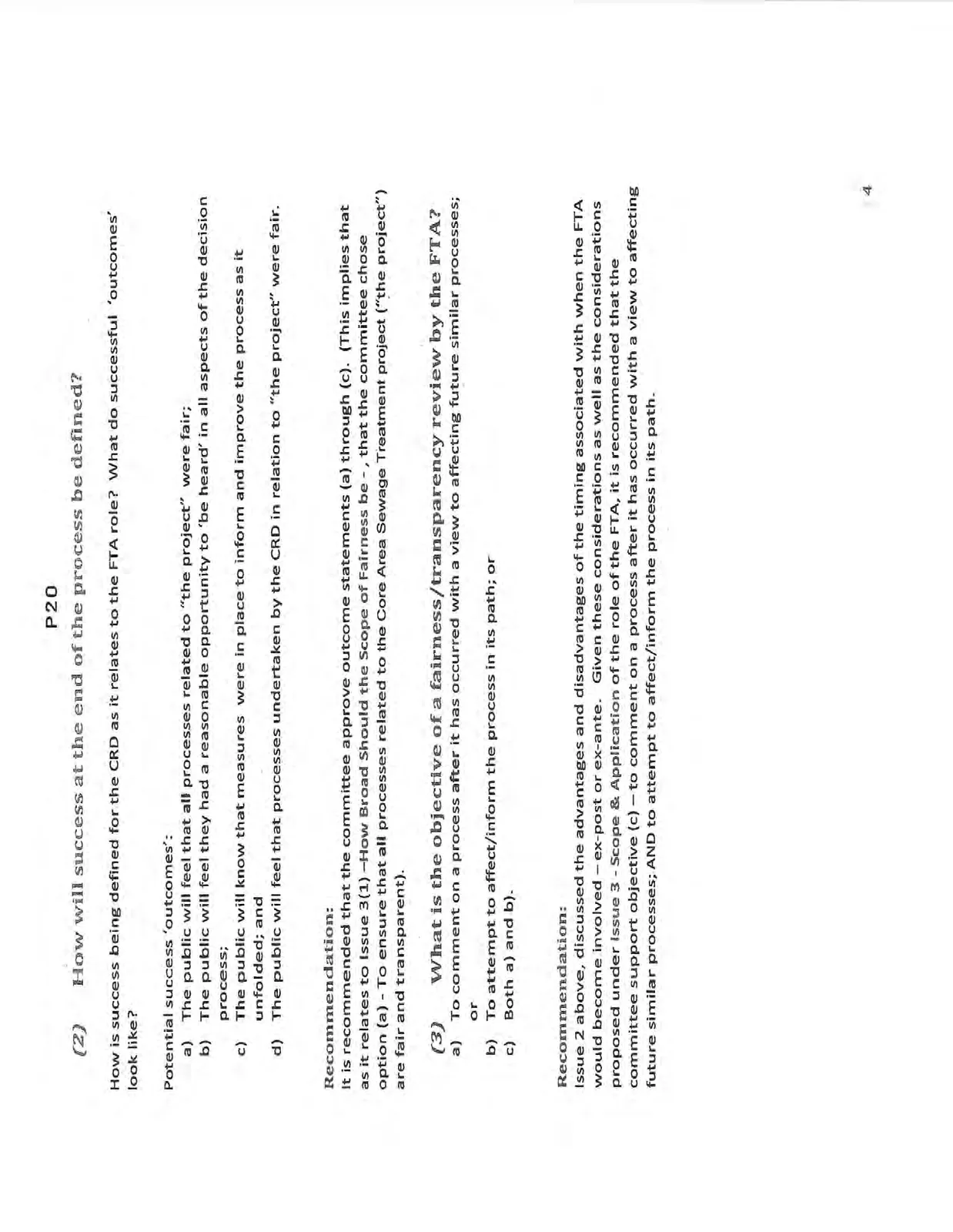
(2) How will success at the end of the process be defined?
How is success being defined for the CRD as it relates to the FTA role? What do successful 'outcomes' look like?
Potential success 'outcomes': a) The public will feel that all processes related to "the project" were fair; b) The public will feel they had a reasonable opportunity to 'be heard' in all aspects of the decision process; c) The public will know that measures were in place to inform and improve the process as it unfolded; and d) The public will feel that processes undertaken by the CRD in relation to "the project" were fair.
Recommendation: It is recommended that the committee approve outcome statements (a) through (c). (This implies that as it relates to Issue 3(1) -How Broad Should the Scope of Fairness be -, that the committee chose option (a) - To ensure that all processes related to the Core Area Sewage Treatment project ("the project") are fair and transparent).
(3) What is the objective of a fairness/transparency review by the FTA?
a) To comment on a process after it has occurred with a view to affecting future similar processes; or b) To attempt to affect/inform the process in its path; or c) Both a) and b).
Recommendation: Issue 2 above, discussed the advantages and disadvantages of the timing associated with when the FTA would become involved - ex-post or ex-ante. Given these considerations as well as the considerations proposed under Issue 3 - Scope & Application of the role of the FTA, it is recommended that the committee support objective (c) - to comment on a process after it has occurred with a view to affecting future similar processes; AND to attempt to affect/inform the process in its path.
ISSUE 4: Exclusions
What exclusions, if any, should there be in the Terms of Reference?
The decision should be informed by the intent relative to the exclusions.
- Is the intent to exclude a group of people on the basis that they are public officials who have either made decisions on the matters at hand or work for the public institutions that have made the decision? (If this is the case, it is suggested that the grounds for review would capture any complaint that is not grounded in a breach of fairness); or
- Is the intent to avoid 'revisiting' political decisions that have been made? (If this is the case, it is suggested that the process as currently contemplated, in addition to requiring grounds for review, limit investigations to matters of administration initiated with respect to "the project". The FTA will not reconsider the merits of decisions of public bodies exercising legislative functions. (See Appendix B- Complaints Driven Investigations.)
Recommendation: It is recommended that there be no exclusions.
ISSUE 5: "Project" timelines
The timelines for the identification of a site (including costing, etc.), as imposed on the CRD by funders, are a constraint. While they do have the potential to affect processes related to public consultation and other related processes, these are not timelines that the CRD has self-imposed. This constraint is unchangeable (unless agreed to by third party funding agencies) and host jurisdictions and the CRD must work within this time constraint.
Recommendation: All process-related complaints must relate to the individual processes within the existing timelines. FTA will not review the fairness of timelines imposed on the project by external parties (e.g., funders).
Role of Fairness and Transparency Advisor and Terms of Reference
Recommendations:
Issue 1: Investigations It is recommended that the committee support the approach to "own-initiative" investigations as described.
Issue 2: Advisory vs. Complaints Role of FTA The committee is asked to support both an ex-ante an ex-post approach, with priority placed on advice up-front. Such an approach ensures that a priority will be placed on actions that inform a process either before it is actioned; or if a complaint is received as a process is unfolding, there would be a commitment to allow the FTA to provide advice in order to affect the process. Implicit in this approach is cooperation by all parties to work with the FTA up-front in the process design stage.
Issue 3: Scope and Application of role of FTA It is recommended that the committee support objective (a) which is that the primary objective is to ensure that "the project" overall, is fair and transparent, inclusive of site proposals from host jurisdictions.
- It is recommended that the committee approve outcome statements (a) through (c). (This implies that as it relates to Issue 3(1) -How Broad Should the Scope of Fairness be -, that the committee chose option (a) - To ensure that all processes related to the Core Area Sewage Treatment project ("the project") are fair and transparent).
- Issue 2 above, discussed the advantages and disadvantages of the timing associated with when the FTA would become involved - ex-post or ex-ante. Given these considerations as well as the considerations proposed under Issue 3 - Scope & Application of the role of the FTA, it is recommended that the committee support objective (c) - to comment on a process after it has occurred with a view to affecting future similar processes; AND to attempt to affect/inform the process in its path.
Issue 4: Exclusions It is recommended that there be no exclusions.
Issue 5: "Project" timelines All process-related complaints must relate to the individual processes within the existing timelines. FTA will not review the fairness of timelines imposed on the project by external parties (e.g., funders).
Document Images
(6)