GROUNDS FOR REVIEW
A detailed explanation of the FTA's mandate and the principles of administrative, substantive, and relational fairness they examine during reviews.
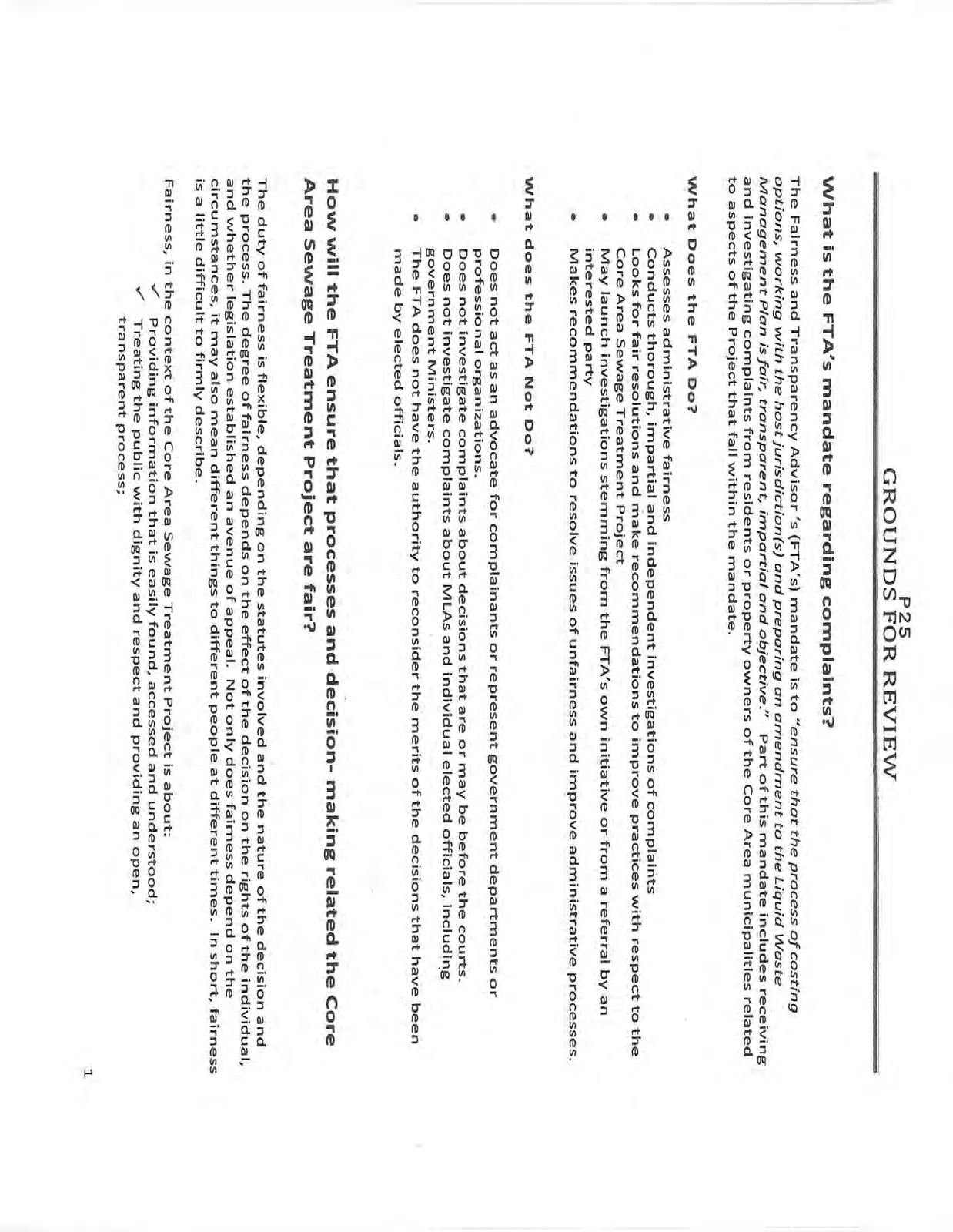
What is the FTA's mandate regarding complaints?
The Fairness and Transparency Advisor's (FTA's) mandate is to "ensure that the process of costing options, working with the host jurisdiction(s) and preparing an amendment to the Liquid Waste Management Plan is fair, transparent, impartial and objective." Part of this mandate includes receiving and investigating complaints from residents or property owners of the Core Area municipalities related to aspects of the Project that fall within the mandate.
What Does the FTA Do?
- Assesses administrative fairness
- Conducts thorough, impartial and independent investigations of complaints
- Looks for fair resolutions and make recommendations to improve practices with respect to the Core Area Sewage Treatment Project
- May launch investigations stemming from the FTA's own initiative or from a referral by an interested party
- Makes recommendations to resolve issues of unfairness and improve administrative processes.
What does the FTA Not Do?
- Does not act as an advocate for complainants or represent government departments or professional organizations.
- Does not investigate complaints about decisions that are or may be before the courts.
- Does not investigate complaints about MLAs and individual elected officials, including government Ministers.
- The FTA does not have the authority to reconsider the merits of the decisions that have been made by elected officials.
How will the FTA ensure that processes and decision- making related the Core Area Sewage Treatment Project are fair?
The duty of fairness is flexible, depending on the statutes involved and the nature of the decision and the process. The degree of fairness depends on the effect of the decision on the rights of the individual, and whether legislation established an avenue of appeal. Not only does fairness depend on the circumstances, it may also mean different things to different people at different times. In short, fairness is a little difficult to firmly describe.
Fairness, in the context of the Core Area Sewage Treatment Project is about:
- Providing information that is easily found, accessed and understood;
- Treating the public with dignity and respect and providing an open, transparent process;
- Providing well-reasoned decisions to the public;
- Providing individuals with an opportunity to be heard, as appropriate;
- A process free of bias and personal interest; and
- Acting on the basis of logical evidence.
The FTA will examine three aspects of administrative fairness in any investigation in the context of the Core Area Sewage Treatment Project: (1) procedural; (2) substantive, and (3) relational.
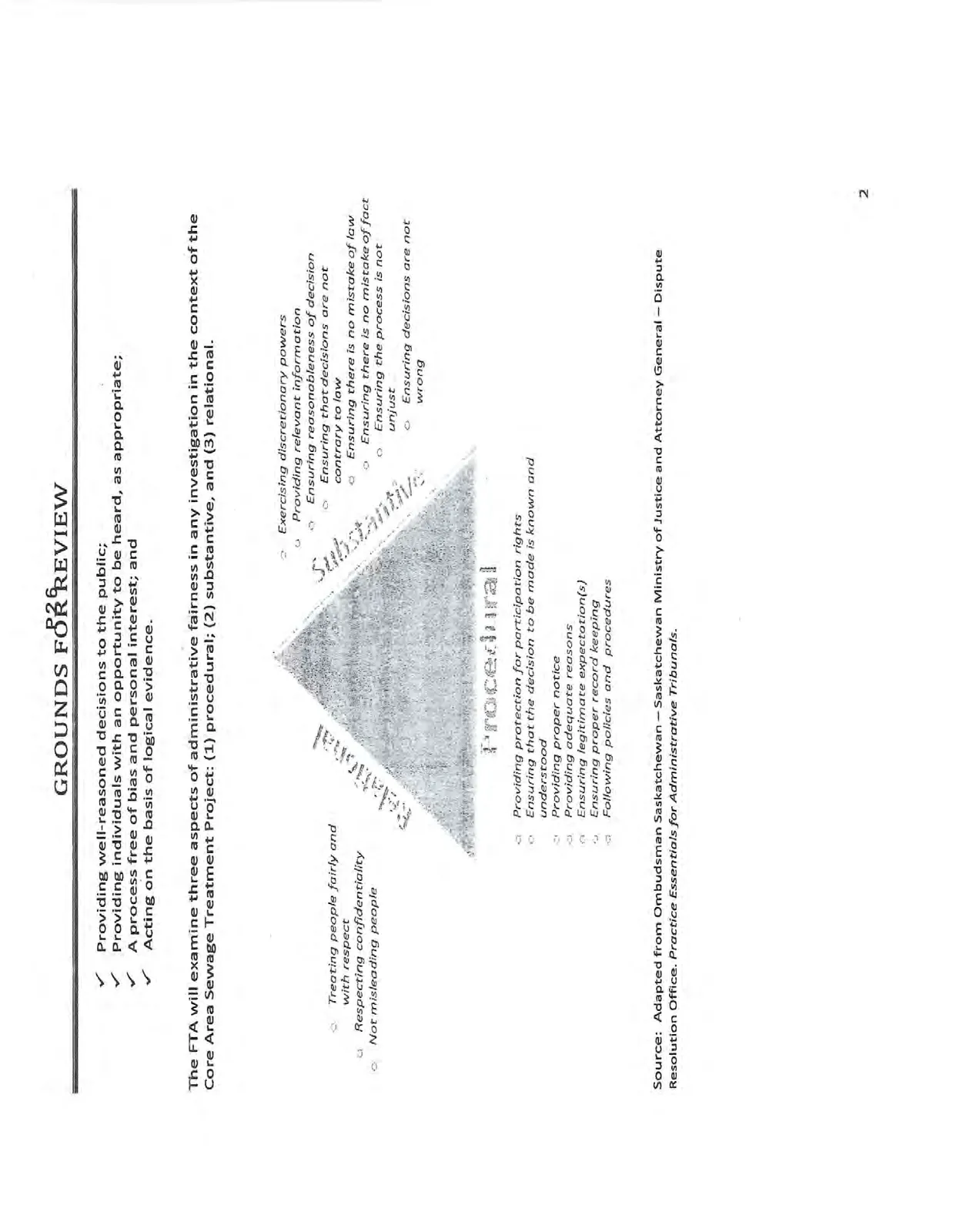
Relational
- Treating people fairly and with respect
- Respecting confidentiality
- Not misleading people
Substantive
- Exercising discretionary powers
- Providing relevant information
- Ensuring reasonableness of decision
- Ensuring that decisions are not contrary to law
- Ensuring there is no mistake of law
- Ensuring there is no mistake of fact
- Ensuring the process is not unjust
- Ensuring decisions are not wrong
Procedural
- Providing protection for participation rights
- Ensuring that the decision to be made is known and understood
- Providing proper notice
- Providing adequate reasons
- Ensuring legitimate expectation(s)
- Ensuring proper record keeping
- Following policies and procedures
Source: Adapted from Ombudsman Saskatchewan – Saskatchewan Ministry of Justice and Attorney General – Dispute Resolution Office. Practice Essentials for Administrative Tribunals.
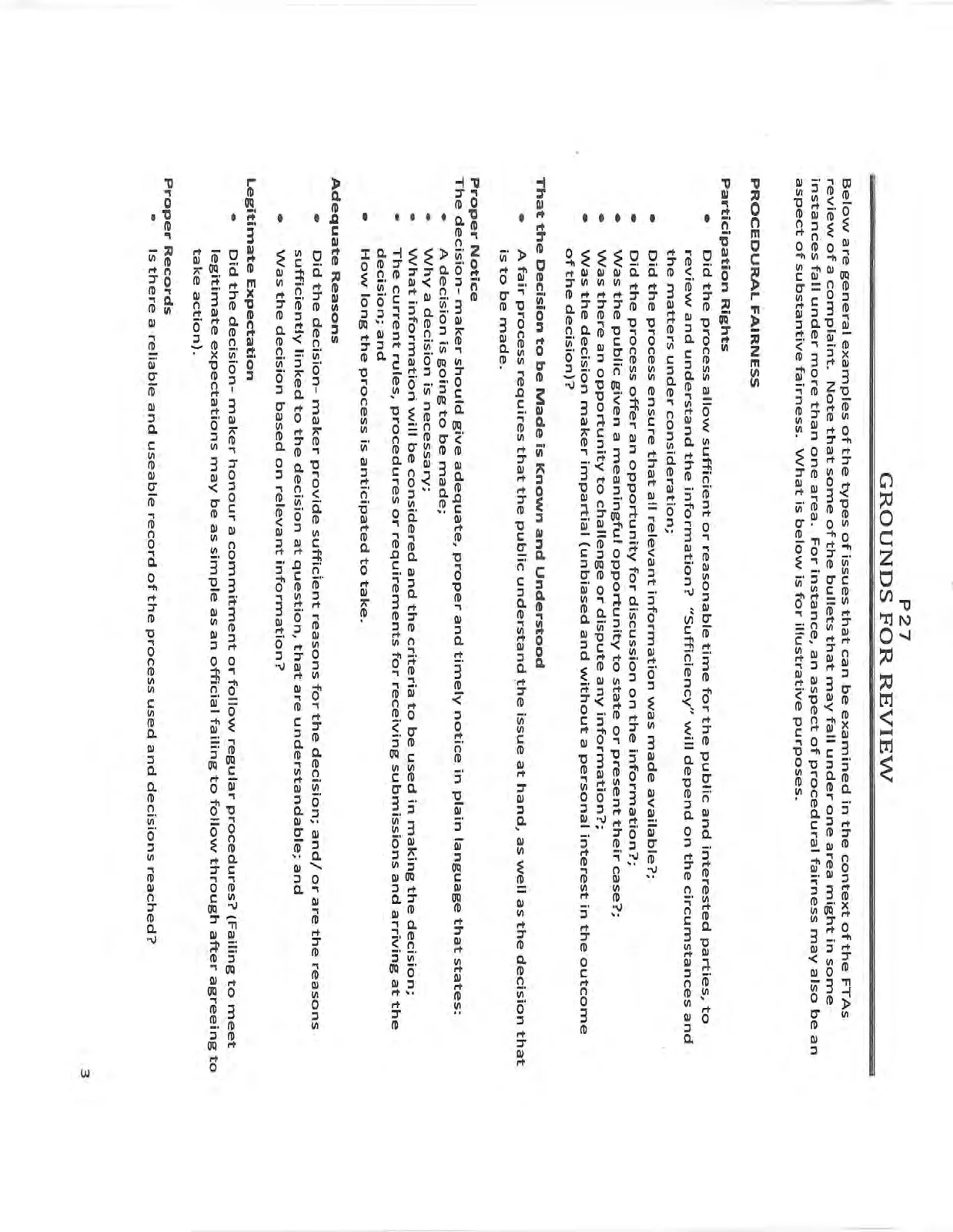
Below are general examples of the types of issues that can be examined in the context of the FTAs review of a complaint. Note that some of the bullets that may fall under one area might in some instances fall under more than one area. For instance, an aspect of procedural fairness may also be an aspect of substantive fairness. What is below is for illustrative purposes.
PROCEDURAL FAIRNESS
Participation Rights
- Did the process allow sufficient or reasonable time for the public and interested parties, to review and understand the information? "Sufficiency" will depend on the circumstances and the matters under consideration;
- Did the process ensure that all relevant information was made available?;
- Did the process offer an opportunity for discussion on the information?;
- Was the public given a meaningful opportunity to state or present their case?;
- Was there an opportunity to challenge or dispute any information?;
- Was the decision maker impartial (unbiased and without a personal interest in the outcome of the decision)?
That the Decision to be Made is Known and Understood
- A fair process requires that the public understand the issue at hand, as well as the decision that is to be made.
Proper Notice
The decision- maker should give adequate, proper and timely notice in plain language that states:
- A decision is going to be made;
- Why a decision is necessary;
- What information will be considered and the criteria to be used in making the decision;
- The current rules, procedures or requirements for receiving submissions and arriving at the decision; and
- How long the process is anticipated to take.
Adequate Reasons
- Did the decision- maker provide sufficient reasons for the decision; and/ or are the reasons sufficiently linked to the decision at question, that are understandable; and
- Was the decision based on relevant information?
Legitimate Expectation
- Did the decision- maker honour a commitment or follow regular procedures? (Failing to meet legitimate expectations may be as simple as an official failing to follow through after agreeing to take action).
Proper Records
- Is there a reliable and useable record of the process used and decisions reached?
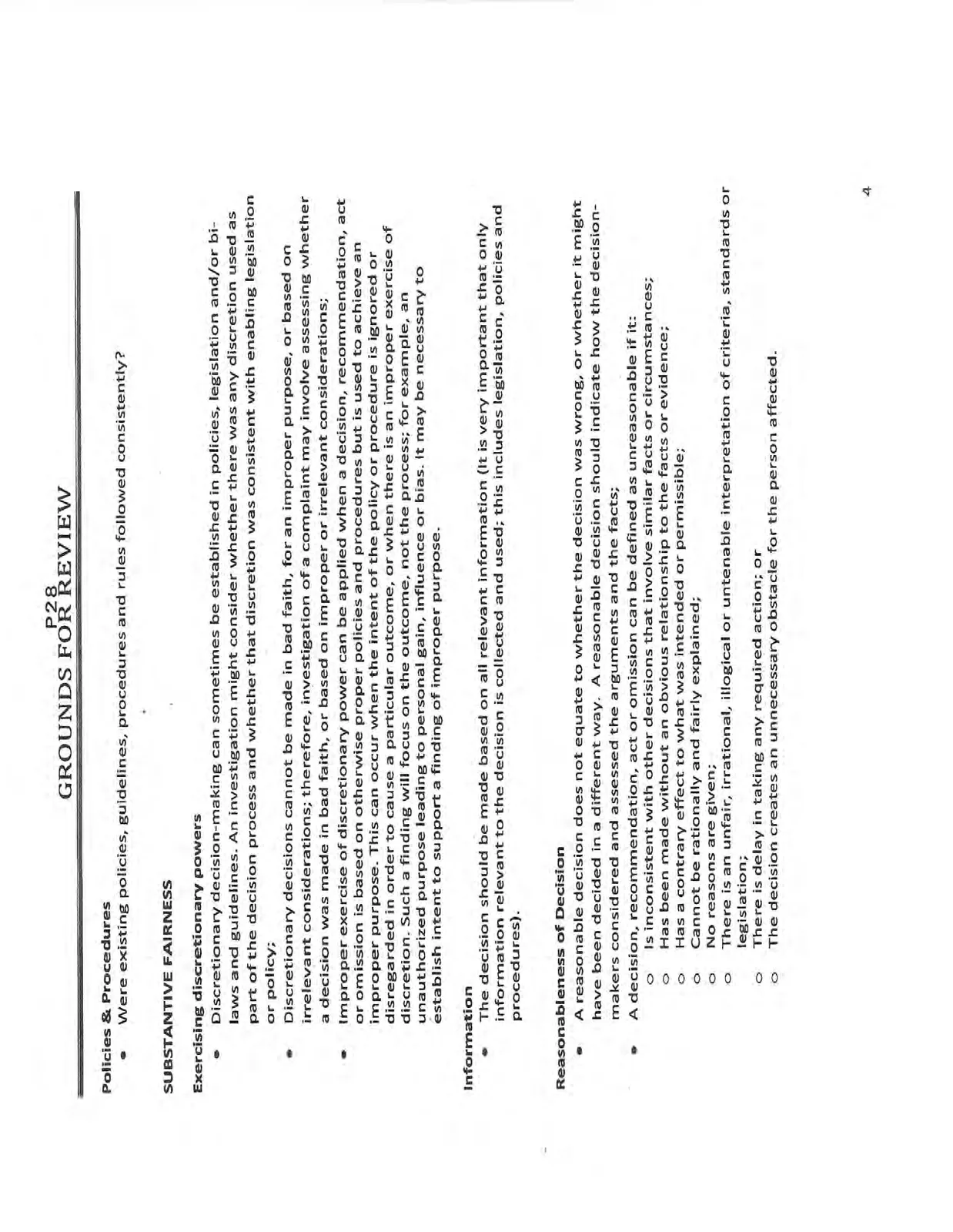
Policies & Procedures
- Were existing policies, guidelines, procedures and rules followed consistently?
SUBSTANTIVE FAIRNESS
Exercising discretionary powers
- Discretionary decision-making can sometimes be established in policies, legislation and/or bi-laws and guidelines. An investigation might consider whether there was any discretion used as part of the decision process and whether that discretion was consistent with enabling legislation or policy;
- Discretionary decisions cannot be made in bad faith, for an improper purpose, or based on irrelevant considerations; therefore, investigation of a complaint may involve assessing whether a decision was made in bad faith, or based on improper or irrelevant considerations;
- Improper exercise of discretionary power can be applied when a decision, recommendation, act or omission is based on otherwise proper policies and procedures but is used to achieve an improper purpose. This can occur when the intent of the policy or procedure is ignored or disregarded in order to cause a particular outcome, or when there is an improper exercise of discretion. Such a finding will focus on the outcome, not the process; for example, an unauthorized purpose leading to personal gain, influence or bias. It may be necessary to establish intent to support a finding of improper purpose.
Information
- The decision should be made based on all relevant information (It is very important that only information relevant to the decision is collected and used; this includes legislation, policies and procedures).
Reasonableness of Decision
- A reasonable decision does not equate to whether the decision was wrong, or whether it might have been decided in a different way. A reasonable decision should indicate how the decision-makers considered and assessed the arguments and the facts;
- A decision, recommendation, act or omission can be defined as unreasonable if it:
- Is inconsistent with other decisions that involve similar facts or circumstances;
- Has been made without an obvious relationship to the facts or evidence;
- Has a contrary effect to what was intended or permissible;
- Cannot be rationally and fairly explained;
- No reasons are given;
- There is an unfair, irrational, illogical or untenable interpretation of criteria, standards or legislation;
- There is delay in taking any required action; or
- The decision creates an unnecessary obstacle for the person affected.
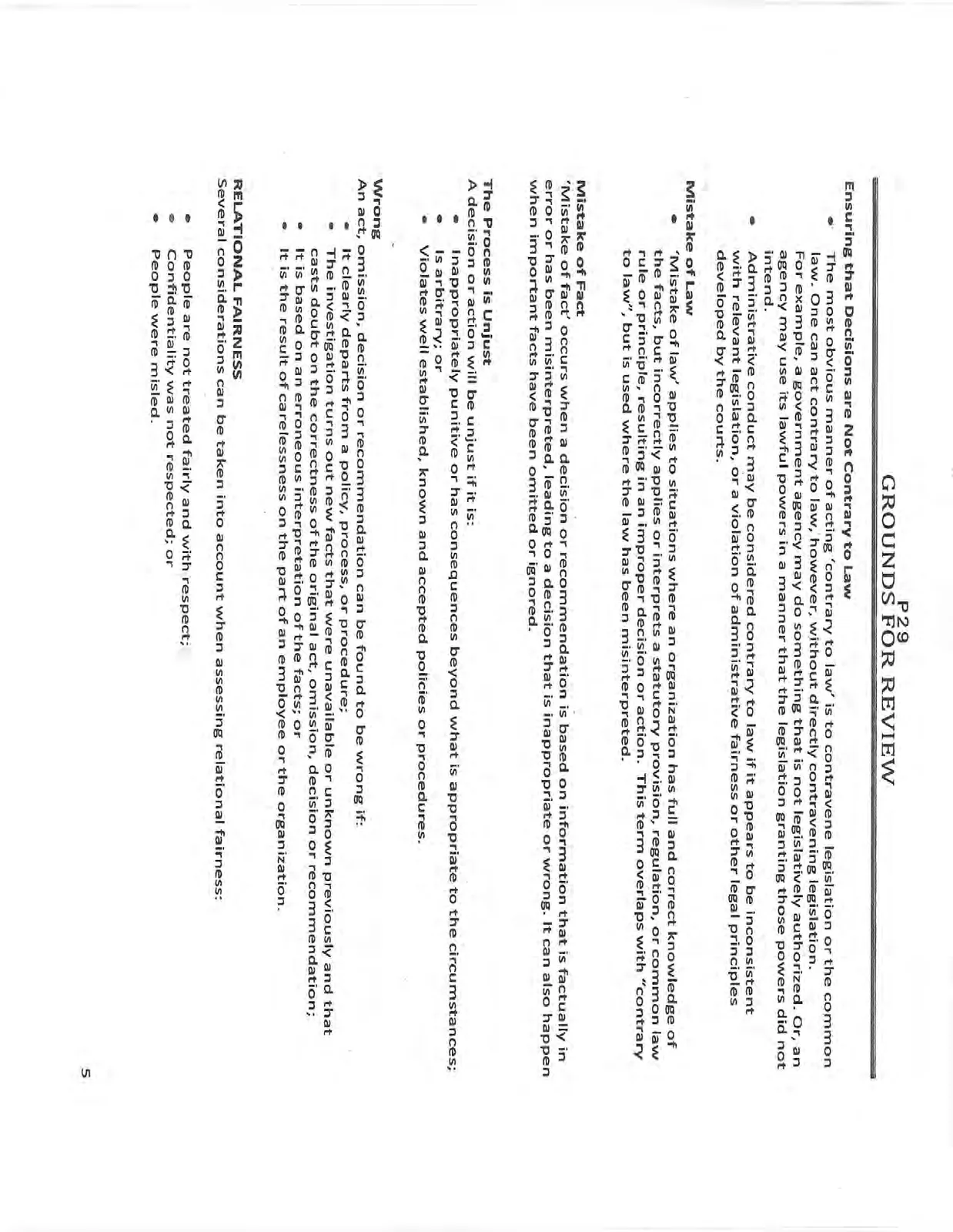
Ensuring that Decisions are Not Contrary to Law
- The most obvious manner of acting ‘contrary to law’ is to contravene legislation or the common law. One can act contrary to law, however, without directly contravening legislation. For example, a government agency may do something that is not legislatively authorized. Or, an agency may use its lawful powers in a manner that the legislation granting those powers did not intend.
- Administrative conduct may be considered contrary to law if it appears to be inconsistent with relevant legislation, or a violation of administrative fairness or other legal principles developed by the courts.
Mistake of Law
- ‘Mistake of law’ applies to situations where an organization has full and correct knowledge of the facts, but incorrectly applies or interprets a statutory provision, regulation, or common law rule or principle, resulting in an improper decision or action. This term overlaps with “contrary to law”, but is used where the law has been misinterpreted.
Mistake of Fact
‘Mistake of fact’ occurs when a decision or recommendation is based on information that is factually in error or has been misinterpreted, leading to a decision that is inappropriate or wrong. It can also happen when important facts have been omitted or ignored.
The Process is Unjust
A decision or action will be unjust if it is:
- Inappropriately punitive or has consequences beyond what is appropriate to the circumstances;
- Is arbitrary; or
- Violates well established, known and accepted policies or procedures.
Wrong
An act, omission, decision or recommendation can be found to be wrong if:
- It clearly departs from a policy, process, or procedure;
- The investigation turns out new facts that were unavailable or unknown previously and that casts doubt on the correctness of the original act, omission, decision or recommendation;
- It is based on an erroneous interpretation of the facts; or
- It is the result of carelessness on the part of an employee or the organization.
RELATIONAL FAIRNESS
Several considerations can be taken into account when assessing relational fairness:
- People are not treated fairly and with respect;
- Confidentiality was not respected; or
- People were misled.
What will the FTA actually investigate in the context of a complaint?
Considerable attention and emphasis in all investigations of complaints undertaken by the FTA will be placed on the process through which a decision was reached and/or if there was no decision involved, the FTA will focus on the processes surrounding the matter at issue.
No matter what the merits of a particular action or decision are, if the process followed was improper, the parties have acted unfairly.
An investigation will include reviewing the public record; documents used to arrive at a decision; interviews with relevant parties, as well as review of any relevant policy or legislation (e.g. by-laws).
Can the FTA's decline to investigate a complaint?
The FTA can refuse to investigate a complaint, or to continue an investigation of a complaint, when it is believed on reasonable grounds that:
- The complaint is not within the mandate of the FTA;
- The complainant has not availed him or herself of other adequate remedies under the law or existing administrative practices;
- The subject matter of the complaint is trivial;
- The complaint is frivolous, vexatious or was not made in good faith;
- Having regard to all of the circumstances of the complaint, no further investigation is necessary; or
- The complaint does not relate to a breach of procedural, substantive, or relational fairness.
Who may initiate a complaint?
A person seeking to make a complaint shall not have to demonstrate a formal interest; nor shall they have to prove that they are principally and directly concerned by the breach or non-application complained of.
Document Images
(5)