Correspondence: Request for Performance Audit of the 2012 Wastewater Systems Effluent Regulations with Reference to Victoria, BC
A formal appeal to the Auditor General of Canada to review federal wastewater regulations as applied to the Capital Regional District (CRD).
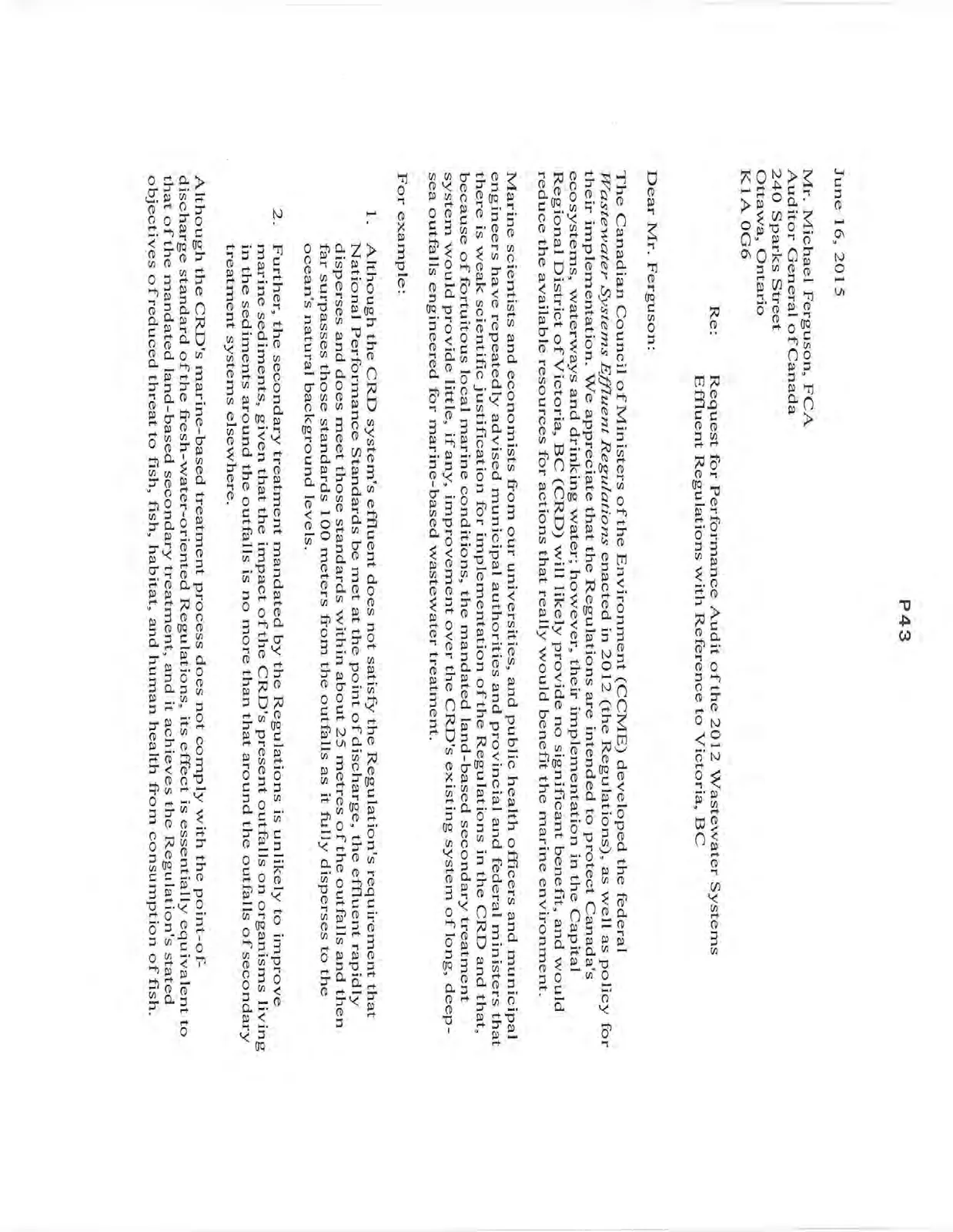
June 16, 2015
Mr. Michael Ferguson, FCA Auditor General of Canada 240 Sparks Street Ottawa, Ontario K1A 0G6
Re: Request for Performance Audit of the 2012 Wastewater Systems Effluent Regulations with Reference to Victoria, BC
Dear Mr. Ferguson:
The Canadian Council of Ministers of the Environment (CCME) developed the federal Wastewater Systems Effluent Regulations enacted in 2012 (the Regulations), as well as policy for their implementation. We appreciate that the Regulations are intended to protect Canada's ecosystems, waterways and drinking water; however, their implementation in the Capital Regional District of Victoria, BC (CRD) will likely provide no significant benefit, and would reduce the available resources for actions that really would benefit the marine environment.
Marine scientists and economists from our universities, and public health officers and municipal engineers have repeatedly advised municipal authorities and provincial and federal ministers that there is weak scientific justification for implementation of the Regulations in the CRD and that, because of fortuitous local marine conditions, the mandated land-based secondary treatment system would provide little, if any, improvement over the CRD's existing system of long, deep-sea outfalls engineered for marine-based wastewater treatment.
For example:
- Although the CRD system's effluent does not satisfy the Regulation's requirement that National Performance Standards be met at the point of discharge, the effluent rapidly disperses and does meet those standards within about 25 metres of the outfalls and then far surpasses those standards 100 meters from the outfalls as it fully disperses to the ocean's natural background levels.
- Further, the secondary treatment mandated by the Regulations is unlikely to improve marine sediments, given that the impact of the CRD's present outfalls on organisms living in the sediments around the outfalls is no more than that around the outfalls of secondary treatment systems elsewhere.
Although the CRD's marine-based treatment process does not comply with the point-of-discharge standard of the fresh-water-oriented Regulations, its effect is essentially equivalent to that of the mandated land-based secondary treatment, and it achieves the Regulation's stated objectives of reduced threat to fish, fish, habitat, and human health from consumption of fish.
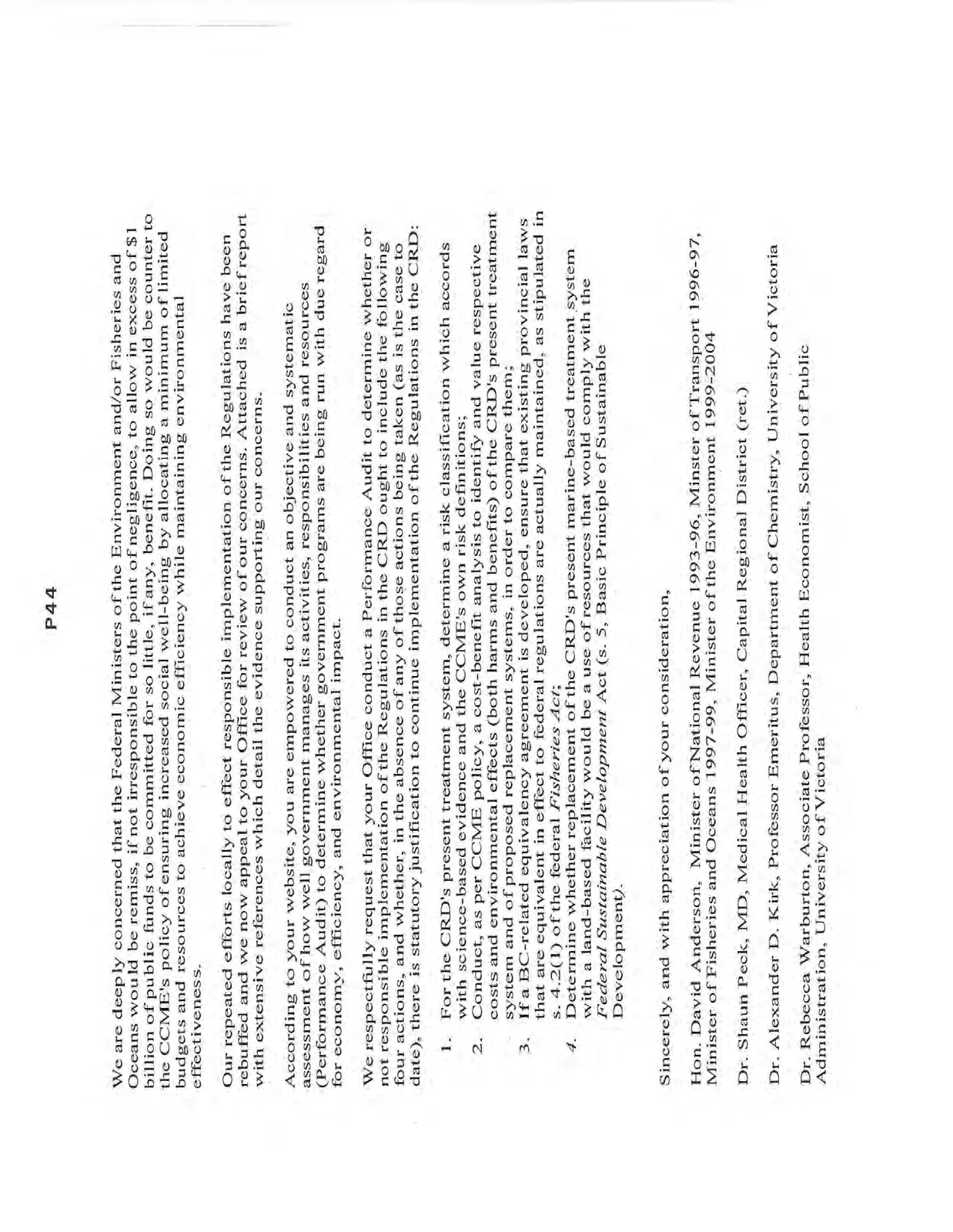
We are deeply concerned that the Federal Ministers of the Environment and/or Fisheries and Oceans would be remiss, if not irresponsible to the point of negligence, to allow in excess of $1 billion of public funds to be committed for so little, if any, benefit. Doing so would be counter to the CCME's policy of ensuring increased social well-being by allocating a minimum of limited budgets and resources to achieve economic efficiency while maintaining environmental effectiveness.
Our repeated efforts locally to effect responsible implementation of the Regulations have been rebuffed and we now appeal to your Office for review of our concerns. Attached is a brief report with extensive references which detail the evidence supporting our concerns.
According to your website, you are empowered to conduct an objective and systematic assessment of how well government manages its activities, responsibilities and resources (Performance Audit) to determine whether government programs are being run with due regard for economy, efficiency, and environmental impact.
We respectfully request that your Office conduct a Performance Audit to determine whether or not responsible implementation of the Regulations in the CRD ought to include the following four actions, and whether, in the absence of any of those actions being taken (as is the case to date), there is statutory justification to continue implementation of the Regulations in the CRD:
- For the CRD's present treatment system, determine a risk classification which accords with science-based evidence and the CCME's own risk definitions;
- Conduct, as per CCME policy, a cost-benefit analysis to identify and value respective costs and environmental effects (both harms and benefits) of the CRD's present treatment system and of proposed replacement systems, in order to compare them;
- If a BC-related equivalency agreement is developed, ensure that existing provincial laws that are equivalent in effect to federal regulations are actually maintained, as stipulated in s. 4.2(1) of the federal Fisheries Act;
- Determine whether replacement of the CRD's present marine-based treatment system with a land-based facility would be a use of resources that would comply with the Federal Sustainable Development Act (s. 5, Basic Principle of Sustainable Development).
Sincerely, and with appreciation of your consideration,
Hon. David Anderson, Minister of National Revenue 1993-96, Minister of Transport 1996-97, Minister of Fisheries and Oceans 1997-99, Minister of the Environment 1999-2004
Dr. Shaun Peck, MD, Medical Health Officer, Capital Regional District (ret.)
Dr. Alexander D. Kirk, Professor Emeritus, Department of Chemistry, University of Victoria
Dr. Rebecca Warburton, Associate Professor, Health Economist, School of Public Administration, University of Victoria
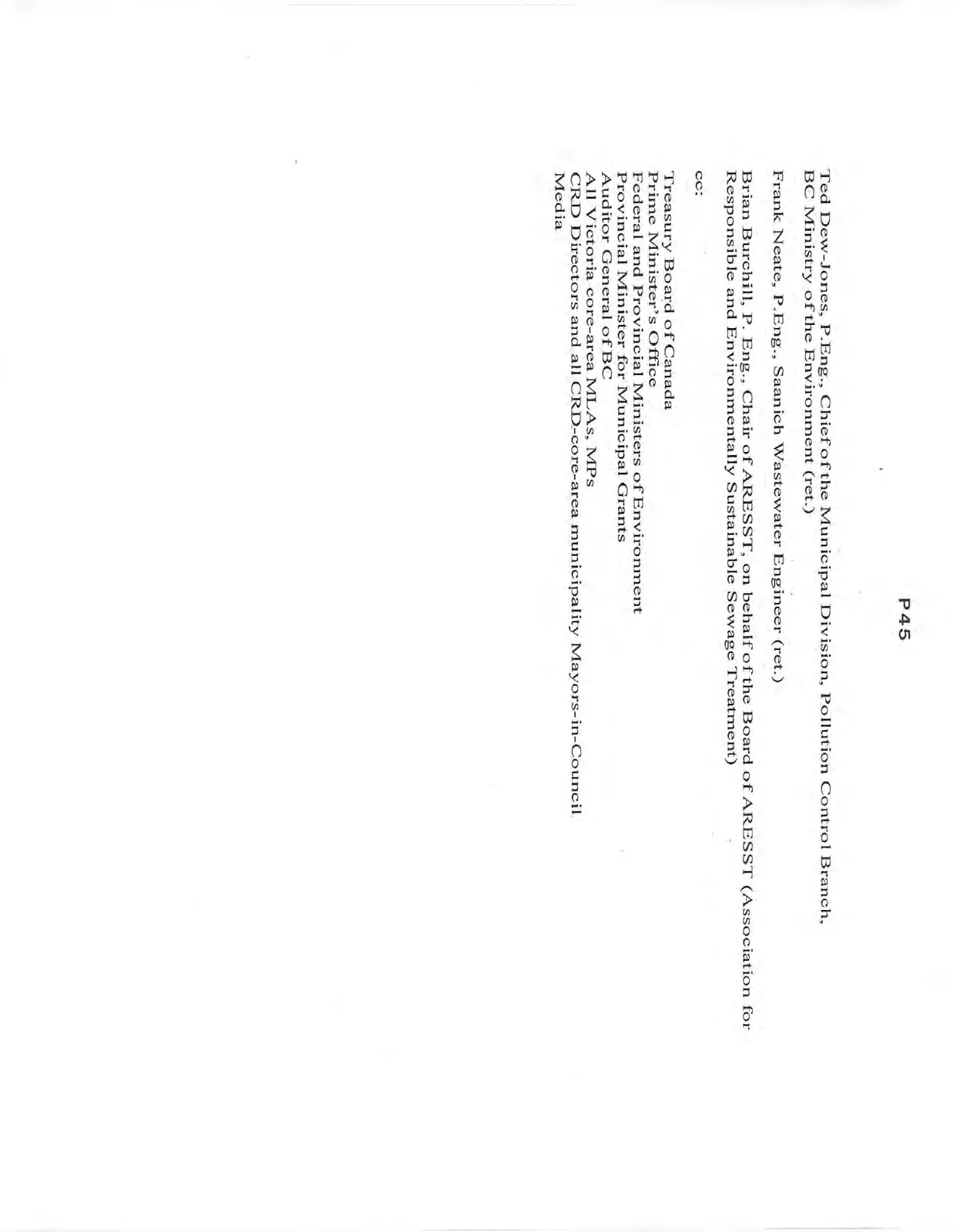
Ted Dew-Jones, P.Eng., Chief of the Municipal Division, Pollution Control Branch, BC Ministry of the Environment (ret.)
Frank Neate, P.Eng., Saanich Wastewater Engineer (ret.)
Brian Burchill, P. Eng., Chair of ARESST, on behalf of the Board of ARESST (Association for Responsible and Environmentally Sustainable Sewage Treatment)
cc: Treasury Board of Canada Prime Minister's Office Federal and Provincial Ministers of Environment Provincial Minister for Municipal Grants Auditor General of BC All Victoria core-area MLAs, MPs CRD Directors and all CRD-core-area municipality Mayors-in-Council Media
Document Images
(3)