Core Area Sewage and Resource Recovery System 2.0 – Project Charter – DRAFT
A detailed draft project charter outlining the vision, goals, stakeholders, and multi-million dollar budget for the CRD sewage system project.
CORE AREA SEWAGE AND RESOURCE RECOVERY SYSTEM 2.0
Phase 2: Analysis, Options Costing and Public Engagement
Project Charter – DRAFT
This document is an incomplete draft, a work in progress. The Core Area Liquid Waste Management Committee (CALWMC) is seeking input from the Eastside and Westside Select Committees, CRD staff and the Technical Oversight Panel. The draft will be amended accordingly with input received. The final project charter will be proposed for adoption at the CALWMC on October 2.
September 4, 2015
Table of Contents
To be completed once content is finalized.
1. VISION
In partnership with the public, the Core Area Liquid Waste Management Committee (CALWMC) will deliver a sewage treatment and resource recovery system that is proven, innovative and maximizes the benefits for people and the planet – economic, social, and environmental – for the long term.
2. BACKGROUND
In 2006, an environmental report commissioned by the Ministry of Environment noted the contamination of seabed sites near the outfalls in the region. As a result, the Province mandated that the Capital Regional District (CRD) plan for and initiate secondary sewage treatment for the region.
In 2012, the federal government passed a law requiring all high-risk Canadian cities to provide secondary sewage treatment by 2020 at the latest. The CRD’s core area was deemed to be in the high-risk category.
Between 2009 and 2014, the CALWMC, CRD staff and consultants, and the Core Area Wastewater Program Commission (the Commission) worked to create and implement a publicly acceptable sewage treatment and resource recovery system for the core area.
In June 2014, the plan to build one regional plant at McLoughlin Point was put on hold by the CRD Board, in response to public input from the residents of Esquimalt, the host municipality.
In June 2014, Langford, Colwood, View Royal, Esquimalt and the Songhees Nation formed the Westside Select Committee to begin planning for a new project to treat sewage and recover resources in those municipalities and the Nation. In January 2015, a similar body – the Eastside Select Committee, comprised of Saanich, Oak Bay, and Victoria was formed – to develop a similar plan for the Eastside municipalities.
Since June 2014 and January 2015, respectively, both Select Committees have been engaged in in-depth public engagement activities to share information with the public, build trust, and seek public input on a range of factors including, but not limited to, level of treatment, treatment technologies, siting of plants, costs, risks, and long-term social, economic and environmental benefits.
In July 2015, both select committees presented their work and recommendations to the CALWMC. The CALWMC approved the solution sets and recommendations from the Eastside Select Committee, including potential sites and direction with regard to investigating secondary and tertiary treatment, anaerobic digestion and gasification, and resource recovery and revenue generation. The CALWMC received a presentation from the Westside Select Committee detailing its work to date and accepting the Westside Select Committee's proposal to carry on with further public engagement and more detailed costing and engineering analysis as per its terms of reference to be presented to the CALWMC as more fully-developed solutions in fall 2015.
The work of the Eastside and Westside Select Committees, the CALWMC, and the public between June 2014 and July 2015 lays the groundwork for the current project, Core Area Sewage and Resource Recovery System 2.0.
3. GOALS AND COMMITMENTS
The Core Area Sewage and Resource Recovery System 2.0 project will deliver the following goals and meet the following commitments. NB goals should be measurable. Each of these goals needs a corresponding metric so at project completion the CALWMC can determine whether it achieved its goals.
a) Meet federal regulations for treatment by 2020 b) Minimize net cost to residents and businesses (life cycle cost) and provide value for money c) Optimize opportunities for resource recovery d) Develop innovative solutions that account for and respond to future challenges, demands and opportunities e) Optimize opportunities for climate change mitigation f) Deliver solutions that are safe for communities and that value and enhance the livability of neighbourhoods g) Deliver all aspects of the project transparently and engage the public before key decision points
4. SCOPE
The scope of this project is to complete the Options Development Phase, submitting and receiving conditional approval by the Minister of Environment of a Liquid Waste Management Plan Amendment for the Core Area. This Plan amendment will be approved by the provincial and federal funding agencies. Completion of this phase includes securing land tenure of sites for all major facilities (wastewater treatment and resource recovery).
The scope of this phase does not include detailed site assessments such as Environmental and Social Reviews, submission of detailed business cases, as may be required by funding agencies, indicative design, finalized cost sharing agreements between the participants or procurement of infrastructure.
5. KEY STAKEHOLDERS
This graphic illustration outlines all the project stakeholders and depicts the relationships among them. For a description of the roles and responsibilities of each please see Section 6.
See Attachment 1.
6. ROLES AND RESPONSIBILITIES
Project Lead (TBD)
Federal Government
In 2012, the federal government passed a law requiring all high-risk Canadian cities to provide secondary sewage treatment by 2020 at the latest. The CRD’s core area was deemed to be in the high-risk category. The federal government has agreed to contribute up to $253 million towards the project out of three different funding programs: Building Canada Fund ($120 million), Green Infrastructure Fund ($50 million) and 3P Canada ($83.4 million).
- Secondary treatment mandated by 2020
- Funding of $253 million
Provincial Government
In 2006, an environmental report commissioned by the Ministry of Environment noted the contamination of seabed sites near the outfalls. As a result, the CRD was mandated by the province to plan for and initiate secondary treatment for the region. Provincial funding agreements provide a maximum of $248 million towards the project.
- Funding of $248 million
- Approval of LWMP amendment and regulatory requirements
Capital Regional District Board (CRD Board)
The CRD Board is responsible for determining siting and securing lands for wastewater treatment facilities, obtaining the rezoning of lands, approving the architectural design guidelines for facilities and approving funding agreements and the budget.
- Final approving body for funding, budget and major decisions
- Collect and disburse the local portion of the funding of $287 million
Core Area Liquid Waste Management Committee (CALWMC)
A standing committee of the CRD Board, the Core Area Liquid Waste Management Committee is comprised of Directors from municipalities and First Nations participating in the Core Area Liquid Waste Management Plan (CALWMP). The committee is responsible for overseeing and making recommendations to the CRD Board regarding the CALWMP and certain aspects of the Core Area Wastewater Treatment Program.
- Standing Committee of CRD Board
- Responsible for overseeing CALWMP
Core Area Liquid Waste Management Committee (CALWMC) Chair
The CALWMC Chair is selected by the Chair of the CRD Board annually. The CALWMC Chair is responsible for participating in CALWMC agenda meetings and chairing CALWMC meetings. The Chair is also responsible for building and maintaining relationships with the Core Area Wastewater Program Commission and liaising with its chair and with the Technical Oversight Panel and liaising with its chair. The CALWMC Chair is the public face of the project and responsible for liaising with other public bodies at the political level, as well as with the media.
Core Area Liquid Waste Management Committee (CALWMC) Vice Chair
Responsible for fulfilling the roles and responsibilities of the CALWMC Chair in the Chair's absence.
Westside Wastewater Treatment and Resource Recovery Select Committee
Westside participants (Colwood, Esquimalt, Langford, View Royal and Songhees Nation) have formed the Westside Wastewater and Resource Recovery Select Committee to evaluate options and develop a sub-regional wastewater treatment and resource recovery plan. The Select Committee reports to the CALWMC and is supported by CRD staff, Westside staff, consultants and a technical working group.
The participants have initiated the Westside Solutions Project to engage citizens to work collectively to identify solutions for wastewater treatment and resource recovery that meet the unique needs of the Westside in a proactive and timely way. The municipalities’ role is to provide political input and take feedback from the public from their respective municipalities and report to the Westside Select Committee. The above municipalities also have zoning authority. The Songhees Nation and the Esquimalt First Nation representatives provide their political input to the Westside Select Committee.
- Representatives from Colwood, Esquimalt, Langford, View Royal and Songhees Nation
- Reports to CALWMC
- Evaluates options to develop a sub-regional wastewater treatment plan
- Supported by CRD staff, Westside municipal staff, consultants and a technical working group
Eastside Wastewater Treatment and Resource Recovery Select Committee
Oak Bay, Saanich and Victoria have formed the Eastside Wastewater and Resource Recovery Select Committee to engage with their communities and develop wastewater treatment options that will meet their needs. The Select Committee reports to the Core Area Liquid Waste Management Committee and is supported by CRD staff, participating municipal staff and consultants. The Eastside Select Committee will develop a plan for the Eastside that, in combination with the plan from the Westside Select Committee, could form the basis for an amendment to the Core Area Liquid Waste Management Plan (CALWMP). The municipalities' role is to provide political input and take feedback from the public from their respective municipalities and report to the Westside Select Committee. The above municipalities also have zoning authority.
- Representatives from Oak Bay, Saanich and Victoria
- Reports to CALWMC
- Working to develop wastewater treatment options for Eastside municipalities
- Supported by CRD staff, participating municipal staff, and consultants
CRD Chief Administrative Officer (Robert Lapham)
The CAO oversees all administrative operations and staff and ensures CRD Board policies are implemented, oversees the operations and functions of the CRD, and aligns the organization to achieve strategic priorities set by the Board. This includes working with federal and provincial staff to coordinate funding agreements and providing advice to the CRD Board regarding potential risks and opportunities for the CRD Board.
- Oversees CRD operations and staff
- Works with partners and stakeholders
- Provides advice to the CRD Board
General Manager of Parks & Environmental Services (Larisa Hutcheson)
Provides general direction and leadership to CRD staff and advises the CALWMC and the Eastside and Westside Wastewater Treatment and Resource Recovery Select Committees regarding the technical and legal aspects of the CALWMP and the wastewater treatment planning process. The General Manager’s role is also to provide information to the Core Area Municipalities' CAOs and First Nations Administrators.
- Provides general direction and leadership to CRD staff
- Advises on technical and legal aspects of the CALWMP
- Informs Core Area Municipal CAOs and First Nation Administrators about the project
General Manager of Finance & Technology (Diana Lokken)
The GM of Finance & Technology is the Chief Financial Officer for the CRD and is responsible for the budget and all financial services, information technology and geographic information services (IT & GIS), property and real estate services, insurance and risk management, facilities management and arts development for the Capital Region.
Corporate Officer (Sonia Santarossa)
Provides support and procedural advice to the CRD Board and the Core Area Liquid Waste Management Committee and is responsible for maintaining the official records of these bodies. The office also processes requests for records in accordance with the Freedom of Information and Protection of Privacy Act.
First Nations Liaison (Sue Hallatt)
The First Nations Liaison serves as a point of contact for First Nations communities involved with the project and provides departmental support and assistance in the areas of service delivery, referral processes, outreach, engagement and relationship building.
Manager, Corporate Communications (Andy Orr)
The Senior Manager of Corporate Communications provides professional expertise and leads the CRD Corporate Communications team, which will work with the General Manager of Parks & Environmental Services and the CAO on overall communications for the CRD Board and CALWMC. There is a dedicated communications coordinator for this work. The Eastside and Westside Select Committee processes are supported by consultants who provide communications and consultation strategy and deliverables those sub-committees.
Technical Oversight Panel (ToP)
The role of the Technical Oversight Panel is to review the costing and feasibility studies developed by the Engineering team during the planning phase of the project and to ensure that the studies for the wastewater treatment options include the necessary due diligence. The ToP receives information from and liaises with the Engineering Firm (Urban Systems and Carollo Associates) and provides feedback and recommendations to the CALWMC. The Chair of the ToP, Teresa Coady, reports to the CALWMC biweekly.
- Independent Oversight Panel
- Review costing and feasibility studies
- Reports findings to the CALWMC
Engineering Resources
The Engineering Firm's role is to conduct the Feasibility and Costing Analysis (Urban Systems partnered with Carollo) for the CRD Core Area Liquid Waste Management Plan Wastewater Treatment System. The team will be assessing the feasibility of a regional and sub-regional system in the core. The team is also looking at a distributed system option based on the potential sites put forward from the Eastside Select Committee and Westside Select Committee. The Engineering Team will provide information to and liaise with the ToP, report to and receive direction from the CALWMC. Additional external resources may be required to prepare the LWMP amendment.
- Conducts feasibility and costing analysis
- Assessing feasibility of regional and sub-regional systems in the core.
- Preparation of LWMP amendment
Fairness and Transparency Advisor (Kim Cholette)
The FTA's role is to act as a point of contact for the public to submit complaints regarding the process of costing the options, working with the host jurisdiction(s) and preparing an amendment to the Liquid Waste Management Plan and to ensure that the process is fair, transparent, impartial and objective. The FTA is independent of the CRD. The FTA's role is to investigate appropriate complaints and report to the Board, through the CALWMC, the results of an investigation, to help strengthen the fairness, transparency or objectiveness of the process followed The FTA is to provide monthly status reports to the CALWMC.
- Independent of the CRD
- Investigates public complaints regarding process
- Ensures process is fair, transparent, impartial and objective
Core Area Wastewater Treatment Program Commission (the Commission)
As part of the funding negotiations with the Province, the CRD was required to establish an independent non-political governance body to manage, implement and commission the Program. The Commission governs the implementation and operation of the Wastewater Treatment Program. It oversees the procurement process for all components of the Program. The Commission operates autonomously of the Committee and Regional Board. However, the Commission is required to seek CRD Board and funder approval on predetermined items as detailed in the CRD Commission bylaw. Several steps have been completed to scale back operations and reduce costs as the CRD continues its planning work to find a new solution to wastewater treatment for the seven core municipalities. The Commission remains in place waiting to implement whatever system of wastewater projects the CRD Board decides upon and is approved by the Province.
- Independent Commission required by Province
- Manages implementation and operations of the Wastewater Treatment Program
- Oversees procurement process
Technical and Community Advisory Committee
The Technical and Community Advisory Committee provides technical and community consultation advice and input to the CALWMC. It assists the CALWMC in making appropriate recommendations to the CRD Board in the following areas: a) plant design criteria and treatment technology, including opportunities for resource recovery, sludge management, odour control and general plant design criteria, b) number and location of treatment plants, and c) timing/scheduling of treatment.
- Provides technical and community consultation advice
- Makes recommendations regarding design criteria, treatment technology, number and location of treatment plants and schedule for treatment
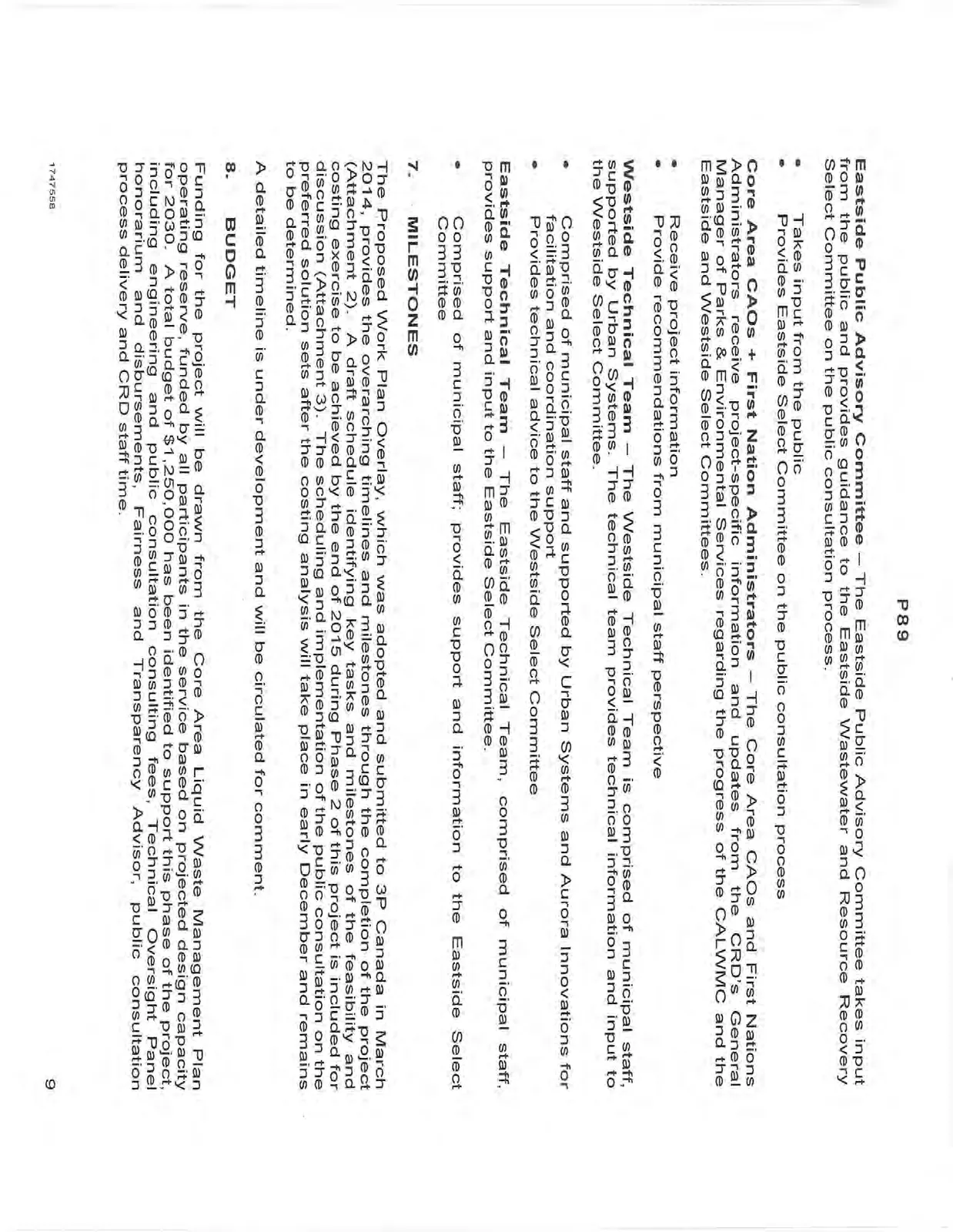
Eastside Public Advisory Committee
The Eastside Public Advisory Committee takes input from the public and provides guidance to the Eastside Wastewater and Resource Recovery Select Committee on the public consultation process.
- Takes input from the public
- Provides Eastside Select Committee on the public consultation process
Core Area CAOs + First Nation Administrators
The Core Area CAOs and First Nations Administrators receive project-specific information and updates from the CRD’s General Manager of Parks & Environmental Services regarding the progress of the CALWMC and the Eastside and Westside Select Committees.
- Receive project information
- Provide recommendations from municipal staff perspective
Westside Technical Team
The Westside Technical Team is comprised of municipal staff, supported by Urban Systems. The technical team provides technical information and input to the Westside Select Committee.
- Comprised of municipal staff and supported by Urban Systems and Aurora Innovations for facilitation and coordination support
- Provides technical advice to the Westside Select Committee
Eastside Technical Team
The Eastside Technical Team, comprised of municipal staff, provides support and input to the Eastside Select Committee.
- Comprised of municipal staff; provides support and information to the Eastside Select Committee
7. MILESTONES
The Proposed Work Plan Overlay, which was adopted and submitted to 3P Canada in March 2014, provides the overarching timelines and milestones through the completion of the project (Attachment 2). A draft schedule identifying key tasks and milestones of the feasibility and costing exercise to be achieved by the end of 2015 during Phase 2 of this project is included for discussion (Attachment 3). The scheduling and implementation of the public consultation on the preferred solution sets after the costing analysis will take place in early December and remains to be determined.
A detailed timeline is under development and will be circulated for comment.
8. BUDGET
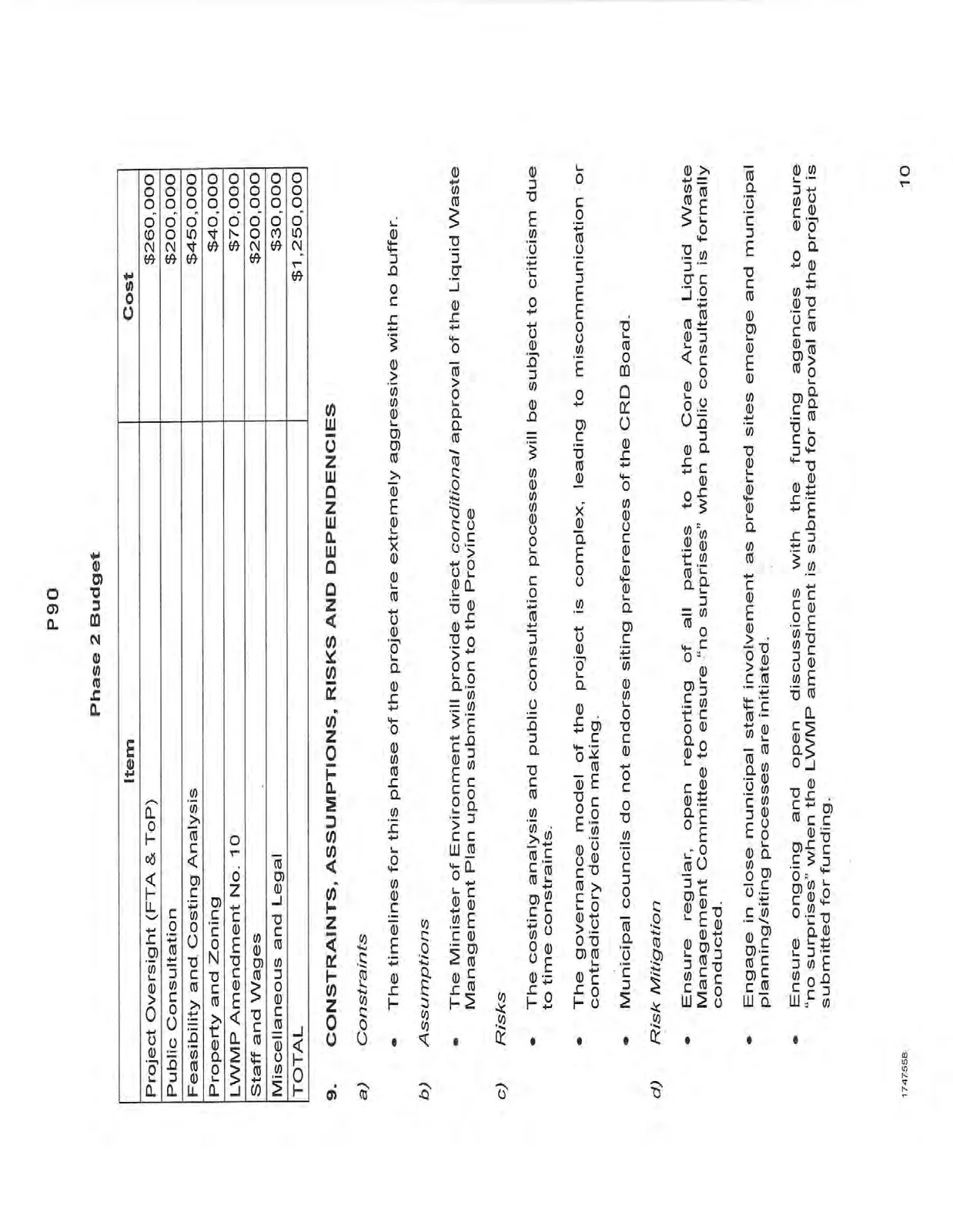
Funding for the project will be drawn from the Core Area Liquid Waste Management Plan operating reserve, funded by all participants in the service based on projected design capacity for 2030. A total budget of $1,250,000 has been identified to support this phase of the project, including engineering and public consultation consulting fees, Technical Oversight Panel honorarium and disbursements, Fairness and Transparency Advisor, public consultation process delivery and CRD staff time.
Phase 2 Budget
| Item | Cost |
|---|---|
| Project Oversight (FTA & ToP) | $260,000 |
| Public Consultation | $200,000 |
| Feasibility and Costing Analysis | $450,000 |
| Property and Zoning | $40,000 |
| LWMP Amendment No. 10 | $70,000 |
| Staff and Wages | $200,000 |
| Miscellaneous and Legal | $30,000 |
| TOTAL | $1,250,000 |
9. CONSTRAINTS, ASSUMPTIONS, RISKS AND DEPENDENCIES
a) Constraints
- The timelines for this phase of the project are extremely aggressive with no buffer.
b) Assumptions
- The Minister of Environment will provide direct conditional approval of the Liquid Waste Management Plan upon submission to the Province
c) Risks
- The costing analysis and public consultation processes will be subject to criticism due to time constraints.
- The governance model of the project is complex, leading to miscommunication or contradictory decision making.
- Municipal councils do not endorse siting preferences of the CRD Board.
d) Risk Mitigation
- Ensure regular, open reporting of all parties to the Core Area Liquid Waste Management Committee to ensure “no surprises” when public consultation is formally conducted.
- Engage in close municipal staff involvement as preferred sites emerge and municipal planning/siting processes are initiated.
- Ensure ongoing and open discussions with the funding agencies to ensure “no surprises” when the LWMP amendment is submitted for approval and the project is submitted for funding.
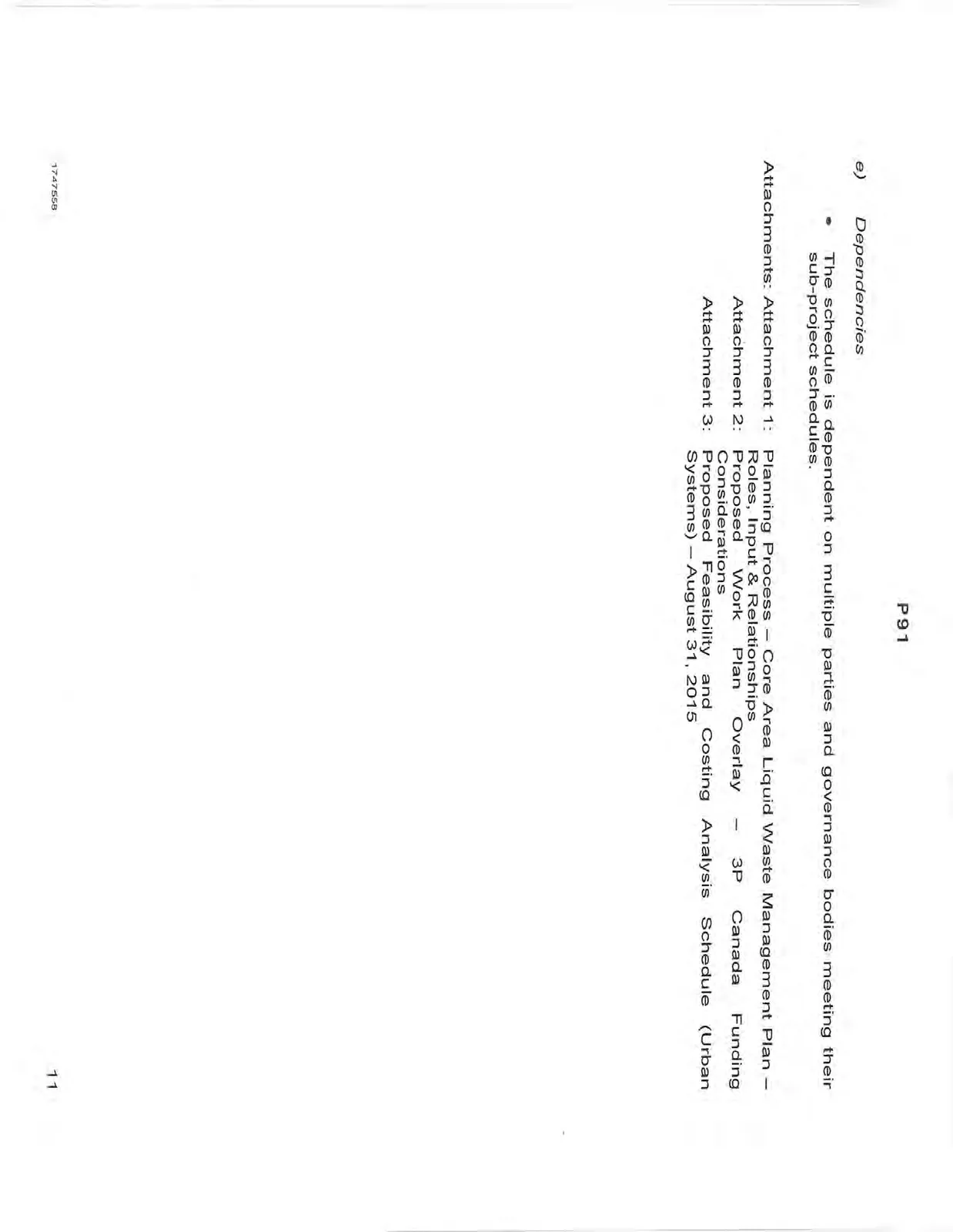
e) Dependencies
- The schedule is dependent on multiple parties and governance bodies meeting their sub-project schedules.
Attachments: Attachment 1: Planning Process – Core Area Liquid Waste Management Plan – Roles, Input & Relationships Attachment 2: Proposed Work Plan Overlay – 3P Canada Funding Considerations Attachment 3: Proposed Feasibility and Costing Analysis Schedule (Urban Systems) – August 31, 2015
Document Images
(11)