The Town of View Royal Guide to Decommissioning Secondary Suites
A technical guide for the public on how to legally decommission a secondary suite by removing kitchen/bathroom facilities or creating permanent openings.
The Town of View Royal Guide to Decommissioning Secondary Suites
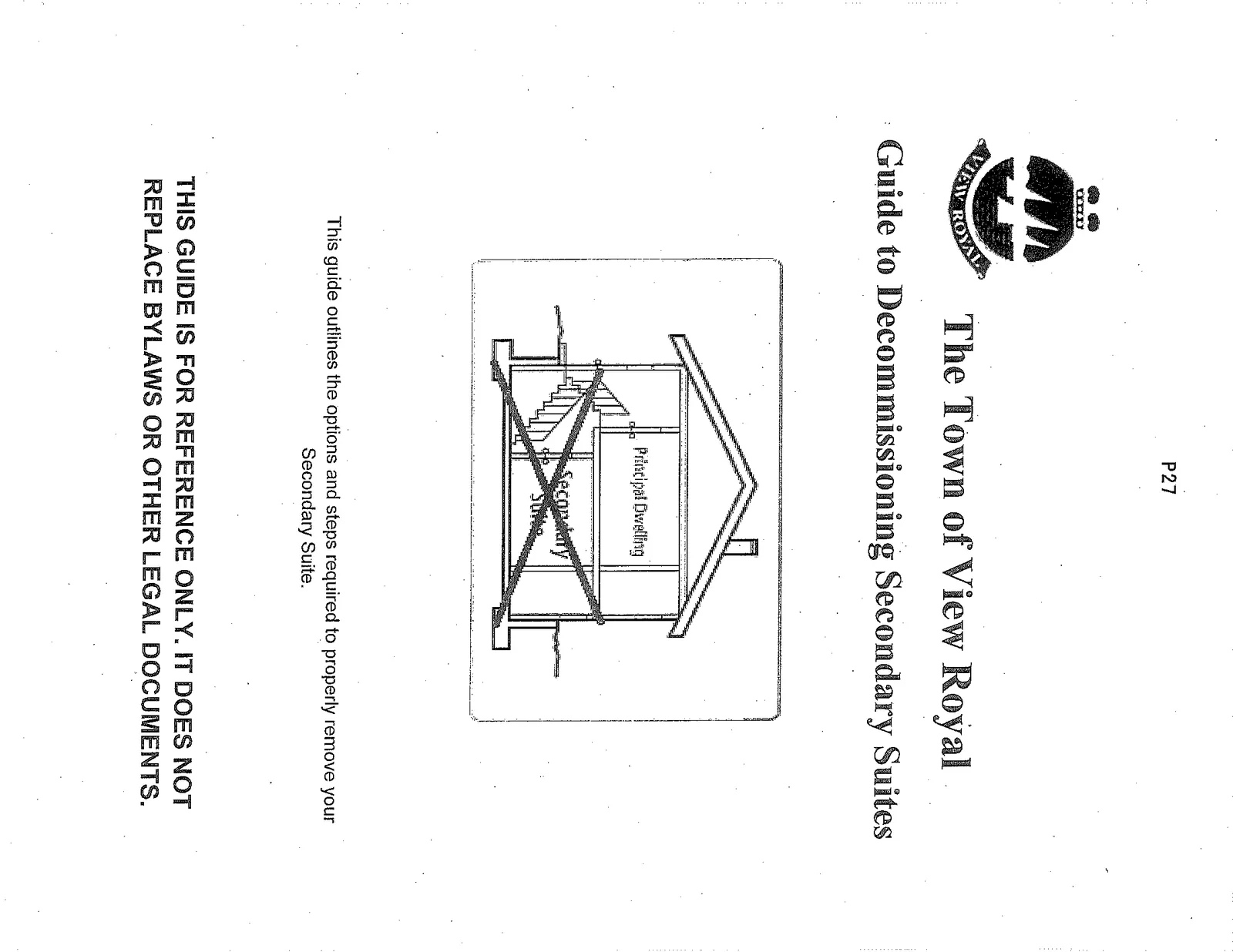
This guide outlines the options and steps required to properly remove your Secondary Suite.
THIS GUIDE IS FOR REFERENCE ONLY. IT DOES NOT REPLACE BYLAWS OR OTHER LEGAL DOCUMENTS.
What is a Secondary Suite?
The Town of View Royal Land Use Bylaw No.35, 1990 defines a "Secondary Suite" as an additional dwelling unit that is entirely contained within a residential single family use building and is located on the same legal parcel as the residential single family use with which it is associated, such that the building containing the secondary suite is a single real property entity. (Amendment Bylaw, 2006, No. 599)
A "Dwelling Unit" means one or a self-contained set of interconnected rooms for the use of one or more persons living together as a single domestic unit, sharing cooking, eating, living, sleeping and sanitary facilities and having only one room equipped for the preparation and cooking of food.
Please note, the bylaw does not differentiate between "in-law", "nanny" and other terms used to reference "suites".
What are the requirements for decommissioning a Secondary Suite?
The primary requirement to decommission a secondary suite is the removal of the cooking facilities as outlined below. In addition, an owner may elect to also remove the bathroom facilities and/or create a permanent opening between the space and the principal dwelling unit.
Please note, any health, fire and safety issues identified during the decommissioning process must be resolved.
To permanently remove the cooking facilities
The requirements are:
- Permanent removal of the hood fan and all cooking facilities (including, but not limited to stoves, microwaves, convection ovens, cook tops, hot plates, camping stoves, barbeques, crock pots, electric fry pans, rice cookers, woks, grills and griddles)
- For gas cooking facilities, a gas permit must be obtained from the BC Safety Authority. The stove is to be removed as well as all associated gas piping. A copy of the gas permit and the inspection report is to be submitted.
- For electrical cooking facilities, an electrical permit is required. The stove, hood fan and all associated wiring is to be removed. Proof of electrical permit and inspection is to be submitted. A building permit will be required for the re-sealing of the vapour barrier and building envelope.
- Removal of all kitchen plumbing and cabinetry.
- Please confirm with Building Inspections which permits are required.
Caution: All works should be completed by professionals with the specialized knowledge to complete the requirements.
Option 1: Permanently remove bathroom facilities
The requirements are:
- Permanent removal of all bathroom fixtures, including toilet, shower, bathtub, sink and vanity,
- A plumbing permit is required,
- All piping is to be properly capped and inspected.
- If the bathroom was installed without permits and the owner elects to keep the facilities, the owner must demonstrate that the construction is code compliant and permits must be obtained.
Option 2: Create opening(s) between the suite and principle dwelling
The requirements are:
- Permanent removal of any door(s) and door frame(s) between the suite area and the principle dwelling,
- Ensure the new opening has a minimum opening of 860 mm or is equal to the width of the existing corridor.
- Finish the opening with a finish material (drywall, wood or other code acceptable material). Any exterior walls will require the vapour barrier to be properly repaired and inspected.
- A smoke alarm will be required as per the BC Building Code.
- A building permit is required.
Are there other permits or regulations that may be required?
You may require one or more of the following:
- A building or plumbing permit. You can get these through the Town of View Royal Development Services Department. Permit fees are required.
- A gas or electrical permit. Your installer will get this from BC Safety Authority.
- An asbestos assessment. This is a provincial requirement through Worksafe BC and applies to all homes from 1990 or earlier. For more information on this please contact Worksafe BC at 1-888-621-SAFE(7233) or on the website at: http://www.hiddenkiller.ca/what-is-asbestos.asp
For Further Information Please Contact:
The Town of View Royal Development Services 45 View Royal Avenue Victoria, BC V9B 1A6
Ph. 250-479-6800 Fax. 250-727-9551
Document Images
(2)