Attachment 23 - Arborists Report: 450 Six Mile Road
A report inventorying protected trees on the site and evaluating construction impacts on them, specifically regarding Garry oaks.
October 6, 2016
Joe Newell Architects Inc 612 Yates Street Victoria, BC V8W 1K9
Attention: Joe Newell
Re: 450 Six Mile Road.
Assignment
To visually examine and inventory the existing bylaw protected trees on the above mentioned property. Prepare a tree retention and construction damage mitigation plan for those trees deemed suitable to retain given the proposed development plans and the existing tree health.
Methodology
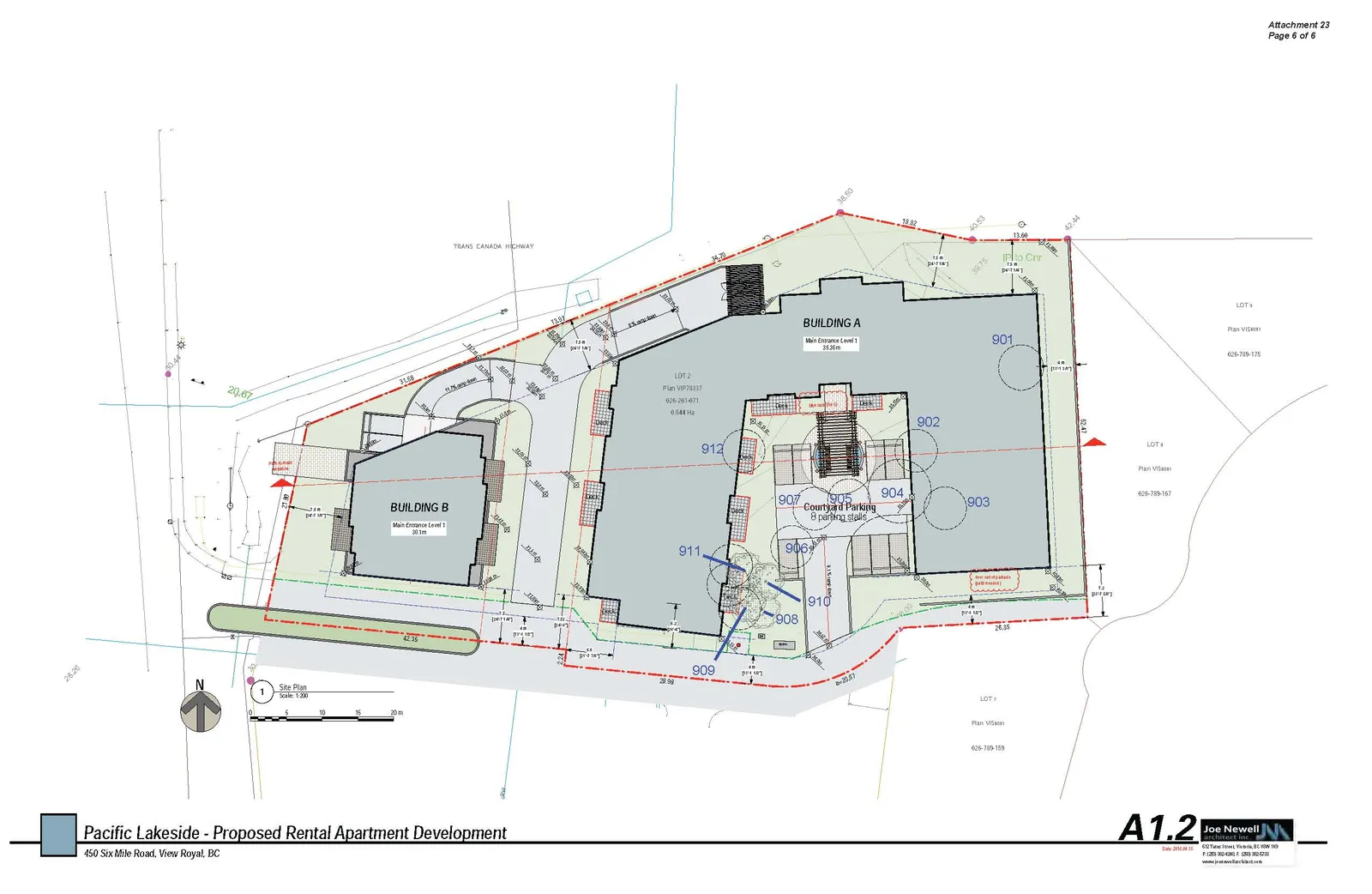
All of the bylaw protected trees on the property were tagged with a numbered metal tag, and the tree locations are shown on the attached site sketch. Information such as tree species, size (dbh), crown spread, critical root zone (crz), health and structural condition, relative tolerance to construction impacts and general remarks and recommendations was recorded in the attached tree resource spreadsheet. The tree location ribbon numbers were not shown on the plans provided, so we have plotted the trees where we believe they are on the plan and provided both our tag numbers and the survey ribbon numbers in the attached spreadsheet.
Observations
The majority of the trees tagged in our inventory are located in areas where they will not be possible to retain given the proposed building scheme. There is a group of four Garry oak trees numbered 908 – 911 on our attached site sketch, that may be possible to retain, depending on the extent of the required excavation for the underground parking area, the extent of required pruning to accommodate the proposed building, any impacts that may be associated with the proposed servicing and the finished grades that are proposed within the critical root zones of the trees.
Recommendations
Based on the plans provided, we feel it may be possible to retain Gary oak trees numbered 908 - 911, providing their critical root zones can be protected during the construction process. Once the building location is surveyed on site, it will be possible to estimate any required pruning that may be necessary and how far the proposed excavation may encroach into the critical root zones. We anticipate that the full extent of the impacts and whether the trees can be retained may have to be decided at the time of excavation. If it is decided to try and retain the trees until the time of excavation, we recommend the following course of action:
- Barrier fencing: The areas, surrounding the trees to be retained, should be isolated from the construction activity by erecting protective barrier fencing. Where possible, the fencing should be erected at the perimeter of the critical root zones. The barrier fencing to be erected must be a minimum of 4 feet in height, of solid frame construction that is attached onto wooden or metal posts. A solid board or rail must run between the posts at the top and the bottom of the fencing. This solid frame can then be covered with plywood, or flexible snow fencing (see attached diagram). The fencing must be erected prior to the start of any construction activity on site (i.e. demolition, excavation, construction), and remain in place through completion of the project. Signs should be posted around the protection zone to declare it off limits to all construction related activity. The project arborist must be consulted before this fencing is removed or moved for any purpose.
- Blasting and rock removal: At this time, we do not know if blasting will be necessary on the site, but if bedrock is encountered near trees to be retained, we recommend the blasting to level these rock areas should be sensitive to the root zones located at the edge of the rock. Care must be taken to assure that the area of blasting does not extend into the critical root zones beyond the building and road footprints. The use of small low-concussion charges, and multiple small charges designed to pre shear the rock face, will reduce fracturing, ground vibration, and reduce the impact on the surrounding environment. Only explosives of low phytotoxicity, and techniques that minimize tree damage, are to be used. Provisions must be made to store blast rock, and other construction materials and debris, away from critical tree root zones.
- Arborist supervision: Any excavation that is proposed within the critical root zone of the trees to be retained must be supervised by the project arborist. Any roots critical to the trees survival must be retained and any non-critical roots in direct conflict with the excavation must be pruned to sound tissue to encourage new root growth. It may be necessary to excavate using a combination of hand digging, small machine excavation and hydro excavation to expose roots that are in conflict with the proposed excavation and determined if they can be pruned or not without having a significant impact on the trees. If it is found that large structural roots must be pruned to accommodate the proposed construction, it may be necessary remove additional trees to eliminate any risk associated with them.
- Servicing: At this time, there is no servicing information on the plans provided but if trees 908 - 911 are to be retained, we recommend that all servicing be located outside of their critical root zones.
- Concrete work: Provisions must be made to ensure that no concrete wash or left over concrete material is allowed to wash into the root zone of the trees. This may involve using plastic or tarps or similar methods to temporarily isolate the root zones of the trees from any of the concrete installation or finishing work.
- Arborist Role: It is the responsibility of the client or his/her representative to contact the project arborist for the purpose of:
- Locating the barrier fencing
- Reviewing the report with the project foreman or site supervisor
- Locating work zones, where required
- Supervising any excavation for the road upgrades and service footprints that are within the critical root zones of trees to be retained.
- Reviewing and advising of any pruning requirements for machine clearances.
- Review and site meeting: Once the project receives approval, it is important that the project arborist meet with the principals involved in the project to review the information contained herein. It is also important that the arborist meet with the site foreman or supervisor before any demolition, site clearing or other construction activity occurs.
Please do not hesitate to call us at (250) 479-8733 should you have any further questions. Thank You.
Yours truly, Talbot Mackenzie & Associates
Tom Talbot & Graham Mackenzie ISA Certified, & Consulting Arborists
Encl. 1-tree inventory, 1-page site plan with tree locations
Disclosure Statement
Arborists are professionals who examine trees and use their training, knowledge and experience to recommend techniques and procedures that will improve their health and structure or to mitigate associated risks. Trees are living organisms, whose health and structure change, and are influenced by age, continued growth, climate, weather conditions, and insect and disease pathogens. Indicators of structural weakness and disease are often hidden within the tree structure or beneath the ground. It is not possible for an Arborist to identify every flaw or condition that could result in failure or can he/she guarantee that the tree will remain healthy and free of risk. Remedial care and mitigation measures recommended are based on the visible and detectable indicators present at the time of the examination and cannot be guaranteed to alleviate all symptoms or to mitigate all risk posed.
Tree Resource
October 6, 2016 | 450 Six Mile Road
| Tree # | Survey ribbon number | d.b.h. (cm) | Species | CRZ | Crown Spread | Condition Health | Condition Structure | Relative Tolerance | Remarks / Recommendations |
|---|---|---|---|---|---|---|---|---|---|
| 901 | 7353 | 52.0 | Cherry | 5.0 | 10.0 | Good | Fair | Moderate | Canker, old tearout injury, surface rooted, tortrix. Within proposed building footprint |
| 902 | 7351 | 23.0 | Service berry | 3.0 | 7.0 | Fair | Fair | Moderate | Dead and broken limbs, not protected size. Within proposed building footprint. |
| 903 | 7350 | 32.0 | Crimson King Maple | 4.0 | 9.0 | Fair | Fair | Moderate | Asymmetric form, large deadwood. Within proposed building footprint. |
| 904 | 7349 | 78.0 | Monterey Cypress | 8.0 | 13.0 | Good | Good | Moderate | Some broken limbs. Within proposed driveway, parking and building envelope. |
| 905 | 7346 | 37, 45 | Plum | 4.0 | 9.0 | Poor | Poor | Moderate | Large dead tops, previous failure. Within proposed driveway and parking footprint. |
| 906 | 7363, 7364 | 26, 17 | Garry oak | 4.0 | 8.0 | Fair | Fair/Poor | Good | Previously disturbed within critical root zone, partially uprooted. Within proposed driveway and parking footprint. |
| 907 | 7361 | multi | Plum | 6.0 | 12.0 | Fair/Poor | Poor | Moderate | Multiple plum suckers, previous failures, broken limbs. Within proposed driveway and parking footprint. |
| 908 | 7354 | 28, 32 | Garry oak | 5.0 | 12.0 | Good | Fair | Good | Co-dominant, some epicormic growth. May be possible to retain |
| 909 | 7355 | 26, 22 | Garry oak | 5.0 | 8.0 | Fair | Fair | Good | Asymmetric form, old tearout injury. May be possible to retain |
| 910 | 7356 | 41, 17 | Garry oak | 5.0 | 10.0 | Fair | Fair | Good | Co-dominant, thinning foliage, some epicormic growth. May be possible to retain |
| 911 | 7357 | 27, 24, 25, 21 | Garry oak | 5.0 | 11.0 | Fair | Fair | Good | Multiple stems, some epicormic, asymmetric form. |
| 912 | 7342 | 30.0 | Birch | 3.0 | 7.0 | Fair | Fair | Moderate | Broken limbs, some dieback. Within proposed building footprint. |