TOWN OF VIEW ROYAL COUNCIL REPORT - ENVIRONMENTAL DEVELOPMENT PERMIT WITH VARIANCES - 265 View Royal Avenue
Staff report recommending approval of an Environmental Development Permit with variances to allow construction of a dwelling and accessory building at 265 View Royal Avenue.
TOWN OF VIEW ROYAL COUNCIL REPORT
TO: Mayor and Council DATE: July 12, 2017 FROM: J. Chow, Senior Planner MEETING DATE: July 18, 2017 FILE NO.: 3060-20-2017/02
ENVIRONMENTAL DEVELOPMENT PERMIT WITH VARIANCES - 265 View Royal Avenue
RECOMMENDATION
THAT Development Permit 2017/02 be approved;
AND THAT Development Permit 2017/02 include the following the conditions regarding environmental protection (as per the Environmental Assessment report from Swell Environmental Consulting dated May 26, 2017 and attached to the report) are as follows:
- Removing invasive species and planting a minimum of 10 m² of native vegetation to BC Landscape Standards within the development permit area, in the areas closest to the shoreline, to help develop overhanging vegetation and habitat along the shore as per the report.
- Timing all works including excavations, and topsoil additions within the dry season and specifically with forecasted dry weather;
- On steep slopes (>1.1:1) installing biodegradable coco-fibre mats over bare soils prior to planting;
- Mulching or otherwise covering bare soils immediately;
- Ensuring petroleum releases to the marine environment are avoided by:
- Checking machinery for oil and gas leaks;
- Providing spill containment for any generators or pumps (purpose-built trays or plastic bins);
- Providing Spill Kits onsite for any machinery at work within 30 m of the High Water Mark and ensuring operators are trained in their use;
- Clearly marking the existing indigenous plants and their surroundings with flagging tape and/or a protective barrier that will still allow access to individual plantings;
- Providing clear instructions to landscaping crews, including drawings, of plants to remain and Best Management Practices outlined in the report;
- Installing erosion and sediment control measures for the house construction (e.g. sediment fencing) to prevent sediment laden runoff from entering the SDPA or marine environment;
- Engaging an Environmental Monitor to oversee construction activities, including (but not limited to) start up, extreme rain events, and periodically throughout the construction period to ensure BMPs are followed;
- Monitoring plant survival for a 2-year period and replacing dead plants.
AND THAT a landscape security deposit be submitted prior to building permit issuance for the provision and installation of on-site planting and for the mitigation of potential damage to the natural environment.
AND FURTHER THAT Development Permit 2017/02 include the following variances: a. Variance to the maximum length or width of an accessory building from 7.5m to 15.9m; b. Variance to permit the siting of an accessory building within the front yard; c. Variance to the maximum lot coverage of an accessory building from 60m² to 123m²; and d. Variance to the total building floor area from 372m² to 438m².
CHIEF ADMINISTRATIVE OFFICER’S COMMENTS I concur with the recommendation.
DIRECTOR OF DEVELOPMENT SERVICES’ COMMENTS I concur with the recommendation.
PURPOSE OF REPORT
To consider an Environmental Development Permit, in conjunction with the construction of a dwelling and accessory building, to rebuild stairs and a retaining wall and to permit storm water infrastructure within the Natural Watercourse and Shoreline Environmental Development Permit area. Variances are requested for the length or width of an accessory building, the siting and lot coverage of an accessory building, and total building floor area.
BACKGROUND
The approximately 1974m² property is zoned R-1: Detached Residential (Large Lot) and backs on to Esquimalt Harbour. Development Permit 2010/21 was approved by Council on December 7, 2010 to permit the construction of a house with variances to allow the siting of an accessory garage in the front yard, increased length/width of an accessory building, and increased fence height. The property has been vacant since a pre-existing dwelling and cottage were removed in 2010 and a foundation was partially constructed.
In 2006 a number of structures were built without permits. The structures that were permitted to remain include wood stairs at the rear of the property leading to a set of concrete steps below the seawall, and a landscape tie retaining wall that stabilizes the slope against the stairs. These wooden structures have weathered and now need replacement.
The application was introduced to the Committee of the Whole on July 12, 2017.
PROJECT INFORMATION
The new property owner proposes to construct a 369 m² detached dwelling with a 123m² garage/office accessory building in the front yard as shown in Figure 1 and Attachment 4. Some trees within the building envelope would be removed to accommodate the development. The applicant has provided letters of support from several neighbours.
The development permit area covers land within 15m of the natural boundary. This part of the property is steep and primarily vegetated with invasive species. Within this area, the applicant proposes the following:
- Replacement of existing retaining wall, walkway and stairs with a wider landing near the seawall
- 5m² surface runoff collection and infiltration area that can also be used for seating
- Placement of boulders to stabilize soils, as needed
- Removal of non-native, invasive species
- Planting of native species
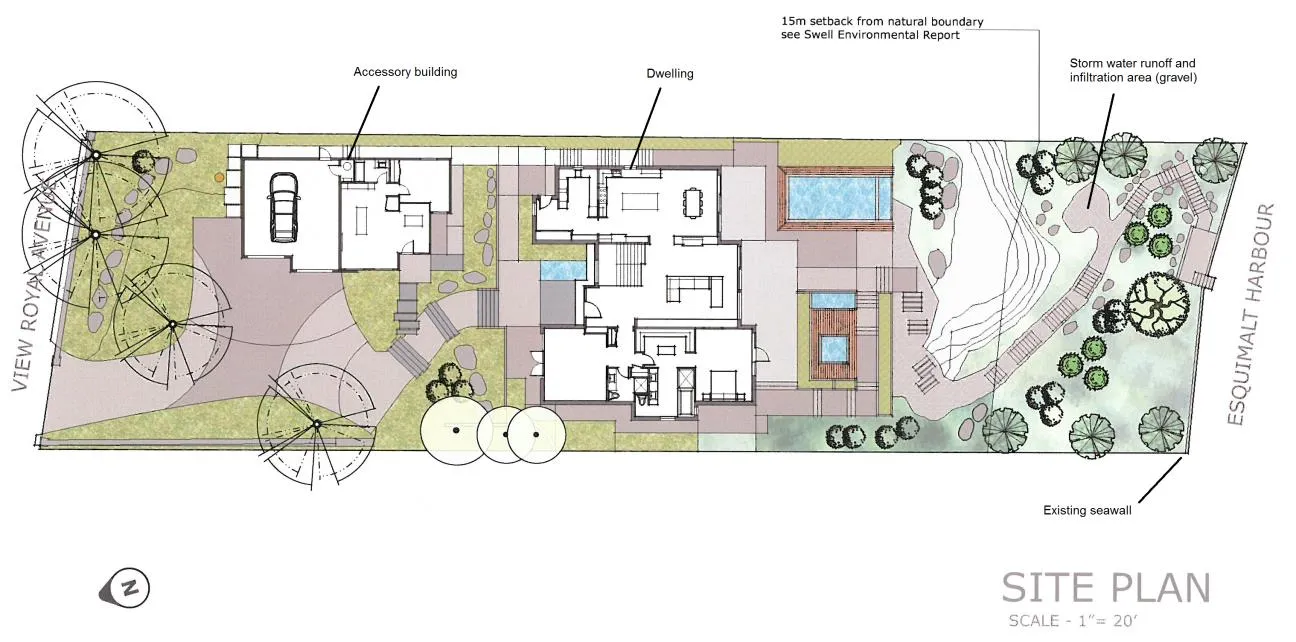
Figure 1. Site Plan
Variances are also requested for the following:
| Description | Required | Proposed |
|---|---|---|
| Length or width of an accessory building | 7.5m | 15.9 m |
| Siting of an accessory building | Not within the front yard | Within the front yard |
| Lot coverage of an accessory building | 60m² | 123m² |
| Total building floor area | 372m² | 438 m² |
The applicant has submitted the following information in support of their application:
- Applicant’s Statement
- Neighbourhood Plan Review Petition
- Renderings – Christopher Developments
- Biologist’s Report – Swell Environmental Consulting Ltd
- Review of Proposed Drainage Plan – MGE Services
ISSUES AND ANALYSIS
The key issues are:
- How does the proposal address the development permit area guidelines?
- Are the requested variances supportable?
1. Development Permit Area Guidelines
The proposal meets the objectives of the guidelines and can be supported for the following reasons: a. Development of the shoreline area is minimal – the storm water detention and infiltration area (see Figure 1) is located on the previous cottage site and the drainage pipes would located under the walkway and stairs to minimize ground disturbance. b. Construction of the 5m² storm water detention and infiltration area would be mitigated by restoring 10m² within the leave strip through removal invasive species and replanting as specified in the biologists report (Attachment 5) for a net increase in native vegetation. c. Areas to be disturbed in rebuilding the stairs and retaining wall are primarily vegetated with invasive plant species and would be replanted with native species. d. The storm water that will be channelled towards the sea will have high velocity from running down the steep slope and a splash pad or other device will be required to meet servicing standards at the building permit stage to prevent scouring of the beach. e. The biologist’s report (Attachment 5) recommends best management practices for timing, erosion and sediment control measures, machinery leak and spill prevention, marking off native plant areas during construction, and monitoring that would be incorporated into the development permit conditions.
2. Requested variances
The requested variances are considered as follows:
a. Length or width of an accessory building The request to vary the length or with of an accessory building from 7.5m 15.9 m can be supported because the lot is large and the building would not have a visual impact from the street and adjacent properties as shown in Figure 2.
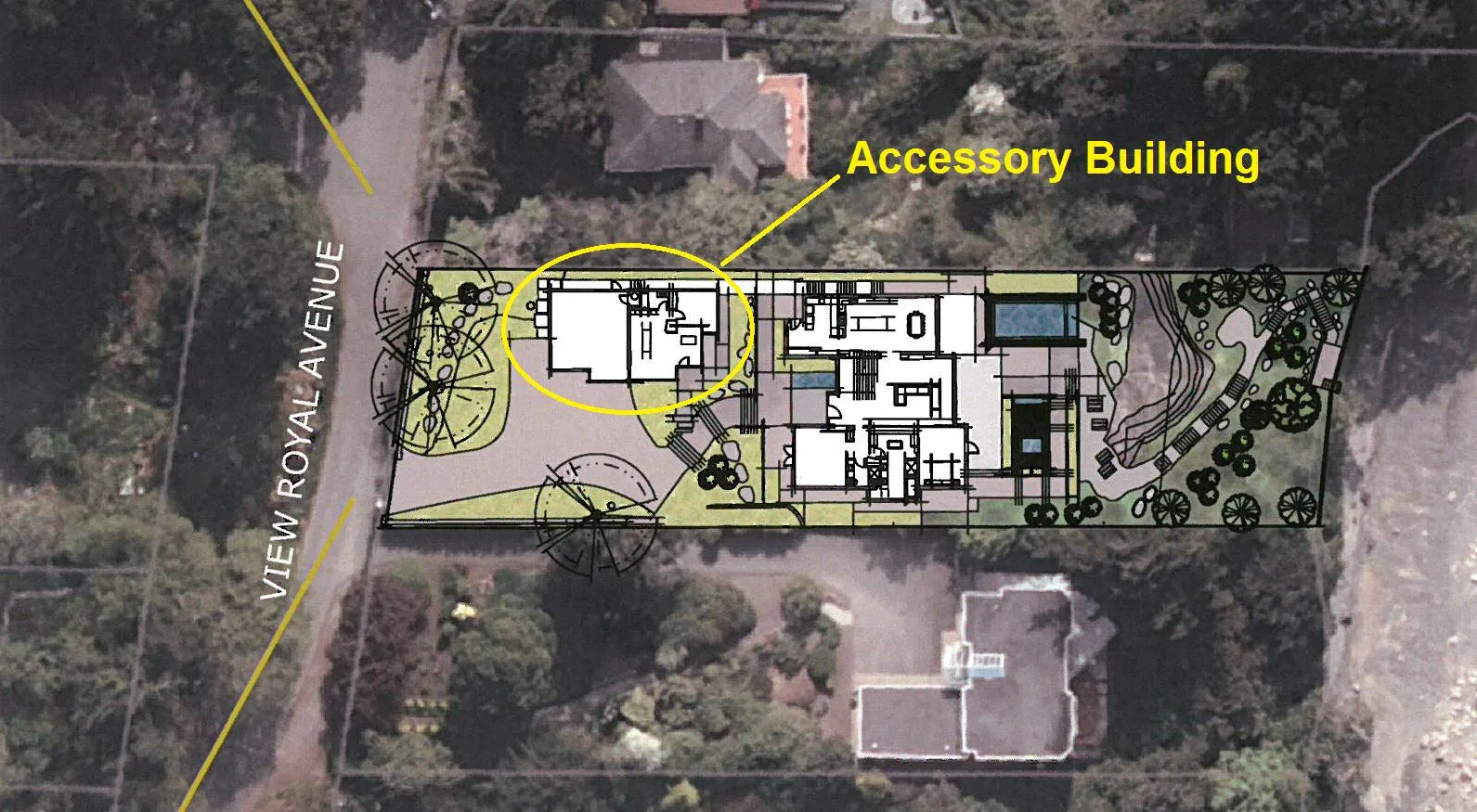
Figure 2. Context air photo
b. Siting of an accessory building The property is narrow and deep with the dwelling proposed to be located in the middle of the lot as shown in Figure 1. The accessory building is proposed to be 12 metres from the front lot, which exceeds the minimum setback for 7.5m for a dwelling. The site also slopes as shown in Figure 3. The proposal can be supported because the accessory building would not be visually obtrusive.
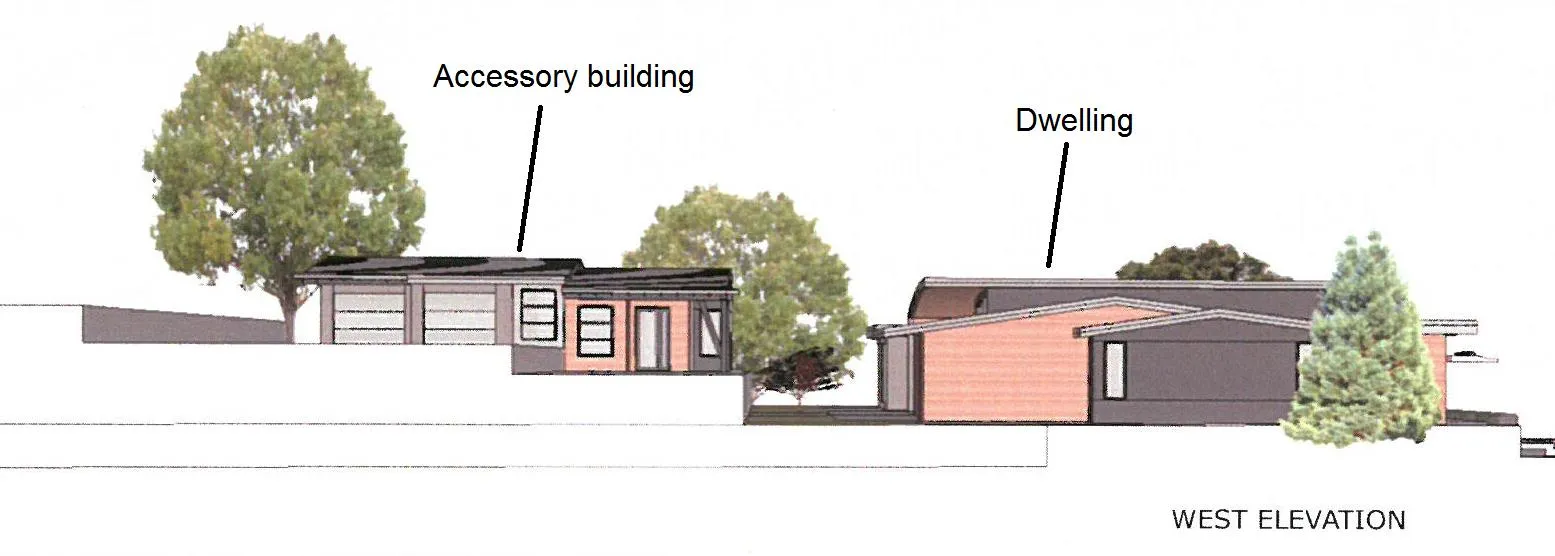
Figure 3. West elevation
c. Lot coverage of an accessory building The proposed lot coverage is 123m² where the Zoning Bylaw requires 10% maximum lot coverage, up to 60m². The proposal to increase the 60m² cap can be supported because the 6% lot coverage would be small relative to the size of the lot.
d. Total building floor area The R-1 Zone permits Floor Space Ratio of 0.42:1 with building floor area capped at 372m². The proposed building floor area of 438m² is comprised of the 369m² dwelling and the 69m² accessory building (garage area is excluded). The variance to increase the building floor area cap be supported because the Floor Space Ratio is only 0.24:1; i.e. the building floor area is small relative the size of the lot. Also, the proposed site layout is not visually obtrusive: the dwelling is set into the slope so that it one storey facing the street and two storeys at the rear. The rooftop of the dwelling would actually be below street level as shown in Figure 4.
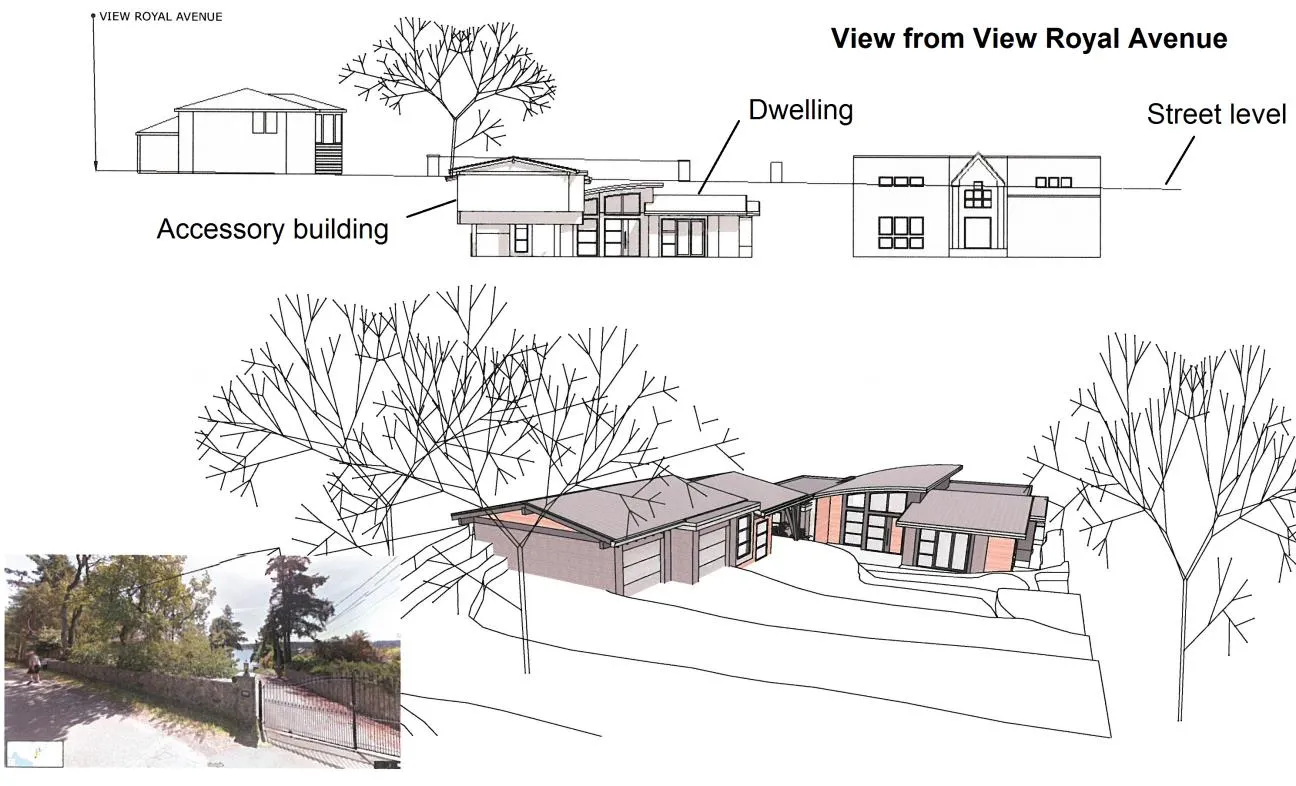
Figure 4. View from View Royal Avenue
CONCLUSION
The application can be supported for the following reasons:
- The proposal is keeping with the objectives of the Natural Watercourse and Shoreline Environmental Development Permit area. Disturbances within the development permit area are minimized by constructing drainage pipes under the stairs. The 5m² area of native planting to be removed would be offset by 10m² compensation planting replacement planting area would mitigate the of 5m²
- Requested variances can be supported given the size and topography of the lot. Offsite impacts are minimal.
RECOMMENDATION
THAT Development Permit 2017/02 be approved;
AND THAT Development Permit 2017/02 include the following the conditions regarding environmental protection (as per the Environmental Assessment report from Swell Environmental Consulting dated May 26, 2017 and attached to the report) are as follows:
- Removing invasive species and planting a minimum of 10 m² of native vegetation to BC Landscape Standards within the development permit area, in the areas closest to the shoreline, to help develop overhanging vegetation and habitat along the shore as per the report.
- Timing all works including excavations, and topsoil additions within the dry season and specifically with forecasted dry weather;
- On steep slopes (>1.1:1) installing biodegradable coco-fibre mats over bare soils prior to planting;
- Mulching or otherwise covering bare soils immediately;
- Ensuring petroleum releases to the marine environment are avoided by:
- Checking machinery for oil and gas leaks;
- Providing spill containment for any generators or pumps (purpose-built trays or plastic bins);
- Providing Spill Kits onsite for any machinery at work within 30 m of the High Water Mark and ensuring operators are trained in their use;
- Clearly marking the existing indigenous plants and their surroundings with flagging tape and/or a protective barrier that will still allow access to individual plantings;
- Providing clear instructions to landscaping crews, including drawings, of plants to remain and Best Management Practices outlined in the report;
- Installing erosion and sediment control measures for the house construction (e.g. sediment fencing) to prevent sediment laden runoff from entering the SDPA or marine environment;
- Engaging an Environmental Monitor to oversee construction activities, including (but not limited to) start up, extreme rain events, and periodically throughout the construction period to ensure BMPs are followed;
- Monitoring plant survival for a 2-year period and replacing dead plants.
AND THAT a landscape security deposit be submitted prior to building permit issuance for the provision and installation of on-site planting and for the mitigation of potential damage to the natural environment.
AND FURTHER THAT Development Permit 2017/02 include the following variances: a. Variance to the maximum length or width of an accessory building from 7.5m to 15.9m; b. Variance to permit the siting of an accessory building within the front yard; c. Variance to the maximum lot coverage of an accessory building from 60m² to 123m²; and d. Variance to the total building floor area from 372m² to 438m².
SUBMITTED BY: Jeff Chow, MCIP RPP, Senior Planner
Document Images
(3)