Appendix
Section 2 Proposed Dispute Resolution Process and Timing
July 4, 2017Pages 64–661 section
Detailed timeline and participant list for the four phases of the mediation process.
Phase 3: Joint mediation session not later than Oct 20, 2017Phase 4: Findings report not later than Oct 27, 2017
Section 2 Proposed Dispute Resolution Process and Timing
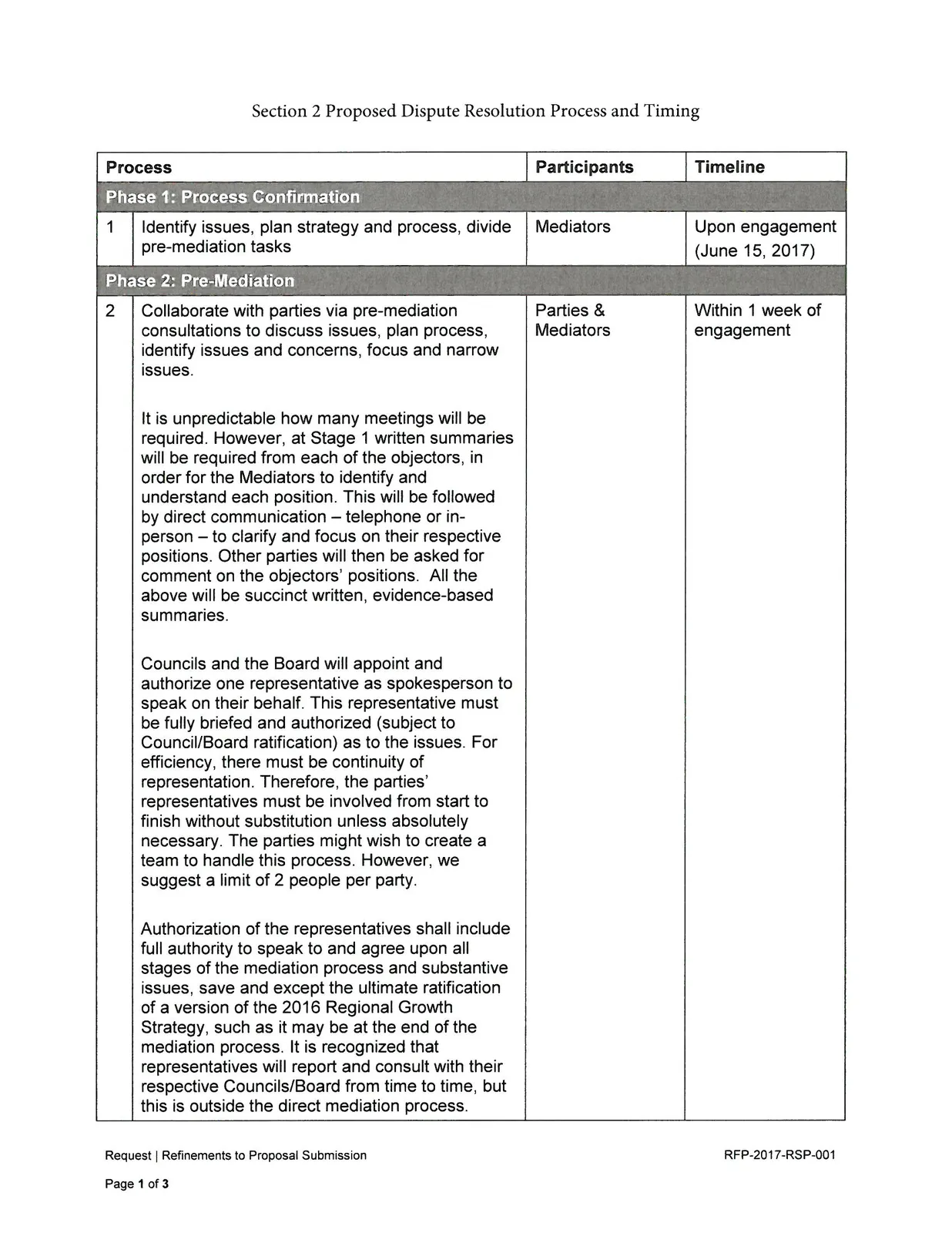
| Process | Participants | Timeline |
|---|---|---|
| Phase 1: Process Confirmation | ||
| 1. Identify issues, plan strategy and process, divide pre-mediation tasks | Mediators | Upon engagement (June 15, 2017) |
| Phase 2: Pre-Mediation | ||
| 2. Collaborate with parties via pre-mediation consultations to discuss issues, plan process, identify issues and concerns, focus and narrow issues. It is unpredictable how many meetings will be required. However, at Stage 1 written summaries will be required from each of the objectors, in order for the Mediators to identify and understand each position. This will be followed by direct communication — telephone or in-person — to clarify and focus on their respective positions. Other parties will then be asked for comment on the objectors' positions. All the above will be succinct written, evidence-based summaries. Councils and the Board will appoint and authorize one representative as spokesperson to speak on their behalf. This representative must be fully briefed and authorized (subject to Council/Board ratification) as to the issues. For efficiency, there must be continuity of representation. Therefore, the parties' representatives must be involved from start to finish without substitution unless absolutely necessary. The parties might wish to create a team to handle this process. However, we suggest a limit of 2 people per party. Authorization of the representatives shall include full authority to speak to and agree upon all stages of the mediation process and substantive issues, save and except the ultimate ratification of a version of the 2016 Regional Growth Strategy, such as it may be at the end of the mediation process. It is recognized that representatives will report and consult with their respective Councils/Board from time to time, but this is outside the direct mediation process. |
Parties & Mediators | Within 1 week of engagement |
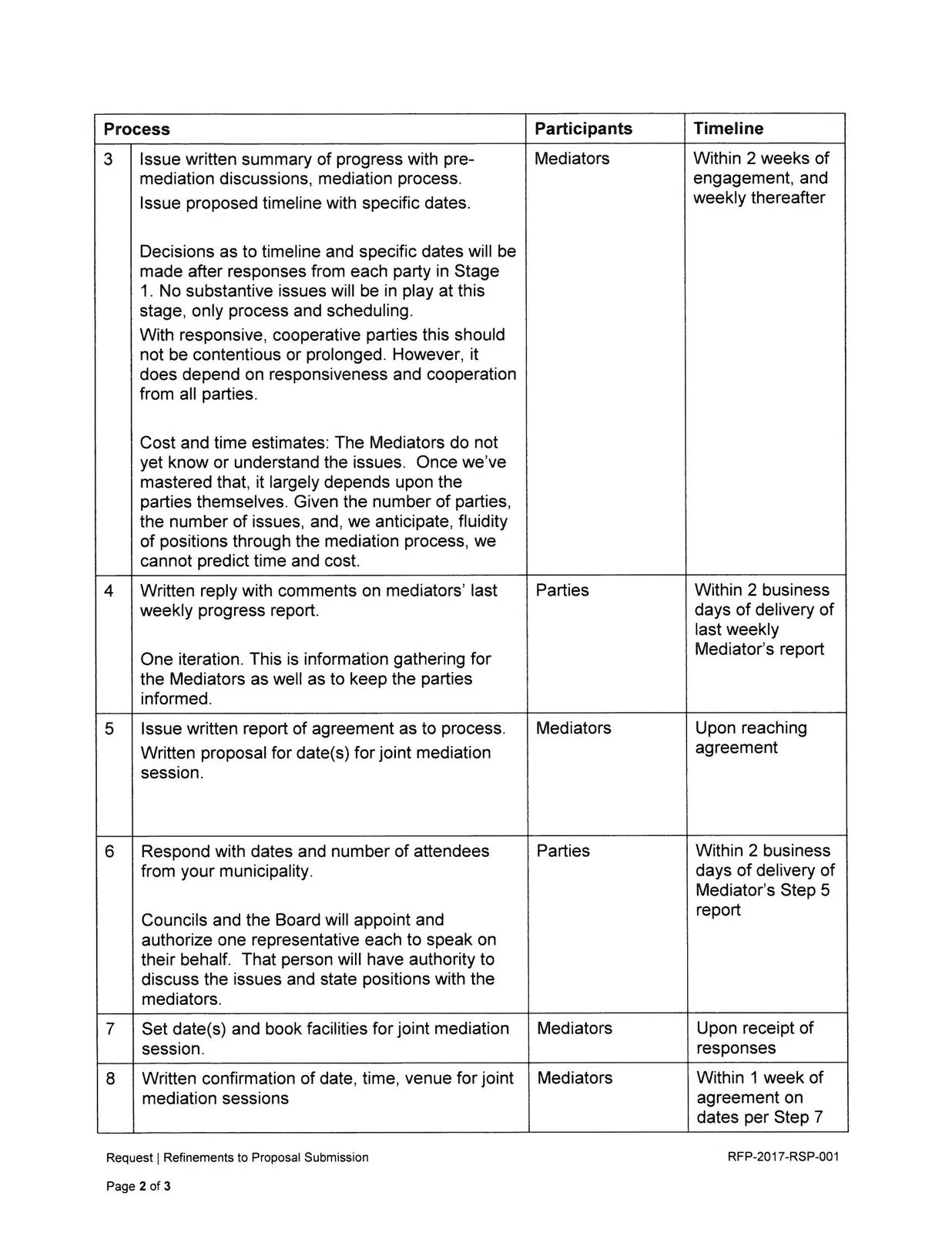
| Process | Participants | Timeline |
|---|---|---|
| 3. Issue written summary of progress with pre-mediation discussions, mediation process. Issue proposed timeline with specific dates. Decisions as to timeline and specific dates will be made after responses from each party in Stage 1. No substantive issues will be in play at this stage, only process and scheduling. With responsive, cooperative parties this should not be contentious or prolonged. However, it does depend on responsiveness and cooperation from all parties. Cost and time estimates: The Mediators do not yet know or understand the issues. Once we've mastered that, it largely depends upon the parties themselves. Given the number of parties, the number of issues, and, we anticipate, fluidity of positions through the mediation process, we cannot predict time and cost. |
Mediators | Within 2 weeks of engagement, and weekly thereafter |
| 4. Written reply with comments on mediators' last weekly progress report. One iteration. This is information gathering for the Mediators as well as to keep the parties informed. |
Parties | Within 2 business days of delivery of last weekly Mediator's report |
| 5. Issue written report of agreement as to process. Written proposal for date(s) for joint mediation session. | Mediators | Upon reaching agreement |
| 6. Respond with dates and number of attendees from your municipality. Councils and the Board will appoint and authorize one representative each to speak on their behalf. That person will have authority to discuss the issues and state positions with the mediators. |
Parties | Within 2 business days of delivery of Mediator's Step 5 report |
| 7. Set date(s) and book facilities for joint mediation session. | Mediators | Upon receipt of responses |
| 8. Written confirmation of date, time, venue for joint mediation sessions | Mediators | Within 1 week of agreement on dates per Step 7 |
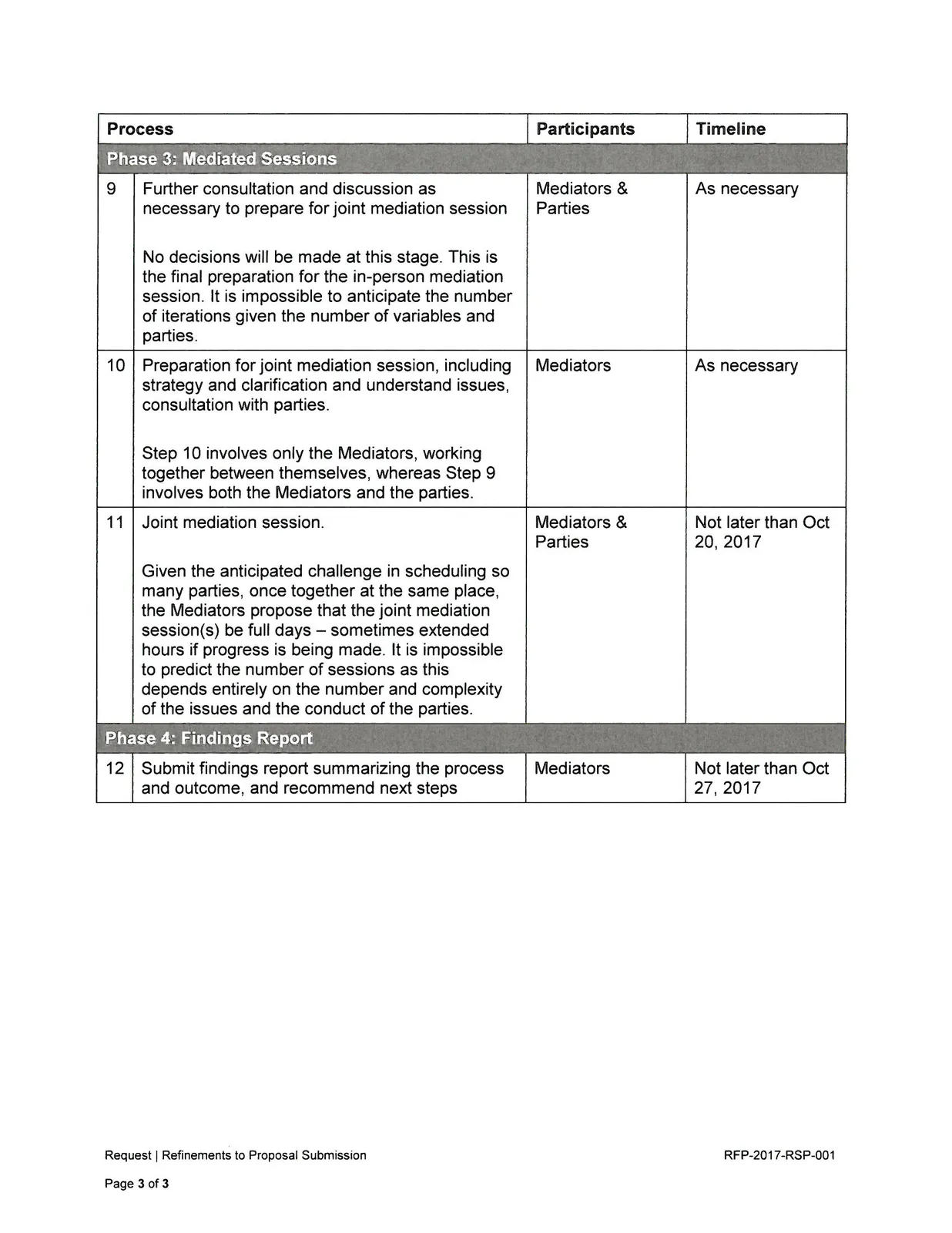
| Process | Participants | Timeline |
|---|---|---|
| Phase 3: Mediated Sessions | ||
| 9. Further consultation and discussion as necessary to prepare for joint mediation session. No decisions will be made at this stage. This is the final preparation for the in-person mediation session. It is impossible to anticipate the number of iterations given the number of variables and parties. |
Mediators & Parties | As necessary |
| 10. Preparation for joint mediation session, including strategy and clarification and understand issues, consultation with parties. Step 10 involves only the Mediators, working together between themselves, whereas Step 9 involves both the Mediators and the parties. |
Mediators | As necessary |
| 11. Joint mediation session. Given the anticipated challenge in scheduling so many parties, once together at the same place, the Mediators propose that the joint mediation session(s) be full days — sometimes extended hours if progress is being made. It is impossible to predict the number of sessions as this depends entirely on the number and complexity of the issues and the conduct of the parties. |
Mediators & Parties | Not later than Oct 20, 2017 |
| Phase 4: Findings Report | ||
| 12. Submit findings report summarizing the process and outcome, and recommend next steps | Mediators | Not later than Oct 27, 2017 |
Page 64–66
Extracted from: 2017 07 04 Council Agenda - Agenda - Pdf