CARIP Reporting: Carbon Neutral Balancing Credits (ICI Kitchen Scraps) 2018
Email correspondence from CRD outlining balancing credits available for local governments for 2018 reporting.
From: To: Cc: Subject: CARIP Reporting: Carbon Neutral Balancing Credits (ICI Kitchen Scraps) 2018 Date: Tuesday, April 16, 2019 11:43:33 AM Attachments: Option 1D-Organic Waste Composting Project Plan 2018.pdf Option 1D-Organic Waste Composting Project Self-Certification 2018.pdf
Members of the CRD Climate Action Inter-Municipal Working Group and associates,
As discussed at our last meeting, please find a breakdown of the ‘balancing credits’ each local government is able to claim in their 2018 carbon neutral reporting based on the Option 1D: Organic Waste Diversion Project Profile from the Industrial – Commercial – Industrial (ICI) sector and private haulers. If you choose, you can include this in your 2018 CARIP reporting (due June 1st), to reduce your local government’s overall carbon liability. This breakdown does not include local government managed household organics diversion.
| 2016 Population Census | % of Population (2016) | Total Available to Claim for 2018 Reporting (tCO2e) | |
|---|---|---|---|
| Esquimalt | 17655 | 0.047299976 | 187.6 |
| Oak Bay | 18094 | 0.048476113 | 192.3 |
| Saanich | 114148 | 0.305816919 | 1213.2 |
| Victoria | 85792 | 0.229847611 | 911.8 |
| View Royal | 10408 | 0.027884347 | 110.6 |
| Central Saanich | 16814 | 0.045046831 | 178.7 |
| North Saanich | 11249 | 0.030137493 | 119.6 |
| Sidney | 11672 | 0.031270763 | 124.1 |
| Colwood | 16859 | 0.045167392 | 179.2 |
| Highlands | 2225 | 0.005961056 | 23.6 |
| Langford | 35342 | 0.094685685 | 375.6 |
| Metchosin | 4708 | 0.012613327 | 50.0 |
| Sooke | 13001 | 0.034831322 | 138.2 |
| Islands Trust | 15289 | 0.040961163 | 162.5 |
| Total | 373256 | 1 | 3967.0 |
Balancing credits were determined using the BC local government specific methodology found here:
- Becoming Carbon Neutral: A Guidebook for Local Governments in British Columbia The guidebook outlines ways for local governments to achieve their goal to become carbon neutral, using options that have been specifically designed to meet local government needs and their desire to invest in locally-based GHG reduction projects. It has been prepared for use by local government staff who are responsible for measuring and reporting on carbon neutrality.
- Green Communities Carbon Neutral Framework Option 1D: Project Profile – Organic Waste Composting (found here) This project profile provides guidance on estimating the amount of greenhouse gas (GHG) emissions that can be reduced by diverting organic[^1] waste into a centralized community composting system rather than sending it to a landfill.
Allocation is based on percentage of total population.
To determine the balancing credits, the following steps were completed, as per the Becoming Carbon Neutral Guidebook:
Table 3: Implementing Option 1
| Step | For more information | |
|---|---|---|
| 1. | Review the information on Option 1 projects and determine if any of these are valid options for your community. | Appendices 2 – 6 |
| 2. | Complete, sign and make public a Project Plan Template to undertake one (or more) of these four GCC-supported projects. | See sample template in Appendix 7 |
| 3. | Implement the project and calculate the project GHG emission reductions. | Appendices 2 – 6 include methodologies for detailed calculations |
| 4. | Complete, sign and make public a Self-Certification Template to certify that the required work was completed in the specified time frame to result in the GHG reductions being claimed. | See sample template in Appendix 8 |
| 5. | Prepare the annual Climate Action Revenue Incentive Program (CARIP) Report and include information on progress towards carbon neutrality. Retain all project paperwork on file in accordance with local government administrative policy and procedures. | See Section 3 and Appendix 12 for information on revised CARIP reporting |
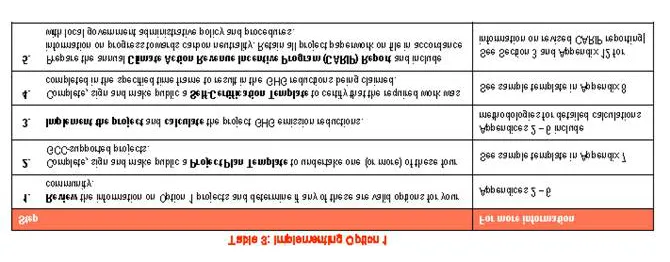
If you choose to use the balancing credits, please append the attached Project Plan Template to your public CARIP report (as per Step 2 above). You are also required to retain the attached Self-Certification Template on file in accordance with local government administrative policy and procedures (as per Step 5 above).
The deadline for CARIP reporting is June 1st. Should you have any questions, please let me know.
Best regards,
Nikki Elliott | Climate Action Program Coordinator Capital Regional District | 250.360.3048 |
[^1] Organic waste can include food waste and organic yard waste such as grass clippings, but should try to avoid branches and other woody debris. This is because woody material does not decompose at the same rate.
This message is intended only for the use of the individual or entity named above, and may contain information that is privileged, confidential or exempt from disclosure under applicable law. If you are not the intended recipient or their employee or agent responsible for receiving the message on their behalf your receipt of this message is in error and not meant to waive privilege in this message. Please notify us immediately, and delete the message and any attachments without reading the attachments. Any dissemination, distribution or copying of this communication by anyone other than the intended recipient is strictly prohibited. Thank you. Please consider the environment before printing this email.