Email from Jason Austin Re: CRD Proposal for Farmlands Trust
Critical feedback from a local farmer regarding the CRD Foodlands Trust proposal, suggesting an alternative voucher system.
From: Jason Austin Sent: Sunday, May 5, 2019 5:28 PM To: Info Address info@viewroyal.ca Subject: To Mayor & Council - letters re CRD Farmlands Trust proposal
Dear Mayor & Council,
Attached is a second letter I sent Council on May 3rd that I understand may not have reached you yet. This second letter was referenced in my first letter, and ideally should be read with it.
In my second letter to Council, I describe the hardship faced by so many in our Region who cannot afford the rising food prices. I describe the small farmers of our region who are willing to grow food but have no market for it. I said "we have the paradox where members of our society cannot afford fresh nutritious food, and farmers who can grow the food but have no easy access to market." And then I considered the millions the CRD would have the municipalities pay to set the entrant farmers up to fail, and the logical solution is clear. Let the CRD create annual farm vouchers that would be allocated to the many support agencies, that those agencies could use to buy food from small farmers at wholesale prices for their clients. This will provide fresh, nutritious produce to those in need in the Capital Region and stimulate our small farming sector, leading to improved food security. I suggested $500,000 because that was one of the cost numbers in the CRD proposal, but a starting number of $200,000 would be more realistic to begin with.
Since writing that second letter I have become aware of more information that members of Council and the CRD should know of.
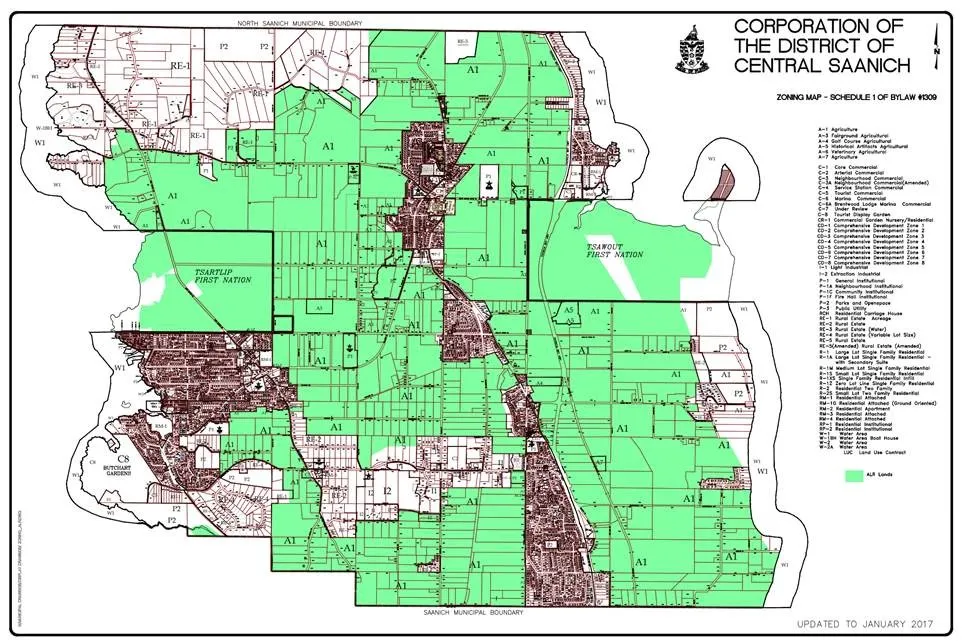
Farm productivity is based on the "farmable" ALR area, not the gross ALR area. The ALC has confirmed that the measurement of the ALR does include the "non-farmable" areas in Central Saanich like municipal parks, most of the two First Nations reserves, and even the high school. That ALC email is attached. I suspect now that the gross ALR area also includes the roads that are within the ALR boundaries, so I have gone back to the ALC to confirm this. What this means is the farming productivity per centage should not be measured by the area farmed divided by the area of the ALR but by the area farmed divided by the farmable area of the ALR. In Central Saanich alone, the non-farmable areas in the ALR may be at least 450ha. And when calculated on a regional basis, I expect the farming productivity may be 85% or more.
Setting up the entrant farmers to fail I have been critical that the CRD report did not provide a study showing the reasonable expectations of the entrant farmer program. After all, these entrant farmers were supposed to be saving the food security for the region at a likely cost to the municipalities in the millions. Instead, the CRD report at Table 7, floated unrealistically high possible gross sales receipts, $100,000 for 5 acres being one of them.
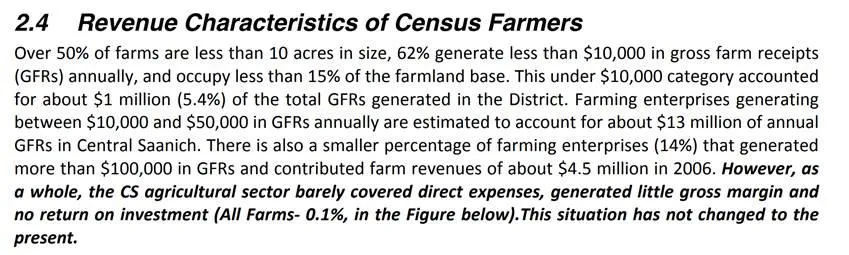
In my first letter I pointed to a 2016 study for the Corporation of Saanich by the same authors that showed 94% of the farmers in the 2-10 acres size in Saanich had gross income less that $25,000.
I have now found a 2011 report done for Central Saanich that confirms the 2016 Saanich study:
https://www.centralsaanich.ca/sites/default/files/uploads/documents/agricultural_area_plan_0.pdf
That last sentence about farming in Central Saanich is worth repeating for the benefit of anyone who thinks the CRD proposal may be a good plan: ... as a whole, the CS agricultural sector barely covered direct expenses, generated little gross margin and no return on investment.
There you have separate consultants for both Saanich and Central Saanich, examining real data, saying that small scale farming here is not profitable.
Anyone who supports the CRD proposal either has a vested interest in it, or has not examined it with care. On the other hand, for a fraction of the cost, a CRD Farm Voucher program will benefit those in need in the Capital Region, and it will stimulate the region's small farmers leading to improved food security - a double benefit for the same funds.
Yours truly
Jason Austin Lamont Road Saanichton
Addressing Food Security in the Capital Region - May 3, 2019
My name is Jason Austin. I am a retired CPA and now an active farmer on 5 acres in Central Saanich. For the last 26 years I have donated my farm produce to the food banks.
I was the largest provider of fresh produce to the food banks in the Capital Region in 2018, sending in 42,000 lbs.
Much is said about food security and I have seen complex and wordy definitions, but these cloud the issue as they become so vague they are meaningless. I believe a clearer goal can be set by the CRD that is understood and capable of measurement.
“That affordable, nutritious food be available to all people in the Capital Region.”
Yesterday I recommended rejection of a CRD proposal for an NGO administered farm land trust program that would entail substantial sums of public funds to set up entrant farmers in competition with existing farmers. The administration costs were high, and also public funds should not be used for the benefit of one group against another.
The use of public funds can, however, have a positive effect where they link different segments of the economy.
The invisible poor
In Victoria we have the visibly addicted and poor, such as the clients served by Our Place. But in much greater numbers throughout the region are the invisible poor – those we might pass on the street and not realize the difficulty they have to pay rent, to buy the necessities for life, and their inability to afford fresh, nutritious produce.
Our motto in Central Saanich is “The land of plenty”, yet that is an obscene mockery when food prices are beyond the reach of our people.
The support agencies
There are many support agencies ranging from the highly visible like Mustard Seed, Our Place, and Salvation Army, to smaller ones like Rainbow Kitchen, Living Edge, St Vincent de Paul, Womens transition House, Gateway Baptist, to mention just a few.
What they have in common is the unrelenting poverty their clients face, and the almost hopelessness to help them escape from that. In too many cases their best hope is that poverty can be made endurable. I have had interactions with some groups over the years and I don’t know how they or their clients manage to face each day.
Even though these agencies receive grants they almost never have sufficient fresh food available for their clients, and another common element they share is the uncertainty over food supplies – many operate day by day.
The farmers
Many of our farmers are struggling. Growing food is the easy part. The tough part is the low price of imported produce; there is the difficulty to get a buyer when that crop is ready, and if there is no buyer then either the crop is lost or it has to go into cold storage which most small farmers do not have. Likewise the buyers prefer to buy from a few large farmers instead of many small farmers. Also the public expect “perfect” produce without blemishes, and reject food with a blemish even though it is disease free and nutritious.
This should be understood clearly – there are many small farmers in the Capital Region willing and capable to grow food, but who are not growing now mostly because of the difficulty to sell the produce.
In other words, we have the paradox where members of our society cannot afford fresh nutritious food, and farmers who can grow the food but have no easy access to market.
The CRD can be the link between them.
The difficulty with many CRD programs is that the administration costs tend to be very high.
A solution would be a CRD Farm Voucher Program.
On a Farm Voucher program, the CRD would provide a fixed sum each year in “Farm Vouchers”, say $500,000.
The Farm Vouchers could be allocated each year by a small committee to the support agencies, who would then use them to buy fresh produce from farmers only in the Capital Region and distribute it to their clients. The farmers would redeem the Farm Stamps from the CRD.
[Diagram: Conceptual flow of the CRD Farm Voucher Program showing interactions between the CRD, support agencies, farmers, and community members using vouchers and produce.]
- It would cost virtually nothing to set up and nothing to administer.
- This would provide fresh nutritious produce to those in need to all areas of the Capital Region
- To put land into production that is not farmed now, the program would need to be directed to the small farmers.
- It would keep the money in the Capital Region
- It would not disrupt other segments of the economy such as the grocery chains because the fresh produce would be going to those who cannot afford to buy from the stores.
- For the same reason this would not affect the operations of the larger farmers who sell to the grocery chains.
- There would be minimal administration for the CRD - just the accounts payable department to redeem the Farm Vouchers as they come in
- The agencies would be able invite bids from farmers to grow for them to meet their needs – specific crops at specific times, and specific wholesale prices.
- It will help preserve the food security of the region.
The key is to keep it simple with minimal administrative overhead.
Jason Austin Lamont Road, Saanichton
Subject: RE: Method of measuring ALR area for the Capital Region - does this include First Nations reserve and municipal parks (CLIFF ID 190278) From: "Duong, Shannon ALC:EX" Shannon.Duong@gov.bc.ca Date: 2019-05-03, 12:25 p.m. To: "'Jason Austin'"
Hi Jason,
I am emailing you to respond to your email inquiry dated May 2nd, 2019 regarding the ALR area within the Capital Regional District.
I just spoke with one of our GIS technicians and she confirmed that as of April 30th, 2019 the total ALR area in the Capital Regional District is 16,389.8 hectares. This total includes First Nations reserves and municipal parks.
Please let me know if you have any additional questions.
Sincerely, Shannon Duong
Shannon Duong Land Use Planning Assistant, Co-op Student Agricultural Land Commission 201-4940 Canada Way, Burnaby, BC V5G 4K6 Shannon.Duong@gov.bc.ca
From: Jason Austin Sent: Thursday, May 2, 2019 12:40 PM To: ALC Burnaby ALC:EX Subject: Re: Method of measuring ALR area for the Capital Region - does this include First Nations reserve and municipal parks
May I please have a reply.
Thanks, Jason
On 2019-05-01 1:16 p.m., Jason Austin wrote: The BC Ministry of Agriculture shows this table for the Capital Regional District at 2016 indicating the size of the ALR in the Capital Region is 16,396 ha
| Category | Unit | Value |
|---|---|---|
| Population (2016) | # | 383,360 |
| Jurisdictional Land Area | ha | 234,049 |
| Agricultural Land Reserve (2017) | ha | 16,396 |
| Population Increase (2011-2016) | # | 23,369 |
Below is a map of the ALR lands in Central Saanich that indicate two First Nations reserves and several municipal parks are within the ALR in Central Saanich.
Questions:
- Is the ALR area for the Capital Region correctly shown as 16, 396 ha?
- Does that area include First Nations Reserves and Municipal parks?
Thank you,
Jason Austin Central Saanich