Staff Report: Recreational Cannabis Regulations
A report evaluating options for regulating cannabis retail stores, including buffer zones, business license fees, and zoning definitions.
TOWN OF VIEW ROYAL COUNCIL REPORT
TO: Council DATE: November 14, 2019 FROM: J. Davison, MCIP RPP Community Planner MEETING DATE: November 21, 2019 FILE NO: n/a
RECREATIONAL CANNABIS REGULATIONS
RECOMMENDATION
THAT Council give first and second reading to Zoning Bylaw No. 900, 2014, Amendment Bylaw No. 1034, 2019 (OPTION 2);
AND THAT Council give first and second reading to Fees and Charges Bylaw No. 958, 2016 Amendment Bylaw No. 1036;
AND THAT Council set a Public Hearing date for Zoning Bylaw No. 900, 2014 Amendment Bylaw 1034 (OPTION 2) for January 21, 2020;
AND THAT Council adopt the Cannabis Retail Store Buffer Guidelines document as the policy for locating Cannabis Retail Stores in the Town of View Royal.
CHIEF ADMINISTRATIVE OFFICER’S COMMENTS
I concur with the recommendation.
DIRECTOR OF DEVELOPMENT SERVICES’ COMMENTS
I concur with the recommendation.
PURPOSE OF REPORT
This report presents Council with bylaw and policy amendments for cannabis land uses in the Town, and includes options for distances between stores, distances to other land uses, and a range of business license fees.
Bylaw 1034 amends Zoning Bylaw No. 900, 2014 uses and definitions relating to cannabis uses.
Bylaw 1036 amends Fees and Charges Bylaw No. 958, 2016 for a cannabis retail store business license fee.
Cannabis Retail Store Buffer Guidelines presents ideal and minimum buffer guidelines for cannabis retail store uses.
BACKGROUND
Currently the production, distribution, sale and home growing of recreational cannabis is prohibited by the Town of View Royal within Zoning Bylaw No. 900, 2014.
Council must amend the Zoning Bylaw to define cannabis and cannabis-related uses, as well as remove the prohibition on these uses, if the use is to be made legal in the Town in a way that satisfies Council. Council must also decide whether the Temporary Use Permit and Request for Proposals process or the rezoning and business license process is the preferred approach for the Town, or indeed if the Town does not want to permit some or any of these uses.
Application to the Town was made for a cannabis retail store at Admirals Walk in May of 2019 and in the interest of customer service it would be beneficial to arrive at a decision on a regulatory framework.
ISSUES AND ANALYSIS
Definitions within the Zoning Bylaw
With Bylaw No. 1034, staff is proposing to add the following new definitions to Section 2.0 Definitions within the Zoning Bylaw. Adding these definitions makes them clear and unambiguous. The switch in language from ‘marijuana’ or ‘marihuana’ to ‘cannabis’ is for consistency with Provincial and Federal regulatory language.
“Cannabis” means the same meaning as the Cannabis Act (Canada) and includes any products containing cannabis.
“Cannabis Plant” means the same meaning as the Cannabis Act (Canada).
“Cannabis Retail Store” means the means the use of a building for selling of cannabis directly to the consumer, and includes the enclosed storage of limited quantities of such items sufficient only to service such a store, including a corporation or other form of business, who holds a valid and sustaining provincial license to sell cannabis through the retail market in British Columbia.
The definition of ‘Retail Store’ is proposed to be amended to now exclude ‘Cannabis Retail Store’ for clarity and separation of uses:
“Retail Store” means the use of a building for selling of goods, wares and other merchandise directly to the consumer, and includes the enclosed storage of limited quantities of such items sufficient only to service such a store, but must not include a Licensed Retail Store use or a Cannabis Retail Store use.
The definition of ‘Medical Marihuana Production Facility’ is proposed to be replaced by ‘Cannabis Production Facility’ to include both medical and recreational production facilities (as there is no meaningful land use difference between the two):
“Cannabis Production Facility” means the use of land, buildings and structures for the federally-licensed research and development, testing, production, administration, packaging and labeling, and distribution of cannabis and related substances, including temporary storage and destruction of cannabis plants, or any component thereof, in accordance with the conditions of use identified in the applicable zone.
Home Growing
Staff is proposing to remove the prohibition on home growing of cannabis plants from the Zoning Bylaw. Growing up to 4 plants for personal use is permitted by the Provincial and Federal governments. As a result, any enforcement action on a violation of growing 4 plants will be criminal in nature and handled by the RCMP.
Bylaw No. 1034 proposes to remove Section 3.3.2.k of the Zoning Bylaw, which currently reads:
3.3.2. The following uses and structures are prohibited in all areas within the municipality, except as noted: ... k) The production or distribution or sale of recreational marijuana, including the growing of marijuana plants for personal recreational use.
Removing Section 3.3.2.k will permit the growing of up to 4 plants for personal use within the Town of View Royal, in accordance with Provincial and Federal regulation. Note that the removal of 3.3.2.k also removes the prohibition on production, distribution and sale of cannabis, which is discussed below.
Cannabis Production Facility
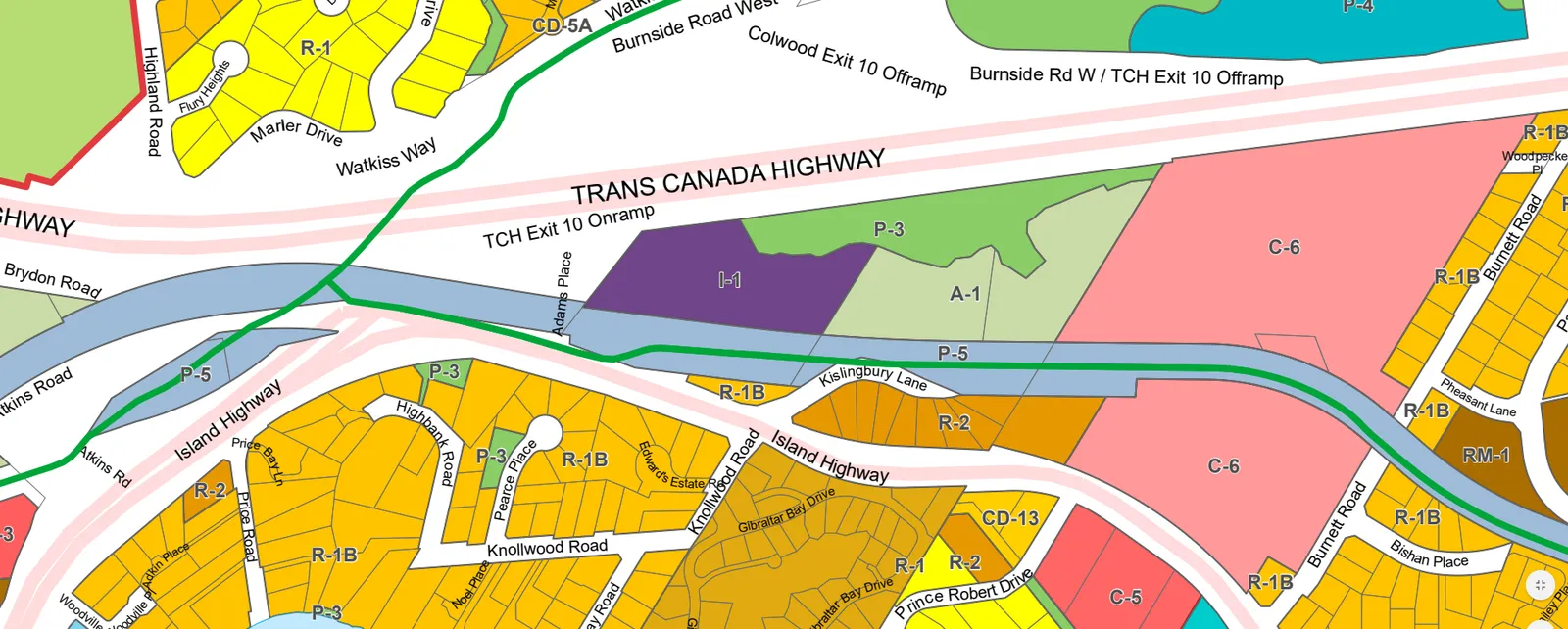
Bylaw No. 1034 proposes to amend the use of ‘Medical marihuana production facility’ to ‘Cannabis production facility’ within the only zone that currently permits it: I-1: Light Industrial. Note that this use is not currently in place. The only property zoned as such in the Town is the Adams Storage Facility at 1 Adams Place (in dark purple, below).
NOTE: A Public Hearing is required for Bylaw No. 1034 unless Council chooses to waive this requirement.
Cannabis Distribution Uses
Bylaw No. 1034 removes the prohibition on distribution uses. The BC Liquor Distribution Branch is the sole wholesale distributor in the province of BC and would require a rezoning to locate a facility in the Town. Staff has chosen to not include a definition of such a use at this time.
Cannabis Retail Store Definitions
The amendments to the Zoning Bylaw in Bylaw No. 1034 as they pertain to the Cannabis Retail Store use are changes to the definitions only. A rezoning will be required for each store.
It is critical for Council to understand that the Provincial cannabis retail store licensing process requires a Public Hearing for every new store. Council has complete control over the rezoning of every store in the Town.
Cannabis Retail Store Location Criteria
It is also critical for Council to understand that Council has complete control over the location of cannabis retail store, regardless of locational criteria established through policy or regulatory processes. Any locational criteria the Town may impose on store locations, distances to other stores, distances to schools, etc, whether through policy (guidelines) or regulation (bylaws) does not reduce Council control. There is also no obligation for Council to adhere to any locational criteria they may have created. Every store must be approved by Council and every store application can be denied by Council for any number of subjective reasons. Council has complete control.
With that in mind, establishing distances between stores and other land uses, such as distances between:
- Individual cannabis retail stores
- schools and cannabis retail stores
- daycares and cannabis retail stores
- parks and cannabis retail stores
- residential uses and cannabis retail stores
are entirely under Council control at the time of rezoning. Staff believes it is very important to establish distances between uses, for the following reasons:
- They establish expectations for applicants for what could be considered a reasonable location for a cannabis retail store in advance of making a rezoning application to the Town
- They give the public a clear indication of Council’s decision-making criteria.
- They establish consistency and guidance for Council in their criteria for decision-making.
Knowing that Council has complete control at every rezoning, there is a clear advantage to having guidelines for locations of stores relative to other land uses, or to other stores, rather than enshrining specific distances within the Zoning Bylaw.
- A guideline allows Council to consider unique situations and unique circumstances with each application without the need to vary regulations associated with distances. Distances are measured ‘as the crow flies’ but there are often more complex realities with unique locations. Should Council want to approve a store that is closer to another store, or close to a daycare, or closer to a school than is permitted within a bylaw, it will force an applicant to make a Development Variance Permit application in the future, immediately after a successful rezoning application. This is unnecessary, and poor customer service.
- Distances within a bylaw exclude uses locating within those distances in the future. That is, if a daycare wished to locate within the buffer zone of an existing cannabis store, the daycare would have to obtain a variance to the cannabis retail store buffer regulation. This would have the unintended but very probable effect of discouraging daycare uses within the Town.
- Establishing guidelines rather than buffers enshrined in bylaw will address Council concern that the first-past-the-post store shuts out future stores, or concerns of unfair processes. Council can approve any number of stores in any location without variance if guidelines are in place.
If the Town used a fairly prohibitive approach to buffering uses, the prohibited areas would be as represented in the figure below, where green represents major or regional parks, light blue is schools, dark blue is commercial daycare, and yellow is R-1, R-1A, R-1B, R-1C and R-2 zoning.
As one can see, the only remaining spaces within existing commercial zones are the lands along Island Highway north of the Casino and the commercial space opposite the Victoria General Hospital. Potentially in the future, the Town Centre at Fort Victoria could support a third, but this would require a major shift in land use in that location.
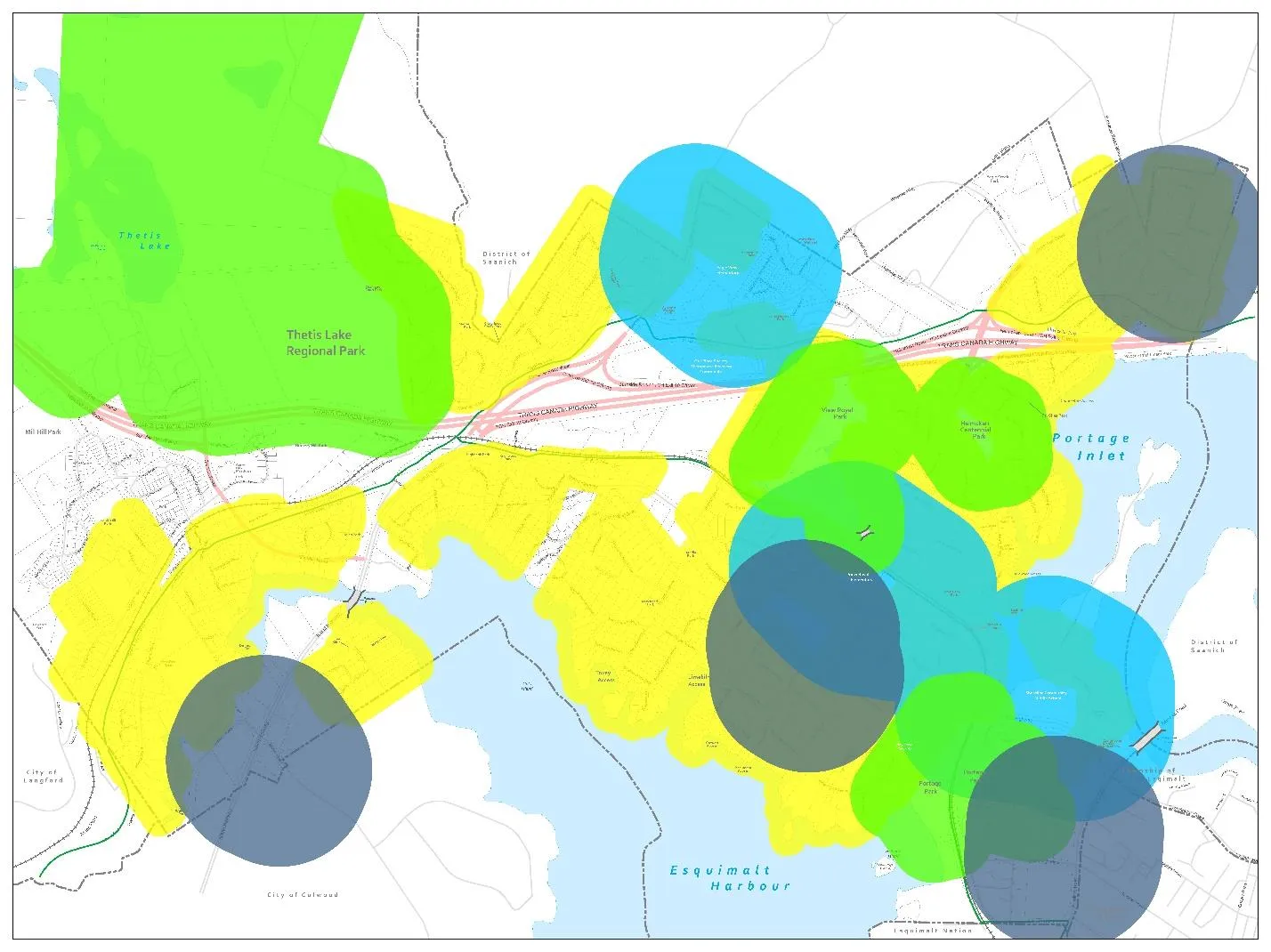
Based on the above coverage, it appears that park buffers have little impact on the commercial areas, except for the pedestrian arms of Portage Park extending to the east. Most children using Portage Park are using the playground and that is significantly separated from the Admirals Rd commercial areas. Detached residential also seems to have a very limited impact.
Including daycares in the buffer removes the Admirals Walk and surrounding commercial areas from cannabis retail stores, as well as removing a good portion of the commercial area near the Island Highway/Wilfert area, as well as Eagle Creek Village. Given that cannabis retail can and would probably act to instead displace much-needed daycares in the future, it does not make sense to buffer these uses. Staff is of the opinion that the downside of losing daycare space is a much more negative impact to the community than any possible presence of cannabis retail.
Buffering only schools and distances to other stores seems like the best and most realistic compromise, given View Royal’s geography. If this is done, realistically the Town can expect to have up to five cannabis retail locations in the future – one near the Island Highway/Wilfert intersection, one potentially at Eagle Creek or nearby, and one at Admirals Walk (for which the Town currently has an application), one at Lakeside Village, and one potentially at the future Town Centre at the current Fort Victoria.
Note that in the diagram below, the school and store buffers can overlap (but not reach the school property itself) but the red store buffers cannot overlap.
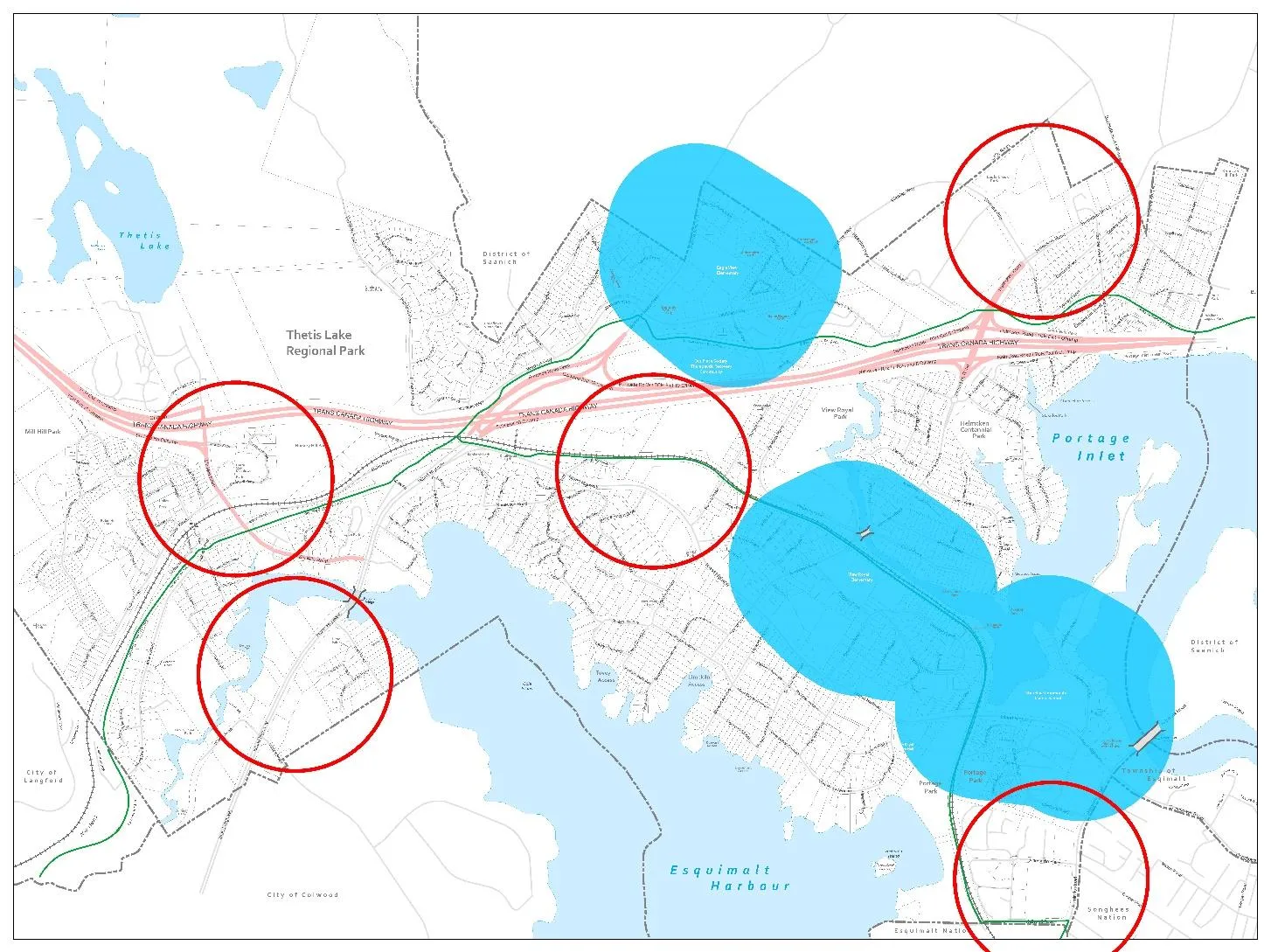
Staff will recommend that distances to other cannabis retail stores and distances to schools be the primary buffer considerations, with distances to parks and daycares a lesser consideration in the proposed guidelines as per the attached recommended Cannabis Retail Store Buffer Guidelines:
Ideal Store Location Requirements
An ideal cannabis retail store application within the Town of View Royal meets these locational criteria:
- 300m from another cannabis retail store location
- 300m from a school
- 300m from a large daycare
- 150m from a park
- 50m from residential uses
Base Store Location Requirements
- 300m from another cannabis retail store location
- 300m from a school
Council has the option of using a guideline-based approach for this project or Council could choose to embed many of the guidelines in the Zoning Bylaw. Because of the lack of impact, the guideline addressing park and residential use separations is not included in this approach.
Cannabis Retail Store approval processes
Two municipalities in the province have taken the approach of issuing requests for proposals and undertaking temporary use permits to approve cannabis retail stores. Most municipalities have chosen to remain with a rezoning and business license approach as their long-established process for regulating business uses.
Staff believes that a significant factor in Langford opting for the RFP/TUP is their lack of business license fees; something of a source of pride and a hallmark of the aggressive economic development approach within that municipality. View Royal’s established process is rezoning and business license fees for approving new land uses and covering the Town’s cost for administering business licenses.
Risks for the Town regarding the RFP process:
- It is less certain in the potential funds received.
- Legal contracts and potential legal challenge represent costs for the Town which must be recovered from funds received by successful proponents.
- The Town must nevertheless transition to a rezoning and business licensing model after the TUP expires.
- The RFP/TUP process is less business-friendly and less transparent than a rezoning and business license model. Transparency is primarily a public engagement consideration in terms of the assumption by the public that these Temporary Use Permits are a foregone conclusion in the RFP process, rather than a property-considered change in land use underpinned by a Public Hearing and informed public input.
Benefits to the Town regarding the RFP process:
- The Town is not driving the funding process, and as such the justification for receiving the funds is shared with the proponent.
- The RFP process frontends the financial contribution and allows the Town to receive funds when the Canadian Centre on Substance Abuse and Addiction says it is the most important to be proactive – at the beginning of the process.
- Does not permanently commit the Town to this use, should it prove to be undesirable or unsustainable; financially or otherwise.
- The now-legal edible market represents an unknown element currently.
Business License Fees
Staff has researched other municipalities’ business license fees for cannabis retail stores. As can be seen in the table below, the only business license fee above $10,000 is Vancouver. Most of the fees are between $2,500-5,000.
| Municipality | Cannabis Retail Business License Fee |
|---|---|
| Abbotsford | n/a |
| Campbell River | $2,500 |
| Castlegar | $85 |
| Central Saanich | n/a |
| Chilliwack | $10,000 |
| Colwood | n/a |
| Courtenay | $2,500 |
| Esquimalt | $2,000 |
| Highlands | n/a |
| Kamloops | $5,000 |
| Kelowna | $8,000 |
| Kimberley | $100 |
| Maple Ridge | $5,000 |
| Metchosin | n/a |
| Nelson | $2,500 |
| New Westminster | $2,752.64 |
| North Saanich | n/a |
| Oak Bay | n/a |
| Osoyoos | $500 |
| Penticton | $5,000 |
| Port Alberni | n/a |
| Richmond | n/a |
| Saanich | n/a |
| Sidney | n/a |
| Sooke | $125-250 |
| Summerland | $400 |
| Surrey | n/a |
| Vancouver | $33,097 |
| Vernon | $2,000 |
| Victoria | $5,000 |
Staff is recommending that Council set a business license fee for a cannabis retail store at $10,000, and that is number is reviewed in two years to estimate the Town’s education and enforcement costs associated with cannabis retail stores. This is on the high end of the range for stores in BC, which represents a cautious and pro-active approach.
Bylaw No. 1036 (Fees and Charges) is proposed to be amended to include this $10,000 fee for cannabis retail store use.
DISCUSSION
Staff’s advice throughout this process has been that recreational cannabis will be integrated into Canadian society quickly, and continuing a prohibitive stance is neither sustainable, nor recommended by public health professionals. Permitting recreational cannabis uses would be considered a proactive public health initiative.
The questions for Council remain:
Does Council wish to permit some of these uses? The most pressing issues are home growing and retail sales. Staff have recommended in previous reports that Council not prohibit home growing; it represents an unnecessary and overly burdensome enforcement issue and should really be handled by the RCMP. Staff is recommending that Council move to approve recreational cannabis retail uses and remove the prohibition for home growing.
Does Council wish to take the RFP/TUP process, or does it wish to pursue the rezoning and business licensing approach? Staff is recommending the approach of a rezoning and business license fee. It is the standard approach that the Town has taken and represents less risk for the Town and less risk for applicants looking to establish a long-term retail location in the Town. It does not require legal contracts. Despite the opportunity to review the appropriateness of these stores with the TUP process, the reality is that recreational cannabis is already a mature societal presence and these stores and uses will be a reality in our society. From the perspective of transparency of process, our community has some familiarity with the rezoning process and the steps that are followed. Introducing a different process carries the risk of eroding public confidence in the transparency of decision making in the Town. Staff is of the opinion that it is important to fund education and enforcement, and these costs can be recouped through a yearly business license fee. Staff does believe that a significant business license fee is justified, and that a fee of $10,000 is a good starting point for discussion based on the information presented in this report. Reductions could be considered in the future should it be necessary.
How much is a reasonable business license fee? Staff is recommending $10,000 as a starting point.
Does Council wish to consider an approach that embeds all locational criteria in zoning, or do they wish to pursue modest regulatory guidance and rely on locational criteria policy? Council always has complete control over store approvals and must hold a public hearing for each store. Staff is recommending a guideline approach in that it is more flexible and represents better customer service, while not relinquishing any control over the decision-making process. Embedding all of the mentioned locational criteria in zoning may be perceived as a very strict approach and may send the message that the Town is not interested in cannabis retail sales. In addition, it eliminates many of the existing commercial/retail locations that would be suitable for such a use from consideration. While a variance may be possible to vary the requirements, the same consideration that would go into a rezoning process would be used, thus creating additional regulation that serves an unclear purpose as Council has the authority to say yes or no to an application for rezoning. Council may wish to turn its attention to considering whether all locational criteria are necessary in the zoning. Staff suggest that the only locational criteria that is essential is the one limiting distance between stores, which is consistent with the zoning criteria for licensee liquor stores. The remaining criteria in the one version of the bylaw are discretionary and may be better suited to a policy that provides guidance to an applicant. If Council wishes to proceed with a regulatory approach that embeds all locational criteria within the current zoning bylaw, staff recommend that this be reviewed within 24 months of adoption so that any necessary fine-tuning can be considered. Both variations are presented for Council consideration and debate. Option 1 presents a regulatory approach that embeds all locational criteria within the zoning. Option 2 presents a more moderate approach where a separation distance is established in the zoning between stores, and this is supported by policy guidance to applicants that highlights some of the considerations that Council might use in their deliberations on a rezoning application. Staff recommends Option 2.
ALTERNATE RECOMMENDATIONS
In considering these alternate recommendations, note that Bylaw No. 1034 proposes to remove the prohibition on production, distribution, retail sale or home growing and that Bylaw No. 1036 proposes a business license fee of $10,000 for a cannabis retail store use.
Regulatory Processes
Should Council wish to take the RFP/TUP approach to regulation, Council should do the following:
- Bylaw No. 1036 to administer a business license fee for cannabis retail store use should not be given first and second readings.
- Council should direct staff to begin preparations for the RFP/TUP process and bring forward a budget request for 2020 for additional resources to administer the process.
Cannabis Uses
Should Council not wish to remove the prohibition on the production, distribution, retail sale or home growing: 3. Section 2(d) of Bylaw No. 1034 must be amended as such, to retain certain prohibitions within the Zoning Bylaw.
Cannabis Retail Store Buffers
Should Council wish to enshrine some or all the recommended buffers within the zoning bylaw (either creating bylaws for some buffers or bylaws for all buffers): 4. Bylaw No. 1034 (OPTION 1) with defined bylaw buffer distances between stores and schools and daycares should be given first and second reading, and a Public Hearing set, with some or all of the buffers included. 5. The Cannabis Retail Store Buffer Guidelines document should be amended to remove any buffer which is defined within Bylaw No. 1034.
Note that this approach would not permit any application at Admirals Walk (without a variance and a rezoning) due to the proximity to a large daycare.
Business License Fees
Should Council wish to choose a different business license fee for cannabis retail store than $10,000, Bylaw No. 1036 should be amended as such.
RECOMMENDATION COMPARISON
| Issue | Staff Recommendation | Alternate Recommendation |
|---|---|---|
| Regulatory Process | Bylaw and Business License | RFP/TUP and budget request |
| Business License Fee | $10,000 | Alternate fee if desired |
| Cannabis Uses in Zoning Bylaw | Remove prohibition on production, distribution, sale and home growing | Remove prohibition on some uses if desired |
| Zoning Bylaw Amendment Version buffers | OPTION 2 300m bylaw buffer to other cannabis retail stores 300m bylaw buffer to schools |
OPTION 1 300m bylaw buffer to cannabis retail stores 300m bylaw buffer to schools 300m bylaw buffer to large daycares |
| Cannabis Retail Store Buffer Guidelines | Large Daycare is included as an ideal store buffer of 300m and not within the zoning bylaw | Large Daycare will be removed from the ideal store buffer guidelines as it will be required in the zoning bylaw |
| Future Variance Requirements for buffers | Schools and other cannabis retail stores less than 300m away | Schools, large daycares and other cannabis retail stores less than 300m away |
RECOMMENDATION
THAT Council give first and second reading to Zoning Bylaw No. 900, 2014, Amendment Bylaw No. 1034, 2019 (OPTION 2);
AND THAT Council give first and second reading to Fees and Charges Bylaw No. 958, 2016 Amendment Bylaw No. 1036;
AND THAT Council set a Public Hearing date for Zoning Bylaw No. 900, 2014 Amendment Bylaw 1034 (OPTION 2) for January 21, 2020;
AND THAT Council adopt the Cannabis Retail Store Buffer Guidelines document as the policy for locating Cannabis Retail Stores in the Town of View Royal.
ATTACHMENTS
- Zoning Bylaw No. 900, 2014, Amendment Bylaw No. 1034, 2019 (OPTION 1)
- Zoning Bylaw No. 900, 2014, Amendment Bylaw No. 1034, 2019 (OPTION 2)
- Fees and Charges Bylaw No. 958, 2016 Amendment Bylaw No. 1036
- Cannabis Retail Store Buffer Guidelines
Document Images
(3)