Council Meeting/Documents/Gorge-Colquitz Special Management Area Collaborative Protocol Agreement Term Sheet
Appendix
Gorge-Colquitz Special Management Area Collaborative Protocol Agreement Term Sheet
October 15, 2019Pages 34–361 section
A draft term sheet outlining the objectives, membership, and principles for the GCSMAC collaborative.
September 25, 2019Objectives: sustainable salmonid and herring populationsMembership includes Songhees Nation, municipal governments, and federal agencies
Gorge-Colquitz Special Management Area Collaborative Protocol Agreement Term Sheet
September 25, 2019
| Preamble | The partners to this protocol agreement have shared interests in working to ensure sustainability of salmonid populations in the Colquitz River and the herring population in the Gorge Waterway and Portage Inlet. These natural resources are critical to the culture and traditional lifestyle of Songhees Nation and the harvesting of these resources is likely unsustainable without a recovery strategy which includes remedial actions and an integrated management regime. It is therefore proposed that the governments and agencies that have an interest in the sustainability of these resources collaborate through the execution of this protocol agreement. |
| Name | The organization will be called the Gorge-Colquitz Special Management Area Collaborative (GCSMAC) (This is a placeholder name to be revised to include Lekwungen name.) |
| GCSMAC Partnership | A protocol agreement will be developed as the initial model for inter-agency/government collaboration for the GCSMAC. This agreement will outline GCSMAC objectives, membership, area, working principles, reporting, and term. |
| GCSMAC Purposes | The two over-arching GCSMAC objectives* are to: 1. ensure sustainable (self-sustaining) salmonid populations in the Colquitz River; and 2. ensure a sustainable (self-sustaining) herring population in the Gorge Waterway and Portage Inlet. * measurable objectives including methods for tracking progress will be identified by the technical group |
| GCSMAC Membership | Membership of the GCSMAC will include: • Songhees Nation • Esquimalt Nation if they wish to participate • Other First Nations if they wish to participate • Township of Esquimalt • District of Highlands • District of Saanich • City of Victoria • Town of View Royal • Capital Regional District • Greater Victoria Harbour Authority • Government of Canada - Fisheries and Oceans Canada - Transport Canada - Environment & Climate Change Canada • Province of BC: - Ministry of Forests, Lands, Natural Resources Operations - Ministry of Agriculture - may be invited to participate • District of Central Saanich & City of Langford: involvement limited to specific projects or actions that involve their jurisdictions By a decision of GCSMAC, additional members may be added to the membership. The GCSMAC will establish and seek input from a GCSMAC Technical Group which will include Government of Canada Fisheries and Oceans, municipal staff, post-secondary institutions, and NGOs active in the area, initially the Colquitz Coalition and Gorge Waterway Initiative. The GCSMAC may change the size and composition of the Technical Group as work of the GCSMAC evolves and changes. |
| Membership commitment | GCSMAC members will commit to “giving serious consideration to recommendations from the GCSMAC” when making plans and decisions at their individual constituency tables. |
| GCSMAC Area | The GCSMAC area is as shown on the map below until such time that the GCSMAC decides the boundaries need to be adjusted.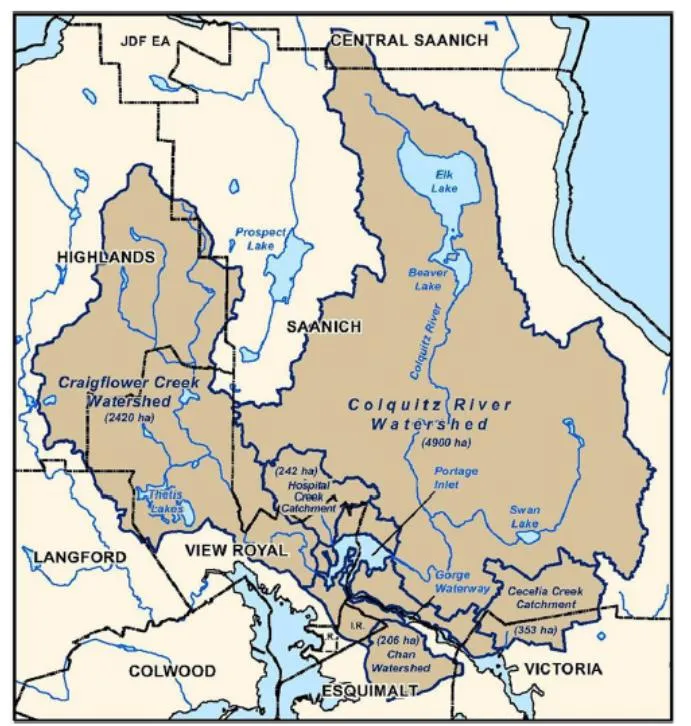 |
| GCSMAC Principles of Collaboration | GCSMAC Working Principles are: Voluntary membership: membership in the GCSMAC is voluntary and withdrawal from the collaborative organization will be made relatively simple Decision making by consensus: every effort will be made to make recommendations and decisions by consensus; however, if consensus cannot be reached recommendations and decisions will be by majority vote. Both majority and minority reports are possible. Evidence based decision making: decision making will be evidence based, using the best available information and will include both science-based and traditional ecological/local ecological knowledge, information and data. The precautionary approach, erring on the side of caution, will be applied. Integrated management: the GCSMAC will have cooperative processes that bring together all relevant partners in the proactive planning and recommendations for management of land-use and infrastructure in the watershed(s). Respect for existing authorities: partners bring different authorities, mandates, and interest to the GCSMAC; GCSMAC processes will respect these. Inclusivity: a diversity of stakeholders will be engaged, and their interests will be included in a meaningful way in GCSMAC initiatives and stakeholder interests will be considered in all recommendations and decisions. Adaptive Management: GCSMAC management and processes will be designed to permit and support evolution and will be monitored and evaluated to support shared learning and adaptation. Transparency: decisions and recommendations will be made openly, with information and results shared with all participants. Efficiency: Issues will be addressed in a timely manner. Accessibility: reasonable steps will be taken to determine how stakeholders wish to be engaged and to provide them with relevant, understandable information. Indigenous led and informed: The Songhees Nation brought us together; we will learn from and about First Nations values and approach and put them into practice. |
| Establishment | The parties agree that this protocol agreement will take effect by a formal resolution of each of the members. |
| Appointment of members | Members will be appointed by their respective organizations and shall serve for a minimum of two years and a maximum of five years with the option of a renewable term. |
| Meetings | The GCSMAC will determine its schedule of meetings (likely 3 to 4 times annually) by agreement which will be supported by the GCSMAC Secretariat provided by the Songhees Nation. |
| Withdrawal from GCSMAC | Membership wishing to withdraw from GCSMAC will do so by written notice to GCSMAC. |
| Accountability and reporting | The GCSMAC will prepare an annual evaluation of progress and report, as well as conduct a comprehensive 5-year evaluation. |
| GCSMAC Term | The GCSMAC will be established for a period of ten years with annual reporting and evaluation of progress. A comprehensive 5-year evaluation will be conducted. A sunset clause in the protocol agreement will provide for a 10-year renewable term unless a not for profit society is registered to replace the GCSMAC protocol agreement. |
| Protocol agreement amendment | The terms of the protocol agreement may be amended by decision of the GCSMAC. |
Page 34–36
Document Images
(1)
Extracted from: 2019 10 15 Council Agenda - Agenda - Pdf