Special Management Area (SMA) Collaborative Action Plan
A draft plan to guide efforts toward establishing and implementing a Special Management Area for the Colquitz/Gorge Watershed.
Special Management Area (SMA) Collaborative Action Plan
September 12, 2019
Background
The concept of a Special Management Area arose out of Te’mexw Treaty negotiations and is referenced in Section 21 of Chapter 9 of the Te’mexw Treaty Association Agreement-in-Principal:
“21. Prior to the Final Agreement any Te'mexw Member First Nation may identify areas of special interest within the Te'mexw Member First Nation Area, and if such areas are identified the Parties will discuss the Te'mexw Member First Nation's role in the management of each area, including special management measures that may be required.”
Conceptually the Treaty Association proposes two Special Management Areas:
- A SMAs is proposed for Songhees Nation focused on the Colquitz River Watershed, including Gorge Waterway and Portage Inlet, and
- A second SMA is proposed for T’Sou-ke First Nation focused on the Sooke Basin.
A special management area is an area where natural, cultural and recreational values are considered in land use and development decision making.
The aim of the SMA organization is to generate outcomes that cannot be achieved by participants working in isolation. It is hoped that the SMA will result in greater certainty and stability in watershed management; better integration and coordination of new and existing management and planning processes; and sustainable management of resources.
An important issue affecting aquatic sustainability is the limitation of many existing management systems (e.g., divided and duplicated jurisdictions and laws, single sector approaches, limited knowledge, and gaps in responsibility for cumulative effects and overall aquatic system health) (PNCIMA 2010). It is hoped that the creation of an SMA for the Colquitz/Gorge Watershed will result in a cooperative and coordinated approach to address this limitation.
The SMA organization is not intended to provide detailed prescription of all measures required to achieve its objectives; instead, it can enhance and support existing decision-making processes by linking sector planning and management to an overarching SMA framework. The SMA participants will identify priorities for action that flow from the SMA framework. Implementation of the framework will take place within existing programs and resources, where possible, and may ultimately lead to the identification of new work which could be implemented as resources permit.
This Action Plan was developed as an outcome of research and workshops sponsored by the Te’mexw Treaty Association in the Spring of 2019 which involved over 30 institutional and agency representatives and Emergent Sustainable Solutions (ESS) consultants. The Action Plan is intended to guide the efforts towards achievement of the SMA for the immediate future.
Supporting documents to this Action Plan include:
- Colquitz/Gorge Watershed Special Management Area Concept Paper
- Governance Models Colquitz/Gorge Watershed Special Management Area
The following summarizes the direction agreed to at the May and June workshops and provides the basis for drafting of the protocol agreement and further work of the SMA.
SMA Partnership
The agencies involved in the Spring 2019 workshops concluded that as a first step a protocol agreement would be developed as the initial model for inter-agency/government collaboration for the SMA. This agreement would outline SMA objectives, membership, working principles, area, and working relationships as outlined in the following sections.
SMA Purposes
The two over-arching Gorge-Colquitz Special Management Area Collaborative* (GCSMAC) objectives** are to:
- ensure sustainable (self-sustaining) salmonid populations in the Colquitz River; and
- ensure a sustainable (self-sustaining) herring population in the Gorge Waterway and Portage Inlet.
*this name is a placeholder until an appropriate Lekwungen name is identified ** measurable objectives for tracking progress will be identified by the technical group.
SMA Membership
Membership of the SMA will include:
- Songhees Nation
- Esquimalt Nation if they wish to participate
- Other First Nations if they wish to participate
- Township of Esquimalt
- District of Highlands
- District of Saanich
- City of Victoria
- Town of View Royal
- Capital Regional District
- Greater Victoria Harbour Authority
- Government of Canada
- Fisheries and Oceans Canada
- Transport Canada
- Environment & Climate Change Canada
- Province of BC:
- Ministry of Forests, Lands, Natural Resources Operations
- Ministry of Agriculture - may be invited to participate
- District of Central Saanich & City of Langford: involvement limited to specific projects or actions that involve their jurisdictions
Technical input would be sought from post-secondary institutions and NGOs active in the area initially the Colquitz Coalition and Gorge Waterway Initiative.
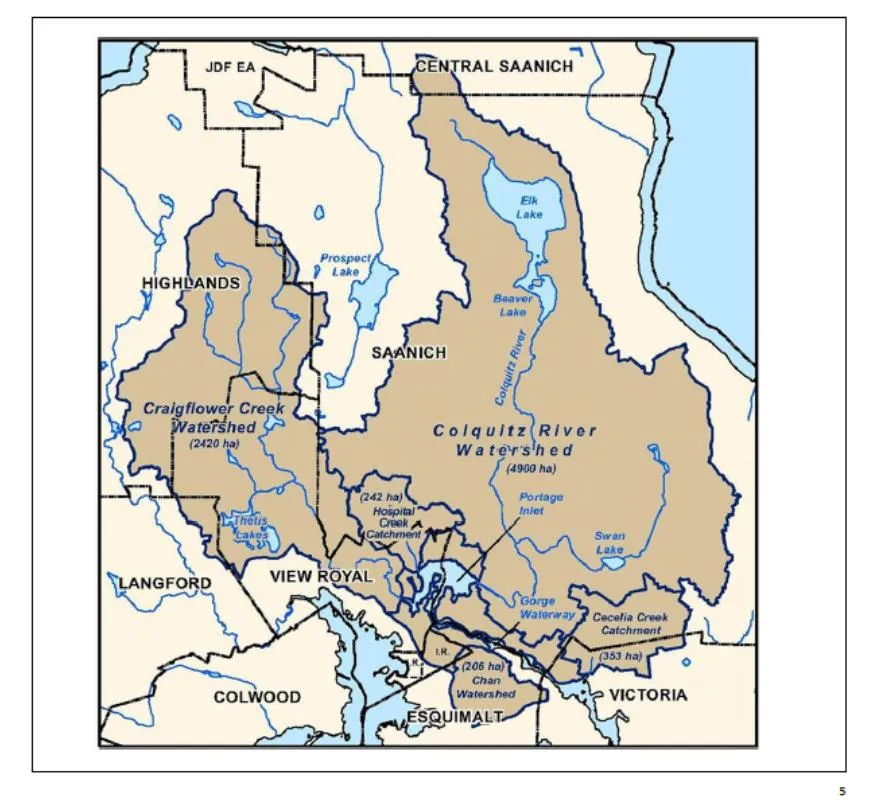
SMA Area
The SMA area is as shown on the map below until such time that the SMA Collaborative decides the boundaries need to be adjusted.
SMA Working principles
SMA Collaborative Working Principles are:
Voluntary membership: membership in the SMA is voluntary and withdrawal from the collaborative organization will be made relatively simple
Decision making by consensus: every effort will be made to make recommendations and decisions by consensus; however, if consensus cannot be reached recommendations and decisions will be by majority vote. Both majority and minority reports are possible.
Evidence based decision making: decision making will be evidence based, using the best available information and will include both science-based and traditional ecological/local ecological knowledge, information and data. The precautionary approach, erring on the side of caution, will be applied.
Integrated management: the SMA will have cooperative processes that bring together all relevant partners in the proactive planning and recommendations for management of land-use and infrastructure in the watershed(s).
Respect for existing authorities: partners bring different authorities, mandates, and interest to the SMA. SMA processes will respect these.
Inclusivity: a diversity of stakeholders will be engaged, and their interests will be included in a meaningful way in SMA initiatives and stakeholder interests will be considered in all recommendations and decisions.
Adaptive Management: SMA management and processes will be designed to permit and support evolution and will be monitored and evaluated to support shared learning and adaptation.
Transparency: decisions and recommendations will be made openly, with information and results shared with all participants.
Efficiency: Issues will be addressed in a timely manner.
Accessibility: reasonable steps will be taken to determine how stakeholders wish to be engaged and to provide them with relevant, understandable information.
Indigenous led and informed: The Songhees Nation brought us together; we will learn from and about First Nations values and approach and put them into practice.
SMA Term
The SMA Collaborative will be established for a period of ten years with annual reporting and evaluation of progress to member organizations. A comprehensive 5-year evaluation will be conducted and reported to members.
A sunset clause in the protocol agreement will provide for a 10-year renewable term unless a not for profit society is registered to replace the SMA protocol agreement.
Next steps: Strategic Actions
Strategic Action 1: Establish the SMA Collaborative through a protocol agreement
Tasks:
- Establish SMA steering committee to oversee startup phase. Suggested SMA steering committee membership to include CRD, Victoria, Saanich, Esquimalt & Songhees representatives.
- Draft and finalize protocol agreement based on the components outlined in the Term Sheet (attached)
- Hold protocol agreement signing event.
- Establish a SMA secretariat to be responsible for overseeing the day to day work meeting organization, agendas, securing funding and reporting. It is proposed that Songhees provide the SMA Secretariat function thus supporting and realizing the First Nation led SMA principle.
- The SMA or the Steering Committee establish a technical advisory group likely including: Government of Canada Department of Fisheries and Oceans, staff from municipalities and representatives from NGOs (Gorge Waterway Initiative and the Colquitz River Watershed (CRD) and post-secondary institutions.
Strategic Action 2: Develop a 5-year strategic plan
Tasks:
- SMA & Technical Advisory Group undertake a process to develop a 5-year strategic plan that identifies measurable objectives, key priorities, scheduling and resourcing.
- Key SMA priorities should include:
- Consideration of the defined SMA area and adjustment if required
- Preparation of a “state of knowledge report” updating the 1997 State of Knowledge Report prepared by Environmental Law Centre, University of Victoria
- Collecting or secondary collection of baseline data e.g. fish counts
- Policy analysis of municipal/CRD policies relevant to SMA
- Communications & outreach plan to stakeholders, interest groups and the public including a workshop focused on what is being done currently in the watershed and celebrations of success
Strategic Action 3: Implement the strategic plan
Tasks:
- Following the development of the SMA strategic plan the SMA will participate in, support and monitor its implementation.
Strategic Action 4: Evaluation of progress
Tasks:
- The SMA will annually report its progress to members, sponsors and the public.
- A comprehensive 5-year evaluation will be conducted and reported to members.
Document Images
(1)